Ah, reality television.
I am, and can be, remarkably naïve when it comes to some things. I literally will believe almost everything I am told because my default is never to assume someone is lying (unless they’ve proven themselves to be a liar before), so I actually believed, all those years I was watching The Real World, that the show was “unscripted” and the cast had cameras and microphones on them 24/7.
Then The Real World came to New Orleans–to my neighborhood, in fact–and the “gay one” got a job bar-backing at Oz (one of my favorite gay bars; and autocorrect tried to turn that into “barebacking”, which is an entirely different thing), and it wasn’t long before I realized that The Real World wasn’t, actually, “real.” I saw them any number of times walking from one destination to another to film, the camera crews not filming and just walking behind the cast; I actually watched them set up a scene in Oz and go through several takes, and so yeah, the luster and magic was gone for me. I think I may have watched another season or two after New Orleans, but reality television had also changed dramatically from when the first season of that show aired (and yes, I am aware that PBS’ An American Family was the first real reality-type show) and by the time I stopped watching that it wasn’t about kids learning to get along and learning from each other’s differences as it was about getting wasted, hooking up, and fighting.
You know, the formula Bravo quickly adapted to in Season Two of The Real Housewives of Orange County.
Viewers want conflict.
I never watched the Real Housewives shows, but usually on Sundays when it wasn’t football season Paul would come downstairs and fall asleep on the couch while I would either read or edit in my easy chair. I’d turn on the television for background noise, and it was just easiest to always park the channel on Bravo because they’d marathon something–originally Law & Order, then The West Wing or Inside the Actor’s Studio, which were fun for an occasional distraction but not enough of one to take my interest away from what I was doing. But Bravo changed, and those marathons eventually became one of the Real Housewives shows. I winced a bit, but again, background noise I didn’t need to pay attention to–it all seemed so exploitative and, well, awful–that I couldn’t see myself ever watching regularly. So I began to slowly recognize who they were–all the gossip site pop-ups and so forth on social media also covered them extensively–and even know something about them. I didn’t want to ever become a regular viewer, didn’t think I ever would.
And yet…
I originally tuned into The Real Housewives of Beverly Hills to see Kim Richards, whom I remembered as a child star when I was a kid–from Nanny and the Professor to Escape to Witch Mountain to Tuff Turf–and was interested to see how she turned out, what happened to her…and just like a soap opera back in the day, I was soon tuning in every week. Some other friends turned out to be big fans of both Orange County and New York, so I started watching New York so we could talk about it (my antipathy to Orange County would be a subject for another essay at some other point), and there was no turning back after that.
I still primarily only watch New York and Beverly Hills with any regularity (although Atlanta is always a favorite), and there have been times when I’ve thrown up my hands in disgust with what was actually going on with the season and stopped watching (I stopped watching Beverly Hills during the “let’s out Denise Richards as bi!” bullshit, for example, and never did finish the season); but I am still absolutely fascinated by the concept behind these shows. Is any of it for real? How much is set up and scripted? It becomes very easy to get sucked into the shows–they are highly addictive; they remind me a lot of soaps as they are very high on petty drama and melodrama, feuds and fights and arguments–and how much of what we see is actually not audience manipulation on the part of production, the network, and the editors. (Women often claim to have “gotten a bad edit”–which always makes me think about The Real World–that show really started everything) I find myself getting emotionally sucked into the petty dramas too–which often spill out into the social media world and the endless blogs that dedicate themselves to reporting on these shows–and there are times when I think, well done, production! I would have never guessed you could ever show me a side of this horrible woman that would make me sympathetic to her.
Because while the women may manipulate and scheme and plan and script things, the primary people being manipulated by production are the audience and the line between reality and “reality” often gets so blurred that it’s hard to tell what is real and what isn’t.
Take, for example, this current rollercoaster of a season of The Real Housewives of Beverly Hills. Before the season started airing there was gossip flying around the Internet about their Aspen trip and a meltdown by a supporting cast member in her second year officially on the show–Kathy Hilton, older sister of OG cast member Kyle Richards–that supposedly went “really dark”…only for the season to start airing and the behavior of other members of the cast (Lisa Rinna, Diana Jenkins, Erica Girardi) being far worse than any of the rumors floated about Kathy’s “meltdown.”
Again, a subject for another time, perhaps once the reunion episodes have aired.
Anyway, I had always thought that a Real Housewives type show, set and filmed in New Orleans, would make the excellent backdrop for a crime story, particularly because of those blurred lines between reality and “reality”…so I used it for one of those e-novellas back in the day. After they were taken off the market, I kept thinking about how I wasted the background of a reality show on a story no one can access anymore and so that original story eventually morphed into Scotty VIII, Royal Street Reveillon.
I fished the last olive out of my almost empty glass and popped it into my mouth. I glanced at my watch as I chewed it, and moaned after swallowing. “There’s nothing like a good martini,” I said, glancing around the bar and getting our server’s attention.
“Do we have time for another?” My nephew Taylor finished the rest of his sazerac and looked at me hopefully.
“I take it you liked it.” I replied, not even trying to hide my smile. “But no time for another unless we want to be late.”
This was Taylor’s first time at the Sazerac Bar. He’d turned twenty-one just a few weeks before Thanksgiving, and since we were going to a party at the Joy Theater, I thought I’d treat him to a sazerac in the bar where they were invented. I personally don’t care for the drink—give me gin or vodka any day of the week—but everyone in New Orleans is required to try a sazerac at least once.
And now I could rest easy, having done not only my civic duty but treated Taylor to a New Orleans rite of passage.
I’d also wanted him to see the Roosevelt Hotel’s Christmas decorations. The Roosevelt was one of the grand old hotels of the city, and their lobby decorations are truly spectacular. Since we were going to a party at the Joy Theater—a mere block or so from the hotel, I thought, why not kill two birds with one stone? This was Taylor’s second Christmas with us, and I wanted to do it right. We’d already done Celebration in the Oaks at City Park, and I’d loved seeing the beautifully decorated ancient live oak trees through a newbie’s eyes.
I know it’s corny, but I love Christmas.
I love everything about it. I love decorating my apartment. I love picking out presents that are one hundred percent perfect for the person and carefully wrapping it up in beautiful paper, topped with a bow and twining ribbons around the box. I love picking out a tree, and the wonderful smell of pine that permeates everything inside once it’s delivered. I love getting the boxes of ornaments down from the storage closet and adorning the branches with them. I love tinsel and opening a new box of icicles for the branches. I love Christmas cookies and cakes and pies and turkey and celebrating and spending time with people I love.
I even love carols—although I do think that September is a bit early to start playing them unless the intent is to drive people to homicide by December.
While I kept the original backstories of the Grande Dames of New Orleans cast as I had in the original, I changed a lot because I didn’t want those few who had read the original to know the ending. I also wanted to do some fun things with the story, adding in another murder that was completely unconnected to the primary story as well as yet another deep personal dilemma for Scotty that doesn’t get resolved in this story, and trying to keep track of all the crazy things I had going on–as well as the complicated and complex backstories and threads of different subplots; I added another murder for the main story and I wanted to make it a bit more topical, so I added an element of “me too” to the story (in all honesty as I write the current one I wish I hadn’t done this because I can’t just drop it, either, like it never happened), and I found myself having fun with it. This was by far the most complicated and layered Scotty book since probably Mardi Gras Mambo, and this was one I felt very contented about when I turned it into the publisher. Even revisiting it now, as part of the prep for the current one, I kind of am proud of myself for it.
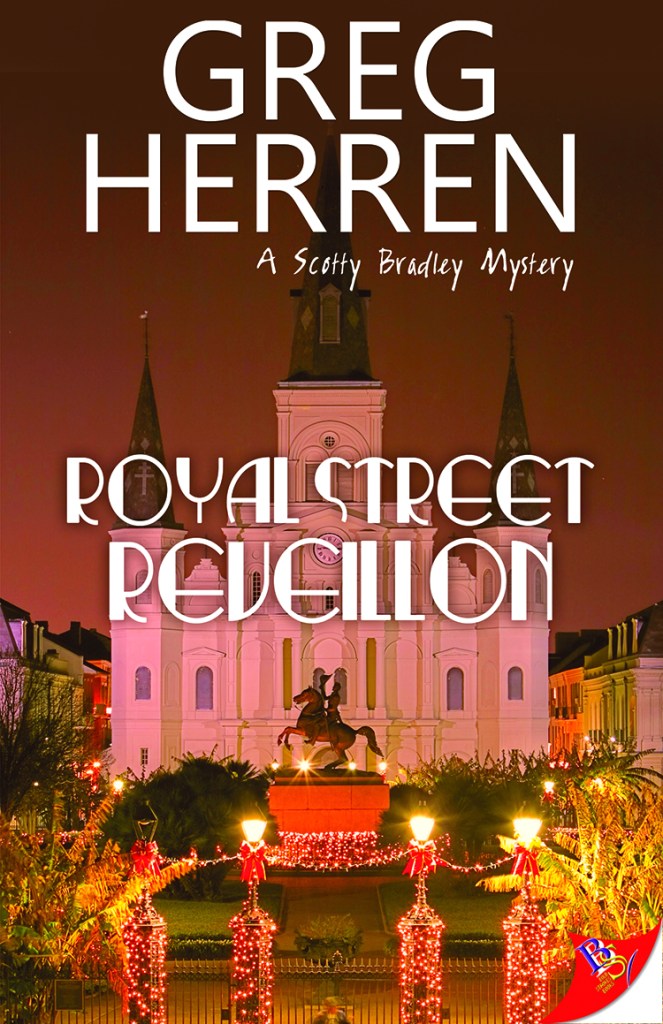
I also set it during Christmas season in New Orleans because I love New Orleans at Christmas-time. It’s one of the few times of the year where I don’t mind that it gets dark so fucking early–because New Orleans has put on her Christmas face and it’s absolutely delightful. One of the things I love most about this crazy city is how everyone here takes decorating so seriously–so seriously they decorate their houses and windows for everything. Jackson Square is stunning with the big red bows tied on the lampposts guarding the gates, as you can see in the gorgeous cover my publisher gave my book (and perhaps the thing about it that make me happiest the most is that one of the lamp’s light is out–just like it would be in real life) and the lights and…sighs happily.
I did think, for a time, about ending the series with this one, but I left the personal story hanging yet again which meant there would be another one–and I honestly don’t know what happened that it took me so long to get around to writing another one, but here we are.

 Queer and Loathing in America