Alfred Hitchcock was a great film director, and was responsible for some of the best movies ever made, from Rebecca through Notorious through North by Northwest to Vertigo to Strangers on a Train to The Birds to Psycho; the list of great Hitchcock films goes on and on and on and has been studied by film academics and written about; you certainly cannot forget Truffaut/Hitchcock, either. Lost in the discussions of his abilities as a filmmaker (and how he was somewhat abusive to his leading ladies) is his contributions to the culture in other ways. Alfred Hitchcock Presents ran for years; an anthology show like The Outer Limits or The Twilight Zone, he presented bizarre stories (often based on short fiction; perhaps the most famous episode of all was based on a Roald Dahl short story in which a wife kills her husband with a frozen leg of lamb, which she then cooks and serves to the investigating police officers) on a weekly basis and the show ran for a long time. (It’s available to stream now, and I keep meaning to dive back into the show.
But Hitchcock also was a master, before it was a thing, of licensing his name out for use; his name meant something as a master director of film suspense, and in addition to the television series there were also anthologies, also published under the aegis of Alfred Hitchcock Presents–my grandmother used to buy and read them; so did my parents–and even today one of the best short story markets for crime is Alfred Hitchcock’s Mystery Magazine. There were anthologies for adults, anthologies for teens and anthologies for kids.
And there was also The Three Investigators.
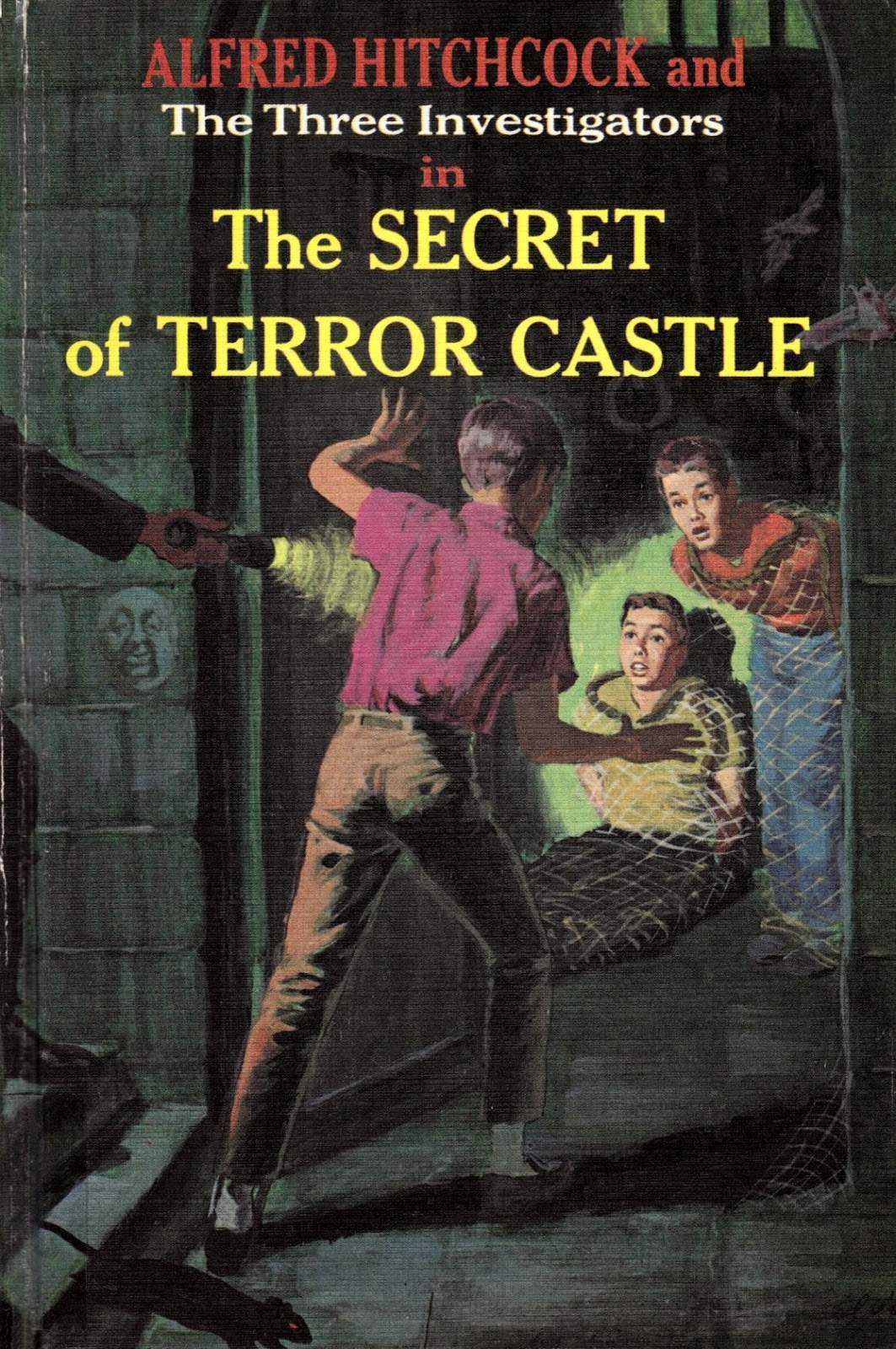
Bob Andrews parked his bike outside his home in Rocky Beach and entered the house. As he closed the door, his mother called to him from the kitchen.
“Robert? Is that you?”
“Yes, Mom.” He went to the kitchen door. His mother, brown-haired and slender, was making doughnuts.
“How was the library?” she asked.
“It was okay,” Bob told her. After all, there was never any excitement at the library. He worked there part time, sorting returned books and helping with the filing and cataloguing.
“Your friend Jupiter called.” His mother went on rolling out the dough on the board. “He left a message for you.”
“A message?” Bob yelled with sudden excitement. “What was it?”
“I wrote it down. I’ll get it out of my pocket as soon as I finish with this dough.”
“Can’t you remember what he said? He may need me!”
“I could remember an ordinary message,” his other answered, “but Jupiter doesn’t leave ordinary messages. It was something fantastic.”
“Jupiter likes unusual words,” Bob said, controlling his impatience. “He’s read an awful lot of books and sometimes he’s a little hard to understand.”
“Not just sometimes!” his mother retorted. “He’s a very unusual boy. My goodness, how he found my engagement ring, I’ll never know.”
She was referring to the time the previous fall when she had lost her diamond ring. Jupiter Jones had come to the house and requested her to tell him every move she had made the day the ring was lost. Then he had gone out to the pantry, reached up, and picked the ring from behind a row of bottle tomato pickles. Bob’s mother had taken it off and put it there while she was sterilizing the jars.
“I can’t imagine,” Mrs. Andrews said, “how he guessed where that ring was!”
“He didn’t guess, he figured it out,” Bob explained. “That’s how his mind works…Mom, can’t you get the message now?”
“In one minute,” his mother said, giving the dough another flattening roll. “Incidentally, what on earth was that story on the front of yesterday’s paper about Jupiter’s winning the use of a Rolls-Royce sedan for thirty days?”
And that is how The Three Investigators series (technically, in the beginning “ALFRED HITCHCOCK and the Three Investigators”) began. While it’s not as smooth, per se, as the opening of the Trixie Belden series in The Secret of the Mansion, this is also a dramatically different series, and will always have a place in my heart as one of the best series for kids–if not the best–ever published. It never reached the same heights of popularity as Nancy Drew or the Hardy Boys; which was a shame, because it was a much better series than either of those. For one thing, the Three Investigators actually considered themselves to be professional detectives; Nancy and the Hardys, amongst with most of the others, were strictly amateurs (although in the Kathryn Kenny books, “the Belden-Wheeler Detective Agency” became kind of a running gag or thing; it was what Trixie and Honey decided they wanted to be when they grew up; and frankly, I’ve always kind of wanted to see a Trixie-as-an-adult hard-boiled series). And while this opening is a little longish about getting to the point, it eventually does; Bob is a highly excitable young man who works at the library, and this is also our first look at Jupiter Jones, and one of the best things about the series is Jupiter; he is the central character and there would be no Three Investigators without him–and he is one of the most remarkable, and original, characters in kids’ mystery series fiction.
I always thought of Rocky Beach as a sort of stand-on for Long Beach in this series; this is where the boys live, and it’s just south of Los Angeles and a drive to Hollywood. This is where the three boys who make up the titular team of the series live; the third investigator, whom we have yet to meet in this opening, is Pete Crenshaw. And that bit about the contest and the Rolls-Royce? It’s very important. Access to a vehicle, and someone to drive them around, is an integral part of the creation of this investigative agency; they can’t always count on getting rides or paying for cabs or only involving themselves in cases they can investigate on bikes; this is the impetus Jupiter has been looking for to open the agency. Jupiter’s message to Bob is impenetrable to his mother; but it makes perfect sense to Bob–and therein lies another one of the great charms of this series: Jupiter lives with his uncle Titus and aunt Mathilda; the couple own and operate the Jones Salvage Yard, a sprawling junkyard where they repurpose other’s people things, or fix them. Jupiter himself is quite adept at wiring and repairing things; just one, as we the readers will find out, of his many skills. Hidden deep within the salvage yard is the wreck of a mobile home, which the boys use as “headquarters”; over the years Jupiter has managed to hide the mobile home behind piles of junk. The yard is also surrounded by an enormous, tall wooden fence, and Uncle Titus has encouraged local artists to paint murals on the fence. With the help of Bob and Pete, Jupiter has created “secret entrances” into the salvage yard, with tunnels through the piled up junk; that way the boys can come and go as they please without having to use the main entrance. They also have a covered workshop in another area hidden from view; Jupiter’s message to Bob is simply Red gate rover, come over come over, the presses are rolling. Bob knows this means, come to headquarters, use red gate Rover, and we’re printing our business cards.
“Red Gate Rover” means use the entrance through the fence that is a mural of a team of firefighters fighting an enormous blaze; there’s a dog watching them, and the knothole in the dog’s eye will spring the hidden gate open. And sure enough, once he gets there, the printing press is rolling and Jupiter presents him with a card, that reads:
THE THREE INVESTIGATORS
We Investigate Anything
? ? ?
–and also has their names. Jupiter is, naturally, the first investigator with Pete as second; Bob is Records & Research, since he works in the library and is their best writer; it is his job to write up their cases. As such, and with an understanding that all cases also need to be introduced as well as get sufficient publicity for their agency to get clients, Jupiter has decided on two things: to ask Alfred Hitchcock to introduce their cases, and offer to help find him a truly haunted house, as he is looking for one for his next film. Using the Rolls-Royce, driven by a very proper British chauffeur named Worthington, Jupiter and Pete call on Mr. Hitchcock at the studio. (The Rolls-Royce, by the way, has every luxurious amenity available to a limousine in that time; and is gold-plated, which sticks out. It was originally commissioned by a Saudi oil millionaire.) They bluff their way in–partly because Jupiter pretends to be Hitchcock’s nephew, even arranging his face to imitate his expressions and voice and patterns of speech–but Hitchcock isn’t that interested in introducing their cases, but has no worries about them looking for a haunted house for him. (While they are calling on Hitchcock, Bob has gone to the library to research something–Jupiter writes the words Terror Castle on the back of one of their business cards and offered no explanation.) But when Jupiter does his impression of “Hitchcock as a 13 year old”, Hitchcock is offended and promises to introduce the first case as long as Jupiter will never do the impression again (and, it is to be noted, the introduction and afterward, as supposedly written by Hitchcock, is clearly done so grudgingly; this was a genius touch by author Robert Arthur–and over the course of the series Hitchcock not only grows fond of the boys but starts sending clients their way).
The thing I loved perhaps the most about this series (outside of the wonderful titles for the books) was they actually were investigators. They actually solved the mysteries they were investigating–well, Jupiter did, mostly–through observation and interpretation of data. Jupiter was, in many ways, kind of a young Sherlock–and he often referred to Holmes. Another thing that was very clever about the series is that the stories were rarely, if ever, told from Jupiter’s point of view; Bob and Pete were always the point-of-view characters, representing the reader, who also couldn’t figure out what was going on. Since it mattered for suspense and storytelling to not know what Jupiter was thinking, Bob and Pete stood in for the reader, confused by the cryptic things Jupiter said–or casually observing Jupiter noticing something that didn’t make sense.
Another thing that, in my opinion, makes the series stronger than others is it is made, very plain, from the very beginning that fat-shaming is a bad thing. Jupiter is described as stocky or husky; he deeply resents being called fat, and whenever someone cruelly makes such an observation, both Pete and Bob always get angry and jump to his defense (Jupiter was also a child star, playing Baby Fatso in a Little Rascals type television show; his being a fat child made him the butt of the jokes in the show and he DESPISES being laughed at)–compare that to how Bess is frequently mocked for being hungry and chubby in the Nancy Drew books, or the depiction of the Hardy Boys’ supposed best friend Chet Morton as an always-hungry, overweight comic relief and foil they always laugh at–yeah, not cool, Stratemeyer Syndicate, not cool at all.
The first Three Investigators story I read was The Mystery of the Moaning Cave. We were in Alabama one summer, and staying with a cousin of my mother’s who had a son my age who also loved to read, and loved mysteries. He had a stack of library books, and I picked up my very first Hardy Boys read, The Mystery of Cabin Island, out of the stack. I was two chapters in when he finished reading his book (The Mystery of the Moaning Cave) and asked me to swap books with him. I was enjoying the Hardy Boys, but the cover of the Three Investigators book he was offering me was tantalizing, plus that title! How could a cave moan? I started reading, and was soon swept up in the story–which remains, to this day, one of my favorites in the series. It reminded me of another book I greatly loved as a child, The Mystery of the Haunted Mine, but the problem was my library didn’t have any of these books, and I could never find more of them anywhere. In junior high a friend of mine was a fan of the series, which led me to reread The Mystery of the Moaning Cave, which I loved all over again, and then its predecessor, The Mystery of the Screaming Clock, which was also amazing. I eventually discovered, on a birthday trip to Toys R Us, an entire shelf of the books; I got five–The Secret of Terror Castle, The Mystery of the Whispering Mummy, The Secret of Skeleton Island, The Mystery of the Laughing Shadow, and The Mystery of the Coughing Dragon.
I honestly don’t recall how I was able to collect the rest of the series, or where I got them or what order in which I read them, but I did eventually read the entire series. Later, the series moved on to other authors other than Robert Arthur and the quality became more hit-and-miss, but even the worst Three Investigators case was better than the best books in other series. I still love the Three Investigators, and occasionally will take one down to reread it, again marveling at how well constructed the books are; how tight the plots and how strong the characterizations. I also loved how something small and simple, like the search for an escaped parrot (The Mystery of the Stuttering Parrot) would lead to a massively complicated and interesting case about a massive art theft, or the search for a missing cat with mismatched eyes turned into The Mystery of the Whispering Mummy, or a near car crash led them to a small European principality and international espionage in The Mystery of the Silver Spider. Their cases inevitably started small, but eventually grew into something major; like they grabbed onto a loose, seemingly unimportant thread that unraveled a much larger case.
One thing that always amused me was how adults rarely, if ever, took them seriously. Jupiter’s aunt and uncle, and the parents of Pete and Bob, always looked at their “firm” as a “little mystery-solving club”. Inevitably the adults who pooh-poohed their abilities had to eat their words. I also loved that Jupiter wasn’t athletic but was smart. I identified with that a lot more than I did with the Hardy Boys, who were literally good at everything they tried.
The death of Alfred Hitchcock was an enormous blow, and the publisher–Random House, I believe–introduced a mystery writer for a while to replace Hitchcock, but the quality was already starting to decline, and eventually even the fictitious mystery writer, Robert Sylvester, was replaced by another fictitious entity; but the book in which the switch was made didn’t avoid the truth of Hitchcock’s death, and they actually handled it very well.
And some of the earlier books are seriously dated now; The Secret of Terror Castle centered on the home of a silent film horror star whose career was derailed by his speaking voice when talkies came; obviously, that would have happened around ninety years ago now, so there wouldn’t be any contemporaries still alive. Likewise, The Mystery of the Screaming Clock centered on someone who was a sound effects expert for radio suspense shows–which would, at best, have been seventy years ago now.
I’ve never believed this series was as popular as it deserved to be, nor did it get the attention it truly deserved. The books have been out of print for awhile now–maybe you can get used copies, there may even be ebooks now, I don’t know–but they should still be available. I would love to write one of these, to be honest.
They were the shit, y’all.

 Queer and Loathing in America