Do You Know What I Mean

The traditional mystery often gets a bum rap by mystery fans. I’m not sure why that is; these books have never gone out of style, have never decreased in popularity, and have always been the backbone of the crime/mystery genre. They are often (wrongly, I think) identified with Agatha Christie–if anything, Christie should be identified with every sub-genre of crime/mystery fiction. She wrote private eye novels (Poirot); dark noir (Endless Night); spy fiction (N or M?, The Man in the Brown Suit, They Came to Baghdad); historicals (Death Comes as the End); and even romantic suspense (as Mary Westmacott). Sure, she often relied on the amateur sleuth–her most famous amateur being probably Miss Marple–but she literally did everything first, really.

Probably why everyone refers to her as the Queen of Crime Fiction.

But the traditional mystery, for some reason, gets short shrift in our modern world, despite being one of the most popular subgenres of crime fiction. Why? I don’t really understand it. Sure, there’s not any blood or sex or violence–the sort of thing generally used to sell everything from television shows to movies to laundry soap and deoderant. Many of us grew up reading books about amateur detectives, from Nancy Drew to the Hardy Boys to Trixie Belden. So why do so many turn their noses up at the traditional mystery, also known as the cozy mystery?

I think it’s much harder to write about crime without using the tough guy male lead (stereotype), blood, violence, swear words, and sex. Is it this lack of the “rougher” aspects of crime that earned these books the nickname “cozy”?

What precisely does the word cozy mean, used as a book descriptor in this way? Ask five mystery fans/writers, and you will get five different answers. It’s often hard to quantify the variety of subgenres within the mystery/crime field. Everything else aside, I think the most important thing, the key, for a mystery novel to get this kind of classification is that the book focuses, on one level, on a sense of community; the reader develops a warm, comfortable feeling, the kind that you usually get from visiting family and friends you don’t get to see all of the time. You open the book and start reading and already feel relaxed and at home; happy to see people you care about, are interested in, and are excited to find out what they have been up to. Donna Andrews’ Meg Langslow series is an excellent example of this; so is Leslie Budewitz’ Spice Shop mystery series (both series, obviously, are favorites of mine). These books welcome you in, invite you to put your feet up, get comfortable, and spend some time with your old friends you’ve not seen in a while.

This, naturally, is very difficult to establish when writing the first book in a new series of this kind; how do you immediately establish this warm environment where the reader feels comfortable enough to kick off their shoes and relax? It’s not the easiest thing to pull off for an accomplished writer; so it’s all the more remarkable when someone nails it in their very first book.

Mia P. Manansala nailed it in her debut.
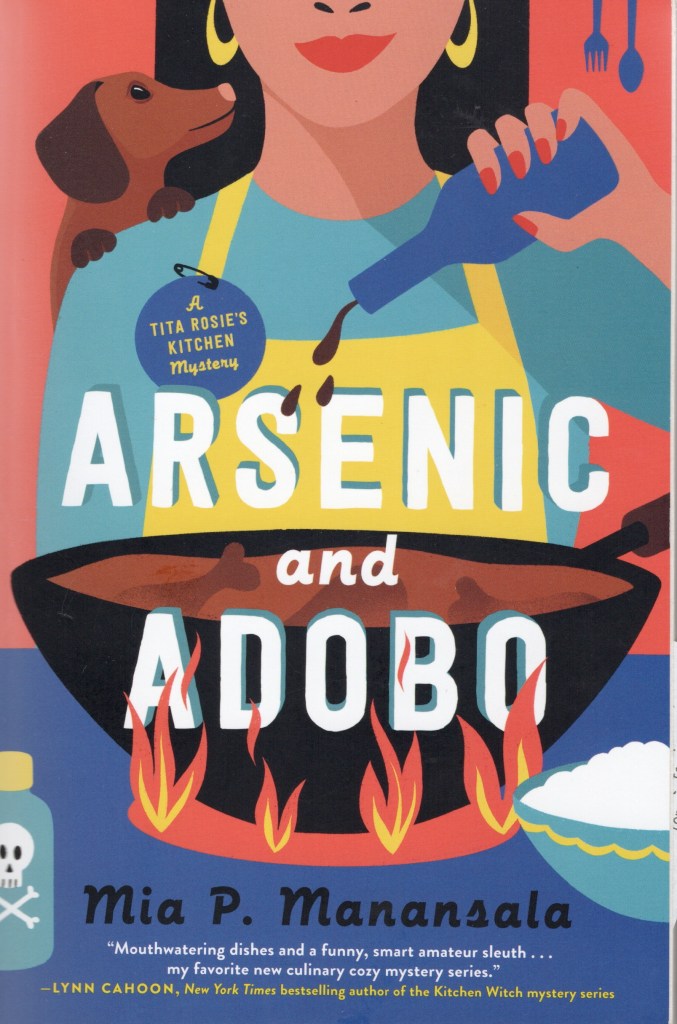
My name is Lila Macapagal and my life has become a rom-com cliché.

Not many romantic comedies feature an Asian-American (or dead bodies, but more on that later), but all the hallmarks are there.

Girl from an improbably named small town in the Midwest moves to the big city to make a name for herself and find love? Check.

Girl achieves these things only for the world to come crashing down when she walks in on her fiancé getting down and dirty with their next-door neighbors (yes, plural)? Double check.

Girl then moves back home in disgrace and finds work reinvigorating her aunt’s failing business? Well now we’re up to a hat trick of clichés.

And to put the cherry on top, in the trope of all tropes, I even reconnected with my high school sweetheart after moving back to town and discovered the true meaning of Christmas.

Okay, that last part is a joke, but I really did run into my high school sweetheart. Derek Winter, my first love.

First of all, can we talk about the voice?

It is impossible not to fall in love with Lila’s voice from the very first sentence of the book. She is smart and funny and eminently likable, which is important in a traditional mystery (no one wants to read a cozy whose main character is an unlikable bitch) and much harder to do than most people who don’t actually write books think it is. Lila is a remarkable character; very clear-eyed about what she wants and what she doesn’t, as well as who she thinks she is and wants to be. She’s returned from her big escape to the big city to the small town she wasn’t terribly happy in when she was growing up–her past experiences continually are reminding her, and not in pleasant way, of why she left in the first place. She never intended to return home (as Thomas Wolfe said, you can’t go home again), but she is back and rather than focusing on what she is certain everyone she knows or is related to sees as her “failure,” she intends instead to focus on helping save her aunt’s restaurant business.

The immense strength of this story rests upon those family bonds, and Lila’s recognition of just how important those bonds–family, friends, community–actually are to her; and her growing realization, over the course of the books, that those things she once thought were strangling and restraining her are actually where her own power comes from.

The mystery itself is also strong: Lila’s wretched local ex, whose mother has since married a businessman who rents Tita Rosie’s building to her and is a total dick, has taken to writing shitty reviews of local restaurants, apparently targeting one and trying to destroy its business before moving on to another. Lila’s relationship with him is also strained; and she also doesn’t like the dickish stepfather either. It is while she is serving them lunch that her ex keels over face-first into his plate–dead from arsenic poisoning. In the food Lila fed him, and came from her aunt’s kitchen. The financially strapped business is shut down pending an investigation into the murder and a health department inspection, and there is the very real fear that Tita Rosie may lose her restaurant. Lila takes it upon herself to investigate and find the real culprit, to clear herself as well as her aunt and the beloved family business of any wrongdoing and scandal. The journey, which introduces us to her friends and family, and welcomes the reader into their charming world and community, twists and turns and is full of surprises every step along the way–as Lila also learns just how much the restaurant, her family, and her friends really mean to her.

This book is absolutely charming, well-written, and very fun. I cannot wait to revisit Lila and her crew in the second book, Homicide and Halo-Halo. Mia P. Manansala is definitely one to watch, and it’s going to be fun watching her career reaching even more heights than she has already achieved.


I’m In Love with a German Film Star

Thursday morning, how you doing?

So New Orleans is slowly beginning to open up this Saturday morning–I’m kind of skeptical, quite frankly, but at the same time, I’m also kind of happy that my gym will be open again. Yes, I’m that shallow gay man. But I had really gotten into a groove working out before the country shut down for the first time in over ten years, and my body was actually responding to it. So, yes, I’ll put on my mask and go to the gym, cleaning everything before and after I use it, and try to maintain distance from people as much as I can.

Does that sound selfish? Now that I’m putting it own into words, it kind of does.

And of course, the irony of catching a potentially lethal virus while working out to be healthier does not escape me.

But I’ve tried to maintain some sort of exercise; taking walks, stretching every other day, and when I’m feeling particularly ambitious, some crunches and push-ups. And the fact that I’ve missed going to the gym, and am anxious to get back to it, is a good thing, right? And yet at the same time, I can’t help but feel maybe I’m being stupid? Ah, the conflict and inner turmoil! I can also be smarter about this, too–going when there isn’t as many people there, for one, and determining whether I feel it’s safe or not to go ahead and work out after getting there and seeing how many people are there and so forth. I suspect with the gym opening up it’ll be similar to January–always crowded at first as people try to stick to their resolutions and then gradually tapering off to normal. I don’t know, I’m really torn. While continuing to do my best while at work to reduce my risk of exposure, is it really smart to be at risk for exposure while at work and then go to the gym?

Well, I have until Saturday to figure it all out and decide.

I slept really well last night, probably the best night’s sleep I’ve had in ages, frankly, and it was lovely. I am still a bit groggy this morning, but that good groggy feeling from sleeping well and wishing I could have stayed in bed a lot longer this morning. I was tired yesterday; and hopefully that will carry over into another good night’s sleep tonight. One can hope, at any rate. But the coffee is tasting particularly good this morning–another sign that I’m still groggy–and I have to leave work early today because I have a doctor’s appointment this afternoon, after which I’ll run some errands before heading home.

I almost finished reading House of Many Shadows last night–I am, according to my Kindle, about 85% finished with the book, so it shouldn’t be an issue to finish reading it tonight. I am also now wondering what I should reread next. I was leaning toward another Mary Stewart–Madam Will You Talk?–but I’ve reread a lot of Mary Stewarts since beginning the Reread Project (each of which was a gem and a total pleasure to reread), and perhaps it’s time to move on to another writer for now, and save the Stewarts for later in the year? I do have an awful lot of Phyllis Whitneys on my Kindle, as well as some other terrific books I would love to reread–there’s also some Agatha Christies, including one that never gets talked about much but was always a favorite of mine, The Man in the Brown Suit–and there are any number of others as well.

Paul was working on things last night, so I watched One for the Ages, the ESPN 30 for 30 documentary recapping LSU’s 2019 football season (I still can’t believe how amazingly good they were; better than my wildest dreams for an LSU football season) and then they replayed the national title game between LSU and Clemson. And no, I wasn’t really watching the game again, it was just on for background noise while I read. (I will admit to having watched it again more than once, but primarily skipping the parts when Clemson played well and scored; while I was doing my data entry yesterday in my easy chair I played through the games with Florida and Alabama on Youtube)

I am also hoping to get back to work on the Secret Project tonight. It took me awhile, but I think I have a better way to open the first chapter than the original way I had.

And on that note, tis back to the spice mines with yours truly. Have a happy Thursday, Constant Reader!

IMG_0998

Careless Whisper

So, for those of you who are keeping score, I rewrote/revised/edited /redid whatever-the-hell-you-want-to-call-it-Chapter-One of the new Scotty last night and you know what? I found Scotty’s voice again. I don’t know, but when I opened the word document for this next attempt to write this book, I knew what the first sentence was going to be, and when I typed it: I love Christmas…somehow Scotty was there again; I could hear his voice, get into his head, everything I need to do in order to write a Scotty book. My God, I might actually get this thing finished.

Huzzah!

I also made it to the gym yesterday morning before work; without complaining, without once trying to think of a reason or rationale to not go. I just got up, had a couple of cups of coffee, did my morning toilette, and when it was time, I put on my sweats and went out the front door. It’s amazing how much better I feel; how much more energy I have,  I’ve not been sleeping as great as I would like this week–not sure what that’s all about–but maybe I just don’t need as much sleep as I used to? A possibility, no doubt. I’m seeing my doctor again next month; perhaps I can discuss it with her then. I know she’ll be pleased I’m working out more regularly.

I also did some things I’ve been procrastinating about–made an eye appointment, called AT&T because I am paying for cellular service on my iPad and not getting it, called my doctor for a prescription refill, cancelled a digital newspaper subscription–and so I am feeling rather proud of myself.  Yay, me!

I also read some Agatha Christie short stories, from her collection The Golden Ball and Other Stories. I originally read, and enjoyed, these stories when I was a teenager; and they were originally published in the 1920’s. To be honest, while I still enjoyed them, on some levels they bothered me. I’ve actually read criticism of Agatha Christie for being, among other things, classist in her writings; this can be problematic in a present-day reading (I didn’t notice when I originally read her). I also had some other issues with these stories that I didn’t originally; Christie, not only in her short stories but her novels, enjoyed romantic happy endings, which happens in a couple of these stories even though they aren’t a real pay-off and kind of clumsily tacked on.

Listen at me, criticizing Agatha Christie! Some nerve, huh?

The first story in the collection is “The Listerdale Mystery”:

Mrs. St. Vincent was adding up figures. Once or twice she sighed, and her hand stole to her aching forehead. She had always disliked arithmetic. It was unfortunate that nowadays her life seemed to be composed entirely of one particular kind of sum, the ceaseless adding together of small necessary items of expenditure making a total that never failed to surprise and alarm her.

Who hasn’t been there? The St. Vincents are what Christie calls “poor gentlefolk,” essentially, people who used to have money or are technically part of the upper classes but no longer have the funds to live the way they are used to, and are pretty much living hand-to-mouth. Her daughter has prospects–a young man with money–but they are living in shabby place they can’t even afford anymore which won’t “show her off properly.” Mrs. St. Vincent stumbles on a rental advertisement in the paper that seems too good to be true–servants the tenants won’t have to pay; a lovely home with rent so cheap there has to be a catch–but it’s only for the ‘right sort of tenant.’ The St. Vincents qualify; they move in, and everything is wonderful. The daughter, having a proper home that shows her off in the right way, gets engaged to her young man with money. But the son, Rupert, is certain something is wrong about the place and wrong with the deal. The owner, Lord Listerdale, has not been seen nor heard from in quite a while, and Rupert starts looking into things. The ending isn’t quite as sinister as one might think if this were a Stephen King short story, but it’s a pleasant little story. But you see what I mean about the classism; “the right sort of people”…and “poor gentlefolk who suffer in silence” as opposed to the working poor who aren’t the right sort of people and apparently suffer loudly?

“The Girl in the Train” is also quite fun; but again–our main character is a young man whose wealthy uncle has become irritated with him, fired him from his employ, and cut him off financially (shades of Wodehouse!). Our young hero takes this all in stride, and isn’t sure what to do with himself, so he gets on a train to a town that bears the family name: Rowland’s Castle. But before the train pulls out of the station a beautiful young woman leaps into his compartment, begs for help, and dives under the other seat. Thus begins a kind of fun adventure which inadvertently gets him involved not only with the possible kidnapping of an heiress, but with a Scotland Yard investigation into a gang of spies! It’s a fun tale, and all works out in the end….and it very much reminded me of Wodehouse, whom I love.

“The Manhood of Edward Robinson” is also quite fun–if dated. Edward has a good job, good prospects, and everything he could wish for–even if he is a little henpecked by his fiancee who wants to wait several years to get married, which is more sensible. He has won a contest with a prize of 500 pounds–and in a bit of rebelliousness against his fiancee, buys a sportscar, and then lies to her and goes driving out of London one night. He winds up on quite an adventure involving a stolen diamond necklace and a car switch (he winds up with someone else’s car–wouldn’t happen today, but could back then). He comes out of the whole adventure with a whole new outlook on life, and again, the end is quite satisfying.

The fourth, “Jane is Search of a Job,” is perhaps my favorite of the bunch. Jane is poor, needs a job, and finds an interesting advertisement, which she answers and soon finds herself body doubling for eastern European royalty. But all is not what it seems with Jane’s new high paying job, and soon she is off on an adventure all of her own. What makes this story work–along with other Christie novels of the time, like The Man in the Brown Suit–is the female character, who is quite realistic, doesn’t ever get hysterical or lose her head, and greets each new twist in the tale with determination, grit, and a very practical, level-headed  “okay, how do I get out of this” attitude. A very fun read, even if at the end she winds up riding off into the sunset with a man she’s just met and who has fallen madly in love with her. Farfetched as that may seem, though, it is a charming end to the story of Jane’s financial woes–although the message “have a wealthy man fall in love with you” isn’t the most practical of advice.

And now,  back to the spice mines.

IMG_3589