Baby Love

It’s Friday, and the weekend. New Orleans continues to swelter and drip in the midsummer heat, with August just around the corner. August is usually worse than July; the peak being around Labor Day; after which the temperatures starts to drop a bit and the humidity seems to lessen. But it’s hot everywhere; even the UK is, or was, having an intense heatwave. That’s why I am always puzzled by questions about how I stand the heat in New Orleans in the summer time; it’s hot everywhere. The places that aren’t humid are even hotter–and that oh it’s a dry heat really only means the difference between a sauna and a steam room; and the damp heat is better for your skin.

You don’t need to  use moisturizer if you live in New Orleans.

We continue to enjoy Castle Rock, and why did I never notice, ever before, how insanely beautiful Bill Skarsgard is? The resemblance to his brother is there, of course, but he is quite handsome all on his own. I mean, those eyes…eyes are always, to me, the sexiest feature; I am a sucker for someone with gorgeous eyes.

I slept better last night than I did the night before, but still woke up several times during the night, which means I am going to have to shake up what I do before I go to sleep; I’d been reading in bed for a half hour or so before going to sleep and it looks like I might have to go back to that again. I want to finish Martin Edwards’ The Golden Age of Murder, which is currently my bedside reading, and I also need to get started reading the Anthony finalists for Best Paperback Original, since I am moderating that panel at Bouchercon.

I am sooooooo behind on my reading.

Also: I am very tired. I had intended to go to the gym tonight after getting home from work, but no…that’s not happening. I think I may even be too tired to read. I think I’ll go watch a documentary.

Yeah, that’s the ticket. What an exciting life I lead.

Have a lovely evening.

IMG_2378

Sledgehammer

We have rain forecast again for today, but right now it’s gorgeous and sunny and blue skies as far as the eye can see outside my windows. Alberto has sped up and shifted east; we are no longer in the Cone of Uncertainty, but Monday evening could be rather unpleasant; the whole day in fact could be rather unpleasant.

Yesterday I broke down and read the first fourteen chapters of the Scotty book. I’d been putting it off–avoidance  having always been one of my top methods of dealing with something I’d rather not–and am pleased to report that while the draft is, in fact and as I’d suspected–terribly rough. But while the writing itself needs to be improved on, and the scenes made better and the dialogue strengthened and the characters deepened; the bare bones of the story are there and they are working precisely the way I wanted them to. Chapter Fourteen is, indeed, terrible and off-track; which means I shall simply have to correct it before moving on to Chapter Fifteen. This was such an enormous relief to me, you have no idea, Constant Reader! I also finally figured out the plot as well, which was equally lovely. Now, I have eleven or so chapters more to do and the first draft is finished; and then it’s just clean-up work.

Huzz-fucking-ah!

I also continued making notes on both “Never Kiss a Stranger” and “A Holler Full of Kudzu,” as well as notes for the y/a I want to write later this year, Bury Me in Satin. I have to say, having this stay-cation has been absolutely necessary and needed; I should probably take these lengthy weekends every few months or so, just to get caught up and reconnect with my writing, rather than just trying to get it done.

I’ve also continued reading Roth’s When She Was Good. Roth is a spectacularly good writer, and he definitely understands character and what to do with it; which is, of course, another way of saying that I am really enjoying reading this book, which I didn’t expect. There is, of course, some casual homophobia in the book, but unfortunately it also fits into the time period and therefore kind of works with the characters…but still kind of jarring to read, while kind of important to remember it wasn’t that long ago that blatant homophobia was so deeply and systemically woven into the fabric of our society that it’s a wonder we’ve made it this far already.

I continue to watch The Shannara Chronicles, and was saddened to see a main character killed off in Episode 8 of Season 2 last night. Shannara is similar to Game of Thrones in that regard; everyone’s life is on the table. I only read the first novel in the series, but it might be interesting to go back and reread the first one and the next two in the series at some point (because I have so much free time).

I also watched the season finale of Krypton, which was terrific. Krypton, which started out kind of ‘meh,’ really hit its stride as the season got going. I rewatched the 1940’s version of And Then There Were None last night, which is terrific other than changing the end of the novel, and the 1974 version of Murder on the Orient Express, which was not as good as I remembered.

I am currently reading two non-fiction books: The Republic of Pirates and The Golden Age of Murder. As my watching of Black Sails no doubt tipped you off, Constant Reader, I am fascinated by pirates and one day hope to write about pirates; whether actually about pirates during their heyday, or about pirate treasure in the present (there’s a Scotty idea in my head somewhere about Jean Lafitte’s treasure I just can’t get my hands on, but someday!), so I am reading The Republic of Pirates as sort of research/for pleasure. Likewise, The Golden Age of Murder is about the Detection Club, and the rise of the British writers who made up the “golden age”: Christie, Sayers, Chesterton, etc. It’s interesting and informative; while I’ve read many of these writers–many of them when I was a teenager–it’s kind of fun finding out what they were like as people; what they thought of their own writing and each other; how they came up with their ideas, and what they did for marketing purposes (Sayers was apparently a tireless self-promoter).

I’ve decided that I have to do more promotion going forward; I am not exactly sure how to do that, but it’s something I need to be more pro-active about. Facebook and Twitter certainly can’t be the be-all end-all of my marketing efforts; however, the gay bookstores are gone as are the gay newspapers, and the mystery bookstores seem to be closing at an equally alarming rate as well. I’ve also come to the conclusion this year, as I’ve mentioned so many times before in past entries this year already, that I need to stop being so self-deprecating and take pride in my work. This is very against my nature; my default is to self-deprecate so I don’t have to worry about other people being deprecating. I’ve always feared that if I say something like I’m really proud of this story someone else will say, well, being proud of THIS isn’t difficult given what you’ve written before; you see how defeating this all can be? Reprogramming my mind isn’t easy, but it is definitely something I need to work on for this year. At the same time I detest arrogance…so it’s a tightrope I have to walk, proud but not arrogant. And I’m not sure I can navigate either properly.

But I am enjoying creating again; enjoying working with my characters and coming up with plots and dialogue and images. Hopefully I’ll do some actually writing–last night I was writing scenes in my journal in long-hand while the television blared in the background; fortunately with the Christie films I’d seen them before and read the novels, so I didn’t miss anything; I may not have been paying as close attention to The Shannara Chronicles as I may have needed to.

Today, I am going to reread the first four chapters of the revision of the WIP (which I have already started revising yet again). I may do some computer-writing today, but then again we’ll see where the day goes, shall we?

I also have been reading some short stories. I’d forgotten that The New Yorker was doing these decades books; showing the decade through collected pieces published in the magazine during that decade. I had purchased the volume for the 1940’s, and forgotten about it. I started paging through it the other day, and came across some great essays as well as some short stories…

The first inThe New Yorker’s The 40’s: The Story of a Decade is”The Second Tree from the Corner” by E. B. White.

\”Ever have any bizarre thoughts?” asked the doctor.

Mr. Trexler failed to catch the word. “What kind?” he asked.

“Bizarre,” repeated the doctor, his voice steady. He watched his patient for any slight change of expression, any wince. It seemed to Trexler that the doctor was not only watching him closely but creeping slowly toward him, like a lizard toward a bug. Trexler shoved his back an inch and gathered himself for a reply. He was about to say “Yes” when he realized that if he said yes the next question would be unanswerable. Bizarre thoughts, bizarre thoughts? Ever have any bizarre thoughts? What kind of thoughts except bizarre had he had since the age of two?

It’s interesting, for one thing, to switch from the crime/horror stories I usually read to read something that’s more along the literary fiction lines; I’ve heard of E. B. White before but never read him other than his collaboration with William Strunk, The Elements of Style, which has become a Bible of sorts, if not to writers then definitely to writing students. So, it was kind of nice to read some of his fiction.

The story itself is rather clever; it’s about the relationship between a psychiatrist and a patient, primarily drawn from the patient’s–Mr. Trexler’s–point of view, and how he sees his own neuroses and if his doctor is actually helping him or not. Mr. Trexler begins to slowly question his therapist during their sessions, which inevitably shifts the dynamic between the two, and Mr. Trexler also has some keen insights into his doctor’s personality. Ironically, this ‘reverse-therapy’ seems to have the most positive effect on Mr. Trexler, and after a session–which may or may not be his final session with this doctor–he’s kind of helped himself; on his walk home from the therapist he is quite buoyant and happy and seeing the world with almost new eyes, seeing everything in a new way.

So, the therapy worked…but just not how it’s intended to work, but does it matter when the final end is the desired outcome?

Interesting.

And now back to the spice mines.
IMG_4108

Burning Heart

Sunday morning, and yet another good night’s sleep. It truly is amazing what a difference that can make in one’s life; I miss the days when I could simply tumble into bed and close my eyes and, as Paul once put it, “sleep through a nuclear holocaust.” Yesterday was a good day; I got groceries and did some cleaning. I read both “This Town” and “Don’t Look Down” aloud, did the necessary clean-ups on them, and this morning I am going to read “Fireflies” aloud and see if it, indeed, does hold together. I wrote the first draft of “Fireflies” something like thirty years ago (!) and it’s still in the file folder, handwritten (because until computers, I almost always hand-wrote everything); I am still not entirely certain the story works; but we will find out today when I read it out loud.

I was very pleased with the two stories I read aloud yesterday, and if I do say so myself, I feel “This Town” is one of the better stories I’ve written. I’m going to read “Fireflies” aloud this morning, and then I’m going to work on “This Thing of Darkness” for a little bit, see how that goes, and then maybe dive into one of the two novels I am working on (focusing on, really; there’s a third I started writing a couple of weeks ago, which I am itching to get back to, but that’s just crazy talk). I also started reading Alex Segura’s Blackout yesterday, not getting very far, alas; but I am looking forward to getting further into it. I also started reading Martin Edwards’ Edgar Award winning The Golden Age of Murder, which is my new ‘read a chapter or two before bed’ book. We also started watching Harlan Coben’s new Netflix series, Safe, and are really enjoying it thus far.

My kitchen is also a disaster area; I made ravioli last night and yes, well, a mess is a bit of an understatement.

I also stopped at Office Depot yesterday to purchase pens. I’ve discovered a new brand of pen that I absolutely love: Tul, with a dash over the u. They sent us a couple of them at the office a month or so ago, and I absconded with them, as is my wont, and then bought a couple more. Yesterday I bought several more packs of them. I’ve always been a bit of a pen nerd, and I also noticed last night, as I made notes in my journal, that my blank book is almost full; time to get a new one soon. Yay! I really am glad I’ve gone back to keeping a journal to write notes and ideas down into; I’ve worked out issues with several of my short stories this year in it, as well as the books.

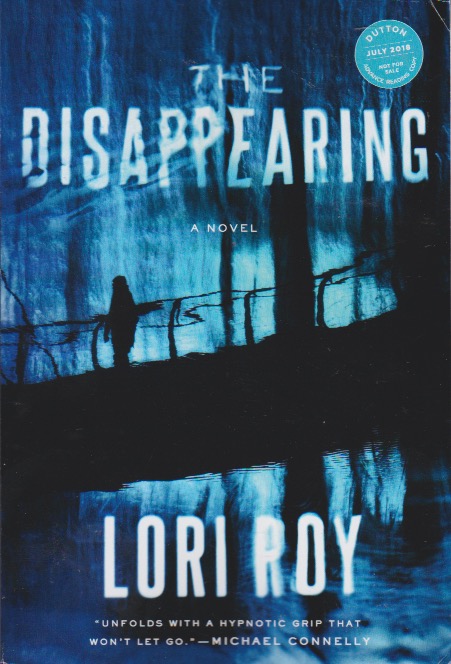
I also managed to finish Lori Roy’s upcoming new release, The Disappearing, last night.

the disappearing

Lane Wallace is alone inside Rowland’s Tavern when the front door flies open. A man stumbles inside, bringing with him a spray of rain that throws a shine on the hickory-brown floors. He scans the dark rooms, stomps his feet, and draws both hands over his wet, round face. If the man says anything, Lane doesn’t hear him for the rain pounding the tin roof and the palm fronds slapping the front windows. It’s supposed to rain through the night, and all around Waddell, people will be keeping a close eye on the river.

Lane smiles because maybe the man is a friend of a friend and not a stranger. She’s expecting a big crowd tonight, and one of her regulars might have invited him. But he doesn’t smile back. Slipping her phone from her back pocket. she lays it on the bar top where the man will be sure to see it. It’s a subtle warning, but if the man is looking for trouble, it’ll make him reconsider.

He’s a little on the heavy side; doughy, a person might say. From behind the bar, Lane asks the main if a beer’ll do him, and as he slides into a booth near the front door, he nods. Hr regulars, men who’ve known her all her life, or rather who have known her father, won’t show up for another hour or so but Rowland Jansen will be back any time now. He ran out to move his car and Lane’s to the higher and drier ground of the parking lot out front, so she won’t be alone with the man for long.

This is Lori Roy’s fourth novel, and it’s quite an achievement. His first three novels–Bent Road, Until She Comes Home, and Let Me Die in His Footsteps–were all shortlisted for Edgar Awards; she won Best First for Bent Road and Best Novel for Let Me Die in His Footsteps, raising her up into the exalted, rarified air of the Multiple Edgar Winner Circle. I’ve only read Bent Road–I do own the others, will every intent to read them at some point; too many books, not enough time–and it blew me away with its stunning depiction of rural Kansas, its juggling of two separate time-lines, and its thematic exploration of how the pains and evils of the past can influence the present.

That same theme runs through this stunning new novel, The Disappearing, as well, and is explored even more deeply and explicitly than in the first. Waddell is a small town in north Florida, amorphously near Tallahassee; Roy’s captured the feel of rural small town Florida deftly (there is, as not many know, a huge and significant difference between the coastal cities of Florida and the insular, small towns of the state’s interior). She plays with the memories of Ted Bundy’s journey through the area; a young woman, a student at Florida State doing some internship work at a local, fading plantation is missing, which has stirred up all those fearful memories of Bundy’s spree. The plantation also shares a boundary with a closed reform school for boys, whose own violent and possibly deadly past has also come back to haunt Waddell.

But it’s also an exploration of family, and how the damage from a past history of deep violence and emotional abuse, locked away and ignored, can reverberate through the years and have deep, horrific implications on the present. Susannah Bauer’s disappearance triggers a chain reaction of emotion and violence and horror, spread over the course of a few days after the night of the heavy rain, that will continue to cycle through the future unless honestly and painfully dealt with in this present.

There are four point of view characters in The Disappearing: three women from generations of the same family–Erma, the matriarch of the Fielding family, with her guilts and secrets festering inside her for decades; Lane, her daughter, whose own emotional damage and baggage perpetuates the cycle; and Lane’s younger daughter, Talley, whose wanderings due to her own loneliness and unhappiness makes her the holder of most of the secrets and truths of the present. The fourth point of view character is Daryl, a mentally disabled young man who is the groundskeeper at the church, and his story is told in the recent past rather than the present, as Lori Roy deftly spins all the secrets and lies and horrors of the town of Waddell into an astonishingly well-blended tale of flawed people and the damage they can leave in their wake.

Even more impressive than the characters and the story itself is the mood and the voice; the way she maintains this almost dreamy tone, creating the perfect mood for the story is masterful. The voices of her characters are compelling and real; only Daryl tells his story in the first person; the others are a very tight third person present tense. The shifts in voice, the tone, the tense and the word choices and the imagery, kept reminding me of Faulkner’s brilliant The Sound and the Fury, and in a very good way.

The Disappearing is an extraordinary achievement, and is destined to make awards short-lists and all the Top Ten lists for 2018.