Silver Bells

So this is Christmas.

It’s very still and quiet this morning. Paul is asleep, Sparky has been fed and has curled up to sleep again somewhere, and I am finishing my first cup of coffee. It’s hitting the spot, too, I might add. My coffee addiction really is something, isn’t it? I had thought about getting out the Espresso machine and making myself cappuccinos this morning, but went to bed last night without thinking about anything and thus didn’t. The kitchen is also kind of a mess this morning. Maybe I’ll do something about it, maybe I won’t. It’s Christmas, after all. We had a lovely day yesterday; I spent the morning rereading some old Scotty books with the intent of rereading/editing that I have done on Hurricane Season Hustle, but after I ordered the pizza and drove out to Metairie to get it–it was fucking fantastic, too, I might add, with leftovers for today–I just kind of zoned out for the day. We watched La Palma, a truly terrible disaster mini-series, on Netflix (cheesily enjoyable in that over-the-top and rather dumb disaster move way), and then watched Kings of Tupelo, which was insane…but again, Jake, it’s Tupelo. I went to bed late and slept late, and feel good today, if weird that I have to go back to work again tomorrow. We’re driving out to Elmwood to see the afternoon show of Babygirl today, and that’s really about all I care about for today. Maybe we’ll stream some movies tonight, or start a new show to watch or something. It was also sunny and warm yesterday–today looks gray, maybe rain–and once I finish this, I will probably do some straightening up in here before repairing to my easy chair to read for a bit.

What do I want for Christmas? World peace would be nice–hell, single-payer health insurance would be terrific, too–but neither of those are possible as long as this country remains enthralled to billionaires and corporations. That’s been the case for most of my adult life, and as far back as the 1990’s I was noticing how the direction we were heading into as a country economically, both at home and abroad, was firmly setting us on the same paths that led to the French and Russian revolutions and the Great Depression. I wrote about this a lot in my journals from back then; I’d even thought about writing a novel based on those observations, but after the fall/collapse. Do I have any answers? No, not really. People will always vote against their own self-interests because they have been convinced by the mythology of the American Dream that they, too, will someday be rich if they work hard (or smart) enough. I was told repeatedly as a child that if I worked hard, I too could become wealthy. Stories of people who went from rags-to-riches proliferated in the fiction stacks (and movies, too, for that matter); almost every “epic saga” was the story of some impoverished immigrant who seized opportunities–sometimes lied, cheated and stealing–that would make them rich. We’re essentially groomed by our art and culture to aspire to wealth and that the richer you are the better of a person you clearly must be, because you accumulated wealth. The great irony of that, of course, is that Christmas (and Christianity, too, for that matter) teaches us to take care of the sick and the elderly and the poor, and to always be empathetic to those less fortunate. Christianity and Capitalism are antithetical to each other, and the influence of capitalism on Christianity has not been a good thing. The prosperity gospel is a heresy, and the worst kind of heresy because it goes against everything Jesus taught in the pages of the New Testament. Everyone celebrating Christmas today–and the “birth” of Jesus–by spending a lot of money and a lot of excess?

Hardly “the reason for the season.” Put Christ back into Christianity, for your own sakes.

I’ve always loved the messaging of Christmas above what it actually is in reality, to be honest. I can remember watching A Charlie Brown Christmas as a kid and seeing that I was looking past what Christmas was supposedly about and approaching it from a greed perspective. (It’s still my favorite Christmas story.) That was filmed in the 1960s, and was about how the season was being exploited by an orgy of spending and excess, which was never the point of the holiday. I am as sentimental about Christmas and what it stands for as a child; Christmas decorations and trees make me smile and feel warm inside. I even like most Christmas music, even if I am heartily sick of some of them (looking at you, Wham!). I love driving down St. Charles Avenue or Prytania Street at night to see all the houses decorated and lit up. I love seeing how much kids enjoy it all. I even watched a couple of Christmas-themed rom-coms this season. I tend to not write about Christmas, because it is so easy to fall into the cheesy Christmas-miracle and all’s right with the world clichéd trope so many stories of that type inevitably fall into. I did have fun with Royal Street Reveillon, which was simply set during Christmas season but that was all–and even then I found myself trying to take the story in that direction a few times.

Sigh.

And on that note, I’m going to get some more coffee and go sit in my easy chair and see what’s going on in the world while doing some reading. Have a merry Christmas today, everyone, even if you do not celebrate; at least enjoy your day off at any rate.


(She’s a) Very Lovely Woman

Saturday morning and it looks kind of gray outside the windows this morning as I look out at the world blearily and drink my first cup of coffee. I slept very well last night–which is always welcome–but woke up feeling a bit groggy this morning. I am sure the caffeine will work–it generally does–but as I glance around at the chaos of my office/kitchen my inclination is to pour the coffee out and go back to bed and sleep the rest of the day away, hoping magical elves or something else will show up whilst I sleep to finish organizing and arranging this mess into something resembling workable order. On the other hand, I don’t think that’s going to happen, so I am going to need to wake up, buckle up, and put my nose to the proverbial grindstone. I’ve got to contain this mess–and do it properly, no more sweeping things under proverbial rugs to get mess out of sight–and I’ve got to work on the book today and I need to run some errands. I also have to go to the gym today, so I will most likely follow football championship games today by periodically looking on-line to check scores only. Paul is going into his office this afternoon to do some work as well, and I need to update my to-do list and…yes, it’s a very busy day for a Gregalicious.

I finished reading Murder Most Fowl by Donna Andrews last night–charming, as always, delightful and witty and funny–and decided, since I was talking about how much I preferred Miss Marple to Hercule Poirot the other day, that I should revisit one of the Marple stories. I have a hardcover copy of A Caribbean Mystery–I don’t recall where it came from–but it has some sentimental value for me in that it was the first Marple novel of Christie’s I had read all those many moons ago when I was a child, holing up in my room on Saturdays with a book and a bag of Bar-B-Q Fritos. (My first Poirot was actually Halloween Party, which I also have a hardcover copy of and again, do not recall where I got it or how long I have had it; I read most Christies in paperbacks purchased at the Bolingbrook Zayre’s off their wire paperback racks) In those first few pages of the book, it spelled out exactly what I loved about the Marple stories–about how living in a small village actually exposes one to almost every kind of human behavior there is in a smaller ecosystem, and the great irony that the smallness and rural aspects of the small community are all too frequently seen as provincial and inexperienced in the world (why Grace Metalious’ Peyton Place was so shocking when it was originally published some seventy years ago; that placid, idyllic on the surface looking village/small town/rural community has a lot more going on than one would think at first glance). This is an excellent set-up, really, for the story Christie is writing about this fictional resort on a fictional West Indies island; her nephew, the successful novelist Raymond West, has paid for this trip for her to get some sun and recover from an illness…and when she originally protested about the expense and “who will watch out for my home in St. Mary Mead”–this response (which I hadn’t remembered) hit me right between the eyes:

Raymond had dealt with everything. A friend who was writing a book wanted a quiet place in the country. “He’ll look after the house all right. He’s very house proud. He’s a queer. I mean–“

He had paused, slightly embarrassed–but surely even dear old Aunt Jane had must have heard of queers.

Now, what is one to make of that? It was a jolt, certainly. It put me in mind of something I came across on Twitter the other day, written by Wil Wheaton, in which he had answered at a con somewhere a question regarding the current debate of “can you separate the art from the artist?” This is something I’ve pondered about quite a bit–most recently, the feeling of guilt I experienced in rewatching Chinatown, knowing now what I–we all–know about Roman Polanski. I enjoyed Chinatown every time I’ve seen it, and I was now watching–rewatching–through a different lens than I had before; I was watching in terms of my own Cynical 70’s Film Festival, to see how a 70’s film that actually harkened back to old-style crime/hard-boiled/noir styles, but with a more modern (at the time) sensibility fit into that 70’s cynicism and darkness about humanity and human behavior. But the discomfort kept popping up, particularly because Polanski himself appears in the film…and I eventually decided not to rewatch another favorite, Rosemary’s Baby, because of it.

I am not going to consign Agatha Christie to the trash heap of history; she was an extraordinary writer, and one of the most influential in the field in which I myself write. Nor do I think a simple throwaway line or two in a book originally published in 1964 is enough to dismiss Christie and her canon as homophobic and never revisit her work. In fact, given the time period in which the book was written, I am surprised the two sentences weren’t, frankly, much worse. Reading the sentences didn’t offend or outrage me; it was just a surprise, primarily because I didn’t remember them at all in a book I’ve read multiple times over the years–and I think when this hardcover came into my possession (I won’t swear to it, but I think I got it during one of my many eBay buying frenzies after Hurricane Katrina, when I felt it necessary to get copies of books with some sentimental value to me) I did actually read it again because I didn’t remember the plot–and this either went right past me or I noticed and didn’t think much of it.

Revisiting this book and viewing it through a modern lens is going to be interesting. And like I said, the reference could easily have been worse–but seeing queer used in this way reminds me of how it used to be used. The younger generations are reclaiming the word, and I myself have been advocating for it as a generic term for the non-straight community for eons…but I also can see why there are people of my generation/the one before me/the one after me who object to its use and why.

But I would a thousand times rather see the word queer used in an Agatha Christie novel than faggot. And I also remember the sympathetic depiction of a lesbian couple in my favorite Marple, A Murder is Announced.

Interesting thoughts on a Saturday morning. The sun has come out now and it’s not quite so gray outside; the second cup of coffee is certainly hitting the spot right now and the grogginess is beginning to leave from not only my head but from my body. I still don’t want to straighten up this mess, but there’s no choice, really, and I want to get some good work on the book done today and tomorrow. I need to go to the gym either today or tomorrow as well; perhaps later this afternoon once I get some writing/cleaning/organizing completed. I cannot be completely lazy this weekend, much as I would like to be; I have to get things done, and the more things I get done now the fewer things I will have to do later this month (I am not, for example, going to want to write on Christmas). But once a procrastinator, always a procrastinator.

And now it occurs to me that perhaps I am procrastinating here, so I am going to bring this to a close. Have a lovely Saturday, Constant Reader, and will talk to you soon.

All I Want for Christmas

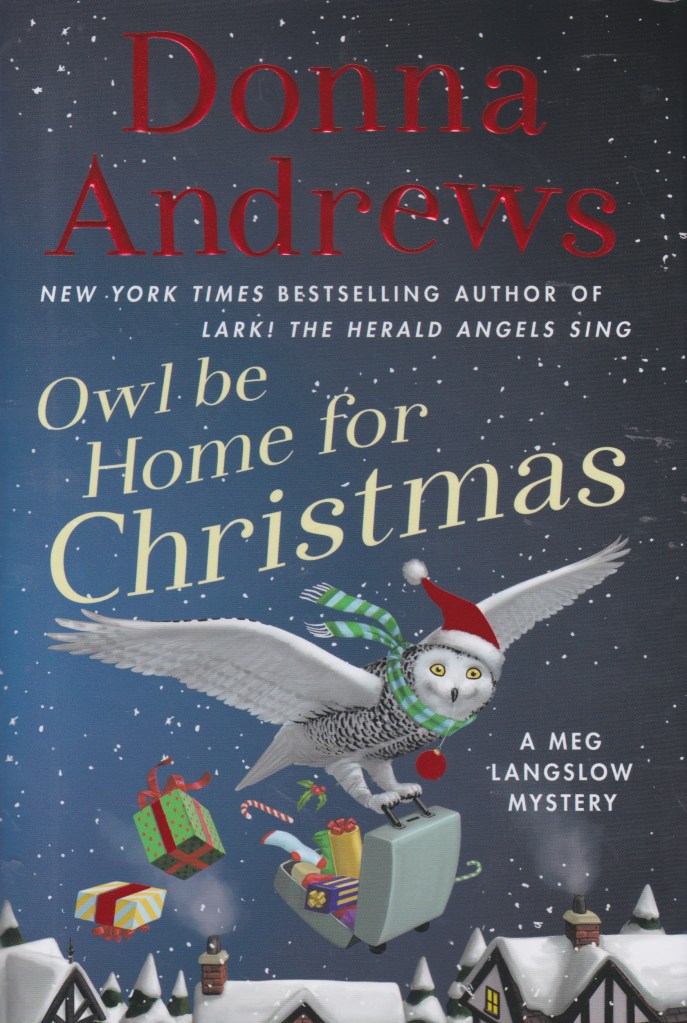
I love prolific writers, but keeping up with their canon when you have very little time to spare on actually reading for pleasure can be difficult. I somehow managed to fall years behind on one of my favorite series–the Meg Langslow mysteries by Donna Andrews–right around the time she started producing two books per year (a regular mystery and one centered on Christmas–hello, Hallmark? This series is perfect for you), which made it even harder to catch up. I did manage to read two this past week (well, I listened to one in the car on the way home, which made the drive a delightful experience), and yes, both were marvelous as always.

“Hoo! Woo-hoo HOO!…HOO! Woo-hoo HOO!”

The gray-haired couple standing at the tinsel-decked front desk of the Caerphilly Inn started slightly, and glanced over their shoulders in the direction of the hooting.

“That’s just the ornithologists again, Mr. Ackley.” Sami, the desk clerk, had probably been hired for his soothing voice. “Having their conference here, you know. Owl Fest.”

“They haven’t brought in live owls, have they?” Mrs. Ackley’s face was anxious. “Surely the hotel wouldn’t allow them to do that.”

“Jane’s terrified of birds.” The man put a protective arm around his wife’s shoulder.

“Of course not!” Sami managed to look shocked at the mere suggestion. “That would be completely against the Caerphilly Inn’s policies.”

Which is why we’d been confiscating all the live owls various ornithologists kept bringing into the conference, and taking them a few miles down the road to temporary headquarters at the Caerphilly Zoo. The owls, that is, not the ornithologists–although I’d been tempted. Two screech owls, a barn owl, and a northern saw-whet owl so far.

Christmas is hard to write about, really. My favorite quote from All About Eve isn’t nearly as famous as the ones everyone quotes regularly–“I detest cheap sentiment”–and I’ve tried to keep that quote in the forefront of my mind when I am writing. That isn’t to say that cheap sentiment doesn’t have its place in entertainment; there’s comfort to be found in works that can sometimes be cloyingly sentimental. For me, I define cheap sentiment as unearned; not coming from the honest emotions of the characters based on circumstance and situations and interactions, but rather from homilies: blood is thicker than water, family above all else, etc. I’ve always wanted to write about Christmas, but it’s a minefield when it comes to sentiment. I myself have written short stories about/around Christmas, but they seemed trite, cloying, and cheaply sentimental, with “all’s well that ends well” ending because, well, it’s Christmas. Everything is supposed to work out in the end because it’s Christmas, right? Clarence gets his wings, bullied Rudolph becomes a hero, etc. etc. I tried to avoid that with my own entry into Christmas crime writing, Royal Street Reveillon, and am not entirely certain I succeeded. Yes, the guilty were punished, but like Die Hard, it wouldn’t have to be the holiday season for the story to work. (This is why I fall on the side of “Die Hard is not a Christmas movie” because Christmas wasn’t integral to the story; it could have been Thanksgiving or the middle of the summer and still worked.)

And yet, Donna Andrews manages to write a new Christmas murder mystery that leaves you feeling contented, satisfied, and enormously happy when you close the book after reading the last line–and Owl Be Home from Christmas is yet another gold standard work from the master.

The premise of this one is that Meg’s grandfather, wildlife expert and activist Dr. Blake, is hosting OwlFest at the Caerphilly Inn, and of course, his assistant Nigel is off for the holidays to visit family so the onerous task of keeping the conference running smoothly, and solving problems, falls to Meg, who has moved herself, husband Michael, and their twins (Josh and Jamie*) to one of the guest cottages on the property. Christmas is looming on the horizon, and a polar vortex has descended on Virginia from Canada, creating a blizzard that has everyone trapped at the Inn. In fact, the storm has cancelled flights up and down the eastern seaboard, and Caerphilly is woefully unprepared for a storm of this magnitude, with the city’s two snowplows stranded in snowbanks. Meg, as always, makes the best of every situation, and with the help of the impressively efficient Inn manager, Ekaterina, tries to make the situation of being stranded at the Inn as comfortable and fun for the conference attendees as possible.

Naturally, there are some difficult attendees who Meg would love to righteously smite–and certainly deserve said smiting–and when the obnoxious and well-hated villain of the book, Dr. Frogmore, drops dead at the conference banquet, there’s a plethora of suspects…and with the Inn cut off from civilization by the blizzard, obviously the killer is someone on site.

Meg and her intrepid family and friends now have to find the killer–while still keeping the conference running smoothly and continuing with plans to keep the stranded guests entertained and happy; making the best of a bad situation, which Meg is fantastic at doing.

I loved this book. Andrews has somehow managed to keep a series running for over thirty books without dropping a stitch. While other series tend to run dry (my own Chanse series, for example, and I regularly worry about Scotty doing the same), somehow she manages to keep her enormous supporting cast involved and memorable (I deeply appreciate the three-dimensional lives of the supporting cast, and she is expert at deciding which ones to highlight in each book; Rose Noire is becoming a favorite), and I don’t think there’s a single book in this series where I’ve not laughed out loud multiple times while reading. Caerphilly is a charming place, and every time I go back to visit–even if the cast isn’t in Caerphilly in the book–I always am a bit melancholy when I finish and have to face the real world again.

And she has managed to write all these Christmas books with heart, compassion, and love–and isn’t that what Christmas is really all about?

Masterful. Andrews is a gift the crime fiction community should cherish.

*More Josh and Jamie, please.