Fame

MWA Partners with G.P. Putnam’s Sons to Create the Sue Grafton Memorial Award

Presented by G.P. Putnam’s Sons, the award will be given at Mystery Writers of America’s
73rd Annual Edgar Awards in New York City on April 25, 2019

Thirty-five years ago, Sue Grafton launched one of the most acclaimed and celebrated mystery series of all time with A is for Alibi, and with it created the model of the modern female detective with Kinsey Millhone, a feisty, whip-smart woman who is not above breaking the rules to solve a case or save a life. Like her fictional alter ego, Grafton was a true original, a model for every woman who has ever struck out on her own independent way.

Sue Grafton passed away on December 28, 2017, but she and Kinsey will be remembered as international icons and treasured by millions of readers across the world. Sue was adored throughout the reading world, the publishing industry, and was a longtime and beloved member of MWA, serving as MWA President in 1994 and was the recipient of three Edgar nominations as well as the Grand Master Award in 2009. G.P. Putnam’s Sons is partnering with MWA to create the Sue Grafton Memorial Award honoring the Best Novel in a Series featuring a female protagonist in a series that also has the hallmarks of Sue’s writing and Kinsey’s character: a woman with quirks but also with a sense of herself, with empathy but also with savvy, intelligence, and wit.

The inaugural Sue Grafton Memorial Award will be presented for the first time at the 73rd Annual Edgar Awards in New York City on April 25, 2019 – the day after what would have been Sue’s 79th birthday – and will be presented annually there to honor Sue’s life and work.

The nominees for the inaugural Sue Grafton Memorial Award were chosen by the 2019 Best Novel and Best Paperback Original Edgar Award judges from the books submitted to them throughout the year. The winner will be chosen by a reading committee made up of current National board members, and will be announced at this year’s Edgars Award banquet.

The nominees for the inaugural Sue Grafton Memorial Award are:

Lisa Black, Perish – Kensington
Sara Paretsky, Shell Game, HarperCollins – William Morrow
Victoria Thompson, City of Secrets, Penguin Random House – Berkley
Charles Todd, A Forgotten Place, HarperCollins – William Morrow
Jacqueline Winspear, To Die But Once, HarperCollins – Harper

ABOUT SUE GRAFTON:
#1 New York Times–bestselling author Sue Grafton is published in twenty-eight countries and in twenty-six languages—including Estonian, Bulgarian, and Indonesian. Books in her alphabet series, beginning with A is for Alibi in 1982 are international bestsellers with readership in the millions. Named a Grand Master by the Mystery Writers of America, she also received many other honors and awards, including the Lifetime Achievement Award from the Private Eye Writers of America, the Ross Macdonald Literary Award, the Cartier Diamond Dagger Award from Britain’s Crime Writers’ Association, the Lifetime Achievement Award from Malice Domestic, the Anthony Award given by Bouchercon (most recently the 2018 Anthony /Bill Crider Award for Best Novel in a Series), and three Shamus Awards. Grafton passed away on December 28, 2017.

Sue-Grafton

When You Close Your Eyes

Well, Constant Reader, we made it to Wednesday, didn’t we? I’m going to do this blog and then run off to the gym for my second workout of this week; sorry if this is getting tedious, but I worry that if I don’t say anything that’s when I’ll start slipping and NOT doing my workouts; a slippery slope I am reluctant to set my foot on, if you will. It’s so lovely to be doing this again and being motivated to do it; it’s more than a little infuriating that I allowed myself such a long break from taking it seriously, and doing it so little. But there’s no sense in crying over spilled milk at this point, is there? I am just happy that I’m at where I am at with it.

I am also very stoked to be jazzed about writing again. It’s interesting, on every level, how gong back to the beginning (both with working out and writing) has turned out so well, isn’t it? I am really pleased with these short stories I’ve written over the last week or so, the chapter of the WIP I wrote Monday, and the rethinking of the Scotty book I’ve done. I am definitely going to keep moving positively forward; and I am going to keep seeking an agent once I get this first fifty pages of the WIP whipped into better shape. This weekend I plan on rewriting and editing the four short stories I’ve done, plus I need to start working on the Bouchercon anthology, which I am also excited about–how long has it been since I was excited to edit an anthology, well might you ask? It’s been a long frigging time would be the proper answer, I am afraid.

I also finished reading Sarah Weinman’s sublime anthology Troubled Daughters Twisted Wives, and am the better for it. If you’ve not read this collection, you really should; particularly if you’re a writer. These stories hold up incredibly well, with only the occasional dated reference–and none of them so jarring that they take you out of the story. I’ve also added several new-to-me authors to my TBR list; alas, I shall have to track down copies of their works via secondhand dealers and eBay, as so much has sadly fallen out of print. I am also disappointed in myself for waiting so long to read this collection; but now that I have, I am glad. I am also grateful to Weinman for her hard work in pulling this together and shining a light on these terrific writers of the past.

It also occurs to me that a similar volume could be done for gay and lesbian crime writers whom modern readers don’t recall or remember; I doubt, though, that there would be a market for such a thing. That’s the tricky thing, isn’t it? Finding a market?

Sigh.

troubled daughters twisted wives

First up was “Lost Generation” by Dorothy Salisbury Davis:

The school board has sustained the teacher. The vote was four to three, but the majority made it clear they were not voting for the man. They voted the way they had because otherwise the state would have stepped in and settled the appeal, ruling against the town…

Tom and Andy, coming from the west of town, waited for the others at the War Memorial. The October frost had silvered the cannon, and the moonlight was so clear you could the words FOR GOD AND COUNTRY on the monument. The slack in the flagpole allowed the metal clips to clank against the pole. That and the wind made the only sounds.

Then Andy said, “His wife’s all right. She came up to Mary when it was over and said she wished he’d teach like other teachers and leave politics alone.”

“Politics,” Tom said. “Is that what she calls it?”

This was my first experience reading Mystery Writers of America Dorothy Salisbury Davis; despite being aware of her for quite some time. Sara Paretsky wrote a brilliant tribute to her after she died a few years ago; she’d been on my radar before that, but again, this is my first time reading her. This story is dark and amazing. We never know what the teacher’s politics are, but given the time period it’s not too hard to imagine what they were, given the fact that the group of men who gather to take care of him also include police officers–which was an all-too true and horrible aspect of the anti-Civil Rights whites of the South; the men paid with tax dollars and charged with protecting everyone were racists who abused their privilege and power to abuse and kill people of color and civil rights workers. There’s an amazing twist in this story, and the denouement is eminently satisfying and dissatisfying at the same time–not an easy thing to do.

Some of Ms. Davis’ books are now back in print, so snap ’em up, peeps!

“The People Across the Canyon” by Margaret Millar

The first time the Bortons realized that someone had moved into the new house across the canyon was one night in May when they saw the rectangular light of a television set shining in the picture window. Marion Borton knew it had to happen eventually, but that didn’t make it any easier to accept the idea of neighbors in a part of the country she and Paul had come to consider exclusively their own.

They had discovered the sight, had bought six acres, and built the house over the objections of the bank, which didn’t like to lend money on unimproved property, and of their friend, who thought the Bortons were foolish to move so far out of town. Now other people were discovering the spot, and here and there through the eucalyptus trees and the live oajs, Marion could see half-finished houses.

But it was the house directly across the canyon that bothered her the most; she had been dreading this moment ever since the site had been bull-dozed the previous summer.

I’ve written about Millar before; I’ve become an enormous fan of her work, and have been slowly making my way through her canon over the past few years. I do have the wonderful reprinted set of her books Collected Millar; a quick glance over at Amazon shows that many of her books, including the Edgar Award winning Beast in View are available as ebooks at fairly reasonable prices.

This story, about a couple and their young daughter, whose increasing obsession with the new neighbors across the way makes the stay-at-home mother not only jealous but concerned about the intensity of the obsession, strikes several chords: the mother becoming aware that her child is growing away from her and lamenting the ways her own every day life has allowed time to slip away, regretting that she didn’t spend more time paying attention to her child; the growing realization that you can influence and affect your child’s personality, behavior and temperament unknowingly; and ultimately, the exquisite torture and pain of being a parent. Millar only had one child, a daughter; it’s not hard to imagine where the roots and inspiration for this story came from. Quite excellent.

“Mortmain” by Miriam Allen Deford

“I’ll be back on Thursday, Miss Hendricks, and I’ll drop in here in the afternoon. It’s only three days, and I don’t anticipate any change. You know what to do. If anything happens, you can call Dr. Roberts; he knows all about the case. I wouldn’t go away, with Marsden like this, but–well, it’s my only daughter, and she’ll never be married again–at least, I hope not!–and she’ll be heartbroken if her old dad weren’t there to give her away.”

Dr. Staples turned to his patient.

“Good-bye, old man; I’m leaving you in Miss Hendricks’ charge till Thursday. You won’t be sorry to have three days free of me, eh?”

This gem of a creepy short story is straight out of what (thanks to Stephen King) I call the EC Comics playbook. The sad, dying patient has a load of cash in his safe; the nurse in whose care the doctor has left him for three days wants it to start a new life with the cad she’s in love with, and there we have the setup for a most clever game of cat-and-mouse in which each sentence builds the suspense and tension. If you want a great example of how to write suspense, this short little tale is all you need. In fact, if I ever teach writing again, this story is going to be one of the things I teach. It may even be one of those stories, like du Maurier’s “Don’t Look Now,” that I reread every now and again, to savor in its delightful brilliance.

And finally, “A Case of Maximum Need” by Celia Fremlin:

“No, no telephone, thank you. It’s too dangerous,” said Miss Emmeline Fosdyke decisively; and the young welfare worker, only recently qualified, and working for the first time in this Sheltered Housing Unit for the Elderly, blinked up from the form she was filling in.

“No telephone? But, Miss Fosdyke, in your–I mean, with your–well, your arthritis, and not being able to get about and everything…You’re on our House-Bound list, you know that, don’t you? As a House-Bound Pensioner, you’re entitled–well, I mean, it’s a necessity, isn’t it, your telephone? It’s your link with the outside world!”

This last sentence, a verbatim quote from her just-completed Geriatric Course, made Valerie Coombe feel a little bit more confident, She went on, “You must have a telephone, Miss Fosdyke! It’s your right! And if it’s the cost you’re worrying about, then do please set your mind at rest. Our Departmenet–anyone over sixty-five and in need–“

“I’m not in need,” asserted Miss Fosdyke woodenly, “Not of a telephone, anyway.”

The tale of Miss Fosdyke, and why she doesn’t want a phone, is the perfect ending to this wonderful collection of short stories. This story is chilling, surprising, and turns around so brilliantly at the end in a way that you do not see coming, and then everything makes sense. Superb, dark, macabre…you name it, it’s all there in this story…and I’ve added Celia Fremlin to my TBR list. Some of her books are currently in print, and if this story is indicative of the pleasures that await in her novels…well, I just can’t wait.

Well done, Ms. Weinman, well done.

And now, back to the spice mines.

Our House

..in the middle of our street.

We will not be discussing the embarrassment that was last night’s LSU “game.”

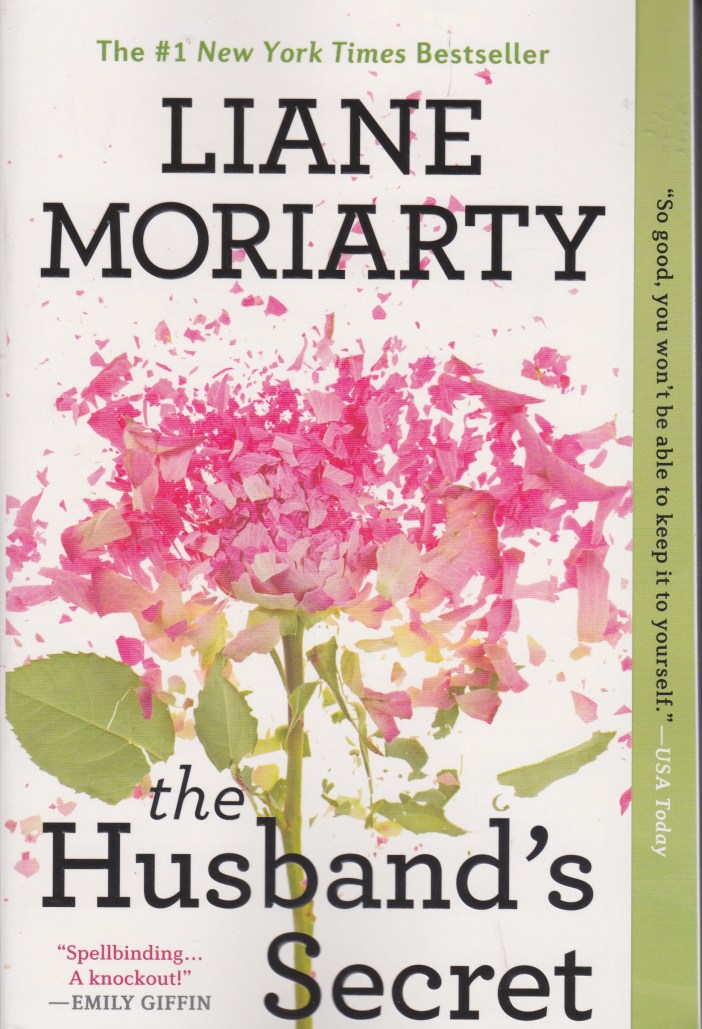
Friends are in town, and we had lunch with them at Commander’s Palace yesterday, which was lovely. I didn’t read the menu carefully and got something that had fried eggs on the top–which ran with yolk when you broke it; shudder–but I simply pushed them away with my fork and ate everything else. I was very tired after that, and came home, worked for a little while, and then curled up with Liane Moriarty’s The Husband’s Secret. I had read Big Little Lies concurrently with watching the HBO series, and enjoyed both the book and the show, so wanted to read another one of her novels. I wasn’t quite sure what I was expecting with this one–the jacket blurb mentioned that a wife finds a sealed envelope addressed to her from her husband, with the words To be opened only in the event of my death.

I would have opened it immediately, of course.

the husband's secret

It was all because of the Berlin Wall.

If it weren’t for the Berline Wall, Cecilia would never have found the letter, and then she wouldn’t be sitting here, at the kitchen table, willing herself not to rip it open.

The envelope was gray with a fine layer of dust. The words on the front were written in a scratchy blue ballpoint pen, the handwriting as familiar as her own. She turned it over. It was sealed with a yellowing piece of sticky tape. When was it written? It felt old, like it was written years ago, but there was no way  of knowing for sure.

She wasn’t going to open it. It was absolutely clear that she should not open it. She was the most decisive person she knew, and she’d already decided not to open the letter, so there was nothing more to think about.

Although, honestly, if she did open it, what would be the big deal? Any woman would open it like a shot. She listed all her friends and what their responses would be if she were to ring them up right now and ask what they thought.

Liane Moriarty is compulsively readable. And that’s not a quality in an author that should be dismissed lightlyAs I mentioned the other day with Louise Penny, it’s hard to classify Moriarty’s work; there’s a crime involved, but is it really crime fiction? I’m not sure it’s marketed that way; this book has a jacket blurb from Anne Lamott, for example, rather than Sue Grafton or Sara Paretsky. She is an enormous bestseller; which is no small feat for an Australian writer to accomplish in the United States, particularly when she is writing about Australia (although Colleen McCullough was quite successful in the US with The Thorn Birds, before she turned to ancient Rome). She structures her books around three women as the main characters; and she writes about the issues that concern women–I suppose, in a way, her novels could be classified as modern domestic suspense. Like the previous masters of domestic suspense (a classification title I am still not entirely convinced I like), she writes about every day women thrust into extraordinary situations, and she also shoehorns in some brilliant social commentary along with social issues, like Margaret Millar and Charlotte Armstrong and Dorothy B. Hughes did. The books are, as I said, compulsively readable and hard to set aside until you’ve reached the end.

Women writers, no matter their success, are rarely taken as seriously as male writers. I’m not sure if it’s because women writers tend to focus on women and issues that affect them while men, in theory, tackle larger themes. Male characters written by men are off saving the world in genre fiction, bedding fabulous babes and getting into fistfights, surviving by their skills or because their masculinity is superior to that of the bad guys. Or the male characters are finding dissatisfaction and misery in their maleness (I’m looking at you, literary fiction), prisoners of societal expectations of manliness and resenting putting aside their fantasy of what their life should be and having to settle for something that is less than that fantasy. Rarely do you find male characters (I’m not saying they don’t exist, so don’t come after me; I am fully cognizant of the fact that these are all incredibly broad generalizations) who are struggling with the work/home balance, juggling having to have a career and an income with finding time to be participants in their children’s lives or even, for that matter, simply helping around the house.

Men do not drive the story in Liane Moriarty’s novels, but they do impact it. They serve as catalysts for her stories, but her books are about the women whose lives are impacted by the men in them.

The Husband’s Secret,  like Big Little Lies, tells the story of three women whose lives intersect due to a private grammar school, St. Agatha’s in Sydney. Rachel is the aging part-time school secretary, widowed and haunted by the unsolved murder of her teenaged daughter many years before. The loss of her daughter has embittered her, and the only thing she basically has to live for is her grandson. Her story is set into motion when the perfect daughter-in-law she doesn’t much like and her son tell her that Lauren, the daughter-in-law, is being sent by her company to New York for two years, taking the only thing in her life she cares about–the grandson–away from her; just as her daughter was taken from her some twenty-five years or so earlier.

Tess’ world has just been ripped apart by the announcement by her husband and her best friend/first cousin that they are in love and want to be together–but out of respect for her having consummated the relationship. Her cousin, Felicity, is like a sister to her; their mothers were twins and they were born within days of each other. Felicity also used to be overweight; over the past year she has lost weight and become beautiful. Tess, betrayed and hurt, uses her mother’s recent accident in which she broke her ankle as an excuse to grab her son Liam and leave Melbourne, returning to Sydney to sort out her life and her future–enrolling young Liam in St. Agatha’s.

Cecilia, the third woman, is like Madeline in Big Little Lies; married, highly competent and efficient, the organizer that winds up running everything and basically being Supermom. She married a handsome rich man, and they have three daughters together. She’s hardly as confident as she seems; it’s a veneer to protect her and hide her own insecurities as she ruthlessly organizes her life and tries to put the world in order–one of those people who are basically exhausting to talk to; who leave you tired and drained when you finish speaking with them and you aren’t sure why.

Their lives intersect primarily because of the letter Cecilia finds in her attic, although Tess is less involved with the other two women, only peripherally floating into their orbit through the school, but the book’s theme is grief and motherhood and how these three different and incredibly complex women deal with both. What sacrifices do mothers have to make for their children, and what do they owe themselves? What is too far, too much, and where do you draw the line? Rachel’s life was decimated by her daughter’s murder and the lack of a conclusion to the story; to the extent that she walled herself up away from the rest of her family, and her relationship with her son has suffered–it is only through the events of this book that she finally realizes that her son is suffering not only from the loss of his sister and the loss of his father but from the loss of his mother. What does Tess owe to her young son in the wake of the apparent end of her marriage, and the horrific betrayal by her husband and her cousin? Does she try to ride out this love affair, rise above her own hurt and anger and put her child first? Is it better for Liam if she ends the marriage or tries to get past everything and forgive him, if that’s the option? She also is forced to take a long hard look at her own life at who she is and who has become as a person, and who does she want to become?

Cecilia’s journey is, of course, the most shattering. Her husband’s secret, contained in the letter, turns her world upside down and inside out; nothing is what she thought it was, what she believed, and she too is faced with a horrible choice: any decision she makes is going to be incredibly difficult to live with–but what can she live with for the sake of her daughters?

There is some reader manipulation; it’s important for the narrative that Cecilia not read the letter until a certain point, and when she does, the chapter ends with her starting to read–which felt unfair, particularly as the book shifted to another viewpoint in the next chapter. It would have been just as effective, I thought, for the text of the letter to appear and not show Cecilia’s reaction before shifting to the other viewpoint; that’s the editorial and/or authorial I would have made. It just kind of felt manipulative.

The book is very clever, certainly smart–I enjoy the way Moriarty writes, and she has a great way of finding the word rhythm that works, slightly altering those patterns as she shifts from viewpoint to viewpoint to give the reader a stronger sense of the character and their voice; a nice hat trick which is not easy to pull off. The decisions the women make–all affected by the letter Cecilia finds–may not be happily ever afters, but are all things they can, they find, live with. They can go on, they can endure, they can survive.

And maybe that is a happily ever after, after all.

After finishing this, I started reading Lisa Unger’s In the Blood, which immediately grabbed my interest; it was hard to put it down in order to get sleep.

And now, back to the spice mines.

Never Gonna Let You Go

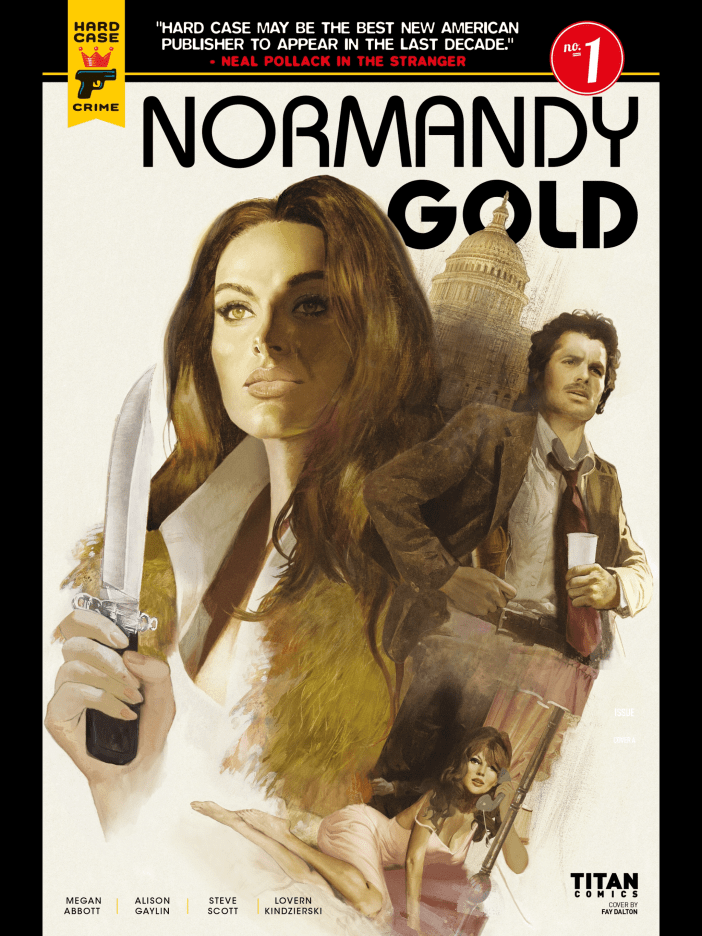
Have you read the comic book co-written by Megan Abbott and Alison Gaylin, Normandy Gold?

IMG_1772

It will come as no surprise that its fantastic. Megan Abbott and Alison Gaylin are two of the best crime writers of our Golden Age of women crime writers.

One of the things that can get confusing with crime fiction is the subgenres and the sometimes slight distinctions between them; take hard-boiled vs. noir as an example. I think the confusion comes because a hard-boiled crime novel, when made into a film, can fit into the film noir category, which is a bit broader than the genre definitions crime novels can use and books can fall into; for example, The Maltese Falcon and The Big Sleep are hard-boiled detective novels; the films, however, are classic film noir. (Your mileage may vary; I am speaking only for myself and how I classify books.) For me, a detective novel that is dark and brooding and cynical in nature is hard-boiled, Sue Grafton and Sara Paretsky’s novels, for me, fall into this category, as do Hammett’s detective fiction and Chandler’s. James M. Cain’s novels were noir, as are Megan Abbott’s. Alison Gaylin’s detective novels are more hard-boiled; her stand alone novels are more noir. For me, a noir novel doesn’t have a professional investigator as the main character; those are hard-boiled.

Charles Ardai’s Hard Case Crime line of novels contains both noir and hard-boiled fiction; the team-up of Gaylin and Abbott with the graphic serial novel Normandy Gold is a fine addition to Hard Case, and one of the best comics/graphic novels I’ve come across in a long while. As I read the first issue on my iPad, all I could think was how glorious this is; excellent, crisp dialogue and incredible storytelling, along with some amazing artwork. If there are awards for graphic novels, just start sending them along to the team that produced this now!

Normandy Gold firmly straddles the line between noir and hard-boiled with guns blazing. Set in the 1970’s, Normandy is a small town sheriff in rural Oregon. Her mother was a prostitute, and she ran away when she was a teen to try to find a better life for herself, leaving her younger sister behind. One day she gets a call from her sister, and is still on the line with her as her sister is murdered. Normandy comes to Washington DC to find out what she can about her sister’s death; the cops have written it off as just another dead whore no one cares about and unsolvable. But Normandy also finds out her sister wasn’t just a prostitute; she worked for a very elite, high level escort service, and decides to go undercover to find what happened to her sister.

This typical-sounding set-up comes alive in the hands of two master storytellers, and the art itself is stunningly beautiful. The story moves very quickly, and the 1970’s setting is perfectly done; not a false note in the entire first issue. This is the kind of story that, as a film in the 1970’s, would have earned a star like Jane Fonda or Ellen Burstyn or Ann-Margret an Oscar nomination, if not the statue itself. Vividly realized, you keep turning the pages to see what happens next…and when you get to the end of the issue, you’re sorry it’s done but can’t wait to read the next.

Highly recommended.