I Didn’t Mean to Turn You On

I’ve been traveling down memory lane a lot lately, it seems. I am also beginning, for the first time in my life, beginning to understand the pull of nostalgia. It’s something I’ve never quite gotten before–the past is the past and it basically is what it is, has always been my mentality, and I have always been quite happy in the present. But rereading Bourbon Street Blues again as I did the proofing/copy editing took me back in time, and I kind of liked revisiting that time again mentally. Setting “Never Kiss a Stranger” in the summer of 1994 also has me revisiting that time, and remembering it quite fondly. Also posting my daily “Pride Books” on Facebook has also had me spending time in my past, as I remember books and what they meant to me at the time I read them.

I also saw a call for submissions for crime short stories set in the past, which also has me wondering about something I could write. I have an idea–don’t I always have an idea?–but it’s still too amorphous. And I still have these other two short stories to write, and need to get six more chapters of the first draft of the Scotty done and then I can let it sit for a couple of months.

I did work on my short story “Children of the Stone Circle” a bit yesterday, and also managed to write a really shitty chapter of the Scotty book. I mean, a really shitty chapter. I now have six chapters left in which to solve two murders, find a kidnapping victim, and wrap up all the other stuff I’ve thrown at the boys in this book. Heavy heaving sigh.

It should be interesting, to say the least.

So, I made my first ever red velvet cheesecake this past weekend; it was a co-worker’s birthday and another co-worker suggested I make one. I used the Cheesecake Factory recipe, but adapted it a bit–I didn’t, for example, cut the cheesecake in half so there would be four layers instead of three–and it turned out pretty well. (I think the red velvet layers were a bit dry, but everyone else seemed to think it was fine. The cheesecake and cream cheese frosting, though, made the dryness not so noticeable. If I had only made red velvet cake, I think it would be too dry.)

I actually love to cook; I love trying new recipes and changing them up a bit to make them my own. I just wish I had a bigger kitchen, or at least more counter space. I have a galley style kitchen, long and narrow, and my workspace for writing is at one end, in the bay windows which would ordinarily be used, I think, as a breakfast nook. I always think, whenever I am cooking and feeling confined in my kitchen, that there would be plenty of room if I didn’t have to use the kitchen as a makeshift office as well. I suspect that is actually untrue; it wouldn’t really change the counter space much, although I suppose I could have a table where my desk is and use it for the microwave and coffee maker, which would free up a lot of counter space.

Yeah, right.

I really just want an entire room for my office, so I could have bookcases lined along the walls and filled with books.

Perchance to dream.
IMG_4132

Let’s Go All The Way

So, yesterday I didn’t write much, but I did get something very very important done: I finished the copy-edit/proofing of Bourbon Street Blues, which is now one step closer to becoming an ebook (and a print-on-demand hard copy, if someone so desires), and that really is exciting for me. Bourbon Street Blues is, out of all my books, special to me for so very many reasons. I always thought, for one thing, that it was a much better book than my first (with apologies to Murder in the Rue Dauphine), and for another it was the book where I created Scotty Bradley and his friends and family and world, and Scotty is, well, I’ve always been terribly fond of Scotty.

It’s sometimes hard to believe I’m currently writing the eighth Scotty book. I would have never dreamed there would be three Scotty books, let alone eight, all those years ago when I first dreamed him up. I was determined to create a character that I’d never seen before in gay fiction, or at least in any of the gay fiction I’d read at that time, and my reading at that time was pretty extensive. The late 90’s/early aughts was a strange time to be a gay writer, or to be a gay reader of gay fictions. We were just finding ourselves again after the development of the initial drug cocktails, which meant HIV/AIDS was no longer necessarily the death sentence it was known to be for so lo those many years. Most gay literature, from almost the very beginning of the plague, had been the art of the epidemic: about death, about loss, about hatred but also about love and compassion.

It was a strange time, frankly. All of us gay writers were faced with the conundrum: do we still write about HIV/AIDS? Do we pretend it doesn’t exist? Can we write about it and try to de-stigmatize it in our work? Do we mention condoms, condom use, safer sex? What responsibility do we, as gay writers, have to our community?

Scotty was, in some ways, a reaction to the work that had gone before mine, and to HIV/AIDS. At the time I was creating him, and writing his first book, the equality movement for the community was moving away from the focus on HIV/AIDS and looking at other issues of equality: overturning the sodomy laws; same sex marriage; and overturning ‘don’t ask don’t tell’, so that we could openly serve in the military.

Gay sexuality had become something dark since the early days of the plague, and even with the drug cocktails prolonging life and all the other medical advances that were taking the definition of the disease from fatal to chronic (i.e. something that could be managed with a drug regimen), there was a lot of sturm and drang about gay promiscuity; and while the sexually liberated days of the 1970’s certainly had a part in the spread of the disease, it wasn’t a punishment for gay promiscuity any more than the bubonic plague was a punishment for the schism of the church in the fourteenth century. 

So, when I created Scotty, I wanted to create a character that I hadn’t seen before; someone who not only embraced his sexuality but reveled in it. Scotty was highly promiscuous; wasn’t interested in a boyfriend or monogamy; and had absolutely no hang-ups or judgments about sexuality or promiscuity. He was a personal trainer and taught aerobics, was a former member of a male-stripper troupe who sometimes got back into his thong and moonlighted as a dancer now and then for extra cash. He smoked pot, drank, and celebrated the Gay High Holy Days of New Orleans (Southern Decadence, Halloween, and Mardi Gras) with Ecstasy. He was good-looking and sexy and he knew it, but wasn’t arrogant about it in the least; he was, if anything, amused by the fact that people found him, in his own words, “irresistible.”

Above all else, though, Scotty was, at heart, a nice guy who cared about other people.

I was surprised by the way people reacted, and related, to him. I was expecting to get bashed in the reviews–after all, hadn’t some reviewers dismissed my first series creation, Chanse MacLeod, as ‘just another gay stereotype’?–but the reviews were all incredibly positive, for the most part, other than the occasional one-star on Amazon.

I also wanted the book–and the series, as it turned out–to be light-hearted and funny, even as it took on social issues.

And you know else? Proofing Bourbon Street Blues was the first time in many years that I read the book again. And it ain’t bad. Ain’t bad at all.

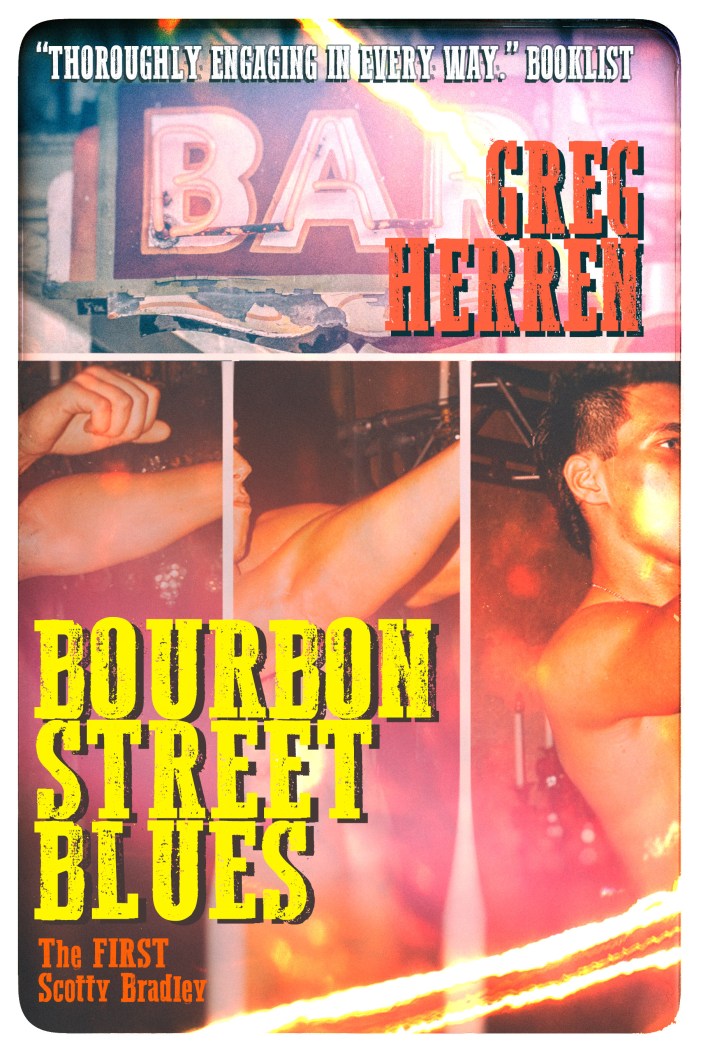
And by the way, here’s the new cover for when it’s released again, courtesy of amazing cover designer J. T. Lindroos:

GregHerren-BourbonStreetBluesx2700

I absolutely love it.

And now, back to the spice mines.


I Miss You

Well, “Don’t Look Down” is now ready for the read-aloud phase. Huzzah! I am pretty darned excited about it, too. I think this most recent draft is actually not bad, to be honest–and I am pretty psyched to be so close to done with this collection. Huzzah! Perhaps it will happen this very weekend. Hope springs eternal.

The question is, does it need an author introduction? I don’t think it does, to be honest; and every time I’ve tried to write one I’ve either drawn a blank or written something that sounded so pompous it annoyed me.

I’m really uncomfortable talking up my accomplishments, because it feels like bragging, and every time I do, I hear a voice sneering in my head, really? I hate that; it always undermines my confidence and makes me doubt myself, which then leads to me not getting anything done or not putting myself forward for anything, and on and on and on it goes.

I also reread the fourth chapter of the most recent revision of the WIP, and it was embarrassingly bad. I literally cringed reading it–and this is not me being self-deprecating or not taking myself seriously. I mean, it’s bad. I’ve not gone back and reread the first three chapters, and I do realize that a lot of this has to do with switching from limited third person POV to first person POV–I am basically just going through and changing the POV, but as I was doing that in this chapter I was really struck by how bad so much of the actual writing was. It was kind of boring, and that’s death for a y/a.

I guess now I know why no agent responded to my queries. I was also right in worrying that it was too early to send it out. The problem is I need to learn how to discern between serious, honest concerns about my writing and the tendency to trivialize, minimize, and self-defeat myself.

Case in point: I was convinced Royal Street Reveillon was terrible. I reread some bits to revise, and realized, nope. it’s not terrible at all. It needs some polish and some work, but it’s pretty good.

I need some serious therapy.

And now back to the spice mines.

32231135_1842660146028220_4874801715049660416_n

Private Dancer

Jessica Knoll, whose debut novel Luckiest Girl Alive I absolutely loved, wrote an op-ed for the New York Times recently in which she unabashedly talked about her ambition, how she wanted to not only be a writer but to be a successful one; that she wanted to make as much money as she possibly could from her writing. Called “I Want to Be Rich and I’m Not Sorry” (you can read it here), I thought it was terrific. I thought it was lovely to hear a writer talk about how much they wanted or desired success in their chosen field; I also thought it was interesting to read about how she had always been underestimated because she was a woman; that somehow success isn’t expected for women; and that women are often not only talked out of ambition but derided, mocked, and shamed for having it. It was kind of refreshing, honestly; I also loved reading an author talking, unashamed, about wanting to be successful and make money at writing–as much money as possible.

The comments on the piece were mostly, not surprisingly, negative; everything she talked about in the essay were right there in the comments, posted without any sense of irony by the posters: I’m also a woman writer but I’m looking for books to read that have something to say. I won’t be reading yours.

Oh, the pearl-clutching.

It’s been a while since I read Luckiest Girl Alive, but I do remember it having a lot to say; about class, about success, about being a woman, about dealing with public shame and then trying to insulate yourself from pain and suffering by marrying a successful man and shielding yourself behind his money. The book carried two time-lines: the present day, where the main character was planning her wedding to a wealthy man while filming a documentary about what happened to her back in high school, flashing back to her high school experience and everything that led up to the subject of the documentary. I thought it was rather well done.

I’ve never understood this mentality that writers shouldn’t want to make money from their work; that somehow wanting to be financially successful somehow lessens what we do, somehow makes our work somehow less important; that we shouldn’t, somehow, want to make a living writing. I guess we’re all supposed to hold down full time jobs and treat it as a hobby, carving out some spare time here and there to pursue making art simply for the joy of doing so. I spoke the other day about how my primary sense of self, my primary identity, is author, and I wouldn’t quite know what to do with myself if I wasn’t able to write, if I wasn’t able to publish, if I wasn’t able to keep my writing career going. I do know how awful last year was when I wasn’t really writing, when I wasn’t able to commit to anything, when I stayed away from the computer and the open word documents and kept the word files closed; it fucked with my mind, it fucked with my self-confidence (always shaky, at best) and it was horribly unpleasant. This year I am writing again, and back to berating myself for not spending every spare moment working on something; I’ve written a ridiculous amount this year and yet at the same time, I’m not all that much closer to finishing the Scotty novel or the draft of the WIP as I should be. I find myself being easily distracted by writing short stories, with ideas for new ones popping into my head all the time–thank God for my journal, and thank God for remembering that was a key component of my writing for years, jotting down notes and ideas and thoughts before they slipped away inside my mind–and even now, this morning, I should be working on either Chapter Twelve of Royal Street Reveillon or the WIP, and am doing neither; have already thought about simply cleaning and reading more short stories, avoiding the work that needs to be done, despite knowing that actually doing it will make me happy and feel satisfied.

I am frequently my own worst enemy.

So, bearing that in mind, and bearing in mind Jessica Knoll’s op-ed, I am going to embrace my ambition. I am going to do whatever it is I need to do to become more successful, to reach for every brass ring that I can.

The only thing stopping me is, after all, me.

And bearing that in mind, I shall now bring this to a close.

16836462_1277495445631850_375592218010177997_o