Jambalaya

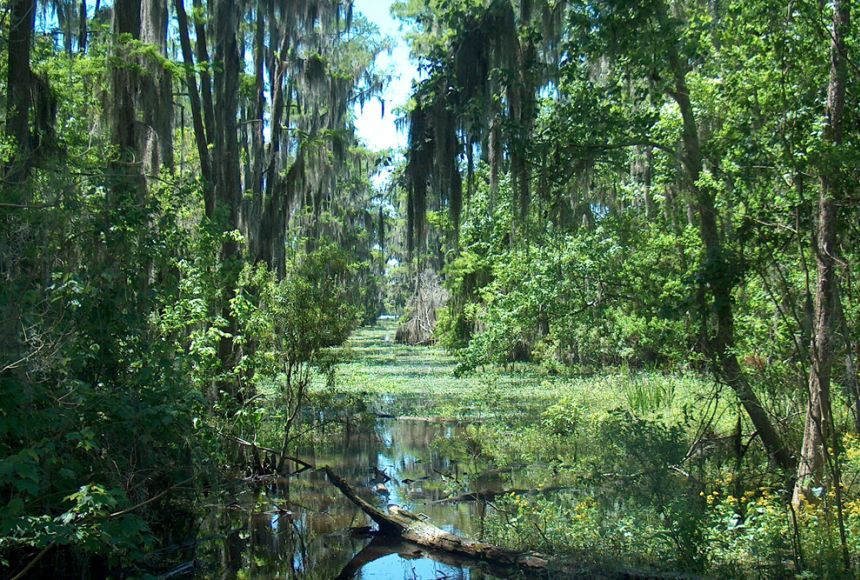
Louisiana is beautiful.

The state’s nickname is “sportsmen’s paradise,” because all of the macho male outdoor sports–hunting, boating, fishing–are available here in abundance. We’re also called the Pelican State (most prevalent) and several other nicknames, not all of which are complimentary.

Louisiana has always been a conservative state, despite the existence of New Orleans. Originally French then Spanish before becoming American, Louisiana also was a part of the Confederacy and had an economy based on enslavement. We weren’t that far removed from David Duke’s gubernatorial bid (which came all too close to succeeding), and I remember Paul had gone on site visits with his boss at the Arts Council south of the city, and came home saying, completely in disbelief, that “people had yard signs saying ‘this is Duke country’–and me replying, sadly, “in the South they don’t bother to hide the racism–they see it as a positive.” But you cannot really go anywhere in Louisiana without being awed by the natural beauty on display here. I love Madisonville, and the Tchefuncte River area. It’s always a lovely drive to take 90 east when you head north (yes, I am aware I am saying you take an east-west highway to go north; welcome to New Orleans), and head out through the Venetian Isles area and drive along that narrow strip of land separating the lakes, crossing the Rigolets bridge and heading into Slidell.

A while ago, I was following a Twitter conversation about Burt Reynolds movies from the 1970s. Mind you, when I was living in Kansas our movie options were limited. There was a drive-in movie theater on the way from our little town Americus to the county seat of Emporia, and there was a small twin cinema on Commercial Street. The summer before my senior year Smokey and the Bandit opened on a Friday, and the following Friday Star Wars opened in the other theater. Both movies ran for about three months….so I saw them both repeatedly as there was very little else to do. The 1970’s were an interesting time for depictions of rural Southern sheriffs; Jackie Gleason hamming it up and going completely over the top. This was also the same time period that gave us corrupt politician Boss Hogg and the inept sheriff and deputies he controlled. These were always played for laughs, but the thing is–there really wasn’t anything funny about these types of characters in real life. Political and police corruption have always gone hand-in-hand in the Southern states; the police merely existing to enforce and enable the existing power structure. That Twitter conversation, along with reading Ethan Brown’s Murder on the Bayou and the various true crime documentaries about the Jeff Davis 8, put me in mind of writing about that kind of corruption. But I also kept wondering, but is this still true in the South? Do these kind of corrupt power structures still exist in the South? Would this read like a period piece?

And then the Murtaugh scandal broke.

Guess what? It IS still like this in the rural South. Thanks, Murtaughs!

I already had an idea for the next Scotty, and was pulling it all together, using a relatively minor political scandal here locally as the starting point for the story–which involved a conservative politician getting involved with a teenaged boy who worked at the food court at a mall, mostly buying him presents–clothes, underwear, swimsuits–and having the kid send him pictures wearing it. The age of consent in Louisiana is seventeen, and the kid was over seventeen, but while still being an icky thing, it wasn’t illegal–and they never did anything beyond that. It was mostly a harmless flirtation, until the kid, who was gay, realized that the nice man buying him gifts was actually a hardcore far right family values politician, so he went public. I still needed a murder, but I thought it would be simple to come up with one–the politician would have every reason in the world to kill to protect his secret, and he had his parish sheriff’s department to help commit and/or cover up the crime.

I did borrow two of the Murtaugh crimes for the book, but as starting points more than anything else, and came up with my own theories of said crimes for my own story–I wasn’t writing true crime, after all, and I wasn’t interested in proving the guilt of the Murtaughs. What I was interested in was exploring the decline and fall of a politically powerful family that had controlled a parish in Louisiana for well over a hundred years, almost like an absolute monarchy with primogeniture. I had also originally started the story with the kid coming to Scotty and Frank (through Scotty’s old buddy and former workout partner, David, who now teaches at NOCCA) because he gets a text from an unknown number which contains one of the pictures he has sent his older male friend (that he doesn’t know is a family values politician), and is worried about his own future if the information comes out. I wrote an entire draft of this story, but it didn’t work and I didn’t care for it…which was when it clicked into place: use two of the Murtaugh crimes to start with, and built it out from there. I decided that the kid at the mall wasn’t the original target of the politician, and that the original target was killed in a hit-and-run accident the year before; I also used the boat crash, turning it from a boat hitting a bridge to a pick-up truck hitting a bridge and pitching the passengers in the back into the bayou.

I also liked the teenager/older man dynamic, because it had played out with Taylor in the previous book–and Scotty had his own past with an older man when he was a teenager, which I was finally able to circle back around to.

I also invented the parish–surprisingly enough, there is no St. Jeanne d’Arc Parish in Louisiana–but it’s based loosely on what are known as the bayou and river parishes (Terrebone, Lafourche, St. Charles, St. John the Baptist). I already had a fictional parish on that side of the river (Redemption), but I decided Redemption wouldn’t work for this book, so I made it a neighboring parish.
Please Remember Me

I am often, incorrectly, referred to as a “New Orleans expert.”

Nothing, as I inferred in that sentence, could be further than the truth.

Don’t get me wrong–I absolutely, positively love New Orleans, for many and varied reasons. The short, elevator-pitch answer is always Because I’m not the weird one here. And it’s true; New Orleans is an eccentric city filled with eccentrics. No other city in North America is like it, even remotely; New Orleans is a city that doesn’t abhor strangeness, but rather embraces it. When I came here for my thirty-third birthday in 1994, when I got out of the cab at the intersection of St. Ann and Bourbon that first night, my actual birthday, to go out to the gay bars of the Quarter, I knew I was home. There was no doubt in my mind, no question; just an immediate and instant connection with the city and I knew, not only that I would eventually live here, but that if and when I did all my  dreams would come true.

And that feeling was right. I fell in love with New Orleans, I fell in love in New Orleans, and after I moved here, all of my dreams did, in fact, come true.

So, when I write about New Orleans my deep and abiding love and passion for the city inevitably comes through. But I always kind of smile inwardly to myself when people call me an expert on the city; I am hardly that, and libraries could be filled with what I don’t know about the city. Sure, I do know some things, but an expert? Not even remotely close.

A perfect case in point is Milneburg. What, you may every well ask, is Milneburg? Milneburg was a resort village on the lake shore that many New Orleanians would escape to during the wretched heat of the summer (and I am vastly oversimplifying this); I’ve read about it in history books and so forth. I even thought Murder in Milneburg might make for an interesting historical mystery. I always saw it, though, in my mind’s eye, as close to the parish line between Orleans and Jefferson parishes; closer to Metairie and the causeway. So, you can imagine my shock when I saw a map of Milneburg posted on one of the New Orleans historical Facebook pages I belong to, and realized that I was completely wrong: there was a railroad line from New Orleans to Milneburg (which I knew) that ran along what is now Elysian Fields Avenue. 

So, Milneburg was actually where the University of New Orleans is now located; and the train line continued along east, crossing at the Rigolets.

Some New Orleans expert I am, which is why I decided to start reading more histories of the city over the last few years. It’s been quite an education, and there are still some things I don’t quite grasp–like when the Basin Canal was filled in to become Basin Street, and what relation that had to Storyville and Treme, because the train station also used to be located near Storyville (this was part of the reason why the drive to clean up Storyville and end legal prostitution in New Orleans was successful; the other part was because New Orleans was an embarkation point for the military during World War I and the Pentagon frowned on delivering green military recruits to whorehouses).

So, yeah, some expert I am.

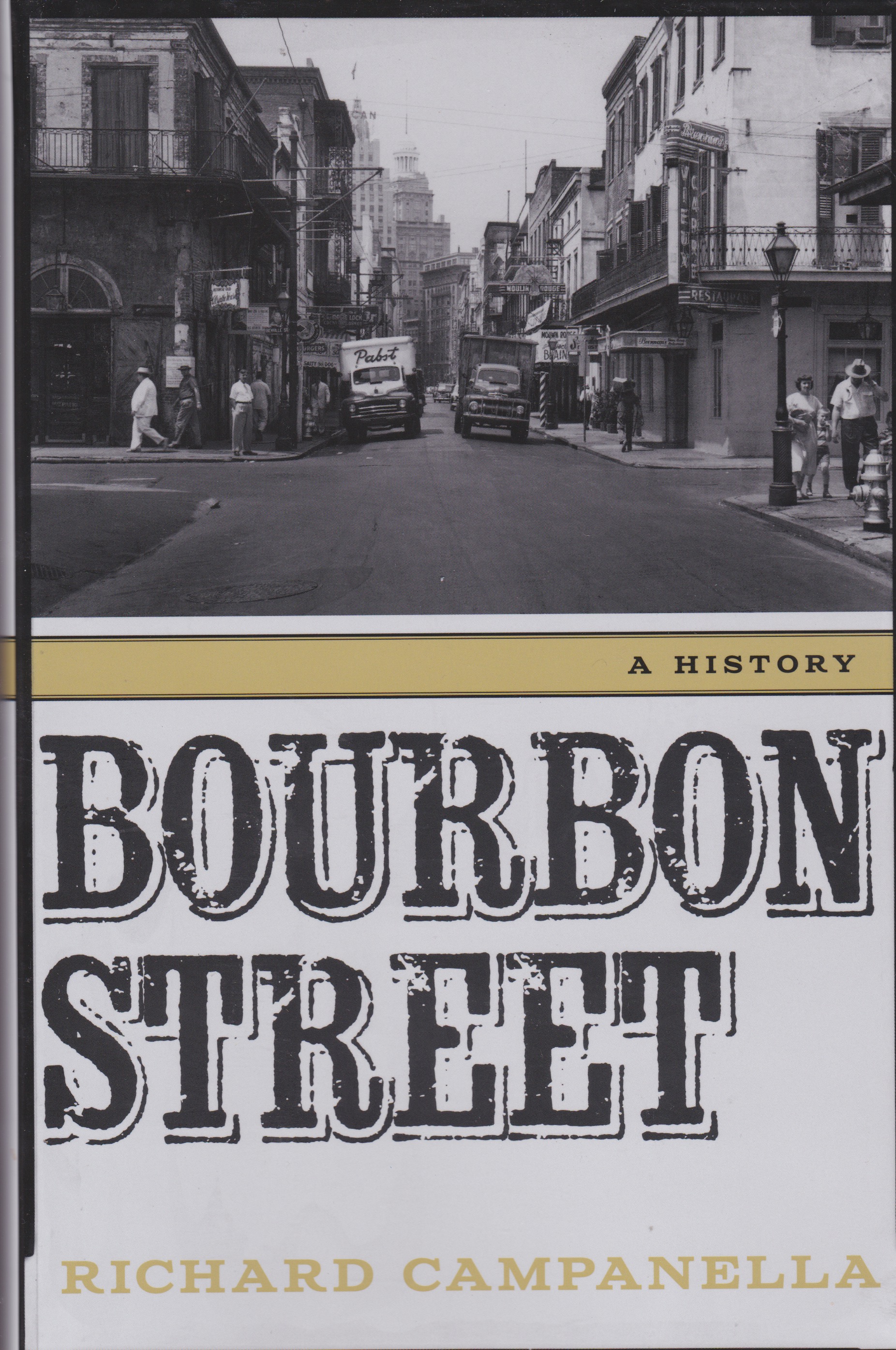
But I really enjoyed Richard Campanella’s Bourbon Street.

bourbon street

There are no straight lines in nature. Nor are there any right angles. Rather, intricate arcs and fractures merge and bifurcate recurrently, like capillaries in a plant leaf or veins in an arm. Nowhere is this sinuous geometry more evident than in deltas, like that of the Mississippi River. Starting eighteen thousand years ago, warming global temperatures melted immense ice sheets across North America. The runoff aggregated to form the lower Mississippi River and flowed southward bearing vast quantities of sediment. The bluffs and terraces that confined the channel to a broad alluvial valley petered out roughly between present-day Lafayette and Baton Rouge in Louisiana, south of which lay the Gulf of Mexico.

Into that sea disembogued the Mississippi, its innumerable tons of alluvium smothering the soft marshes of the Gulf Coast and accumulating upon the hard clays of the sea floor. So voluminous was the Mississippi’s muddy water column that it overpowered the (relatively weak tides and currents of) Gulf of Mexico, thus prograding the deposition farther into the sea. Occasional crevasses in the river’s banks diverted waters to the left or right, creating multiple river mouths and thus multiple depositions. High springtime flow also overtopped the river’s banks and released a think sheet of sediment-laden water sideways, further raising the delta’s elevation.

In this manner, southeastern Louisiana rose from the sea. The process took about 7,200 years, making the Mississippi Delta, as Mark Twain put it, “the youthfulest batch of country that lies around there anywhere.” Young, dynamic, fluid, warm, humid: flora and fauna flourish in such conditions, as evidenced by the verdant vegetation and high productivity of the delta’s ecosystem. Humans, on the other other, view these same conditons as inhospitable, dangerous, even evil, and endeavor to impose rigidity and rectitude upon them, so as to better exploit the delta’s resources.

If New Orleans is known for anything, it’s Bourbon Street. Everyone has heard about Bourbon Street, it seems; just as they’ve heard about Carnival/Mardi Gras, beads, and show us your tits (which locals do NOT do–either yell it or bare them). Campanella’s book traces the history of the famous street, and by extension, the French Quarter itself, from its very beginnings when the French arrived and designed the streets, to its modern day incarnation as a street of endless partying and no little debauchery. It’s very well researched, and Campanella, who I believe teaches at Tulane, is the true expert on the city; I follow his pages on Facebook, and I can’t even begin to tell you how much inspiration and information Bourbon Street  has given me. I’ve put so many page markers in my copy that I’m worried about breaking the spine!

One thing that my reading of New Orleans history has further emphasized to me–and it also really comes through strongly in Campanella’s book–is how New Orleans has always been a city of neighborhoods, and how each neighborhood of the city had (has?) its own unique  sense of itself, and how those who lived in those neighborhoods so strongly identified with them. The evolution of the French Quarter from the original city and seat of its government, to the original French leaving and being replaced by immigrants (as late as the 1960’s the lower quarter was known as ‘little Sicily’ because of all the Italian immigrants and their descendants who lived there), and then evolved again into a different type of neighborhood, with mixed incomes and everything from inexpensive apartments to gradiose condos; and a variety of ethnicities, races, sexualities, and gender identities.

One of the primary concerns modern-day New Orleanians have is the fear of the loss of those neighborhoods; because those neighborhoods were the incubators for all the things that makes New Orleans so special and unique: the music, the art, the literature, and the characters. Short-term rentals are carving up neighborhoods and the rents/property values are currently climbing, with no peak in sight, and people are rightfully concerned about these things.

But one thing I’ve learned from reading these histories, and Campanella’s in particular, is that New Orleans has always changed and evolved, yet has also always managed to keep that unique strangeness that make it New Orleans somehow intact.

If you love New Orleans or find it at all interesting, I cannot recommend Bourbon Street enough to you.