Moonlight (A Vampire’s Dream)

I often refer to ‘salem’s Lot as “Peyton Place, but horror.” Because while Stephen King’s second novel (and still one of my favorites) absolutely does its job as a wrenching piece of horror fiction, it’s also a truly insightful and meaningful look at a small town (population 1300) and how everyone knows everyone, as well as the way their lives intersect and connect and cross intricately; we get to know a lot of the townspeople before they succumb to the horror that is overwhelming their little town. If you took the vampires out of the story, you’d have to replace them with something, as there’s no story without them, but at the same time, this novel along with Needful Things some twenty or so years later, are remain two of the best books about life in small towns that I’ve ever read.

I used to reread old Stephen King novels a lot for comfort, losing myself in the worlds he creates and enjoying the stories, the writing, and the characters. ‘salem’s Lot is definitely one of my favorites of his; definitely always in the Top 5, with perhaps only The Stand outranking it.
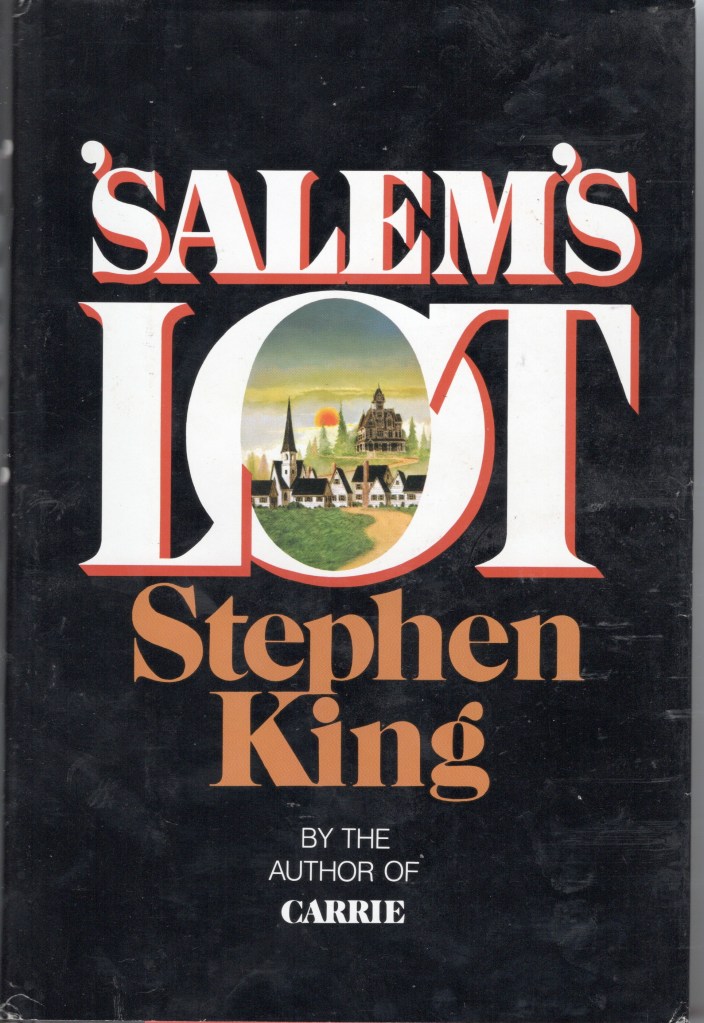
Almost everyone thought the man and the boy were father and son.

They crossed the country on a rambling southwest line in an old Citroen sedan, keeping mostly to secondary roads, traveling in fits and starts. They stopped in three places along the way before reaching their final destination: first in Rhode Island, where the tall man with the black hair worked in a textile mill; then in Youngstown, Ohio, where he worked for three months on a tractor assembly line; and finally in a small California town near the Mexican boarder, where he pumped gas and worked at repairing small foreign cars with an amount of success that was, to him, surprising and gratifying.

Wherever they stopped, he got a Maine newspaper called the Portland Press-Herald and watched it for items concerning a small southern Maine town named Jerusalem’s Lot and the surrounding area. There were such items from time to time.

He wrote an outline of a novel in motel rooms before they Central Falls, Rhode Island, and mailed it to his agent. He had been a mildly successful novelist a million years before, in a time when the darkness had not come over his life. The agent took the outline to his last publisher, who expressed polite interest but no inclination to part with any advance money. “Please” and “thank you,” he told the boy as he tore the agent’s letter up, were still free. He said it without too much bitterness and set about the book anyway.

The boy did not speak much. His face retained a perpetual pinched look, and his eyes were dark–as if they always scanned some bleak inner horizon. In the diners and gas stations where they stopped along the way, he was polite and nothing more. He didn’t seem to want the tall man out of his sight, and the boy seemed nervous when the man left him to use the bathroom. He refused to talk about the town of Jerusalem’s Lot, although the tall man tried to raise the topic from time to time, and he would not look at the Portland newspapers the man sometimes deliberately left around.

When the book was written, they were living in a beach cottage off the highway, and they both swam in the Pacific a freat deal. It was warmer than the Atlantic, and friendlier. It held no memories. The boy began to get very brown.
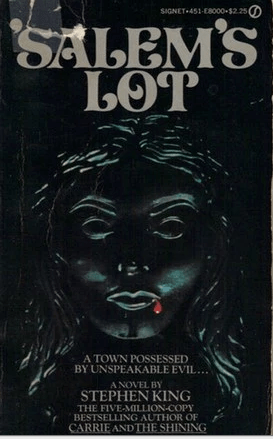
This is the cover of the version I originally read in high school–I bought it off the paperback rack at the Safeway in Emporia, Kansas. I kept that copy for years; eventually replacing it with a hardcover reprint in the 1990′, before finally getting an old copy with the original cover on eBay (which has since turned out to be a first edition; I love finding all the mistakes in it as I reread it).

I had read Carrie in paperback in one night when I’d borrowed it from a friend; it was only in the last decade that I finally acquired a copy of it to keep and reread periodically (I bought it to read the opening shower scene at Banned Books Night; ironically, the objections to the book have nothing to do with explicit talk about menstruation, or bullying, or violence…people object to the book because of its depiction of Christianity, particularly in the case of Carrie’s fanatic mother, Margaret (whom I always see in my head as Piper Laurie, who should have won an Oscar). I don’t think Carrie was the book that made me begin to question Christianity, to be honest; I think I already was questioning it before I read the book, but it was one of the first times I’d see a disparaging representation of someone committing horrifying abuses in the name of Jesus, or how the way the religion viewed sexuality could be taken to such horrific extremes. But I loved the book and became interested in Stephen King as an author. I was aware of ‘salem’s Lot before I found a copy while grocery shopping with my mom; I’d known he’d published a second book because I saw it in the book club ads (Doubleday, Book of the Month, etc.) in magazines. I had no idea what the book was about when I started reading it–I had no clue it was about vampires, and vampires never even crossed my mind when I started reading. It was a Saturday (Mom always drove into Emporia on Saturday to buy groceries), and I repaired to my room with the book (my homework was already done, and whatever college football game was on that Saturday was of no interest to me) and started reading. I finished reading it at around two in the morning, and was completely blown away by it. There was no way I was going to stop reading, and there was no way to stop reading once the big reveal about the vampires happened and the pace picked up.

The book was utterly terrifying, and it started raining later on that day as I read. I was living in a small town (population 973) and my bedroom window looked out at a corn field that was right across the street. I started seeing, as I read, a lot of similarities between Jerusalem’s Lot in the book and my little town–the characters, the interconnectedness of the community, and like Ben Mears, I was still kind of a stranger in the town. I just remember that when I got to the part where Danny Glick comes to Mark Petrie’s window, the storm outside brushed a tree branch against my window and I literally jumped, the book flying out of my hands and landing across the room in the middle of the floor.

It was also the first time I remember reading a book whose main character was a writer–something Stephen King returns to quite regularly, write what you know indeed–which also helped me connect with the book more; Ben Mears was a publisher novelist of minor success, but had published three books already and hadn’t graduated from college. He also seemed like a real person, living and breathing and absolutely real; it wasn’t until this reread that I realized how much physically he’s like King–tall and slender with thick black hair.

But it was also the first time I’d read anything about vampires that was so clearly set in the real world, in the real present, and with real characters I could relate to–which made it even more terrifying. I started thinking about how easy it would be for, say, a vampire to come to our small little town and how quickly people could be turned, primarily because no one would believe it was actually happening until it was too late–which King handled beautifully in the book.

It still holds up, and I am glad I revisited it.

Haunted

It’s gray outside this morning, and right now the trees and the crepe myrtles are swaying in a strong wind. It must have rained at some point during the night because the sidewalk looks wet, but I’m not sure. We’re supposed to experience tropical storm conditions, and it looks as though that won’t be until later this evening; we’ll see how that turns out though. Our syringe program may be short-staffed today so I am probably going to go into the office to help out–the storm may not reach us until around five thirty and I should be able to get home by then (am I crazy? The jury, as always, remains out on that one).

I’ve been sleeping really well lately–stress reduction has occurred on many different levels over the past week. My back and shoulders feel relaxed and not knotted anymore–I hadn’t noticed how much of my stress was being carried there until it wasn’t there anymore–and maybe I am going to be able to start focusing with laser intensity again. I miss that, frankly; the ability to focus all my brain and creativity and intelligence (such as it is) on one particular thing and get it finished; I think I may even go back to being able to keep all the plates spinning again–stop that crazy talk, Greg!–so we shall see. As I said, some things that have been weighing heavily on my mind–and knotting my shoulders–have wrapped up now and if i can finally manage to get myself organized, look out world.

Do keep Lake Charles and western Louisiana/eastern Texas in your thoughts, Constant Reader, as they are going to get hammered again tonight.

Yesterday as I made condom packs I queued up Terence Malick’s debut film as part of the Cynical 70’s Film Festival, Badlands,which starred a very young Martin Sheen and an even younger Sissy Spacek playing a version of Charles Starkweather and his girlfriend Caril (in the movie they are Kit and Holly); as they embark on their killing spree–although in the movie it’s South Dakota and Montana, as opposed to the Nebraska and Wyoming in reality. It is set in the 1950’s, which is also when Starkweather went on his spree (makes you think about how everyone remembers the 1950’s as this idyllic time; what I call Leave it to Beaver Syndrome), and the performances are stellar. The movie is narrated by Spacek’s Holly, in an almost unemotional monotone that captures the spirit of the movie itself. The movie doesn’t explain why Kit decided to start killing people, or why Holly chose to go with him, other than they fell in love and her father–the first victim–disapproved. (It’s also very weird seeing President Bartlet on a shooting spree, really.) Both are terrific in their roles, and the movie is visually stunning, really hammering home the isolation of the countryside in those rural states and their vast emptiness–and literally, how on the great plains or in the badlands there is no one to hear you scream. It made me think also of In Cold Blood; and of course, gave me some story ideas.

I decided to make it a Sissy Spacek double feature and queued up Carrie next–it was also a cynical 70’s movie, after all; and while it can hardly be termed a teen movie, it was about high school, after all, and the only adults in the film are supporting characters–Miss Collins the gym teacher; the principal; and of course, the piece de resistance, Margaret White–and everyone else is theoretically a teenager/high school student. I’ve not rewatched Carrie in years, and I’d forgotten what a great film it is; it’s one of the best (if not the best) Stephen King adaptations ever made–I might even go so far as to say it may be one of those rare instances when the film is better than the book. (And as a big King fan, I am quite aware of what blasphemy I just uttered.) Both book and film might be the first time bullying was addressed so strongly, and an argument can even be made that Carrie is one of two Stephen King novels that could be classified as young adult novels (Christine is the other one). Reading Carrie was a revelation to me as a teenager; it was the first time I’d ever read anything in fiction that depicted high school as I knew it that closely; most books and films at the time that did so were completely unrealistic. I had found junior and senior high school to be jungles of cruelty and viciousness with a rigid caste system; it was the first time I’d ever read anything centering the poor kid whom nobody likes, everyone picks on or mocks, and did it with sympathy. It was the first time I saw high school girls depicted as “mean girls”–it later became a trope–and the book was also the first time I ever saw in fiction anyone try to explain the weird, visceral group reaction to a figure who is more to be pitied than hated. (The book was also the first time I realized that we all love an underdog story–is there anything more popular in American popular culture than rooting for the underdog–while in real life the majority of us all will kick the underdog in the ribs or stand by and do or say nothing when they are being abused; King got that, as well as the shame decent people feel about doing nothing later) The movie is incredibly well done; there’s more gratuitous female nudity than perhaps necessary but it doesn’t feel exploitative; the locker room scene that opens the book features female nudity but it would be unrealistic to not show some–and later, we see Spacek’s nude body when she bathes and washes the blood off herself. It’s also very well-cast: Betty Buckley is terrific as the gym teacher who goes from irritated with poor Carrie until she realizes the girl has no idea what her period is; Amy Irving as Sue Snell, the decent girl who participates in the taunting but later feels remorse–a difficult role to be believable in, but she manages it; Nancy Allen is perfectly cast as spoiled hateful bitch Chris Hargensen; and of course John Travolta, playing against type as Chris’ low-life drop-out boyfriend and co-conspirator, which was really a brave move on his part–he was a star already and a teen idol from Welcome Back Kotter, and making his screen debut as a dirtbag thug was a risk (and his next film was Saturday Night Fever); but the movie truly belongs to Sissy Spacek, who is perfect as Carrie, and Piper Laurie as her mother, Jesus-freak Margaret White. Watching them again, I can’t help but feel that each deserved to win Oscars (they lost to Faye Dunaway and Beatrice Straight, both in Network). The use of music in the movie is perfect, and the whole movie seems to be shot with this weird, slightly blurry, out of focus dreamlike style, like the camera was coated in vaseline or covered in gauze. And the clothes and hairstyles! The prom tuxedos with the ruffled shirts and in bizarre color choices! The feathered hair and the gym shorts pulled up so high they barely covered the girls’ asses! William Katt as Tommy Ross, the nice guy who takes Carrie to the prom! Even a young Edie McClurg as one of the teenaged girls, I think the character name was Frieda? As I rewatched the movie, I couldn’t help but think how King subverted the trope of the underdog story by making Carrie so sympathetic to the viewer, and then of course she blossoms at the prom with her make-up and her hair out of her face, in the beautiful dress she made herself, escorted by the most popular boy in the school, and elected Prom Queen–only to have it all come crashing down around her.

The movie differed from the book in several important ways, too–in the book, they do all laugh when Carrie is coated with the pig’s blood; the election for King and Queen isn’t rigged in the book; and in the book Carrie wreaks havoc and destroys the entire town on her walk home. The book also–a stylistic choice I may have questioned as an editor–made it very clear almost from the very beginning that Carrie’s story has a terrible ending, by intercutting the chapters with clips from news reports, books, etc. talking about the Black Prom–the reader just doesn’t know what happens at it, and whatever we may have been expecting, it certainly wasn’t the extreme it turned out to be–and my sympathies were entirely with Carrie, all the way to the very end.

I may need to reread Carrie.

It’s been such a fucked-up year that I forgot that I usually spend October reading horror novels, to celebrate the Halloween season. So maybe tonight, after I get home and the storm rages around us, maybe I’ll take Carrie down from the shelf and give it a reread.

And on that note, tis back to the spice mines. Stay safe, everyone, and I will catch you later.