Freedom

Thursday. I don’t have to go in until later today, which is nice; it gives me the morning to slowly wake up and get going. I didn’t sleep well last night for some reason so I am going to be really tired this evening; which is fine, I suppose. Maybe I’ll sleep well tonight, who knows? Paul came home just as I was getting ready to go to bed, which was nice. Normality, such as it is, has returned to the Lost Apartment. I started reading William J. Mann’s Tinseltown: Murder, Morphine, and Madness at the Dawn of Hollywood. It won the Edgar several years ago for Best Fact Crime, and I’ve been wanting to read it for years. I’ve know Bill for years–I was also there at the Edgars the night he won–and have always enjoyed his work.

I started writing that short story “Burning Crosses” yesterday, and am trying really hard to not allow fear to stop me from working on it. I think it could be a really good story, but…it’s also potentially a dangerous one to try to tell. but I can’t let fear of reaction stop me from working on something. That’s just not a good thing, you know?

51AFYZxNRhL._SX304_BO1,204,203,200_

“Everyone in Venice is acting,” Count Girolamo Marcello told me. “Everyone plays a role, and the role changes. The key to understanding Venetians is rhythim–the rhythm of the lagoon, the rhythm of the water, the tides, the waves…”

I had been walking along Calle della Mandola when I ran into Count Marcello. He was a member of an old Venetian family and was considered an authority on the history, the social structure, and especially the subtleties of Venice. As we were both heading in the same direction, I joined him.

“The rhythm in Venice is like breathing,” he said. “High water, high pressure: tense. Low water, low pressure: relaxed. Venetians are not at all attuned to the rhythm of the wheel. That is for other places, places with motor vehicles. Ours is the rhythm of the Adriatic. The rhythm of the sea. In Venice the rhythm flows along with the tide, and the tide changes every six hours.”

Count Marcello inhaled deeply. “How do you see a bridge?”

“Pardon me?” I asked. “A bridge?”

“Do you see a bridge as an obstacle–as just another set of steps tp climb to get from one side of a canal to the other? We Venetians do not see bridges as obstacles. To us bridges are transitions. We go over them very slowly. They are part of the rhythm. They are the links between two parts of a theater, like changes in scenery, or like the progression from Act One of a play to Act Two. Our role changes as we go over a bridge. We cross from one reality…to another reality. From one street….to another street. From one setting…to another setting.”

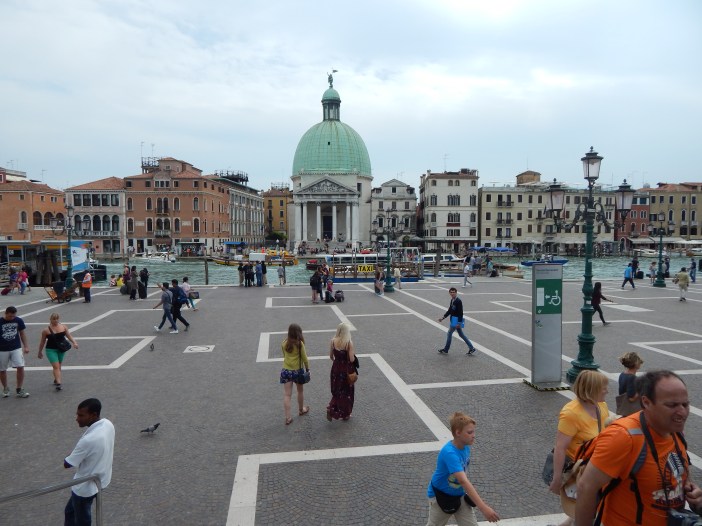
I love Venice. We spent a mere twenty-four hours there on our trip to Italy several years ago, taking the train from the magnificent station in Florence through the Italian countryside north and then across the lagoon to the Venetian station. I walked ahead of Paul through that Italian station, unable to wait to catch my first glimpse of the city from the top of the stairs rising from the piazza and vaporetto station on the Grand Canal.
DSCN6269

I was enchanted from that first glimpse.

I’d always wanted to visit Venice–ever since reading Daphne du Maurier’s brilliant story “Don’t Look Now” and seeing the film version, which is incredible–and also Anne Rice’s Cry to Heaven. Seeing Venice, even if was only for twenty-four hours, was wonderful. We were also incredibly lucky because Venice wasn’t crowded; apparently that’s become a huge problem (goo.gl/ePMQjT). It was even a problem when Berendt was writing The City of Falling Angels.

The title comes from a sign Berendt saw one day while strolling around Venice, near an old church that was crumbling and in need of restoration: BEWARE OF FALLING ANGELS. Apparently, the statues of angels on the sides of the church and along the rooftop had become loose with the rotting of the masonry, and one had fallen, almost hitting a pedestrian. The book reminded me so much of Venice, and why the city had enchanted me during my all-too-brief visit. I want to write about Venice; I’ve been toying with a story for years, and as I am just now starting to write my Panzano story, maybe I will soon write the Venice story.

Anyway, Berendt is best-known, of course, for his book about Savannah: Midnight in the Garden of Good and Evil, which I read decades ago when it was new. I enjoyed it; it was an examination of the quirks and curiosities of the city, built around the lens of a murder committed by a member of Savannah society. The City of Falling Angels is the same type of book, only viewed around the lens, not of a murder, but the burning of the Fenice Opera House. It did turn out to be a crime; two men were convicted of arson, but Berendt uses the fire, the investigations, and the subsequent trial, to view Venice; and along the way he takes a look at the quirks, eccentricities, and curiosities of a place that, like Savannah, is quaint and historic and beautiful–yet also very small. A lot of the things he talks about in the book–the concerns of locals that Venice is no longer for the Venetians, that the city is losing its neighborhoods to tourism; that poorer and middle class Venetians are being pushed out in the name of tourism–are concerns that we locals now have about New Orleans, so that made the book even more interesting to me. When we were there, we stayed overnight at a wonderful little family run hotel just off the Rialto Bridge and on one of the side canals; the Hotel San Salvador. We, too, had a lengthy conversation with two of the young women working there–members of the ownership family–who told us the same thing: Venice is no longer for the Venetians. Their family can no longer afford to live in the city, despite owning a hotel there; they live on the mainland and commute into the city. Most of the city’s apartments are being bought up by foreigners who then rent them out to visitors, so it is also affecting business for establishments like the Hotel San Salvador. I loved the hotel, it was charming and quaint and cozy; I loved the second floor lounge overlooking the canal below, and the family who owned and operated it were so nice, friendly, and charming. If and when we return, we will undoubtedly stay there again.

I’ve met John Berendt exactly once; he was very nice, and I liked him. I like his books, too. My character, Jerry Channing, who appears in both The Orion Mask and Garden District Gothic, and whom I’ve considered spinning off into his own series, is based on him only in that he writes the same kinds of books and articles Berendt does; kind of a cross between Berendt and Dominick Dunne. (I still might spin Jerry off; a lot of my short stories, which have first-person narrators who are never identified, are told in what I imagine Jerry’s voice to be) In fact, Jerry’s biggest success is a book called Garden District Gothic (very meta of me), which is about the quirks and curiosities and eccentricities of New Orleans, viewed through the lens of a society murder in the Garden District. The Scotty novel that bears the same title is an investigation into that case twenty-five years later, in fact (again, very meta of me).

16903185_10210905674210634_792277906514866377_o

Anyway,  I highly recommend The City of Falling Angels. I think I enjoyed it a lot more because I’d been to Venice, but it definitely made me want to go back. It’s very well-written, and a lot of fun to read.

And now back to the spice mines.


No More Lonely Nights

Paul returns tomorrow night, so I will return to my usual status as second best to Scooter. I have to say I’ve enjoyed his neediness more than usual this past week, as he cuddles with me in the bed and sleeps in my lap while I read or watch television.

I didn’t get nearly as much done this weekend as I had hoped or wanted to; I did reread the first ten chapters of the Scotty book and got some edits on it done–it does need a lot more work to be smooth–and I am trying to figure out how much I want to have happen here in the second half of the book. I may end up writing it a lot longer than it needs to be–surgically removing the bits that aren’t necessary afterwards. I worked some more on “Don’t Look Down,” which took up the majority of my writing time this weekend, and remained just as difficult and painful to write as I remembered it being. It’s going to be a long story–I am not worried about its length, as it is going into my short story collection rather than being sent out into the open market (gay main character, after all, makes it basically un-publishable).

I also started writing out ideas for three more stories: “Burning Crosses,” “Feast of the Redeemer”, and “Cross Roads.” Not sure if anything will come out of any of them, but there they are.

Today I need to get some things done that are due, and then I can focus on getting back to work on the other writing.

I am drawing to the end of The City of Falling Angels by John Berendt, and really enjoying it; in fact, I am enjoying it more than I enjoyed Midnight in the Garden of Good and Evil, to be honest. Venice is ultimately more interesting than Savannah, sorry; at least to me. (Don’t get me wrong, I’d love to visit Savannah–but if I had to choose between the two Venice would always win.)

I also read a shit ton of short stories this weekend, and sadly, finished reading both Lawrence Block’s wonderful anthologies, In Sunlight and In Shadow and Alive in Shape and Color. I do hope he’s doing another one this year, because they are quite marvelous.

So, for today’s edition of The Short Story Project, I do have a story up from In Sunlight or In Shadow, Joe R. Lansdale’s “The Projectionist”:

There’s some that think I got it easy on the job, but they don’t know there’s more to it than plugging in the projector. You got to be there at the right time to change reels, and you got to have it set so it’s seamless, so none of the movie gets stuttered, you know. You don’t do that right, well, you can cause a reel to flap and there goes the movie right at the good part, or it can get hung up and the bulb will burn it. Then everyone down there starts yelling. and that’s not good for business, and it’s not good for you, the boss hears about it, and with the racket they make when the picture flubs, he hears all right.

I ain’t had that kind of thing happen to me much, two or three times on the flapping, once I got a burn on a film, but it was messed up when we got it. Was packed in wrong and got a twist in it I couldn’t see when I pulled it out. That wasn’t my fault. Even the boss could see that.

Still, you got to watch it.

This is a marvelous story, about a mentally challenged young man who grew up in an incredibly abusive household and never graduated from high school. He’s gotten a job, through a mentor, as the projectionist at a local movie theater. The job makes him incredibly happy, and the voice! Lansdale has nailed the character’s voice so poignantly and beautifully, you can’t help but care about him and his undoubtedly doomed relationship with the beautiful usherette. The conflict in the story comes when two hoods attempt to shake down the theater owner for protection money, and how the staff, how our main character, tries to deal with that situation. A truly great story. Lansdale is a terrific writer, just terrific, and this short story, as well as the one in Alive in Shape and Color, are both so strong that I really want to start tracking down all of his short stories. A quick Google search shows that there are, in fact, quite a few. How lovely!

And then, I turned to “The Lottery” by Shirley Jackson, from The Lottery and Other Stories.

The morning of June 27th was clear and sunny, with the fresh warmth of a full-summer day; the flowers were blossoming profusely and the grass was richly green. The people of the village began to gather in the square, between the post-office and the bank, around ten o’clock; in some towns there were so many people that the lottery took two days and had to be started on June 26th, but in this village, where there were only about three hundred people, the whole lottery took less than two hours, so it could begin at ten o’clock in the morning and still be through in time to allow the villagers to get home for noon dinner.

The children assembled first, of course. School was recently over for the summer, and the feeling of liberty sat uneasily on most of them; they tended to gather together quietly for a while before they burst into boisterous play, and their talk was still of the classroom and the teacher, of books and reprimands. Bobby Martin had already stuffed his pockets full of stones, and the other boys soon followed his example, selecting the smoothest and roundest stones; Bobby and Harry Jones and Dickie Delacroix–the villagers pronounced this name “Dellacroy”–eventually made a great pile of stones in one corner of the square and guarded it against the raids of the other boys. The girls stood aside, talking among themselves, looking over their shoulders at the boys, and the very small children rolled in the dust or clung to the hands of their older brothers and sisters.

“The Lottery” is probably one of the most famous–if not the most famous. American short story of the twentieth century. It was, in fact, quite a shock when I realized, paging through my copy of The Lottery and Other Stories, that I had in fact actually never read the most famous short story written by one of my favorite writers; we did the play in Acting class when I was in high school, and I have seen the short film based on it. But I had never actually read the story itself. I don’t have to get into what the story is about–who doesn’t know what the story is about–but wow, what an exceptional piece of writing. Jackson, as always, just writes about something terrible in a matter-of-fact, nondescript way, like what she is writing about is nothing extraordinary; these lotteries have always happened and will always happen and she’s just recording one of them. I would be willing to go so far as to say (and bear in mind I am not an expert) that this story firmly established New England as the best setting for horror in this country; Jackson’s influence from this story is clearly evident in everything of Stephen King’s,  some of Peter Straub’s work, and most definitely in Thomas Tryon’s. Even knowing what the story was about didn’t lessen it’s chill, and that has everything to do with the authorial voice, and how powerful it is.

Whew.

And now, on to the spice mines.

IMG_1182

We Belong

Wednesday morning, and I have go have blood work done. No worries–it’s just for the semi-annual check-up, but I hate this whole process of fasting/not having anything to drink after midnight, plus the abject misery of having blood drawn–my veins roll, so they always have to DIG for them, generally leaving me with an enormous bruise–blah blah blah. Yay.

Plus, I can’t have coffee until I get back home.

AIEEEEEE!

Heavy heaving sigh.

Well, it wasn’t as bad as feared. She managed to get the blood vials filled on the first try, without having to dig! For once, I don’t mind getting one of those damnable “how was your visit?” emails, as now I get to recognize my technician for a job very well done. I don’t even have a bruise!

It’s been an interesting week. I’m watching the Netflix series Seven Seconds, which I am enjoying the hell out of, and Paul and I are watching also a BBC series called Retribution, which is one of the best concepts for a crime series I’ve seen in quite a while: a young married couple, who grew up as neighbors in rural Scotland, are murdered a few weeks after the wedding by a junkie robbing their apartment; the wife is about seven months pregnant. As the families get the news and grieve, the very next night after the bodies are found the killer for some reason is coming to see them and buys guys at a station twenty miles from where they live. There is a terrible storm that night and he wrecks his car, and the families find him and bring him inside. After they do, they see a news report which identifies him as the killer…and he is at their mercy. They drag him out to the barn, and sometime during the night someone cuts his throat…and now they have to cover up the crime. Juicy, right?

I also started writing two new short stories this week; don’t ask me why, I don’t know why I am on such a short story roll lately. One of them is my Italian short story, the one I’ve been wanting to write since we visited Panzano; I wanted to set a story there ever since I first saw that gorgeous village in Tuscany. The other is one I started a long time ago, but only wrote the opening paragraph; for some reason the rest of the story revealed itself to me this week so I started working on that as well. Who knew?

I also read some short stories this week.

First was “Where Are You Going, Where Have You Been” by Joyce Carol Oates; which was originally published in 1966 and is now available for free pdf download on-line;

Her name was Connie. She was fifteen, and she had a quick, nervous giggling habit of craning her neck to look into mirrors or checking other people’s faces to make sure her own was all right. Her mother, who noticed everything and knew everything and who hadn’t much reason any longer to look at her own face, always scolded Connie about it. “Stop gawking at yourself. Who are you? You think you’re so pretty?” she would say. Connie was raise her eyebrows at these familiar old complaints and look right through her mother, into a shadowy vision of herself as she was right at that moment: she knew she was pretty and that was everything. Her mother had been pretty once, too, if you could believe those old snapshots in the album, but now her looks were gone and that was why she was always after Connie.

I’m not sure how I came across this story, but wow, is it ever disturbing. I’ve really enjoyed my discovery of Oates’ talents through reading the occasional short story, and each one makes me want to read more. Connie, so confident in her looks and the power they give her, unfortunately attracts the attention of the wrong guy who turns up at her house one day with a friend when she is there by herself. As Connie tries to handle the situation…the sense of dread Oates evokes in her prose is palpable. I couldn’t stop reading, while at the same time was afraid to keep reading.

The next story I read was “A Jury of Her Peers” by Susan Glaspell.

When Martha Hale opened the storm-door and got a cut of the north wind, she ran back for her big woolen scarf. As she hurriedly wound that round her head her eye made a scandalized sweep of her kitchen. It was no ordinary thing that called her away–it was probably further from ordinary than anything that had ever happened in Dickson County. But what her eye took in was that her kitchen was in no shape for leaving: her bread all ready for mixing, half the flour sifted and half unsifted.

She hated to see things half done; but she had been at that when the team from town stopped to get Mr. Hale, and then the sheriff came running in to say his wife wished Mrs. Hale would come too–adding, with a grin, that he guessed she was getting scary and wanted another woman along. So she had dropped everything right where it was.

“Martha!” now came her husband’s impatient voice. “Don’t keep folks waiting out here in the cold.”

She again opened the storm-door, and this time joined the three men and the one woman waiting for her in the big two-seated buggy.

When I was in high school, I was in a contest play; one of the many disciplines for what was called Speech Competition in the state of Illinois was one-act plays. I auditioned for the contest one-act at my high school and was cast in Susan Glaspell’s one-act play Trifles, which was based on this short story. As a teenager, I thought the play was kind of silly and dumb, to be honest. We did well, but didn’t make it out of regional competition; we placed third, with every judge placing us third; if any judge had given us a first we would have moved on. But hey, it was my high school’s first time doing a contest play, we had practically no budget or set, and the two schools that beat us did the first act of Antigone, complete with sets and costumes, and the other did the first act of The Importance of Being Earnest, again, with an apparently bottomless budget for sets and costumes; both schools were also known for their drama departments.

Reading the original short story, all these years later, as both a fan and writer of crime fiction, made me appreciate the tale all the more. It’s about psychology; what drove the woman to kill her husband, after years and years of a miserable existence, why now? And the two other wives, the ones who find the motive, and understand it and sympathize with her, have to decide whether to share that with the condescending men/husbands, who basically spend the whole story mocking them and women in general, when they are the ones who actually solve the case…it’s actually genius and actually quite brilliant.

And now, back to the spice mines.

12795475_1033437423383944_9161554592569797704_n