Put Your Hand in the Hand

And now it’s Easter! Happy Easter to those who celebrate, to those who don’t, well, Happy Sunday.

I bought a flat of fresh Ponchatoula strawberries yesterday. It was an impulse buy, of course; I was heading down Tchoupitoulas Street in the midst of my errands when I saw a little stand set up, and impulsively I pulled over, got out, and forked over twenty bucks for some beautiful and delicious fresh strawberries. I made myself a protein shake with some of them (along with two bananas) once I’d gotten home and put everything away; for the rest of the day whenever I walked into the kitchen for anything I grabbed some strawberries and ate them quite happily. There really is nothing like Ponchatoula strawberries freshly picked from the fields. Today I will have to freeze some, naturally; I am now really excited for Creole tomato season, which should be here at any moment (I’ve started looking for them every time I set foot in a grocery store). It’s very odd how delighted I am about having these strawberries; I only wish I could eat even more of them…but I am only one person and there are only so many I can eat…and the frozen ones will be perfect for slushing up my protein shakes a bit, giving them more of a daiquiri style consistency.

I really do need to write about Ponchatoula strawberry season at some point–and Creole tomatoes.

As usual, I was very tired once I got home from the errands. I was also startled at how hot and humid it was outside yesterday; despite being only mid-April it felt like early June already. This does not bode well for the unholy hell that is the usual New Orleans summer. They’re predicting a slightly less active hurricane season this year–slightly being the operative adjective doing the heavy lifting in that sentence. I can’t imagine that the Gulf water temperature isn’t going to be significantly elevated this year, which means that the hurricanes that come into the Gulf of Mexico will intensify dramatically once they reach the hot water of the Gulf before they head ashore. Yay? Heavy heaving sigh. But it is what it is, and God knows you cannot control the weather, so it looks like it’s going to be another one of those insanely intense years of storm-watching for six months. But once I was home in the cool and out of the muggy nastiness that was yesterday’s climate, I felt a bit better. Paul came home from his trainer–which was weird, I’d gotten used to him going to the office directly from the trainer and having the rest of the day to myself. We watched The Truth About Pam on Hulu, which was creepy and weird and bizarre–although at the end of the final episode they actually showed footage of the real-life Pam, and you can see how Renee Zellweger actually underplayed the role. We then moved on to BritBox and Why Didn’t They Ask Evans?, an adaptation of one of my favorite Christies–one I feel doesn’t get nearly the credit it deserves–and then had to look up the American title (Why Didn’t They Ask Evans? is the British title, which was better than the American title, which I had to look up because I couldn’t remember it, and it was The Boomerang Clue, which is clearly inferior. Why did her American publisher do this to her books when the British title was always superior? Murder on the Orient Express was actually originally published in the US as Murder in the Calais Coach, which is clearly inferior). It’s very well done, and I always liked the characters of Bobby Jones and Lady Frankie Derwent. WIll Poulter is a very good choice for Bobby Jones; he’s becoming one of my favorite working actors.

So I kind of didn’t really do a whole lot yesterday. But it was a good battery-recharging kind of day, which was necessary and needed, methinks, and so today I can dig into all the things I need to get moving on and make some forward progress. Paul will be heading out today to one of the many Easter parades around town to hang out with an old friend who is in town, and I need to get going on my lists and things. I got my tax refund already–I literally scanned the signature sheets and emailed them back to my accountant on Monday and yesterday morning it had already hit my bank–which means I also need to strategize bill payments. I had also meant to spend some time with Marco Carocari’s Blackout yesterday, but I think this morning, once I have finished this and made myself a second cup of coffee, I will head to my easy chair with said coffee to read a few chapters and get a feel for his writing style and the story. Tomorrow I am taking a sick day; I need to take the car in for an overdue oil change at the crack of dawn tomorrow, and as such I made appointments for the afternoon in which to get some things taken care of with my routine bi-annual servicing to make sure things aren’t breaking down somewhere; so tomorrow I’ll be out running around most of the day in the heat. Huzzah? Fucking hardly.

I also need to get a lot of other work done today as well–writing, editing, organizing, and so forth. I’d like to get that working first draft of my story done today, and maybe even the first chapter of the book I started working on this week to get my writing kick-started again; I also need to cut up these strawberries and start putting them into freezer bags for future protein shakes. The glamour around here truly never ends, does it? And there’s cleaning to do, as always, and organizing, and so forth–all that lovely stuff that I absolutely love to do.

And on that note, probably should head into the spice mines and get my day underway.

Ooh Baby Baby

There is no question that Agatha Christie is one of the giants (if not the giant) of crime fiction.

Agatha Christie was one of my gateways to adult crime fiction (along with Charlotte Armstrong, Phyllis A. Whitney, and Victoria Holt); if I remember correctly the first book of hers I bought was Witness for the Prosecution (which I didn’t know was a short story collection) and the first novel of hers I read was Murder in the Calais Coach (best known as Murder on the Orient Express; the former was a short-lived American title for the book, and frankly, isn’t an improvement; why make the title about something no one would know what is was? Everyone knew the Orient Express). I eventually read everything she wrote, with a few exceptions (I still haven’t read Murder in Three Acts or Death in the Air) but the first Miss Marple novel I read was A Caribbean Mystery. I always preferred Miss Marple to Poirot, but I kind of want to give a Poirot or two a reread; Donna Andrews made a very clever observation about him on one of my social media posts which provides another lens for me to read through.

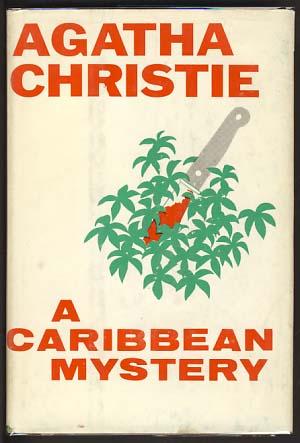
I found a hardcover copy of A Caribbean Mystery somewhere since we moved into the Lost Apartment; I’m not sure where. I certainly don’t remember buying it on eBay (the only other Christie I have in hardcover, Halloween Party, is missing its dust jacket, and I think I got it at a yard sale? But wait! It’s a Poirot! And has Ariadne Oliver, Christie’s stand-in! Yes, that’s a reread for the new lens for Poirot! And now that that’s sorted…), so there’s no telling where it came from. I don’t know why it took me so long to reread it–it’s actually on the short side–but it did take me a while. Maybe because there was no urgency because I remembered who the killer was?

“Take all this business about Kenya,” said Major Palgrave. “Lots of chaps gabbing away who know nothing about the place! Now I spent fourteen years of my life there. Some of the best years of my life, too–“

Old Miss Marple inclined her head.

It was a gentle gesture of courtesy. While Major Palgrave proceeded with the somewhat uninteresting recollections of a lifetime, Miss Marple peacefully pursued her own thoughts. It was a routine with which she was well acquainted. The locale varied. In the past, it had been predominantly India. Majors, colonels, lieutenant-generals–and a familiar series of words: Simla. Bearers. Tigers. Chota Hazri–Tiffin. Khitmagars, and so on. With Major Palgrave the terms were slightly different. Safari. Kikuyu. Elephants. Swahili. But the pattern was essentially the same. An elderly man who needed a listener so that he could, in memory, relive days in which he had been happy Days when his back had been straight, his eyesight keen, his hearing acute. Some of these talkers had been handsome soldierly old boys, some again had been regrettably unattractive; and Major Palgrave, purple of face, with a glass eye, and the general appearance of a stuffed frog, belonged in the latter category.

Miss Marple has bestowed on all of them the same gentle charity. She had sat attentively, inclingin her head from time to time in gentle agreement, thinking her own thoughts and enjoying what there was to enjoy, in this case the deep blue of a Caribbean sea.

I decided to reread this book for several reasons. First, I am reading a lot of “cozy” mysteries (mysteries with amateur sleuths as the main crime-solver) because I am writing one myself; second, because I’ve been wanting to revisit Christie on a smaller scale (there’s no way I could reread her entire canon again); and third, because I read a piece recently somewhere (Crime Reads, perhaps?) about the enduring legacy of Christie despite some problematic aspects to some of the books (I was well aware of the classism and anti-Semitism, and VERY WELL AWARE of the various problematic title changes for And Then There Were None over the years), and this one was mentioned. I remembered the book, I remembered the story; I remembered that this was the book where Miss Marple met Mr. Rafiel and she became, in some ways, Nemesis to the two of them (one of the later Marples was, in fact, Nemesis, and Mr. Rafiel sent her a murder to solve from beyond the grave); but I wasn’t so sure I remembered why precisely this book was problematic, could be see that way. So, I took it down from the shelves, and started reading.

The premise of the book is this: Miss Marple had a rough winter, having contracted pneumonia, and her nephew, bestselling novelist Raymond West, has decided to send his beloved elderly aunt to a warmer climate to recuperate–St. Honoré, to be exact, in the Caribbean, or the West Indies–at the Golden Palm Hotel resort. (St. Honoré is, of course, fictional; I may use it if I ever need a fictional Caribbean setting) As she sits in the warm sun, knitting and observing the people around her–she is always watching–and half-listening to the pompous bore rattling on to his captive audience (this scene, and her thoughts about Major Palgrave being of a type who really doesn’t need anyone to really pay attention, but to just be in hearing range with the proper noises being made when necessary, is quite insightful and brilliant; haven’t we all been there in that situation?), when he asks her if she wants to see the picture of a murderer? Since she isn’t really listening, she assents and continues to observe and watch everyone around her, and as he is reaching into his wallet to show her a picture of said murderer, he stops, turns quite purple, shoves the photo back into his wallet and loudly changes the subject. This does catch her attention, and she turns around to see what he saw–but doesn’t see anything or anyone that could explain this behavior change. He then makes excuses and leaves.

And of course, he dies that night–and this incident nags at Miss Marple. His death is explained away by him having high blood pressure, and having drank too much on top of his medication; but she isn’t so sure. And then she makes up a lie about the photograph, which she tells the doctor, and it turns out the photograph is missing.

Obviously, the Major was murdered, and did he really have high blood pressure, or is that merely gossip? As Miss Marple observes, “it’s very easy to get a rumor about, and people will just repeat it. There’s never any first-hand knowledge; it always A heard it from B who heard it from C and no one can really pinpoint where the story started.”

It’s a good story, with lots of suspects and suspicious behavior and trying to sort rumor from truth, but two more people wind up dead–a very common theme in Christie is a murderer having to kill others to cover up their original crime–before Miss Marple remembers something and figures out not only who the killer is, but who their actual target was from the very beginning.

And yes, there’s some serious problematic views of the islanders from the British paternalistic colonialist point of view. But Christie herself never says anything problematic–it always comes from the mouth of one of her characters, who, given the time period, would inevitably think that way–side comments about how many of the islanders are in committed relationships without benefit of clergy; etc. etc. etc.

So, I would say it held up about 95% on the reread; yes, there’s some problematic stuff that might be jarring for someone to read now for the first time and would probably not be allowed past the editorial process today–and excising it wouldn’t harm the book in the least.