Good morning, Constant Reader, and a happy Thursday to you. I am a bit groggy this morning as I swill my first cup of coffee, but Scooter has already been fed and so at least the cat cries have stopped.
For now, at least.
I slept pretty well last night again, and maybe my body has readjusted to my work schedule already, which is nice and I was a bit concerned that it might take a while for that to happen. But I seem to have slipped right back into the routine I was in before I left for New York, and that is, of course, quite lovely. I stopped at the grocery store on my way home from the office yesterday and picked up a few things, then once I was home I retired to my easy chair to edit “Solace in a Dying Hour,” which actually is a much better story than I thought it was. In fairness to me, expecting the story to need a great deal of work really isn’t a case of Imposter Syndrome, as one might have expected (it so often is just that), but rather because it was so hard for me to write and took me so long to get into the story groove. It’s actually not bad at all, and just needs some tweaking here and there; which I should be able to do tonight and get turned in by the end of the day. This is actually rather nice, and I am most pleased about it, in all honesty. By the time I’d finished, Scooter was in my lap and I tuned in to get caught up on Superman and Lois; Paul came home while I was watching and we switched to the new Jane Seymour mystery series on Acorn, which is quite good. I’ve always appreciated Jane Seymour and thought she was more talented than she often received credit for; I suppose being a Mini-series Queen during the 1980s didn’t really help all that much–but I thought she was exceptional in the adaptation of East of Eden that was done in the 80’s, in which she played Steinbeck’s perhaps most evil creation, Cathy Ames. (She was also good as Natalie in War and Remembrance, having a remarkably long career for someone who started as a Bond girl in Live and Let Die.) The show is Harry Wild, and we quite enjoyed it; although it’s hard to think of a British crime series we haven’t enjoyed.
I also didn’t get an opportunity to read any more of my Carol Goodman novel, either, which didn’t please me. Perhaps tonight I can relax with my book and the Gothic story of what is going on at that boarding school on the lake. Really, y’all, if you’ve not read anything by Carol Goodman, you really should. But tonight I am coming straight home from the office–no detours, no stops to make–and so hopefully that means I can spend some good quality time reading tonight. Fingers crossed, at any rate, especially since Saturday I have an appointment in the late morning and a ZOOM appearance to make in the mid-afternoon, which means I won’t have a lot of time to do much of anything on Saturday other than making the kitchen background to my computer camera neat and tidy.
I was also delighted to see that the Saints signed former LSU and Kansas City Chiefs standout (and local high school star from St. Augustine’s) TYRANN MATHIEU. The Honey Badger is finally coming home to New Orleans (HUZZAH!) and I think this was an incredibly smart move by the Saints. Mathieu has already proven himself to be a leader who is interested in helping and giving back to the community (he helped fund the new state-of-the-art training center for the LSU football team, for example, despite the fact that he was kicked off the team and out of school for infractions after his sophomore year), and what better brand ambassador in the city of New Orleans for the Saints than a local kid who made good? I’ve never really understood why the Saints never signed anyone from LSU over the many years since Sean Payton took over–especially since so many of those stars were from either New Orleans or Louisiana–but maybe it was a “local hero ego” kind of thing. Who knows? (Paul and I dreamed that Joey Burrow would end up playing for the Saints, but that would have been too much to hope for, really.) I’ll be actually curious to see how LSU and the Saints will do this year; I remember the last time new coaches came in to both around the same time was 2005 at LSU (Les Miles) and 2006 with the Saints (Sean Payton)–both of those turned out well, so here’s hoping the new coaches at both for 2022 will also turn out well.
As always with football season, hope springs eternal.
And on that note, I am heading into the spice mines. Have a lovely Thursday, Constant Reader!
It probably goes without saying that I wasn’t a typical boy-child; a complete mystery and disappointment to my parents. For years, I attributed the disappointment and confusion to my complete inability, and resistance, to conform to gender expectations of how little boys were expected to behave and what they were supposed to be interested in because I was not born heterosexual despite being born into a overwhelmingly heterosexual society, country, and culture. It took many years for me to recognize and understand that even had I not been innately attracted to males romantically and sexually and emotionally I still would have been an unfathomable mystery to my parents because I was an artistic child born into a family where an interest in the arts was just as foreign to them as if I had been a foundling from another planet they discovered on their doorstep one morning. We were a family of readers–everyone in my family was a reader–but no one was as voracious a reader as I was; because I was interested in stories and fictions, and because I felt like such an outsider in my own life that I was more interested in escaping it into the different worlds that books offered me.
Even when my parents, mystified, encouraged my reading habit (it was really more of an addiction more than anything else; the most effective punishment was denying me books) they were also mystified by what I wanted to read; I was interested more in books by and about women than I was in books by and about men. I’ve always wondered if their violent reaction to this interest in women pushed me further, in my innate stubbornness, along that path; why the forbidden Nancy Drew books were of greater interest than the Hardy Boys–the greatest irony, of course, being that my favorite series, in truth, were always books about boys (the Three Investigators, Rick Brant, Ken Holt) rather than girls. This preference for books by women over men continued into my adulthood; I inevitably read more books by and about women than I do by and about men. I am digressing a bit from the point of this entry, but one thing I’ve always rebelled against is this notion that men’s stories are universal while women’s are more micro and intimate; I prefer more micro, intimate stories to universal ones, and there is often more universal truths and intellectual honesty and curiosity in an intimate story than in what is supposedly a more universal one.
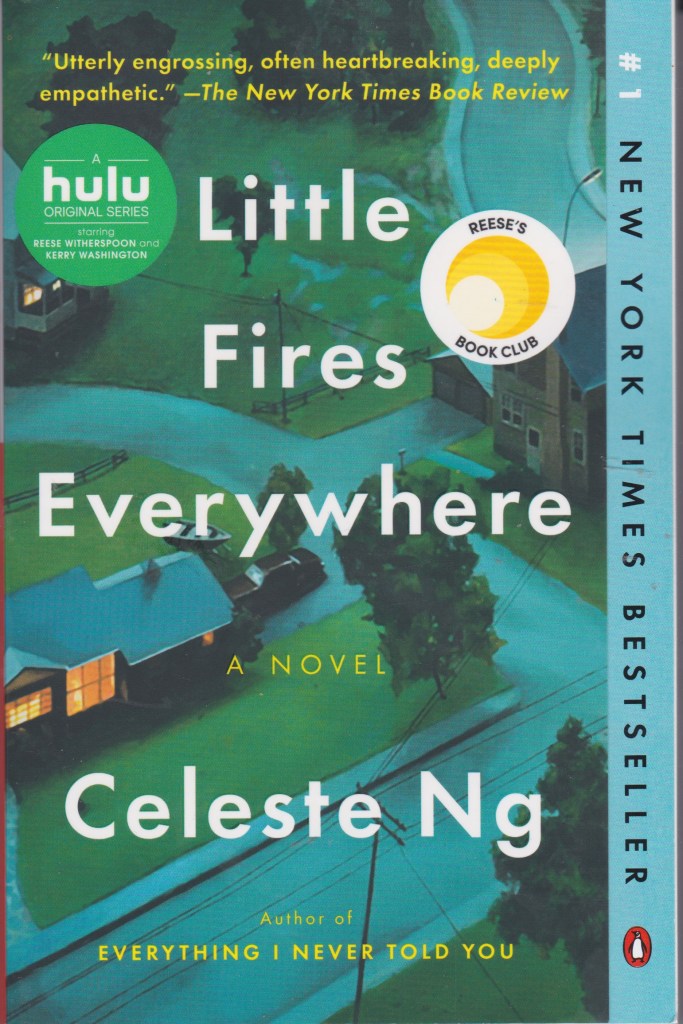
Take, for example, Celeste Ng’s brilliant Little Fires Everywhere.
Everyone in Shaker Heights was talking about it that summer: how Isabelle, the last of the Richardson children, had finally gone around the bend and burned the house down. All spring the gossip had been about little Mirabelle McCullough–or, depending which side you were on, May Ling Chow–and now, at last, there was something new and sensational to discuss. A little after noon on that Saturday in May, the shoppers pushing their grocery cartsin Heinen’s heard the fire engines wail to life and careen away, toward the duck pond. By a quarter after twelve there were four of them parked in a haphazard red line along Parkland Drive, where all six bedrooms of the Richardson house were ablaze, and everyone within a half mile could see the smoke rising over the trees like a dense black thundercloud. Later people would say that the signs had been there all along: that Izzy was a little lunatic, that there had always been something off about the Richardson family, that as soon as they heard the sirens that they knew something terrible had happened. By then, of course, Izzy would be long gone, leaving no one to defend her, and people could–and did–say whatever they liked. At the moment the fire trucks arrived, though, and for quite a while afterward, no one knew what was happening. Neighbors clustered as close to the makeshift barrier–a police cruiser, parked crosswise a few hundred yards away–as they could and watched the firefighters unreel their hoses with the grime faces of men who recognized a hopeless cause. Across the street, the geese at the pond ducked their heads underwater for weeds, wholly unruffled by the commotion.
Mrs. Richardson stood on the tree lawn, clutching the neck of her pale blue robe closed. Although it was already afternoon, she had been still asleep when the smoke detectors had sounded. She had gone to bed late, and had slept in on purpose, telling herself she deserved it after a rather difficult day. The night before, she had watched from an upstairs window as a car had finally pulled up in front of the house. The driveway was long and circular, a deep horseshoe arc bending from the curb to the front door and back–so the street was a good hundred feet away, too far for her to see clearly, and even in May, at eight o’clock it was almost dark, besides. But she had recognized the small tan Volkswagen of her tenant, Mia, its headlights shining. The passenger door opened and a slender figure emerged, leaving the door ajar: Mia’s teenage daughter, Pearl. The dome light lit the inside of the car like a shadow box, but the car was packed with bags nearly to the ceiling and Mrs. Richardson could only just make out the faint silhouette of Mia’s head, the messy topknot perched at the crown of her head. Pearl bent over the mailbox, and Mrs. Richardson imagined the faint squeak of the mailbox door opened, then shut. Then Pearly hopped back into the car and closed the door. The brake lights flared red, then winked out, and the car puttered off into the growing night. With a sense of relief, Mrs. Richardson had gone down to the mailbox and found a set of keys on a plain ring, with no note. She had planned to go over in the morning and check the rental house on Winslow Road, even though she already knew that they would be gone.
At this point, writing about Little Fires Everywhere is probably a bit of overkill; it was a New York Times bestseller and selected by Reese Witherspoon for her book club and adapted by same into a critically acclaimed and highly watched mini-series on Hulu; Kerry Washington currently is an Emmy nominee for Outstanding Actress in a Limited Series or Movie for her stunning personification of Mia, the photographer whose arrival in peaceful quiet Shaker Heights with her daughter sets into motion the story of both book and television series. But this entry is about the book and not the television series (which you should watch, if you haven’t already), and the book is a gem all by itself.
Little Fires Everywhere focuses, on the surface, on the interactions between two completely different women, and by extension, their families. One is Mrs. Richardson; easy to recognize in any number of women we all know–we’ve all known, at one time or another, a Mrs. Richardson: the uber-organized working wife-and-mother who has definite opinions on everything and sees the world in black-and-white with no shades of gray; the woman who is so certain of her ultimate rightness that she can shape reality, and interpret things that happen in her life, to fit her worldview rather than expanding her worldview to fit new data, new experience, new people. It seems cruel to suggest that these women have calcified, but there’s also an element of truth to that; they have constructed their lives in such a way that they must convince themselves that they’ve always made the right choice, because anything that might make them question anything about themselves and their lives would create a crack in that facade of perfection they’ve built to show the world–but they are more worthy of pity and compassion than judgment and contempt, if not for the damage they cause in their correctness.
Mia, whose choices were so different from all of Mrs. Richardson’s (and therefore wanting, which also makes Mia suspicious to Mrs. Richardson if fascinating at the same time), is a Dionysian force in peaceful, nothing-ever-happens Shaker Heights. (Mrs. Richardson is the embodiment of Shaker Heights: planned, perfect, progressive.) Mia is a vagabond, an artist who pulls up stakes and moves on, following her drive to create and make art, choosing the kind of life Mrs. Richardson once might have chosen–but ultimately didn’t; so of course Mrs. Richardson must judge Mia and find her wanting, otherwise she might start questioning and doubting herself. We are, of course, meant to identify with and like Mia, while holding Mrs. Richardson at a cold distance and judging her and her choices. Ng always refers to her as Mrs. Richardson and her husband as Mr. Richardson, very formal, just as they think themselves above judgment and disapproval, while Mia is simply Mia: companionable, likable, a peer.
Mia’s past has its own secrets and choices, some of them questionable, others causing pain to others–not the least of which are her own parents. Like Mrs. Richardson, Mia is convinced her decisions were the right ones, and so she is kind of her mirror image; reflecting back at each other who they might have become had they made other choices at those crossroads of their lives, when they set their feet down on their opposing paths. The two women are much more alike, certainly more than either wants to think, or believe; this is inevitably why they come into conflict, and their very different choices about what it means to be a mother and parent, is clearly reflected in their children; the Richardson children are very different from each other, and often accurately named, and how they are treated and react to their mother, and who they become, is very much because of how she mothers them. Pearl is very much Mia’s daughter; compassionate and understanding yet mysterious at the same time–she understands her mother and is much closer to her mother than any of the Richardson are to theirs. To the Richardsons, their mother is an abstract presence that is always there–supportive and loving with Lexi; sometimes exasperated but caring with Trip; absent with Moody and antagonistic with Izzy.
The trigger that drives them all into opposite corners is of course the custody battle over Mirabelle/May Ling; the Richardsons are friends of the McCulloughs; Mia is a friend of the birth mother, and the book really is, ultimately, who or what is a good mother?
How that could not be a universal story is a mystery to me, frankly.
Ng is also a brilliant writer; sentences and paragraphs constructed as beautifully and carefully as her characters, all of whom are realistic and believable, people we all know, or at least, think we do. The book left me wanting more; wanting to know what happened to them all (the book set twenty years into the past) and where they are now. Are they happy? What choices did they make? And the writing is so strong and poetic that as I read along, the truths and honesty inspired me–new stories, new ideas, new insights into the characters of my own creation.
And for me, that’s the sign of a masterful writer: one whose work inspires other writers to new ideas, new creations, and to do better.

 Queer and Loathing in America