Rose Garden

My paternal grandmother–the one who went undiagnosed for bipolar disorder until she was in her eighties; better late than never, I suppose–was also the first person in my life to encourage me to not only read but to become a writer. She also introduced me to old movies–including horror, suspense, mystery, and noir–and also was the person who introduced me to some of my favorite writers, including Ellery Queen, Victoria Holt, Erle Stanley Gardner, and the magnificent Mary Stewart. My grandmother gave me a copy of Mary Stewart’s The Ivy Tree in hardcover, saying, “This one has a huge surprise in it.”

She wasn’t wrong, either.

Flash forward a few years, and a friend in high school convinced me to read a novel called The Crystal Cave. I started reading it and couldn’t stop reading it, and then immediately went out and bought my own copy of the sequel, The Hollow Hills. The friend–Felisha–told me I should also check out some of Mary Stewart’s other, non-Arthurian novels, so the next time I went to the library, I went to the S’s in fiction and there it was on the shelf: The Ivy Tree, even the same edition I read when I nine or ten. Of course I checked it out, and also checked out Airs Above the Ground, The Moonspinners, and This Rough Magic. Spoiler: I loved them all. I would eventually read the rest of the Arthur books, buying them in hardcover when they were released (The Last Enchantment and the Mordred story, This Wicked Day), and gradually went back and read the majority of her suspense novels…but there are some, to this day, that I have not read–primarily because I don’t ever want to run out of Mary Stewart novels to read.

And now that I think about it…truth be told, it’s been so long since I read so many of these novels that I could probably reread them now and they would seem new to me. But I have reread both The Ivy Tree and Airs Above the Ground many times; I always considered The Ivy Tree my favorite of her novels because it was the first I read–but in truth, Airs Above the Ground is definitely my favorite of them all. I am including Mary Stewart in the Reread Project, naturally; but I definitely need to make time to reread some of the ones I don’t remember.

Mary Stewart is often frequently mis-categorized as a Gothic writer, when in fact nothing could be further from the truth; perhaps some of her novels (Touch Not the Cat, The Gabriel Hounds) might skirt the edge of Gothic suspense, but that isn’t what she wrote. She is also often called romantic suspense, and again, while some of the book danced close to that (Madam Will You Talk? and Nine Coaches Waiting–which, come to think of it, might also fall into that Gothic category again), she basically wrote suspense novels about headstrong young women who took charge of their situations and rarely, if ever, needed rescuing.

.airs above the ground

Carmel Lacy was the silliest woman I know, which is saying a good deal. The only reason I was having tea with her in Harrods on that wet Thursday afternoon was that when she rang me up she had been so insistent that it had been impossible to get out of; and besides, I was so depressed anyway that even tea with Carmel Lacy was preferable to sitting alone at home in a room that still seemed to be echoing with that last quarrel with Lewis. That I had been entirely in the right, and that Lewis had been insufferably, immovably, furiously in the wrong was no particular satisfaction, since he was now in Stockholm, and I was still here in London, when by rights we should have been lying on a beach together in the Italian sunshine, enjoying the first summer holiday we had been able to plan together since our honeymoon two years ago. The fact that it had rained almost without ceasing ever since he had gone hadn’t done anything to mitigate his offence; and when, on looking up ‘Other People’s Weather’ in the Guardian each morning, I found Stockholm enjoying a permanent state of sunshine, and temperatures somewhere in the seventies, I was easily able to ignore the reports of a wet, thundery August in Southern Italy. and concentrate steadily on Lewis’s sins and my own grievances.

“What are you scowling about?” asked Carmel Lacy.

“Was I? I’m sorry. I suppose I’m just depressed with the weather and everything. I certainly didn’t mean to glower at you! Do go on. Did you decide to buy it in the end?”

God, how I love this character. Vanessa March was not your ordinary run-of-the-mill heroine; look at how much we learn, not only about her, but who she is and where she is at emotionally, in that opening paragraph! We learn she is married; has had a horrible fight with her husband about having to change their vacation plans; is completely and utterly convinced she was in the right; and would rather spend time with someone she clearly doesn’t like rather than stay in her lonely apartment with her memories of the argument–which she is still angry about. But this tea at Harrod’s with silly Carmel Lacy is what sets the story in motion: you see, Carmel is divorced; left by her husband who now lives in Vienna, and she needs someone to travel with her teenaged son who wants to go see his father. Why would Vanessa be interested in making such a trip? And that’s when we get an insight into Carmel’s personality; she slyly mentions having seen Lewis in a newsreel at the cinema; something about a fire involving a traveling carnival in Austria, and surely Vanessa is going there to meet him? Vanessa never lets Carmel see she doesn’t have the slightest idea why or how Lewis could be in Austria rather than Sweden. Instead, she goes to the same cinema, watches the newsreel, sees that it is, indeed, her husband in the newsreel–he’s obviously lied to her, and then she calls Carmel and tells her she’d be delighted to escort her son to Austria.

Vanessa has no idea what’s in store for her in Austria, and yet she has no qualms about taking off for there, with a teenaged boy who’s practically a stranger to her, in tow; this is one of the reasons I love Stewart’s heroines; they were definitely not shrinking Violets, and impetuously always set off for adventure to parts unknown. The second chapter, which details the flight from London to Vienna, is another gem of a chapter. Timothy Lacy, a young teenager, cannot hide his disdain, dislike, and disapproval of his traveling companion; like all teenagers, he doesn’t think he needs an escort or a glorified babysitter. After a while, he buys a carton of cigarettes from the flight attendant, much to Vanessa’s inward amusement, and finally she says:

“You know, I couldn’t really care less is you want to smoke all day and all night till you die of six sorts of cancer all at once. Go right ahead. And as a matter of fact, the sooner the better. You have the worst manners of any young man I ever met.”

The paperback dropped to his knees, and he looked at me full for the first time, eyes and mouth startled open. I said: “I know quite well that you’re perfectly capable of traveling alone, and that you’d prefer it. Well, so would I. I’ve got troubles enough of my own, without bothering about yours, but if I hadn’t said I’d go with you, you’d have never got away. I know you’re sitting there fulminating because you’ve had a kind of nursemaid tagged onto you, but for goodness’ sake aren’t you adult enough to know that there are two sides to everything? You know you’d get on fine on your own, but your mother doesn’t, and there’s no sense in making gestures to reassure oneself, if they’re only distressing other people. Surely all that matters now is that you have got your own way, so why not make the best of it? We’re stuck with each other till I get you–or you get me–safely into Vienna and you meet your father. Then we’re both free to go about our own affairs.”

I don’t think I’ve ever loved a character more than I loved Vanessa March at that moment. It’s an excellent icebreaker, and she and Timothy Lacy–Tim–become friends after that exchange. But Tim, like Vanessa, has secrets of his own–for one thing, his father has no idea he’s showing up; has a new, younger fiancee; and no place or welcome for Tim–so without any other option, Vanessa brings Tim along on her search for the carnival from the newsreel. Tim is absolutely fascinated with horses–and Vanessa, as it turns out, is, like her father, a certified veterinarian.

I cannot say more without giving away spoilers–and spoilers in a Stewart novel are quite distressing; as part of the joy of reading her novels for the first time are the surprises she pulls on her unsuspecting readers; surprises that, even on a reread when you know what’s to come, you still can’t spot the stitching in her seamless plots. One of my all time favorite reveals in crime fiction takes place in this book–the brilliantly composed scene in which the old horse begins to dance in the moonlight, and what all that scene means–every time I reread the book I still get chills…and that’s not the only surprise Stewart pulls on the reader in Airs Above the Ground. It’s quite an exceptional thriller, with Vanessa and Tim making an exceptionally fun and interesting and witty team of sleuths trying to get to the bottom of what is going on around the carnival–and one of the best climaxes to a suspense novel I’ve ever read; then again, it’s hard to go wrong with a speeding train.

Genius, absolute genius.

And of course, being a devotee of Airs Above the Ground (which was, in fact, an Edgar nominee for Best Novel) also enabled me to surprise people with a Jeopardy! answer–“The horses known for the airs above the ground”–to which I quickly replied, “What are the Royal Lipizzan stallions of the Spanish Riding School, Alex?”

If you’ve not read this–despite it being slightly dated, you really need to.

You Don’t Love Me Anymore

Sunday morning, and with no Saints game today I have no excuse not to get a lot done today. It’s chilly this morning and gray outside; we still have rain in the forecast but it’s calm and quiet out there right now; perhaps the calm before the storm? Ugh, such a tired cliche–but it’s fine with me.

Yesterday I got a lot of chores done–very little writing, but the chores were necessary and of course, being the Master Procrastinator that I am; I have to have a clean apartment–or at least one that’s been straightened up some–in order to have a clear conscience enough to get work done. I now have no excuses to not get everything done that I need to get done today–but we’ll see how that goes; there’s always something.

I read another Holmes story yesterday–“The Musgrave Ritual”–which I couldn’t remember the plot of, other than remembering that it was one of my favorite Holmes stories. Like “The Gloria Scott“, it’s a “let me tell you a story” story; I really don’t remember the Holmes stories being like this, of course, but it’s something to think about as I prepare to write my own pastiche. It’s a style of writing/story-telling I’m not so certain I want to try, but then again–the entire point of me writing a Holmes story is to push myself as a writer and get better overall, so perhaps…perhaps I should try it that way and see how it goes. Anyway, as I reread it, I remembered why I liked it so much; it’s a treasure hunt story, and I absolutely love treasure hunts. At least two Scotty books–Jackson Square Jazz and Vieux Carre Voodoo, are treasure hunts.

I also rewatched the original film version of Shirley Jackson’s The Haunting of Hill House, 1963’s The Haunting, directed by multiple Oscar winner Robert Wise, and starring Julie Harris as Nell. I saw this movie long before I even knew there was a book, let alone read it; my grandmother loved old black and white movies, and she especially loved crime and horror–probably where I get it from, and she also introduced me to the novels of Mary Stewart, Victoria Holt, Ellery Queen, and Erle Stanley Gardner. I was very young and the film absolutely terrified me–to this day, even remembering the scene with the door expanding and contracting unsettles me. I was, of course, quite delighted as a teenager to discover it was actually a novel (I had read Richard Matheson’s Hell House, with it’s similarities to The Haunting, year earlier and wondered if he’d gotten the idea for the book from the movie), and it quickly became one of my favorite novels of all time; in fact, I believe it was Stephen King who introduced me to the novel, because the opening paragraph was an epigram to ‘salem’s Lot. But I hadn’t watched the film in years; I’d watched the horrible 1999 remake, and of course the Netflix series loosely based on the book (I do recommend the series, it’s fantastic, once you get back the fact that it’s not a faithful adaptation but kind of fan-fiction; it didn’t even have to be Hill House for the story to work, but that’s a subject for a different blog. I do recommend it, though). Julie Harris is perfectly cast as Nell, and Claire Bloom does an excellent job as Theo. There are differences between the book and the film; why they changed Dr. Montague’s name to Dr. Markway is a mystery, and the later third of the film, after his wife arrives, is vastly different from the later third of the novel, and her character is completely changed; the young man who escorts her to Hill House is also excised from the movie. But the way the film is shot–the use of light and shadow, the up angles of the camera, and the ever-so creepy claustrophobia of the enclosed house–is absolutely terrifying, and you never see what is actually haunting the house. That was the singular brilliance of the book, and Wise kept that for his film (the execrable 1999 remake went completely over the top with CGI effects and so forth; ruining the necessary intimacy of the story). I still think of it as one of the scariest movies I’ve ever seen, and on a rewatch–the way you hear Nell’s thoughts, whispered, while Julie Harris’ eyes dart around–adds to the intimacy. I think that interior intimacy is a large factor in why the book is so fantastic, and why both book and original film work so well. The Netflix series does show the ghosts of Hill House, but it’s also done in a very subtle, unsettling way, which is why I think I liked it so much.

I also was thinking about rewatching Anthony Minghella’s film adaptation of The Talented Mr. Ripley, but decided to hold off until I finish the reread of the book–which I am still in the midst of–I want to finish it before my trip this week, because I want to take two different books with me to read.

I did finish my reread of Kirkland Revels by Victoria Holt, which was much better than I remembered, with it’s haunted monastery and ghostly monk haunting the big manor house. It’s also a terrific novel about paranoia and gaslighting; the ultimate evil scheme behind everything hinges on the heroine of the story being eventually committed to an insane asylum, and hopefully miscarrying her child, or it being born dead as a result of the confinement. Holt novels often hinged on the possibility of insanity being genetic–if the mother is insane, her child most likely will be as well–and this horror, which was probably very real in the nineteenth century, makes this book terribly unsettling. The main character, Catherine, is very strong-willed and intelligent, but she marries a man without meeting any of his family, moves into the family estate (Kirkland Revels), and then he dies in a fall from a balcony, and she returns to her father’s house; only to have to return to Kirkland Revels when she discovers she is pregnant. The combination of vulnerable and pregnant heroine being gaslit into believing she is insane was pretty unsettling to me when I originally read the novel; which is probably why it’s one of the few Holts I never took down from the shelf on a rainy afternoon and reread. Rereading it, thought, makes me appreciate the mastery apparent in Holt’s writing. She never again wrote another novel with a pregnant heroine–while some of her later novels did involve pregnancies and/or motherhood (On the Night of the Seventh Moon, The House of a Thousand Lanterns) the mystery, and the plot against the heroine, never occurred during the pregnancy. Romantic suspense, and its twin sister, domestic suspense, were a kind of “women’s noir,” in that the stories always focused on what were seen as the biggest fears for women–marrying the wrong man, danger to her child, not being able to trust your husband–were the recurring thread through all of them.

I also did manage to get some work done on the new project yesterday, which was lovely and my goal for the day. Not as much as I would like–I wouldn’t be me if I didn’t fail to achieve everything in a day that I wanted to–but enough to be satisfactory. I also came up with an idea for another Scotty, one that takes place down in the bayou–Cajun Country Cavaille–but whether I’ll write it or not remains to be seen. But I’d like to address the loss of the Louisiana wetlands at some point in print, and writing about a (probably fictional) version of Lafourche and Terrebonne parishes is probably the best way to do that; I just don’t have a murder mystery to hang the story on. My interest in the Scotty (and possible resurrection of the Chanse) series is expanding outward from New Orleans to the rest of Louisiana; I’ve come to realize that not only do I love New Orleans but I also love Louisiana, frustrating and irritating as that love can be sometimes. Louisiana is so beautiful…I also want to write about the Atchafalaya basin sometime, too, and of course let’s not forget the infamous Bayou Corne sinkhole no one talks about anymore…and of course there’s Cancer Alley along the river between Baton Rouge and New Orleans, which is also begging to be written about.

And on that note, perhaps it’s time for me to head back into the spice mines. Have a lovely Sunday, Constant Reader.

warrior-2-678x381

Frosty the Snowman

And just like that, we are now at Tuesday; a week before Christmas Eve.

Recently, I was tagged in one of those “post seven books you love with no explanation” things on social media–I posted the book covers on both Facebook and Twitter–and while I understand the motivation behind these things (someone might see one of the posts and think, Oh I want to read that) but for me, it’s always difficult to boil things down to a finite number; only seven books that I love? I don’t have favorites, really; the books I love can be quantified any number of ways: ones I’ve reread the most, etc. And I’ve literally read thousands and thousands of books over the course of my life; picking seven absolute favorites is always an odious chore, particularly as I inevitably forget one or more books. This last time, I decided to go with women crime writers I enjoyed reading when I was young, and excluding Agatha Christie. The seven books I chose were all written by women between the years 1956 (the oldest) and 1972 (the most recent); and they were all books that had appeared in print at least once with the inevitable women’s suspense book cover: woman in long dress running away from, or standing some distance in front of, a haunted-looking house, and the woman also always has long hair, usually blowing in a sharp breeze of some sort, and her face has a look of either apprehension or terror, or both, on it.

Those covers were almost inevitably always slapped on any book with any sort of suspense in it, if it was written by a woman and the main character was a woman. Thus, Mary Stewart often got categorized as romantic suspense–and while there might have been some romance in her novels, the mystery/suspense was the primary aspect of the books…I’ve always thought her novels were just straight up mysteries with female protagonists–in Airs Above the Ground she’s married, for Christ’s sake–but Charlotte Armstrong often got the same kind of covers, and she was far from romantic suspense.

But when I posted the cover of The Secret Woman by Victoria Holt, a friend commented, asking if “the secret woman” was a mistress. And I realized how deeply clever the novel actually was, as I started to reply.

There were several “secret women” in the book. One was a ship, the Secret Woman; the wealthy family in the book, the Creditons, were a shipping family with a fleet of merchant vessels. The main character in the book was a young orphaned girl who goes to live with her aunt Charlotte, who lives in the Queen’s House (supposedly because Queen Elizabeth I once slept there) and is an antiques dealer. Young Anna Brett is trained by her aunt her entire life to take over the antiques business, and nearby is the home of the Crediton family; and Anna’s life becomes eventually entwined with theirs, when she is hired as a governess for the son of an illegitimate Crediton–old man Crediton had an affair with a young woman named Valerie Stretton, who was also the “secret woman” the ship was named for. Anna needs to get out of England because she was tried for murdering her aunt when she died; she became friends with the nurse who took care of her aunt, and she takes the job so she and her friend can go take care of the young boy’s mentally deranged mother on a tropical island in the Indian Ocean. She of course falls in love with the boy’s father…but all kinds of strange things go on, until we finally find out who has actually been going around killing people, and why. Anna herself is a ‘secret woman’; because she is in love with a married man and he with her. Holt was a pseudonym of British writer Eleanor Hibbert; who also wrote as Philippa Carr and Jean Plaidy. I went on to read most of her work under all her names, and enjoyed most of them. The Holt novels began to seem repetitive in the 1980’s, and so I stopped reading her at long last then.

I may revisit some of her work–Kirkland Revels is the one I’ve been thinking about; it;s the only romantic suspense novel I can recall whose heroine spent most of the novel pregnant.

I also finished reading  Watchmen last night, and it’s extraordinary. I will undoubtedly discuss it further, once I’ve digested it a bit more. It really is exceptional.

Insomnia also paid me a visit last night–which sucks, as today is a long day, but on the other hand I can’t complain because it really has been a long time since I lay in bed all night half-asleep/half-awake, only having to open my eyes to be awake. Hopefully that means I’ll be tired this evening and able to get right to sleep.

We shall see, at any rate.

I also got some writing done last night, so the malaise has, for now, gone away.

And on that note, tis back to the spice mines with me.

IMG_0971

U Got the Look

This week, The CW debuted a new version of Nancy Drew. I sort of watched it Thursday night, and will probably watch again so I can pay better attention. It’s definitely a reboot, with a lot of changes–Nancy’s mom died much later in her life, for example, and there’s no Bess. The story is also set in Horseshoe Bay rather than River Heights, and Nancy has hung up her sleuthing cap since her mother’s death and is now working as a waitress in a diner. George Fayne isn’t a close friend but now her boss, and they don’t get along–I expect that to change. Ned Nickerson is not white–a change I liked a lot–and prefers to go by Nick. It’s also a bit more in the vein of Riverdale than the classic Nancy Drew stories, but let’s face it–the real Nancy as originally written is kind of insufferable–bit more on that later.

I’m also sure these changes will enrage the Nancy Drew fanbase–anything other than the way she was originally written by a lot of ghostwriters generally sets them off. I am not such a purist–I recognize that changes have to be made for a different medium, for one thing, and for another–as I said earlier, Nancy was a bit insufferable as originally written.

I did enjoy the movie a few years ago with Emma Roberts (it might be the only time I’ve ever actually enjoyed an Emma Roberts performance, frankly); a lot was changed from the books to the series.

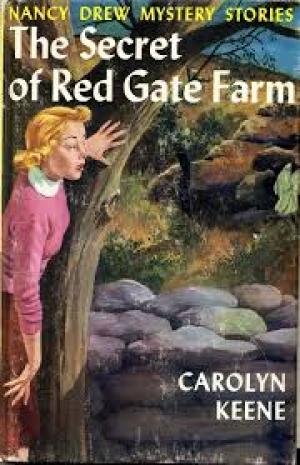
Nancy Drew and I go back to my fifth grade year at Eli Whitney Elementary in Chicago. I was already reading as many mysteries as I could get my hands on–those Scholastic Book Fairs were my favorite part of school–and I was checking out as many mysteries from the library as I could. (This was also the period of time when I discovered Phyllis Whitney’s mysteries for children; the first I read was The Secret of the Tiger’s Eye.) My fifth grade teacher had a big table in the back of the room with books for kids on them; we were on the honor system. We could borrow a book but we were supposed to return it when we finished reading it. The first day of school I wandered back there and looked at the books on the table; the first title to jump out at me was The Secret of Red Gate Farm. Above the title was NANCY DREW MYSTERY SERIES, and on the cover was a picture of a girl with wavy blonde hair, wearing a sweater and a long skirt, hiding behind a tree and looking, her mouth wide open in shock, fear or surprise, staring at the entrance to a cave  as some strangely robed figures entered it. I took it back to my desk, and started reading it.

red gate farm

“That Oriental-looking clerk in the perfume shop certainly acted mysterious, ” Bess Marvin declared, as she and her two friends ended their shopping trip and hurried down the street to the railroad station.

“Yes,” Nancy Drew answered thoughtfully. “I wonder why she didn’t want you to buy that bottle of Blue Jade?”

“The price would have discouraged me,” spoke up Bess’ cousin, dark-haired George Fayne. Her boyish name fitted her slim build and straight-forward, breezy manner. “Twenty dollars an ounce!”

“Oriental-looking.”

Sigh. The great irony is that both the Nancy Drew and Hardy Boys series were rewritten and revised to remove racist stereotypes and language…

Anyway, The Secret of Red Gate Farm enthralled me, as Nancy and her friends tried to help a young girl and her grandmother save Red Gate Farm from mortgage foreclosure while also trying to expose a ring of counterfeiters. There was a list of intriguing-sounding Nancy Drew titles on the back of the book, and back on the table in my fifth grade classroom there were three more titles: The Mystery at Lilac Inn, The Haunted Showboat, and The Clue of the Leaning Chimney. As I scoped around, there was another series novel, but it wasn’t Nancy Drew; it was the Dana Girls The Secret of the Old Well, allegedly written by the same person: Carolyn Keene.

Nancy Drew introduced me to the world of Grosset & Dunlap series–which were actually all produced, for the most part, by the Stratemeyer Syndicate. I eventually found myself reading–and collecting–many of those series, including the Hardy Boys, Dana Girls, Ken Holt, Rick Brant, Biff Brewster, Chip Hilton, and Judy Bolton, among others–I also wound up collecting Trixie Belden and the Three Investigators, too.

I always wanted to write a series like these when I was a kid; I even came up with a list of about forty titles I could use. I wrote one, actually, when I was in the fifth grade–called The Secret of the Haunted Mansion–which, to the best of my recollection, might be the first fiction I ever wrote; alas, it is lost in the mists of time. Periodically, I come back to the thought of writing such a series, but I don’t know that there’s a market for them anymore. Most of the series have gone out of print, with only Nancy Drew and the Hardy Boys, as far as I know, still available; Trixie Belden might be but I’m not sure. I still collect the books–it really pleases my OCD to have the series completed. I’m still missing a few from some of the harder to find series–like Biff Brewster and Ken Holt, and I do think I am missing a couple of Judy Boltons and Dana Girls as well–but I’ve stopped scouring eBay over the last few years because, well, money.

But at some point, I imagine I will go back and try to complete the series.

I do credit these series with a lot of my devotion to the world of crime and crime writing; while I always loved mysteries, it’s entirely possible I would have moved on to something else had I not discovered, and become addicted, to these series. These series led me eventually to Agatha Christie, Mary Stewart, Charlotte Armstrong, and Ellery Queen; and those authors eventually led me to others…and wanting to write crime fiction of my own.

So, thank you, Nancy Drew. It’s kind of your fault.

That’s the Way (I Like It)

Friday and we have made it to the end of the week, Constant Reader!

I am most pleased, and am even more pleased that I woke up before my alarm this morning. This, as you can imagine, doesn’t happen as often as I would like, and I was not only awake but functional, so I went ahead and got up. The kitchen is a mess this morning, primarily because I made dinner last night after cleaning when I got home yesterday afternoon, so I should probably do something about that before I leave for my half-day this morning. I am hoping to run to Costco after work today, and then come home to my usual Friday chores–primarily washing the bed linens–and perhaps getting back on track with writing. I really need to get back into the habit of writing some fiction every day. I do have other errands to run this weekend–making groceries being the most important of those–and I absolutely have to clean the Lost Apartment. I’ve not done the floors in forever, and the kitchen windows are filthy, absolutely filthy.

I also would love to finish reading Jamie Mason’s quite marvelous The Hidden Things this weekend. This is Jamie’s third novel; her first, Three Graves Full, was quite a stunning and brilliant debut, but I’ve been holding on to her second until she’d published another so I would always have one of her books that I’ve not read on deck. It really is quite odd that I do this; but I never want to run out of authors I enjoy’s books. (I’m still holding back on some Mary Stewarts, Daphne du Mauriers, and Charlotte Armstrongs)

I’ve also had a strong breakthrough on my short story “And the Walls Came Down,” which I reread this week, and think I can fashion with another revision into something quite marvelous. So, that’s also on the agenda for the weekend–and I’ve decided that each week I am picking one of my short stories for a reread and a final revise. At one story per week, it’s going to probably take me the rest of the  year to get them all done–I had no idea precisely how many short stories I have that are in some sort of progress–but at some point I am also going to have to finish the ones I’ve started and never finished the initial draft for–I also need to go through my journals and start digging out the short story ideas I’ve jotted down over the last year, because there were quite a few of those as well.

Paul and I watched the first season–there were only seven episodes–of a Netflix show called Bonding–which was actually quite funny at times and rather clever. The premise of the show is two former close friends from high school run into each other as adults; she is now a dominatrix and he’s an aspiring stand-up comedian who has too much stage fright to ever actually get up and do his act. He winds up working as her assistant, and they begin to bond and learn from each other while negotiating their own hang-ups and possible new relationships. I’m not entirely certain this is an accurate depiction of the BDSM community, or even of what a dom is like; but it was clever and cute and funny; and up till the last episode, we greatly enjoyed it. (The last episode got kind of weird.)

I also got some new books in the mail yesterday: They All Fall Down by Rachel Howzell Hall; Miracle Creek by Angie Kim; A Darker Shade of Magic by V. E. Schwab; and Upon a Burning Throne by Ashok Banker. I’ve bumped Rachel’s book to the “on-deck” position on my TBR pile; so I am hopeful I can get Jamie’s book finished this weekend so I can dig into Rachel’s.

I am also bound and determined to get caught up on the WIP this weekend, so I can start writing new chapters next week.

Or…I might just be a slug and lay around and not do a goddamned thing all weekend. It happens.

And on that note, tis back to the spice mines with me. Have a lovely Friday, everyone.

132690_10150115526071427_157011751426_8057788_2561006_o

Ride Like the Wind

Yesterday I felt fantastic. Yes, I overslept, not getting out of bed until a disgraceful almost ten am, had a couple of cups of coffee while checking social media and writing yesterday’s blog entry, and then buckled down to clean, organize and write. I got about 2400 words down on Chapter Ten of the WIP–which I originally thought was Chapter Nine but I had already written that chapter so this was ten, which means the first draft is over halfway done. How marvelous is that?

Pretty mother-fucking marvelous, if I do say so myself.

I slept well again last night, but set the alarm so I wouldn’t stay in bed as late. As it is, I set it for eight and hit snooze repeatedly, not to sleep more, but rather because I felt so relaxed and comfortable in the bed I didn’t want to get up. But I still have some laundry to do, a grocery store run to make (KING CAKE!), and I want to spend the day cleaning and editing a hard copy of the Scotty book. (Yes, I do my original edits on a paper copy. SUE ME.) I also want to finish rereading The Shining so I can move on to Pet Sematary. I am not reading as quickly as I used to, which is aggravating. Once I finish these two rereads, I am going to dive into reading for the Diversity Project, and I also want to get back into the Short Story Project. I also need to clean the apartment more thoroughly–I spent most of the day yesterday organizing and filing, as well as purging books. But I need to get the floors done today, and finish the laundry. This is my first full week of work since before Christmas, and I am hoping if I can focus on getting to bed at a decent hour on the nights before I have to get up early, I can get things done and not wear myself out too terribly along the way. I am not going to try the gym this week, as I need to get a handle on my work schedule and see how I can make that work, with plans to make it back to the gym this coming Friday or Saturday. There’s also no Saints game today, which makes today easier. One of the things that was amazing to me yesterday was how much time I had…it’s amazing how that works. No LSU or college football, and the day is suddenly wild and free. Go figure.

And yesterday was Twelfth Night, so it’s now officially Carnival. Hurray! The city will soon be festooned in purple, gold and green; the bleachers will be going up on Lee Circle and St. Charles Avenue on the downtown side of the circle; King cakes will have their own enormous display table at the grocery store; and that sense of anticipation of the coming madness can be felt in the air. It’s going to be weird not going to work on Parade Days, but it will also make life a little bit more interesting. I’m obviously hoping to get a lot done on those days, but we shall see how that all works out, shan’t we?

I also need to do some cooking today; trying to get food for the week ready and for our lunches. Which means making a mess in the kitchen and something else to do for the day; cleaning the mess. But I don’t like going into the week with a messy apartment; it gets messy enough during the work week when I don’t have the time or energy to keep up with it (or the filing, for that matter). So, there’s some touching up I need to do on my office space, and I can vacuum and so forth while I am editing.

Last night we started watching Homecoming on Prime. What an amazing cast–Julia Roberts, Bobby Canavale, Sissy Spacek, and Dermot Mulroney, just for starters. The plot is also interesting–we’re about half-way through. and will probably finish this evening. We may go see The Favourite  next weekend, which is kind of exciting. I can’t remember the last time we saw a non-popcorn movie in the theater. I’m sure the film is rife with historical inaccuracies–what historical films aren’t–but my knowledge of Queen Anne is fairly limited; I’ve not even read the Jean Plaidy historical fiction about her, so perhaps that won’t be too much of issue to keep me from enjoying it (I’ll watch the new Mary Queen of Scots movie when I can stream it for free; every film biography of Mary Stuart is rife with license and inaccuracy; but it’s always a great opportunity for two great actresses to chew the scenery. The 1971 version with Vanessa Redgrave and Glenda Jackson is probably, in my opinion, the best; I always picture Glenda Jackson whenever I think of Queen Elizabeth). I did know that Queen Anne had seventeen children that all died; she didn’t particularly want to be queen, and she had female ‘favorites’–it wasn’t common, but several English kings and queens had same-sex favorites, including Edward II, James I, and Queen Anne. Histories and biographies and encyclopedia entries would mention this, but gloss it over….it wasn’t until my late teens that I began putting together the coding and realized these monarchs were queer.

Yup, queers have been systematically erased from history, glossed over and forgotten, for centuries. Yay.

Part of the research/reading I am doing into New Orleans history is precisely to try to uncover the city’s queer past; trying to find the clues and coded language in books as we are glossed over and hidden from incurious minds. Every once in a while I’d find a glimmer of a hint in Gary Krist’s Empire of Sin, for example, that there were gay male prostitutes working in Storyville, and I kind of want to write about that. As I’ve said a million times before, New Orleans history is rife with terrific stories that would make for great fictions. One of the reasons I am so bitter about the Great Data Disaster of 2018 is not only because of the time spent reconstructing things but because it so completely broke my momentum and totally derailed me. I’m not sure how to get back on that streetcar (see what I did there?) but I’m going to have to relatively soon. But i’ve also been so focused on the Scotty and the new WIP that I’ve gotten away from it. I think diving back into The French Quarter by Herbert Asbury will help.

I also bought some cheap ebooks on sale yesterday, including Sophie’s Choice by Williamt Styron and Fear of Flying by Erica Jong. When I was checking the Kindle app on my iPad to make sure they downloaded properly, much to my horror I discovered that I have almost 400 books in that app–which doesn’t include the ones I have in iBooks or the Barnes & Noble app. YIKES. Clearly, I don’t need to take any books with me when I travel, because there are plenty in my iPad. I also have a ridiculous amount of anthologies and single author short story collections loaded in there…so yes, the Short Story Project will be continuing for quite some time, I suspect. There are also some terrific books in there I’d like to read, or reread, as the case may be…I have almost all of Mary Stewart’s novels on Kindle, for example, and a lot of Phyllis Whitney’s. I also have a Charlotte Armstrong I’ve not read, The Seventeen Widows of San Souci, and on and on and on….I really am a book hoarder, aren’t I?

Ah, well, life does go on.

And on that note, tis back to the spice mines with me.

524568_10151614701576714_2011628574_n

This Used To Be My Playground

GEAUX TIGERS!

I watched the Auburn-Washington game yesterday while I cleaned the downstairs. I did a lot of chores and errands yesterday; and also did some reorganizing and cleaning so the living room doesn’t look quite so…book hoarder-ish. 

I’m getting better about it. I’ve realized that the true value, for me, of the ebook is that if I read a book I really like and think I’ll want to hang on to for one reason or another, I can donate the hardcopy and buy the ebook; if I’m patient enough and pay enough attention to email alerts and so forth, I can usually get it at a much discounted price. I don’t feel quite so bad about buying ebooks at low sale prices as I would had I not paid full price already for a print version. So, I’m really buying the book twice.

(I also find myself taking advantages of sales on ebooks by a particular author whose books I loved and would love to revisit sometime. I have the entire canon of Mary Stewart on my iPad, and a shit ton of Phyllis Whitneys. I’m also occasionally finding books by Dorothy B. Hughes and Charlotte Armstrong and Dorothy Salisbury Davis, which is lovely; I’ve also managed to get some of Susan Howatch’s lengthy family sagas, like Penmarric, The Wheel of Fortune, and Cashelmara. There are many treasures to be found through e-retailers.)

And I also find that, once I’ve let go of the hard copy, I’m not usually all that anxious to buy the e-version. Most of the books I want to keep is because I think it might be something I’d want to write about in a broader, nonfiction sense; like a book about the Gothic romances of the 1960’s thru the 1980’s, what they were inspired by, and how they were books about women’s fears; yes, there was romance involved, but they were also about the dark side of romance. Or a lengthy essay or study about how gay men are portrayed in crime novels written by authors who aren’t gay men, like the rampant homophobia in James Ellroy’s Clandestine or the male/male relationship in James M. Cain’s Serenade or any number of gay male portrayals over the decades of American crime fiction. Then there are, of course, the nonfiction tomes, about periods of history that interest me that I hold onto because I may need them as research for a book or story idea that I have.

I also keep copies of books by my friends, and whenever a friend has an ebook sale I will always grab a copy if I can.

I still haven’t really shifted from reading hard copies to reading electronically, but I am slowly but surely getting there. Anthologies are really helpful in that way; short stories are, of course, self-contained and by definition can usually be completed in one sitting.

I also finished reading James Ziskin’s wonderful Cast the First Stone, and am now eighty percent of the way finished with my Bouchercon homework.

cast the first stone

Monday, February 5, 1962

Sitting at the head of runway 31R at Idlewild, the jet hummed patiently, its four turbines spinning, almost whining. The captain’s voice crackled over the public-address system to inform us that we were next in line for takeoff. I’d noticed him earlier leaning against the doorframe of the cockpit, greeting passengers as we boarded the plane. He’d given me a thorough once-over–a hungry leer I know all too well–and I averted my gaze like the good girl that I’m not.

“Welcome aboard, miss,” he’d said, compelling me to look him in the eye. He winked and flashed me a bright smile. “I hope to give you a comfortable ride.”

I surely blushed.

Now, just moments after the handsome pilot had assured us of our imminent departure, the engines roared to life, and the aircraft lurched forward from its standstill. Juddering at first as it began to move, the plane rumbled down the runway, gathering speed as it barreled toward takeoff. I craned my neck to see better through the window,  holding my breath as I gripped the armrest of my seat and grinned like a fool. I sensed the man seated next to me was rolling his eyes, but I didn’t care. Of course I’d flown before–a regional flight from LaGuardia to Albany on Mohawk Airlines, and a couple of quick hops in a single-engine Cessna with a man who was trying to impress me with his derring-do. Alas, his derring-didn’t. But this was my first-ever flight on a jet plane.

This is a terrific start to a terrific novel. The fifth book in James W. Ziskin’s highly acclaimed and award-winning Ellie Stone series, it is, alas, the first Ellie Stone I’ve read. I met the author at a Bouchercon some time back (I don’t recall which one) and of course, I’ve been aware of the awards and the acclaim, and have been accumulating the books in his series for my TBR pile, but just haven’t gotten to them yet, much to my chagrin. So while I am not a fan of reading books out of order in a series (a crime I committed earlier in my Bouchercon homework with Nadine Nettman’s wine series), I certainly didn’t have the time to go back and read the first four.

Now, of course, I am going to have to–and what a delightful prospect this is.

Ellie is a delight, for one thing. The book/series is set in 1962/early 1960’s; and Ellie is a report for the New Holland Republic, not taken terribly seriously by the men she works with or for (with the sole exception her direct editor), even though she is the best reporter and the best writer on her paper. (It kind of reminds me of Mad Men in that way.) The opening is terrific; Ziskin captures that excitement of your first jet flight in a time period where it wasn’t terribly common to fly beautifully, and using that experience to not only showcase how adventurous Ellie is but to introduce her to the new reader as well as give some of her background. She is flying out to Los Angeles to interview a local boy who’s gone out to Hollywood to be a movie star, and has recently been cast as the second male lead in one of those ubiquitous beach movies the 60’s were known for, Twistin’ at the Beach. But he hasn’t shown up for his first day of shooting on the Paramount lot, placing his job in jeopardy, and soon the producer has been murdered…and the deeper Ellie gets into her story and her search for Tony Eberle soon has her digging through the seaming, tawdrier side of the Hollywood dream and system. Saying much more would be giving away spoilers, but Ziskin’s depiction of the secretive side of Hollywood, what studios were willing to do back in the day to protect bankable stars, and what that meant to those on the seamier side of the business is heart-wrenching and heartbreaking, and sympathetically written.

I can’t wait to read more about Ellie Stone.

And now I have moved on to Thomas Pluck’s Bad Boy Boogie, the last part of my homework. LSU plays tonight (GEAUX TIGERS!), and I want to go to the gym, do some more cleaning, and do some more writing today.

So it’s back to the spice mines with me.

Nikita

I read a terrific piece about Mary Higgins Clark the other day; about how her books are really, at the barest bone, about how women cannot even truly trust men. It’s a terrific read, and I do think everyone should read this piece–draw your own conclusions. The brilliant Sarah Weinman then tweeted the piece, positing that she considers Clark the bridge between the domestic suspense thrillers of the past (writers like Dorothy B. Hughes, Margaret Millar, Charlotte Armstrong, and scores of others) to the modern day women who are killing it in the crime fiction world. On that tweet thread, someone (I think Jeff Abbott?) brought up Phyllis A. Whitney.

Now, Phyllis A. Whitney is one of my favorite writers of all time. I first read her children’s/young adult mysteries (the first being The Secret of the Tiger’s Eye, which I checked out from the library at Eli Whitney Elementary School, after which I started tearing through them. Some were available through the Scholastic Book Club, others I got from the library. I loved them all because they were always set in far off places I wanted to visit–Tiger’s Eye taught me about South Africa and apartheid; The Mystery of the Hidden Hand taught me about Greece and the black market for antiquities, etc.

My mom let me join the Mystery Guild when I was eleven, and I was very thrilled and excited to see as one of the choices, a book by Phyllis A. Whitney, Listen for the Whisperer, and I added it to my choices, filling in the little white box with the correct item number. I was also, at this same time, going through my Hollywood period, reading biographies of movie stars and producers and histories of the film industry. So, you can imagine my thrill to discover that Listen for the Whisperer also was sort of about the film industry; the main character’s biological mother, had been a major Hollywood star, even winning an Oscar, when a scandal destroyed her career; her director was murdered one night on the film set of what would ultimately be her last film, a Gothic black-and-white suspense film called The Whisperer.

It was amazing. A romance and a thriller and a murder mystery, with a lot of Hollywood background to it, it’s remained one of my favorite books of all time, and always makes any list I make of books that were important and/or formative to me.

I soon began tearing through her backlist: Thunder Heights, Seven Tears for Apollo, Blue Fire, Black Amber, Skye Cameron, The Trembling Hills, Silverhill, The Winter People, The Quicksilver Pool, Lost Island, The Moonflower, Sea Jade, Columbella, and Hunter’s Green. Mrs. Whitney continued producing work for almost another twenty years, and I read those books as they were released in paperback, later getting them as they were originally released in hardcover: Snowfire, The Turquoise Mask, The Golden Unicorn, The Glass Flame, Spindrift, Rainbow in the Mist, Woman without a Past, and Vermilion, among many others. Like her teen books, the adult novels also were often set in exotic places which Mrs. Whitney described perfectly, and you learned a little something about the places as you read about them. I also began to realize that when Mrs. Whitney went on one of her research trips, she often wrote two books set there–one for kids, and another for adults.

But the primary difference, I think, between Mary Higgins Clark and Phyllis Whitney is this: if, as the article I read (and linked to) is correct, Ms. Clark’s message is a woman can’t trust any man, then Mrs. Whitney’s was a woman can’t trust anyone, ESPECIALLY not family.

Mrs. Whitney’s books were often, not always, about a young woman trying to either obtain closure (like meeting the birth mother she never knew in Listen for the Whisperer, or confronting her estranged husband who finally wants a divorce after several years of separation in Hunter’s Green, or seeking a relationship with the child she gave up in Lost Island) or trying to get to know a family she’s never met or knew existed (Silverhill, Woman without a Past, Thunder Heights, Sea Jade). 

You couldn’t trust anyone in a Whitney novel; sometimes her killers were actually women.

A common trope in Whitney’s work was also the bad girl, who was often either married to, or engaged to, the love interest for the main character; and frequently, particularly in her earlier works, the bad girl wound up as the murder victim (Columbella, Lost Island). There was almost always a “bad girl” archetype in these books; a beautiful, sexually free woman who refused to be a submissive wife, and was sometimes, quite frankly, a nasty bitch to the main character (The Turquoise Mask, Vermilion) but eventually came over the heroine’s side and thus survived the story.

Here’s a list of all her novels (you can see, she was very prolific and her career lasted over fifty years; often publishing more than one book per year–and remember, she had to use a typewriter):

  • A Place for Ann (1941)
  • A Star for Ginny (1942)
  • A Window for Julie (1943)
  • Red is for Murder (1943), Reissued as The Red Carnelian (1965)
  • The Silver Inkwell (1945)
  • Writing Juvenile Fiction (1947)
  • Willow Hill (1947)
  • Ever After (1948)
  • The Mystery of the Gulls (1949)
  • Linda’s Homecoming (1950)
  • The Island of Dark Woods (1951), Reissued as Mystery of the Strange Traveler (1967)
  • Love Me, Love Me Not (1952)
  • Step to the Music (1953)
  • Mystery of the Black Diamonds (1954)
  • A Long Time Coming (1954)
  • Mystery on the Isle of Skye (1955)
  • The Quicksilver Pool (1955)
  • The Fire and the Gold (1956)
  • The Highest Dream (1956)
  • The Trembling Hills (1956)
  • Mystery of the Green Cat (1957)
  • Skye Cameron (1957)
  • Secret of the Samurai Sword (1958)
  • The Moonflower (1958)
  • Creole Holiday (1959)
  • Mystery of the Haunted Pool (1960)
  • Thunder Heights (1960)
  • Secret of the Tiger’s Eye (1961)
  • Blue Fire (1961)
  • Mystery of the Golden Horn (1962)
  • Window on the Square (1962)
  • Mystery of the Hidden Hand (1963)
  • Seven Tears for Apollo (1963)
  • Secret of the Emerald Star (1964)
  • Black Amber (1964)
  • Mystery of the Angry Idol (1965)
  • Sea Jade (1965)
  • Columbella (1966)
  • Secret of the Spotted Shell (1967)
  • Silverhill (1967)
  • Hunter’s Green (1968)
  • Secret of Goblin Glen (1969)
  • The Mystery of the Crimson Ghost (1969)
  • The Winter People (1969)
  • Secret of the Missing Footprint (1969)
  • Lost Island (1970)
  • The Vanishing Scarecrow (1971)
  • Nobody Likes Trina (1972)
  • Listen for the Whisperer (1972)
  • Mystery of the Scowling Boy (1973)
  • Snowfire (1973)
  • The Turquoise Mask (1974)
  • Secret of Haunted Mesa (1975)
  • Spindrift (1975)
  • The Golden Unicorn (1976)
  • Writing Juvenile Stories and Novels (1976)
  • Secret of the Stone Face (1977)
  • The Stone Bull (1977)
  • The Glass Flame (1978)
  • Domino (1979)
  • Poinciana (1980)
  • Vermilion (1981)
  • Guide to Fiction Writing (1982)
  • Emerald (1983)
  • Rainsong (1984)
  • Dream of Orchids (1985)
  • Flaming Tree (1986)
  • Silversword (1987)
  • Feather on the Moon (1988)
  • Rainbow in the Mist (1989)
  • The Singing Stones (1990)
  • Woman Without a Past (1991)
  • The Ebony Swan (1992)
  • Star Flight (1993)
  • Daughter of the Stars (1994)
  • Amethyst Dreams (1997)

She won two Edgars for her mysteries for children, and was eventually named a Grand Master by the Mystery Writers of America.

I did sometimes get frustrated with her heroines for being more wimpy than they needed to be; usually, though, the course of the novel allowed her heroines to become more confident in themselves as well as to work through whatever neuroses they had at the start of the novel. And like I said, a common theme was damaged families. Her books, along with those of Victoria Holt and Mary Stewart, were labelled as romantic suspense, but I think female noir is actually a better label for them; and as an adult, I really don’t think Stewart’s books actually are romantic suspense…but that’s a topic for another time.

And now, back to the spice mines.

freddie stroma

Don’t Stand So Close to Me

SATURDAY! I’ve already been to the gym–I did not want to wake up this morning and head over there, but like a good boy I did–and now am getting ready to clean the kitchen, make my post workout protein shake, and make a grocery list. I have the galleys of a pseudonymous novel to finish going over today, and I also want to get some more revisions done on the WIP. I have big plans for today, obviously, but we’ll see how it all turns out. I’m almost caught up on American Gods (one more episode to go and I’ll be current), and we also started watching 11/22/63 on Netflix this week–it auto-started after we finished this week’s episode of The Handmaid’s Tale–and we’re enjoying it. It’s very strange to watch something based on a Stephen King novel which I haven’t read; it’s one of the few I’ve not read (including the last three volumes of The Dark Tower, Black House, The Girl Who Loved Tom Gordon, Doctor Sleep, Bronco Billy, and End of Watch) and wasn’t, honestly, feeling all that inspired to read it–I wasn’t all that inspired to watch it, either; the whole Kennedy thing doesn’t really interest me anymore–but we are really caught up in the show, which makes me tend to think the book (which is almost always better than visual adaptations) is probably fantastic; it’s just so damned long. Paul and I have been talking about taking a long weekend and going back to a tennis resort like we did a couple of years ago; if we do that, I’ll probably take 11/22/63 with me to read.

I haven’t had the time to really get further in Ill Will, which is also something I hope to get further along with this weekend. The writing is exceptionally good, and I love the entire premise of the book, too. I’ve not read Chaon’s Await Your Reply, but I do have a copy of it as well. I’ve heard a lot of good things about Chaon; Ill Will is certainly bearing those good things out. And isn’t lovely to find a new writer you enjoy?

Yes, it is. Always.

I’ve also been rereading Mary Stewart’s Airs Above the Ground this week, which is one of my favorite books of all time–Mary Stewart was simply brilliant. I love the premise behind the opening of this novel, just as I loved the premise of The Ivy Tree, and so many other of her books; I’d love to recycle those premises as an homage to her at some point; who knows? Every time, though, I reread a Mary Stewart novel I remember my friend Sara come up to me at a Bouchercon and telling me someone had said on a panel she was watching that “Mary Stewart’s heroines were just too passive for his/her tastes.” I was as appalled as Sara; Mary Stewart’s heroines were not passive; they had agency, didn’t need to be rescued,  and went sailing forth happily into adventures. Airs Above the Ground’s Vanessa March was one of those amazing heroines; and the premise–someone saw her husband on a newsreel somewhere he wasn’t supposed to be, and so naturally she heads off to find out what he’s doing, all the while suspecting he is having an affair. God, how I would love to use that same style of opening…but the premise of The Ivy Tree is even better; a young woman is hired to impersonate another young woman–missing for years–in order to manipulate a dying man into making sure his will leaves his estate to the people who hired her. So fucking brilliant, really.

And now, it’s probably best for me to return to the spice mines. Them galleys ain’t going to proof themselves.

Here’s a Saturday hunk for you:

d954e593-4f28-4cc2-a9a1-43150d9615e0_thumb