Sunglasses at Night

Sunday morning. Last evening I went to a Christmas party and had an absolutely lovely time; but stayed much longer than was probably warranted and got home much later than I should have. But there were lots of laughter, and I got to hang out with friends that I don’t see nearly enough, and so overall, I would classify it as a win. I also slept beautifully and deeply and restfully after getting home, so that, too, was absolutely lovely.

Today I have to do a lot of writing; I finished a project yesterday, which was also lovely, and managed to get the cleaning of the downstairs finished. Today I will move to the upstairs, doing cleaning and organizing when I take breaks from the writing/editing I have to do. I also will read some more of Donna Andrews’ How the Finch Stole Christmas when I can; hopefully wrapping up reading it this evening as well. I’m not sure what I am going to read next; I am rather torn between a reread of George Baxt’s A Queer Kind of Death, Joan Didion’s Miami, Dashiell Hammett’s The Dain Curse (also a reread), or something else in the pile. I also haven’t done my annual reread of Rebecca, but I think I am going to save that for actual Christmas. There are also some other duMauriers lying around the apartment I haven’t read that I need to (The House on the Strand, The Progress of Julius, The Scapegoat), some Ross MacDonalds, many Margaret Millars, and so many other books by writers I adore and am way behind on–I still have Stephen Kings that are languishing on my shelves, unread–and of course, come January it’s going to be Short Story Month again.

I also have another short story to write that I keep forgetting about, which, of course, is insane. (Note to self: put post-it note up on computer.)

But the good news is I am finally feeling motivated again about writing; this past year hasn’t been, for me, a good one as far as writing is concerned. I had a long conversation with my friend Susan last night about the current Scotty and the problems I’m having with it–and of course, while talking about the problems out loud with her I solved the problem. (It really is amazing, isn’t it, how saying things out loud can make a difference and make you see what’s been missing? The same thing happened with the WIP when I was chatting about it with my friend Wendy in Toronto–as I spoke I could see in my head what I needed to add, and then she put her finger right on the problem and pointed it out just as I was coming to the realization, which confirmed that it was the correct one. Again, it’s all a matter of having the time to make these fixes, but now that I know whatI need to fix, well, that makes it all a lot easier.

I also finished post-it-noting Garden District Gothic yesterday while watching the first half of the SEC championship game, so the Scotty Bible also proceeds apace, which is also lovely.

So much I need to get done this month!

And on that note, it’s back to the spice mines.

CalvinKlein11

Our House

..in the middle of our street.

We will not be discussing the embarrassment that was last night’s LSU “game.”

Friends are in town, and we had lunch with them at Commander’s Palace yesterday, which was lovely. I didn’t read the menu carefully and got something that had fried eggs on the top–which ran with yolk when you broke it; shudder–but I simply pushed them away with my fork and ate everything else. I was very tired after that, and came home, worked for a little while, and then curled up with Liane Moriarty’s The Husband’s Secret. I had read Big Little Lies concurrently with watching the HBO series, and enjoyed both the book and the show, so wanted to read another one of her novels. I wasn’t quite sure what I was expecting with this one–the jacket blurb mentioned that a wife finds a sealed envelope addressed to her from her husband, with the words To be opened only in the event of my death.

I would have opened it immediately, of course.
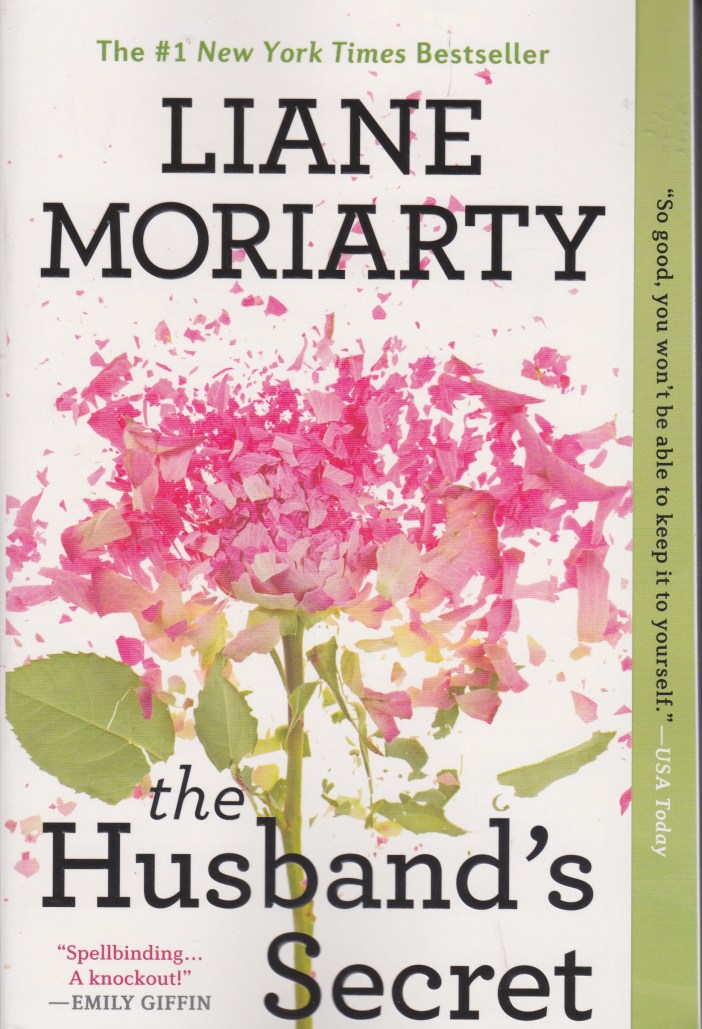
the husband's secret

It was all because of the Berlin Wall.

If it weren’t for the Berline Wall, Cecilia would never have found the letter, and then she wouldn’t be sitting here, at the kitchen table, willing herself not to rip it open.

The envelope was gray with a fine layer of dust. The words on the front were written in a scratchy blue ballpoint pen, the handwriting as familiar as her own. She turned it over. It was sealed with a yellowing piece of sticky tape. When was it written? It felt old, like it was written years ago, but there was no way  of knowing for sure.

She wasn’t going to open it. It was absolutely clear that she should not open it. She was the most decisive person she knew, and she’d already decided not to open the letter, so there was nothing more to think about.

Although, honestly, if she did open it, what would be the big deal? Any woman would open it like a shot. She listed all her friends and what their responses would be if she were to ring them up right now and ask what they thought.

Liane Moriarty is compulsively readable. And that’s not a quality in an author that should be dismissed lightlyAs I mentioned the other day with Louise Penny, it’s hard to classify Moriarty’s work; there’s a crime involved, but is it really crime fiction? I’m not sure it’s marketed that way; this book has a jacket blurb from Anne Lamott, for example, rather than Sue Grafton or Sara Paretsky. She is an enormous bestseller; which is no small feat for an Australian writer to accomplish in the United States, particularly when she is writing about Australia (although Colleen McCullough was quite successful in the US with The Thorn Birds, before she turned to ancient Rome). She structures her books around three women as the main characters; and she writes about the issues that concern women–I suppose, in a way, her novels could be classified as modern domestic suspense. Like the previous masters of domestic suspense (a classification title I am still not entirely convinced I like), she writes about every day women thrust into extraordinary situations, and she also shoehorns in some brilliant social commentary along with social issues, like Margaret Millar and Charlotte Armstrong and Dorothy B. Hughes did. The books are, as I said, compulsively readable and hard to set aside until you’ve reached the end.

Women writers, no matter their success, are rarely taken as seriously as male writers. I’m not sure if it’s because women writers tend to focus on women and issues that affect them while men, in theory, tackle larger themes. Male characters written by men are off saving the world in genre fiction, bedding fabulous babes and getting into fistfights, surviving by their skills or because their masculinity is superior to that of the bad guys. Or the male characters are finding dissatisfaction and misery in their maleness (I’m looking at you, literary fiction), prisoners of societal expectations of manliness and resenting putting aside their fantasy of what their life should be and having to settle for something that is less than that fantasy. Rarely do you find male characters (I’m not saying they don’t exist, so don’t come after me; I am fully cognizant of the fact that these are all incredibly broad generalizations) who are struggling with the work/home balance, juggling having to have a career and an income with finding time to be participants in their children’s lives or even, for that matter, simply helping around the house.

Men do not drive the story in Liane Moriarty’s novels, but they do impact it. They serve as catalysts for her stories, but her books are about the women whose lives are impacted by the men in them.

The Husband’s Secret,  like Big Little Lies, tells the story of three women whose lives intersect due to a private grammar school, St. Agatha’s in Sydney. Rachel is the aging part-time school secretary, widowed and haunted by the unsolved murder of her teenaged daughter many years before. The loss of her daughter has embittered her, and the only thing she basically has to live for is her grandson. Her story is set into motion when the perfect daughter-in-law she doesn’t much like and her son tell her that Lauren, the daughter-in-law, is being sent by her company to New York for two years, taking the only thing in her life she cares about–the grandson–away from her; just as her daughter was taken from her some twenty-five years or so earlier.

Tess’ world has just been ripped apart by the announcement by her husband and her best friend/first cousin that they are in love and want to be together–but out of respect for her having consummated the relationship. Her cousin, Felicity, is like a sister to her; their mothers were twins and they were born within days of each other. Felicity also used to be overweight; over the past year she has lost weight and become beautiful. Tess, betrayed and hurt, uses her mother’s recent accident in which she broke her ankle as an excuse to grab her son Liam and leave Melbourne, returning to Sydney to sort out her life and her future–enrolling young Liam in St. Agatha’s.

Cecilia, the third woman, is like Madeline in Big Little Lies; married, highly competent and efficient, the organizer that winds up running everything and basically being Supermom. She married a handsome rich man, and they have three daughters together. She’s hardly as confident as she seems; it’s a veneer to protect her and hide her own insecurities as she ruthlessly organizes her life and tries to put the world in order–one of those people who are basically exhausting to talk to; who leave you tired and drained when you finish speaking with them and you aren’t sure why.

Their lives intersect primarily because of the letter Cecilia finds in her attic, although Tess is less involved with the other two women, only peripherally floating into their orbit through the school, but the book’s theme is grief and motherhood and how these three different and incredibly complex women deal with both. What sacrifices do mothers have to make for their children, and what do they owe themselves? What is too far, too much, and where do you draw the line? Rachel’s life was decimated by her daughter’s murder and the lack of a conclusion to the story; to the extent that she walled herself up away from the rest of her family, and her relationship with her son has suffered–it is only through the events of this book that she finally realizes that her son is suffering not only from the loss of his sister and the loss of his father but from the loss of his mother. What does Tess owe to her young son in the wake of the apparent end of her marriage, and the horrific betrayal by her husband and her cousin? Does she try to ride out this love affair, rise above her own hurt and anger and put her child first? Is it better for Liam if she ends the marriage or tries to get past everything and forgive him, if that’s the option? She also is forced to take a long hard look at her own life at who she is and who has become as a person, and who does she want to become?

Cecilia’s journey is, of course, the most shattering. Her husband’s secret, contained in the letter, turns her world upside down and inside out; nothing is what she thought it was, what she believed, and she too is faced with a horrible choice: any decision she makes is going to be incredibly difficult to live with–but what can she live with for the sake of her daughters?

There is some reader manipulation; it’s important for the narrative that Cecilia not read the letter until a certain point, and when she does, the chapter ends with her starting to read–which felt unfair, particularly as the book shifted to another viewpoint in the next chapter. It would have been just as effective, I thought, for the text of the letter to appear and not show Cecilia’s reaction before shifting to the other viewpoint; that’s the editorial and/or authorial I would have made. It just kind of felt manipulative.

The book is very clever, certainly smart–I enjoy the way Moriarty writes, and she has a great way of finding the word rhythm that works, slightly altering those patterns as she shifts from viewpoint to viewpoint to give the reader a stronger sense of the character and their voice; a nice hat trick which is not easy to pull off. The decisions the women make–all affected by the letter Cecilia finds–may not be happily ever afters, but are all things they can, they find, live with. They can go on, they can endure, they can survive.

And maybe that is a happily ever after, after all.

After finishing this, I started reading Lisa Unger’s In the Blood, which immediately grabbed my interest; it was hard to put it down in order to get sleep.

And now, back to the spice mines.

Allentown

I was so tired last night when I got home from work–and I worked a short day! After work yesterday, a friend and I went to lunch to a place on the corner of Tulane and Carrollton called Namese, and I had an enormous  bowl of beef pho, which was absolutely delicious. I was in the mood for noodles, and having never actually had pho before, was quite thrilled to try it, and it was amazing. I’ve been wanting to try pho since seeing a show on our local PBS channel, WYES, about the big Vietnamese community in New Orleans, and one of the things they talked about on the documentary was pho. I’d been wanting to try it ever since, and got my chance.

DAMN THAT WAS GOOD.

I’d known we have a big Vietnamese community in New Orleans for quite some time–most of them live in New Orleans East, and were devastated by the flooding after the levees failed back in 2005. Poppy Z. Brite wrote about that community in his brilliant (and deeply disturbing) Exquisite Corpse, doing it so well I never had the nerve to try to write about it myself. (Our first, and only,  Congressman from Orleans Parish was a Vietnamese; Joseph Cao, who defeated “Dollar Bill” Jefferson in the post-Katrina scandal created by the fifty thousand dollars in cash he had stored in his home freezer. Cao was born in Ho Chi Minh City (then called Saigon), and only served one term in Congress–but I liked Congressman Cao; he put New Orleans ahead of party, and I was sorry to see him go.

I have an idea for a noir involving the Vietnamese communities of the Gulf Coast that I hope to write some day. I’ve also been toying with an old idea for a horror novel that’s been dancing in my head for the last thirty years or so–I can tell that I am writing another book; my creativity always spikes when I am writing a book.

Honestly. One would think I could get that under control.

Anyway, I also finished reading Margaret Millar’s Do Evil in Return last night. It wasn’t the below edition I read, but rather one of the volumes of The Collected Millar; this volume also contains Fire Will Freeze, Experiment in Springtime, The Cannibal Heart, and Rose’s Last Summer. But I rather like that Gothic-style cover.

millar-do-evil-in-return-lancer

The afternoon was still hot but the wind carried a threat of fog to come in the night. It slid in through the open window and with curious, insinuating fingers it pried into the corners of the reception room and lifted the skirt of Miss Schiller’s white uniform and explored the dark hair of the girl sitting by the door. The girl held a magazine in her lap but she wasn’t reading it; she was pleating the corners of the pages one by one.

“I don’t know if Dr. Keating will be able to see you,” Miss Schiller said. “It’s quite late.”

The girl coughed nervously. “I couldn’t get here any sooner. I–couldn’t find the office.”

“Oh. You’re a stranger in town?”

“Yes.”

“Were you referred to Dr. Keating by anyone?”

“Referred?”

“Did anyone send you?”

Margaret Millar is a treasure, and her work, despite now being dated because of societal and social changes, are worthy of not only being read by modern audiences but also deserving of study. She, along with Dorothy B. Hughes and Charlotte Armstrong, formed a triumvirate of strong women writing suspense novels featuring women protagonists that were the equal of anything written by male contemporaries; there were numerous other women doing the same, but these three had longer careers and are now being rediscovered, in part thanks to the diligent work of Sarah Weinman and Jeffrey Marks. Library of America has released a two-volume collection of works by great women writers of the time; Soho Crime is releasing thick volumes collecting all of Millar’s work, which I am happily acquiring. I read Armstrong when I was young, and loved her; I am in the process of working my way through the canons of both Millar and Hughes, as well as two other great women writers of the same period, the incomparable Patricia Highsmith and my personal hero, Daphne du Maurier.

Do Evil in Return, originally published in 1950, is ultimately a novel about how society and its hypocritical misogynistic treatment of women can destroy them. The main character of the novel, Dr. Charlotte Keating, is a strong, independent woman with a successful practice in a small California coastal town. She is both single and hard-working; owns her own car and her own home–no small feat for a woman in 1950–and the book opens with a young woman coming to her for help. The woman, Violet O’Gorman, is only twenty and married, but finds herself with a particular problem; estranged from her husband, she had a one-night stand with a married man which has left her pregnant, and she is desperate for an abortion, which of course was illegal in 1950. Dr. Keating–Charley to her friends–refuses to break the law and perform this service, but her heart goes out to her patient and wants to help her, but while distracted by a phone call doesn’t notice the girl slipping out of her office. With a local address her only clue as to how to find Violet, she goes looking for her…and soon finds herself wrapped up in a terrible string of events beyond control, a noose tightening around her own neck. For, like her patient, Charley herself is involved in a love affair with a married man–a platonic one, to be sure, for she refuses to become intimate with him as he is married–and the similarities she sees between herself and young Violet is part of what drives her. The following morning, Violet’s body washes ashore, an apparent suicide, according to the police but Charley herself isn’t so sure.

And of course, she is right.

Millar’s particular genius lies in how casually she lays out her cards; she never tells her reader straight out what’s going on, but allows it to unfurl naturally, leaving it to her reader to figure it out. When we meet Charley’s platonic lover, there is no mention of his being married–Millar simply talks about the stifling existence he has at home with Gwen. As the story continues the reader slowly realizes that Gwen is actually his wife, and she is also one of Charley’s patients. Charley has tried to foist Gwen off on other doctors, but hypochondriac Gwen refuses to see anyone else–and is incredibly needy, ringing Charley for help at all hours of the day or night. Charley’s own feelings for Gwen’s husband also aren’t that simple; and in 1950 divorces weren’t as easy to obtain as they are today.

Perhaps the strongest part of the book is how Millar clearly depicts how claustrophobic a woman’s world was in 1950, and the delicate balance a single, independent professional woman had to maintain. Exposure of the relationship would ruin Charley, both personally and professionally; just as Violet’s unexpected pregnancy has ruined her. Society’s expectations of women, and their sexuality, are the true villains, the true evil in this novel; and the realization that this world Millar so brilliantly depicts was only sixty-seven years ago is truly chilling.

I think this book would be excellent reading for a Women’s Studies course; to let young women know how truly awful and misogynistic society was not so long ago, as a reminder to everyone today how far women have come in a short period of time, and how hard they fought to get to where they are today.


Stray Cat Strut

Friday!!!!

I have almost made it through this short week–I am working tomorrow before we head up to Baton Rouge for the LSU-UT Chattanooga game–and am pretty happy about it. It seemed off this week; I’m not sure what that’s about. We’ve had a chilly week here–for September, it’s been in the 70’s without humidity, which is November weather, really. I’ve slept fairly well, despite waking up a couple of times per night, and each morning have not wanted to get up. I may get up tomorrow morning so I can get the groceries and run errands prior to going to the office–get that out of the way so I can sleep late Sunday, since we’ll probably not get back from Baton Rouge until around midnight.

This week my short story “Keeper of the Flame” came out in Mystery Weekly magazine, and I am inordinately proud of this. Short stories are so hard for me to write, so each sale of one makes me feel like I’ve truly accomplished something.  I struggle so much with short stories…I have so many right now that aren’t finished, but I am trying to get the edits input and the first draft of the new Scotty written and … and…and…

I also got pretty deep into Margaret Millar’s sublime Do Evil in Return, and can’t wait to finish reading it so I can post about it. It’s so extraordinary!

Anyway, if you want to read “Keeper of the Flame”, you do have to pay for it, alas. This is the link to the preview of the story, to give you an idea of whether you want to read it or not:

http://mysteryweekly.com/issues/keeper.asp

You can buy the magazine in either print or e-form here:

https://www.amazon.com/dp/1549639919/

And you can also buy or subscribe here:

http://www.mysteryweekly.com/subscribe.asp

Do support markets that pay–even in a small amount–for short crime fiction!

Here’s a hunk to get your weekend rolling, former Tarzan actor Gordon Scott:

20728242_10212670337849946_4851579278645951324_n


1999

So, I had to go to the DMV this morning to renew my driver’s license, which had expired on my birthday and I hadn’t realized it, like an idiot. The DMV is never a great experience, and yesterday was no exception to that rule. But I was able to finish reading Christopher Golden’s Ararat while I was there, which made the time pass much faster (I was there slightly less than two hours) and I did end up taking what had to be the worst driver’s license photo in history–at least my personal history of driver’s license photos. Insult to injury? My last one looked terrific. Heavy heaving sigh.

Even more insult to injury? It looks like me.

Ah, well.

You have to hate that. Anyway, I managed to finish reading Ararat, which was enjoyable, and this evening I started reading Margaret Millar’s Do Evil in Return, which is quite marvelous.

ararat

Just past eight o’clock on the last morning of November, the mountain began to shake.

Feyiz froze, breath catching in his throat as he put his hands out to steady himself, waiting for the tremor to end. Instead it worsened. His clients shouted at him in German, a language he did not speak. One of the men panicked and began to scream at the others as if the devil himself were burrowing up through the heart of the mountain to reach them. They stood on the summit, vivid blue sky rolling out forever before them, the frigid air crisp and pure. An idyllic morning on Mount Ararat, if the world had not begun to tear itself apart.

“Down!” Feyiz shouted. “Get down!”

He dropped his trekking poles and sank to his knees on the icy snowpack. Grabbing the pick that hung at his hip, he sank it into the ice and wondered if the six men and three women in this group could even hear him over the throaty roar of the rumbling mountain.

The Germans mimicked his actions.

I read an essay recently which discussed how, out of all the types of genres and subgenres in literature, that horror is the most faith-based of them all. It sounded absurd at first, but as I read the essay and thought about it more–and have, obviously, continued to think about it–that premise is pretty spot-on. Not all horror is faith-based, of course; there’s nothing about faith in films like Halloween or any number of horror novels I could think of (The Other, for example); but so many of them actually are that it’s kind of fascinating; especially when you take into consideration the way religious groups generally condemn horror books and films. The Exorcist is deeply rooted in Catholicism; and to name two, neither The Omen nor Rosemary’s Baby could have been written without knowledge of the Christian Bible. Ghost stories are predicated on the idea that there is life after death; that the soul continues to live on and needs to move on to another plane–whether that be heaven or hell, those books rarely make the distinction. The existence of the supernatural in a lot of horror proves that faith, and religion, are real and true; and after all, isn’t religion itself supernatural? I have made the offensive (to Christians) joke about Easter being a celebration of a zombie; and if you can get past the faith and look at any religion and its rituals, you can see what I mean.

I blaspheme, of course. I am an apostate heretic who would have burned not so long ago in our history.

I’ve read Christopher Golden before; I greatly enjoyed his Dead Ringers, and have Snowblind in my TBR pile. This week I took his Ararat out of the pile to read, and it again put me in mind of how so much horror fiction is dependent on religion for its existence. The opening scene quoted above, of an earthquake shaking Mount Ararat in Turkey, ends with a tremendous landslide, one which greatly changes the geography and the face of the mountain itself, long purported to be the final resting place of Noah’s Ark. The existence of the Ark, of course, would prove that the Bible is, at least in this instance, literally true (although Christianity is not the only belief system from the Middle East that tells of an ancient flood); there have been reports in the past that it has been found; but the likelihood of wood thousands of years old surviving is not great. But this landslide opens a new cave on the side of the mountain, high up; and soon the race is on to be the first to scale the mountain and see what’s inside the cave. The first section of the book has to do with one particular team racing to beat several other’s to the cave; risking their lives in the process. But the team–lead by adventurous couple David and Meryam, who explore and write books and make documentaries about their exploits–that arrives first soon discovers that the cave isn’t really a cave but the Ark itself…and there’s something else there that should have never been discovered.

To tell anymore would, of course, risk spoiling the story; there are so many twists and turns and scares and shocks that to give away anything more than is contained in the cover jacket blurb would be a disservice to future readers and to author Golden. But I couldn’t stop reading; resented having to put the book down, and was very satisfied when it was finished. Golden also includes diversity of characters in all of his books and does it casually; I also appreciate the fact that he chooses not to describe non-white characters in terms of food or drink–I could go the rest of my life without reading about “cinnamon” or “chocolate” or “cafe-au-lait” skin.

But just think about it for a moment–if the story of Noah is actually true, the flood changed the world and refreshed it; a reboot by God, as it were, and there are some verses in Genesis that show how different the original world was before it was cleansed–the one that readily comes to mind is There were giants in those days.

I look forward to reading more of Mr. Golden’s work.


You Can’t Hurry Love

I read a lot this weekend! I did work on the writing a little bit, but not nearly as much as I could/should have. I finished reading the Highsmith, reread The Exorcist, and finally got to Ross MacDonald’s The Drowning Pool, which I read yesterday afternoon, and then last night while watching the US Open I started reading Christopher Golden’s Ararat (which is great fun so far; I’m a little less than halfway through and having a great time reading it).

It might interest you to know, Constant Reader, that I’d never read Ross MacDonald until I was on a panel somewhere with Christopher Rice, either in 2002or 2003, and Chris mentioned MacDonald as one of his favorite writers/greatest influences. I’d read John D. MacDonald and Gregory McDonald; but had somehow never gotten around to Ross. I knew of the Lew Archer series, of course, but had never read any of them, nor any of his standalones. Based on Chris’ recommendation, I started reading them, and never looked back–although I have been slowly doling them out, as there is a limited amount of them and no new ones coming anytime soon. I was a little surprised, after finishing The Exorcist, to pick up The Drowning Pool and realize it was one I hadn’t read.

411U1dmvA2L

If you didn’t look at her face she was less than thirty, quick-bodied and slim as a girl. Her clothing drew attention to the fact: a tailored sharkskin suit and high heels that tensed her nylon-shadowed calves. But there was a pull of worry around her eyes and drawing at her mouth. The eyes were deep blue, with a sort of double vision. They saw you clearly, took you in completely, and at the same time looked beyond you. They had years to look back on, and more things to see in the years than a girl’s eyes had. About thirty-five, I thought, and still in the running.

She stood in the doorway without speaking long enough for me to think those things. Her teeth were nibbling the inside of her upper lip, and both of her hands were clutching her black suede bag at the level of her waist. I let the silence stretch out. She had knocked and I had opened the door. Undecided or not, she couldn’t expect me to lift her over the threshold. She was a big girl now, and she had come for a reason. Her stance was awkward with urgency.

“Mr. Archer?” she said at last.

“Yes. Will you come in?”

“Thank you, Forgive me for hanging back. It must make you feel like a dentist.”

“Everybody hates detectives and dentists. We hate them back.”

The Drowning Pool is hard-boiled, borderline noir (based on the fact that Archer works as a private eye), and can’t you imagine the above scene being played, in black-and-white by either Humphrey Bogart or Robert Mitchum, talking to either Gloria Grahame or Ida Lupino or Barbara Stanwyck? The story is simple: Archer is hired by the wealthy-seeming Mrs. Slocum to find out who has written her husband a poison-pen letter accusing her of adultery; back at the time the book was written, adultery was one of the few grounds for divorce recognized in every state. But as Archer begins to investigate, turns out Mrs. Slocum and her husband don’t have money; the money belongs to her mother-in-law, and she keeps them on a tight leash. Her estate is also sitting on a lot of oil, which she refuses to allow anyone to drill for, which would in turn make them even filthier rich. The elder Mrs. Slocum winds up dead in the swimming pool during a party, and soon the case begins twisting and turning left and right–and more bodies continue to pile up as Archer tries to get to the bottom of what is going on at the Slocum estate. It’s a great, fast read–and MacDonald’s grasp of language is extraordinary.

There’s a reason why MacDonald is up there with the greats of crime fiction.

There’s also an interesting subplot–almost a throwaway–about why the second Mrs. Slocum’s marriage is an abject failure. MacDonald doesn’t spend a lot of time on this, but it’s there for the queer reader to pick up on. It would be interesting to compare and contrast this book with MacDonald’s wife, Margaret Millar’s, Beast in View, released a few years later. There’s also an interesting comparison to be made between The Drowning Pool and James M. Cain’s Double Indemnity, in the character of Mrs. Slocum’s daughter Cathy, and the daughter in Cain’s book; also, an interesting comparison between this book could be made with Hammett’s The Maltese Falcon.

Maybe someday when I have more time.


Every Little Thing She Does is Magic

Good morning, Sunday! I slept extremely well last night, and am working on getting through my ‘just-woke-up’ grogginess with some coffee while Paul watches the French Open final (Go Rafa!) while figuring out what I need to get done today (besides the obvious revisions/rewriting). I was exhausted yesterday–the combo of getting up early for Wacky Russian to running errands and so forth wore me out so completely I dozed off a couple of times in my easy chair while reading the brilliant Dan Chaon’s Ill Will, which is quite exceptional and extraordinary. I am also rereading Margaret Millar’s simply brilliant The Fiend as well.

Although both are so good they make me despair. Heavy sigh.

We also finished watching 11/22/63 last night; it was disappointing at the end, but I kind of figured it would be; it was a great premise but at the same time, how do you change history? Time travel is also full of logical and logistical problems–I think one of the (very) few times it worked in a novel was Dean Koontz’ Lightning, which I loved; it also worked in (only) The Terminator–all the sequels, at least the ones I saw, broke all the rules of paradox; which Koontz went into great detail about explaining in Lightning, and was great about sticking to the rules. I hoped King would be able to pull it off as well–and he may have, in the book–but the show didn’t. I do look forward to reading the book…not sure when that will be, of course, I feel pretty certain about what I’ll be reading next, and I have such a massive TBR pile….well, then again one never knows, although the next King I will probably tackle will be End of Watch.

And in other exciting news, Orphan Black is back for it’s final season. Huzzah!

So, I think I am going to get some cleaning done while I wake up. And congratulations to Rafael Nadal, for his 15th Grand Slam title and ridiculous 10th French Open title! Here he is, for Armani.

nadal-armani