Get Used to It

Wednesday Pay the Bills Day blog! And it’s also the middle of the week, and the three day weekend looms large. I don’t feel tired or groggy this morning, which is odd, but hey–what can I say? I slept well and feel good. The coffee is also good this morning, and I had the last piece of king cake this morning (yes, it’s all gone already and no, I didn’t have more than three smallish pieces); I’ll pick one up on the way home from work tonight, as I have to make some groceries to get us through until the weekend. I can’t wait for next week, when miraculously all prices will suddenly drop by at least 75% and gas will be back to a dollar. Woo-hoo, life-changing! As if. The presidential troll has already walked that lie back, as he is walking all of his campaign lies back, and things will just be worse, and of course, it’ll be the fault of Democrats somehow, despite the Right controlling all three branches of government and are going to overplay their hand (they always do)–but they will not give up power voluntarily so we’re looking at violence in the next election (should there be one) as the republic continues to limp on and try to recover from the latest Republican attempt to turn the entire country into Alabama. (And I say that as someone from Alabama–although Mississippi, Arkansas, and Tennessee would work just as well.) I mean, if you want to get a sense of what one-party Republican rule looks like, pick a fucking red state and see how it’s doing on every scale of quality-of-life metrics. Funny how regularly blue states aren’t on government welfare, isn’t it? So why would a view of politics and government clearly doesn’t work on a state level work on a national one?

Oh yes, Black and Brown people. You can never go wrong boiling everything right-wing to bigotry and prejudice of some sort. People will always vote against their best interests if you consistently tell them they are oppressed and play to their most basic instincts–it’s not YOUR fault, it’s Black/Brown/gay/trans people’s fault! THEY’RE TAKING AWAY YOUR BIRTHRIGHT!

Ironically, the “party of personal responsibility” loves to blame everyone else for their utter and complete failures.

The Internet continued to roil yesterday over the latest publishing scandal, and it’s even more amazing how many people “just had that vibe about him” and “everyone at his publisher knew not to leave female interns around him” and so on–to me, the latter goes to show how people in power covered for their cash cow, and while I know it’s generally not smart to take shots at big name people who are generally beloved, some of this anger should be directed at the institutions that covered for him and allowed him to get away with it for so long? There’s absolutely nothing wrong with trusting someone who has been kind or generous or supportive of you; I tend to not ask people who are that way with me whether or not they have problematic behaviors or values or beliefs; no one does. When you get a good impression of someone you tend to not look for reasons to not like them. Abusers are generally masters at gaslighting, and sadly, you can’t tell by looking at someone that they are a predatory abusers with a trail of victims in their wake. I also don’t feel like the gaslit people an abuser fooled need to publicly made statements or so forth to distance themselves. I get that the natural instinct is to make sure no one thinks you sympathize with them, or are a collaborator or are complicit, but I also don’t think it’s necessary, either. I also get that it’s hard when your hero takes a fall–which is why I think hero-worshipping is usually a mistake. People are fallible; that design flaw is baked in. You’re always going to be disappointed when someone you’ve given your money and your affections to do something that is against your values and system. But…no one’s values or beliefs are going to perfectly align with yours, and sadly, art doesn’t discriminate–people who do bad things can create amazing (and influential) art. Can you enjoy the art after (or already) you know the artist is a problem? I think that’s up to you. Caravaggio was deeply problematic, but his gorgeous art has lasted for centuries. And granted, someone who’s been dead for centuries is a bit different than a rapist who is still alive. Personally, having the works of a problematic current day artist in my house makes me a bit uncomfortable, but your mileage may vary.

This recent public rending of garments and gnashing of teeth in the wake of the latest “good guy turns out to be predator” publishing news seems funny (in the weird/strange meaning way, not haha funny) to me. For one, I’ve never completely trusted men who claim to be feminists; maybe it’s because I learned feminism from lesbians, but I refuse to identify as a feminist–as a male, I can’t truly be a feminist because I will never completely understand or appreciate the experiences of being a woman. I call myself a feminist sympathizer–please note I don’t say “ally” for the simple reason that I grew up in a society and culture of toxic masculinity, and no matter how much I think I’ve recalibrated that out of my system, every once in a while I’ll have a thought, immediately followed by man, it’s so hard to break that programming, isn’t it? I’m not sure why people feel guilty simply because they knew a predator and thought he was nice. The reasons predators succeed for as long as they do is because their carefully constructed persona is camouflage for the darkness within. Last spring someone I knew in the crime community1–well enough that I not only had his email address but I also had his cell number stored in my phone (if I have your cell number saved in my phone, I consider you a friend and have let you inside a bit). Was I surprised when he was arrested and charged with possession of (an incredible amount of) child pornography? Absolutely. Had I ever seen any sign of such a possibility at any time in any of my interactions with him over the last fifteen or so years? No. I didn’t berate myself for not seeing it sooner, or not having my primordial instincts triggered by his badness. There weren’t many, if any, kids around at writers’ conferences and award ceremonies and other professional environments where I ran into him. Granted, he also wasn’t a hero of mine, either. But…Stephen King’s support of J. K. Rowling was disappointing, and I don’t read him anymore. I didn’t get upset about it, nor did I mind donating all my copies of his books to the library sale. I didn’t know him personally; we met once and had a lovely, if brief, conversation. I don’t know if I have an equivalence for Neil Gaiman in my life?

But it does make me think that I am right to be so guarded with straight white men.

Which reminds me of another book I’ve wanted to write. Sigh.

And on that note, I am heading into the spice mines. Have a lovely day, Constant Reader!
  1. An anthology I was in with him is being reissued with his story removed in a week or so; more to come on that. ↩︎

Mystery to Me

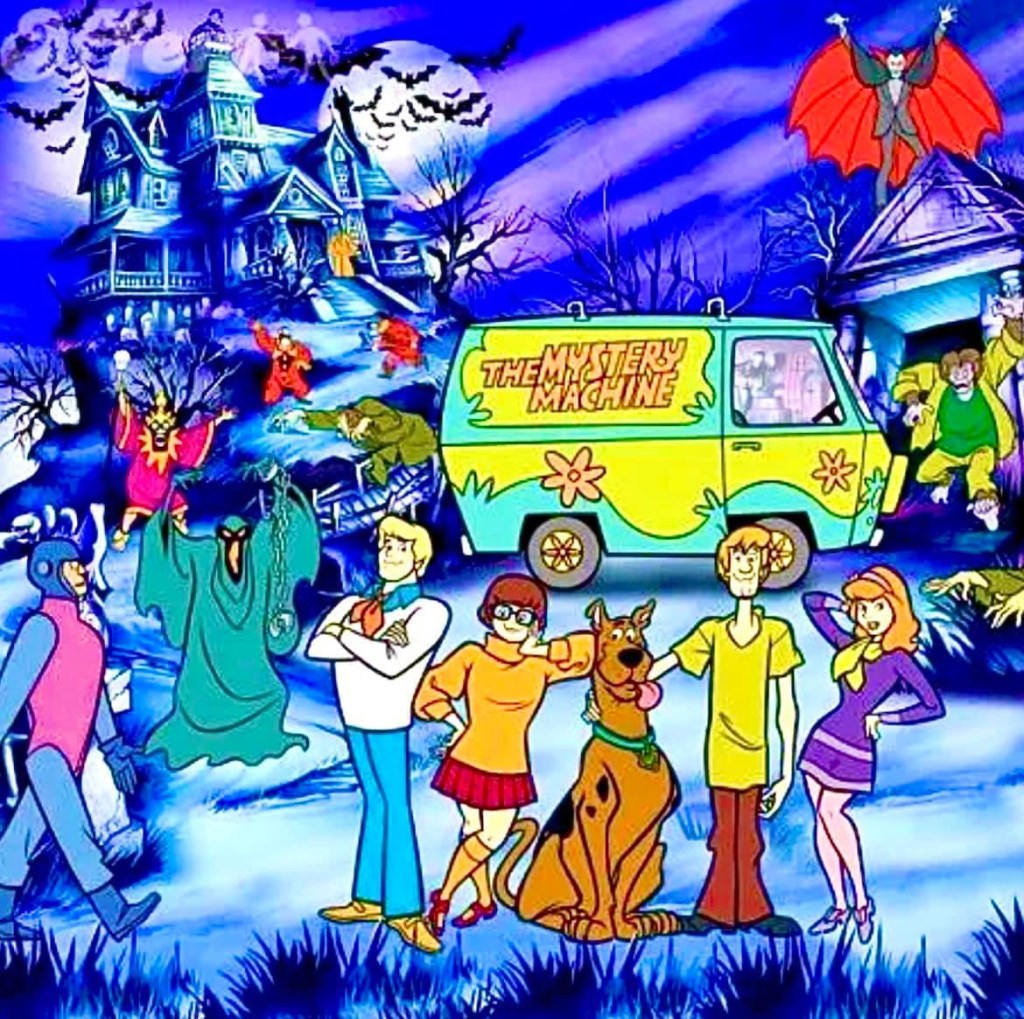
The other day after work I was too tired to write and so I settled into the easy chair with one Sparky for cuddle time, but needed something to watch. I finished burning through the news to get caught up as I do every day, and then started searching for something else to watch when I saw Scooby Doo, Where Are You? in my “Up Next” list as I scrolled through it. It’s always tricky when I need something to watch on my own without Paul–it has to be something he’s not interested in watching–and at some point over the last four years I started revisiting this show from my childhood but never finished the rewatch–mainly because I am now in my sixties; far too old for the audience they were going for.

While I wouldn’t say Scooby Doo Where Are You? was necessarily a huge influence on me and my life, I did love it and watched it every Saturday. It started sometime after Jonny Quest and The Hardy Boys cartoon was cancelled, and a kid who was devouring kids’ series books by the stacks and checking out every book in the school and public library that had the words mystery, secret, clue, haunted, ghost, riddle, or phantom in the title, the adventures of the Scooby gang was usually the highlight of my Saturday morning cartoon experience. I have not been a fan of anything that came in the wake of the original half-hour show (we will never discuss the abomination/hate crime that was Scrappy Doo), and for the purpose of this entry (and really, in my heart and mind) we will pretend that the show was cancelled after the original series run and nothing was rebooted, restarted, revamped, or overhauled in the years since the original Scooby Doo money train was derailed.

But saying Scooby Doo didn’t cement my interest in mysteries wouldn’t be true. The show did, silly as it was (watching as an adult I couldn’t help but wonder, “why would the bad guys go to such extremes to scare people off?”–which also is a contrivance often used in the Nancy Drew/Hardy Boys type books, too), but I watched it every Saturday morning. I kept watching through the next iteration, the hour long show with guest stars, but after that I was too old and had better things to do on Saturday morning than watch cartoons. I’ve always had a soft spot for Scooby, just as I did for the animated Hardy Boys show and Jonny Quest, and unlike many others, I never see reboots or remakes or re-imaginings as “destroying my childhood” because I am not a moron. I can see how the show appealed to kids–you can never go wrong with a sentient Great Dane with limited speaking abilities–and I remember writing Scooby fan-fic when I was young. I started out “novelizing” episodes, and started writing my own. I’d forgotten about that when I was originally rewatching, but in my head the kids’ series I eventually came up with was linked very much, not only to other kids’ series, but Scooby Doo as well.

I don’t want to adapt Scooby or write Scooby books anymore, but I do occasionally want to go back to my kids’ series and think, why don’t you give this a try? Often times, the reason I don’t write things I think might be fun challenges is mostly cowardice and Imposter Syndrome. Can I really write kids’ fiction? Can I really write historicals? However, writing Jonny Quest might be interesting, especially with a reading of the Quests as a queer family.

One of the things about Scooby Doo that always interested me as a kid, and continues to interest me as an adult: Velma. Velma was clearly the smartest of the gang1, which was fun and unusual, and Daphne (‘danger prone Daphne’) wasn’t dumb despite being the pretty one, even though she often needed rescuing. Over the years the character of Velma was really interesting to me–being a brain, of course, meant she had to wear glasses and was hopelessly far-sighted–because she wasn’t easily scared and she was often the one who figured everything out. It was also interesting to me over the years to see many people read Velma as a coded lesbian, which begs the question why? She never has any interest in the opposite sex, but none of them do, really–it’s not that kind of show. We have no background on the gang, either–how are they able to just drive around the country at their age without having to check in with parents, and where does their money come from?

Of course, this is asking a lot out of a children’s cartoon series, which is also why I find it odd to revisit these shows looking for queer coding, and you can usually find it. The all-male environment of Jonny Quest, which is also a kind of “found family” show or Velma not being a late 1960’s/early 1970’s stereotyped girl are good examples of this.

I’ve always wanted to do a reread of all the kids’ series (I still have the books) to reread them for queer coding. I’ve already mentioned before that there was homoeroticism in both the Ken Holt and Rick Brant series–deliberate or not, it’s hard to say–but does this exist in the more popular Nancy Drew and Hardy Boys books. Is tomboy Trixie Belden a budding butch lesbian, with Honey her future femme wife? What about cousins Bess and George in the Nancy Drew series, who are also almost a parody of butch/femme dynamics?

This is the kind of stuff I would love to write–critical queer theory about kids’ mystery series, books, and television programs.

Maybe when I retire.

  1. Calling themselves that also always amused me, since gangs usually are criminals of some sort or another; gang is usually mean that way, even though it’s just a descriptor for a group of people with a similar interest. ↩︎

Are You Lonesome Tonight?

Lonesome is a great word that doesn’t get as much use as it used to; it was a very popular emotion/feeling for songwriters (especially those in the genre then known as “country and western”) to write about back in the 50’s and 60’s. It’s a very evocative word, and I am not sure why I don’t hear it as often as I used to. I love the word, and one of my ideas is to write a book called Kansas Lonesome at some point. The premise would be that there’s a podcast called that, which covers Kansas true crime stories throughout the state’s history; I am not sure how that podcast will play into the story I want to write, but that’s the foundation of that book, whatever it turns out to be. I am currently in the process of writing a short story (one of many, by the way) with a college student investigating a crime site out in the countryside to sus out background information for a podcast episode for the producer/star of the podcast. I do think the book may be inspired (Kansas Lonesome) on a homophobic incident that occurred in my old school district in Kansas; a young lesbian was put off the bus and banned from riding for saying she was a lesbian. The school district tried to cover up everything, but it turned out the girl was the only one telling the truth, the bus driver was fired, and the superintendent lost out on a big career move…and a few months later, she disappeared. Her name was Izzy Dieker, and as best as I can tell, she’s not turned up yet and it’s been over two years since she went missing. There are just some articles noting her disappearance, and then….nothing.

That is a great premise for a crime novel, isn’t it? Kansas Lonesome is becoming what I will soon probably be referring to now as “the Kansas book,” now that the other one was finally finished and published. But I think I will probably write The Crooked Y first; there is so much material in Kansas for prairie noir, isn’t there?

It really is amazing how much crime–specifically brutal murders–have happened in such a sparsely populated, deeply Christian red state. (“But crime only happens in those scary big cities!” Fuck off, trash. And by the way, immigrants aren’t coming for your women or your jobs.) The Benders are another grisly story from Kansas’ blood-drenched past, and I’ve always wanted to write about them, too; and hope to do so before I run out of time on this mortal coil.

And last week I stumbled across another fascinating tale of corruption and illegality involving a district attorney, a judge, and a police chief…a truly horrifying tale about how justice can be (and is all too frequently) twisted to fit the agendas of people who are evil but so convinced of their own righteousness that bending rules and not turning over evidence to defense attorneys, suborning perjury and coercing confessions from people?

Sidebar: Yes, Sarah Palin, that’s the real America, you charlatan snake-oil salesperson. Hope you’re enjoying being completely forgotten, grifter and Grandmother of Bastards.

Anyway, that’s a lot of words to talk about how Kansas is actually a horrific true crime state, with lots of examples of horrible murders and desperate people. I sometimes wonder if has anything to do with how flat the state is, and how sparsely populated. I know sometimes those winter winds off the prairies are brutal, whistling around the house and rattling the windows, trying to find a way into the warm cozy inside. Sometimes that wind can whistle, too–and I can imagine in a time without electricity or much entertainment, listening to that wind and being so lonesome out on the prairie could easily drive you mad1. I could write a book of short stories and simply call it Kansas Lonesome, with the premise that the podcast host and researchers are doing the background research into these old crimes or something. That could be an interesting way of bringing those stories together…but I also think Kansas Lonesome is too good of a book title to not use it for the novel I was thinking about earlier in this entry–the one about Izzy Dieker.

Loneliness, though, while sad and depressing, is a writer’s friend. When you’re lonely, you have to entertain yourself, and I always drag out the journal at those times, or warm up my computer and start writing away. I think a lot of my creativity came from being lonely as a child, the recognition I clocked early that I wasn’t like other kids in many ways so I stayed away from them because I didn’t know if they were going to make fun of me or bully me. and so I retreated very often into my own mind. I read a lot, obviously, and watched a lot of television and movies (while reading), and I just kind of lived in my imagination for lengthy periods of time. I preferred my own world, frankly, and still do; I hate leaving my own world for the real one.

I do wonder sometimes if I would have still wanted to be a writer if I had felt like I belonged, if I was like every other little boy. But even when I was a kid, I looked at the future that was expected of me and found it wanting. A Lot. I hated the very idea of fitting into one of the ticky-tacky houses in the suburbs and the day job that was all-consuming and the wife and the kids and the lawn work and upkeep on the house and…yeah, that sounded always terrible to me, and the older I got the more I resisted that future. Had I followed the path laid out for me by society and family I would have been absolutely miserable by now. Would I have been so attached to books if I had friends, kids in the neighborhood and the comfort of knowing people did actually like me? It was the love of books and wanting to give other people the feeling I got when I read one I enjoyed that made me want to be a writer in the first place, and the more I read the more I wanted to write. I used to write all the time when I was a kid–things I didn’t take seriously at the time, and would completely dismiss…but I was always writing. I made up a world once, with its own countries and lineages and so forth, kind of a fantasy alternate kind of history. I wrote my own versions of the Hardy Boys and Nancy Drew. I wrote short stories in high school. I started writing a novel when I was seventeen, and while I might have gone months without writing at times, I always was writing, always coming up with titles and ideas, and I was always happiest when I was creating.

And now, here I am hurtling toward my sixty-third birthday with a lot of publishing credits to my name and boxes and boxes of ideas…that I want to digitize and throw away the paper files in an attempt to cut back on clutter. I have my next two years’ writing schedule pretty much figured out already. I’m happy. That’s the bottom line of everything, isn’t it? Being happy? I love my life. I love writing. I love connecting with readers and other writers. And I think I am continuing to grow and develop as a writer. I don’t ever want my best work to be behind me, and I don’t think it is. I’m feeling good and optimistic again, and that’s always a good thing.

  1. There was a really great chapter in James Michener’s Centennial that talked about this very thing; how on the prairies in the winter the wind could drive one mad. After I read that book I could never listen to the wind again without remembering that. ↩︎

Season of the Witch

I read a lot of Norah Lofts when I lived in the suburbs of Chicago.

I originally found her through her historical fictional biographies of royal women, or royal-adjacent. I was in a Henry VIII phase–the whole six wives thing–and I saw a copy of her book about Anne Boleyn–The Concubine–on the wire racks at Zayre’s, so I bought it. It was very well done, and Lofts tried to get into the head of Anne and who she was, the reasons she basically changed Western civilization, and gave me an entirely new perspective on the infamous Anne. From there I went on to A Rose for Virtue (Napoleon’s stepdaughter/sister-in-law Hortense de Beauharnais, Queen of Holland), The King’s Pleasure (Katherine of Aragon), Crown of Aloes (Isabella of Castile), The Lost Queen (Caroline Matilda of Denmark), and Eleanor the Queen (Eleanor of Aquitaine)1. I also read, from there, some of her historical fiction, which I greatly enjoyed (Nethergate comes to mind). What I liked most about Lofts was she was not, in any way, a sentimental writer; her stories didn’t end happily all the time (especially her books about royal women; they all died miserable). I always wanted to read her Nativity novel, How Far to Bethlehem?, or her book Esther (obviously, the Bible’s Queen Esther). I remembered Lofts sometime within the last four or five years, and got a copy of her ghost story collection, which I enjoyed.

And then I remembered one whose plot I really couldn’t recollect–The Little Wax Doll, and got a second hand copy on-line.

It was like reading an entirely new novel, and I am glad I revisited it, believe you me.

The interview had been arranged to take place in London at half past three on a Saturday afternoon. This was a time so extremely convenient to Miss Mayfield that she was disposed to regard it as providential. It had saved her from the embarrassment of having to ask for time off to attend an interview in which she might not be successful, and from which she might be obliged to return to face her present Head’s resentment. In her diffident attempt to maintain secrecy she had left Alchester without the precaution of obtaining a testimonial. This she recognised as the action of a fool, but she had taught in the ugly Midland town for a bare two years, and she carried in her shabby handbag a coolly eulogistic report of her twenty years’ work in Africa, If that did not suffice, and if the interview showed any sign of leading to a new appointment, then would be time enough to approach Miss Stevens and break the news she was contemplating a move,

Canon Thorby had written, “Claridge’s Hotel would be convenient for me, since I have another appointment there earlier in the day. I shall be waiting for you and if you ask at the desk someone will will point me out to you.”

He wrote on thick smooth paper which justified the term “cream-laid.” His writing was small, elegant, meticulously legible. It called up an imaginry vision of the writer, plump, rubicund, with a fringe of silvery hair and tranquil blue eyes. Kindly, perhaps a trifle pompous.

As I said earlier, I didn’t really remember much of this story, other than the main character was an older schoolteacher moving to an idyllic village in East Anglia to teach at the village school, and the little rural village has some pretty dark secrets that she’s going to stumble into. Another thing I’d forgotten–although I should have remembered from reading her ghost story collection–was how compelling a writer she was. There are beautiful turns of phrase everywhere, as well as observations about life–particularly in a small village–that are really spot on, clever and insightful.

I also love that her heroine is a woman many people would overlook–particularly in the time in which this book was written (originally published in 1960)–a dowdy, plain spinster in either her late thirties or early forties. I wouldn’t have thought much about it when I first read the book, but the deep devotion of her attachment to a woman named Ruth, with whom she built a school and hospital in Kenya and worked there with her for forty years, and her determination to save enough money so she and Ruth can retire together and share a cottage blissfully for the rest of their lives?

In this read, this friendship just screamed lesbian to me.

Deborah Mayfield could easily have turned into a stereotype–the old maid schoolteacher–but Lofts isn’t interested in stereotypes; she created a character who is interesting by virtue of the journey she takes over the course of the story. She is a bit unsure of herself at the beginning of the book, always afraid of calling attention to herself and just keeps her opinions to herself. But as she falls in love with this interesting little village and blossoms with not only her students but the other villagers–she still sees herself as a nonentity, not really seeing herself as the others see her–she also, slowly but surely, finds herself being pulled into a strange situation which makes her, always questioning herself, question herself further. Surely, what she suspects cannot be? There can’t be people who believe in the dark arts and witchcraft in this town? But it’s really the only explanation, and as she gets pulled further and further into the odd circumstances regarding her student Ethel and her grandmother Granny Rigby–to the point where she is willing to give up her comfy little home and job to try to call out what’s going on in Walwyk–she begins to get a sense of her own power; the inability to stand by and do nothing while something untoward is going on strengthen her resolve and makes her stronger.

Then about halfway through the book there is a huge plot twist, which throws everything into a different, just as suspenseful and thrilling, direction–and one in which Deborah finally comes into her own, managing to get her way back to Walwyk in order to stop a horrible outcome that isn’t predestined.

One of the other things I like about the book is Lofts’ lack of sentimentality. The ending of the book makes it seem as though the day has been saved…but has it, after all? I also love that we never really know if there is actually witchcraft going on in the town–or maybe it just looks like it? Lofts leaves this up in the air as well–which she probably wouldn’t get away with today.

A terrific reread, and a terrific author I am very happy to rediscover.

  1. She also wrote The Lute Player, about Richard the Lionhearted, his wife Berengaria, and the minstrel Blondel–which was my first exposure to the idea that Richard, the great English hero, was queer. That revelation was a bit life changing, as I began looking for hints of homosexuality being covered up in history books. ↩︎

Boogie Woogie Bugle Boy

And just like that, Gregalicious is fifty-eight. I’ve been saying I’m fifty-eight, of course, since the new year began–I’m contrarian that way–just like in 2020 I’ll start saying I’m fifty-nine. Sixty is approaching, looming over the horizon. Who would have ever thought I’d make it this far?

Certainly not me.

Yesterday was a complete bust for the most part. Sunday night my insomnia returned, and it was also my night off from taking anything prescription, so I spent the evening lying in bed with my eyes closed, sometimes drifting off but never too deeply. I was also hungry–my toothache returned over the weekend, making chewing incredibly difficult, and so as a result of being hungry, was so drained and tired yesterday I even took a two-hour nap in the afternoon. It helped, but not that much–so I made meatballs for dinner. Ironically, by the time the meatballs were ready to eat in the slow cooker, the toothache had somewhat gone away, so I was able to eat a bowl of meatballs over wild rice (it was delicious) and having some food in my stomach made all the difference. We watched two more episodes of Mindhunter (the guy playing Manson is amazing), which were terrific–I love how they are dealing with Dr. Carr’s lesbianism, and how she has to stay deep in the closet at work, as well as having to deal with the unwanted attentions of predatory men.

I did spend some time savoring Laura Lippman’s Lady in the Lake, which I am going to spend some more time with this morning. It’s so well-done, really, as all of her books are, and I like that I am taking the time to enjoy it, resisting the urge to rush through to the end. I love that her main character isn’t necessarily the most likable protagonist…it’s very layered and textured.

I also finished reading Otto Friedrich’s City of Nets: A Portrait of Hollywood in the 1940’s yesterday afternoon; I love reading books about old Hollywood and the way things used to be. The 1940’s were the last full decade of the studio system, and it was also the decade when, obviously, World War II swept away the last vestiges of the old world and gave rise to a new one, from the ashes. Chlorine is most likely going to be set in the early 1950’s, but as much as I think I know about the history of Hollywood, what I don’t know is voluminous.

I also worked on an essay briefly yesterday; completing the first draft, which is more of an abstract. I’ll need to expand on it more before I turn it in, but I write essays differently than the way I write fiction–which probably makes little to no sense to anyone besides me. But I always want to make sure that the points I want to make have come across in the piece–so I have to do that sketchy outline/abstract thing first, and then I can look at it and see where to move things around and what order they should go in and once I do that, I can start expanding on those thoughts more.

It works for me, what can I say?

Today I am going to take it easy and relax. I have to return to the office tomorrow–but at least I only have three days to work this week, two of which are half-days–and so, for my birthday, I think I’m just going to spend most of the day reading, relaxing, and organizing. I might reread Bury Me in Shadows, which will hopefully get me back into writing it (only three chapters to go! SERIOUSLY), or I might just take today as a day off. There’s a little voice in the back of my head shrieking at me you didn’t do anything yesterday so you need to make up for it today but I suspect I shall have very little trouble ignoring that voice today. Maybe I’ll stream Strangers on a Train today; it’s on Netflix, I think, and it’s been quite a while since I’ve watched the movie. I also have to run get the mail today–some packages were delivered–and Paul is going to bring Chinese food home for dinner tonight (I do love me some shrimp lo-mein), but other than that? Maybe some organizing–I enjoy doing that–and even maybe some writing, I have a short story due in a couple of months, and I think I’m going to do it in epistolary form; so I’ve been reading letters from the time period to get a better grasp on how people wrote letters during that time period. It may be entirely too ambitious of a story for me, but I guess I won’t know that until I start writing it.

And on that note, I am going to go curl up in my easy chair with a purring kitty and Laura Lippman’s book. Have a lovely day, Constant Reader.

15-copy-683x1024