Right Place Wrong Time

Well, I survived Monday’s return to the office–and there wasn’t a body count.

It is, however, still early in the week.

Yesterday’s heat was simply insane. The heat index was about 115, I think, and it felt every one of those degrees every time I had to go outside. It was 95 last night when I drove home from work at eight o’clock, which is also just completely insane.

I did a little bit of writing yesterday, not much, trying to get going on the WIP again. I’m a little bit at sea with the WIP right now; not touching it over the course of my vacation wasn’t exactly much of a help, and the heat and everything  yesterday, as well as adjusting to getting back to the office, kind of made that a bit on the difficult side. I will, of course, try again tonight.

Paul also got home really late last night, so Scooter and I are no longer on our own here in the Lost Apartment anymore. I’m glad he’s home–he’s always gone just long enough for me to get over the “home alone” thing; I enjoy the solitude at first, and then it gets a bit lonely by the end of his trip. And now we can get caught up on everything we’re watching, which is also another one of those win-win things. Huzzah!

I’ve been watching Netflix’ The Last Czars, which I am enjoying–it’s very well done, and the actors cast playing Nicholas and Alexandra are perfectly cast; but it’s a little bit different watching a show about doomed royalty than it used to be. There’s been a kind of tectonic shift in my mind and my way of thinking, and while the story of the last Romanovs is certainly tragic on a human scale, on a national scale I don’t really have that much sympathy for them as I might have in the past. He was an ineffectual ruler, and they were both religious bigots; they actually believed they had a divine mission from God to be autocrats and sole authority in Russia; and therefore they were always in the right–as their people starved and his bad decisions and policies brought the country to the brink of ruin, while they lived and dined in luxury and spent, spent, spent. It’s really not hard to think they sort of deserved the basement in Ekaterinburg–and the way history is taught, I’ve come to realize, with its emphasis on royalty and nobility with no interest on the lives of the people whose bodies, taxes, and lives were exploited by the ruling class–all with the blessings of their religion–isn’t necessarily the right way to teach history. I’m not saying the lives of the rulers aren’t important to the histories, just that the emphasis on them is misplaced. History should be taught as the history of the people, and the development of law and modern government–which the people have had to fight for, every step of the way…one thing I’m enjoying about this show–an odd combination of documentary, reenactment, and actual footage from the time–is that it doesn’t shy away from the crimes or the arrogance of the Romanovs, especially when it comes to their people. There’s one particularly brilliant scene where Alexandra scolds Nicholas for even considering giving in and creating a duma (the Russian version of parliament), while the nation is on the brink of revolution. “They’ll want more,” she scoffs, convinced of their divine right to power, “they’ll always want more, and then what?” She wasn’t wrong about that, but she was most definitely wrong about their divine right, and she was almost always wrong about the people.

I have agreed to write a forward to a new edition of an almost forgotten gay classic back from the plague years; the book was published posthumously after the author died from AIDS in the early 1990’s. The author, Jay B. Laws, had only managed to write two gay horror novels before died; the first, Steam, is better known than the second, and is one of my favorite horror novels as well as one of my favorite gay novels. I had read the second, The Unfinished, years ago but it’s quite odd; I don’t remember anything about it, so rereading it is like reading it for the first time. It’s quite good, and I don’t think I’ll have any trouble writing the forward–and I am also glad this has kind of forced me into rereading the book, which is practically like a new book to me. And, as a gay novel, it fits into the Diversity Project quite nicely.

There’s a low-pressure zone drifting from mid-Georgia into the Gulf, which will most likely turn into either a tropical depression or a tropical storm; forecast to dump a shit ton of rain on wherever it comes to shore, either Thursday or Friday, possibly this entire weekend. Hurray. The water in the Gulf is also ridiculously warm–89 degrees off the coast of Louisiana, near the mouth of the river and New Orleans–which isn’t really going to help matters much. (This heat wave has me already dreading my next power bill.)

Oh, yes, I also spent some time rereading the opening chapters of the Kansas book, which I’d started revising one last time last summer before being pulled away into other projects, and it’s in much better shape than I had remembered–I was still marking up the pages with a highlighter and my pen–but it also has me thinking that perhaps this final rewrite isn’t going to be nearly as painful as I first thought, or had been thinking since I got pulled away from it to work on something else. Huzzah!

And on that note, tis back to the spice mines.

IMG_1672

Wildflower

Back to reality.

I feel rested, relaxed, and ready to get back to the office and to writing. This is a really lovely feeling, Constant Reader, and one I’d love to feel more often, you know? But the truth is as I get older, I need to take these breaks from everything every few months, in order to keep on a-keepin’ on, as it were. I’d hoped to do some writing–didn’t happen, but I managed to get the proofs for Royal Street Reveillon finished, which was something, and I also made a to-do list, and tried to schedule out the books I need to write next, which is also an accomplishment. I have twelve–yes, you read that right, twelve–books in some form of completion; whether there’s a draft finished, a partial draft, an outline, or just a fleshed out idea. Twelve. 

And yes, I am completely and totally aware how utterly insane that is.

That doesn’t count the short story collections (two or three), or the essay collection, or the copy editing for Jackson Square Jazz so the ebook can finally go live.

So I guess it’s more like seventeen.

I also have agreed to write two short stories for anthologies, and I also want to write something to submit to the new MWA one whose deadline is coming up this fall. (Fortunately, I already have one written that fits the MWA criteria, so it just needs to be tweaked and cleaned up and polished and made pretty; I have to write the others from scratch, and I worry that won’t end well.) I am in the process of making a list, so that I can try to make sure I can get everything logged and written and therefore stay on top of things.

There’s a heat advisory today, from noon till about seven this evening, where it’s going to feel like 106-111 degrees outside, which should, of course, do wonders for my power bill for next month. Hurray. I’ll be curious to see how our new building handles this onslaught of heat; the side of the building we’re on is in direct sunlight after about one in the afternoon, so that should be lovely. It already gets hot over there in the afternoons as it is; I’m curious to see how that turns out. There’s also a low out in the Gulf, close to shore and in that corner of Florida where the peninsula descends from the mainland, that might turn into a tropical depression this week. Not likely to do anything to us other than outer bands, but not good for the Florida coastline.

I am reading Jay B, Laws’ second, and posthumous, novel The Unfinished. It’s being rereleased in a new edition by ReQueered Tales, and they’ve asked me to write the introduction for it, which is a lovely, nice thing to do. I read the book a long time ago, and barely remember any of it, but the opening sequence, in which our deaf main character (so far) has corrective eye surgery is not for the squeamish–I count myself amongst the squeamish when it comes to eyes–and I am really enjoying the ride again nevertheless. It’s amazing to me that I can’t remember anything about the story–I didn’t remember that the main point-of-view character was deaf, for that matter–because I used to be able to remember plot points and details of every book I’ve read; another by-product of age, I suppose, was the loss of many of those memories and details. I do remember, however, the enormous sadness I felt that Laws died so young of HIV/AIDS, back in the plague years, and was only able to produce two high quality gay-themed horror novels, this one and Steam.  HIV/AIDS did so much damage, not just to our community but also to our creative community that even now, so many years later, that we are struggling to recover from the losses.

I would imagine there’s an amazing academic study to be done on the impact of HIV/AIDS to the queer writing community, and how it shifted and changed our work, the direction of it, and how younger queer writers also lost the mentoring possibilities of the older, more established writers who were dying off, one by one. I myself have never once addressed the plague in my own work. It was a conscious choice back when I first started; the cocktail had already been discovered and lives being extended. The plague was no longer a death sentence for those diagnosed, and the advances that have been made in the years since I first started writing and getting published are the things we could only dream of during the 80’s and 90’s. Ironically, I wrote a short story for a horror anthology (more details on that to come) called “A Whisper from the Graveyard” which is the first time I’ve addressed the plague in fiction (the story was set in the early 1990’s), and I am writing about it in my so-far unfinished novella “Never Kiss a Stranger.”

God, so much writing to do and always, always, new ideas arrive. Even as I listed the books I plan to write yesterday, afterwards I remembered there were at least two more that I’d forgotten about.

Heavy heaving sigh.

And now, back to the spice mines, as I must prepare for my return to the office this morning.

Have a lovely Monday, Constant Reader.

IMG_1677

I Sing the Body Electric

I’ve been reading a lot of history lately (nothing new there, really; my favorite non-fiction generally tends to be history), focusing primarily on New Orleans and Louisiana for the most part. As I read histories of New Orleans, here and there I find little bits, here and there, about the queer subculture in the long years and decades before Stonewall; little bits, here and there, more of asides in longer narratives than anything else. There were, of course, male prostitutes in Storyville back in the day–generally not housed or regularly employed in the houses, but should a customer be desirous of, shall we say, male companionship, the madams would send a runner down to a gay watering hole a few blocks away in the Quarter and find someone looking to make some quick cash…and they never failed to find someone willing to satisfy the “peculiar tastes” of the john.

Finding this, and other references to bordello activity by reformers protesting their existence and wanting them shut down, as “sodomy” quite naturally piqued my interest. As a port city that was, at one time, the largest port and largest city in the southern United States, a city that was also a blend of many different cultures and so forth, New Orleans clearly had always had havens for homosexuals in those dark times when we were outlaws. As I read other New Orleans histories, I do keep an eye out for these references, and mark the pages in order to find them easily again.

There’s a lot of stories untold there in the past, and I’ve been considering the possibilities of writing more historical-based fiction in New Orleans. I’ve already started a short story about a young gay man who occasionally picks up extra cash by working in one of the brothels at night “on demand,” and I think it has some terrific potential.

Queer people have often been erased by history, just as people of color and women have been, and while I will most likely never write non-fiction (you can’t make things up, which is the primary drawback for me), I do enjoy reading histories that focus on the gay community.

For example, David K. Johnson’s award-winning The Lavender Scare, about the purge of gay employees from the federal government in the 1950’s as intelligence risks (their sexuality left them open to blackmail from foreign spies; at least this was the fear) eventually led to my short story “The Weight of a Feather” (which I am still not convinced shouldn’t have been a novel); and as such, was quite delighted when Johnson released another scholarly look at queer American history this year, Buying Gay: How Physique Entrepreneurs Sparked a Movement.

I had, of course, known that “physique pictorial” magazines essentially were the original gay porn magazines; those images still can be found on the Internet.

buying gay

Johnson’s thesis holds that the mailing lists, and sales, of these magazines early on developed a cohesive gay market, and the recognition of said market gradually led to activism and wholesale societal change; that the magazines themselves created a sense of community by letting deeply closeted and frightened gay men know they weren’t alone; there were others like them, and helped them feel seen.

This further extrapolated into films and books, and gradually a gay rights movement.

The book is well written and deeply researched, as was The Lavender Scare (recently filmed as a documentary I am looking forward to seeing), and shed a light on a time I don’t know much about; few people know much about that time. One of the greatest tragedies of the community is how it was ravaged by HIV/AIDS in the 1980’s and 1990’s, until the development of the drug cocktails that first extended life, and eventually managed to make HIV a manageable infection rather than a fatal one; a lot of oral histories were lost as a result, and an entire generation of gay men was not only lost, but deprived the next generation of community elders and mentors.

I’ve been toying, over the last few years, with several ideas for noir novels with gay themes and characters set in the decades before Stonewall, and Buying Gay will, should I ever decide to do so, prove to be an invaluable source of material.

Well done, Dr. Johnson.

Let’s Go All The Way

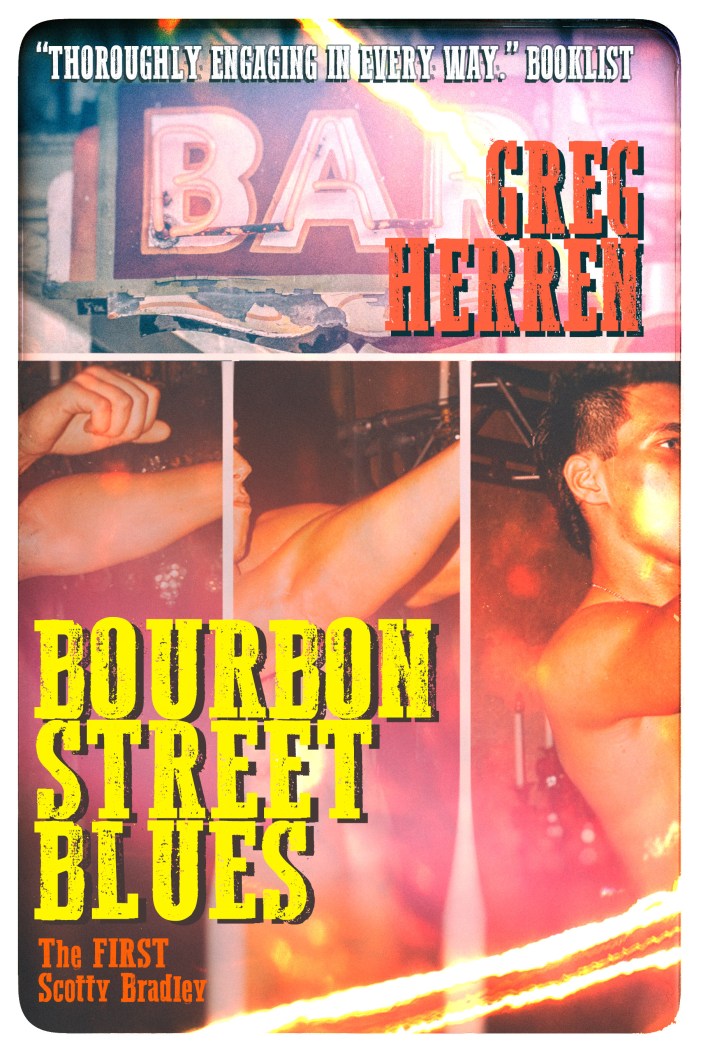
So, yesterday I didn’t write much, but I did get something very very important done: I finished the copy-edit/proofing of Bourbon Street Blues, which is now one step closer to becoming an ebook (and a print-on-demand hard copy, if someone so desires), and that really is exciting for me. Bourbon Street Blues is, out of all my books, special to me for so very many reasons. I always thought, for one thing, that it was a much better book than my first (with apologies to Murder in the Rue Dauphine), and for another it was the book where I created Scotty Bradley and his friends and family and world, and Scotty is, well, I’ve always been terribly fond of Scotty.

It’s sometimes hard to believe I’m currently writing the eighth Scotty book. I would have never dreamed there would be three Scotty books, let alone eight, all those years ago when I first dreamed him up. I was determined to create a character that I’d never seen before in gay fiction, or at least in any of the gay fiction I’d read at that time, and my reading at that time was pretty extensive. The late 90’s/early aughts was a strange time to be a gay writer, or to be a gay reader of gay fictions. We were just finding ourselves again after the development of the initial drug cocktails, which meant HIV/AIDS was no longer necessarily the death sentence it was known to be for so lo those many years. Most gay literature, from almost the very beginning of the plague, had been the art of the epidemic: about death, about loss, about hatred but also about love and compassion.

It was a strange time, frankly. All of us gay writers were faced with the conundrum: do we still write about HIV/AIDS? Do we pretend it doesn’t exist? Can we write about it and try to de-stigmatize it in our work? Do we mention condoms, condom use, safer sex? What responsibility do we, as gay writers, have to our community?

Scotty was, in some ways, a reaction to the work that had gone before mine, and to HIV/AIDS. At the time I was creating him, and writing his first book, the equality movement for the community was moving away from the focus on HIV/AIDS and looking at other issues of equality: overturning the sodomy laws; same sex marriage; and overturning ‘don’t ask don’t tell’, so that we could openly serve in the military.

Gay sexuality had become something dark since the early days of the plague, and even with the drug cocktails prolonging life and all the other medical advances that were taking the definition of the disease from fatal to chronic (i.e. something that could be managed with a drug regimen), there was a lot of sturm and drang about gay promiscuity; and while the sexually liberated days of the 1970’s certainly had a part in the spread of the disease, it wasn’t a punishment for gay promiscuity any more than the bubonic plague was a punishment for the schism of the church in the fourteenth century. 

So, when I created Scotty, I wanted to create a character that I hadn’t seen before; someone who not only embraced his sexuality but reveled in it. Scotty was highly promiscuous; wasn’t interested in a boyfriend or monogamy; and had absolutely no hang-ups or judgments about sexuality or promiscuity. He was a personal trainer and taught aerobics, was a former member of a male-stripper troupe who sometimes got back into his thong and moonlighted as a dancer now and then for extra cash. He smoked pot, drank, and celebrated the Gay High Holy Days of New Orleans (Southern Decadence, Halloween, and Mardi Gras) with Ecstasy. He was good-looking and sexy and he knew it, but wasn’t arrogant about it in the least; he was, if anything, amused by the fact that people found him, in his own words, “irresistible.”

Above all else, though, Scotty was, at heart, a nice guy who cared about other people.

I was surprised by the way people reacted, and related, to him. I was expecting to get bashed in the reviews–after all, hadn’t some reviewers dismissed my first series creation, Chanse MacLeod, as ‘just another gay stereotype’?–but the reviews were all incredibly positive, for the most part, other than the occasional one-star on Amazon.

I also wanted the book–and the series, as it turned out–to be light-hearted and funny, even as it took on social issues.

And you know else? Proofing Bourbon Street Blues was the first time in many years that I read the book again. And it ain’t bad. Ain’t bad at all.

And by the way, here’s the new cover for when it’s released again, courtesy of amazing cover designer J. T. Lindroos:

GregHerren-BourbonStreetBluesx2700

I absolutely love it.

And now, back to the spice mines.


Dancing on the Ceiling

So, yesterday I managed to finish the afterward to the short story collection; worked on “Never Kiss a Stranger” a little bit (also figured out the rest of the story, crucial!); decided on the story I am going to revise/rewrite to submit to Cemetery Dance; did some thinking about the Scotty book and where to go with it next; and continued the copy editing of Bourbon Street Blues.  I am about a quarter of the way through with this; hoping to have it finished by the end of the month so I can get the ebook/print-on-demand up before the end of summer. The book has been too long out of print, and by the way, I fucking love the new cover I got for it and the new one for Jackson Square Jazz.

I’m having some seriously terrific luck with covers this year, methinks.

So, I didn’t get as much done as I would have liked this weekend but again, progress, which is everything. As long as I am moving forward, I celebrate the win because staying in place is a loss.

Last night, I started watching the new Ryan Murphy series, Pose, and was most impressed with it. I still have not watched the Versace season of American Crime Story, but that’s on my ‘to-watch’ list. The thing with Murphy is that his series are so frequently hit-and-miss. Often they start out fantastic (Glee, Nip/Tuck) and then go south; the uneven quality of pretty much every season of American Horror Story is legendary. So, I am not holding out much hope that Pose won’t derail; but at the moment it’s high-quality, riveting television; taking us back to those awful days of the late 1980’s and shining a spotlight on queers of color, which doesn’t happen very often–and especially, the transwomen and drag queens, who rarely get to see themselves on television or in the movies. Having the show set during the height of the HIV/AIDS crisis was also a brilliant move; there was, I think, a tendency in the late 90’s and ever since, for queer publishing to shy away from HIV/AIDS; it enveloped so much of queer writing for so long…and I’m thinking that it might be time for us to start addressing it again.

HIV/AIDS plays a part in “Never Kiss a Stranger” and in “The Feast of St. Expedite” (the story I started writing last week); both are set in New Orleans in 1994 and you simply can’t write about gay men and the gay male community in that time and not have it be a part of the story in some way. The question of whether I am handling it properly or not remains to be seen…but I’ve been spending a lot of time in the past lately, and it’s been kind of fun.

I had gotten tired of most of my iTunes playlists last week and then remembered, duh, the new car has an actual CD player in it; you can listen to some of your CD’s. This thought led me to browsing through our CD tower–yes, we still have one, and yes, it’s covered in dust–and discovering a lot of great music that I don’t have in digital form and haven’t listened to in a long time. I found a lot of dance music mix CD’s, including Deborah Cox: The Remixes and so every time I get in my car I’ve been listening to old gay dance music. I even was playing some of them while I was cleaning the house on Sunday (the only CD players in the house are in the computers), and yes, I’d forgotten how much easier dance music makes cleaning (note to self: always play dance CD’s in the computer when cleaning).

In the car this morning I was listening to a Pride 2001 CD, and a song come on called “Movin’ Up” (I think) and without even realizing it I was singing along with it and this lyric popped up: I take my problems to the dance floor. and I was flooded with memories. I remember someone in the bars back then had a T-shirt that said this, and although I don’t remember his name, he was around a lot back in those days and he always had a great time on the dance floor; and I enjoyed watching the joy and sheer abandon with which he danced.

I do kind of miss dancing.

And now, back to the spice mines.

IMG_4118

Kiss

Thursday morning, and the first full day of my mini-stay-cation. Hip hip hurray! Yesterday I got a new journal, which is always a lovely thing; I’d forgotten how much I loved getting new journals once I’d filled the last one. When I started using them again by buying one on New Year’s Eve this year, I was excited to be starting up again with them; I’d forgotten how getting a new one felt–how wonderful and full of possibilities and potential the new journal is; all those blank pages to be filled with thoughts and ideas and titles and characters and sentence fragments and snippets of dialogue. Do I get too excited about the new journals? Maybe; but they also, for my OCD/anal retentive self, symbolize new beginnings as well as completion; even if finishing a journal doesn’t mean completing an actual manuscript or short story, there’s something about filling those pages that is enormously satisfying. When I first started writing when I was in high school, I always wrote on notebook paper long hand; usually in black ink with a fine point (I’ve always been partial to fine point black ink pens; and this new brand I’ve recently discovered, Tul, is amazing. I love these pens), and I think that’s why I get that satisfaction from writing by hand in a journal. Opening a Word document and starting to type isn’t quite the same feeling, and I always have a sense that everything I write that way is somehow incomplete.

I don’t know why that is, but it’s true, and probably is at the root of my deep sense of dissatisfaction with almost everything I write.

Or I’m simply neurotic.

My back is incredibly sore this morning; it was sore yesterday, but the pain is so bad I fear that I am going to be on a heating pad pretty much for the entire day. This is, while enormously disappointing, not the end of the world; I had hoped to be really productive today. I still can be, of course; it simply means not doing what I’d planned to do–which was organize stuff and deal with storage, but that will also include lifting boxes and I am in no place to do that–so maybe today means some light cleaning, writing, and reading. As long as I am productive, that’s all that really matters. And there’s quite a bit of mess that needs tidying up. I am taking the car to the West Bank tomorrow to have the oil changed at the dealership; I am going to treat myself to lunch over there and possibly do a little shopping whilst over there as well. And then I still have the three day weekend, which is lovely, of course.

I’d hoped to go to the gym today, but that’s simply not an option at this point. There’s no way I’m risking weight-bearing exercise with my back like this.

Sigh. I’m turning into that Grumpy Old Man, aren’t I?

I did get some more work done on “Never Kiss a Stranger” yesterday, and I have to say, setting it in the past (1994) was a pretty smart thing for me to do. Thinking about the past, of course, isn’t something I tend to do very often and when I do, it’s rare that I dwell on anything. But trying to remember that time period for a gay man has been kind of interesting; ever since that Twitter kerfuffle about HIV/AIDS the other week and my post the other day about writing about the subject has got me thinking about that time more. Yesterday on Twitter there was a thing–based on I guess something Suze Orman said, about people needing to have twice their salary saved by age thirty-five–and all I could think was how, at age thirty-five, I was just so happy to be still alive that the future wasn’t something I didn’t really think that much about. A few years ago, at work I sat down with a retirement financial planner and as she went over my finances and so forth she very sweetly and gently scolded me for not planning better for my future. Without thinking I replied, I didn’t think I would live this long, to be honest, and watching the implications of what I’d said play on her face and her embarrassment was an interesting experience. She was a younger woman, of course, and as I quickly reassured her that I wasn’t offended by anything she’d said I also marveled that the mentality most of us gay men had back in the early to mid 1990’s is forgotten largely today, not thought about, that fatalistic resignation that infection and death was inevitable.

This heating pad feels fantastic, I must say.

I am also watching The Shannara Chronicles on Netflix, based on the series by Terry Brooks. I read the first, The Sword of Shannara, when I was a teenager and it was new; I never continued with the series despite enjoying that first book. The Shannara Chronicles is/was MTV’s attempt at a Game of Thrones style high-fantasy series. It’s very well done; visually it’s stunning, and apparently the show covers the series beginning with the second book, The Elfstones of Shannara. The primary difference between HBO’s series and MTV’s is that, of course, Game of Thrones is gritty and dark and unafraid to be ugly; the entire cast is an interesting mix from stunningly beautiful young people to older people–an entire range of bodies and faces on the spectrum of looks, just like real life. Shannara is glossy and everyone on the show is quite spectacularly beautiful; and mostly young. I was interested in the show because I remembered the first book fondly and thought I’d give it a chance; it also has Manu Bennett as Allanon the druid, and I’ve been “stanning” (isn’t that what the kids call it?) him since his days on Spartacus: Blood and Sand. 

Austin Butler, who plays lead hero Wil Ohmsford, is quite pretty:

e30a25427e5d658b4e2dd06391312238

As is the primary villain in season 2, Bandon, played by James Trevena.

Shannara08

And who doesn’t enjoy looking at pretty people on their television? One of the things I find interesting is that in Season 1, when Wil was finding himself as a hero he had long hair; which he has cut off in Season 2. Bandon, in season 1, finding himself he had short hair; now in Season 2 as the primary antagonist, he’s grown out his hair.  I’m sure there’s symbolism there; but the longer hair has made the character of Bandon look older and more mature, and likewise, the shorter hair for Wil makes him look more adult.

Strange.

And on that note, I’m heading back into the spice mines. The heat has made me back hurt a lot less, so I am going to take advantage of that until it starts hurting again.


Broken Wings


I have written, from time to time, about the issues I face  as a “gay author.”  I try not to get into it often; I always fear there’s a stench of sour grapes when I talk about the challenges of being a gay author of fiction that place gay men in the center of their own stories. Revolutionary, right?

When I first started publishing, back when dinosaurs roamed the earth, ironically there was a movement by gay authors to not be called or considered “gay” authors. More than one disdainfully told me when refusing to be interviewed for either Lambda Book Report when I was editor or for one of the queer newspapers I wrote for, or said on panel discussions at conferences, “I’m not a gay writer; I’m a writer who happens to be gay. You don’t call them straight writers, after all.” This statement, which I heard on more than one occasion, always took me aback, because the truth was it didn’t matter what you called yourself; booksellers and reviewers and readers would still see you that way. There was an arrogance, a smugness, to it; kind of saying yes, technically I am but I am not one of those writers, don’t lump me in with THEM.

Basically, you can call yourself whatever you want, but the market and the industry won’t give a rat’s ass what you call yourself.

Case in point: without fail, when you’re a gay author (or a queer author, or whatever kind of minority writer you might be) and you attend a mainstream writer’s/reader’s conference for whatever genre you may write in, you will inevitably find yourself assigned to what’s called a diversity panel. Make no mistake about it: these panels are important and do need to be held. My primary objection to them is their ghettoization aspect; i.e., the only thing of value these authors have to add to the conference conversation is whatever it is that marginalizes them. I have always argued that any minority writer assigned to a diversity panel should also be assigned to another panel. Reducing a minority writer’s value to simply being able to speak to diversity issues doesn’t help the author; and if we are really concerned about increasing diversity in publishing/whatever genre we are discussing, then audiences besides those who show up for diversity panels should also be exposed to those minority writers. People who come to diversity panels already are hungry for diversity in their reading and writing, which makes it a little bit of preaching to the choir.

Case in point: I was at a mainstream genre conference a few years ago, and of course was assigned to the diversity panel. (I was assigned to another, so I was fine with it.) It was an interesting mix of people, but as we talked about how to find and help new minority writers, a noted editor on the panel, cut me off and passionately said, But it has to be about the WRITING. The WRITING has to be good.

In other words, the reason we don’t have more diversity in publishing in general is because the writing isn’t good.

My jaw literally dropped, and I was stunned into silence by the implications of this noted, and relatively powerful, editor’s statement.

And it takes, as you can imagine, a lot to stun me into silence.

During the years 2004-2008 I kind of withdrew into myself and wasn’t really paying attention to the world of LGBTQ publishing as I had from 1997-2004; a lot of things were going on in my personal life, Katrina happened, and I basically just kept my head down and did my work. It seems, to me, looking back, that the world of LGBTQ publishing changed dramatically during that four years I wasn’t paying attention, when I wasn’t deeply immersed in it; perhaps these things were around before and I simply hadn’t been aware, or noticed; but when I started looking around again at queer publishing I became very aware of something that I hadn’t been aware of before: a new-subgenre of fiction called “m/m”; which was fiction about gay men written by straight women for other straight women (a generalization, of course; some of it is written by gay men and some of the authors are queer-identified women, and likewise, the readership is not all, but primarily, straight women). I found it to be a rather interesting phenomenon; I had always argued that gay male writers should market our work to heterosexual women, so it didn’t bother me that straight women were writing about gay characters and gay themes. I’ve always believed writers should write about subjects and characters they are passionate about, and if straight women were passionate about writing about gay men, more power to them, and welcome to our little niche of the publishing world. I certainly don’t want anyone telling me what I can and cannot write, or who I can write about, any more than any other writer would. There was a bit of a kerfuffle over the Lambda Literary Awards back then making a rule stating the awards were only for actual LGBTQ writers, and there was some outrage about that. I completely concurred with the outrage; the awards were for books and writing rather than the actual author. In my opinion, if a straight woman wrote a great and deserving book about a gay man, why not allow her to enter the Lambdas? The book and its writing is what, ostensibly, was being judged; let it be judged on those merits.

Yet I also noticed, in the wake of this decision by the Lambdas (which was later reversed), some horrific commentary and borderline, if not outright, homophobic statements being made by some of these ostensible so-called allies; homophobic statements always seem to rear their ugly heads whenever any gay man dares question the validity and/or authenticity of these works:

If authors only wrote from their experience, we wouldn’t have science fiction or vampires or werewolves.

Funny how a community that wants to be accepted and treated equally will discriminate.

The first is so fucking offensive on its face I don’t think I really need to explain precisely why it is; but imagine if a white writer said that in defense of writing about a black main characterYes, Virginia, queers ARE like mythological creatures or beings from another planet, so you just go right ahead! Frankly, if this is your line of thinking, you definitely shouldn’t be writing stories about characters with experiences different than your own. Imagine if I said well, of course I can write about a straight woman because it’s really no different than writing about werewolves or vampires or Martians.

If that’s not clear enough for you, try this: WE ARE HUMAN BEINGS.

The second is an implied threat; you need our support to get your equal rights as citizens so how dare you question us? You’d better shut your mouth and toe the line or else, you know, I might vote for homophobic candidates!

Ah, yes, the blackmail argument, which begs the question: Are you really an ally? A real ally doesn’t support a community so long as it toes the line of cisgender straight white people’s way of thinking.

Has there been a more flagrant and obvious expression of clueless straight privilege?

Another favorite was well, the best novels about gay men have always been written by straight women! Mary Renault and Patricia Nell Warren, to name two!

Ah, nothing like a nice straight white lady turning actual lesbians into straight ladies in order to prove their point. Um…yeah.

Or, my personal favorite, gay fiction largely began on the Internet, which erases decades of powerful writing by successful LGBTQ fiction writers, and their careers–not to mention all those Lambda Literary Awards given out, apparently, to “Internet writing” in the late 1980’s thru the mid 1990’s….

Needless to say, when I denounced the exclusion of their books but called out the homophobia…if you guessed they ignored the fact that I was on their side in general but instead focused on me calling out their comments as homophobic, you guessed correctly.

Seriously?

In 1998, Sarah Schulman published Stagestruck: Theater, AIDS, and the Marketing of Gay America. As a gay man of a certain age, reading (and reviewing) this book was an eye-opening experience. In that year, we were in approximately the seventeenth year or so of the HIV/AIDS crisis in the United States, but things were starting to change and look different. Medications were being developed and prescribed that lengthened life and reduced the impact of the HIV virus on immune systems; there was light at the end of the proverbial tunnel, and it looked like an HIV/AIDS diagnosis might not be the death sentence it had been since its first discovery.

Schulman’s book opened with her being made aware of similarities between her novel People in Trouble and the hit Broadway musical Rent.

Here’s what happened: I was twenty-eight years old in 1987, the year I joined ACT UP (the just-born AIDS Coalition To Unleash Power) and full throttle into a love affair with a married woman. An artist, she was very conflicted about sexuality with women and had contempt for the gay community in general. She practiced an art ideology that equated formal invention with radical content, something I contest passionately. My fantasy was that by exposing her to the realities of the AIDS crisis, she would drop her blinders about the functions of homophobia and simultaneously develop an understanding of the value of artwork based in experience. Needless to say, older now, I understand that my project was doomed from the start.

That year I completed my fourth novel, People in Trouble, about a love triangle composed of a married artist couple and the woman’s younger lesbian lover. The novel was set against the backdrop of the AIDS crisis and featured many scenes and feelings that came out of my actual experience. People in Trouble is about an East Village performance artist who is at the end of a relationship with a male artist and who, despite her own homophobia, falls in love with a lesbian. She creates a performance piece that targets a greedy landlord who is evicting people with AIDS. There is a subplot about an interracial gay male couple–one a queen, one an activist–in which ones dies of AIDS. A second subplot involves an activist group called Justice, who devise a credit card scam to feed homeless people. It was, as David Leavitt wrote in 1990, “the first work of fiction that portrays the enormous activist response the epidemic has generated.” And the book clearly showed how this response was firmly rooted in the gay and lesbian community, despite the neglect and inaction of dominant society.

Does the plot of her novel sound familiar?

The first part of Stagestruck, about Schulman trying to get someone, anyone, to acknowledge the great similarities between her book and Rent, was interesting to me, but what was even more interesting to me was the sudden realization she had, which led to the rest of her book, and her thesis: her book, which was well-received and sold well, basically told the same story as one of the behemoth Broadway musical successes of all time; the primary difference being her book centered the point of view of the lesbian in the love triangle while the musical centered the straight male POV. She then took this thesis; that gay and lesbian works can only be presented to a mass audience if told from a heterosexual point of view, and ran with it. She examined marketing of products, the how things are sold to gays and lesbians (and how those marketing techniques differed); film and television, using Philadelphia (the great HIV/AIDS movie, told from the point of view of the homophobic lawyer, whose experience with the dying gay man was used as an opportunity to grow as a person) as a prime example; the entire book absolutely fascinated me, and it changed forever my perceptions of what is now known as “own voices” in terms of film, books, plays, and television programs.

The other day, on a social media thread, initiated by a female writer about how tired she was of trying to convince straight white male crime writers that representation of other voices and characters wasn’t oppression, I blithely commented, I love to ask them to name a crime novel by a gay man with a gay main character. A very well-meaning straight woman posted a link to a review of one such book as comment in response to mine, adding, here’s a great one to recommend when you run out of the handful.

When. You. Run. Out. Of. The. Handful.

In all honesty, I wasn’t sure whether I should be offended or not. She didn’t mean to be offensive, and props to her for actually knowing such a book to recommend. She clearly had no idea who I was or the kinds of books I write (and have been writing for nearly twenty years), nor how extensive my knowledge of the literature of my community actually is.

And yet…yeah.

The other day, there was some interesting threads going on Twitter because of a book announcement: a nice straight lady, with no doubt good intentions, announced the sale of her latest young adult manuscript, which is about teenagers in 1983 dealing with the HIV/AIDS crisis.

There was some pushback.

First of all, there’s absolutely no reason why a straight woman cannot write a novel about the HIV/AIDS crisis in 1984. I want to be absolutely clear about that. But yes, like Philadelphia, a book about HIV/AIDS that centers the heterosexual point of view on the subject rather than the gay male one is kind of intrinsically offensive. Is that invalid to write about? No, it’s not. But, as Schulman said about Philadelphia, “making straight people the heroes of the HIV/AIDS crisis is a lie.” It wasn’t straight people who created ACT UP or the Gay Men’s Health Crisis or any of the HIV/AIDS organizations that sprang up in response to the epidemic, and the recent historical revisions like the mini-series The Reagans that try to paint Ronald and Nancy Reagan somehow as heroes of the AIDS crisis is a slap in the face to everyone who died during the 1980’s and the people who loved them. Don’t get me wrong: there have always been, and always will be, straight allies in the fight against HIV/AIDS; but the truth is the crisis became an epidemic because of deliberate societal and institutional neglect; or to quote the bigot on the powerful episode of Designing Women, one of the first prime time television series to address the crisis, “At least it’s killing all the right people.”

Because this is what people actually believed at the time.

The beleaguered author also went on to tweet: First off, I was actually in high school in ’83 and the fear affected everyone in different ways which is what this addresses. Second, I worked for a state government’s outreach office in the early ‘90’s bringing money in for prevention and support of AIDS programming 1/2 Third, I worked closely on this with a knowledgeable and generous AIDS activist. Also, there are currently NO YA books about this time in this context. I’m not taking space from a gay male author. Feel free to write one. Seriously. Teens today need to know what it was like.

Those responses, by the way, were written to a gay man who questioned her about her profiting on the experiences and suffering of gay men.

Now, let’s dissect this woman’s tweets, shall we?

  1. “I was actually in high school in 1983 and the fear affected everyone”: ‘I am going to write about the AIDS epidemic in 1983 and center straight people and their fears because that was the most important thing about HIV/AIDS in 1983.
  2. “I worked for a state’s outreach office in the early 90’s bringing money in for prevention and support of AIDS programming”: how very dare you question me, you ungrateful gay man after everything I’ve done for your community!
  3. “I worked closely on this with a knowledgeable and generous AIDS activist”: I have a gay friend. Please note she didn’t actually go so far as to name the activist; so yeah, this is the ever-popular dodge. Nor does she say this activist is a gay man.
  4. “There are currently NO YA books about this time in this context. I’m not taking space from a gay male author. Feel free to write one. Seriously. Teens today need to know what it was like.” Dripping with contempt and privilege here; so this is the one I really want to break down.

First of all, there are very few y/a books from mainstream presses written by gay men about gay teenagers.

I suppose it’s never occurred to Nice White Lady that maybe there are reasons why there aren’t any of these books; namely, for one, we lost almost two entire generations of writers to societal neglect and homophobia which led to the prolonging of this epidemic in the first place.

There is actually plenty of what is called “witness fiction” out there about HIV/AIDS and the 1980’s; in addition to Schulman’s People in Trouble, there are also Christopher Bram’s In Memory of Angel Clare; Felice Picano’s Like People in History; William J. Mann’s The Men from the Boys, simply to name a few—and that’s just in fiction. Paul Monette’s memoir  Borrowed Time is pretty brilliant, as well. It actually won the National Book Award.

And yes, she is right on that score: none of the witness fiction is young adult. Imagine, just imagine, a gay male author trying to sell a young adult novel to a major publisher about HIV/AIDS and gay teens in the 1980s, the 1990’s, or even in the aughts.*

But let’s not forget: I was personally banned from speaking at a GSA in Virginia in 2005. Nancy Garden’s Annie on My Mind was tried for obscenity in Kansas in the early 1990’s.

So…yeah, I can’t imagine a y/a about HIV/AIDS from a period when the majority of people writing about it were gays and lesbians going out to auction in New York.

When I started writing fiction and getting published, of course HIV/AIDS was something I had to think about. Did I want to talk about it in my fictions? In my stories and my novels? I decided not to; fully knowing that some people might see, or consider, this to be an abdication of responsibility. But writing from my own experience, my own witness fiction, drawing from that emotional well, isn’t a place I ever wanted to go to in fiction. I decided not to because there was already plenty of fiction and non-fiction, beautifully rendered and written, that told the HIV/AIDS story. There was also a very strong sense in publishing that I recall in the early aughts that it was time for gay writers to move away from the HIV/AIDS narrative, that we had other stories to tell.

This woman’s book sold at auction, which kind of denies her statement that she “isn’t taking space from a gay male author.” Yes, dear, you actually are, because there aren’t many out gay men either writing books about HIV/AIDS or just telling gay stories that are going out to auction to every publisher in New York.

I don’t wish her ill. I hope her book is well-researched and well-written, and I hope she has written a great novel exploring the issues of HIV/AIDS in 1983 amongst teenagers. I don’t know whether I will read it or not—it’s very title seems a bit, well, distasteful to me—but I might; I cannot speak about something I’ve not read. I think it’s terrific she wants to bring this story, and that year, to life for modern teen audiences.

But if this book centers straight white people as the heroic center of the HIV/AIDS crisis in 1983; if the focus is the fears and worries of straight teenagers about HIV/AIDS; if this book doesn’t show realistically the overwhelmingly homophobic heterosexual response to not only the epidemic but to gay men in general; then it is not only an ahistoric and offensive lie, but a slap in the face to everyone currently living with the disease, to everyone who died, and to those of us who are still mourning the overwhelming losses we suffered.

*I am merely taking this woman at her word that there are no such books. I am not as widely read in queer fiction as I once was, and I certainly am not well versed in what’s out there for young adult fiction.