Black and White

I don’t remember how old I was the first time I saw Robert Wise’s film The Haunting; all I do remember was it was late at night–in Chicago, one (maybe more) of the local affiliates always ran films after the news at 10:30; they also ran afternoon movies at 3:30 Monday thru Friday–which is where I got most of my education in classic Hollywood movies. But The Haunting was probably the most terrifying movie I’d ever seen; it wasn’t until a rewatch later in my life that I realized that perhaps the most terrifying and unsettling thing about the movie was you never saw whatever it was that was creating the happenings at Hill House–and they were never really explained, either. I had nightmares after watching it the first time, and those nightmares became recurring. To this day I am not comfortable climbing a metal spiral staircase…

One afternoon when we were at Zayre’s for whatever reason–we went there almost weekly, although I am not sure why–I found a copy of Hell House by Richard Matheson on the paperback racks. It sounded, from reading the back, similar to the movie that had scared me so when I was younger, and I couldn’t help but wonder if the movie was taken from the book? I bought it and read it–loved it, in fact–but while it was similar to the story of The Haunting, it was also different enough for me to be certain they weren’t the same. (Hell House was filmed actually as The Legend of Hell House, which was also a terrifying film–more on that later). It wasn’t until years later, when I was in a used bookstore in Emporia, that I stumbled across this:
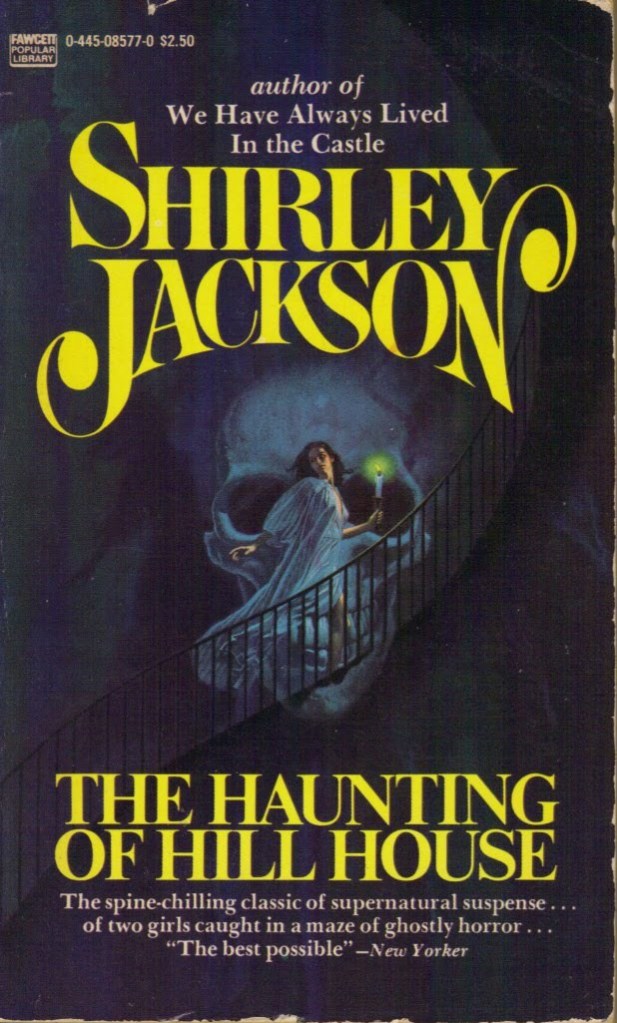
It was only a quarter, and looking at the back I recognized the characters–Nell, Theo, Dr. Montague, Luke–and of course, the name of the haunted house–Hill House. I bought it and a couple of others, and I started reading at the first opportunity, and was completely mesmerized. It quickly became one of my favorite novels of all time–I already knew Jackson’s story “The Lottery”, because at some point in school I’d been shown the film (why was this appropriate school viewing? Imagine trying to show it to students today!) and in a Drama class we’d actually read the stage adaptation and even put it on for the school (I think I had one line in our production?). Reading Stephen King’s Danse Macabre also told me more about both Jackson’s writing and the Robert Wise directed film, which was my first exposure to Julie Harris; I also remembered that the opening of Jackson’s novel was used by King as an epigram in ‘salem’s Lot; he also dedicated a book to her “because she never had to raise her voice,” which is a very poetic way to describe the softly macabre writing style and voice she used in her works. I lost my original copy at some point during moves over the years, and I acquired another copy after we returned to New Orleans in 2001 from our brief, preferably forgotten interlude in Washington DC–and have made a point to reread it every year since.

And no matter how many times I reread it, I never tire of its haunting, terrifying beauty.
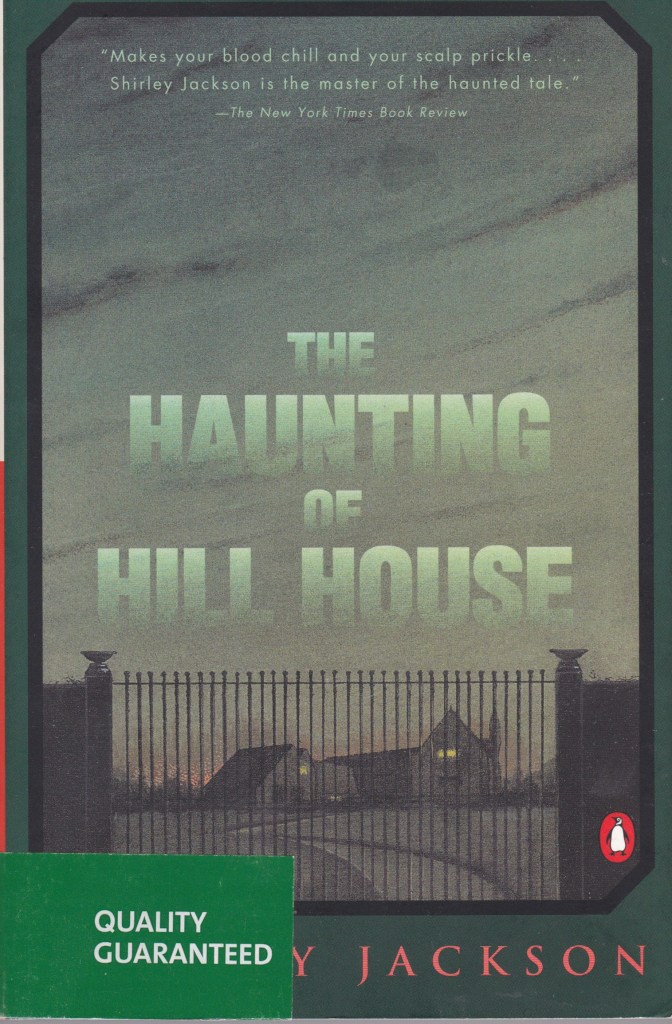
No live organism can continue for long to exist sanely under conditions of absolute reality; even larks and katydids are supposed, by some, to dream. Hill House, not sane, stood by itself against its hills, holding darkness within; it had stood so for eighty years and might stand for eighty more. Within, walls continued upright, bricks met neatly, floors were firm, and doors were sensibly shut; silence lay steadily against the wood and stone of Hill House, and whatever walked there, walked alone.

Dr. John Montague was a doctor of philosophy; he had taken his degree in anthropology, feeling obscurely that in this field he might come closest to his truest vocation, the analysis of supernatural manifestations. He was scrupulous about the use of his title because, his investigations being so utterly unscientific, he hoped to borrow an air of respectability, even scholarly authority, from his education. It had cost him a good deal, in money and pride, since he was not a begging man, to rent Hill House for three months, but he expected to be compensated for his pains by the sensation following upon the publication of his definitive work on the causes and effects of psychic disturbances in a house commonly known as “haunted.” He had been looking for an honestly haunted house all his life. When he heard of Hill House he had been at first doubtful, then hopeful, then indefatigable; he was not the man to let go of Hill House once he had found it.

Dr. Montague’s intentions with regard to Hill House derived from the methods of the intrepid nineteenth-century ghost hunters; he was going to go and live in Hill House and see what happened there. It was his intention, at first, to follow the example of the anonymous Lady who went to stay at Ballechin House and ran a summer-long house party for skeptics and believers, with croquet and ghost-watching as the outstanding attractions, but skeptics, believers, and good croquet players are harder to come by today; Dr. Montague was forced to engage assistants. Perhaps the leisurely ways of Victorian life lent themselves more agreeably to the devices of psychic investigation, or perhaps the painstaking documentation of phenomena had largely gone out as a means of determining actuality; at any rate, Dr. Montague had not only to engage assistants but to search for them.

That opening paragraph alone is a masterpiece.

I parodied it for the beginning of one of my Scotty books–it gave me great pleasure to write the words New Orleans, not sane, stood by itself within its levees–and of course, this book was a pretty heavy influence on Bury Me in Shadows. The book reads almost like a fever dream, with its rhythms and poetries of language, and the story itself is as mysterious as one could possibly hope. The genius of Jackson is knowing that the biggest fear of all is the unknown; so we never know what is actually going on at Hill House–is the house actually bad, or just unlucky? The house’s history is bad and tragic from the very beginning, as we are told in Jackson’s spellbinding voice; who precisely was Hugh Crain, who built the house for his wife and family but never knew any kind of peace within its walls? What went wrong? Jackson never lets us know anything other than that the house is bad. Her primary point of view character is perhaps the must untrustworthy and unreliable of narrators, Eleanor Vance, Nell. Dr. Montague invited Nell because of a strange occurrence that happened when she was a small child; stones rained down on their house out of clear blue sky; her mother darkly blamed it on the neighbors (this also happened to Carrie White’s house when she was a little girl in Stephen King’s Carrie–in the newspaper write-up included in the book Mrs. White also blamed it on “the neighbors”), but other than that, Nell is pretty ordinary and small. She’s wasted most of her adult life taking care of her invalid mother; she’s now in her early thirties and living with her sister’s family, sleeping on the couch. She’s meek but capable of anger–she has a lot of anger and rage buried deep inside of herself–anger at the world, at the injustice of her wasted life, at the lack of a viable future; she has no prospects, no job, no friends, no nothing. The invitation to Hill House awakens a joy in her that she’s never known–she’s wanted somewhere. Her sister and brother-in-law refuse to let her take their mutual car; she gets up early and rebelliously takes the car anyway and heads to Hill House. As she drives she daydreams and observes everything along the road, making up a lovely fantasy for herself about living in a house with stone lions at the foot of the driveway; she stops for lunch and observes a little girl who refuses to drink her milk because she doesn’t have her special cup with stars on the bottom she can she as she drinks. Mentally, Nell urges the little girl not to give in, to not surrender to the injustice of not having her proper cup–as it will be the first of many surrenders of herself she’ll end up making throughout her life until she, like Nell, becomes invisible.

And then, hopeful and happy and excited, she arrives and gets her first look at Hill House:

The house was vile. She shivered and thought, the words coming freely into her mind, Hill House is vile, it is diseased; get away from here at once.

Which then gives Jackson the opportunity, as the next chapter opens, to describe Hill House:

No human eye can isolate the unhappy coincidence of line and place which suggests evil in the face of a house, and yet somehow a maniac juxtaposition, a badly turned angle, some chance meeting of roof and sky, turned Hill House into a place of despair, more frightening because the face of Hill House seemed awake, with a watchfulness from the blank windows and a touch of glee in the eyebrow of a cornice. Almost any house, caught unexpectedly or at an odd angle, can turn a deeply humorous look on a watching person; even a mischievous little chimney, or a dormer like a dimple, can catch up a beholder with a sense of fellowship; but a house arrogant and hating, never off guard, can only be evil. This house, which seemed somehow to have formed itself, flying together into its own powerful pattern under the hands of its builders, fitting itself into its own construction of lines and angles, reared its great head back against the sky without concession to humanity. It was a house without kindness, never meant to be lived in, not a fit place for people or for love or for hope. Exorcism cannot alter the countenance of a house; Hill House would stay as it was until was destroyed.

Nell’s sanity, never the strongest, is affected deeply by the house–she both hates and loves it, separate parts of her nature begging her to flee while the other telling her she’s come home, to stay. The other three in the party–Dr. Montague, Theo the lesbian with some psychic ability, and Luke, due to inherit the house one day–become aware very quickly that the house is having an odd effect on her; they also hate and fear the house, but that welcoming feeling Nell experiences, that desire to never leave, is for her and her only. The rest of the book is quietly terrifying–the noises in the night, the realization that whatever is going on in the house has a sly intelligence of a sort–and the scene where Nell is terrified in the night and holds Theo’s hand…until Theo turns on the lights and Nell realizes she was across the room so whose hand was I holding? is one of the most horrifying moments in horror fiction. And then, the chilling, tragic end.

I also always see the house the way it was shown in the movie.
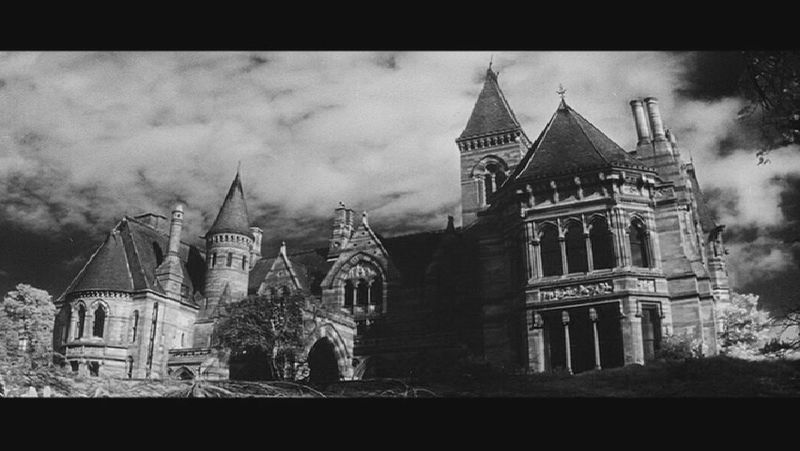
I also rewatched the movie while I was rereading the novel–not the execrable remake but the original–and it holds up just as terrifying and unsettling as it was the first time. Julie Harris is fantastic as Nell, fragile and frayed and slowly unraveling; in the movie isn’t not quite as left to the viewer as it is to the reader the notion that Nell herself is the one haunting Hill House; the house gains its power through her. (This was done beautifully in the Netflix adaptation, The Haunting of Hill House, which is loosely based on the book but updated and adapted and changed significantly; I thought the series was fucking fantastic and an excellent homage to both the book and the original film. You can’t improve on what came before, so why not reinterpret it? I know Jackson purists were outraged, but having seen the dreadful 1999 remake…yeah, this wasn’t that, for sure.)

Also, because of the movie, whenever I read the book I see it in my mind in black and white. The film wouldn’t work in color, either.

If you’ve not read the book, you really should. It’s a masterpiece on every level.

Open Your Heart

Well, the Saints managed to win again yesterday. I had the game on while I went through the Bury Me in Shadows manuscript, making notes; I have to concur with the assessment I made of the manuscript initially Saturday–it’s not going to require a lot of work before I turn it in. It might even be ready to go as early as next weekend, if I stay focused, pay no attention to shiny objects, and stay on course. During the Saints game, I went over the manuscript more carefully; making notes on what to add and what to take away, and the whole thing is actually more cohesive than I originally thought. It’s not going to be easy–it never is–but getting this manuscript ready for my publisher isn’t going to be as rough a slog as it could have been.

I was very proud of myself this weekend as I got a lot done. I cleaned and organized and got so much done that was on my list of things to do–and I even got a great night’s sleep and so felt pretty rested…until the alarm went off at six this morning. I’d actually woken up at 5:52, and just stayed in bed until the alarm went off, hitting snooze twice because the bed felt nice and comfortable and warm. I’d rather not venture out into the world today–I’d much rather stay here in the comfort of my own home, and definitely would have preferred to stay in the warmth of my comfortable bed, but I have to get up and go to work and prepare myself for my two long days.

Heavy heaving sigh.

We watched more episodes of Bigmouth last night, and I can’t decide if the show is actually really uproariously funny, or if the shock of the things the show covers–all the joys of junior high school puberty, with all that entails–is what makes it funny; the whole oh my God are they really talking about that? thing that I also always wondered about South Park.

I finished my reread of The Haunting of Hill House also yesterday–it’s a very short book–and am still in awe of the genius of Shirley Jackson. The way she created a mood, and tension, with beautifully crafted sentences and paragraphs is simply amazing. I couldn’t help but think how much stronger her book is than the nearest thing to it that I can think of–Richard Matheson’s Hell House, which was excellent and used the same basic structure–a notorious haunted house, and some ghost hunters arrive to see if they can figure out what is going on there–in a completely different way. The books’ titles are even similar. But I love both books, enjoy them both tremendously, but one always makes me think of the other. Again, I’m not really sure Jackson should be classified as a horror writer–her work kind of defies classification–but she was definitely one of the best American writers of the twentieth century.

I was trying to remember how I first came across the Jackson novel; I knew of her through her short story “The Lottery,” which I read in high school. I’d seen the 1963 film version, The Haunting, which was one of the most terrifying movies I’d ever seen at that point in my life–I’ll never forget Julie Harris as Nell–but at that time I didn’t know it was a novel. I think I first became aware of the novel because Stephen King used that famous opening paragraph as an epigram for salem’s Lot; and shortly thereafter came across a copy in a used book store–so naturally I had to buy it, and read it in one afternoon, completely enthralled…and I’ve never been without a copy of the book since. I started rereading it every year about ten years or so ago–the other book I reread every year is Daphne du Maurier’s Rebecca–and I think both books have influenced me as a writer, even if that isn’t apparent in my actual work. (I’ve never finished reading the entire canon of either Jackson or du Maurier; they are both dead and therefore the established canon is all there is…and I never want to be finished with either author. I know, it’s crazy, but it’s also just the way I am.)

And on that note, tis off to the spice mines with me. Have a lovely day, Constant Reader!

557620_306575759457433_1737305115_n

What’s Love Got To Do With It

I finished my reread of Hell House last night, and it does, in fact, hold up rather well. It was, frankly, a most satisfying way to close out my Halloween Horror month of reading; even if it was a reread, and a book I’ve read several times before.

I first read it when I was a teenager; it was one of the many mass market paperbacks I found on the wire racks at the Zayre’s in Bolingbrook. The cover was rather non-distinct; black, with a photograph of a woman in a red halter dress, carrying a candelabra and looking back over her shoulder, a terrified look on her face, her long dark hair being blown backwards by the same wind pushing the candle flames backwards, with the title above it in red letters: HELL HOUSE. I had watched The Haunting several years earlier, and was absolutely terrified by it; I hadn’t yet realized that it was based on a Shirley Jackson novel. So when I saw Hell House, I did think that it might be the same story, and of course Hollywood had to change it to Hill House. So I bought it, took it home and started reading.

It was similar, but it wasn’t the same story. By any stretch of the imagination.

Scan

It had been raining hard since five o’clock that morning. Brontean weather, Dr. Barrett thought. He repressed a smile. He felt rather like a character in some latter-day Gothic romance. The driving rain, the cold, the two-hour ride from Manhattan in one of Deutsch’s long black leather-upholstered limousines. The interminable wait in this corridor when disconcerted-looking men and women hurried in and out of Deutsch’s bedroom, glancing at him occasionally.

He drew his watch from its vest pocket and raised the lid. He’d been here more than an hour now. What did Deutsch want of him? Something to do with parapsychology, most likely. The old man’s chain of newspapers and magazines were forever printing articles on the subject. “Return from the grave”; “The Girl Who Wouldn’t Die”–always sensational, rarely factual.

Wincing at the effort, Dr. Barrett lifted his right leg over his left. He was a tall, slightly overweight man in his middle fifties, his thinning blond hair unchanged in color, though his trimmed beard showed traces of white. He sat erect on the straight-back chair, staring at the door to Deutsch’s bedroom.

What Deutsch, an old and dying billionaire, is proof that either that afterlife exists, or that it doesn’t. In order to get that proof, he is willing to pay an almost obscene amount of money, and do pretty much anything. He is, in fact, assembling a team to send to the “Mount Everest of haunted houses,” the Belasco house in Maine; more commonly known as Hell House.

Like in The Haunting of Hill House,  a team of four people are going to go into the haunted house to, basically, see the phenomena, observe and document it, and, if possible, cleanse the house of the infernal spirits haunting the house. Two teams have gone into the house in the past; with one exception, all of them were either killed or went insane.

That one survivor, Ben Fischer, is a part of this expedition.

Dr. Bartlett, though, is no Dr. Montague; who merely wanted to experience the phenomenon at Hill House and write a paper about it; Dr. Bartlett’s life’s work has been based on the theory that hauntings, or so-called paranormal phenomena, are not actually caused by ghosts or spirits, but are simply residual energy. He has designed a machine that will reverse that energy and therefore cleanse Hell House–or any other haunted house. His much-younger wife, Edith, believes in him and his work…but there are issues within their marriage; he is a polio victim and the polio has also left him impotent; Edith herself has issues with sex and her own sexuality and this sterile, sexless marriage is a refuge for her.

The other two members of the party, Ben Fischer and Florence Tanner, are both mediums. Ben was a mere teenager when he went into Hell House the first time; he was the lone survivor, the one Hell House could not kill or drive insane. He has since stopped used his psychic gift. Florence is a beautiful woman who has her own ministry and believes her gifts come from God; she believes ghosts are spirits that have not moved on and it is her duty to use her gift to help them move on, through love and the power of prayer. She and Dr. Bartlett have competing beliefs and values…and once they are all inside of Hell House, the terror truly begins.

Richard Matheson was a great writer; many of his writings were made into films–Stir of Echoes, Somewhere in Time, I Am Legend, The Incredible Shrinking Man–and many of his short stories became classic Twilight Zone episodes–he wrote “Terror at 20,000 Feet”–and Hell House was filmed as The Legend of Hell House, which I also saw as a teen and it absolutely terrified me.

It’s awesome that the book holds up.

When Doves Cry

We finished watching Stranger Things last night, and were sorry to see it end; it was quite a lot of fun, and Episode 8 was a non-stop adrenaline rush from beginning to end. The last thirty minutes of the season was absolutely charming; those kids are just so damned appealing, and Winona Ryder was much better in this season than she was in the first. I also got much further along in Hell House; I should finish it today to end my official month of Halloween Horror reading. Some great crime novels have stacked up while I devoted myself to horror this month; can’t wait to start digging into crime again.

I finished outlining Jackson Square Jazz last night, and am going to start work on the Scotty concordance/Bible this week while I also work on Crescent City Charade. I’m still not completely sold on that title, let me say that right now; it’s very likely going to change before I turn it into the publisher. It’s been fun rereading (or rather, skimming) Jackson Square Jazz preparatory for doing the outline; I feel much more connected to Scotty than I was. The amazing thing to me is how many continuity mistakes I’ve made over the years. The lovely thing is that I can now go back to the original books and fix the errors–there’s nothing i can do about them in the later books. In fairness to myself, I don’t really remember much of anything I wrote pre-Katrina, but I could have–should have–gone back and reread the originals, and the Bible/concordance is way overdue.

It’s also amazing how much I did forget. The plot of Jackson Square Jazz was almost a complete mystery to me, and it was a much better book and story than I remembered it being. Ah, memory is such a strange thing, isn’t it?

I really do need to be better organized. The kitchen is a mess this morning, and I need to make another to-do list. I’ve got some laundry going and I need to do the dishes and make chili for the crockpot to cook all day. And on that note, it’s back to the spice mines.

Here’s a Halloween hunk for you:

99f6e0a8a379d8f1d937cabc0430e6b2

Fall in Love with Me

A chilly Monday morning in New Orleans. I am arming myself with coffee and a thorough to-do list to get me through the week. I am confident both will hold me in good stead.

We’re binging Stranger Things, and after a slow first couple of episodes, it certainly has picked up steam. We were both regretful we had to turn it off last night in order to go to bed; if we didn’t have to work this morning we would have stayed up and finished it off. But there’s always tonight. (rubs hands together in glee).

I’m also about halfway through Hell House, which is holding up beautifully. I am again amazed at how similar, both in title and structure, the book is to The Haunting of Hill House, The tone and voice are completely different, of course; Hell House actually goes into the POV of all of the characters at one time or another, whereas Jackson focused primarily on Eleanor. And Hell House is definitely more haunted than Hill House; it’s called ‘the Mount Everest of haunted houses’–and the house has a much more infernal history than Hill House’s softer, more Gothic history of madness and death. There are times, too, when Hell House’s backstory seems almost over-the-top; yet at the same time, I can’t help but think wow, a book about everything that went on back then would be fascinating. It’s very definitely both a haunted house book and a “bad place” book.I do remember how it ended, I just don’t remember how Matheson gets the reader there. Definitely enjoying the ride thus far.

This morning I also had a breakthrough on a short story I’ve put aside. The question is, can I finish it and polish it in time for the looming deadline? I think so.

Okay, it’s time to get back to the spice mines. Here’s a hunk to get your week rolling:


swim3


Breaking Us in Two

Sunday. It’s one degree warmer than yesterday morning–wow, right? But you will undoubtedly be thrilled to know that I get everything on my list done yesterday other than go to the gym; and after spending two hours in the storage unit moving boxes of books around, I was pretty damned exhausted physically, and then braved Costco on a Saturday afternoon (it wasn’t bad at all, other than stupid people, which is every day). I also came across some books in the storage that I thought hey, these need to be reread and so I took them out. One of them was Richard Matheson’s Hell House, which seemed, at least to me, to be the proper reread after The Haunting of Hill House, in that they’re very similar; one could even go so far as to say Matheson basically took Jackson’s story structure and turned the dial up a notch. I am enjoying the reread very much; although I’m not very far into it thus far. I also found my copy of Michael Rowe’s groundbreaking anthology Queer Fear, which I reviewed in the Lambda Book Report many years ago when I worked there, and was to be my first encounter with Mr. Rowe; I remember he came up to me at the Lambda Awards the next year, introduced himself, and thanked me for the lovely review. We’ve crossed paths a few times since, and have become friends over the years. I do remember loving Queer Fear, and look forward to delving into it and rereading its short stories again.

I also found my high school scrapbook and my diaries from the 1990’s. I used to buy blank books and carry them around with me everywhere, so I could jot down story and/or book ideas, or write diary entries whenever I wanted to. I am always hesitant to reread my old diaries; I often wince from my immaturity and my over-dramatization of events in my life. Yet at the same time, the diaries also served as a very vital source of self-reflection and self-examination; I suppose this blog has served that purpose since I started it on Livejournal back in 2004 (the idea that I have been consistently blogging for thirteen years rather staggers the mind, doesn’t it? But I’ve been writing in a diary of some sort, off and on, since I was a teenager; this seems to be a natural continuation of that process).

I also found the three ring binder where I kept everything from the Virginia situation of 2005 and 2006; including the ACLU letter to the school board. I’d always intended to write a non-fiction book about it all, called Gay Porn Writer, in which I examined what happened to me in the context, not only of the times but extrapolating it out further into what was going on in publishing and the culture. My memory lies to me now, of course, so I am not certain that I’ll ever write such a book–I don’t know that I would remember things correctly, and even then, what is colored by my perceptions of things. I’ve since moved on, of course–I mentioned the incident in passing on my panel at Bouchercon and had to explain it a little, which was kind of crazy. It was so long ago, and I used to get invited to speak about it all the time. The memories are now hazy and unclear, but I am definitely going to keep all this information.

You never know.

I think I am probably just going to scan everything in the scrapbook, in order to preserve it electronically, and then throw it away. I don’t really need to keep programs from my high school football games, or from choir concerts, and scanning them will better preserve them anyway.

I have one errand to run today, and I also want to go to the gym for a little bit, start dipping my feet back into the water of working out regularly, and despite the cold, I am going to give that a try.

And hopefully, I’ll get some writing done, or at least something done that will move all projects forward.

Here’s a Sunday hunk for you:

IMG_3002

Feelings

Since October is, for me, the month of Halloween and therefore irrevocably tied to the horror genre, as Constant Reader already knows, I have decided to write only about horror in this month. I am casting my mind back, as it were, over the years and trying to remember what films and books drew me to the genre in the first place. As an author, I am often asked in interviews or on panels about influences, and while there are certain answers that I always give–Shirley Jackson, Stephen King, James M. Cain, Daphne du Maurier–there are often authors, books, films and television programs I forget at the time. (I once made a list of my favorite movies in response to a meme…and somehow forgot to name what could possibly be my favorite film of all time: The Princess Bride. In my defense, I often do these things very quickly and off the top of my head. )

So, in talking about the genre this month, I am also trying to dig deeper and not write about influences I have talked about before; or at least I am going to try not to–there is simply no way I can write about horror and not, for example, talk about Thomas Tryon’s terrific The Other, or Ira Levin. I do feel as though I’ve talked about Shirley Jackson and The Haunting of Hill House ad nauseum already; likewise with Daphne du Maurier’s sublime “Don’t Look Now.” (I may give in to the inevitable temptation and do so before the 31st; but I am going to honestly try to resist those temptations.)


omegamancover

I think I was twelve when I first read something by Richard Matheson: I Am Legend. It had recently been made into a film starring Charlton Heston (I’ve seen the film, renamed The Omega Man. It’s okay, but not as good as the book.) I Am Legend, for those not familiar with the story (it was also filmed again sometime in the last decade or so, with Will Smith. I have not seen the remake), is one of those “last man on earth” stories; only in Matheson’s world, a terrible plague has turned everyone who has not died into vampire-like creatures. The last man on earth is Robert Neville, who somehow is immune to the plague. He barricades himself up into his home at night while the vampires try to find a way to either get inside or taunt him, hoping to lure him out–while during the day he scavenges for supplies and kills vampires by staking them through the heart (the matter-of-fact description of him doing this is chilling and has always stayed with me; there are several scenes in Stephen King’s ‘salem’s Lot where the gang of heroes also hunts and stakes vampires during the day–when I first read ‘salem’s Lot this reminded me of Matheson’s book. Likewise, when I read Stephen King’s apocalyptic novel The Stand, it again reminded me of Matheson’s book.) I Am Legend isn’t just a scary book about the aftermath of the end of the world though; there’s a lot of thought given to what it means, what this new society of people, this Brave New World of vampire-like people will be like, and what it’s like to be the last of your own kind. I didn’t catch a lot of this when I was a kid, and frankly, as it delved more into philosophy towards the end the unsophisticated reader I was found it a bit disappointing. When I revisited the book in the 1980’s–I went on a Matheson kick, and was delighted to discover that many episodes of television shows, or films, that I greatly enjoyed were actually based on Matheson’s work: Somewhere in Time, What Dreams May Come, Stir of Echoes–it’s quite an extensive list.

0ee08510ac0676ae995599ec51738eff

I also read Hell House when I was about thirteen, but didn’t connect that Matheson had written both books. Hell House, about “the Mount Everest of haunted houses”, was similar in structure to Shirley Jackson’s The Haunting of Hill House, but also very different. It was made into a terrifying film called The Legend of Hell House, which I recently rewatched, and actually holds up. (As a weary, cynical adult, I can see how cheaply the film was made now; but it’s just as spooky and scary as it was when I was a teenager and it terrified me.)

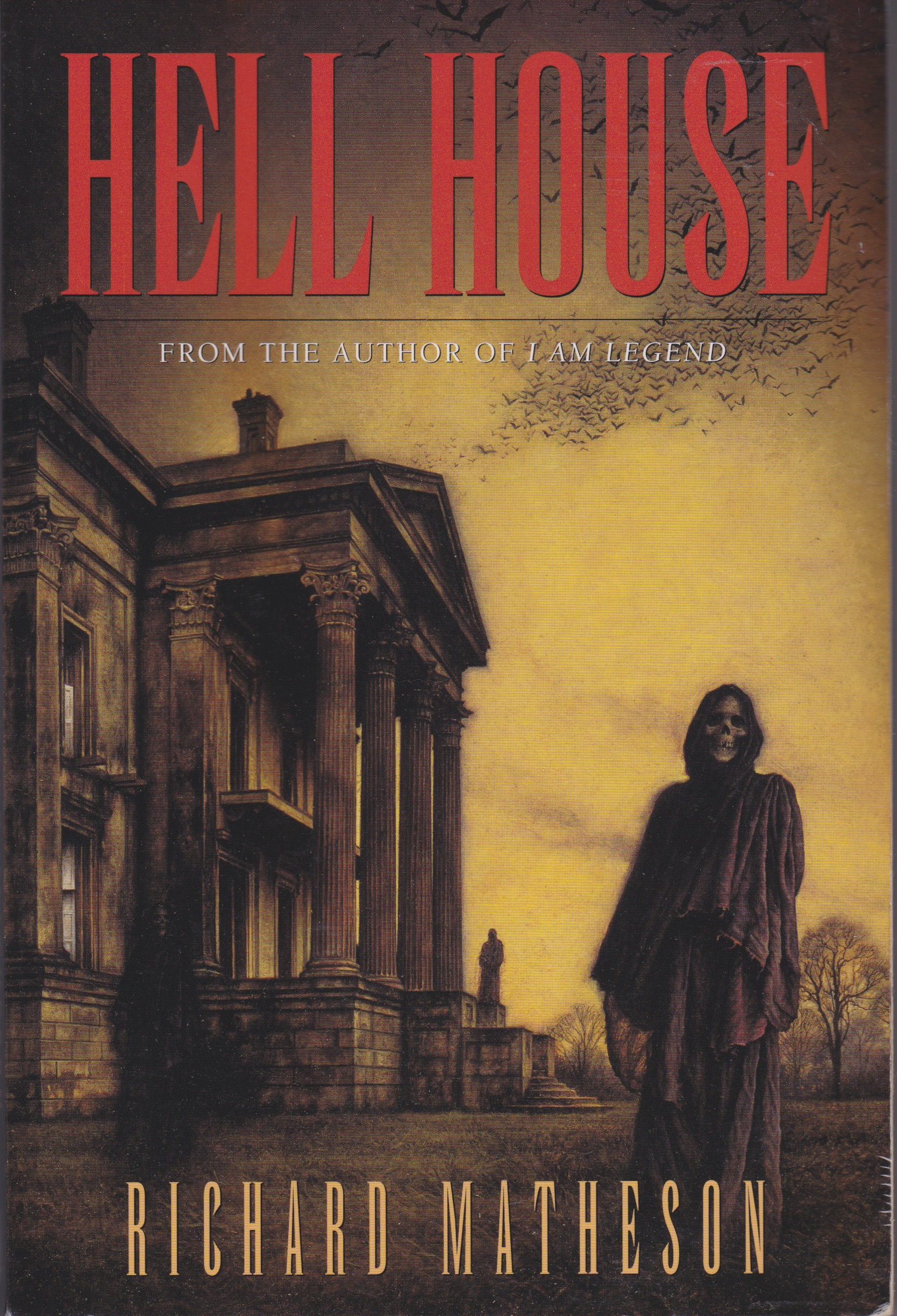
hellhousebookcover

That was the version I originally read; this is the one I reread:

imgres

Again, I would love to spend a week in a mountain cabin sometime revisiting Matheson’s work.

And now, back to the spice mines.