I came to Disney later in life. You also have to remember that I grew up in a different world than the one everyone who grew up in the 1970’s or later did; we couldn’t rent movies, there were only three television networks plus PBS and whatever local independents there might be, and so the only chance to actually see classics of Disney’s past was if they were re-released, and that didn’t happen very often. My parents, despite their youth, weren’t going to spend the money to take us to see something they didn’t care about seeing, either; money was tight, and Mom used to take us to see movies when we were little in the summer to get out of the heat. I do vaguely remember seeing The Happiest Millionaire on the big screen–my only real memory of it was he owned an alligator–but for the most part, we never really saw many Disney movies, and especially not animated ones.
Yes, when I was a child I watched Disney’s Wonderful World of Color every Sunday night after Mutual of Omaha’s Wild Kingdom for years. But my childhood was also not a great time for Disney, either in animation or live action. Sure, some films were gems, but not in the same vein as the big classics, like Snow White and the Seven Dwarves and Peter Pan and Cinderella. Disney was more focused on live animation movies (this was the period of The Love Bug movies and Kurt Russell’s college student movies (and beautiful Jan-Michael Vincent in The World’s Greatest Athlete.) at this time.
It was the Disney renaissance of my late twenties/early thirties, timed with my self-discovery journey about who I was and wanted to be and figuring out everything, really, that turned me into a Disney Queen. It was hard not to get up caught up in Disney’s beautiful visuals and songs about misunderstood outsiders who eventually find where they belong, from The Little Mermaid to Beauty and the Beast to so many others. All the films essentially had the same basic story beats: someone who doesn’t feel like they belong goes on an adventure, where they find themselves and what they were meant to be, and wind up with a great final reward of love and acceptance. How does that not resonate with gay men in the time of HIV/AIDS? The fact that songwriter Howard Ashman was a gay man dying of AIDS while working on The Little Mermaid and Beauty and the Beast1 only made the films resonate with gay men all the more–and I went whole hog on the Disney Queen roleplay. (My favorite character of all Disney animation remains Malificent, of course.)
But I also always had a very soft spot for Hercules, even though it wasn’t one of the more popular animated Disney films. I’m always a little curious when Disney announces it’s making an animated film out of something that hardly seems kid-friendly; like The Little Mermaid, which is a horrible Hans Christian Anderson fairy tale. Likewise, when I heard they were making Hercules I arched an eyebrow. I loved Greek mythology and ancient Greece when I was a kid (my three favorite ancient civilizations were Greek, Roman, and of course Egyptian), and I was always interested in Hercules–although as a child I knew the correct Greek name was Heracles–because I kind of saw him as an ancient Greek Superman; the heavily muscled physique he was always depicted as having was just a bonus for little gay Greg, and I always wanted to write about him; discovering that in the original myths he had both male and female loves once I became an adult was just more fire to the flame. The Disney film, of course, altered a lot of the not-so-kid-friendly aspects of the myth, obviously; they made Hera his mother rather than his principle enemy, they cut the Muses down from nine to five, and eliminated his cruelty, his bouts of madness, and his insane all over the map sexuality to make him another Disney prince, who grows up an outsider and has to prove himself and that he not only belongs but is a hero.
The Muses were the narrators of the movie, and they were a delight. Their songs were all done in the style of old-time girl groups, and I thought they were a terrific narrative device. I loved the soundtrack, too.
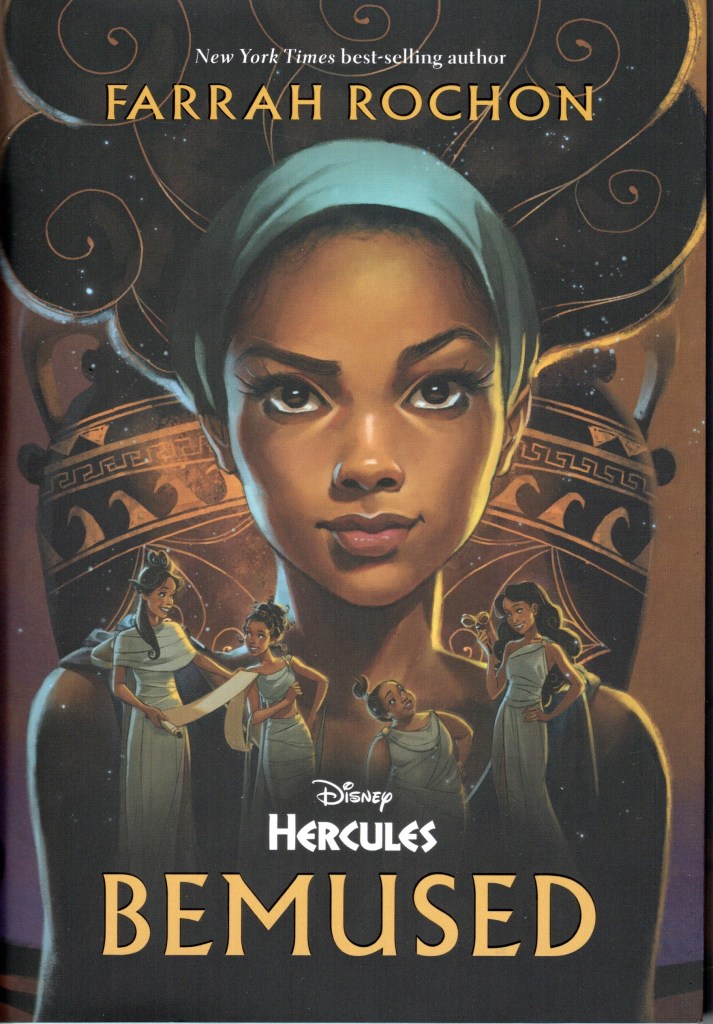
Imagine my delight when I found out local New Orleans author Farrah Rochon, who is an highly acclaimed romance writer, was writing the backstory for the Muses in a young adult novel called Bemused.
And Reader, it was utterly charming.
I loved it.
Mnemosyne stood on the edge of the craggy cliff, listening to the whistle of the brisk windblowing through the barren tree branches below. The blanket of thick gray storm clouds that had shrouded the valley for the past few days had finally lifted. She took in a lungful of the clean mountain air. It was invigorating. And comforting.
And she was far enough away from the oppressive demands of Mount Olympus that she could finally feel a sense of calm. She had not experienced true peace in so long that even she, the Goddess of Memory, could barely recall what it was like.
Her fear had lessened with every moment that passed after she’d fled from Mount Olympus, the place where she’d spent so many onerous years. Now, she had a new destiny to fulfill. Had the time finally come?
A loud crack, followed by a harsh, high-pitched squawk, sent Mnenosyne scrambling for cover. She looked up just intime to see a bird swooping overhead, its wings extending out several feet on each side.
Mnenosyne, you see, was a Titan who didn’t fight Zeus and his siblings in their war to take over the heavens. She stayed on Olympus, and eventually developed relationships with several of the other goddesses in the pantheon, namely Athena and Artemis. But (this is the Disney universe, not the ancient Greek one) Hades spends a lot of time undermining her faith in capricious and fickle King of the Gods, Zeus, whom he resents for giving him the underworld to rule over and wants to overthrow (straight up from the film) him. He wants Mnenosyne on his side due to her control over memories; she can convince all the gods that Hades has always been the King of the Gods and Zeus the lord of the underworld, and so she is key to his plans. But she flees Olympus, making all of them forget she ever existed–but Hades kept a journal so she couldn’t do that to him as there was a written record. Hades is the big bad in this book, just as he was in the movie (which was probably the last time I’ve enjoyed James Woods in anything), and she creates her daughters, but keeps their gifts hidden as she keeps moving them around to avoid scrutiny and coming to the attention of the gods. But Hades finds her and kidnaps her, and her daughters now must use their powers to find her and save her from the clutches of Hades, so it’s also a very charming coming of age story as well as an interesting adventure.
This is an excellent read, and belongs on your shelves next to your Rick Riordan novels.
- Miss me with the “Stockholm syndrome” takes on Beauty and the Beast, thank you very much; the entire point of the film is that someone monstrous becomes capable of love and caring for someone besides himself, which finally breaks the curse on him. It’s actually a beautiful story, it makes me cry every time I watch it at least three times (when he loves her enough to let her go; when he dies; and when he transforms back), and at some point I am going to write about this masterpiece of a movie. ↩︎


 Queer and Loathing in America