Mrs. Brown, You’ve Got a Lovely Daughter

Well, here we are on Thursday and it’s my last day in the office for the week. Huzzah! I was very tired yesterday when I got home. I did pick up the mail and did start running out of steam in the afternoon, but I did manage to get a thousand words done on new Scotty before my brain sputtered and went dormant. It’s fine, it’s a transitional chapter and I always kind of struggle with those at first before I break through the wall. I’ll probably get through it tonight. I do feel more rested this morning than I did yesterday, but I imagine I’ll hit a wall this afternoon the way I did yesterday. It also rained yesterday–not all day, on the afternoon and it started raining again once I got home after picking up the mail. Today I am coming straight home from work with. no stops on the way, which will be lovely. The house didn’t slide too badly over the course of the week, so I am not going to have to spend a lot of time on any of those chores tomorrow or tonight or the weekend.

We watched this week’s episode of Bad Monkey, which we are really enjoying. I would like to mention that Bad Monkey was the book that made me a fan of Carl Hiaasen. I had read one of his books when I lived in Florida, Tourist Season, maybe? I didn’t care for it, thought it silly and not very funny at all, and I began grouping comic Florida crime novels together under the category “Florida wacky.” But when I was on a work trip, I ran out of things to read with another night to go before we flew home, so I walked over to a Barnes & Noble for something new to read, and Bad Monkey was on a severely discounted book table, and I liked the font, so I gave him another try–and thought the book was hilarious. I laughed any number of times, and I couldn’t believe how tangled and tightly it was plotted. I went on to read several other of Hiaasen’s books, and found them to be equally hilarious and clever and that plotting! As someone who’s not very strong on plot, people who are capable of such epic plots with off-shoots and side plots and so forth, I really admire that ability. (If you ever want to see mastery in plotting, P. G. Wodehouse’s comic novels about the British upper class have unbelievably intricate plots.) Anyway, Bad Monkey is a terrific series, and Vince Vaughan (not a fan) is actually perfect for the main character of Yancy, and it’s stunningly beautifully shot.

And we’re going to have thunderstorms and rain most of the day, beginning in the afternoon. I’ve not checked the hurricane center to see what’s going on with those two new systems out there, but today is the red-letter anniversary day for five , storms to hit New Orleans–Katrina, Gustav, Isaac, Harvey and Ida. (I don’t even remember Harvey, frankly.) So we’ve made it through today without having to evacuate, but that doesn’t mean we’re in the clear yet. September is a very busy month, and we’ve had them in October before, too.

We have a three day weekend this weekend, too, huzzah! LSU’s season opener is Sunday night, and there are games on Saturday, too. I am getting my COVID booster Saturday morning, so if it makes feel unwell, I can spend the day at home just relaxing, watching football games, and reading. Woo-hoo! So tomorrow I’ll do my work-at-home tasks, and then spend the rest of the day writing and/or cleaning and doing laundry. I also shouldn’t have to leave the house tomorrow, either, which is always a plus for me. But now that I don’t have anxiety (at least not to the crippling degree that I used to have it) leaving the house really isn’t as big of a deal as it used to be, and I don’t resent having to run errands in quite the way that I used to. The new medications have been life changing, and my secret fear–losing the anxiety also was costing me the ability to write, and I would have to choose between them–is clearly not a thing. My brain is rewired, so I am having to come up with different methodologies of doing things now, including writing. Not getting more than a thousand words done yesterday before the new meds would have been a cause for anxiety and Imposter Syndrome and everything else counter-productive in my brain. The meds haven’t taken away the Imposter Syndrome completely, but it’s much easier to deal with now and it doesn’t come with the old spiral the way it used to, and it’s so much easier to deal with when it pops up now. This week, I’ve been ignoring that, and dismissing it as soon as it rears its ugly psychotic head.

More to the point, I’m enjoying writing again, something I’ve not really felt in a while (a lot of the outside stuff was taking up too much space in my brain, so it began to feel like an obligation and work rather than something I find pleasure in–and I really do love writing), and it feels good again. Huzzah!

And on that note, I am going to make some more coffee and head to the spice mines over on Elysian Fields. May you have a lovely Thursday, Constant Reader, and I may be back around later. Stranger things, you know. 🙂

Russian Roulette

Tuesday! Tuesday! We survived Monday and lived to tell another day!

You know, I’ll take accomplishment wherever I can find it these days.

Yesterday was a better day; I think making it into the office and spending the day doing my duties around the office helped banish things to the background rather than keeping them there in the front of my mind. I ran some errands when I left the office–mail, pick up a prescription–and then came home to have a nice quiet evening at home, alone. The festivals are next weekend, so hopefully at some point I’ll have my husband back. If I could only get him to work the same schedule as me…but that will never happen. I can’t say that I blame him, either; if it were up to me this getting up at six thing would long be in my rearview mirror. Adjustments. Life is all about the adjustments.

I was very tired when I got home last night, though, and didn’t get much of anything done as a result. I feel better this morning–not that I couldn’t have slept another few hours, of course, and it’s chilly this morning in the Lost Apartment; ah, it’s a frigid 47 degrees outside, that could explain the chill I am feeling this morning. I’m glad I slept well, though; it’s such a struggle when I didn’t. I feel rested this morning–we’ll see how long that lasts, won’t we?–and my coffee tastes good this morning and I think it’s going to be a good day. Of course, there are all kinds of variables that are out of my control–will there be horrible and inconsiderate drivers encountered on the way to the office (of course there will)? They are also working on repairing and repaving Elysian Fields by the office as well; this made leaving an issue yesterday and could make it even more of one tonight when I get off work. I ran errands on the way home last night, and I don’t think I really need to do anything after work other than come straight home tonight, which is lovely. Tomorrow is Pay-the-Bills Day (always a joy), and I am looking forward to doing some writing tonight as well as diving into my next book, which is probably going to be Bobby Mathews’ Living the Gimmick. I might need to switch things up with my reading once I finish Bobby’s book; and read something completely different from everything I’ve been reading lately. I’ve gotten some good books lately–The Velvet Rage, Wined and Died in New Orleans, Scorched Grace–which all look interesting, but maybe I should mix it up by reading horror or science fiction or something completely outside what I usually write and read.

I actually feel good this morning–I know I’ve already said it, but it’s true–and some of it is mental; I think today is going to be one of the good days; I don’t feel like there’s some kind of darkness in the back of my head, weighing me down the way it felt yesterday. I’m not sure if I’m making sense or not in trying to get what this feels like across to you, but I do feel this morning like I might be coming out of the numbness and the grief–or at least getting a day’s respite from it. It’s very strange. I don’t know if there’s a methodology for this or not–everyone grieves differently–but it becomes so incredibly tiresome not having any kind of instruction manual or rules for anything. I suppose I could read Joan Didion’s The Year of Magical Thinking, but I’m a little Didion-ed out, to be honest. Brilliant wordsmith, of course, but I don’t know that I could handle her memoir of grief.

I also wonder if you are weary of hearing about this, and perhaps I should start keeping it all to myself and not oversharing in my usual oblivious manner? (My complete obliviousness is a character trait I’ve only recently–since the pandemic–become aware of, and explains a lot about my personal history; ironically, I made that very obliviousness a central part of my character Valerie in A Streetcar Named Murder, and people loved her; go figure, right? I guess it’s endearing? In fiction, at any rate.)

God, how I wish I could get back under my blankets in my warm bed. Cold mornings are so uninspiring, really; especially when you have a warm bed with a purring kitty and a mountain of blankets where you can stay comfortable and warm. That’s the best feeling, really; maybe it will be cold Saturday morning when I can stay in bed later. One can dream, at any rate, can’t one?

And on that dull note, I think I am going to go ahead and get ready to spend the day in the spice mines. Have a lovely Tuesday, Constant Reader, and I will be back tomorrow.

Please Remember Me

I am often, incorrectly, referred to as a “New Orleans expert.”

Nothing, as I inferred in that sentence, could be further than the truth.

Don’t get me wrong–I absolutely, positively love New Orleans, for many and varied reasons. The short, elevator-pitch answer is always Because I’m not the weird one here. And it’s true; New Orleans is an eccentric city filled with eccentrics. No other city in North America is like it, even remotely; New Orleans is a city that doesn’t abhor strangeness, but rather embraces it. When I came here for my thirty-third birthday in 1994, when I got out of the cab at the intersection of St. Ann and Bourbon that first night, my actual birthday, to go out to the gay bars of the Quarter, I knew I was home. There was no doubt in my mind, no question; just an immediate and instant connection with the city and I knew, not only that I would eventually live here, but that if and when I did all my  dreams would come true.

And that feeling was right. I fell in love with New Orleans, I fell in love in New Orleans, and after I moved here, all of my dreams did, in fact, come true.

So, when I write about New Orleans my deep and abiding love and passion for the city inevitably comes through. But I always kind of smile inwardly to myself when people call me an expert on the city; I am hardly that, and libraries could be filled with what I don’t know about the city. Sure, I do know some things, but an expert? Not even remotely close.

A perfect case in point is Milneburg. What, you may every well ask, is Milneburg? Milneburg was a resort village on the lake shore that many New Orleanians would escape to during the wretched heat of the summer (and I am vastly oversimplifying this); I’ve read about it in history books and so forth. I even thought Murder in Milneburg might make for an interesting historical mystery. I always saw it, though, in my mind’s eye, as close to the parish line between Orleans and Jefferson parishes; closer to Metairie and the causeway. So, you can imagine my shock when I saw a map of Milneburg posted on one of the New Orleans historical Facebook pages I belong to, and realized that I was completely wrong: there was a railroad line from New Orleans to Milneburg (which I knew) that ran along what is now Elysian Fields Avenue. 

So, Milneburg was actually where the University of New Orleans is now located; and the train line continued along east, crossing at the Rigolets.

Some New Orleans expert I am, which is why I decided to start reading more histories of the city over the last few years. It’s been quite an education, and there are still some things I don’t quite grasp–like when the Basin Canal was filled in to become Basin Street, and what relation that had to Storyville and Treme, because the train station also used to be located near Storyville (this was part of the reason why the drive to clean up Storyville and end legal prostitution in New Orleans was successful; the other part was because New Orleans was an embarkation point for the military during World War I and the Pentagon frowned on delivering green military recruits to whorehouses).

So, yeah, some expert I am.

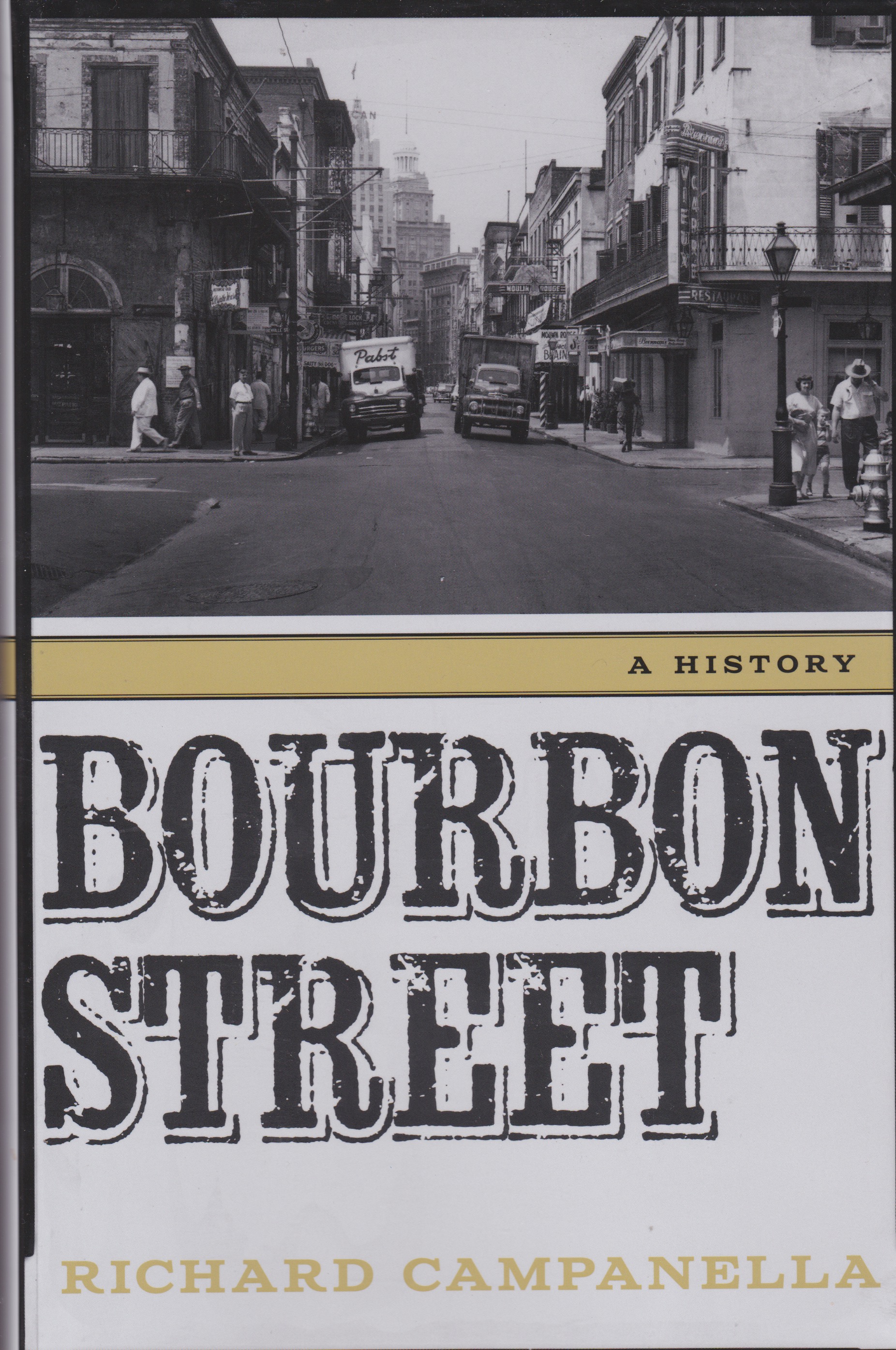
But I really enjoyed Richard Campanella’s Bourbon Street.

bourbon street

There are no straight lines in nature. Nor are there any right angles. Rather, intricate arcs and fractures merge and bifurcate recurrently, like capillaries in a plant leaf or veins in an arm. Nowhere is this sinuous geometry more evident than in deltas, like that of the Mississippi River. Starting eighteen thousand years ago, warming global temperatures melted immense ice sheets across North America. The runoff aggregated to form the lower Mississippi River and flowed southward bearing vast quantities of sediment. The bluffs and terraces that confined the channel to a broad alluvial valley petered out roughly between present-day Lafayette and Baton Rouge in Louisiana, south of which lay the Gulf of Mexico.

Into that sea disembogued the Mississippi, its innumerable tons of alluvium smothering the soft marshes of the Gulf Coast and accumulating upon the hard clays of the sea floor. So voluminous was the Mississippi’s muddy water column that it overpowered the (relatively weak tides and currents of) Gulf of Mexico, thus prograding the deposition farther into the sea. Occasional crevasses in the river’s banks diverted waters to the left or right, creating multiple river mouths and thus multiple depositions. High springtime flow also overtopped the river’s banks and released a think sheet of sediment-laden water sideways, further raising the delta’s elevation.

In this manner, southeastern Louisiana rose from the sea. The process took about 7,200 years, making the Mississippi Delta, as Mark Twain put it, “the youthfulest batch of country that lies around there anywhere.” Young, dynamic, fluid, warm, humid: flora and fauna flourish in such conditions, as evidenced by the verdant vegetation and high productivity of the delta’s ecosystem. Humans, on the other other, view these same conditons as inhospitable, dangerous, even evil, and endeavor to impose rigidity and rectitude upon them, so as to better exploit the delta’s resources.

If New Orleans is known for anything, it’s Bourbon Street. Everyone has heard about Bourbon Street, it seems; just as they’ve heard about Carnival/Mardi Gras, beads, and show us your tits (which locals do NOT do–either yell it or bare them). Campanella’s book traces the history of the famous street, and by extension, the French Quarter itself, from its very beginnings when the French arrived and designed the streets, to its modern day incarnation as a street of endless partying and no little debauchery. It’s very well researched, and Campanella, who I believe teaches at Tulane, is the true expert on the city; I follow his pages on Facebook, and I can’t even begin to tell you how much inspiration and information Bourbon Street  has given me. I’ve put so many page markers in my copy that I’m worried about breaking the spine!

One thing that my reading of New Orleans history has further emphasized to me–and it also really comes through strongly in Campanella’s book–is how New Orleans has always been a city of neighborhoods, and how each neighborhood of the city had (has?) its own unique  sense of itself, and how those who lived in those neighborhoods so strongly identified with them. The evolution of the French Quarter from the original city and seat of its government, to the original French leaving and being replaced by immigrants (as late as the 1960’s the lower quarter was known as ‘little Sicily’ because of all the Italian immigrants and their descendants who lived there), and then evolved again into a different type of neighborhood, with mixed incomes and everything from inexpensive apartments to gradiose condos; and a variety of ethnicities, races, sexualities, and gender identities.

One of the primary concerns modern-day New Orleanians have is the fear of the loss of those neighborhoods; because those neighborhoods were the incubators for all the things that makes New Orleans so special and unique: the music, the art, the literature, and the characters. Short-term rentals are carving up neighborhoods and the rents/property values are currently climbing, with no peak in sight, and people are rightfully concerned about these things.

But one thing I’ve learned from reading these histories, and Campanella’s in particular, is that New Orleans has always changed and evolved, yet has also always managed to keep that unique strangeness that make it New Orleans somehow intact.

If you love New Orleans or find it at all interesting, I cannot recommend Bourbon Street enough to you.