Wrapped Around Your Finger

The temperature took a dip here Thursday evening, and has kept falling, even further than was projected. That means the heat is on and my space heater is back at work here in the kitchen/office, as I try to get the kitchen cleaned and the bed linens laundered. I slept later than I’d intended this morning–not a big deal, just got me off to a later start on my day than I’d wanted–and am now in the process of getting the things done that were on my Saturday agenda. I remembered that the last cold snap, coupled with my illness, had knocked me off my daily abdominal workout plan, so I got that started again this afternoon after running my errands, and it really is amazing what a difference that makes. I have an errand to run on Monday, but tomorrow if I rise early enough to get the things done that I want to, I am going to venture out into the cold temperatures and head to the gym to lift weights, stretch, and get on the treadmill. (I have all those lovely films on Starz to watch; movies I want to rewatch and others–like Friday the 13th–that I’ve never seen. Yes, I’ve never seen any  of the Jason movies, can you believe that? Shame on me! Bad, bad Gregalicious!)

Also, when I was talking about watching The Towering Inferno, I neglected to mention that the film was based on two books (I am a firm believer in mentioning the source material; so many people don’t know films were based on books, which is a shame). Two novels about fires in skyscrapers were released in the same year, so when the film was being prepared Irwin Allen bought the screen rights to both books to protect against another similar, competitive film being made. The two books were The Tower by Richard Martin Stern (which I did read) and The Glass Inferno by Thomas N. Scortia and Frank M. Robinson (I didn’t see any need to read a second book about a fire in a skyscraper). Whew. I feel better having giving them credit now.

As you are probably aware, the Short Story Project is really proceeding apace. Last year I tried to read a short story a day for January; I am reading a lot more than two a day this year, particularly since I decided to expand the project to last the entire year. In fact, blogging only once a day (although I blogged twice yesterday) isn’t enough for me to devote an entire entry to simply one story; I am having to at the very least double them up per entry, and I am still getting behind on the blog entries! Madness!

But after these three stories, I am caught up through Saturday.

Whew! The pressure is so intense.

These next three stories, of course, are from Sarah Weinman’s anthology Troubled Daughters Twisted Wives. The first is Helen Nielsen’s “Don’t Sit Under the Apple Tree.”

It was exactly ten minutes before three when Loren returned to  her apartment. The foyer was empty–a glistening, white and black tile emptiness of Grecian simplicity which left no convenient nooks or alcoves where a late party-goer could linger with her escort in a prolonged embrace, or where the manager–in the unlikely event that he was concerned–could spy out the nocturnal habits of his tenants. Loren moved swiftly across the foyer, punctuating its silence with the sharp tattoo of her heels on the tile and the soft rustling of her black taffeta evening coat. Black for darkness; black for stealth. She stepped into the automatic elevator and pressed the button for the seventeenth floor. The door closed and the elevator began its silent climb. Only then did she breathe a bit easier, reassuring herself that she was almost safe.

There was an apex of terror, a crisis at which everything and every place became a pulsing threat. Loren wore her terror well.

Loren, you see, is a second wife; thoroughly organized and ruthlessly efficient as a secretary, she first became the other woman when he was married to another woman. When that marriage inevitably ended in divorce, Loren not only got her man but she also got a big promotion. But Loren, you see, has a secret past she doesn’t want her husband to know about, lest he might go back to his former wife. And when the man who knows her secrets shows up–in the company of the first wife–she knows she has to do something about it. So, thoroughly organized and ruthlessly efficient, Loren comes up with a plan. But…even the best planner can get caught off-guard by a twist of fate they never foresaw, never considered. And as the suspense rises, as does Loren’s paranoia and fear…well, what a fantastic story.

The next story is by Dorothy B. Hughes, the master of suspense who crafted such brillaint novels as In a Lonely Place, The Blackbirder, and The Expendable Man, amongst others. I can attest to the particular brilliance of the first and third mentioned novels; the middle is in my TBR pile. Her other books are sadly out of print, and hard to find; but I am on a quest to read her entire canon, and I will not be denied.

Her contribution in this collection is a strange little story called “Everybody Needs a Mink.”

One was dusty rose brocade, tranquil as an arras in a forsaken castle. One was a waterfall of gold, shimmering from a secret jungle cache. And there was, of course, the stiletto of black, cut to here and here–the practical one, as it would go everywhere–and she had the black evening slippers from last year, like new for they only went to the New Year’s Eve and Mardi Gras dances at the club, and the annual office executive dinner at the Biltmore. With her pearls, single strand, good cultured, Christmas present two years ago from Tashi–black and pearls, always good.

She selected the gold. She’d dash down to Florida and pick up a copper tan before the Christmas party, or maybe Hawaii. Or a week in Arizona, quite chic. She could buy gold slippers and hunky gold jewelry. When you were selecting, you didn’t have to think practical, you could let yourself go.

This is an excellent character study of the interior life of women, or at least this woman, shopping the before school sales for her children at a department store in Manhattan, pretending that she’s a socialite with money to burn, trying on clothes she couldn’t possible afford and pretending for a moment, before she has to get back to reality, get the sale items for her kids and catch the train to her little suburb north of the city, Larksville-nearly-on-the-Hudson and her life as a middle-class wife and mother who must scrimp and save…but she tries on a mink, encouraged by an older man. an eleven thousand dollar coat, which he buys for her without her knowledge and then disappears. Terrific stuff.

The last story to catch me up on the Short Story Project is a deeply disturbing little tale called “The Purple Shroud” by Joyce Carrington. Originally published in Ellery Queen’s Mystery Magazine, it won the Edgar for Best Short Story for 1972. Dark, told in a distant, observational voice, it’s the kind of dark little story with a twist that would have been perfect for an episode of Alfred Hitchcock Presents.

Mrs. Moon threw the shuttle back and forth and pumped the treadles of the big four-harness loom as if her life depended on it. When they asked her what she was weaving so furiously, she would laugh silently and say it was a shroud.

“No, really, what is it?”

“My house needs new draperies,” Mrs. Moon would smile and the shuttle would fly and the beater would thump the newly woven threads tightly into place. The muffled, steady sounds of her craft could be heard from early morning until very late at night, until the sounds became an accepted and expected background noise and were only noticed in their absence.

Then they would say, “I wonder what Mrs. Moon is doing now.”

You see, every summer Mr. and Mrs. Moon come to an art colony at a remote lake in the woods, and Mrs. Moon weaves while her husband George instructs others in art, because he is the best instructor the art colony has ever had. But George has a bad habit of having affairs with young girl students at the colony every summer, ending them when it’s time to go home again, of course, and everyone knows and kind of feels sorry for Mrs. Moon, but this summer…this summer it’s different.

And now back to the spice mines.

23032766_10159569670925290_5398154575532610393_n

Our House

..in the middle of our street.

We will not be discussing the embarrassment that was last night’s LSU “game.”

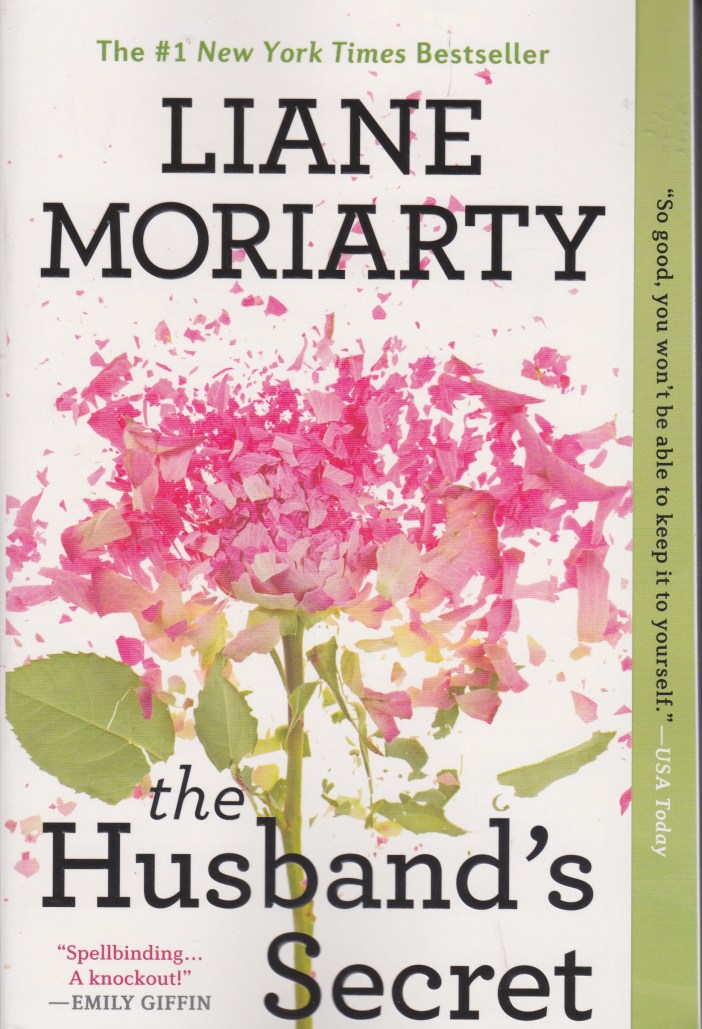
Friends are in town, and we had lunch with them at Commander’s Palace yesterday, which was lovely. I didn’t read the menu carefully and got something that had fried eggs on the top–which ran with yolk when you broke it; shudder–but I simply pushed them away with my fork and ate everything else. I was very tired after that, and came home, worked for a little while, and then curled up with Liane Moriarty’s The Husband’s Secret. I had read Big Little Lies concurrently with watching the HBO series, and enjoyed both the book and the show, so wanted to read another one of her novels. I wasn’t quite sure what I was expecting with this one–the jacket blurb mentioned that a wife finds a sealed envelope addressed to her from her husband, with the words To be opened only in the event of my death.

I would have opened it immediately, of course.

the husband's secret

It was all because of the Berlin Wall.

If it weren’t for the Berline Wall, Cecilia would never have found the letter, and then she wouldn’t be sitting here, at the kitchen table, willing herself not to rip it open.

The envelope was gray with a fine layer of dust. The words on the front were written in a scratchy blue ballpoint pen, the handwriting as familiar as her own. She turned it over. It was sealed with a yellowing piece of sticky tape. When was it written? It felt old, like it was written years ago, but there was no way  of knowing for sure.

She wasn’t going to open it. It was absolutely clear that she should not open it. She was the most decisive person she knew, and she’d already decided not to open the letter, so there was nothing more to think about.

Although, honestly, if she did open it, what would be the big deal? Any woman would open it like a shot. She listed all her friends and what their responses would be if she were to ring them up right now and ask what they thought.

Liane Moriarty is compulsively readable. And that’s not a quality in an author that should be dismissed lightlyAs I mentioned the other day with Louise Penny, it’s hard to classify Moriarty’s work; there’s a crime involved, but is it really crime fiction? I’m not sure it’s marketed that way; this book has a jacket blurb from Anne Lamott, for example, rather than Sue Grafton or Sara Paretsky. She is an enormous bestseller; which is no small feat for an Australian writer to accomplish in the United States, particularly when she is writing about Australia (although Colleen McCullough was quite successful in the US with The Thorn Birds, before she turned to ancient Rome). She structures her books around three women as the main characters; and she writes about the issues that concern women–I suppose, in a way, her novels could be classified as modern domestic suspense. Like the previous masters of domestic suspense (a classification title I am still not entirely convinced I like), she writes about every day women thrust into extraordinary situations, and she also shoehorns in some brilliant social commentary along with social issues, like Margaret Millar and Charlotte Armstrong and Dorothy B. Hughes did. The books are, as I said, compulsively readable and hard to set aside until you’ve reached the end.

Women writers, no matter their success, are rarely taken as seriously as male writers. I’m not sure if it’s because women writers tend to focus on women and issues that affect them while men, in theory, tackle larger themes. Male characters written by men are off saving the world in genre fiction, bedding fabulous babes and getting into fistfights, surviving by their skills or because their masculinity is superior to that of the bad guys. Or the male characters are finding dissatisfaction and misery in their maleness (I’m looking at you, literary fiction), prisoners of societal expectations of manliness and resenting putting aside their fantasy of what their life should be and having to settle for something that is less than that fantasy. Rarely do you find male characters (I’m not saying they don’t exist, so don’t come after me; I am fully cognizant of the fact that these are all incredibly broad generalizations) who are struggling with the work/home balance, juggling having to have a career and an income with finding time to be participants in their children’s lives or even, for that matter, simply helping around the house.

Men do not drive the story in Liane Moriarty’s novels, but they do impact it. They serve as catalysts for her stories, but her books are about the women whose lives are impacted by the men in them.

The Husband’s Secret,  like Big Little Lies, tells the story of three women whose lives intersect due to a private grammar school, St. Agatha’s in Sydney. Rachel is the aging part-time school secretary, widowed and haunted by the unsolved murder of her teenaged daughter many years before. The loss of her daughter has embittered her, and the only thing she basically has to live for is her grandson. Her story is set into motion when the perfect daughter-in-law she doesn’t much like and her son tell her that Lauren, the daughter-in-law, is being sent by her company to New York for two years, taking the only thing in her life she cares about–the grandson–away from her; just as her daughter was taken from her some twenty-five years or so earlier.

Tess’ world has just been ripped apart by the announcement by her husband and her best friend/first cousin that they are in love and want to be together–but out of respect for her having consummated the relationship. Her cousin, Felicity, is like a sister to her; their mothers were twins and they were born within days of each other. Felicity also used to be overweight; over the past year she has lost weight and become beautiful. Tess, betrayed and hurt, uses her mother’s recent accident in which she broke her ankle as an excuse to grab her son Liam and leave Melbourne, returning to Sydney to sort out her life and her future–enrolling young Liam in St. Agatha’s.

Cecilia, the third woman, is like Madeline in Big Little Lies; married, highly competent and efficient, the organizer that winds up running everything and basically being Supermom. She married a handsome rich man, and they have three daughters together. She’s hardly as confident as she seems; it’s a veneer to protect her and hide her own insecurities as she ruthlessly organizes her life and tries to put the world in order–one of those people who are basically exhausting to talk to; who leave you tired and drained when you finish speaking with them and you aren’t sure why.

Their lives intersect primarily because of the letter Cecilia finds in her attic, although Tess is less involved with the other two women, only peripherally floating into their orbit through the school, but the book’s theme is grief and motherhood and how these three different and incredibly complex women deal with both. What sacrifices do mothers have to make for their children, and what do they owe themselves? What is too far, too much, and where do you draw the line? Rachel’s life was decimated by her daughter’s murder and the lack of a conclusion to the story; to the extent that she walled herself up away from the rest of her family, and her relationship with her son has suffered–it is only through the events of this book that she finally realizes that her son is suffering not only from the loss of his sister and the loss of his father but from the loss of his mother. What does Tess owe to her young son in the wake of the apparent end of her marriage, and the horrific betrayal by her husband and her cousin? Does she try to ride out this love affair, rise above her own hurt and anger and put her child first? Is it better for Liam if she ends the marriage or tries to get past everything and forgive him, if that’s the option? She also is forced to take a long hard look at her own life at who she is and who has become as a person, and who does she want to become?

Cecilia’s journey is, of course, the most shattering. Her husband’s secret, contained in the letter, turns her world upside down and inside out; nothing is what she thought it was, what she believed, and she too is faced with a horrible choice: any decision she makes is going to be incredibly difficult to live with–but what can she live with for the sake of her daughters?

There is some reader manipulation; it’s important for the narrative that Cecilia not read the letter until a certain point, and when she does, the chapter ends with her starting to read–which felt unfair, particularly as the book shifted to another viewpoint in the next chapter. It would have been just as effective, I thought, for the text of the letter to appear and not show Cecilia’s reaction before shifting to the other viewpoint; that’s the editorial and/or authorial I would have made. It just kind of felt manipulative.

The book is very clever, certainly smart–I enjoy the way Moriarty writes, and she has a great way of finding the word rhythm that works, slightly altering those patterns as she shifts from viewpoint to viewpoint to give the reader a stronger sense of the character and their voice; a nice hat trick which is not easy to pull off. The decisions the women make–all affected by the letter Cecilia finds–may not be happily ever afters, but are all things they can, they find, live with. They can go on, they can endure, they can survive.

And maybe that is a happily ever after, after all.

After finishing this, I started reading Lisa Unger’s In the Blood, which immediately grabbed my interest; it was hard to put it down in order to get sleep.

And now, back to the spice mines.

Allentown

I was so tired last night when I got home from work–and I worked a short day! After work yesterday, a friend and I went to lunch to a place on the corner of Tulane and Carrollton called Namese, and I had an enormous  bowl of beef pho, which was absolutely delicious. I was in the mood for noodles, and having never actually had pho before, was quite thrilled to try it, and it was amazing. I’ve been wanting to try pho since seeing a show on our local PBS channel, WYES, about the big Vietnamese community in New Orleans, and one of the things they talked about on the documentary was pho. I’d been wanting to try it ever since, and got my chance.

DAMN THAT WAS GOOD.

I’d known we have a big Vietnamese community in New Orleans for quite some time–most of them live in New Orleans East, and were devastated by the flooding after the levees failed back in 2005. Poppy Z. Brite wrote about that community in his brilliant (and deeply disturbing) Exquisite Corpse, doing it so well I never had the nerve to try to write about it myself. (Our first, and only,  Congressman from Orleans Parish was a Vietnamese; Joseph Cao, who defeated “Dollar Bill” Jefferson in the post-Katrina scandal created by the fifty thousand dollars in cash he had stored in his home freezer. Cao was born in Ho Chi Minh City (then called Saigon), and only served one term in Congress–but I liked Congressman Cao; he put New Orleans ahead of party, and I was sorry to see him go.

I have an idea for a noir involving the Vietnamese communities of the Gulf Coast that I hope to write some day. I’ve also been toying with an old idea for a horror novel that’s been dancing in my head for the last thirty years or so–I can tell that I am writing another book; my creativity always spikes when I am writing a book.

Honestly. One would think I could get that under control.

Anyway, I also finished reading Margaret Millar’s Do Evil in Return last night. It wasn’t the below edition I read, but rather one of the volumes of The Collected Millar; this volume also contains Fire Will Freeze, Experiment in Springtime, The Cannibal Heart, and Rose’s Last Summer. But I rather like that Gothic-style cover.

millar-do-evil-in-return-lancer

The afternoon was still hot but the wind carried a threat of fog to come in the night. It slid in through the open window and with curious, insinuating fingers it pried into the corners of the reception room and lifted the skirt of Miss Schiller’s white uniform and explored the dark hair of the girl sitting by the door. The girl held a magazine in her lap but she wasn’t reading it; she was pleating the corners of the pages one by one.

“I don’t know if Dr. Keating will be able to see you,” Miss Schiller said. “It’s quite late.”

The girl coughed nervously. “I couldn’t get here any sooner. I–couldn’t find the office.”

“Oh. You’re a stranger in town?”

“Yes.”

“Were you referred to Dr. Keating by anyone?”

“Referred?”

“Did anyone send you?”

Margaret Millar is a treasure, and her work, despite now being dated because of societal and social changes, are worthy of not only being read by modern audiences but also deserving of study. She, along with Dorothy B. Hughes and Charlotte Armstrong, formed a triumvirate of strong women writing suspense novels featuring women protagonists that were the equal of anything written by male contemporaries; there were numerous other women doing the same, but these three had longer careers and are now being rediscovered, in part thanks to the diligent work of Sarah Weinman and Jeffrey Marks. Library of America has released a two-volume collection of works by great women writers of the time; Soho Crime is releasing thick volumes collecting all of Millar’s work, which I am happily acquiring. I read Armstrong when I was young, and loved her; I am in the process of working my way through the canons of both Millar and Hughes, as well as two other great women writers of the same period, the incomparable Patricia Highsmith and my personal hero, Daphne du Maurier.

Do Evil in Return, originally published in 1950, is ultimately a novel about how society and its hypocritical misogynistic treatment of women can destroy them. The main character of the novel, Dr. Charlotte Keating, is a strong, independent woman with a successful practice in a small California coastal town. She is both single and hard-working; owns her own car and her own home–no small feat for a woman in 1950–and the book opens with a young woman coming to her for help. The woman, Violet O’Gorman, is only twenty and married, but finds herself with a particular problem; estranged from her husband, she had a one-night stand with a married man which has left her pregnant, and she is desperate for an abortion, which of course was illegal in 1950. Dr. Keating–Charley to her friends–refuses to break the law and perform this service, but her heart goes out to her patient and wants to help her, but while distracted by a phone call doesn’t notice the girl slipping out of her office. With a local address her only clue as to how to find Violet, she goes looking for her…and soon finds herself wrapped up in a terrible string of events beyond control, a noose tightening around her own neck. For, like her patient, Charley herself is involved in a love affair with a married man–a platonic one, to be sure, for she refuses to become intimate with him as he is married–and the similarities she sees between herself and young Violet is part of what drives her. The following morning, Violet’s body washes ashore, an apparent suicide, according to the police but Charley herself isn’t so sure.

And of course, she is right.

Millar’s particular genius lies in how casually she lays out her cards; she never tells her reader straight out what’s going on, but allows it to unfurl naturally, leaving it to her reader to figure it out. When we meet Charley’s platonic lover, there is no mention of his being married–Millar simply talks about the stifling existence he has at home with Gwen. As the story continues the reader slowly realizes that Gwen is actually his wife, and she is also one of Charley’s patients. Charley has tried to foist Gwen off on other doctors, but hypochondriac Gwen refuses to see anyone else–and is incredibly needy, ringing Charley for help at all hours of the day or night. Charley’s own feelings for Gwen’s husband also aren’t that simple; and in 1950 divorces weren’t as easy to obtain as they are today.

Perhaps the strongest part of the book is how Millar clearly depicts how claustrophobic a woman’s world was in 1950, and the delicate balance a single, independent professional woman had to maintain. Exposure of the relationship would ruin Charley, both personally and professionally; just as Violet’s unexpected pregnancy has ruined her. Society’s expectations of women, and their sexuality, are the true villains, the true evil in this novel; and the realization that this world Millar so brilliantly depicts was only sixty-seven years ago is truly chilling.

I think this book would be excellent reading for a Women’s Studies course; to let young women know how truly awful and misogynistic society was not so long ago, as a reminder to everyone today how far women have come in a short period of time, and how hard they fought to get to where they are today.


Jeopardy

So, yesterday was my birthday. Fifty-six officially; although I always add a year to my age on New Year’s Day for the sake of simplicity. I had some trouble falling asleep on Saturday night; a combination of restlessness and heartburn. I wound up sleeping in till almost ten; which is late for me but since I didn’t really fall asleep until around three in the morning it wasn’t that much sleep. But I had a lovely day, really. I kind of just laid around and reread In a Lonely Place by Dorothy B. Hughes, rewatched The Philadelphia Story on TCM (Katharine Hepburn and Cary Grant were both robbed of Oscars), then watched The Nineties and The History of Comedy on CNN before finally watching last night’s Game of Thrones.  I also thought about the new Scotty some; I have today off from work as my birthday gift to myself, so I plan on doing some writing, line editing, and revising, and thinking about what I’m going to write next before actually sitting down at the computer is always a wise thing to do (although usually I never had the time to do that, thanks to deadlines). There’s a serious moral dilemma coming for Scotty in this book; one that really has been needing to be dealt with in the series for quite some time, but I’ve dodged it and avoided it; this is the book where I am finally going to have to have him face up to it, the way I am bringing it to the forefront so he can no longer avoid it is, if I do say so myself, rather clever.

Or it’s just going to be a steaming pile of shit. There’s no middle ground, really.

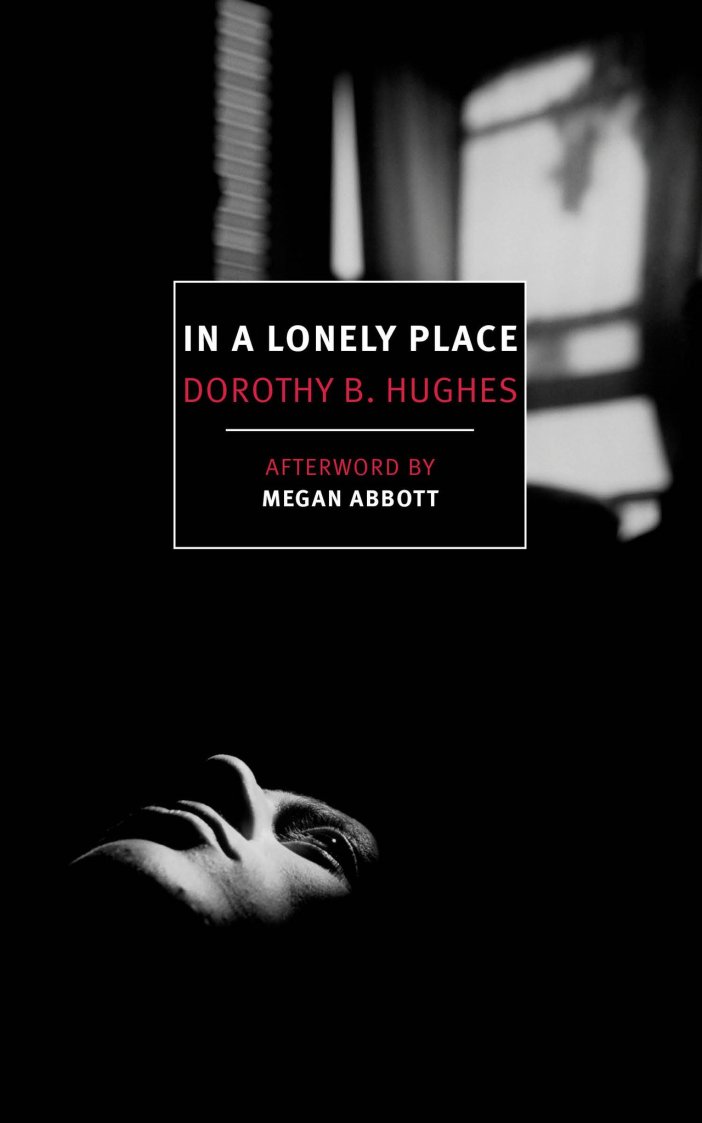
It was kind of fun to reread the Hughes novel; it is a masterpiece of noir that has been sadly overlooked for many years. Hughes was an exceptional writer, and I do admit that opinion is based on my having read only two of her novels, this and The Expendable Man (which, sadly, was her last and published in 1962). It’s not easy to find Hughes’ novels. I do feel safe in calling Hughes one of the best writers of her generation, and certainly one of the best noir writers of all time, based on those two books because they are just that good. I do have a copy of her The Blackbirder, which I want to read before the end of the year. In A Lonely Place was also filmed, directed by Nicholas Ray and starring Humphrey Bogart and Gloria Grahame; the film is significantly different from the novel, but it’s also outstanding. The new edition of the novel, from New York Review Books (who also have republished The Expendable Man and The Blackbirder), includes an afterward by the wonderful Megan Abbott, who is not only one of this generations greatest writers but also one of crime fiction’s most knowledgeable critics; her literary criticism is intelligent, thoughtful, incredibly well-written, and certainly puts me in my place whenever I am lucky enough to read some of it; I would love to read her study of literary and film noir, The Street Was Mine. (Whenever I read her criticism, any thoughts I might have about pursuing academic criticism–gay noir, gay representation in crime fiction, the heyday of romantic suspense from the 1950’s till its unfortunate death in the 1980’s–go out the window.)

Her all-too-short essay in the back of this edition alone makes the cover price worthwhile.

hughes.final_hi-res_2048x2048

It was good standing there on the promontory overlooking the evening sea, the fog lifting itself like gauzy veils to touch his face. There was something in it akin to flying; the sense of being lifted high above crawling earth, of being a part of the wildness of air. Something too of being closed within an unknown and strange world of mist and cloud and wind. He’d liked flying at night; he’d missed it after the war had crashed to a finish and dribbled to an end. It wasn’t the same flying a private little crate. He’d tried it; it was like returning to the stone ax after precision tools. He had found nothing yet to take the place of flying wild.

It wasn’t often he could capture any part of that feeling of power and exhilaration and freedom that came with loneness in the sky. There was a touch of it here, looking down at the ocean rolling endlessly in from the horizon; here  high above the beach road with its crawling traffic, its dotting of lights. The outline of beach houses zigzagged against the sky but did not obscure the pale waste of sand, the dark restless waters beyond.

He didn’t know why he hadn’t come out here before. It wasn’t far. He didn’t even know why he’d come tonight. When he got on the bus, he had no destination. Just the restlessness. And the bus brought him here.

Isn’t that an incredible opening?

Not being an expert in crime fiction–there’s so much of it to read, and there’s more new stuff all the time, so it’s hard to keep up with the new let alone trying to read everything already published–I am unable to place In A Lonely Place into any kind of context as far as the history of crime fiction is concerned, but Abbott does this beautifully in her afterward. But it’s very clear in this opening paragraphs that Hughes is addressing alienation in this book, and toxic masculinity, which may have seen its ultimate pinnacle in the second World War (the alienation of returning veterans, and the difficulty of readjusting from war to peace was also being addressed in films like The Best Years of Our Lives) and by having Dix, her main character, pretend to be writing a novel also took on the glut of post-war war novels that so many returning soldiers were writing; novels that continued to proliferate for several decades beyond the war.

The first time I read the book, having already seen the film, I was more focused on the story itself rather than an examination of how deftly Hughes creates her story, the language and imagery she chooses, and the nuanced way she creates her character. On this read, knowing how it’s going to end, I was able to pay more attention to these things, and was able to marvel at how brilliant the entire package is.

A recurring motif in the novel is fog; Hughes uses the fog as a metaphor for the fog in Dix’s brain; and we are never sure when Dix’s mind changed, making him lethal. He was raised by a puritanical uncle, Fergus, who is currently supporting him while he writes his novel–but there is a limit to the support, and while in our time $250 a month may not seem like much, at the time of the novel it was a fortune, just over $2500 in today’s dollars. Dix’s resentment of the uncle–we never learn what precisely happened to his parents–who is rough on him and has always made him work, even when he was in college at Princeton trying to fit in with the idle rich sons of privilege and then goes into detail how humiliating it all was, doing things for them for ‘tips’ until he could manipulate events to make it look as though he were the wealthy one and the sad unfortunate, unpopular boy he used for money were the dolt. In this way, Hughes also makes a sly commentary about class and privilege (which, in my opinion, she does far better than Fitzgerald did in an entire novel with The Great Gatsby, and she does it only in a few pages). So, there was always some kind of a chip on Dix’s shoulder; the war simply gave him a way to channel that anger and discontent and alienation. Now the way is over, and Dix is having to find a new way to channel those diabolical energies–and he does, in committing murder.

The entire tale is told through Dix’s perspective, which also makes him one of the first unreliable narrators in crime fiction. (It was done before, but never quite so lethally.) So, when we see the other characters–and there are only three: his old war buddy Brub, now a police detective; Brub’s wife Sylvia, whom Dix despises on first sightl and of course, the love interest, Laurel Gray–is she the femme fatale he thinks she is, or is that just a product of his own warped sense of right and wrong? Who is Laurel, of the reddish gold hair and the tempting figure? Is she the hard-as-nails user he thinks she is, or is she an entirely different character altogether?

In  A Lonely Place is a masterpiece of noir, and hopefully, this edition will elevate Hughes to the position both she and the book deserve in the annals of our genre.

And now back to the spice mines.


Twilight Zone

Ugh, my dryer is on the fritz, and I just can’t–in the ultimate of bougie problems–I just can’t function without a working washer and dryer. I can’t decide if it’s worth it to get a repair guy out here, or if we should just go ahead and get a new one. I know I called a repairman once for the washing machine–and it was only slightly less expensive than buying a new one. Heavy heaving sigh. I think we’ve already replaced the dryer once before. It’s so infuriating. I wish I were more handy, because I bet it is something that is really easy to fix; but I am not handy like that. I’m so glad my parents were so focused on my future that they wouldn’t let me take Shop or Auto Shop because they were too easy.

Yeah. They just would have saved me thousands of dollars over the years. But hey, those classes weren’t useful for my future.

Heavy heaving sigh.

So, I spent the evening trying to dry clothes in a faulty dryer–eventually they dried–while filing and washing dishes and also finishing reading Eric Ambler’s Journey Into Fear, which was quite fun.

journey into fear

The steamer, Sestri Levante, stood high above the dock side, and the watery sleet, carried on the wind blustening down from the Black Sea had drenched even the small shelter deck. In the after well, the Turkish stevedores, with sacking tied round their shoulders, were still loading cargo.

Graham saw the steward carry his suit-case through a door marked PASSEGGIERI, and turned aside to see if the two men who had shaken hands with him at the foot of the gangway were still there. They had not come aboard lest the the uniform of one of them should draw attention to him. Now they were walking away across the crane lines towards the warehouses and the dock gates beyond. As they reached the shelter of the first shed they looked back. He raised his left arm and saw an answering wave. They walked on out of sight.

For a moment he stood there shivering and staring out of the mist that shrouded the domes and spires of Stamboul. Behind the rumble and clatter of the winches, the Turkish foreman was shouting plaintively in bad Italian to one of the ship’s officers. Graham remembered that he had been told to go to his cabin and stay there until the ship sailed. He followed the steward through the door.

The man was waiting for him at the head of a short flight of stairs. There was no sign of any of the nine other passengers.

Eric Ambler, considered (per his bio) is considered the father of the modern thriller and was named a Grand Master by the Mystery Writers of America in 1975. His novels, focused on intrigue, espionage and spying, have been called influences by many writers, including John Le Carre and Robert Ludlum and Len Deighton. (I loved Ludlum, but am ashamed to admit I’ve never read Le Carre or Deighton; but I do have a copy of The Spy Who Came In From the Cold that I need to get around to reading.) I had never read Ambler; although my friend Pat, a huge fan of the crime genre, has recommended A Coffin for Demetrios to me on several different occasions, and usually one of Ambler’s works winds up on those lists of ‘crime novels everyone should read.’ I bought Epitaph for a Spy and several others a few years ago; I finally sat down and pulled Journey Into Fear out of the TBR Mountain and started reading it. It took me longer than it should have; it’s short, for one thing, but very engrossing. It’s also very…for want of a better term, it’s very British.

I love novels where normal, every day people going about their business and minding their own business are suddenly thrust into peril. Ludlum was a master of this, and I call it Hitchcockian; it was also a staple in many of his films. Journey into Fear also falls into this category; Graham, the main character, is a forty year old British man who works for an engineering firm and was sent to Turkey to help work on updating and refitting the Turkish fleet because of the outbreak of World War II. Graham, who is happily married and generally just goes about his business. What Graham, in his unassuming way, doesn’t realize or understand just how valuable he–and his work–are to the Allied forces; he is just doing his job. Then, on his last night in Istanbul, someone is waiting for him in his hotel room and shoots at him. Fortunately, he is only slightly wounded in his hand but this is when Turkish intelligence gets involved. It is a matter of vital Turkish importance to their defense that Graham make it back to England and his work not be interrupted; Graham doesn’t it take it seriously…at first. But once he is on the freighter traveling through the night to Genoa, he finds out just how much danger he is actually in.

The book is very tightly written, and not very long; but it also falls into the classic trope of suspense in a tight, controlled area with a very small cast of characters; like Murder on the Orient Express. This trope is very hard to pull off–even harder nowadays–and Ambler does it beautifully, even adding the element of “no one will believe me if I ask for help.” The other characters on the ship are richly drawn; Ambler is able to create a character with brief sentences that pretty much tell you everything you need to know about that character to make them real.

I am very much looking forward to reading more Ambler. Now I am going to give Dorothy B. Hughes’ sublime In a Lonely Place  a reread.

And now, back to the spice mines.


Let’s Dance

I managed, yesterday, to polish off Chapter Two; I wrote 1700 words or so in about an hour and fifteen minutes and voila! The pesky chapter was finished. I also started Chapter Three this morning; alas, maybe about a paragraph was all I was able to get done, but it was a start, and a start is always lovely. This weekend is my birthday; I will officially be fifty-six; but I’ve been saying I’m fifty-six for quite a while now. (I usually add the year after New Year’s; it’s just easier and I don’t really think of my birthday as a big deal, quite frankly). Paul and I are going to go see Dunkirk tomorrow night, and then out for dinner afterwards. I’ve taken Monday off, and I am working a late night on Tuesday, so I won’t have to be in to work until around three, which means I basically have a three and a half day weekend, which is lovely. I am hoping to be able to get a lot done this weekend; I want to finish reading the Ambler, which I am loving, then I am going to reread Dorothy B. Hughes’ In a Lonely Place, and then I am going to reread The Haunting of Hill House. After that, it’s either Jeff Abbott’s Blame or my advance copy of Laura Lippman’s newest, Sunburn.

One of the best perks of being a writer is that I get advance copies of books, or know people who do that can pass them along to me. My dear friend Lisa recently gave me an advance copy of this:

IMG_2507

I don’t consider myself to be a horror writer (SHUT UP BACK THERE! I said horror, not horrible), but I do consider myself to be a big fan of the genre. I read a lot of these books–not all, who knew there were so many? But I was a voracious reader, and I loved to read horror. The first horror novel I read was The Other–I still have the hardcover copy I originally read in junior high; I’m not sure I remember how I got a hardcover copy of it, maybe it was my grandmother’s–and I also read The Exorcist in junior high; everyone was reading it, and as all tweens (although we weren’t called that then) are wont to do, all we talked about was the crucifix masturbation scene. I always liked horror–I remember watching old black and white scary movies with my grandmother (she also likes mysteries) when I was a kid, but I never thought I could write it. I certainly never tried until the 1980’s, when my fandom of Stephen King made me give it a try. I still love reading horror, and there are certainly some amazing horror writers being published today whose books I greatly enjoy.

My inability to get any of it published is an indicator that crime was a better fit for my talents.

But what a wonderful resource this is! And a lovely trip down memory lane. To be honest, I thought I hadn’t read much horror throughout my life outside of the usual suspects (Stephen King, Peter Straub, Poppy Z. Brite) and some others that have come along more recently, but in going through this, I saw many titles I’d forgotten I’d read, and authors I’d forgotten.

This is a must for all horror fans; even those who are too young to remember the glory days of the mass market paperback boom of the 70’s and 80’s.

And now, back to the spice mines.


Hungry Like the Wolf

Ah, Thursday. I am very tired this morning; my sleep last night was restless and of course, after a long day yesterday (twelve hours), which included bar testing and all the walking that entails, I am very low energy this morning. I didn’t get much writing done yesterday morning; I am still in the midst of Chapter Two of the new Scotty but part of that problem is trying to make sure I have the voice and tone right–which is, of course, ridiculous; it can always be fixed in a later draft. I need to plow through this first draft and get the story done. Everything else can be repaired later.

Why do I always try to make it right the first time? So stupid. How many books have I written? Some people seriously never learn, you know what I mean?

The line edit continues as well, and is beginning to feel like my own personal invasion of Afghanistan; an endless quagmire I’m never going to get out from under. I still want to have it all finished by the end of the month and the clock is seriously ticking. Heavy heaving sigh.

The lovely thing is I have a three day weekend to look forward to; my birthday is this weekend and as such, I took Monday off as a treat for myself. We’re going to go see Dunkirk Saturday evening, and have a lovely dinner out afterwards. I also hope to be able to use the extra time off to get some work done and do some reading; I want to get the Ambler novel read this weekend so I can reread Dorothy B. Hughes’ sublime In a Lonely Place in its new edition with an afterward by the sublime Megan Abbott. I read it several years ago on the recommendation of Megan, Margery Flax and the wonderful Sarah Weinman, and I became a huge fan of Hughes as a result. I went on to read everything she’d written that was still in print, and started hunting down used copies of the rest on eBay and second hand booksellers on-line. If you’ve not read Hughes and are a fan of crime fiction, you really should read In a Lonely Place. You owe it to yourself to read it.

The film, while different from the book, is also extraordinary. You can’t go wrong with Humphrey Bogart and Gloria Grahame.

All right I need to hit the spice mines. Your Throwback Thursday hunk is actor/model Ed Fury.

IMG_2419