Tennessee Williams is kind of responsible for my career, in a very indirect way. Sounds impressive, doesn’t it? But it’s true, even if he had been dead almost two decades.
When we first moved to New Orleans, Paul got a job working for the Grants Director of the Arts Council of New Orleans, and at that time, the Tennessee Williams New Orleans Literary Festival had an office in the Arts Council’s suite. Paul got to know the director, and he convinced me to volunteer with him at the 1997 Festival…which was my introduction to the world of the book/writing festival/conference. I had the best time. That first year I met so many authors, and they were so kind and lovely. I volunteered again the next year, after Paul was hired part time (he left the Arts Council), and that was the year I met the author who would offer to mentor me. Three years later, I had a book contract and had sold some short stories and there was no turning back for one Gregalicious at that point.
So, yes, Tennessee Williams had a hand in the establishment of my career as a professional writer. I began reading the plays again, and started using quotes from them as epigraphs for my books.
It was a no-brainer when John Copenhaver asked me to contribute to this anthology to write about Tennessee Williams, even if it wound up being kind of peripheral to the story itself. The anthology is up for preorders everywhere, or you can preorder from Bywater here.

There was a little brass plaque on the next to the table the host showed me to.
The plaque was below an enormous tinted picture window looking down Dauphine Street. Engraved on the face were the words “TENNESSEE’S TABLE.” The host offered me a menu as I sat in a chair facing the door, placing another down on the setting across from me. “Why Tennessee’s Table?” I asked. “Are there tables for Alabama and Mississippi, too?”
I was joking, but in my two months in New Orleans thus far I’d found there were historic markers pretty much everywhere you looked. The others explained why the place was historic, but this one had no explanation, no words in smaller type below explaining why it was there.
This meant there was a story behind the plaque. I was also finding out the city had a story about almost everything.
His grin exposed a chipper incisor. “Tennessee is for Tennessee Williams, the playwright,” he explained, adding, “He loved the Quarter Scene and had lunch here every day he was in town. This was his favorite table, and he’d just call whenever he’d get in and let them know, so they’d reserve it for him. They put the plaque up after he died.” He winked. “We get a lot of Williams tourists who like to trace his steps—I guess to commune with his spirit, maybe? The plaque makes it easier for them.”
And less hassle for the staff, I added mentally.
I’d heard of Tennessee Williams. He’d also been out and proud when that could have been career and social suicide. The name brought up memories of chalk dust, a cold classroom in winter, and canned dry hot air. We must have studied him in high school. A Streetcar Named Desire and Cat on a Hot Tin Roof, I think the plays were? I’d slept with a Williams scholar once, on a vacation in Honolulu. I’d met him on the beach. He had a stack of non-fiction books piled up on his nightstand for a paper he was writing, pages marked by a forest of Post-It notes.
You see the peripheral connection in that excerpt, don’t you? That’s all Tennessee had to do with my story, other than a later mention.
That table and plaque did exist. The Quarter Scene closed and was replaced by Eat, but it now called the Quarter Scene again. I don’t know if the plaque is still up by his table or not, but I always sat there whenever I ate there.
Years ago, when we first moved here, I started working on two novels. One became Murder in the Rue Dauphine, the other was a kind of Tales of the City kind of thing about three young gay men who rented apartments around a courtyard in the Quarter, with an older gay man living in the main house and kind of being a mentor to them all. I called that one The World is Full of Ex-Lovers, and began putting it together by writing short stories. One of those stories was called “Tennessee’s Table,” and that was what I immediately thought of when casting about in my head to write a Tennessee Williams inspired kind of story. I dug it out of the files–it was dreadful–and threw everything out except the very opening with the main character arriving at the Quarter Scene to meet someone for lunch. I also realized that this story would actually work in a longer project I am also writing–a book set in 1994 New Orleans called Never Kiss a Stranger, and so I wrote that story with the idea that I could insert it into the novel manuscript.
I am kind of pleased with it, to tell you the truth. It’s called “The Rhinestone.”
And just look at this contributors’ list!
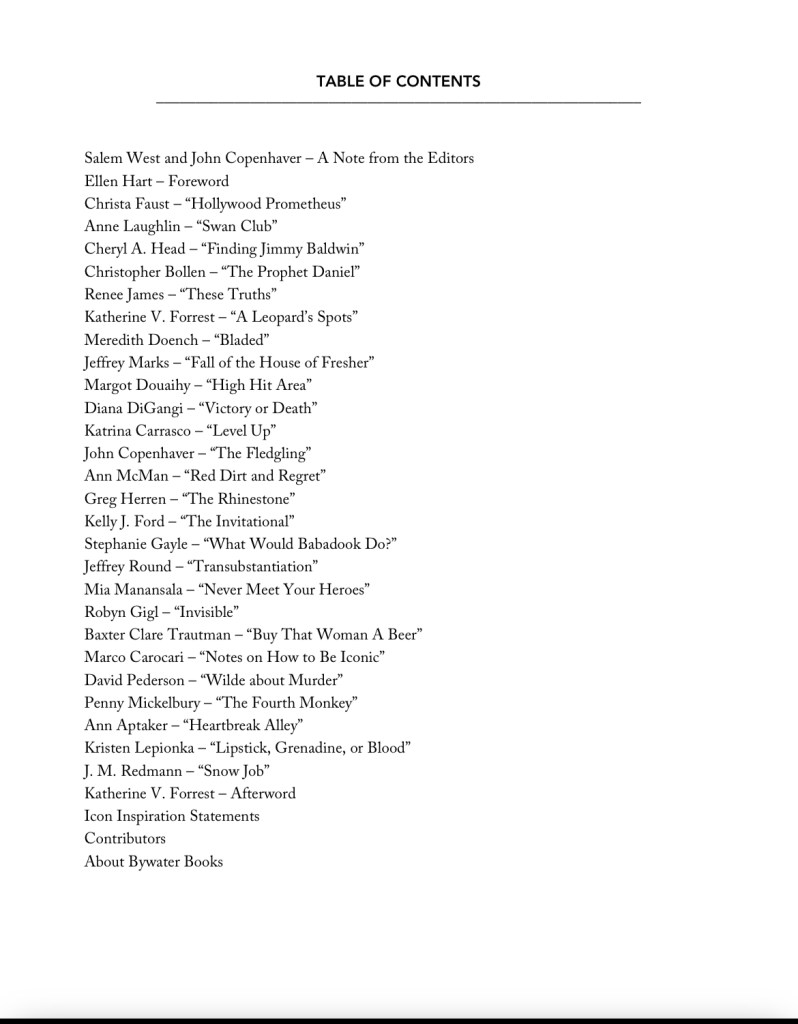
Have you preordered your copy yet?

 Queer and Loathing in America