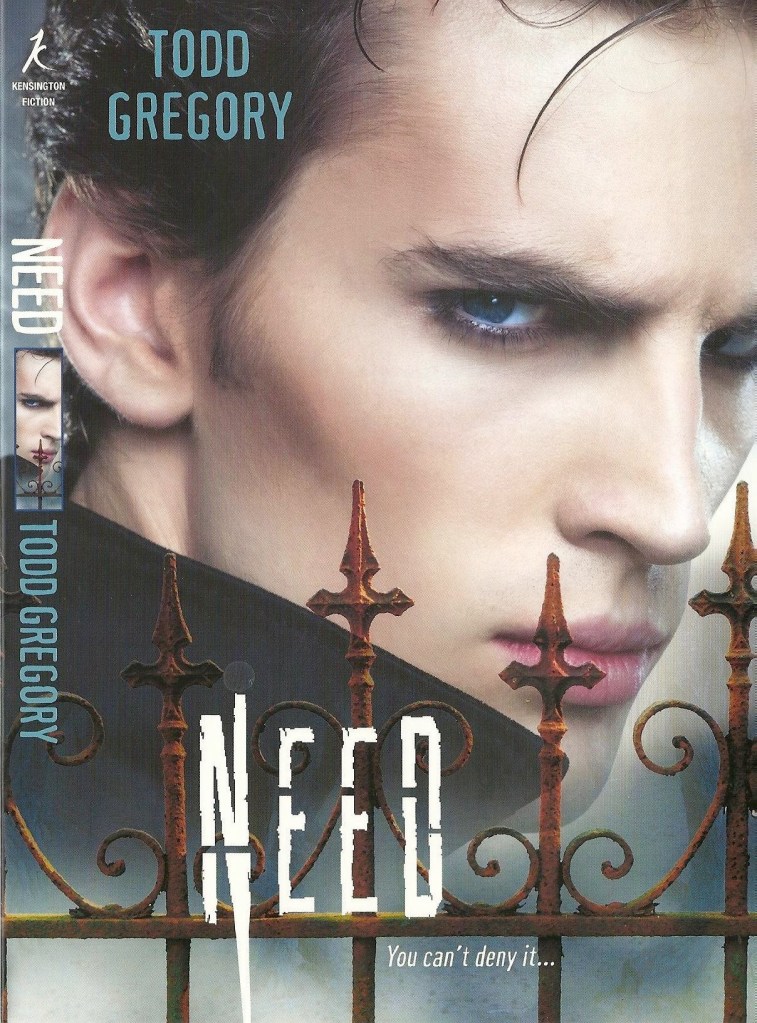
Need

Ah, vampires.

I never really meant to write a vampire story. For one thing, Poppy Z. Brite and Anne Rice had already done the New Orleans vampire story and set the bar super-high for anyone else wishing to write about vampires in New Orleans; Charlaine Harris also kind of cornered the market on Louisiana supernatural novels, too. It really seemed cliché to do New Orleans vampires, and I never would have, had I not been asked, and offered a lot of money, to do so. I make no bones about writing for money; if that renders me an unreadable hack, so be it.

I was initially asked to write a New Orleans vampire novella for a collection of four to be called Midnight Thirsts, which Kensington was publishing. Once I signed the contract and got paid half the advance, I decided to adapt a vampire short story I’d written, probably in or around 1997 or 1998, called “The Nightwatchers”; the main character was a young wannabe actress with a lot of talent but a lot of insecurity, who discovers that the reason she hasn’t been getting good roles in her theater company is because the woman who does is fucking the director. The story wasn’t good–she is easy prey for a vampire looking for a companion, who kills the director and the competition actress before turning her–but there was some lovely stuff about the French Quarter in the fog and her crumbling apartment–this was when you could still get a decent enough apartment in a crumbling old building in the Quarter for a price that seems unbelievable and unrealistic today–that I thought I could use. I also like the title, and as is my wont, when I started world-building and creating, I went overboard on back story. There were two point of view characters; the main, Philip Rutledge, who works as an escort, and his best friend Rachel, an aspiring singer who works in a coffee shop on Frenchmen Street, as well as a third; an older man who is a “nightwatcher,” member of an ancient society that reins in supernatural threats to humanity all the while keeping them in the dark about the reality of supernatural creatures and beings in the world. He has followed a rogue vampire to New Orleans, who has set his sights on Philip. I left the ending open, because I thought there was more story–if not a book, if not an entire series–in this idea. I decided I was going to write the vampire novel after finishing Mardi Gras Mambo…which wound up being delayed over a year. Then Katrina happened, and by the time I was ready to write about vampires again, too much time had gone by, alas. But they were doing another collection of vampire novellas, and asked me to do a Todd Gregory story for them (they had started publishing the Todd Gregory fraternity novels by this time), and that story became the novella “Blood on the Moon.” But rather than starting fresh, I used the same structure and world I’d created with “The Nightwatchers”–and tied it into the fraternity novel world as well, making the main character a member of the fraternity’s University of Mississippi chapter, visiting New Orleans for Carnival and winding up getting turned (it’s a longer, more complicated story than that, but that’s the bottom line). I brought Rachel and the old man from “The Nightwatchers” back–and when I was doing the anthology Blood Sacraments, I wrote a short story “Bloodletting”, that basically picked up where “Blood on the Moon” left off.

So, when Kensington asked for an erotic vampire novel rather than another fraternity book, I decided to use “Bloodletting” as the first chapter and build on the story from there, also using “Blood on the Moon” as the foundational story and the supernatural world I’d created for “The Nightwatchers.” This was to serve as an introductory work to a new supernatural Todd Gregory series.

It’s working title was A Vampire’s Heart. The powers that be didn’t like that title, thinking it sounded more like a romance novel title (which wasn’t wrong), and suggested Need, which was a recurring theme in the book.

And I really loved the cover.
The damp air was thick with the scent of blood.

It had been days since I had last fed, and the desire was gnawing at my insides. I stood up, and my eyes focused on a young man walking a bicycle in front of the cathedral. He was talking on a cell phone, his face animated and agitated. He was wearing a T-shirt that read Who Dat Say They Gonna Beat Dem Saints? and a pair of ratty old paint-spattered jeans cut off at the knees. There was a tattoo of Tweetybird on his right calf, and another indistinguishable one on his left forearm. His hair was dark, combed to a peak in the center of his head, and his face was flushed. He stopped walking, his voice getting louder and louder as his face got darker.

I could smell his blood. I could almost hear his beating heart.

I could see the pulsing vein in his neck, beckoning me forward.

The sun was setting, and the lights around Jackson Square were starting to come on. The tarot card readers were folding up their tables, ready to disappear into the night. The band playing in front of the cathedral was putting their instruments away. The artists who hung their work on the iron fence around the park were long gone, as were the living statues. The square, so teeming with life just a short hour earlier, was emptying of people, and the setting sun was taking the warmth with it as it slowly disappeared in the west. The cold breeze coming from the river ruffled my hair a bit as I watched the young man with the bicycle. He started wheeling the bicycle forward again, still talking on the phone. He reached the concrete ramp leading up to Chartres Street. He stopped just as he reached the street, and I focused my hearing as he became more agitated. What do you want me to say? You’re just being a bitch, and anything I say you’re just going to turn around on me.

I felt the burning inside.

Desire was turning into need.

I knew it was best to satisfy the desire before it became need. I could feel the knots of pain from deprivation forming behind each of my temples and knew it was almost too late. I shouldn’t have let it go this long, but I wanted to test my limits, see how long I could put off the hunger. I’d been taught to feed daily, which would keep the hunger under control and keep me out of danger.

Need was dangerous. Need led a vampire to take risks he wouldn’t take ordinarily. And risks could lead to exposure, to a painful death.

You see why they suggested we rename it Need? That opening pretty much says it all.

I had never really put a lot of thought into writing about vampires, in all honesty. To date, I have only published two novellas, one short story, and the novel, of course, but while I was writing Need that world began to expand and grow in my head as I worked on the story. I wanted to tie both “The Nightwatchers” and “Blood on the Moon” together, with Need as the continuation, so I brought back both Rachel and Nigel from the former, while keeping Cord from the latter as the main character. Cord Logan (how is that for a gay porn star name) was, despite being young in terms of being a vampire, quite powerful and growing in his power exponentially by the day. Headstrong, he’d broken away from the coven of vampires that turned him during Carnival, without learning everything he needed to learn first. What he didn’t know–and his former coven also didn’t–was that because of the circumstances involved in his own turning–when a male witch also tried to steal his power from him, he inadvertently wound up transferring his own power to Cord, who was then turned into a vampire to save his own life. This combination of witch/vampire is actually quite dangerous–as are any vampires Cord himself might create, which was the entire problem he faced in the story “Bloodletting” and didn’t understand.

The Supreme Council wants Cord summarily executed, but Nigel wants to keep him alive, to study and learn from, as well as to try teaching him how to control his powers. For me, Need was the introductory tale to a much longer story, where I’d be able to bring in vampires and shifters and witches and faeries and pretty much every kind of supernatural being. The next book was going to be called Desire, and every book was going to have a one-word title. I had a lot of fun with writing Need, and was really getting excited and writing lots of note for Desire…but the book didn’t do very well. It did okay, but not in the kind of numbers that would make a sequel a no-brained, and by then I had already moved on to writing the young adult books. The reviews weren’t great, either–but I never really care or pay much attention to them. The real problem is that there were sex scenes, and I don’t write the kind of gay sex scenes people want to read anymore. Mine are physical, lots of sweats and smells and experiencing how it feels and so on…most people want the sex scenes to be more esoteric and romantic and sweet.

I don’t think I’ve ever had sweet, romantic sex. I’ve certainly never written it.

Every once in a while, when I am writing something more along the lines of horror or with a supernatural tones, I remember my vampires and the world I created for them with a slight ping of sadness.

Maybe someday I’ll write Desire, but it’s highly unlikely at this point.

Blood on the Moon

Quite a number of years passed between the time when I wrote my first vampire novella, The Nightwatchers, and the time I was asked to write another.

I also hadn’t intended to use Todd Gregory, but that was the name I was publishing under with Kensington at the time, and so they wanted me to use it for the novella–and you know me: they were paying me well so I didn’t care. The fraternity books I was writing for them under that name were doing well, and so they wanted some kind of tie into the fraternity stuff. I didn’t want to write a vampire story set in fictional Polk, California; I wanted to write about New Orleans–I’m sorry, I know it’s a cliche, but vampires and New Orleans just go together in my head. What I actually wanted to do was go back to the mythology I’d created for The Nightwatchers, and at first worried that using my “other” name precluded me doing just that…but then I reminded myself you’re both the same person, dumbass and so that’s precisely what I did. For the fraternity connection, I decided to bring four college students from the University of Mississippi to visit New Orleans for Carnival (one of them was from New Orleans), and have them all be brothers from the same fictitious fraternity I used for the fraternity stories: Beta Kappa. (I first used Beta Kappa in Murder in the Rue Dauphine; it’s the same fraternity Chanse belonged to at LSU, so whenever I need a fraternity that’s my go-to; I even used it in my story “This Town” for the anthology Murder-a-Go-Go’s), and of course, one of the boys gets turned over the course of the weekend.

After all, shouldn’t everyone be afraid of coming to big, bad, dangerous New Orleans?

“Happy Mardi Gras!”

The woman was obviously drunk as she threw her arms around Cord Logan and pulled him close and tight to her soft breasts. She pressed her mouth on his before he had time to react and push her away. His entire body stiffened and he winced. Her mouth had the nauseating taste of sour rum and stale cigarettes. He pushed her arms away from him.  Repulsed, he pulled his head backward and took a step back, almost bumping into a weaving guy in an LSU sweatshirt carrying a huge cup of beer. She stood there in the middle of Bourbon Street, grinning at him. She looked to be in her mid-thirties, and heavy strands of beads hung around her neck dipping down into her cleavage. Her lipstick was smeared, making her look kind of like a drunken clown.  Her hair was bleached blonde with about three inches of dark roots growing out of her scalp, and was disheveled and messy—her hairspray had given up on it hours ago. Her bloodshot eyes were half-shut, and she tilted her head to one side as she looked at him, her sloppy smile fading. She was wearing a low-rise denim mini-skirt over stout legs and teetering heels. Her red half-shirt with Throw me something mister written on it in gold glitter revealed a roll of flab around her middle, and a fading sunburst tattoo around her pierced navel. She tried to grab his head and kiss him again, but he deflected her arms.

She narrowed her eyes, going from ‘happy drunk’ to ‘mean bitch’ in a quarter second. “What’s a matter? Don’t you like girls?” she jeered at him, weaving a bit on her heels. She put one hand on her hip, replacing the smile with a sneer.

What? He stared at her, and froze for a moment as horror filled him.

For that instant, everything seemed to stand still. The dull roar of marching bands in the distance, the rock music blaring out into the street from the bars lining Bourbon Street, the shouting and yelling of the revelers, all faded away as he stood staring at her squinting eyes.

Don’t be stupid, Cord, no one can tell just by looking at you.

The spell was broken when a strand of purple bands flew between them, hitting the pavement with a clatter. Cord involuntarily took another step back. The woman squealed with excitement and bent over, her T-shirt falling open  at the neck to reveal a cavernous blue-veined cleavage. She stood up clutching the beads in her fist, a look of triumph on her face. She turned around, Cord forgotten, and lifted her shirt, showing her bare breasts to the crowd of men holding beads on the balcony. She shook her shoulders, making the large breasts sway from side to side, and she started yelling up at the men on the balcony. They all began whistling and cat-calling. The beads began to fly—Cord grabbed a strand of gold ones just before they hit him in the face. He slipped them over his head and moved on down the street before she remembered him and tried to kiss him again.

Something like this actually happened to me at my first ever Carnival, when I flew in from Tampa for it in 1995. I was walking with a friend up Bourbon Street to the gay bars (“running the straight gauntlet” is what we used to call it) when this woman stepped directly in front of me and went through this entire song-and-dance that I later adapted into the opening of Blood on the Moon.

I don’t remember if I’d ever written about a young gay man slowly beginning to take baby steps out of the closet before, or i Cord was the first–I think he may not have been the first; Jeff in Every Frat Boy Wants It I think was probably the first–but I really liked the idea of him coming to New Orleans for Carnival with some of his fraternity brothers, and that his best friend in the fraternity is the only other person who knows about his true sexuality–and suggests, in fact, that Cord lose the group during a parade and head to the gay end of the Quarter to explore and be free. Unfortunately for Cord, he runs into Jean-Paul, an incredibly hot older man and his group of really hot older gay men…but the next morning, Cord has some issues with the sun and other things. That evening Cord heads back down to the Quarter to see if he can find Jean-Paul, and instead runs into a Creole named Sebastian; and Sebastian is a male witch with an ulterior motive: he wants to drink from Cord’s blood–Cord is infected, but hasn’t completely succumbed to transitioning into a vampire yet, and Sebastian thinks vampiric-infected blood will make his own witchcraft powers even stronger.

I liked the character of Cord a lot, and I liked that he didn’t really transition into becoming a young gay vampire by any choice–Jean-Paul selected him as a plaything for the night, that’s all, and had no intentions of turning him, until Sebastian got involved–and while this story ended with a definite resolution–I also saw not only how the story could continue, but how I could also weave The Nightwatchers and the mythology I created for that novella into this new story. I eventually wrote another short story about Cord–“Bloodletting”, which was in Blood Sacraments, and when my editor asked me to write an actual vampire novel, I made “Bloodletting” the first chapter and continued it from there…and that became the novel Need–which is a tale for another time.

End of the Road

I started researching new markets to potentially submit short stories to–after my breakthrough that my stories cannot be described, as a rule, as ‘mystery’ tales–and I was very surprised to see how few magazines actually are interested in stories that could be considered mysteries. The stories I have–that I am thinking about sending out into the void–are technically not mysteries, but then again…will markets not looking for mystery stories consider them to be mysteries?

I guess the only way to find out it to actually submit stories.

What was also really interesting to me was that there are still markets that want you to send them hard copies through the mail, with the SASE for response. Ten years or so ago, when I was doing an open call for Blood Sacraments, I wanted hard copy submissions, and was surprised (and more than a little appalled) at some of the emails I received from authors who demanded to know how very dare I not want to take electronic submissions? Needless to say, those were writers I put on the “never work with” list; I would never presume to write an editor and demand an explanation for their submission guidelines, never ever ever ever. But with the passage of time, my own reluctance to read submissions electronically and get them in my inbox has gradually eroded away; times change and you have to change with it. If I want to submit to those markets, I will have to get large envelopes, print out copies, and purchase postage.

I am certainly not going to send them a pompous email demanding they explain why they don’t take electronic submissions.

And, FYI? Blood Sacraments was the last time I did an open call for submissions untilt he Bouchercon anthologies. And yes, the entitled attitude in the emails from people who saw the call and “had questions” about my guidelines is entirely why.

Helpful hint: editors and publishers don’t owe anyone explanations for why they set their guidelines the way they do. And when you send snarky emails questioning them, all you do is point out to them that you would be an enormous pain in the ass to work with. And unless you have the kind of star power that will guarantee lots of sales, you aren’t worth it.

Sad, perhaps, but true.

And I have absolutely no problem whatsoever with disqualifying stories that are not submitted properly or ignored the guidelines in any way, shape or form. That’s my first system of weeding out stories from “possibles” to “rejects”: did they follow the guidelines?

I won’t read anything that doesn’t–nor will I write the person back to tell them they need to. You get one chance.

I have myself submitted things and not followed the guidelines–primarily out of stupidity–and you know what? If that got me rejected without being read, it’s only fair and I have no one to blame but myself.

Next up in Florida Happens is Barb Goffman’s story “The Case of the Missing Pot Roast.”

Barb Goffman
 

Barb Goffman has no idea how to cook pot roast, but it sure was fun to write about. She’s won the Agatha, Macavity, and Silver Falchion awards for her short stories, and she’s been a finalist for national mystery short-story awards twenty-two times, including eleven times for the Agatha (a category record). Her book Don’t Get Mad, Get Even won the Silver Falchion for the best collection of 2013. Barb is thrilled to be a current Macavity and Anthony award finalist for her story “Whose Wine is it Anyway?” from the anthology 50 Shades of Cabernet.  She works as an independent editor and proofreader and lives with her dog in Winchester, Virginia. Learn more at www.barbgoffman.com.

About her story, Barb says, “My story is about a woman whose husband has been diagnosed with Alzheimer’s disease. She wants to care for him at home, but it’s proving challenging, with strange things going on, including a missing pot roast. I can’t say any more about the plot without giving things away, but I will say that I loved writing this story. It’s heartfelt but also funny and–perfect for an anthology about Florida–also a little bit weird.”

Looking back, I should have known something was wrong when the pot roast disappeared. Sure, everyone misplaces something sometime. I once searched for the remote control for an hour till I spotted it in the bathroom. And for years I’ve found my husband, Charles’s, false teeth all over the house—they’ve never fit quite right so when they bother him he takes them out and puts them down, never paying attention where. But the pot roast? I was sure I’d left it defrosting on the counter when I went to get my hair done, yet when I came home, it was gone.

I searched for it in vain. It wasn’t in the fridge or freezer. Not in the garbage. Not in the oven. Charles was clueless. There was no way he’d cooked and eaten it in the hour I was gone. So what happened to that pot roast was a mystery. In the back of my mind, I wondered if I’d only dreamed I’d bought the roast. But I couldn’t admit my faculties might be failing. So I dismissed the missing pot roast as weirdness and whipped up some pasta.

That was a month ago. Perhaps if I’d forced myself to figure out what happened to the pot roast, I wouldn’t be in this position now. But back then, I had bigger problems. Charles had started suffering from short-term memory loss and personality changes, and he was getting worse every day. One minute he’d be the man I’d loved for decades, optimistic and kind; the next, he’d be surly and paranoid, acting like a wary stranger. He’d accused me of stealing from him—me, his wife of fifty-one years. And then, in a heartbreaking moment, he’d accused me of trying to kill him.

“Alzheimer’s,” his doctor had diagnosed.

I’d figured that was the problem, but having it confirmed was a terrible blow. His doctor gave me all kinds of pamphlets and urged me to look into long-term care for Charles. I cried when he did that. I knew eventually such care would be necessary. But not yet. I was only seventy-one years old and in relatively good health. I was determined to care for Charles in our home for as long as I could. He was my husband. My love. I owed him that.

It’s easy to see why Barb’s work is so award-worthy with this tale. She really gets inside the head of her main character, who is dealing with a raeally difficult situation–complicated with her own issues of dealing with her husband’s illness in addition to questioning, at times, her own sanity and whether the things her husband says to her when in the grips of his dementia are true, real, or based in anything even slightly reality based. Can she trust the home health-care worker who is helping out with things around the house? Where are the pot roasts going?

And that last paragraph is chilling, absolutely chilling. Well done, Barb!

R.O.C.K in the USA

Happy Sunday and a good morning to all y’all.

I didn’t get as much done yesterday as I would have liked; running my errands in the pre-rain humidity literally wore me out, and then when I got going again I started cleaning and doing laundry and well, once I start doing that–as well as going through and trying to organize the books–I am pretty much done for the day….especially after I discovered Burnt Offerings was available for streaming on Prime. Oliver Reed! Karen Black! Bette Davis (who was totally wasted in her role)! I’d seen the movie years ago, I think when it first aired on television after it’s theatrical run, and while it’s still has some moments, it overall doesn’t hold up as well as I would have hoped. I read the book for the first recently in the last few years, and it was wonderful. But watching Burnt Offerings put me in mind of an essay about horror in the 1970’s; the 1970’s was a time when the suburbs really developed because of ‘white flight’ from the cities and desegregation; this was this whole movement of back to the country from the urban centers, and at the same time, there was horror that specifically focused on this phenomenon (without the racism and white flight issues); namely this book, Harvest Home by Thomas Tryon, The Stepford Wives by Ira Levin, and even Stephen King lightly touched on this in ‘salem’s Lot; the dangers of the country to people from the city.

One could even argue that James Dickey’s Deliverance also belongs in this category, and it put me in mind of an essay that I may never write. I also thought up another yesterday while running my errands, after car after car after car violated traffic rules and almost caused me to be in in accident (three times, to be exact; which might be a new record): “Right of Way,” in which I would extrapolate the American contempt for traffic rules and laws for everyone’s safety can be directly correlated to contempt for law and order, the system, taxes, everything. I made some notes, and this is one I may actually write. Essays are fun and I do enjoy writing them but I don’t very often, unless one is requested of me for something, and perhaps that’s the wrong approach.

Today I am going to go to the gym and I am going to start rereading Royal Street Reveillon and make notes for the big revision that is coming. I’m also going to start reading Jackson Square Jazz out loud for copy editing purposes, and I’d also like to work on “A Whisper from the Graveyard” today. I should at some point also work on finished “Never Kiss a Stranger,” which means I should also make a to-do list for everything I want to get done in July.

Hmmm. Perhaps not a bad idea, at that.

I also remembered I have notes on a short story I need to read and decide what revisions I need to be make.

It never truly ends, does it? But I am looking forward to Sharp Objects tonight on HBO; I actually liked this book by Gillian Flynn better than Gone Girl, which of course made her hugely famous and hopefully hugely rich. I still haven’t read her Dark Places, but that’s because I still subscribe to the “if I don’t read all the canon then I still have something by her to read” mentality, which is partly why I still have not read the entire canon of either Daphne du Maurier or Shirley Jackson or Patricia Highsmith.

So, I have a lot to do today–only one more day after today before I return to the office, but at least it’s only a four day work week–and so I should probably get back to the spice mines.

The next story up in Promises in Every Star and Other Stories is “Bloodletting”:

The damp air was thick with the scent of blood.

It had been days since I had last fed, and the desire was gnawing at my insides. I stood up, and my eyes focused on a young man walking a bicycle in front of the cathedral. He was talking on a cell phone, his face animated and agitated. He was wearing a T-shirt that read Who Dat Say They Gonna Beat Dem Saints? and a pair of ratty old paint-spattered jeans cut off at the knees. There was a tattoo of Tweetybird on his right calf, and another indistinguishable one on his left forearm. His hair was dark, combed to a peak in the center of his head, and his face was flushed. He stopped walking, his voice getting louder and louder as his face got darker.

I could smell his blood. I could almost hear his beating heart.

I could see the pulsing vein in his neck, beckoning me forward.

The sun was setting, and the lights around Jackson Square were starting to come on. The tarot card readers were folding up their tables, ready to disappear into the night. The band playing in front of the cathedral was putting their instruments away. The artists who hung their work on the iron fence around the park were long gone, as were the living statues. The square, so teeming with life just a short hour earlier, was emptying of people, and the setting sun was taking the warmth with it as it slowly disappeared in the west. The cold breeze coming from the river ruffled my hair a bit as I watched the young man with the bicycle. He started wheeling the bicycle forward again, still talking on the phone. He reached the concrete ramp leading up to Chartres Street. He stopped just as he reached the street, and I focused my hearing as he became more agitated. What do you want me to say? You’re just being a bitch, and anything I say you’re just going to turn around on me.

I felt the burning inside.

Desire was turning into need.

I knew it was best to satisfy the desire before it became need. I could feel the knots of pain from deprivation forming behind each of my temples and knew it was almost too late. I shouldn’t have let it go this long, but I wanted to test my limits, see how long I could put off the hunger. I’d been taught to feed daily, which would keep the hunger under control and keep me out of danger.

Need was dangerous. Need led a vampire to take risks he wouldn’t take ordinarily. And risks could lead to exposure, to a painful death.

The first lesson I’d learned was to always satiate the hunger while it was still desire, to never ever let it become need.

I had waited too long.

“Bloodletting” is an unusual story for me in that it’s actually a short story that bridges the gap between my novella “Blood on the Moon” and the novel Need; I eventually used it as the book’s first chapter. I have always wanted to give vampire fiction a try; I created an entire world that I first wrote about in the novella “The Nightwatchers,” which I always intended to develop into a series. I still would like to develop that series, and when the opportunity came to write “Blood on the Moon” I realized I could simply still use the world I’d created for “The Nightwatchers” and move on to different characters. The second book in the series, the one that was to follow Need, Desire, was going to tie the two story-lines together but Need didn’t sell as well as the publisher would have liked and so Desire died in the water. I may still go back and write it, of course, but I have no publisher for it and I am not particularly interested in self-publishing that much. But…I never say never. I wrote “Bloodletting” for Blood Sacraments, and only had to change the original concept a little bit; in the original idea Cord, my vampire, was actually sitting on the roof of St. Louis Cathedral watching the crowd for his next victim. I still love that image, and may use it sometime, but I did eventually change it to how it reads now.

57921a3ee18a224b7db94cbb1638e3d2