Devils in the Canyon

More years ago than I care to remember, I returned to Palm Springs for the first time in years for a Bold Strokes authors weekend event. It was a lot of fun–I always enjoy visiting Palm Springs–and this time I rented a condo on Flipkey (this was before Air B-n-B became a thing), which was a short walk from Las Casitas, a women’s only resort place that hosting the event. It was a great trip. We made side trips to Joshua Tree National Monument (it was cold), I had my first In-n-Out Burger, and we also took an early morning expedition to Bombay Beach, a failed resort village on the shores of the Salton Sea. People still lived there, but most of the place was derelict and looked bombed-out, post-apocalyptic.

The place fascinated me, and in the years since I’ve occasionally, idly, when in between books and other research…looked it up on line to do vague informational research with an eye to eventually writing about it. It still fascinates me…sometimes stuff will come across a social media feed, or I don’t know, some reading material will be suggested to me by the algorithms. That whole area of California really is interesting to me–more so than Los Angeles or the other more, better known, better documented parts of the state–which is also why I enjoyed reading Ivy Pochoda’s Imperial Valley so much.

So when I heard about this short story collection–and the Salton Sea was mentioned, I thought, hey let me take a look at this.

Three hours out of the hospital, his left foot too swollen for a shoe, Shane’s car breaks down. It’s July, a trillion degrees outside, Interstate 10 a gray ribbon of shit unspooling east out of Palm Springs toward Arizona. Not exactly where he wanted to go, but who the fuck wants to go to Arizona? It’s what was on the other side of Arizona that mattered to Shane, the chance that there might be another life in that direction. He never liked being on the coast. The one time he ever tried to swim in the Pacific–during a vacation with his dad, so, over twenty years ago, half his lifetime now–he was gripped with the ungodly realization that unlike a pool, there were no sides. You were always in the deep end.

It was a feeling that stuck with him, even when he was in one of those towns in the San Fernando Valley that sounded like an escape route from an old Western: North Hills…West Hills…Hidden Hills…

The Honda was the one damn thing Shane thought he could depend on. But as soon as he pulled out of the parking lot at Centinela Hospital in Inglewood, the check-engine light flashed on. A hundred thousand miles he’d put on that fucking car and not a single problem and the one time he really needed it, it was telling him to fuck off. He didn’t have the time–or the money–to swing by the mechanic considering he’d left the hospital before the nurse had filled out the paperwork for the cops, which was a problem. Not as big a problem as staying would have been. It wasn’t the kind of thing that would have the cops trawling the city for him, especially since the wound did look self-inflicted, since it was…someone else holding his fucking hand while he shot himself with his own damn gun.

And so begins the first story in the collection, “The Royal Californian,” and what a ride this story is!

This story reminded me of a story I read in college, in a writing class, by Barry Hannah–all nerves scratched raw and in-your-face. The voice is incredible, and the noir sensibility–really, what could be more noir than the desert of southeastern California?–is right there. We don’t really learn a whole lot about Shane, but just enough to understand who he is, why he behaves the way he does, and that weird sense of desperation that drives him. This low-end, low-rent motel he finds himself in, the Royal Californian, kept reminding of the Eagles’ classic hit, “Hotel California”–this was a place you check in, but you never leave. Everyone he encounters at this place–from the two-bit lawyer, the knowing bartender who’s seen too much and doesn’t care, and the mysterious clown at the motel bar–is kind of a lowlife, kind of a desperate character, and out for themselves. No one can be trusted at this hellish motel– least of all Shane. As the story unfolds we learn why he was on the road on his way out of California, and a little of his backstory…and while you kind of want him to get his shit together, everything he does indicates that he is not going to.

And there’s also a truly marvelous twist at the end, that gives this story that extra little sharpness in its edge that makes it truly memorable.

I was highly impressed with this story, and am looking forward to reading more of Tod Goldberg…I just wish I had before!

Missing You

Sunday morning, and after a glorious night’s sleep I am wide awake this morning and pretty ready to give the day my best shot. The Lost Apartment needs to be cleaned, as always, and I am wanting to do some writing/editing today as well. I am going to go to the gym later today–it is my experience that going earlier wears me out, despite the endorphin high, with the end result I often don’t get any writing done. I want to work on revising and polishing a story to get it out of my hair–early submission, since the deadline is a long way’s off–and the same with another. I also want to get that Chanse story–the first one–revised and sent off somewhere as well; and in addition to all that revising I want to work on the Italy story.

My work, as it were, is cut out for me today, is it not? I’ll also probably finish watching season 2 of Versailles as well this evening.

Yesterday I got my contacts ordered and did some shopping at Target, which was lovely. I also went car shopping with a friend; he needed a ride and I took him out there. I merely sat there and read short stories from Sue Grafton’s Kinsey and Me; I finished all the Kinsey short stories yesterday, and read some others as well. I was, frankly, worn out by the time I got home but managed to finish the laundry somehow, despite being so tired; I also watched several episodes of Versailles before finally retiring for the evening once the laundry was finished. Paul moves into the hotel this Wednesday; tomorrow morning I am touring the FBI offices in New Orleans with the local Sisters in Crime chapter, and then Tuesday is my usual long day. Then of course the festivals kick into gear, and the rest of the week/weekend is utter and complete madness.

There’s also some filing needing to be done, as always. I’ve also renamed both the Italy story and the Chanse story–the Chanse title, “Glory Days”, only worked if it were his high school reunion, which I dropped from the story–and I think the new title of the Italy story is better.

Here are two of the short stories I read yesterday”

First up is “Trapped! A Mystery in One Act” by Ben H. Winters, from Manhattan Mayhem, edited by Mary Higgins Clark.

Setting

Studio L, an unremarkable rehearsal studio in a warren of unremarkable rehearsal studios, collectively known as the Meyers-Pittman Studio Complex, located on the sixteenth floor of a tall nondescript building in Chelsea, a couple blocks south and one long avenue over from Port Authority. The walls are mirrored; the floor is marked with tape; tables and chairs are clustered to represent the location of furniture on the real set.

Downstage right is a props table, laden with all manner of weaponry. The play in rehearsal is the Broadway thriller “Deathtrap” by Ira Levin, and the table displays the full range of weaponry called for in that show, viz., “a collection of guns, handcuffs, maces, broadswords, and battle-axes.”

This is an incredibly interesting twist on the short story; it’s actually a short story written in play form, and it’s also an homage to the classic thrilled play Deathtrap by Ira Levin. The play was an enormous hit on Broadway, and featured the wonderful Marian Seldes in a supporting role; she set a record for most consecutive performances by one actor in this play. Ira Levin is also one of my favorite writers. Deathtrap was made into a film; not as successfully as the play, alas; the film starred Michael Caine, a young post-Superman Christopher Reeve, and Dyan Cannon. What makes this story/play so clever is it’s a play on Deathtrap; which is a play about a play which basically tells the same story of the play–and this is a play about a murder during a production of a play about a play; complete with the requisite twists and so forth. Winters is an Edgar-winning author (for The Last Policeman), and one of my favorite novels of the last few years, Underground Airlines. if you’re not familiar with Winters, you should make yourself so. I loved this; clever clever clever.

It also reminded me of a crime short story I wanted to write about the production of a play. *makes note*

Next up is  “Fat” by Raymond Carver, from the collection Will You Please Be Quiet Please?

I am sitting over coffee and cigarets at my friend Rita’s and I am telling her about it.

Here is what I tell her.

It is late of a slow Wednesday when Herb seats the fat man at my station.

This fat man is the fattest person I have ever seen, though he is neat-appearing and well dressed enough. Everything about him is big. But it is the fingers I remember best. When I stop at the table near his to see the old couple, I first notice the fingers. They look three times the size of a normal person’s fingers–long, thick, creamy fingers.

When I talked about Barry Hannah several weeks ago, I mentioned that the other writer my professor in my second attempt at taking Creative Writing wanted us to read, whose glory we should bask in, was Raymond Carver. The only texts for the course were Airships by Barry Hannah and Will You Please Be Quiet Please? by Carver. We read two stories before starting on our short stories; I was unimpressed with both writers. Several years ago I decided to repurchase the collections and try them again (I’ll talk about Hannah another time) thinking that perhaps now, as a more mature adult and reader, I might appreciate them more. It wasn’t the case with Hannah, and it certainly isn’t the case with Carver, either.

I am not sure what the point of this story is; waitress waits on a large gentleman, everyone else on staff is mean and cruel about him whereas she is fascinated in him in some way; it’s rather oblique in its meaning, and in its ending; when she says she feels like her life has changed in some way, why? Why did this man have such an effect on her? It isn’t clear and maybe that’s the intent; is it the recognition of the casual cruelty of her co-workers and her boyfriend? Why is she so fascinated by this customer and how much he eats?

It’s a very small story, and rather intimate; I like the way Carver does his writing and tells his story, yet I fail to see the genius here in the actual story itself. I learn nothing about the waitress, not do we learn anything, really, about her customer other than he is polite, well put together, and enormous. Is it about the waitress seeing, and disliking, the casual cruelty of her co-workers and her lover, seeing them in a different way in their inability to see her customer as anything other than enormously fat, that his size somehow strips him of his humanity? Is that what Carver’s intent is, to be so vague and uninvolved with the story that it’s left to our interpretation? I honestly don’t know, and what’s more, I don’t care. I don’t care about this waitress. I don’t care about her friends. The authorial distance just doesn’t work for me. I’ll keep reading his stories, though–I read “Neighbors” for the class, and I remember it fondly–although it didn’t drive me to read more of Carver’s work.

I suppose this is why I am not a literary writer, and could never be one; my purpose is writing a story is to not only to tell the story but to make the reader understand the characters, get to know them, and hopefully empathize with them; to make, in the case of anything I write, to make the inexplicable explicable. I don’t get that from either Carver or Hannah, to be honest. Ah, well.

And now, back to spice-mining.

IMG_1980


Head over Heels

Well, I survived yesterdays’ trip to Metairie and Target (shudder) and also spent way more money than I should have; which of course is part of the Target trap. But none of the money was wasted and it was all things we will use, and things we needed. So there’s that. I’m still flummoxed, though, at how much I spent. Heavy heaving sigh.

I wasn’t sore at all from my workout Sunday yesterday, although I did start feeling tired/sleepy early in the evening. I wrote two thousand words of a short story I got the idea for while watching Broadchurch Sunday evening (we finished season two, and started season three last night); the show and the story are kind of linked as the show gave me the idea for the story; it’s called “Neighborhood Warning” and the story really flowed, at least until I started getting sleepy. AT that point I retired to my easy chair to read; I worked on the Short Story Project while waiting for Paul to come home. I read  “Safety Rules” by Jill D. Block from Lawrence Block’s anthology Alive in Shape and Color.

Day One

This was my third time, and I knew exactly what to expect. I got downtown early, so I had time to stop at Starbucks when I got off the subway. I was upstairs, in the appointed room, at 8:55. I found a seat, took out my magazine, flipped past the fashion ads, and was already pretty well into Graydon Carter’s piece on Trump by the time things got started. The lady told us to tear our cards along the perforated fold, and after she collected the bottom piece, she turned on the instructional video.

I wasn’t at all surprised when a court officer came into the room, about thirty minutes after the video ended, to call for the first group. I knew the drill–twenty or twenty-five of us would be taken up to a courtroom where they’d be selecting a jury. Everyone else would stay here, and other groups would be called for throughout the day and maybe into tomorrow. Three days tops, and I’d have done my civic duty. I hoped that I would be called in this first group–early in, early out. Maybe I’d even have time to look for boots before I headed uptown.

Veronica Ellis, our main character, is following the rules; summoned for jury duty, she assumes it’s going to be the same as it always has been before. But this time is different, and she starts paying more attention as she realizes a lot more people have been called than she is used to, and soon enough the jury pool finds out that their case is the 1978 kidnapping and murder of Milo Richter, a young boy and the person who may have committed the crime at long last is being brought to trial. The Richter case is famous, but has even more resonance for Veronica–when she was young, around the same time as the Richter case, her best childhood friend Micheline was kidnapped and murdered. At first, Veronica sees that is a kind of karmic justice–she is meant to serve on this jury, as a way of getting justice for Micheline…but then she begins to wonder if she actually should serve on this jury. Block skillfully juggles her timelines between the present day going through the motions of jury duty with Veronica remembering Micheline and what happened when she was a little girl. I was totally sucked into this story, and enjoyed it very much.

I also read Barry Hannah’s “Testimony of Pilot,” from his collection Airships.

When I was ten, eleven and twelve, I did a good bit of my play in the backyard of a three-story wooden house my father bought and rented out, his first venture into real estate. We lived right across the street from it, but over here was the place to do your real play. Here there was a harrowed but overgrown garden, a vine-swallowed fence at the back end, and beyond the fence a cornfield which belonged to someone else. This was not the country. This was the town, Clinton, Mississippi between Jackson on the east and Vicksburg on the west. On this lot stood a few water oaks, a few plum bushes, and much overgrowth of honeysuckle vine. At the very back end, at the fence, stood three strong nude chinaberry trees.

I’ve always felt my lack of appreciation for the talents of Barry Hannah an obvious intellectual failure on my part. This edition of Airships, which was originally published in 1978, had an introduction–or rather, an “appreciation”–by Pulitzer Prize winner Richard Ford; the collections itself won the PEN/Malamud Award back when I was just graduating from high school. I bought my first copy of this collection back in the early 1980’s, when I was attending Fresno City College after flunking out of school in Kansas, to try to get my GPA up to a level that would warrant admission into the California State University system. I took another Creative Writing class there, after my first horrible attempt in Kansas, and there I found an instructor who not only believed in me and my talents, but actively encouraged me to take writing up as a profession; several of the stories I wrote for his class he encouraged me to submit to magazines and professional journals. None of those stories ever saw print, of course, but I always appreciated him as a teacher. He was very into Barry Hannah and Raymond Carver (the other text for the class besides Airships was Carver’s Will You Please Be Quiet Please), and while I could see why, at the time, he appreciated and loved Hannah’s writing style so much, it didn’r work for me. We were asked to read the story “Love Too Long” to discuss in class; the rest was independent reading, and after “Love Too Long” I never picked the book up again. Hannah didn’t resonate with me. I bought another copy of this book last year, along with Hannah’s novel Geronimo Rex when I was looking at Southern Gothic literature; I found a list of Southern Gothic writers somewhere and Hannah was listed. I thought, perhaps I can appreciate him now and bought the two books.

One of the things that has to be addressed right off the bat is the racism and homophobia in this story. I didn’t address the issue of racism in Faulkner’s story “Barn Burning” yesterday; primarily because the use of the n-word was only in dialogue and was only used in dialogue by the character of the asshole redneck father; it worked in that instance, even as it was jarring to read for me, and while Faulkner used the word “Negro” to refer to people of color in the text, at the time the story was written that was the commonly accepted, socially acceptable word to use. But Hannah’s character is very much a racist and very much a homophobe; the words fag and queer are used in this story as casually as the n-word. This automatically renders the main character of this story unlikable to me, and likewise unrelatable; I am predisposed to dislike him and he gets none of my sympathy. In fact, nothing he does in this story makes him sympathetic in any way. Maybe that was what Hannah was trying to do in this story, but I couldn’t help but think, as I read it, that the story was loosely slapped together and in a strong need of editorial guidance. I’m still not even sure what the point of the story was. The story opens when the main character is a kid, with his psychotic neighbor kid launched M-80’s from a makeshift cannon at a house where people of color live (lovely); turns out they are sending them at the wrong house and the kid who lives there for some reason comes across the field to tell them to stop and for some reason brings his saxophone with him–I guess that’s because it’s something kids would do? They launch an M-80 at him and injure him without much remorse. He then becomes friends with the main character when they are both in the high school band and the story keeps following them from point to point until the sax-player, Arden Quadberry, winds up a fighter pilot in the Nacy during Vietnam and…I guess this is a slice of life story.

It was originally published in Esquire, which paid what would be considered a lot of money now, let alone in the 1970’s, for short fiction.  Maybe Hannah was a writer of his time, who hasn’t aged well–Richard Ford notwithstanding–but it’s just more of the straight white cisgender male macho posturing to me, and his literary word choices/flourishes just don’t work for me, which is clearly my own failing; I ‘d rather read a genre short story than something like this. I’ll continue to read Hannah, hoping to have that aha moment where his genius will reveal itself to me–after all, they’re short stories so it’s not a colossal time suck if I never get it–but yeah, I just don’t get it.

And now, back to the spice mines.

26196451_321860411641954_3040436925599999815_n

Turn to You

Very tired this morning; a late night of bar testing concluded my twelve hour day yesterday and there is nothing like walking ten blocks on a sultry, steamy New Orleans night to stand in the upstairs of a bar whose a/c is set to “Econo”, and then walking ten blocks back.

I changed my socks three times yesterday.

But I have a short day today; only four hours to put in today, and I don’t have to be at the office until four. Huzzah! I also get to go in a little later tomorrow, and don’t have to work a full eight hour shift then, either. So, I get to sort of ease my way in to the weekend, which is lovely. I am making a Costco run this morning, making a grocery run tomorrow, and then I get to only leave the house to go see Wacky Russian Saturday morning. I do rather have to get motivated, though, which isn’t easy when you’re already tired. But if I have another cup of coffee, do my morning stretching, and then hop in the shower, I will be good.

One can hope, anyway.

My short story continues to putter along, and man, is it all over the place. I am trying very hard not to stop myself and correct the narrative–I’m just trying to get the story down, do the polishing and reorganizing on the next go round, but it’s kind of slow going. I kind of have a vague idea of what the story is and how it’s going to end, and I am writing a lot of chaff that will have to be separated out later, and the voice is all over the place as well. Ah, well, the great joys of being a writer; this constant internal struggle between confidence, over-confidence, and NO confidence. The Three Faces of Greg, as it were.

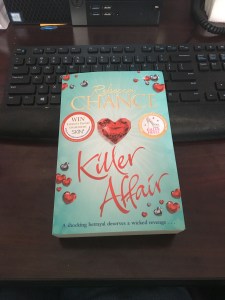
I’m still reading A Feast of Snakes; it’s very short, and I should be able to finish it soon. But I am going to absolutely reward myself with the latest Rebecca Chance, Killer Affair, when I am finished with this one. (I need a break from the Southern Gothic, frankly, but I’ll be jumping back in right after.) My copies of Barry Hannah’s Airships and Raymond Carver’s Will You Please Be Quiet Please arrived, so I also have more short stories to read, and of course, there are more stories in Faulkner’s Knight’s Gambit to read as well.

I think it’s very important for a writer to read as widely as possible. I read scifi, fantasy, horror, romance, ‘literary’, ‘popular’, and historicals, in addition to social history and commentary, literary criticism, and biographies, as well as history. I also love comic books. But I’ve been reading almost exclusively crime novels for a very long time, and as such, there’s been such a narrow focus in my reading that I need to expand out a bit; I am enjoying the Southern Gothic reading I’ve been doing–some of which could be defined as crime fiction, which makes it all the more fun–and it also makes me realize that reading all these different types and styles of fiction should be helping make me into a better writer.

I am hoping to get back to the serious chore of the final edit of the WIP this weekend; one of the reasons I want to get all this errand running finished over today and tomorrow is so that I won’t be too tired on the weekend to get this accomplished.

And on that note, I need to get the day going.

Here’s a Throwback Thursday hunk for you, Constant Reader:

3005e6390cf20ad64273209c1c0b9308--days-of-our-lives-hot-hunks

Robert Kelker-Kelly, from Another World and Days of Our Lives

I’ll Set You Free

This week was so crazy and intense. We were so busy at the day job this week; combined with a couple of not good nights of sleep, and by last night I was like the walking dead. I didn’t have time to blog, was too exhausted to even write when I had free time–my brain was even too fried to do much of anything other than read and watch some television before going to bed and trying to sleep. All of my muscles were tired and sore and aching; this morning before my first workout with Wacky Russian in three weeks I headed over early so I could spend some time stretching first–it was horrifying to me how tight my muscles were! But as I stretched, slowly and patiently, the muscles gradually began to stretch and loosen, knots being released, and as a result, the workout was great and I felt terrific afterwards. I know I am going to be tired later–but after my daily chores and errands, Paul and I are going to go see Spiderman Homecoming (which I originally wasn’t very interested in seeing–until I saw Tom Holland on Lip Sync Battle nailing Rihanna’s “Umbrella”, and became a fan). Tomorrow I have to make a Costco run and we’re going over to our friend Susan’s to watch Game of Thrones and eat pizza.

Moral of the story: I need to stretch regularly. I have always been naturally flexible, and never needed to stretch much; but now that I am older my muscles tighten up without being stretched, so I need to do that on a fairly regular basis. And I should, anyway; because it feels amazing.

Last weekend I not only started rereading The Great Gatsby but also started reading William Faulkner’s crime short stories. They are collected into a book called Knight’s Gambit, and feature County Attorney Gavin Stevens. I always forget Faulkner dabbled in crime fiction from time to time; I was reminded by a piece on the Ellery Queen’s Mystery Magazine website blog (“Something is Going On”), about how the magazine had published some of Faulkner’s short stories (“A Rose for Emily” would have been perfect for Alfred Hitchcock’s Mystery Magazine, come to think of it), and I remembered my copy of Knight’s Gambit, never read, still in the TBR pile where it has been collecting dust for God knows how long. I’ve only had time to read the first story, “Smoke,” which was very Faulkner-esque. It wasn’t “A Rose for Emily” Gothic-good, but it was very Southern Gothic, very rural Southern; it was about the murder of a judge probating the will of a really awful man who owned two thousand of the best acres in the county and was estranged from his twin sons; and how Gavin figures out who the killer was and gets him to confess. It was kind of clever, and kind of reminded me of Mark Twain’s Pudd’nhead Wilson, which I read in my twenties and absolutely loved (another one due for a reread).

It poured while I was running my errands today; I got drenched getting into the grocery store, and while it had stopped raining when I was leaving, the parking lot was near the doors was under about three inches of water. So, my shoes and socks got soaked; which was deeply unpleasant, but hey–summer in New Orleans. It’s rained every day for the last two months, I think, and the humidity has been kind of intense.

IMG_2380

This was also a really good week for books; I got the new Rebecca Chance (Killer Affair) in the mail, as well as The Complete Stories of Flannery O’Connor and Geronimo Rex by Barry Hannah (a signed copy of the new Bill Loefhelm is waiting for me at Garden District Books; I intended to pick it up today but it was pouring, I didn’t have my umbrella and there was no place within two blocks to park, so I decided to put that errand off until someday next week). I’ve never read Barry Hannah other than a short story in college: “Love Too Long.” As Constant Reader is aware, my very first attempt at taking a writing class in college was a disaster; the instructor basically told me I’d never be published and “if being a writer is your dream, you need to find another dream.” Oy. Anyway, flash forward a few years and I started attending Fresno City College, a junior college in the Tower District of the city, to try to get my GPA back up to a point to where I could get accepted into the California State University system. Bravely, I enrolled in another creative writing class, and the teacher was a man named Sid Harriet. He required us to buy, for the class, two short story collections: Airships by Barry Hannah, and Will You Please Be Quiet, Please? by Raymond Carver. He asked us to read the afore-mentioned Hannah story, as well as Carver’s “Neighbors.” Both stories were unlike anything I’d ever read before; and I decided to try to stretch myself creatively with the two stories I had to write for the class. The first story I wrote (seriously) was called “Bottles, Booze, and Bette Davis,” about a young couple having a disagreement about their commitment to each other in a diner–and their interactions with their waitress, Marge. It wasn’t a good story by any means, but when critiqued in class, it got some favorable comments and some good criticism, actually. Sid was very supportive, as well–and after my previous experience, this was a revelation for me. The second story was worse than the first, “A Single Long-Stemmed Red Rose” was the title; and it was an alternating point of view story about an encounter between a young college student cutting through a cemetery with a beautiful young widow. Again, it didn’t work; the points of view weren’t delineated enough to justify using this technique and the story itself didn’t work. Sid was highly enthusiastic about my attempt to push myself, though, and he was the one who recommended I read Faulkner’s  As I Lay Dying (which I did, and was blown away; that was, interestingly enough, when I became a Faulkner fan). You were allowed, as a student, to take the class twice; so I took it again the next semester and decided to take full advantage of the class by writing and turning in as many stories as I could–the minimum was two; which is what everyone did. Amongst the many stories I turned into that class were “Seminole Island” and “Whim of the Wind”, which everyone in the class loved; Sid even turned them both back to me with the note, “You need to send these out for submission.”

Manna from heaven for someone who hadn’t gotten any encouragement to be a writer since graduating from high school. I can even remember having a meeting in his office, and I told him what Dr. Dixon said. He just shook his head and said “that man shouldn’t be anywhere near students.”

The funny thing is, I would have told this story years ago but I couldn’t remember his name. Isn’t that awful? The person who, in addition to Mrs. Anderson from high school, was supportive of my desire to write, and recognized my ability was someone whose name I couldn’t remember until today. 

I bought the Barry Hannah novel because it was on a list of ‘essential Southern Gothic novels’; and I remembered reading that story back in 1983 in Fresno. And when I started writing this blog entry, I knew I had to talk about Sid, owed it to him really–and as I started typing his name popped into my head.

Funny how that works.

Okay, I am now going to make some lunch, and get this kitchen cleaned and organized; maybe I can get some work done on “A Holler Full of Kudzu” before we leave for the movie.

Have a great day, Constant Reader!