Lightnin’ Strikes

I have mentioned numerous times that I was asked last year–early last year? I don’t recall precisely, but that’s a pandemic year for you–to write a Sherlock Holmes story. I was enormously flattered–and let’s face it, if anyone offers to pay me to write, I will–as I inevitably am whenever someone wants me to write for them; as I have mentioned before (a lot), it’s rare for me to get validation for my writing, and so being included (which is a whole other neurosis I will inevitably write about someday) is so enormously flattering that I feel like I can’t say no; being asked to write something also is such a rare thing for me that I am always afraid to say no because I fear I won’t ever be asked again.

Ah, the joys of being a writer. I probably could stand to be a little more egocentric when it comes to my writing, and build up more confidence…I seriously aspire to the confidence of a mediocre straight white male writer.

In those first few years during which I shared the upper floors at 821 B Royal Street with Mr Sherlock Holmes, it was my custom to rise early in the mornings and take a walk on the earthen levee containing the mighty river. Holmes was by habit a late riser, rarely springing out of bed before the noon-time whistle rang along the waterfront, but taking such exercise was good for the damage to my leg caused by the wound – a souvenir of the Spanish War.

I enjoyed those quiet, early mornings, watching the ships sailing up the river to the docks from foreign ports, and the barges floating down the currents from points as far north as Cincinnati, St. Louis and Memphis, all while I strolled with my walking stick along the levee. Seeing the large bales of cotton being unloaded as the morning mists arose from the dark muddy water, the unloading of crates of coffee and bananas from the central American republics, I marveled each morning at the hubbub of activity that created and maintained this most curious of American cities, rising from the swamps like something from a forgotten myth.

After, I would adjourn to my favorite café, the Aquitaine, mere blocks from my home, where I would read the morning papers while enjoying coffee and Italian pastries.

This particular morning in early December, I cut my morning walk short. The temperature had dropped most precipitously overnight, and I had not chosen a heavy enough jacket. My leg ached terribly from the damp and the cold, and I limped along the banquettes to the café. My usual table was in the back, away from the hustle and bustle and smells of Royal Street. In those days, the French Quarter stank to high heaven, malignant odors hanging in the thick wet air from breweries and sugar refineries and, of course, seafood. Holmes often burned heavily scented candles in the various rooms of our apartments, particularly the parlor whose windows opened out onto our third-floor balcony facing Royal Street.

But on this morning, there were no tables to be had. The cold and damp had driven others inside, seeking the solace of warm air, fragrant Italian pastries, and piping hot café au lait. So, disgruntled, I paid for my papers.

I noticed a headline in the lower right corner of the front page of the Daily Picayune: FAMED ITALIAN OPERA SINGER ADDS DATES FOR NEW ORLEANS ENGAGEMENT.

I have mentioned before that I’ve never been much of a Sherlock fan, as written by Doyle. I read The Hound of the Baskervilles when I was a child, and didn’t really like it near as much as I felt I should, and never went back to read the rest of the Holmes canon (yet another reason I say my education in the classics–in general and in my chosen genre–was sorely neglected). I read the Nicholas Meyer pastiches in the 1970’s, and have since read other Holmes-fiction by modern writers; there was a story in particular by Lyndsay Faye in one of The Best American Mystery Stories collections I particularly enjoyed, and of course I am completely smitten by Laurie R. King’s take on the character in her marvelous Mary Russell novels. I’ve watched a lot of Holmes film and television adaptations (not caring particularly for the Robert Downey Jr version, alas), and of course like so many others was completely smitten by Benedict Cumberbatch’s interpretation in the modern series (I also liked Elementary, but we never finished watching its run). I had bought the Baring-Gould compendiums a few years back from eBay; lovely, enormous and richly bound editions that I treasure. In preparation for writing my own story I went into the Baring-Gould to read some of the short stories, to get a feel for Doyle’s style and his characterizations.

(It is interesting, though, that my favorite fictions about Holmes are written by women…and King’s stories center a woman.)

I had come up with this title, “The Affair of the Purloined Rentboy,” years ago. Little known fact: I originally envisioned the Chanse series to have titles all derived from Poe: Murder in the Rue Dauphine of course was paying homage to “The Murders in the Rue Morgue; and I thought the next would be The Purloined Stripper and go from there. Alyson Books said not to the Poe conceits, although they liked Murder in the Rue Dauphine as a title (another little known fact: the book was originally called Tricks; when I first met Felice Picano and picked him up at the airport here for the Williams Festival we chatted on the drive into the city and he nixed Tricks, and the Poe homages were HIS idea, which I don’t even think he himself remembers) and wanted me to brand the book with “Murder in the” titles. But I always liked The Purloined Stripper and kept that title in my back pocket, as it were, and when editor Narrelle Harris reached out to me for a Holmes story, to be set in New Orleans during any time period I chose, that title sprang into my mind and, having only recent read some New Orleans history (and been fascinated, at long last, by Storyville and the tales of the old Quarter) I thought to myself, yes, I can write about the pre-Great War period and include Storyville in it…and instead of a stripper I’ll use a rentboy. There had been allusions to rentboys and gay bars in the Quarter in the New Orleans histories I’d been reading–often times, when a client’s tastes ran that way, a madam would send one of her bouncers to the gay bars to find someone who fit what the client was looking for, appearance wise; I thought that was interesting. Only a few bordellos houses actual rentboys permanently; even in the bawdy houses of Storyville men who were interested in other men were reticent about putting voice to their desires….and isn’t “The Affair of the Purloined Rentboy” a lovely title?

And yes, it’s one of my favorite titles, and one of my favorite stories of my own.

As I said, it was a challenge for me to write it–the original submission required a significant revision; but as someone who appreciates editorial input I didn’t mind in the least–and as previously mentioned, it also inspired an appreciation for Sherlock Holmes and Conan Doyle in me. I keep thinking it would be fun to do more “Sherlock in New Orleans” stories; I may do just that very thing. I have some ideas that have been bouncing around in my head for him since finishing this story; I also liked the new universe of New Orleans I created for him–which inevitably will be tied in some way to my other New Orleans universe as well– I really cannot help myself when it comes to linking all of my work together.

Here is a short interview I did about my story: https://www.clandestinepress.net/blogs/clan_destine_press_blog/the-only-one-in-the-world-greg-herren-interview?fbclid=IwAR10KeDfVRv9Tcp9xioQ4aE7Fj4CUNdibVdVwdsjONN7ozvxKVFfF6gUTxw

And here is the editor talking about my story: https://narrellemharris.com/short-stories/narrelle-m-harris-on-greg-herren/?fbclid=IwAR0ei8LLFJjZaB0ATV3IKwg1s8NBcgapvQOFYe0PaGVNdV2LFMBOf5bw_8A

Don’t Toss Us Away

Edgar Allan Poe is credited with inventing the detective story, or so the lore of our genre goes, which is why the Mystery Writers of America named their awards for excellence in the field after him. The private detective has gradually evolved over the years from the times of Poe’s Auguste Dupin (“Murders in the Rue Morgue”–which Constant Reader should recognize as the source for my Chanse titles, beginning with Murder in the Rue Dauphine) through Conan Doyle’s terrific Sherlock Holmes to the twentieth century masters of crime-solving: Ellery Queen, Nero Wolfe, Lew Archer, Philip Marlowe, etc. The 1970’s served as a bridge for the post-war detective to the dawning of a new age–which was necessary because by the early 1980’s the genre had become a bit stagnant, repetitive, overloaded with tropes that were deeply misogynistic.

In the 1980’s, three women–Sara Paretsky, Sue Grafton, and Marcia Muller–breathed new life into the genre by introducing three hard-boiled women private eyes; tough women who could hold their own with their male counterparts and were also incredibly well-developed and extremely well written. All three women were named Grand Masters by the Mystery Writers of America in their turn; alas, only Paretsky is still publishing, and we still mourn the loss of Grafton to cancer several years ago, before she finished her alphabet series featuring Kinsey Millhone.

And while there is still great private eye work being produced today by both men and women, it’s also very exciting now to be on the verge of yet another re-invigorization of the private eye novel–and crime fiction in general–with new takes on old tropes, subversion of those tropes, and the exciting arrival of writers of color and queer writers. The passing of Sue Grafton was a great tragedy, but her publisher, Putnam, partnered with Mystery Writers of America to create an award to honor her and her work; by celebrating the series private eye novels with women firmly centered as the investigator. The first Grafton Prize, awarded last year, went to Sara Paretsky for Shell Game; this year there are six finalists: Linda Castillo (Shamed); Tracy Clark (Borrowed Time); Edwin Hill (The Missing Ones); Sujata Massey (The Satapur Moonstone); Gigi Pandian  (The Alchemist’s Illusion), and Marcie R. Rendon (Girl Gone Missing)–all books I am looking forward to reading,

Ironically, I had already arranged to interview Tracy Clark for the Sisters in Crime quarterly column I do, “The Conversation Continues”–so I had already obtained copies of all her works.

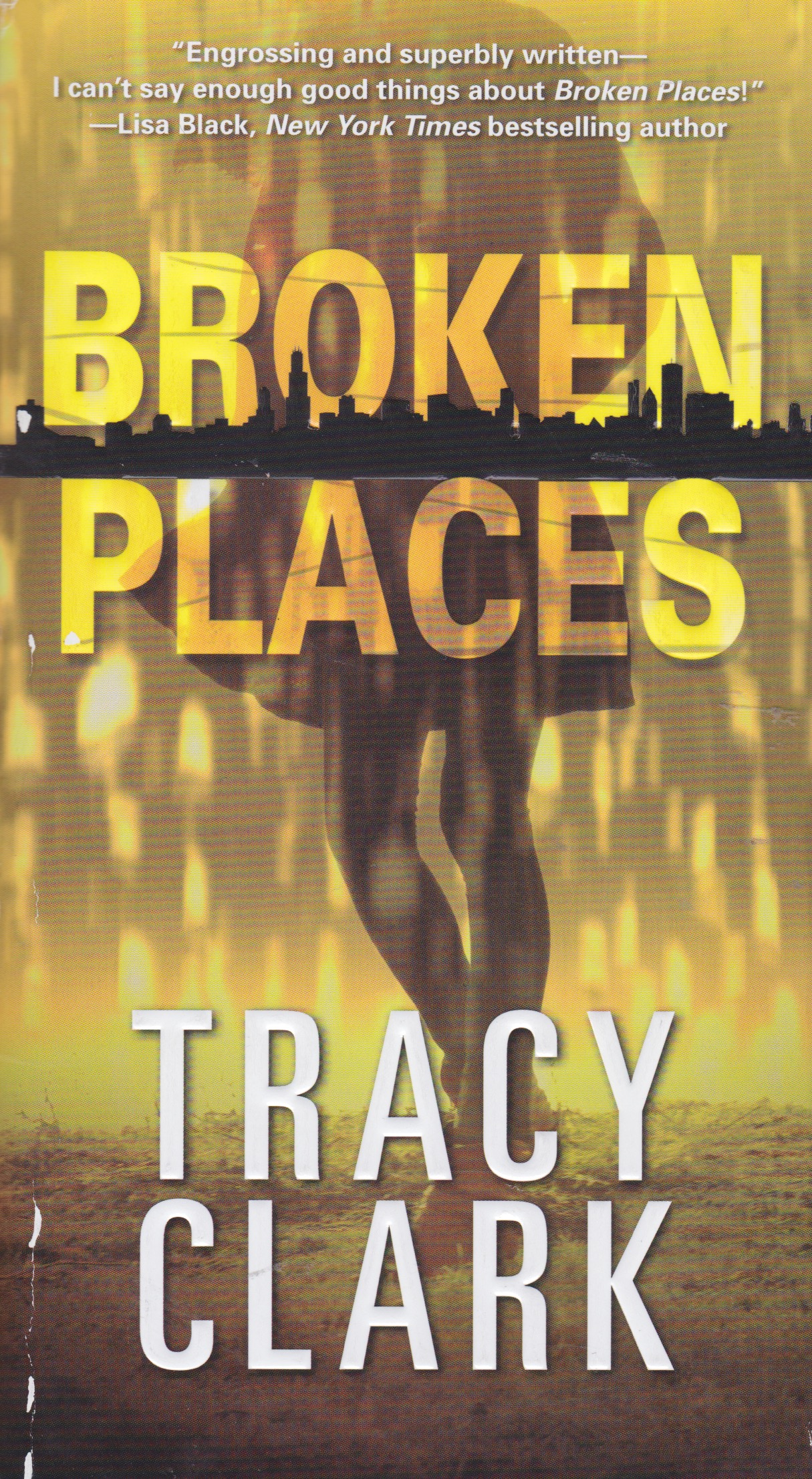
Yesterday I  finished reading the first Cass Raines mystery, Broken Places.

broken places

Chicago cops had to be on the lookout for any number of nefarious mopes eager to take a potshot, but this morning my biggest enemy was turning out to be the scorching rays of the summer sun. I slid into the driver’s seat of the unmarked car and cranked the windows down, balancing a rapidly melting iced tea, extra ice, between my thighs. A few feet away, my partner, Detective Ben Mickerson, stood in front of the Dairy Queen basking in the hellfire. “Vitamin D,” he said, ruddy face pointed skyward. “Soak in that Vitamin D.”

“You say Vitamin D, I say skin cancer,” I groused, The hot vinyl seats nearly seared through my blazer and pants–and they were both summer weight. I checked myself in the rearview. The little makeup I’d started the day with was long gone now, melted away by flop sweat. I flicked at the sweaty ringlets at the nape of my neck and wiggled uncomfortably in my bulletproof vest, my breasts pressed flat, as though squeezed between the hot plates of a waffle iron.  I looked like I’d gone through a car wash, and it was just ten AM. No great loss, though. Five mintues tops was all I ever invested in primping. I didn’t have the patience for it, and in the long run it seemed rather silly. Thugs and killers didn’t care what I looked like. They spotted the cop car, they ran, then I had to run after them. I’d be thirty-five in the spring. Eyeliner and blush weren’t going to make the running any easier.

“The sun is going to kill you,” I yelled out the window.

Cass Raines, Clark’s private eye, is actually a cop when the book opens; and she and her partner are tracking a problem kid, a gangbanger who killed four members of a rival gang, starting a war of attrition and revenge. They chase him down to a rooftop, and Cass almost has him talked down when another douchebag of an officer–protected by powerful political connections–ruins the situation and she ends up having to shoot the kid. She resigns from the force, haunted by the kid she killed, and become a private eye. This backstory plays out over the first several chapters, and then we flash forward two years to the present day. Cass is a complicated young woman–her mother died when she was young; her father took off and she was raised by her grandparents, whose home she inherited–and she is very solitary. This, her first case, kicks off when her father figure, a local priest (she’s lapsed) hires her to find out who is following and harassing him; but before she can even get truly started on her investigation Pops (as she calls Father Ray Heaton of St. Brendan’s) is found dead in the confessional booth, with the gun in his hand, an apparent suicide–and there’s another body in the church, a young Latino gangbanger named Cesar. The police–including her nemesis, the douchebag who ruined her attempt to bring the kid in several years earlier–are very quick to rule it a murder-suicide, but Cass doesn’t believe it for a minute, and begins her own investigation.

The case itself is full of surprising twists and turns, and Cass takes quite a beating as she tries to find out the true story of what happened that night at St. Brendan’s–and her personal life also starts to grow a little complicated, with the return of her birth father and the introduction of a possible love interest police detective for her. Well written, Cass is the kind of character you love to get behind and root for; she has, like all the best private eyes in fiction, a strong moral code of her own that turns her into a complex and fascinating character, one you can’t help but like even when she maybe isn’t behaving at her best. Clark has done a fantastic job of breathing life, not only into Cass, but into her supporting characters and the people she comes across throughout the course of the case.

Clark also makes Chicago into a very real place. I spent eight years of my childhood growing up on the south side, and she brings Chicago to life, with all of its problems and charms, with a loving but critical eye. It’s not the same Chicago we see through the eyes of Paretsky’s V. I. Warshawski, but it’s to Clark’s credit that she doesn’t try to imitate the queen of Chicago crime, but rather emulate her.

An impressive debut, and I am looking forward to reading further adventures of Cass Raines.

He Can Put His Shoes Under My Bed Anytime

As Constant Reader might remember–or if you don’t, here’s the reminder–I’ve been tasked with writing a Sherlock Holmes short story. Being quite mercenary–I rarely turn down opportunities to make money–I of course said yes; I am not a Sherlockian by any means, but it was precisely this lack of knowledge regarding perhaps the greatest private detective in the history of crime fiction (along with the offer of payment) that also was part of my inspiration to respond to the querying email with a most enthusiastic yes, of course I would love tofor there is also nothing such as the combination of payment AND a challenge to my writing skill and ability that I will welcome most gratefully.

Which, of course, was immediately followed by what the fuck were you thinking?

Now, I read most of the Holmes stories when I was in junior high, and they never really took with me. I enjoyed them, don’t get me wrong, but I never became what I call a “Sherlockian”; an enormous fan who devours any and all Holmes-related materials, whether they were written by Doyle himself, or the pastiches/homages, or any of the scholarship. I’ve watched some of the films, yes, and enjoyed both Sherlock and Elementary, even though we gradually lost interest in the latter and stopped watching. I also read the Nicholas Meyer “new cases” published in the 1970’s, The Seven Per Cent Solution and The West End Horror (I believe he’s published yet another one, as well). And a few years ago I bought the definitive annotated Holmes two volume set on eBay. So I figured I could reread some of the original stories, ask some of my friends who are deep into Sherlockiana to help if I needed it (both said yes, because writers are often very kind and generous people–side-eye at Romance Writers of America), and then I remembered a story I meant to read for last year’s Short Story Project, “The Case of Colonel Warburton’s Madness,” by Lyndsay Faye, which was a Sherlock Holmes story originally published in an anthology called Sherlock Holmes in America, and reprinted in The Best American Mystery Stories 2010, edited by Lee Child. I got the book down from the shelves yesterday and started reading.

My friend Mr. Sherlock Holmes, while possessed of one of the most vigorous minds of our generation, and while capable of displaying tremendous feats of physical activity when the situation required it, could nevertheless remain in his armchair perfectly motionless longer than any human being I had ever encountered.  This skill passed entirely unnoticed by its owner. I do not believe he held any intentions to impress me so, nor do I think the exercise was, for him, a strenuous one. Still I maintain the belief that when a man has held the same pose for a period exceeding three hours, and when that man is undoubtedly awake, that same man has accomplished an unnatural feat.

I turned away from my task of organizing a set of old journals that lead-grey afternoon to observe Holmes perched with one-leg curled beneath him, firelight burnishing the edges of his dressing gown as he sat with his head in his hand, a long-abandoned book on the carpet. It was with a view to ascertain that my friend was still alive that I went so far against my habits as to interrupt his reverie.

Isn’t that a wonderful start? And very Doyle-ish, yet uniquely Lyndsay Faye’s style. Lyndsay is a dear friend–and one of the people who agreed to advise me on my story–and we’ve known each other for years. I first saw her at the first Edgar banquet I attended; she was a finalist for Best Novel for The Gods of Gotham, which was fantastic and you should read it–and again more recently for her novel Jane Steele. We later were both on a judging panel for the Edgar for Best Short Story and became friends; I later recruited her for the Mystery Writers of America board of directors, and we’ve been buds ever since.

The story is truly fantastic, and as I read it–it’s a reminiscent story, in which Watson recounts an old story to Holmes from his days traveling in the United States, and this story is set in San Francisco. Colonel Warburton was a war veteran of both the Mexican War and the Civil War who’d made a fortune and built himself a mansion in San Francisco. But now in his latter years he fears he is losing his mind, having flashbacks to his war days, and Watson never really quite figured out what was going on in the Warburton mansion–but in relating his story and observations, he delivers the missing piece to solve the puzzle to Holmes’ brilliant deductive mind.

And thus, I realized that my fears–ever-present, of course–of imposter syndrome and so forth, which had been swirling around in my head about writing this story, began to disappear. I also grabbed one of the annotated volumes and started reading another Holmes story–and the idea that I had, “The Affair of the Purloined Rentboy”, began to take even better shape in my head…and I decided that today, as part of my writing, I would attempt to start writing the story. Which is very exciting, I might add.

Yesterday was a most productive day here in the Lost Apartment. I got a really good night’s sleep Froday night, and woke up aflame to get shit done yesterday. I cleaned, I organized, I filed, I did laundry, I cleaned the floors, I did the dishes and I read and I wrote and I did all kinds of things that made me feel quite accomplished by the time I plopped down in my easy chair to relax for the evening and watch television. Paul had gone into the office for the afternoon, and went out for the evening with friends, so I was pretty much alone all day yesterday and was able to accomplish a lot–not having an LSU football game to get stressed over was a big part of my getting so much done. The Saints are playing Minnesota today in the play-offs; I’m debating whether I should watch with my full attention, or stay here in the kitchen writing, checking in on the score periodically. I should, of course, stay in here writing. I need to get further along with Bury Me in Shadows, of course, and of course there’s the Sherlock story, and some website writing I agreed to do by a week from Monday.

So, on that note, I need to head back into the spice mines. I didn’t sleep as deeply last night as I did on Friday night, but it’s okay; I’m neither tired, nor exhausted; I actually feel rested if not completely awake this morning. Perhaps once I finish my second cup of coffee, and sort through my emails, I’ll be more awake.

So, it is off to the spice mines with me now, Constant Reader. Have a lovely Sunday!

53063626_2500889266606528_4900311205152817152_n