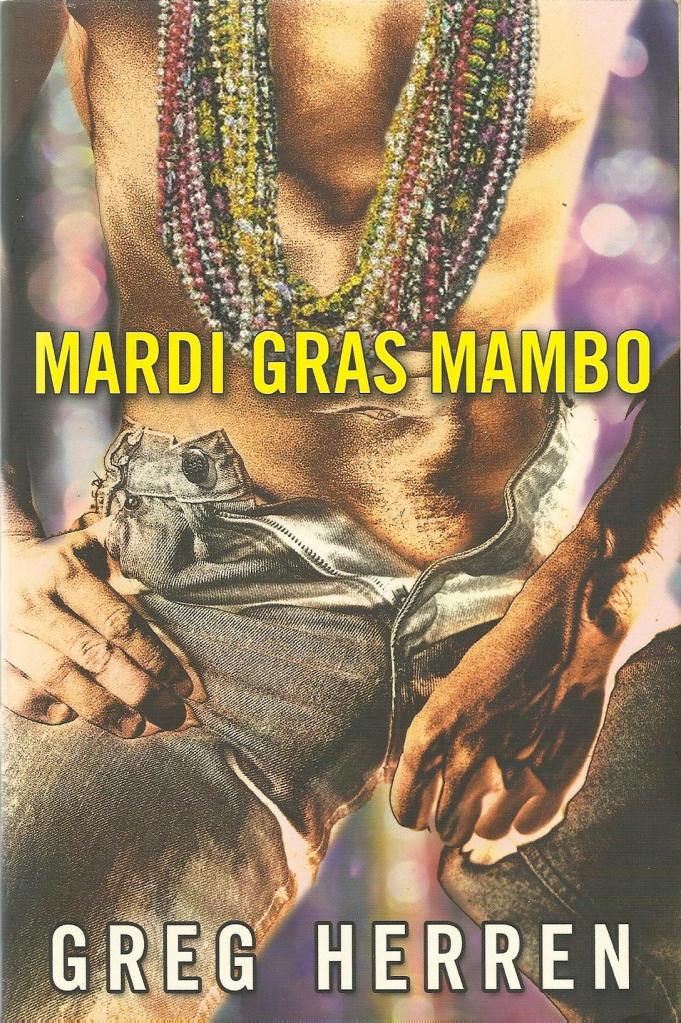
Mardi Gras Mambo

Or, my own personal Vietnam.

I’ve told this story any number of times; how the writing of the book was derailed by two awful things that happened in my life, and how I finally got back to writing again in the spring of 2005, managing to finish this and turn it into literally two or three weeks before Hurricane Katrina came barreling ashore and changed everything in my life, and the long recovery time from that paradigm shift, trying to adjust to the new reality I was facing every day. It felt weird going over the copy edits, weirder still doing the page proofs (I actually had the incredibly sharp-eyed Becky Cochrane and Timothy J. Lambert do it for me while I was visiting the Compound, thanks again, guys!), and even stranger having to tour and promote a book about New Orleans set before Katrina while still dealing with the recovery.

I’ve told those stories before, and that isn’t really what these entries are about; these entries are about the books themselves and how I came up with the stories and so forth, and the writing of the books. The primary problem, of course, is that I wrote this book between and around tragedies; the two year period I call the Time of Troubles that began on Memorial Day weekend in 2004 and ran through about 2008, really; because that’s about how long it took after all those issues for me to feel like my feet were beneath me again and I once again had a grasp on my life. I don’t remember what the original story was about, other than it centered on the Krewe of Iris, Scotty’s Diderot grandmother’s best friend who’d married a much younger muscle-stud Russian, and that’s really about it. The Russian would have something to do with a Colin case–and it would turn out actually be the case that brought him undercover to New Orleans in the first place during Southern Decadence; in Jackson Square Jazz we find out what Colin’s real job is, and that he was in town originally about the Napoleon death mask–but he was also in town to keep an eye on the young muscle-stud Russian who’d married Scotty’s grandmother’s best friend. It wasn’t really working, and I didn’t much care for the story, to be honest; I’d already asked for an extension before Memorial Day weekend in 2004 when all the shit started happening; after Paul was attacked they took it off the schedule and told me not to worry about it. (I appreciated the courtesy greatly at the time, but at the same time had this sinking feeling in the back of my head uh oh, they may not want another one after this–which turned out to be correct. But I dismissed the fear as part of my on-going struggle with Imposter Syndrome. It took me about six months, more or less, to get back to writing. I started my blog right after Christmas that year, and there I was writing every day again, and by January of 2005 I was ready to get going on this book again. I remember rereading everything I’d already done, not liking it, and deciding to scrap it and start over with the same essential premise: rich older society woman in New Orleans has married a much younger Russian boy-toy; Colin is investigating the boy-toy; and it’s Carnival season. Shortly after getting about halfway into a new first draft, the Virginia thing happened and I was derailed again. After that was over and I went back to the book…once again I didn’t like what was happening in the story and I threw it all out and started over again.

But this time, I hit my stride and four months later I turned the book in at long last, along with a proposal for a fourth, Hurricane Party Hustle, which was going to be set during an evacuation and would wrap up the loose ends left at the end of Mardi Gras Mambo.

And of course, three weeks later Katrina changed everything, and Hurricane Party Hustle went into the drawer.
Last night I dreamed it was Mardi Gras again. It seemed to me I was standing inside an iron gate, watching one of the night parades go by. The sidewalks in front of the gate were crowded with people, all shouting, with their grasping eager hands up in the air. Out beyond the edge of the curb, I could see people sitting in lawn chairs. Still others were up on ladders, with coolers and plastic bags of booty piled around them on the ground. Fathers and mothers were holding up babies, while black kids with the crotches of their pants down around their knees walked behind the crowd, weighted down by the ropes of beads around their necks. Beads were flying through the air, some getting caught and tangled in the branches of the towering gnarled oaks lining the avenue.  The heavy upper branches of those oaks also blocked out the glow of the ancient street lamps so the night seemed even darker than it should. I could hear a marching band, playing a recent hip-hop hit, and the strange clicking sound of the baton girls’ tap shoes on the pavement. The air was heavy with the heavy fragrance of hot grease, corn dogs and the strange melted yellowish-orangey substance the vendors put on nachos that purports to be cheese—but no one is really sure what it is. A group of flambeaux carriers were passing by, dancing that odd little circular dance they do, their propane tanks popping and hissing, throwing long and twisted shadows that also danced inside the iron fence I was behind. Right behind them a huge float pulled by a tractor was coming and the crowd’s shouts became louder, more desperate, more pleading. On the float’s front was a huge white clown face, its bright red lips parted in what passed for a smile but seemed to me to be a frightening leer. The masks on the float riders glowed supernaturally at the hordes begging them for generosity in the strange light cast by the moon when it cleared the thick clouds in the cold night sky.   I stood inside the black iron fence, my arms wrapped around me against the cold as an increased sense of menace and dread built inside me. Something bad was going to happen—

Oh, get real, Scotty!

If I do have bad dreams, I don’t remember them when I wake up. I’ve certainly never been troubled in my sleep, even though crazy things always seem to happen to me. I’m just one of those people, I guess. For whatever reason, the Goddess has decided to throw some wild stuff at me—she always has, even when I was a kid—and what can you do? I just don’t think I am one of those people who were destined to have a nice, normal, quiet life. Maybe it’s because I was named Milton Bradley at birth. Yes, that’s right. Milton Bradley. My older brother started calling me by my middle name, Scotty, before I started school and thank the Goddess, it stuck. Can you imagine how cruel the kids would have been to someone named Milton, let alone Milton Bradley? And then of course there’s the gay thing. I was lucky—my parents are pretty liberal and were delighted to have a gay son—like it somehow proved how truly cool they really are or something. They are pretty cool, actually.

By now, I’d taken to starting all of my New Orleans novels with a Tennessee Williams quote; for this one I chose a line from Vieux Carré: “You’ve got a lot to learn about life in the Quarter.”

I had opened Bourbon Street Blues with a parody of “The name’s Bond, James Bond” and I’d done something similar with Jackson Square Jazz–“Danger is my middle name”, riffing on Trouble is My Business. I decided to open this book with a parody of the opening line of Rebecca: “Last night I dreamed I went to Mardi Gras again.” But that entire opening paragraph of du Maurier’s is so fucking brilliant, I couldn’t help myself and made my entire first paragraph a parody of that opening. I then decided that from then forward, every Scotty book would have a Williams quote and each prologue–where Scotty introduces himself and his cast of characters and gives backstory so I don’t have to do it in the text of the story itself–would parody the opening paragraph of a famous novel, rather than just the first line (I am actually struggling to find the proper opening to parody to start the prologue for this one. I’ve used Rebecca, Peyton Place, The Haunting of Hill House, and Lolita, among others so far already; I’ve tried with this one to use An American Tragedy, Atlas Shrugged and The Great Gatsby thus far, with no luck. I’ve tried Valley of the Dolls several times for other books in the series already, but I can’t ever get it to work for me).

I do remember that the one thing that didn’t come across in those earlier drafts that I had abandoned was the sense of insanity that Carnival always brings with it; that feeling of “controlled anarchy” we experience those two weeks of parades, of knowing you have to schedule your entire life around a parade schedule–true even for those who do not live inside the box, as we say here; the box being the Uptown parade route–I always have to schedule my job, my trips to run errands uptown, everything, predicated around having to get home at least two hours before the parades start, and am incredibly lucky if I can get a parking spot within three blocks of the Lost Apartment. The thing I kept forgetting in those earlier versions was the books are meant to be fun. Granted, I was hardly in a mental space to write something fun…and of course the decision to really take it completely over the top the way I did was something I still think about to this day and wonder, where on earth did you get the idea for identical triplets?

Which, while crazy, made more sense than the cloning story I tried to write the second time.

Maybe those bad things happened for a reason? Because I couldn’t be more pleased with how the story and the book turned out. I also ran out of room to finish the personal story…but I also was operating on the assumption I’d get a contract for a fourth book. If not for Katrina, Kensington might have made another offer and Hurricane Party Hustle might have been the fourth Scotty than something just sitting in the files.

The book was released on Fat Tuesday, 2006. Paul and I had been out of town–the truncated Carnival/parade season seemed almost too sad to handle, so we’d accepted a gig to speak at the South Carolina Book Festival. We flew back to New Orleans the Sunday morning before Fat Tuesday. I’d checked my email that morning before boarding the flight to Atlanta (we changed planes) and then our cab driver couldn’t get closer to St. Charles than Baronne Street. A parade was going as we got out of the car, and we had to cross the parade (it was in the high seventies and sunny) with our luggage–I’ll never forget looking up as we got ready to cross and catching a bag of beads with my hand just before it connected with my face–and got home. I checked my emails and my word! SO MANY EMAILS.

You see, that day’s edition of the Times-Picayune carried Susan Larson’s review of the book, and it was a rave! Everyone emailed me as soon as they saw it–I still bask in the glory of that review–and I was about to embark on probably the most ambitious book tour of my career.

I just didn’t see, though, how I could write another funny, light book about a city still in ruins whose recovery was still questionable.

The series was, for the moment, over–with the personal story not resolved the way I would have wanted, but it could stand as it was, should there never be another Scotty story.

Rereading it, I couldn’t but laugh at some of the outrageous twists and turns the plot took.

I guess you could say I’m proud of it.

King of My Heart

I went down a wormhole thought pattern of sorts this morning, triggered by reading a Crimereads essay about spy novels, and their genesis; it mentioned that Rudyard Kipling’s Kim was one of the first spy novels, and I also realized that only had I not read Kim, I’m not entirely sure I’ve ever read Kipling; however, a quick Internet search just not has reminded me that I have, indeed, read Kipling: Rikki-Tikki-Tavi, The Jungle Book, Captains Courageous, but I really don’t remember anything about them (let’s be honest, all my memories of The Jungle Book are naturally from the Disney animated film). I may have also even read Just So Stories, but am not entirely sure. I’m sure Kipling’s work does not stand the test of time–just the title of the poem “The White Man’s Burden” made my eyes almost pop out of my head when I came across it this morning–as they undoubtedly reflect the white supremacist view of Imperialism and the need for the British Empire.

On that same note, I feel relatively certain that the M. M. Kaye novels I once enjoyed (Shadow of the Moon and The Far Pavilions) probably wouldn’t hold up well, either.

I always read for pleasure and for enjoyment; to escape the world in which I found myself inhabiting and feeling like a changeling for the most part; I still do, for the most part. I haven’t been paid to write a book review in over a decade; I’ve always felt that as an author myself, there was a conflict of interest in accepting pay to read and critique another author’s work, and there was always, inevitably, the possibility that an honest view on something that didn’t work for me as a reader would be seen as a vindictive move on my part to torpedo another author, out of jealousy or spite or both. There are any number of these reviewers being employed, and paid quite handsomely, by major newspapers, and I don’t want to be one of them. I don’t like writing negative reviews, and if I am reading something I don’t care for, having to finish reading it because I am being paid to write about would inevitably make me resent the book and its author and would thus color the review.

I generally read things I think fall under my purview as a writer–mostly crime novels, some horror now and then, and maybe something every once in a great while, that would be considered literary. Often these are books by writers I already have discovered, or new ones recommended to me by others whose tastes I respect–The Coyotes of Carthage came to me in this way; Lisa Unger was recommended to me by numerous friends; and yes, Paul Tremblay came to me as a recommendation from a friend. I know I need to expand my horizons to improve as a writer, which is why I am not only committed to the Diversity Project (books by marginalized writers) but also to the Short Story Project. The Diversity Project has been a terrific learning experience, and the Short Story Project has helped me become a better short story writer. I’ve been trying to read New Orleans history lately–with a dash of Louisiana thrown in for flavor–in order to get a better sense of the city and state, so that I can write about them both more knowledgeably; plus there is so much inspiration in reading about the past of both city and state! It’s also incredibly humbling to know how little of that actual history I did know, and even though I knew how rich that history was, I had no idea just how much of a gold mine of inspiration and ideas it would prove to be.

Like I said, I tend to read things I think I will enjoy, and if I am not enjoying the experience, I inevitably stop reading. I have started things and put them aside, only to go back to them again and greatly enjoy them; Paul Tremblay’s A Head Full of Ghosts being the best and most recent example of this I can remember; I started it, got several chapters in, and wasn’t feeling it. I went back to it months later and couldn’t put it down, and frankly, after The Cabin at the End of the World, Tremblay is becoming one of my current favorite authors.

So, I’ve been wrong about books before, and I’ve also been wrong about authors before. Hence the dilemma in being a book reviewer, and why I have chosen for many years now to seek extra income by reading for reviews. I enjoy writing about books I enjoyed on here, my blog; that’s part of its reason for existence, and I also curate what I read and write about here. No one chooses for me what I read or what I write about; and I will only review something negatively if the writer is, frankly, long dead; and even then, it’s simply an explanation of why the book didn’t work for me (an example of this latter type was Night Has a Thousand Eyes by Cornell Woolrich; I appreciated the book but there were things about it I didn’t like, that I felt didn’t “play”, but since he is long dead–over fifty years–I wasn’t overly concerned about hurting his feelings….and I have enjoyed other works of his).

I often talk about how my education in what the Academy considers to be classic American literature (British, too, for that matter) is sorely lacking. It’s something that I occasionally wonder about; should I go back and read these so-called classics as decided by a group of people whose opinion I generally don’t respect very much? It’s entirely possible, I know, that books I was forced to read as a teenager in high school and college were actually better than I thought at the time because I loathed being forced to read anything and I despised the way they were taught by pompous pseudo-intellectuals with tenure (I really enjoyed mocking that world in my story “Lightning Bugs in a Jar”, and will probably mine it again at some point as story fodder).

But I can honestly say I went back twice to reread The Great Gatsby only to discover that I loathed it even more than I remembered loathing it the first time; I also spent some time in my twenties trying to read other works by the writers I was forced to read and found that I did, in fact, enjoy some of them. I hated Sinclair Lewis when I was forced to read Main Street in college; I later went back and enjoyed both Elmer Gantry and It Can’t Happen Here very much. I disliked Fitzgerald’s This Side of Paradise very much, and I loathed the Hemingways I was forced to read (The Old Man and the Sea, A Farewell to Arms) so much that I just can’t bring myself to read anything else of his. I was very surprised, actually, to find myself enjoying Faulkner quite a bit, and I keep meaning to go back and reread both The Sound and the Fury and Sanctuary–but there are also a lot of other Faulkner novels I’ve not read, and probably should. I also despised Tom Sawyer and the other, celebrated Mark Twain short stories I was forced to read; but as an adult greatly enjoyed Puddinhead Wilson, The Prince and the Pauper, A Connecticut Yankee in King Arthur’s Court, and Life on the Mississippi.

But I am not someone who became a writer because I wanted to have a legacy, or be lionized; I became a writer because I wanted to tell stories, and I wanted to tell the stories that I wanted to tell. I never had any desire to have my work be taught in colleges, or for students to be forced to write papers about my work. I always say that sort of thing isn’t up to me to decide, and it’s never been my aim. If I’m forgotten after I die, well, I won’t be the first.

I justify to myself not reading a lot of literary fiction by saying there simply isn’t enough time for me to read everything that I actually want to read, let alone find the time things people think I should read. But I also have this sense in my mind that perhaps I am missing out on something; I know I’ve read books that have gotten critical acclaim that were more on the literary side and liked them very much and learned from reading them. Colson Whitehead, for example, is simply brilliant while also writing genre fiction–The Nickel Boys and Underground Railroad were stunningly brilliant; I really need to read more of his work–and thinking about Colson Whitehead led me to thinking about, of all people, Cormac McCarthy. I’ve not read McCarthy, but from what I have gathered from what I have heard about his work is it technically is also genre fiction; The Road is a post-apocalyptic dystopian novel, after all–a friend whose opinion I respect read and hated the book, so I’m probably not going to go there–so I started going through his canon on the web and I finally settled on one to add to my TBR pile at some point, Outer Dark, because it too sounds like genre fiction. We shall see how that goes, shan’t we?

Laura Lippman often says that genre fiction is literature, and by claiming literary classics as genre (the most common is, of course, Crime and Punishment) we are demeaning the great genre work, which stands on its own without the necessity of claiming Dostoevsky or Faulkner’s Sanctuary as crime fiction (although I do believe Sanctuary is pulpy noir of the best kind). I do agree with her to some degree; as I said, I do think Sanctuary is noir, and an argument could be made that An American Tragedy by Dreiser is as well. (I’ve also pointed out numerous times that The Great Gatsby is really a murder mystery told in reverse) But her point is spot on: genre fiction doesn’t need to claim classics from the Academy in order to be recognized as literature, and claiming those books does make it seem like trying to make fetch happen.

I also like to believe that my best work is still ahead of me.

Of course, that means I actually need to do it.

And on that note, tis back to the spice mines.

Did You See Me Coming?

And somehow, just like that, we made it to Wednesday again. Well done, Constant Reader; sometimes it feels like we’re just not going to get there.

So, yesterday morning between screenings, I checked out my iCloud drive to just see what precisely I have in progress at the moment (not counting everything else that has been unfinished for years) and the count is: four novels, four novellas, and at least nineteen short stories. (And y’all wonder why I talk about having creative ADHD. Barbara, please.) Then again, should I get all of these things finished by the end of the year, I would absolutely have another short story collection completed (there are already several unpublished, finished stories I have in my “to submit” folders as well, and three that have been sold–two of which are out now–in The Beat of Black Wings and The Faking of the President; so at some point that second collection will be ready to go within the next year or so*) and so it looks as though the dearth of Gregalicious publications will be solved once he gets off his ass and starts finishing things.

Heavy heaving sigh.

One thing I noticed yesterday as I drove to my essential job (yes, my job is considered essential) is that there was a lot more traffic then usual at that time; and then I remembered driving home Friday night after work in heavier traffic than usual as well. Oh no, I thought, I wondered how long it would be before New Orleanians couldn’t stand the isolation anymore and despaired; but there was so little traffic on my way home from work last night that I managed to play one song on my phone through the car speakers as I pulled onto the highway and it was just finishing as I pulled into a parking space across the street from my house (yes, I managed to hit every light as green once I got off the highway too; I LOVE when that happens), so maybe it’s not so bad after all.

These are such strange and new times, and I’m never really certain what to think about them, you know? Or to try to think ahead; this week is about all I can handle right now, thank you very much and good night.  But I’m also a planner, even if the plans and their timing remains somewhat amorphous all the time; it’s just kind of who I am. I’m also aware that if you don’t plan ahead a bit, you tend to get very surprised along the way and that is never, ever a good thing.

Yesterday I discovered, entirely by accident, that one of my favorite old movies–The Letter, starring Bette Davis, had actually been a short story by W. Somerset Maugham first, before he himself adapted it into a play which then became the basis for the two film versions (the more famous Bette Davis version was actually a remake of the Jeanne Engels version from the previous decade), and it was in the public domain, so I downloaded a copy of it to read for the Short Story Project; it’s a long story, clocking in at over 13,000 words, which in today’s world I suppose would make it a novella. I am, of course, rather excited to read the original source material, and I’m not sure I’ve ever read Maugham before–just another one of those great old white male writers I’ve never read; and it occurs to me just now that one of the things I should reread for the Reread Project is Hemingway’s A Farewell to Arms. I’ve never really gotten Hemingway, and certainly didn’t when I was forced to read him in high school–hating the experience so much I never went back to him–but maybe it wouldn’t hurt to give Papa another turn. Perhaps as a more mature adult and reader I can appreciate him more (although my recent reread of The Great Gatsby made me hate the book even more than I already did); but I certainly didn’t mind reading some other Old White Men over the years, like Sinclair Lewis and Theodore Dreiser (I should tackle the massive An American Tragedy sometime; I really liked Sister Carrie when I read it), and I should probably make up one of the greatest gaps in my reading history–The Adventures of Huckleberry Finn, which I’ve never read–but I’ve read a lot of Twain over the years.

It is absolutely insane how many works I have in progress! (I just reread the opening of this entry again) But I do believe that perfectly illustrates my point about my creative ADHD….and there are even more short stories than that, really; those are the ones I’ve worked on at some point over the last few months. And of course, more ideas come to me all the time. Heavy heaving sigh.

And on that note, I need to get ready to face my day. Have a good Wednesday, Constant Reader!

*the third, “The Carriage House”, has been sold to Mystery Tribune, and I’m not sure when it will be released; so stay tuned!

IMG_0695