Thursday morning and my last day in the office for the week–and until a week from Monday, at that! Huzzah! The dark is pressing up against my windows this morning, which means the time change is coming. I still get to come home from work in the daylight, though. I slept pretty decently last night, and my legs are tired this morning but they don’t ache, which is much, much better than earlier this week. The bed also felt warm and comfortable this morning. Sparky was a cuddle puddle, too, which wasn’t exactly motivating me to get up, you know? Ah, well.
I was very tired when I got home from work last night, but did my chores so the house isn’t a disaster area this morning. I worked on the book first, caught up on the news (which is truly grim every day), and then cleaned out the sink and ran the dishwasher. I also finished two loads of laundry and folded everything before I started dozing off in my chair. I started my reread of The Haunting of Hill House, and it always, on every reread, just blows me away. Shirley Jackson was such a master.
What a bizarre week this has been, and it’s only Thursday. It hasn’t been bizarre for me, per se, but more along the lines of “I’m not enjoying this final season of United States.” We have Senator Rafael Cruz insisting that we need to “stop attacking pedophiles” (for which I have rechristened him Tedophile), to the government shutting down, to the cowardice of the House Speaker in not swearing in a duly elected congressperson to protect the Epstein files from coming out, to whatever the fuck that was with the top military brass the other day. (Someone posted on social media that the generals were calling them “Fat Man and Little Boy” because they bombed so hard, which made me howl with laughter.)
I do love how President Canks1 seems to think destroying the major cities in this country–which also are the primary economic engines of the country–won’t bankrupt the nation, not to mention a president threatening US cities with military reprisals because they don’t like him is a kind of a terrifying new wrinkle (gee, if only someone could have said something about this before the election…), but not a surprise. MAGA has been running this country as a fascist state since at least 1/20/25, and anyone who doesn’t see that is too stupid to engage with other than a simple “hello” in passing. Is it any wonder everything is fraying and decaying, including everyone’s emotional and mental states? Prices certainly are out of control and getting worse every time I go to the grocery store or order groceries for delivery; how’s that cost of eggs no one on the Right seems to care about anymore? Fortunately I only use eggs for cooking (rarely), and while Paul loves them, he doesn’t eat them very often–thank the Lord. And who would have ever thought the so-called “answer” to illegal immigration was to make the country such a hellhole that no one would want to come here for opportunity anymore? I always thought illegal immigration was the ultimate compliment to our country–that whole “land of opportunity” thing I was brainwashed into believing when I was a kid. My generation was completely gaslighted into the dual mythology of American exceptionalism and white supremacy; talk about a miseducation! I’ve spent most of my adulthood unlearning those lessons.
But I do feel good this morning–I know I’ll be tired tonight, but the only chore left is folding that last load of laundry, so I can probably do a spot of writing before collapsing into my easy chair for the evening. I do hope Paul gets home early enough before I fall asleep/go to bed, so we can watch some shows and get caught up with each other. I think they’re finished moving the office to their new, temporary space.
And on that note, I am heading into the spice mines. Have a lovely day, Constant Reader, and don’t let the news get to you too much; I need to follow my own advice, don’t I? See you tomorrow morning!
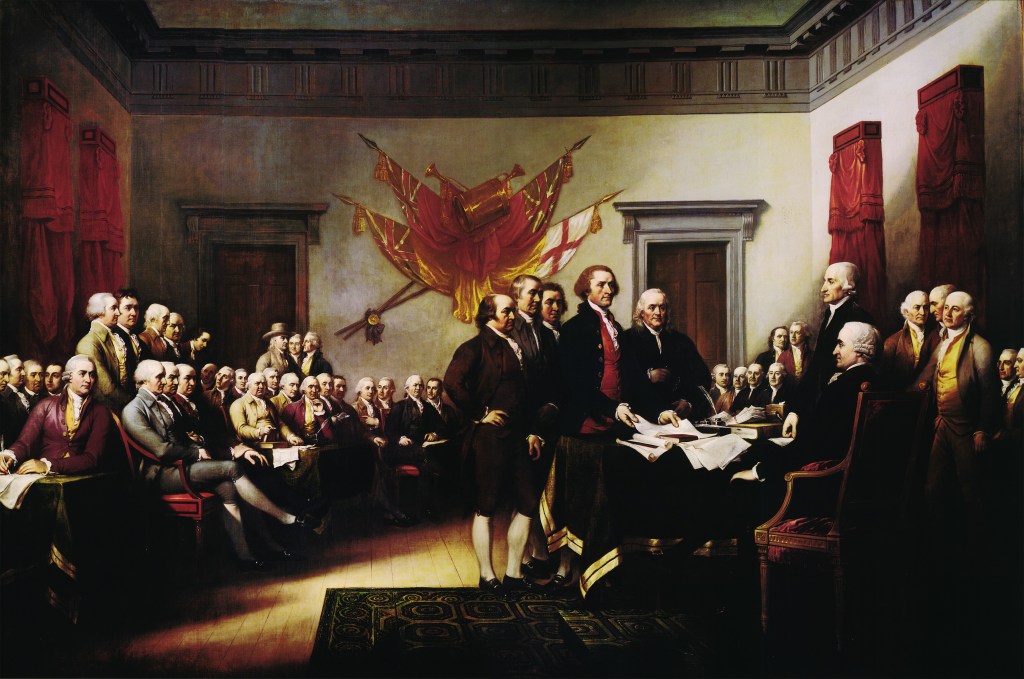
We are taking a break from our regularly scheduled blog to talk about US History and current affairs, which is something I don’t do very often here. But since it’s the 4th of July, how can we not reflect on our most imperfect union and the journey to where we are now?
Today’s title is from the musical 1776, which doesn’t get near enough attention. I was thinking about using something from Hamilton, but…I don’t think Lin-Manuel will mind, do you? I saw the film version of 1776 when I was in junior high school (I think it was; we used to go see movies periodically; which is how I saw both Fiddler on the Roof and Jesus Christ Superstar1). But 1776 seems to have been largely forgotten.
It’s hard to imagine, really, how courageous the American rebels actually were. They were farmers and lawyers and doctors; yet they believed in their cause enough to defy and stand up to, and take on, the mightiest Empire the world has ever seen. 2They were imperfect humans, as we all are; the attempt by the Right to frame them as infallible gods, guided in their work by the Christian god, is offensive and insulting. The greatest of humans are still human, and all humans have frailties and flaws, and enshrining any human as an infallible instrument of God is, at the very least, blasphemy. The Founding Fathers were both racists (more than a few enslaved people) and misogynists (where are the rights for women?), which made them….fallible. They weren’t gods, they were men.
I grew up in the 1960s and 1970s, and my education was tailored to the times. We were in a Cold War with the “evil” Soviet Union, when the possibility of nuclear annihilation was always in the back of our heads. Communists were the enemy, and they were evil; so…we all had to be brainwashed into the mentality of American exceptionalism. The right of white Europeans to the continents of the Americas, despite the fact people already lived there, was never to be questioned…the ends justifying the means, I suppose. The true horrors of enslavement weren’t taught; it was just something that happened, we fought a civil war to end it, and then it was over…we weren’t taught about the racism baked into the country and society from colonial days that continues to the present day.
And a lot of the failures of the Constitution were primarily due to the Founding Fathers being unable conceive of things that are just taken for granted by us today–politics as a profession; primaries and elections as a multi-billion dollar industry, and the levels of corruption in our political class, as well as the failures of the news media to hold the government accountable.
The passage of yesterday’s foul and evil legislation was the final betrayal of the Founders, and I think people are finally waking up to the clear and present danger in Washington. Funny that the people always screaming about their freedom and their liberties are too blind to see how their freedom and liberties are being taken from them–and how happy they are to give them up so long as they think other people will suffer. I see a lot of social media posts since yesterday talking about the new authoritarianism, yet have never noticed how the Right has been building to this point for decades. The police state’s foundational legislation was the PATRIOT Act–which has never been repealed and has been reauthorized by Congress several times.
I don’t see a great future for us over the next ten years, frankly. I do not see a way out of this situation we’re in without it becoming really ugly. MAGA isn’t going to go down in any electoral defeat because, as we have seen, they will not accept the results and are more than willing to use violence to get their way. That will get ugly, don’t you think? And let’s face it, our current situation isn’t much different than the one the country was in during the 1850s–when enslavers controlled the Supreme Court, Congress, and the White House. Losing that control led to the Civil War, because enslavers weren’t willing to give up the power they’d enjoyed for so long because they feared losing their slaves.
How long before the people in the prison camps are contracted to work in the fields and doing the grunt work we’ve pushed off onto immigrants for decades?
I always suspected our system was collapsing, rotting from the inside and spreading the foul disease across the nation. I always hoped I was wrong, but the logical side of me couldn’t deny the evidence of the decay.
My one hope was that if I was correct, I wouldn’t live long enough to see the collapse. Ah, well. That ship has sailed, hasn’t it?
Yeah, not up for celebrating seventeen million people losing their health insurance, or the many millions of children who will go hungry.
But there’s always hope, no matter how bleak it seems. As Winston Churchill once said, “You can always count on Americans to the do the right thing–after they’ve exhausted every other possibility.”
I also believe this will not end well for corporations and billionaires–as it did not for the French and Russian aristocracies.
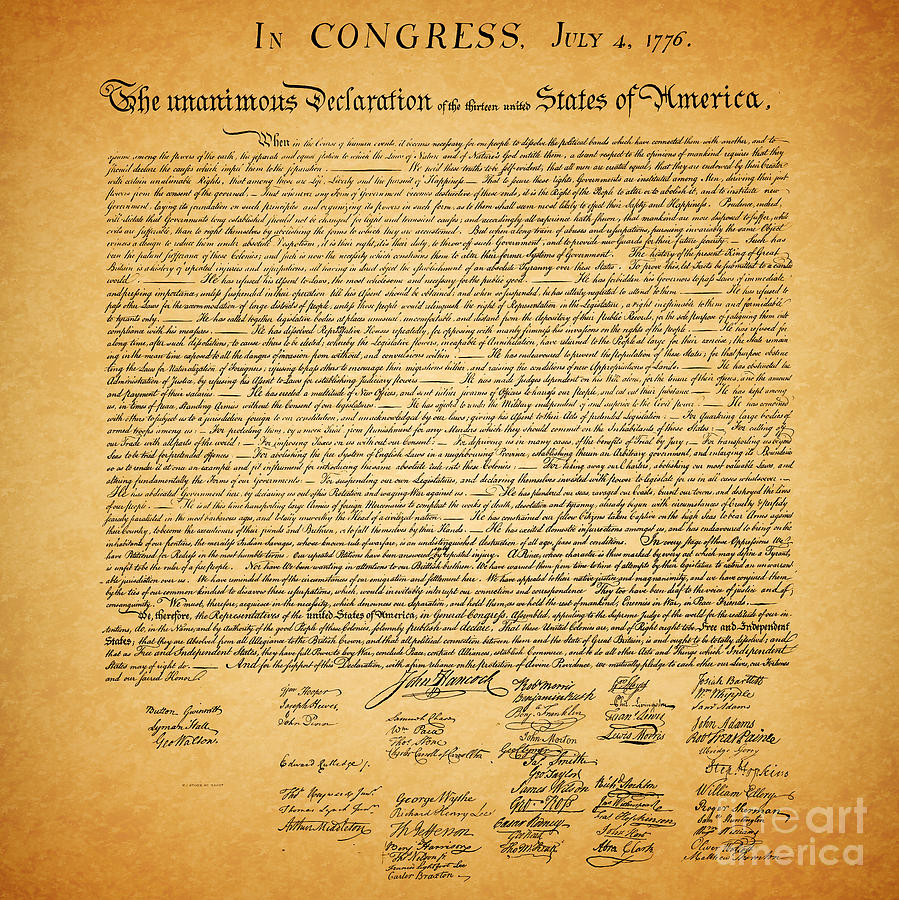
And in case you’ve forgotten (or never knew) the text:
When, in the course of human events, it becomes necessary for one people to dissolve the political bands which have connected them with another, and to assume, among the powers of the earth, the separate and equal station to which the laws of nature and of nature’s God entitle them, a decent respect to the opinions of mankind requires that they should declare the causes which impel them to the separation.
We hold these truths to be self-evident, that all men are created equal, that they are endowed by their Creator with certain unalienable rights, that among these are life, liberty, and the pursuit of happiness. That, to secure these rights, governments are instituted among men, deriving their just powers from the consent of the governed. That, whenever any form of government becomes destructive of these ends, it is the right of the people to alter or to abolish it, and to institute new government, laying its foundation on such principles, and organizing its powers in such form, as to them shall seem most likely to effect their safety and happiness.
Prudence, indeed, will dictate that governments long established should not be changed for light and transient causes; and, accordingly, all experience has shown, that mankind are more disposed to suffer, while evils are sufferable, than to right themselves by abolishing the forms to which they are accustomed.
But, when a long train of abuses and usurpations, pursuing invariably the same object, evinces a design to reduce them under absolute despotism, it is their right, it is their duty, to throw off such government, and to provide new guards for their future security. Such has been the patient sufferance of these colonies; and such is now the necessity which constrains them to alter their former systems of government. The history of the present King of Great Britain is a history of repeated injuries and usurpations, all having in direct object the establishment of an absolute tyranny over these states. To prove this, let facts be submitted to a candid world.
He has refused his assent to laws the most wholesome and necessary for the public good.
He has forbidden his governors to pass laws of immediate and pressing importance, unless suspended in their operation till his assent should be obtained; and when so suspended, he has utterly neglected to attend to them.
He has refused to pass other laws for the accommodation of large districts of people, unless those people would relinquish the right of representation in the legislature; a right inestimable to them and formidable to tyrants only.
He has called together legislative bodies at places unusual, uncomfortable, and distant from the depository of their public records, for the sole purpose of fatiguing them into compliance with his measures.
He has dissolved representative houses repeatedly, for opposing, with manly firmness, his invasions on the rights of the people.
He has refused for a long time, after such dissolutions, to cause others to be elected; whereby the legislative powers, incapable of annihilation, have returned to the people at large for their exercise; the state remaining in the meantime exposed to all the dangers of invasion from without, and convulsions within.
He has endeavored to prevent the population of these states; for that purpose obstructing the laws for naturalization of foreigners; refusing to pass others to encourage their migrations hither, and raising the conditions of new appropriations of lands.
He has obstructed the administration of justice, by refusing his assent to laws for establishing judiciary powers.
He has made judges dependent on his will alone, for the tenure of their offices, and the amount and payment of their salaries.
He has erected a multitude of new offices, and sent hither swarms of officers to harass our people, and eat out their substance.
He has kept among us, in times of peace, standing armies, without the consent of our legislatures.
He has affected to render the military independent of and superior to the civil power.
He has combined with others to subject us to a jurisdiction foreign to our constitution, and unacknowledged by our laws; giving his assent to their acts of pretended legislation:
For quartering large bodies of armed troops among us;
For protecting them, by a mock trial, from punishment for any murders which they should commit on the inhabitants of these states;
For cutting off our trade with all parts of the world;
For depriving us, in many cases, of the benefits of trial by jury;
For transporting us beyond seas to be tried for pretended offenses;
For abolishing the free system of English laws in a neighboring province, establishing therein an arbitrary government, and enlarging its boundaries, so as to render it at once an example and fit instrument for introducing the same absolute rule into these colonies;
For taking away our charters, abolishing our most valuable laws, and altering fundamentally the forms of our governments;
For suspending our own legislatures, and declaring themselves invested with power to legislate for us in all cases whatsoever.
He has abdicated government here, by declaring us out of his protection, and waging war against us.
He has plundered our seas, ravaged our coasts, burnt our towns, and destroyed the lives of our people.
He is at this time transporting large armies of foreign mercenaries to complete the works of death, desolation, and tyranny, already begun with circumstances of cruelty and perfidy scarcely paralleled in the most barbarous ages, and totally unworthy the head of a civilized nation.
He has constrained our fellow citizens, taken captive on the high seas, to bear arms against their country, to become the executioners of their friends and brethren, or to fall themselves by their hands.
He has excited domestic insurrections amongst us, and has endeavored to bring on the inhabitants of our frontiers, the merciless Indian savages, whose known rule of warfare is an undistinguished destruction of all ages, sexes, and conditions.
In every stage of these oppressions, we have petitioned for redress, in the most humble terms. Our repeated petitions have been answered only by repeated injury. A prince, whose character is thus marked by every act which may define a tyrant, is unfit to be the ruler of a free people.
Nor have we been wanting in attentions to our British brethren. We have warned them from time to time of attempts by their legislature to extend an unwarrantable jurisdiction over us. We have reminded them of the circumstances of our emigration and settlement here. We have appealed to their native justice and magnanimity, and we have conjured them by the ties of our common kindred, to disavow these usurpations, which would inevitably interrupt our connections and correspondence. They too have been deaf to the voice of justice and of consanguinity. We must, therefore, acquiesce in the necessity, which denounces our separation, and hold them, as we hold the rest of mankind, enemies in war, in peace friends.
We, therefore, the representatives of the United States of America, in General Congress assembled, appealing to the Supreme Judge of the world for the rectitude of our intentions, do, in the name, and by authority of the good people of these colonies, solemnly publish and declare, that these United Colonies are, and of right ought to be free and independent states; that they are absolved from all allegiance to the British Crown, and that all political connection between them and the state of Great Britain is and ought to be totally dissolved; and that, as free and independent states, they have full power to levy war, conclude peace, contract alliances, establish commerce, and to do all other acts and things which independent states may of right do. And for the support of this declaration, with a firm reliance on the protection of Divine Providence, we mutually pledge to each other our lives, our fortunes, and our sacred honor.
Funny how some of their indictments of George III also apply today…
I still can’t believe we saw Jesus Christ Superstar and no parents complained. That wouldn’t happen today. The show and movie and music were highly offensive to Christians back in the day, but they don’t complain much about it anymore. ↩︎
I’m always amazed at how the people screaming the loudest that they are the REAL American patriots…would never put themselves at risk for their values and beliefs. For the record, conservatives in 1776 were called…Tories. ↩︎
Sunday morning in the Lost Apartment, and a very nice day was had here in the Lost Apartment. I worked and ran my errands and cleaned and had a rather nice, productive day. It was also a pretty day to run errands, despite the hordes of tourists on foot in the Garden District who somehow think it’s a pedestrian mall and will literally step out into the street without looking.1 Heavy heaving sigh. I will also never understand tour buses that want to make the left turn off Prytania onto Washington (by the cemetery); Washington is a very narrow two-lane street with cars parked on both sides. Probably heading to Commander’s Palace, but a bus will block the entire street. Ah, the trials and tribulations of driving in uptown New Orleans!
But I got up at a pretty decent hour (this morning as well) yesterday so I could get things done in the morning before I had to venture out into the errands. I was most pleased with what I was able to get done in the morning–the apartment still needs to have the floors cleaned, but at least it’s not nearly as horrifying around here as it was on Thursday night when I got home from work. This morning I am going to do the floors and the weekend’s dishes, so I can head into the work week with a sparking and shining home. I made major progress on a project, and hope to get it finished today. I also did some mental writing of my own on the Scotty book–I am not sure why I always struggle and then remember oh yeah, the plots are supposed to be over-the-top and ridiculous, the more ridiculous the better. So I would really like to get back to work on it, so I need to get this other project finished. When I get this finished I am going to read for a bit before I get cleaned up and get back to work.
I read manage to read some more of Winter Counts, and it’s really exceptionally well written. I am having a good time reading it, and seeing how the standard hard-boiled noir style can be interpreted and developed in an entirely new way and perspective is pretty awesome, too. (Seriously, people: broaden your minds and read diverse books.) I also spent some time with White Too Long, which thus far isn’t really telling me anything new–it opens with an explanation of how the Southern Baptists came into being in the first place, and how it has evolved from those racist roots (without losing the white supremacy) ever since. That may help me with the essay I am writing about religion and why I am so antipathetic to it; unpacking my miseducation on both it and American exceptionalism has been very revelatory–and it also makes me more than a little angry. This is what happens when you confront the truth about this country’s actual history, rather than the American mythology my childhood education groomed me into believing–which is why I guess people are so afraid of the truth and what their children might think of them? You cannot be both a good person and a racist at the same time; because if you harbor bigotry and racism inside of your personality it will spill over into other aspects of your life, and color your decisions and your votes and how you conduct yourself as you navigate through the world.
Paul was at the office for most of the day, and he got home rather late. I bought one of those Costco ready for the oven fresh pizzas Friday, and made it for dinner last night. It was quite good–what isn’t good from Costco, really–but when he got home, he had a tale to tell. As he was leaving his office from the rear of the building he was stopped by firemen (they were hot and young) and he eventually spoke to both the fire chief and the chief of police. Apparently, his building started to collapse while he was at his office. He didn’t even know anything had happened! Ah, New Orleans is always going to New Orleans. Never a dull moment in this city, is there? We’re almost to the anniversary of the Hard Rock Hotel collapse, too.
And on that note, I am going to get cleaned up and read for a while before I get to work for the day. Have a great Sunday, Constant Reader, and I may be back later on, if Sparky will allow it.
Screenshot
In fact, this made me think about Chanse’s computer guy, Jephtha, and his video game, “Tourist Season.” ↩︎
It is impossible for me to express how much books have always meant to me, and how grateful I am, to this day, to my parents and grandmother for encouraging me to read. We’ve always been a reading family–but no one ever has read as much, or as often, as I did. One of my aunts called me “the readingest child I’ve ever seen”–and she was a librarian. Books made sense to me; the worlds I escaped into whenever I opened a book made sense to me, and none of the worries or cares of my childhood bothered me when I was lost in a book. I also loved history, and thus read a lot of it when I was a kid; the basic overview history classes I had were pretty easy for me because I already knew the history in greater depth than the textbook provided.
The Scholastic Book Fairs were always my favorite day every month, and I was always so delighted when my mom would let me order a few–never all the ones I wanted, because I really wanted them all–and it was even more exciting when I found one that was also set in a period of American history. Johnny Tremain remains, to this day, one of my all-time favorites, and when I was a kid, I wanted to write both a mystery series (like the Hardy Boys and Nancy Drew) as well as historical fiction.
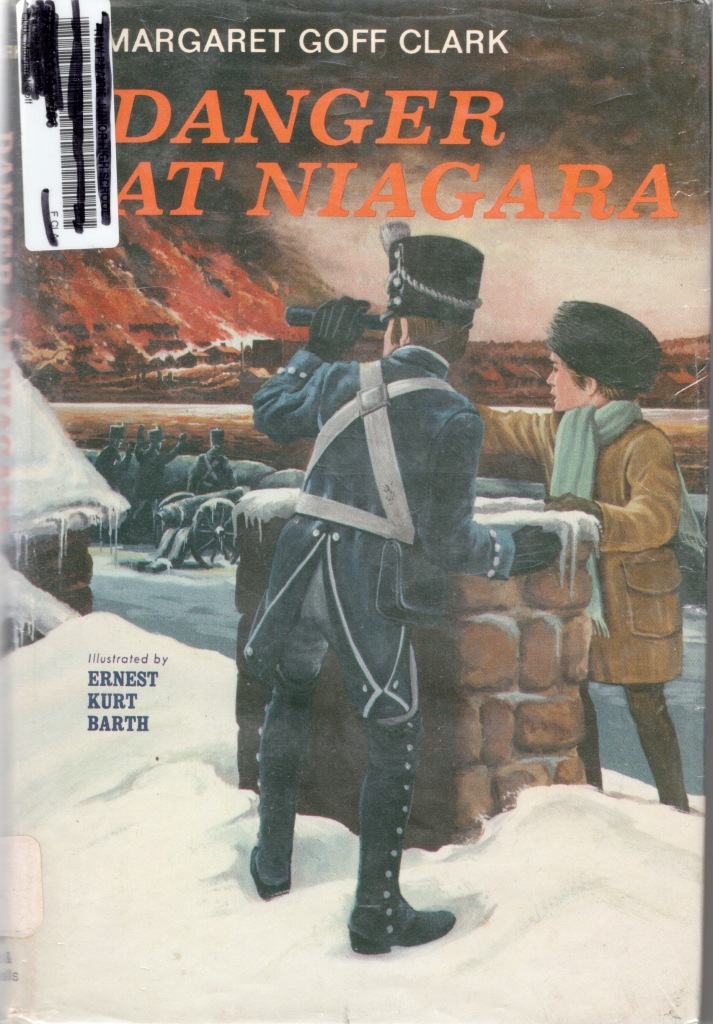
One such book that stuck with me over the years–and didn’t have as big an impact on culture as Johnny Tremain, which won awards and was filmed by Disney–was Margaret Goff Clark’s Danger at Niagara, which was set on the US/Canadian border during the War of 1812 (which few people write about and is mostly forgotten today). A few years ago I was looking for the original hardcover of Johnny Tremain I had read as a child, when a copy of Danger at Niagara was recommended to me by the eBay algorithm. It wasn’t expensive, it was a library remainder, and I thought, what the hell and shelled out the less than five dollars including postage, and the other day while they worked on the ceiling, I reread its 120 pages.
Sorry for the not-clear cover image; my copy is a library discard and there are no clear images of this cover on-line; at least not that I can find.
Exhausted from a day of fruitless hunting, Homan Reed ate a cold supper of cornbread and milk. Hastily he banked the fire and then fell into bed, forgetting his loneliness and the ever-present danger from across the river.
He awoke at dawn, shivering under the heavy quilts, awakened as much by the silence as the cold. He lay still, listening. Gray morning light had come through the small panes of glass Uncle Oliver had carried all the way from Connecticut. A sound that usually penetrated the log walls of the cabin was missing–a sound that was part of the background of his life in this lonely frontier clearing in western New York State.
His hear began to beat too fast, and he sat up in bed, reaching for the buckskin breeches he had laid on top of the quilts. Homan was a good-looking boy, rather small for his almost fifteen years.
There really isn’t much to the story, really. Homan wakes up to realize he has slept through a raid on his little family farm, and their livestock is gone. His uncle brought Homan and his brother up here after their parents died, and his brother is off fighting in the American army in the War of 1812. The Reed place is right across the river from Canada–and of course, at that time Canada was the enemy. Putting myself into Homan’s place was exciting; trying to imagine what it was like to know that not only was the British army capable of crossing the river at any time, their Mohawk allies were also out and about and a constant threat. Shortly after the opening of the book, the American army burns a Canadian town and turns out women, children, the sick and the elderly out into the cold with no shelter or food; to the author’s credit, she makes it clear this is horrible and a war crime; Homan, who witnesses this from inside Fort Niagara (he’s gone looking for his brother and to try to enlist), is horrified and ashamed Americans could do something so heinous–and everyone on the American side of the river knows there will be retaliation and retribution.
As I reread this short book, I paid very close attention to what we now would call propaganda for American supremacy–and there was some, but not as much as I would have thought, and there was less problematic language than I would have expected for the time (it was published in 1967 originally). Yes, Clark refers to the Tuscarora and Mohawk peoples as “Indians,” as do the characters (which is what they would have said at the time, so historically accurate, if offensive) but she treats the natives with respect–no references to them not being human beings, or being savages or uncivilized or anything like that; Homan even has a friend his age from the Tuscarora people. The Mohawks are referred to as the enemy, but in the same way the British are. There are a few mentions of pro-American exceptionalism propaganda–things like “we are a growing power the world needs to respect”, that sort of thing that Americans have always believed and never questioned until the last few decades or so. But Homan is likable enough, and the story itself, of worrying about your safety and losing your home and so forth, resonates still, even if technically Homan and his family were colonizers.


 Queer and Loathing in America