RuPaul likes to say we’re all born naked–everything else is just drag, and she isn’t wrong here.
Everything we wear is a form of drag. We always try to dress properly for whatever occasion, but yes–there’s work drag and formal drag and casual drag and gym drag and sports drag and around-the-house drag and pretty much any way you want to look at clothing…it’s all kind of a costume, really. And those costumes also depend on the time period.
I used to always think that I had no fashion sense–straight women and other gay men have often been astounded at how little I care about clothes or fashion or style. I have slight color-blindness, too–it’s hard for me to differentiate between darker shades; the darkest shades of blue and purple and brown and gray and green all look black to me. I also have some difficulty determining whether colors actually go together or not–which is why when it comes to formal/dressier clothing I tend to stick to black, white and red; I have so many red dress shirts, Constant Reader, you have no idea–so as I got older, I tend to go with what is easiest and less anxiety-inducing for me.
Of course, I also worked at an airport and had to wear a uniform for over two years: airline work drag. And after years of being a personal trainer, where all I wore was workout clothes or sweats, so yeah–my fashion sense has always been untrained and severely lacking for the most part.
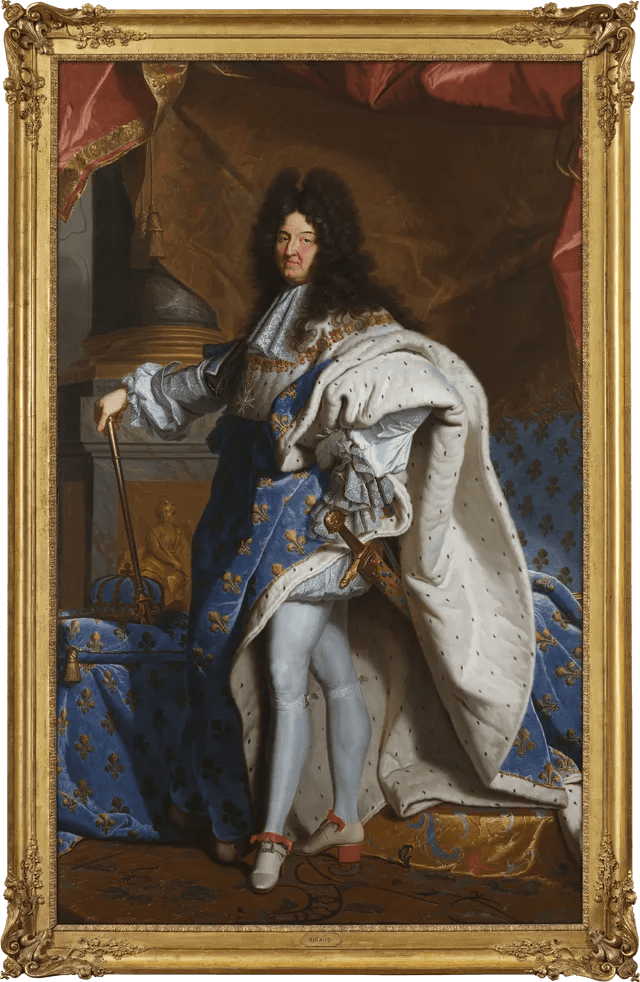
Louis XIV, the Sun King–but those tights! That wig! Those shoes! More like La Reine Soleil, am I right?
I also always used to deplore the fact that men’s clothes gradually became so incredibly boring from the heydays of Beau Brummel-type male fashion icons. Look at the above painting of Louis XIV. Now imagine a man wearing that outfit to an awards show or a film premiere. Even our own Founding Fathers wore tights, powder, wigs, and heeled shoes.
But somehow, those clothing items became feminized and gender swapped–of course, women in the past also wore heeled shoes, wigs, powder and tights beneath their skirts and bustles and hoops. But even in the 1930’s and 1940’s, men’s clothes were far more stylish–trench-coats and linen pants, fedoras and other hats, spats and Oxford shoes, argyle socks. I hated the “traditional” styles of dress for men that developed in the post-war period. and the utter rejection of those same styles in the 60s and 70s. Men’s clothing began to evolve a bit more during this period–and some serious fashion faux-pas were prevalent during the last decades of the century.
As I said the other day (and as so many others have pointed out), men have always dressed as women for one reason or another that had nothing to do with gender expression or identity for years. The Sun King’s gay younger brother (he also had a gay bastard son by Louise de la Valliere; homosexuality was rampant at the Sun King’s court) Philippe duc d’Orleans (whose son was the namesake for New Orleans) had many male lovers and often dressed as a woman for appearances at court. I’ve always wanted to write about Philippe, who has always fascinated me–the young gay bastard son of Louis XIV, who died young, was Louis duc de Valentinois; I’ve also had some minor interest in writing about him as well, or just gay life at Versailles in general.
There is a long-standing drag tradition in New Orleans as well. The Red Dress Run, for example, may not be full drag as we know it, but it’s essentially all about men in red dresses for charity.
One of the things I really enjoy about the modern young generation is they don’t subscribe to the antiquated rules of fashion for men and women. I love seeing young actors and celebrities showing up at red carpet events in daring outfits instead of that tired old tux look. Yes, men look dashing in tuxedos; I’ve always wanted to go full tuxedo with hat, cane, tails and gloves–but again, not the ordinary or expected.
I wore a kilt twice when I went to the Edgars, and wore it again at Bouchercon in Albany for our Real Housewives of Bouchercon panel. I loved wearing it–skirts are sooooo much more comfortable than pants–and it was definitely a fashion risk; people who didn’t know me but saw me wearing it undoubtedly thought ah, that one must be gay. I love the way the Musketeers dressed in The Three Musketeers–I think the seventeenth century was probably my favorite era for men’s clothes; I also love a pirate look from the early eighteenth as well.
One thing I definitely need to explore more with Jem is not only his sense of fashion for his clients, but for himself–both in and out of drag. Those are critical decisions for a queen–because while a particular look or style for a queen can evolve over the years, it’s very unusual for them to do something radically different than their usual; again, it probably has to do with ease more than anything else; it’s much easier to fall back on a regular look and color palette than to reinvent yourself every time or to come up with something new every time. I do think I am going to have Jem do the Madonna constant reinvention thing–mainly because it’s more interesting that way for me–because it is part of who he is as a person; Jem thinks he’s boring but he’s actually quite adventurous. Jem has very little confidence in Death Drop, which is easy for me to write because I know how that feels. One of the goals of the series is to show him develop self-confidence and self-assurance and becoming more comfortable with himself, and part of that is going to come from performing in drag and another part from actually solving crimes…which makes him start believing in himself more.
And that is always fun to write–character growth and development.
I have really come to love Bouchercon, and it’s always a highlight of my year.
Things have seriously changed for the better.
Queer Crime Writers after a dinner out in San Diego, with Marco’s lovely husband Mark Gutkowski
Bouchercon last week was a marvelous, marvelous experience. I had such an amazing time, saw some people I’ve not seen in quite some time (and quickly remembered why I love them so much), and stayed up way later every night than I should have–one of my many neuroses is FOMO, of course; I still regret not going to Dallas in 2019–but I laughed a lot, had some great panels, and made some new friends, too. I ate great meals, had some marvelous cocktails, and I really liked the hotel (once I figured out the shortcuts to the meeting spaces). It also made me think about my own history with the event, how things have changed for the better, and how I hope it keeps changing for the better. There were so few of us queer writers who used to go back in the day; now we have enough of us to have a happy hour where we get together and drink and chat about writing and the business and oh, how we all laugh. It’s wonderful.
When I first got started in this business, publishing was different. I had to explain this recently to someone I am hiring to do the ebook for Jackson Square Jazz for me; why I didn’t have a pdf file, because back then there were no ebooks and you got your page proofs in the mail, as well as your marked up manuscript for the editing process. So all I have on hand is the unedited version of the book I turned in. But what also was nice back then was there was a support system for queer writers that we no longer have–there were queer newspapers, queer magazines, and queer bookstores. We had a queer book of the month club–Insightoutbooks–and their influence in shaping and developing my career cannot be underestimated. After Hurricane Katrina and the six months spent touring for Mardi Gras Mambo, I kind of withdrew back into myself. I don’t remember much of 2006-2008, to be perfectly honest; I just know that I went back to work full time in 2008 and after adjusting my writing/editing schedule to that, it was around 2009 or 2010 that I resurfaced and started thinking about promotion and marketing again.
And what I found was that during those lost years (I call it the Hibernation) everything had changed. The queer newspapers and bookstores were mostly gone. ISO shut down. And I realized, with a sinking heart, that I was going to have to start going to mainstream conferences to promote myself. After working so hard in the mid to late 1990’s ensuring I could exist in almost entirely queer or queer-friendly places, I found myself having to essentially start over. Queer writers never mattered to the mainstream crime organizations and conferences, and I braced myself, knowing I was going to encounter homophobia yet again.
It didn’t take very long–although in retrospect, I’m actually surprised it took as long as it did.
I joined Mystery Writers of America, and later, Sisters in Crime. I also went to Bouchercon in Indianapolis and San Francisco. I didn’t know more than a handful of people and tended to glom onto the people I did know (sorry about that, guys; social interactions at events where I don’t know anyone ramps up my anxiety, so I glom onto the people I know). Indianapolis I wasn’t in the host hotel, I was across the street–and it was cold. It was the weekend of the Ohio State-Purdue game, I can remember that because my hotel was full of OSU fans, so I found myself mostly hanging out in my hotel room and reading, while braving the cold to go across the street for my panels and events. It was nice, and decided to go to San Francisco for it the next year. There I was in the host hotel and realized oh you really need to stay in the host hotel in the future, because it made everything easier. I was starstruck most of that weekend–I rode in the elevator with S. J. Rozan once and another time with Laurie R. King, which was incredible. I only had one panel, at 4 pm on Friday afternoon that no one came to, but I had a really good time—and even decided to put together a bid to host it in New Orleans (and that is a whole other story), before yet another person decided that it was time for a Bouchercon programmer to put the fag back in his place, letting me know that I and my books weren’t important enough (the exact wording was “surely you have to understand that someone who’s edited a couple of anthologies doesn’t really deserve to be on panels”–despite the fact that my tenth novel had just been released…and of course, the greatest irony of this was that I went on to edit three of their anthologies) to grace any panel, and that any panel I’d been given in the previous two years should be considered a gift.
Should be considered a gift.
A fucking GIFT.
(For the record, Paul is an event planner by trade. He is executive director of both the Tennessee Williams/New Orleans Literary Festival as well as Saints & Sinner, a queer litfest. Just to be certain I wasn’t overreacting and being a diva-bitch, I let him read the email. His response? “If one of my staff, interns or volunteers wrote an email like that to an attending author I would fire them on the spot.” And before anyone starts up with the “programming a Bouchercon is hard” I will remind you that Margery Flax and I wrote over one half of the program for Dallas in three fucking days and contacted everyone with their assignments and then reorganized and redid the program to accommodate schedules and wrong panel assignments for about two weeks before it was done–with the local chair constantly throwing things at us that made us start pulling threads and weaving it back together again….nothing like “oh, sorry, I forgot that I promised these people a panel for this” after you’ve redone it for the fourth time. That happened a lot. And the entire time, we were incredibly polite and friendly and did whatever we could to accommodate people; apologizing and fixing it repeatedly. NOT ONE PERSON RECEIVED A FUCKING EMAIL TELLING THEM TO CONSIDER ANY PANEL THEY GOT AS A GIFT.
But then, I’m not an unprofessional piece of shit whose pathetic ego sees programming as power to abuse, either.
I wasn’t saying (and was very respectful) oh I am such a big deal how could you not give me an assignment, all I asked was hey, I know how hard your job is, but I don’t understand how you get on a panel and what can I do differently in the future to get one? What am I doing wrong? I approached them with kindness and respect for the work they were doing and got bitch-slapped, demeaned, and insulted in response. No author who is paying their own way to a conference and essentially providing the event with free entertainment for its audience should ever be treated so contemptuously by event organizers, period. The fact that when I expressed these concerns to the national board all I got back was mealy-mouthed excuses and “we’re sorry you’re offended” told me everything I needed to know about the organization and its board; the way they were treating me about the New Orleans bid (I had planned on having Susan Larsen–former chair of the National Books Critic Circle, chair of the Pulitzer Prize for fiction twice, long time programmer for the TW Fest and a nationally respected book reviewer–help out along with Pat Brady, long time publications chair of the Historic New Orleans Collection, huge mystery fan, and also a long time programmer for TWFest only to be told their vast knowledge and experience wasn’t “good enough” and I needed to get the homophobic trash who told me I was nothing to program New Orleans–yeah, like that was ever going to happen) was also egregiously horrible, condescending, insulting, and unprofessional.
Needless to say I cancelled my trip to St. Louis and never considered attending Cleveland; I tend to not go where I am not welcome. I am not taking my hard-earned money from my “nothing career” and giving it to a homophobic organization, where I then get to beg for scraps and get treated like shit. I have better ways to spend my money, thank you. (And yes, I know who the programmers were and yes, I will carry that grudge to the grave.)
I withdrew my bid to host for New Orleans, and I washed my hands of the mainstream mystery community. Who needs it? They were never going to accept me or my work, they were never going to read my work, they didn’t give a shit about me, and it was pretty clear they never would. I was kind of at sea for a few years, there. There were no more queer newspapers, no more queer bookstores, no more gay Insightoutbooks.com book club, nothing. Outside of the TWFest and Saints & Sinners, I had no conference outlets to promote myself and my work. The mainstream mystery world clearly wanted no part of me, so what was I supposed to do? So, I just kept writing. I operated my social media pages as a promotional outlet for my work, and I kept writing this blog. I did finally return to Bouchercon when it went to Albany; friends convinced me to go, and one powerful friend requested me for a panel she assembled–and it came through. Having friends made a huge difference, really, and through my friends I met and made more friends, and Bouchercon slowly became a must-go event for me every year…eventually reaching the point where I never had to be concerned about getting on a panel, while at the same time no longer caring whether I did or not. It became more about seeing my friends and being around other writers than a work/promotional thing for me. Ironically, once I no longer cared or worried so much about being on things…I started getting put on more and more things, with bigger and increasingly more important co-panelists (I still can’t get over the fact that I was on a panel with ATTICA LOCKE in Minneapolis. I was too nervous to say anything to her; I spent that entire panel looking at my co-panelists and listening to them speak and wondering why the fuck I was on that panel).
And now, of course, we have a group: the Queer Crime Writers, and a core group of us have been showing up together at conferences ever since we bonded at Left Coast last year (and bonded even more with more of us at Bouchercon Minneapolis last year): John Copenhaver, Marco Carocari, Kelly J. Ford, and Robyn Gigl–who’ve all become very dear to me over the last year or so. Teresa Cain/Carsen Taite joined us in San Diego, and became my con-wife; what a great time we had!
And somehow, I am getting nominated for mainstream awards, an outcome I could have never predicted. I won the Anthony for Best Anthology for editing Blood on the Bayou, and was nominated for Best Short Story at the Dallas event for “Cold Beer No Flies” (I lost to S. A. Cosby, no disgrace there). Last year Bury Me in Shadows was nominated for Best Paperback Original (losing to Jess Lourey) and Best Children’s/Young Adult (losing to Alan Orloff); neither of those losses were devastating because Jess and Alan are also friends of mine, and I couldn’t have been happier for them both. This year I had three nominations in three categories for three different books–Best Anthology for Land of 10000 Thrills (losing to S. J. Rozan for MWA’s Crime Hits Home); Best Children’s/Young Adult (losing to Nancy Springer for the latest Enola Holmes, hello, no disgrace there); and Best Humorous for A Streetcar Named Murder (losing to Catriona McPherson for Scot in a Trap)–again, with the exception of Springer, I lost to very talented friends I like very much (I’ve not met Springer). That’s seven Anthony nominations in total, to go along with the Macavity, the Agatha, the Lefty, and the Shirley Jackson nominations. Not bad for a queer writer, wouldn’t you say? Ten mainstream award nominations? I certainly never would have dreamed all those years ago when I was told “any panel you get should be considered a gift” by Bouchercon programming.
That doesn’t mean the community is free from homophobia; it’s still there. I have mentioned before the mainstream cisgender male author who is clearly afraid to acknowledge my existence and always beats a hasty retreat whenever I walk up; I find his homophobia amusing. You’re not hurting me, bro, because I don’t want to know you, either. It doesn’t mean that I can’t be sitting in a booth in the hotel bar with a bunch of friends only to have a straight man look at me, smirk and say “faggy” in a sentence, as though daring me to call his ass out because he’s so much more important than I am; no worries, asshole, I don’t even have to repeat the story to anyone because since then you’ve shown all the big names you’re buddies with that you’re actually a piece of shit, and yes, I’ve watched it all with the same fucking smirk you had on your face when you thought you’d pull out your micro-penis and slap it down on the booth table in Toronto, and when I hear stories about you, I am delighted to pull out “Well, I’ve known he was trash since he said faggy in front of me, looking me in the face and smirking as he said it”.
Assholes will always out themselves, at least in my experience–and I’m very patient. I store the receipts and pull them out to corroborate horrific behavior when the timing is right.
I’ll save the racism, sexual harassment, and homophobia I faced in Albuquerque at Left Coast for another time.
I’m very pleased with the progress that has been made in our community over the last five or six years–I mean, the Rainbow Diversity panel about queer crime writing in Toronto was packed, when such panels in the past only drew maybe four or five audience members. Codes of conduct have been implemented to protect attendees from sexual harassment and pervy conduct, as well as racism and homophobia.
Progress is often slow, and it is easy to get impatient. I don’t know if my involvement with Bouchercon has made things better for queer writers there, but I do know the award nominations show other queer writers that such things are possible for them. Nothing says you’re welcome here than seeing members of your community nominated for the awards. The more of us that attend also means that more of us will get nominated, be on panels, and be able to talk about our work to readers who might open their minds and read our books. Being visible at these events is crucial and important.
And like water wearing down a stone, we have to keep relentlessly pushing.
(John, Marco, Kelly, and Rob Osler have all been nominated for mainstream awards over the last year, along with me. Edwin Hill and PJ Vernon have also been recognized for their brilliant work, too. This is so wonderful to see–I’d be delighted even if I weren’t with them in this grouping. And if you’ve not read any of us, there’s not a single person I’ve mentioned by name you can go wrong with. It’s also exciting seeing the new queer talent rising in writers like Margot Douaihy.)
I was torn about going to Nashville next year; their anti-trans and anti-queer laws have me not really wanting to spend my queer money there. But the point was made that going and being very present was an act of defiance…and Lord knows I love defying homophobes, so I guess I am probably going to go. I can visit Dad either before or after, so it actually makes sense for me to go. I’ve decided to write a very gay story to submit to their anthology (which means I need to get back to work on it), and so yeah…I think defiance is the way to go.
Plus….I love my Queer Crime Writers. I can’t imagine not being around them next year, and I would absolutely go nuts from FOMO.
So, in closing, thank you, Queer Crime Writers. I love you all, and thank you for letting me into your group. Let’s keep making a difference, shall we?

 Queer and Loathing in America