A month or so ago, Ira Levin’s A Kiss Before Dying was one of those “special deals for ebooks,” and I can never pass up a classic for a mere $1.99 (I generally replace my hard copy books with ebooks when they are on sale, so I can donate the real book; but Ira Levin novels will never be donated), which put me in mind of him again (the book is a crime fiction classic), and I started thinking about what is the best part of two of my favorites by him, Rosemary’s Baby and The Stepford Wives, which is the slow build of paranoia until the heroines are completely convinced that everyone is in on it and there’s no one she can trust. This is what I consider “women’s noir,” which is books that depict and explore women’s fears (which is why Gothics were so popular, I think; the wife can never trust the husband and always thinks he is trying to kill her–before the real culprit is exposed and they have their happily ever after. This, to me, mimics what it’s like for a woman when she gets married in real life; she wants to believe in her marriage and love, but how many times has that turned to ashes and dust in reality? Husbands kill wives or cheat on them or leave them; all these marriage fears were tentpoles of Gothics). I was going to revisit both novels–I had some other things I wanted to talk about with The Stepford Wives, and its similarities to Rosemary’s Baby, but I couldn’t find my copy of the latter so went with the former.
Since 2015, the term “gaslighting” has come back into vogue, with small wonder. Gaslighting can make you question your own judgment and your grasp on reality1; something many of us have experienced over the past nearly ten years and it isn’t an enjoyable experience.
Paranoia, combined with not being believed, makes for a fantastic novel that is very difficult to pull off; I can think of any number of films and books that use paranoia as a driving theme for their plots, and I always enjoy them. There really is nothing more frustrating than being being not believed about something that’s happened–or is happening–to you. It can make you crazy, make you question yourself and your own grasp of reality. It’s horrible and cruel in reality, and it’s something everyone can relate to because we have all not been believed at some point in our lives. It’s happened to me enough times (including losing jobs) that it certainly resonates with me. (I have an idea for a gaslighting/paranoia short story that I’ve been wanting to write for some time now.)
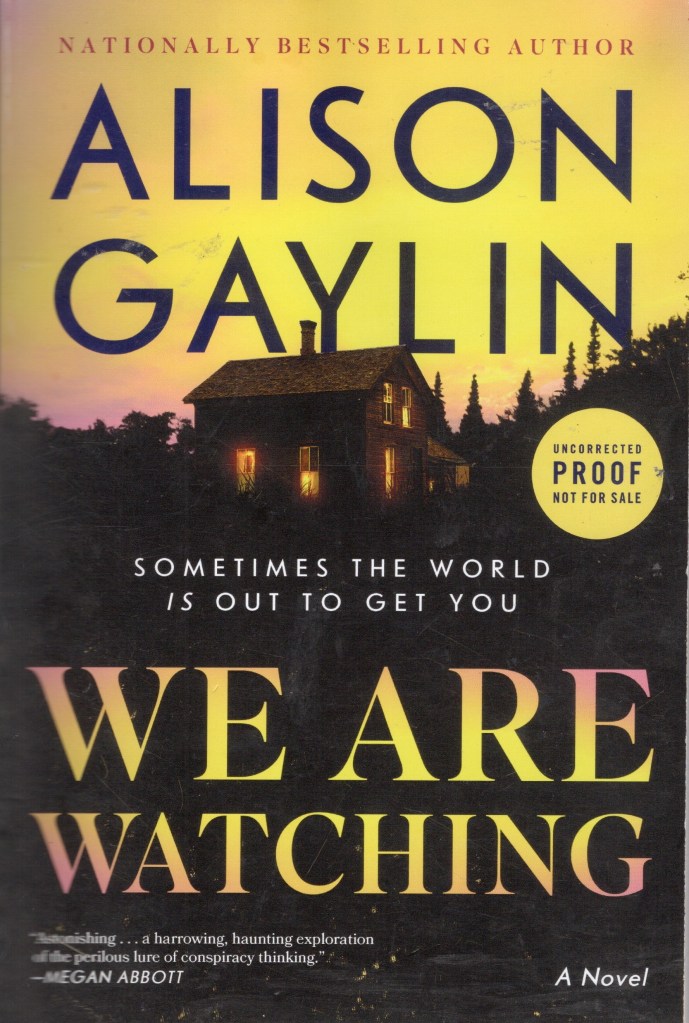
So, needless to say, I greatly enjoyed reading my advance copy of Alison Gaylin’s upcoming January release, We Are Watching.
It’s been the longest day of Meg Russo’s life, and it isn’t even half over. Her stomach gnaws at her, her hands heavy on the steering wheel. But when she glances at the clock on the dashboard, she sees that it’s a little shy of 11:30 a.m., which means that Meg, her husband, Justin, and their daugheter, Lily, have only been on the road for an hour. They’ve got at least three more hours on the thruway, and then they’ll have to contend with the series of veinlike country roads Meg and Justin haven’t traversed since their own college days. If they don’t hit too much traffic, they should be in Ithaca by five, which now feels like some point in a future so distant, Meg is incapable of envisioning it.
Time is strange that, the past eighteen years zooming by in an instant, all of it leading up to a single day that’s already lasted eons. Meg blames the stress of last night, wanting everything to be perfect for their daughter’s send-off, which led to thoughts of Lily’s first visit home for Thanksgiving break, which in turn made Meg think for the millionth time about how cold their house gets in the fall, and how Lily always complains about it. New windows, Meg had thought, lying in bed with her eyes open, envisioning insulated windows to replace those paper-thin sheets of glass, the same windows that were here when she and Justin bought the place twenty years ago–and it was a fixer-upper then. What if Lily came home to new windows? Meg mused, still awake in the wee hours of the morning. Will she have changed by then? Will she have grown too sophisticated to get excited over a warmer house? And so on, until the sky was pink and it was time to wake up and Meg had barely slept at all.
I’ve enjoyed Alison Gaylin’s work since I first read And She Was back in 2012, and have been a fan ever since, gobbling up each new book as she releases them. She has always been a terrific novelist, but what has been amazing to watch is how she pushes herself to do better with each book, tackling bigger themes and creating believable, relatable characters you can’t help but want to root for. We Are Watching may be her best yet, starting as a slow burn but building into an adrenaline boosting rollercoaster of a thriller.
The book opens with Meg and Justin taking their daughter Lily off to college, with all the emotions and fears and sense of loss that comes with a child leaving home and starting to move into their adulthood. Meg is likable, and so is her family. But as they drive a carload of skinheads pulls up alongside of them and start taking pictures. Meg reacts very strongly–so strongly that even I was like take a chill pill, girl!–which eventually leads to a crash that kills Justin, leaving the two women shattered shells of their previous selves. Lily decides to take time off from college and even Meg becomes housebound, despite needing to run her book store in the small Hudson Valley town they live in.
But things slowly begin closing in on both Meg and Lily; who were those skinheads in the other car? Why are truly strange, cult-like people showing up in the store or in town, chanting weird things at them? As Meg’s paranoia and fear grows, it soon becomes apparent that a religious cult is targeting her and her family, but why? But to find the truth, Meg has to not only survive the cult, which seems determined to kill her and her child, but when she has the time, to dig back into her own past to discover the truth–because the truth is the only thing that can set them free.
This book is fantastic, and I couldn’t put it down. It has all the hallmarks of a great Gaylin novel–a compelling and relatable main character doing the best she can in a terrible situation; a twisty plot full of surprises; and the kind of strong writing that makes her sentences and paragraphs sing.
Preorder it now and thank me in January when you finish reading it.
- The film this term comes from, Gaslight, is a great movie and Ingrid Bergman is terrific as the wife who isn’t sure if she is losing her mind; she deserved her Oscar and the film still holds up–and a very young Angela Lansbury makes her screen debut in it. ↩︎




 Queer and Loathing in America