Thursday morning and here we are, with a mere two more days before we can call it the weekend again. I’m not really sure why I am looking so forward to it; I just have to write and clean and do shit all weekend. Yay? But I guess it’s lovely because I am on my own schedule, I suppose?
I didn’t sleep for shit last night, which was highly annoying. Also, convenient because I forgot to set my alarm. Fortunately, my eyes opened at promptly six this morning. Huzzah?
So, overnight my HBO app on my Apple TV magically converted to an HBO MAX app, and I got lost in there for hours last night, just exploring all the options. I doubt I’ll ever watch the eight or nine Harry Potter movies ever again, but they are there, along with all kinds of over things. Scooby Doo Where Are You in its original two series is there–I watched one last night, delighted, before making dinner–and of course TCM is there, and there are so many classic films I’ve either not seen, or haven’t seen in a very long time. One of my all time favorites, Body Heat, is also there; I can’t wait to rewatch, as I’ve been wanting to rewatch it for quite some time. Also a lot of classic Hitchcock films, many of which I’ve never seen, including North by Northwest and several others. Essentially, with HBO MAX, combined with Hulu and Netflix and Prime and Disney Plus, I really don’t think I ever will have an excuse to be bored ever again, as there’s always something I can watch on one of those streaming services. There’s also some very good classic Hollywood, thank to TCM (Mildred Pierce, Laura, Bringing Up Baby, etc.). In other words, I am quite pleased.
Alas, that will undoubtedly cut into my reading and writing time–but better that than Youtube black holes, right?
Larry Kramer died yesterday, and I thought, “you know, I’ve been meaning to reread Faggots for a really long time and perhaps this is the time to do so, as a tribute to Larry and everything he did for us all.” As I took the book from the stack, I also realized this meant pushing Night Has a Thousand Eyes back into the pile, and this was probably the kind of thing that has happened with far too great a frequency and why I’ve never gotten back to reading the Woolrich, so I decided to go ahead and read the Woolrich and then I’ll get back to the Kramer. Faggots was one of the first “gay” books I read after coming out officially (I had read Gordon Merrick and The Front Runner and The Swimming-Pool Library while in the closet. Faggots was recommended to me when I walked into my first gay bookstore, Tomes and Treasures, in Tampa in the early nineties; the incredibly sexy bookseller–on whom I had a major crush–told me I should read it and Dancer from the Dance, so I bought both and read them) and I sometimes joke that “it almost pushed me back into the closet.” The gay sexuality was so in in-your-face, and all the kinks and other variations depicted within the covers of that book–plus the clear misery and unhappiness of the main character, Fred Lemish–kind of was shocking to someone as naïve as I was when I first came out.
This also made me think about my life in those years prior to my thirty-third, which was when I stopped passively floating through my life and tried to take control of it–to start actively living instead of passively letting my life happen to me. I rarely talk about, or even think much about, my life between moving to the suburbs when I was ten and my thirty-third birthday; primarily because my existence was so completely miserable and tragic and pitiful. There was the duality of living as both a closet case in my more regular day-to-day life (and fooling no one, as I was quick to find out later), plus my hidden, furtive life on the edges of gay world. It’s difficult for me to look back at that twenty-three years and not wince or recoil in embarrassment at what a miserable life I was leading, and how desperately unhappy I was all the time. But that time was necessary, because it was also that same period where I was starting to recognize, and learn, that almost everything I was raised to believe was not just a lie but a horrible one. Unlearning those decidedly terrible values and lessons is an ongoing process to this very day, but it’s also terribly important and necessary to shed all that conditioning in American exceptionalism, evangelical Christianity with its bizarre morality and cognitive dissonance, and the true American legacy of white supremacy. As I thought about this last night–we watched the first episode of CNN’s docuseries The Movies on HBO MAX last night, and I was remembering, not only the unhappy first more-than-half of my life, but started unpacking the rest as well.
And it will inevitably show up in my writing at some point.
ANd now back to the spice mines. Have a lovely Thursday, Constant Reader.
That’s one lovely thing about three day weekends; inevitably it also means a shorter work week at least once. I know, I am simply doing nothing more than wishing my life away; but so be it. I don’t really mind the day job, really; I just wish I had maybe another hour or two free to write every day. Somedays I don’t write at all; some days I write over three thousand words; some days, like yesterday, I only manage six or seven hundred, and I basically was sweating blood to get those done. The three thousand I did on Monday? In the blink of an eye, without even putting any real conscious thought into it; I simply opened the document, knew where the story needed to go, went back to the beginning and corrected and deleted and rewrote and by the time I got to where I’d left off I was in a groove and I had not only managed to correct and revise about 1200 words, I was able to add 3700 to them. I only need one more chapter, and I honestly do think if I go back over the first two again, I can break it down into three, and revise it again to get them to a fairly proper length. Since the painful six or seven hundred words today were an attempt at a third chapter…well, I’ll just take a look at that document tomorrow, hope that I have more energy, and maybe I can have the same writer’s luck I had on Monday.
I’ve pretty much decided to read Cornell Woolrich’s Night Has a Thousand Eyes next; I can’t think why I didn’t pick it back up once I was done with prepping for moderating that panel, whenever and wherever it was. I think I forgot what I had read–I have a vague memory of it being about a man walking home alone late at night in Manhattan along the river, near a park of some sort, and he starts noticing debris on the path–personal belongings, like things that may have fallen out of a purse. He eventually catches up to the woman whose things they are; I vaguely think that she was on a bridge, or standing by a rail along the water or something, like she was going to jump; instead she starts telling him this strange story–which I don’t remember; I don’t know if I didn’t read that part–I think I may have started; I seem to recall her father, an airplane crash, and a prediction that his plane would crash–but I can’t remember anything else. I do remember that the opening section I was reading was very well done–just as his short story “It Had to Be Murder” was very well done and clever. I think I may embark on a Woolrich Project next, in fact.
I was also thinking I should probably reread Joseph Hanson.
Today’s pay day, and most of the bills aren’t due until next week; so I am thinking I may just wait to pay them until say, the weekend, and bask in the false sensation of having money in the bank for a few days. It’s such a lovely feeling, really, even if it’s entirely false.
We continue to watch White Lines every night; it’s really quite a bizarrely entertaining show. One of the things I’ve noticed about Spanish productions (or co-productions, as in this case) is that when it comes to drama, there’s no limits for the writers. For example, White Lines also features, in one of the warring Spanish/Ibiza Mafia families, an extremely twisted mother-son relationship that is physically inappropriate on every level–but never quite crosses over into full-on mother/son incest. The funniest thing about White Lines is the primary story–in which Zoey has come to Ibiza to find out what happened to her d.j. brother Axel twenty years earlier after his dead body turns up–is the least interesting part of the show. If you simply took Zoey out of the show entirely, you could still do the murder mystery about Axel’s murder (he was fucking both mother and daughter in the bizarrely incestuous Spanish mafia Calafat family, as we discovered last night) and you’d eradicate the least interesting part of the show. Zoey makes no sense whatsover; she had a complete mental breakdown when Axel disappeared, wound up in therapy and institutions for a while, married one of her therapists and has a daughter–she has abandoned both husband and daughter to go to Ibiza to solve this mystery…and is having an affair with the head of security for the Calafats (his name is Boxer and I don’t blame her for this in the least), has gotten involved in a cocaine cover-up and a couple of murders…her motivation doesn’t really make any sense, and she can’t seem to make up her mind whether she wants to salvage the marriage her behavior is slowly disintegrating or embrace the party-hearty freedom of life in Ibiza. Unless there’s a big twist coming, she exists solely so this show is bilingual; partly in English and partly in Spanish.
And apparently, my HBO app today is going to transform into HBO MAX today. I am curious to see what difference that may make. More shows to stream! As it is, I often forget about Amazon Prime–and frankly, their streaming service isn’t the best; primarily because a single show will have each season have its own link, rather than having sub-links per season under a single link for the entire show–probably has to do with some of the stuff needing to be rented or purchased, I suppose, but still annoying.
And on that note, tis back to the spice mines and back to work. Have a lovely Wednesday, everyone!
A while back, I talked about how intimate living conditions in urban areas are, and how we all like to pretend that we do live in privacy. I was talking about my story “The Carriage House,” which was published in Mystery Tribune, but it really does apply to many other stories. One of the (ridiculously many) stories I have in progress now (“Condos for Sale or Rent”) is one of those stories; it’s also a quarantine story, which makes it even more claustrophobic–and of course, the ultimate urban lack of privacy crime story has to be Hitchcock’s film Rear Window, which also touches on the voyeuristic impulses so many of us have (to a lesser degree, that’s what Raymond Carver’s short story “Neighbors” is about as well). I wrote my own version of Rear Window years ago as an erotic short story called “Wrought Iron Lace”; which is a great title that I wish I’d saved for something more mainstream.
So, recently when I was looking into Cornell Woolrich, imagine my surprise to realize he had written the short story which the film was based on. WHo knew?
I read it yesterday, and it’s called “It Had to Be Murder.”
I didn’t know their names. I’d never heard their voices. I didn’t even know them by sight, strictly speaking, for their faces were too small to fill in with identifiable features at that distance. Yet I could have constructed a timetable of their comings and goings, their daily habits and activities. They were the rear-window dwellers around me.
Sure, I suppose it was a little bit like prying, could even have been mistaken for the fevered concentration of a Peeping Tom. That wasn’t my fault, that wasn’t the idea. The idea was, my movements were strictly limited just around this time. I could get from the window to the bed, and from the bed to the window, and that was all. The bay window was about the best feature my rear bedroom had in the warm weather. It was unscreened, so I had to sit with the light out or I would have had every insect in the vicinity in on me. I couldn’t sleep, because I was used to getting plenty of exercise. I’d never acquired the habit of reading books to ward off boredom, so I hadn’t that to turn to. Well, what should I do, sit there with my eyes tightly shuttered?
Just to pick a few at random: Straight over, and the windows square, there was a young jitter-couple, kids in their teens, only just married. It would have killed them to stay home one night. They were always in such a hurry to go, wherever it was they went, they never remembered to turn out the lights. I don’t think it missed once in all the time I was watching. But they never forgot altogether, either. I was to learn to call this delayed action, as you will see. He’d always come skittering madly back in about five minutes, probably from all the way down in the street, and rush around killing the switches. Then fall over something in the dark on his way out. They gave me an inward chuckle, those two.
The next house down, the windows already narrowed a little with perspective. There was a certain light in that one that always went out each night too. Something about it, it used to make me a little sad. There was a woman living there with her child, a young widow I suppose. I’d see her put the child to bed, and then bend over and kiss her in a wistful sort of way. She’d shade the light off her and sit there painting her eyes and mouth. Then she’d go out. She’d never come back till the night was nearly spent—
Once I was still up, and I looked and she was sitting there motionless with her head buried in her arms. Something about it, it used to make me a little sad.
The third one down no longer offered any insight, the windows were just slits like in a medieval battlement, due to foreshortening. That brings us around to the one on the end. In that one, frontal vision came back full-depth again, since it stood at right angles to the rest, my own included, sealing up the inner hollow all these houses backed on. I could see into it, from the rounded projection of my bay window, as freely as into a doll house with its rear wall sliced away. And scaled down to about the same size.
Woolrich was gay, lived with his mother for much of his life, and was an alcoholic–but he was a fantastic writer. “It Had to Be Murder” is a terrific story, absolutely terrific–and while many of the things from the movie (particularly the Grace Kelly character) are not in the story, it’s suspenseful and scary at the same time.
I highly recommend it, and can’t wait to read more of his work.
I’ve always wanted to go to London, and hopefully, one day before I die I’ll be in that former capitol of world empire; visit the Egyptian exhibit at the British Museum; see the jewels in the Tower of London and the spot where Anne Boleyn died; stand at the side of the Thames and acknowledge all the history that sailed from its banks. I do love me some history, after all, and after I’d become incredibly familiar with American history I moved on to English, and eventually European (primarily French, to be honest); it was the time that PBS was airing first The Six Wives of Henry VIII, with Keith Michell, and later Elizabeth R with Glenda Jackson (who is whom I always picture when I think about Elizabeth I, with due apologies to both Bette Davis and Cate Blanchett); plus, the establishment of the Atlantic coastal colonies was directly, obviously, tied to English history. I read about the Wars of the Roses and the family split that led to them in Thomas B. Costain’s The Last Plantagenets, bought at a flea market for a dime; I eventually read his entire “Pageant of England” series: The Conquering Family, The Magnificent Century, and The Three Edwards; The Last Plantagenets was the final volume of that series (Costain also wrote terrific historical fiction, which I ate up with a spoon), and thus, Costain is responsible for my fascination with two of the most interesting women in English history–Eleanor of Aquitaine (total badass) and Isabella, aka the She-wolf of France; she who overthrew and murdered her husband Edward II, with the help of her lover…only to eventually have her lover murdered by her son’s adherents and wind up banished to Castle Rising for the rest of her life.
Someday, London. I know you’re waiting for me over there to come.
Yesterday was a good day as far as work was concerned; I managed to write almost three thousand words on the Secret Project (maybe even more, since i also revised the first chapter) and I’m feeling a lot more confident about it. I knew I would, once I dove back into work on it, but just wish I hadn’t pushed it off for so long; I could be done with it by now if I’d not wasted so much time, which is highly annoying, but also kind of par for the course, really.
But…there it is, you know? Why waste time with regrets?
White Lines continues to entertain us highly; I swear, people, if you’re not watching shows from Netflix Spain, you are missing out on some seriously bonkers drama. First Toy Boy, now this? A crime drama set on Ibiza, with feuding club families, cocaine and Ecstasy everywhere, and murder? I’m telling you, it’s like Jackie Collins and Sidney Sheldon got together and created a show–and it’s oddly compelling, for all of that (as was Toy Boy).
Tuesday and a short week staring us all down. I already feel off; as though my hard-won equilibrium has been stripped away somehow and I’m not even remotely sure where I am at and what I need to do.
When I was a kid both of my parents worked, so my sister and I were latch-key kids before it was cool. In the mornings on her way to the bus stop my mom would drop my sister and I off at the home of an older Polish lady down the street, who would feed us breakfast and send us off to walk to block or so to school from her house. Eli Whitney Elementary School didn’t have a cafeteria nor did it provide lunches for the students, so everyone had an hour to walk home to get lunch and come back. We went to our babysitter’s, and she would feed us. She’d had like six or seven kids of her own, and the youngest was a senior in high school when we first started being watched by her; I guess she liked having kids around. Anyway, in the summer time we would spend the days with her–she watched General Hospital, One Life to Live, and Dark Shadows–and sometimes she would go to Goldblatt’s, a department store that seemed a million miles away to us as kids, and do her shopping. Whenever she went–and sometimes we went with our mom–Mom would give my sister and I a couple of bucks to spend. The real treasure of Goldblatt’s was the bargain basement, where they remaindered stuff, and there was always this enormous table filled with books for kids, marked down to 39 cents.
It was on this table that I discovered some of the lesser Grosset & Dunlap series for kids, and particularly the Ken Holt, Biff Brewster, and Rick Brant series (they also had copies of the Chip Hilton sports stories by Clair Bee; I would buy one or two of those because my parents were trying to make me more boyish than I was, and it always pleased them when I showed an interest in something more masculine than usual). I remember the very first two Ken Holts I bought off that table: The Secret of Skeleton Island and The Mystery of the Plumed Serpent. (I would also get The Rocket’s Shadow and The Egyptian Cat Mystery in the Rick Brant series, as well as the first three Biff Brewsters: Brazilian Gold Mine Mystery, The Mystery of the Chinese Ring, and Hawaiian Sea Hunt Mystery.)
And Ken Holt very rapidly became my favorite, above even the Hardy Boys and Nancy Drew.
The phone booth was hot and stuffy, and Ken Holt wiped the moisture off his forehead for the third time. He opened the door slightly to get some fresh air an just then the phone came alive.
“Here’s your party,” the operator intoned.
“Hello,” Ken said loudly. “Hello.”
“Global News,” came the answer. “Granger speaking.”
“This is Ken Holt, Mr. Granger. I’m out at school.”
“What’s up, Ken?” Granger asked. “Need some money?”
“It’s not that. I just wanted to know if my father had come in.”
“Your father?” There was a pause before Granger continued. “Why, kid? He’s not expected so far as the office knows. He’s still in France.”
“I got a letter from him last week saying he’d be in on the eighteenth and that he’d call me.I haven’t heard from him since. And today’s the twentieth.”
Some hundred miles of telephone carried Granger’s booming laugh from the busy offices of an international news agency to the quiet corridor of Galeton Preparatory School.
“That’s pretty good,” Granger said, after he had stopped laughing. “He’s only two days overdue and you’re worried. He‘s famous for that, son. We’ve lost track of him for weeks, but finally he’d let us know where he was or what he was doing. Forget it. He’ll turn up when he gets good and ready.”
Ken blinked a little to get the perspiration out of his eyes. He moved a little closer to the mouthpiece as if that would help Granger understand better.
“But you see, Mr. Granger, Dad wrote me that he’d be in on the eighteenth. He’s never missed a date with me.”
The Secret of Skeleton Island opens with Ken, as you can see, worried about his father, who’s two days overdue for a meeting–and Richard Holt, who tends to disappear or vanish while chasing a story, has never once in his life stood up Ken or been late without letting him know ahead of time–not an easy task, either, in times when operators had to place your phone calls for you and you either sent telegrams or wrote letters.
Having loved those first two Ken Holt novels I’d read, the next time I went to Goldblatt’s I got a few more: The Riddle of the Stone Elephant, The Clue of the Marked Claw, The Secret of Hangman’s Inn, and The Mystery of Gallows Cliff. But after that, they became much harder to find; we’d moved out to Bolingbrook by then, and they had already lapsed out of print (hence the Goldblatt’s sale table), and it took years for me to start collecting them again–in the wake of Katrina and my discovery of eBay. I still don’t have a complete set–and some of the copies I acquired were not in the best shape–and the ones I am missing are generally so rare that they command prices I am not willing to pay. But the quality of the series never let up, even in the later books–and the writing was always stellar.
Ken Holt also was responsible for me having a weird bonding moment with James Ellroy; during his Grand Master interview at the Edgar symposium, he mentioned reading the kids’ series when he was growing up, and preferring the Ken Holt over the rest–and asked, “Does anyone here remember the Ken Holt mysteries?” and I raised my hand, to which he replied something along the lines of, “Ah, only the gentleman right here in the sweater. You, sir, have excellent taste.” He also pointed at me with his index finger, cocked his thumb like he was pulling a trigger, and winked.
Strange, yes–but even with what little Ellroy I’ve read, I can actually see the influence. The Holt novels were pretty hard-boiled for kids’ books; and one of the things I loved about them (just like The Three Investigators) was that Ken actually solved the mysteries; and unlike the Hardy Boys, Ken and his best buddy Sandy frequently were involved in fisticuffs; threatened by criminals with guns or knives; and were often placed into incredibly dangerous situations where they literally had to, by use of their wits and whatever else might be handy, escape with their lives (there’s a particular scene in The Riddle of the Stone Elephant that has always stayed with me; they walked into a set up where the floor of an old shack collapsed beneath their weight, sending them plummeting down an old well; and they had to climb the slick walls of the well to get out; this scene, and its aftermath, had this weirdly homoerotic flavor to it that I remember to this day–and will inevitably write about it, I’m sure).
Shortly after this opening, Ken gets permission from the headmaster to head into New York and nose around his father’s apartment, to see if he can find out any clues to where his father is or what may have happened to him. As he waits at the train station (a six hour ride into the city; still not sure if he’s on Long Island or really far upstate, but my guess is, given speed and so forth, most likely Long Island) he is offered a ride by two men who purport to be from Global News; it isn’t until Ken is in the car with them that he realizes they are liars, and undoubtedly connected to whatever happened to his father–and they plan on using HIM as leverage against his dad. Ken has to figure out how to escape–and manages to do so near the town of Brentwood, running away and dodging into the only lighted building on the town’s main street, the offices of the Brentwood Advance, which is how he encounters the Allen family. He tells Pop, Bert and Sandy Allen–enormous beings with red hair, whom he convinces of the veracity of his story and they get on board with helping him. Sandy is his own age, and all the Allens:
Ken swung around quickly toward the direction of the new voice and saw two replicas of the man before him. They were much younger, one of them looked about Ken’s age, the second a bit older. They too were huge. There was no doubt in his mind that this trio was a father and two sons. Actually, the only difference between them was that the sons had flaming red hair and the father’s was beginning to gray.Ken almost felt like a pygmy surrounded by these three towering figures.
The Allens listen to his story, check it out, and believe hi–and the next morning he and Sandy go out to start looking into the case. The action comes fast and furious after this–there’s one particularly harrowing scene where the boys, captured by the bad guys, are duct-taped to chairs. Ken manages to break an alarm clock, and gripping a jagged edge of glass in his teeth, saws at the tape holding down one of Sandy’s arms (this feat is repeated in The Riddle of the Stone Elephant, only instead of a piece of glass he uses the jagged edges of a can lid, removed by an opener).
The adventure is pretty amazing; the boys wind up escaping the bad guys onto one of the freighters that the bad guys are using as part of their scheme, and find their way back to Skeleton Island, where the adventure also continues. So much action–and it’s all so well-written you feel like you’re a part of it, right there with Ken and Sandy as they basically use the combination of their wits and their brawn to get away and break the case wide open, rescuing Richard Holt and…in a lovely happy ending, it’s decided that Ken will finish his term at the boarding school and move in with the Allens.
It’s a great set-up for a series, and it’s mystifying to me that it never achieved the heights of popularity that the Hardy Boys did. Every one of the books is good–I can’t think of a single clunker in the entire series–and the typical masculinity based boys’ story (9-12 year olds aren’t, apparently, old enough to care about girls yet) sees neither Ken nor Sandy ever have a date or a girlfriend, or even anything remotely close to a romantic interest; in fact, the friendship bond between Ken and Sandy eventually grows so strong they are practically a couple–and that homoerotic undercurrent to the series (which, frankly, also existed in the Rick Brant series) was also an enormous part of its appeal to me. I wanted a “best friend” like Rick or Sandy; and the frequent references to how “big” and “muscular” Sandy is…well, yes.
Perhaps someday I will do an essay about the homoerotic undertones in both this series and the Rick Brant series.
So here we are, on Memorial Day Monday, the final day of the three day holiday weekend, and I’m wondering–without checking social media (I do not intend to go on social media at all today)–how many people are wishing others have a Happy Memorial Day? Memorial Day isn’t a happy day–even though the majority of people don’t have to work today–it’s supposed to be a day of quiet reflection in honor (or memory) of those who have died serving the country in the military. It’s a day when you should visit the graves of the military dead and clean them, bring flowers, and reflect on their service. While I have no one in my family, on either side, who was lost to a battlefield, it’s still a somber day, and wishing others well or to have a happy day is in extremely poor taste.
But then, Americans generally have a tendency to go through their lives blithely, completely unaware of their own history and the meanings behind national symbology, holidays, memoriams, etc.
Yesterday was a blissful day. I quite happily finished reading The Red Carnelian, and then reread a kid’s mystery I remembered fondly, The Secret of Skeleton Island, book one of the Ken Holt series–one of my childhood favorites, and was very pleased to see that it still held up. I wrote for a little while, did some cleaning and organizing (not nearly enough of either, quite frankly), and then we finished watching Outer Banks, which is really quite something. It’s kind of a hodgepodge of story, really; at first, it didn’t seem like it was sure what it wanted to be, but once it decided to kick it up a gear after a few dull episodes of set-up, it really took off. A lost treasure, betrayals and murder, class struggles, the heartbreak of teen romance–it was a non-stop thrill ride, culminating in our hero, John B., and his star-crossed lover, Sarah, taking off to sea while being hunted by the cops and driving their boat directly into the path of a tropical storm. Cheesy, completely ridiculous, and over-the-top, Outer Banks turned to be much more fun than I would have ever guessed, particularly given the first few episodes, which were just tedious. We then moved on to another Netflix series, a joint British/Spanish production of a crime thriller called White Lines, set on Ibiza and focusing on the discovery of the body of Axel Collins, missing for over twenty years–and his younger sister’s determination to get to the bottom of who killed her brother. It’s trash, but ever so entertaining.
I also spent some time with Harlan Ellison’s collection of television columns from the Los Angeles Free Press from the late 1960’s, The Glass Teat. Harlan Ellison was a writing hero of mine, yet at the same time he was one of those people I never wanted to meet. He wrote one of my favorite short stories of all time (“Paladin of the Lost Hour”) and is probably my favorite short story writer of all time; he also wrote the best episode of the original Star Trek series, “The City on the Edge of Tomorrow”; and also wrote the original story that became the film A Boy and His Dog, which was a bit of a cult classic in the 1970’s and 1980’s. All of his stories are really exceptional, and he was very opinionated–if he thought you were a garbage writer and you wrote garbage, he would let you know–but his television writings, while undoubtedly accurate, are really dated. It also got me thinking about the time period, and the struggles that were going on in the country–the Vietnam War, the rise of feminism, the Civil Rights battle–and how much of that period is not only not remembered today, but the specific language of the time has been forgotten: people using words like groovy and squares and the establishment, etc.; I also remember how false those words seemed when filtered through the lens of television producers and writers trying to seem hip and modern and cool….which, naturally, killed the popular usage of the words; after all, after you’ve heard Greg Brady enthuse about something being “groovy” on The Brady Bunch, it’s kind of hard to use the word in any other way than ironic from that point on. But a lot of what he was complaining about, what he was eviscerating, is still true today–that the television networks are all too terrified to put something that actually mirrors people’s realities on; that the whole point of television is to sell products to consumers; and as such, the commercial concerns inevitably will outweigh the artistry and truth of the show.
I’d love to know what he thought of All in the Family, in all honesty.
Today I want to get to some serious work on the multiple projects lying around; I also have two short stories queued up on the Kindle to read–“Rain” by Somerset Maugham, and Cornell Woolrich’s “It Had to Be Murder,” which was adapted into Hitchcock’s film Rear Window. I’ve been aware of Woolrich for quite some time now, but I have yet to read his work. He is considered a noir master, not perhaps as well known today as he should be, considering how many of his stories and novels became famous films, and he was also gay in a time period where being gay was exceptionally difficult–so naturally, I have a growing fascination for him. I started reading his The Night Has a Thousand Eyes a few years ago, but had to put it aside to read something else (prep work for a panel I was moderating) and somehow never got back to it….maybe instead of proceeding with another book in the Reread Project–I’ve yet to select one–I can go back and finish reading that? I looked at the opening of “It Had to Be Murder” last night as I queued it up and was most pleased with how it opened…so am looking forward to reading the story today.
And on that note, it’s time for me to get back to the spice mines.
Constant Reader is no doubt aware–or may not be, who knows–that I’ve always had a love for wrestling, particularly in professional wrestling. I first became a published writing of fiction with two wrestling stories, “The Wrestling Match” in Men for All Seasons, an anthology of erotic (porn) sport stories, and “Headlock”, published in Men magazine. Yes, I started my career writing gay porn, you got a problem with that?
I published quite a few more over the years, eventually collecting them into a book titled Wanna Wrestle?–which was the first time in my publishing career I was fucked over by a publisher, but that’s a story for a different time–and eventually, as “Greg Herren writing as Cage Thunder”, published an erotic novel about a gay professional wrestler called Going Down for the Count. Alas, by the time that book came out, the market for gay erotica had completely dried up (thanks, free Internet porn!) and so it didn’t sell as well as it might have, say about ten years earlier. I’ve long been toying with a wrestling noir novel, Muscles, which I was hoping to write last year (ha ha ha ha ha) and might eventually get around to; the story has taken firmer shape in my head over the last few years.
So, I was very interested when I saw on Twitter that Hector Acosta (an Edgar finalist for Best Short Story) had recently put up a wrestling short story on the Mystery Tribune website, “Besos”:
Fabi el Fantastico beat La Sombra Blanca with a kiss, and the crowd hated him for it.
Cries of maricon littered ringside, landing next to crumpled wads of paper and empty cups. Grabbing his pink feathered boa, Fabi climbed the turnbuckle and soaked it all in. Lips painted rojo vivo turned up in a smile even as the crowd pelted him with what he told himself was warm beer, the arena voicing their unhappiness at seeing some exotico beat their idolo in the ring.
Fabi el Fantastico beat La Sombra Blanca with a kiss, and the crowd hatedhim for it.
Cries of maricon littered ringside, landing next to crumpled wads of paperand empty cups. Grabbing his pink feathered boa, Fabi climbed the turnbuckle and soaked it all in. Lips painted rojo vivo turned up in a smile even as the crowd pelted him with what he told himself was warm beer, the arena voicing their unhappiness at seeing some exotico beat their idolo in the ring.
Their boos grew as Gloria Gaynor’s defiant voice escaped out of the speakers, Fabi swaying to the tune. A big reason the gimmick worked as well as it did was because of his willingness to go the extra mile.
It’s why he came out to this song, feathered boa suggestively dangling from the front of his wrestling trunks, and the reason his finishing move revolved around locking lips with his opponent, which per wrestling logic, confused them to the point he could roll them up for an easy three count.
Voice cracking, Fabi sang about surviving and blew more besos, his sweat mixing with the heavy mascara running down his face. He was preparing to step down when the beer bottle sailed out of the crowd and struck him on the forehead.
It’s a great story; short, sweet and to the point–with a couple of twists added to the story for good measure; proof you don’t need a lot of room or a lot of words to tell a great story full of surprises for the reader. He really captures the feel of an arena filled with wrestling fans; the sounds and feels and emotions of the crowd, and the characters are all remarkably well developed. Highly recommended.
You can read the rest of the story, here, at Mystery Tribune.
Phyllis A. Whitney is one of my all-time favorite authors.
I first discovered her, as Constant Reader is probably already aware, when I was a kid looking for mysteries in the school library. I distinctly remember that day in the fourth grade when I found The Mystery of the Hidden Hand on the shelves at the Eli Whitney Elementary School library; this was during my period of fascination with the ancient world (I was getting the Time-Life series Great Ages of Man; and had just gotten the volume Classical Greece). The description on the back of the book told me it was set in Greece, and had to do with antiquities and Greek history; that was all I needed and I signed it out. (I have, in the past, mistakenly identified The Secret of the Tiger’s Eye as my gateway drug into Whitney’s novels; I remembered incorrectly.) I enjoyed the book tremendously; I returned it and checked out The Secret of the Tiger’s Eye. I went on to read many of her children’s mysteries; she won two Edgars for Best Juvenile and was nominated twice more. After we’d moved to the suburbs, Signet started reissuing her children’s mysteries, and I started buying them at Zayre’s: The Mystery of the Angry Idol, The Secret of the Spotted Shell, The Mystery of the Black Diamonds, The Mystery of the Golden Horn, The Mystery of the Gulls, and numerous others. (I started collecting them again as an adult, thanks to eBay.)
I won’t tell the story again of how I rediscovered Whitney as a romantic suspense writer for adults; I’ve told that story any number of times, and I read almost everything she wrote for adults–but with The Ebony Swan I noted a decline in the quality of her writing, and never read anything she published after that. (I do intend, at some point, to read the ones I’ve never read–it’s the completist in me.)
Cunningham’s department store is quiet again now. Sylvester Haring still puts his head in the door of my office whenever he goes by, to call out “Hi, Linell!” and perhaps to linger and study the pictures on my walls, to speak briefly of the past. But his days are given over to the humdrum of catching shoplifters and petty thieves, instead of trailing a murderer.
He never mentions that one picture we hunted down together, or the tragic denouement to whichit led. But now and then we cock an eyebrow at each other because we are conspirators and know it.
Not that the law was in any way defeated. Payment in full was made for all those terrible things that happened. But still, Haring and I know what we know and the case as it broke in the papers told only half the story.
There are still things about Cunningham’s that make me shiver. I can never cross that narrow passageway that leads past the freight elevators into the display department without a feeling of uneasiness. I cannot bear the mannequin room at all, and I will go to any length to avoid setting foot in it. But most of all I am haunted by the symbols that came into being during the case.
The color red, for instance. I never wear it anymore, because it was the theme of those dreadful days. It ran beneath the surface of our lives like a bright network of veins, spilling out into the open now and then to accent with horror. And there are the owls. Sometimes in my dreams that eerie moment returns when I stood there in the gloom with all those plaster creatures crowding about me, cutting off my escape.
Nor will I ever again breathe the scent of pine without remembering the way the light went out and those groping hands came toward me. Strange to have your life saved by the odor of Christmas trees.
But the worst thing of all is when I imagine I hear the strains of Sondo’s phonograph. For me, those rooms will never be free of ghostly music and I break into cold chills in broad daylight whenever a radio plays Begin the Beguine.
And while there are some romantic aspects to The Red Carnelian, it’s probably one of the least romantic suspense-like novels she published (Skye Cameron, The Quicksilver Pool, and The Trembling Hills were not mysteries, at least not that I recall; but they were also early in her career and once she hit her stride, she became enormously successful). It’s a straight-up murder mystery, told in the first person point of view of Linell Wynn, who works at Cunningham’s Department Store on State Street in Chicago, writing copy for advertising posters, ads, and so forth. When the story opens, the entire store is on edge, because the window display manager, Michael “Monty” Montgomery, is returning to work that day from his surprise honeymoon; he and Linell had been a thing before his sudden elopement caught everyone by surprise. He’d married Chris Gardner, whose father Owen ran the luxury floor–the 4th–evening gowns and jewelry and furs. Linell claims that she and Monty were cooling things off when he suddenly eloped; I’m not entirely convinced that’s not something she claims to salvage her damaged pride. Naturally, later that day Monty is murdered, and of course, Linell finds the body; a fact which she, on the advice of Bill Thorne (one of the store’s vendors) keeps quiet from the police. He was killed near one of the window displays, by a golf club; Linell found the broken end of it in the window before she finds the body and put it back in the golf bag, thus handling the murder weapon. She also finds a piece of stone, a red carnelian, in the window display and puts it in her smock pocket and forgets about it.
Linell, of course, immediately becomes suspect number one–but it doesn’t take long for her, her store detective buddy Sylvester Haring, and new love interest Bill (who she does suspect from time to time) to find out almost every single person working in the store who’s a character in the book has a reason for hating Monty and wanting to see him dead. Linell of course also finds herself targeted from time to time by the killer–who never actually kills her (obviously)–as she sort of starts figuring out the who’s and what’s and why’s of the story.
It’s quite a good read; the characters are very well fleshed out, and the writing itself is pretty good. Whitney always wrote in a more Gothic style, in her books for adults; a style that seems a little dated now as well but still manages to hold your interest. I also would imagine a teenager reading the book today would have to look up what a “phonograph” was–although its usage makes it fairly clear to me what it is; but of course I grew up with phonographs and vinyl records and needles and all the accoutrement that goes along with them.
I’d recommend it as a gateway to Whitney’s other, more romantic suspense type work; it works very well as a stand-alone cozy type mystery novel.
Sunday morning and I slept very well last night, which feels pretty lovely this morning, quite frankly. Yesterday was a good day, which I took off from all my deadlines, worries, and cares. I did run to the grocery store for a few things, tried to buy ink at Office Depot to no avail, and then went to the gym. I then came home and showered before reading for a while, and then I started watching Outer Banks again, after it being recommended by Chris and Katrina Niidas Holm; this time I got sucked into the story. Is it a great show? Not really, but it is trashy fun, and I like that the writers finally got what they were actually doing and went all in. We also finished watching The Great last night, which is actually quite fun and terrific. I’m not quite sure who the audience for The Great is, but Elle Fanning is terrific as Catherine and it’s highly entertaining.
Sigh. Saturday nights are a whole lot different for me now than they were for years.
It doesn’t seem that long ago that Saturday meant an entirely different thing than it does to me now. Now, it’s all about what can I get done today and what will we watch this evening and so forth; back then it wasn’t a question of whether we would be going out or not–the question was which bars would we be going to and what time would we be going out. Even if the idea was always just to be around people and listen to fun music, we’d inevitably pass the tipping point over into drunk. Sometimes we’d go dancing, sometimes we’d just hang out in the non-dance clubs with friends or would run into people; the free flow of going out on the weekend in the French Quarter was something that could never be planned. You never knew who you’d run into and how that would impact or change your plans; whether the mood or the music in a particular club would be off or fun–which also impacted how long we’d stay there before moving on.
I miss going dancing sometimes, but I don’t miss the late nights and the cigarette smoke (of course that’s also a thing of the past) and I don’t miss getting drunk two or three times on the weekend, either (the only question of the weekend wasn’t if we would go out on Saturday or not, it was would we also go out on Friday as well? And Sunday inevitably wound up being a given). I drank enough in those days to last me the rest of my life, and while I do like the occasional cocktail and the occasional buzz, I don’t like getting sloppy drunk anymore, and that happens more rarely now than it used to.
Now, of course, as a fifty-eight year old who feels like he’s going on eighty sometimes, the thought of going to a bar or a club isn’t appealing to me in the least. I can’t imagine standing around for hours, for one thing, and for another, I can’t imagine dancing for hours like I used to, getting hot and sweaty and taking off my shirt and tucking it into the back of my jeans. Then again, it’s been so long since I’ve been to a gay bar I don’t know if gays still do that–oh, what am I saying? Of course they do. Just like the swallows return to Capistrano, a certain subset of gay men will always go dancing on the weekends, drink too much, perhaps indulge in some illegal substances, and dance the night away with their shirts off. Why else would you go to the gym all week if you’re not going to show off the hard work on the dance floor?
I do miss it sometimes, though.
Today I am going to do some writing and trying to get out from behind this eight ball I seem to have been behind for most of this year. I have some things to reread and edit, and of course I want to get going on the Secret Project again, which has stalled for a moment–damned work week heat and humidity, sucking the life out of me every day–and there’s some cleaning to do as well. I didn’t get the floors done yesterday–trying to get caught up on the dishes and laundry was hard enough work as it was–and I am going to try to finish reading Phyllis Whitney’s The Red Carnelian today, as well as Bruce Campbell’s The Secret of Skeleton Island, which is the first novel in one of my favorite kids’ series, the Ken Holt mysteries. And yes, as always, I am probably assuming I can get more done today than I actually can, but hey–you never know until you try.
It’s also so incredibly easy to get distracted…I must try to avoid distractions at all cost. Distractions are the progress killer.
And I am, after all, so easily distracted. In fact, even as I type about not letting myself get distracted….I am thinking about things to do to waste my time today rather than writing.
But one important thing: I am going to close my web browser before I start writing. The Internet is the true distraction.
And on that note, tis off to the spice mines. Have a lovely Sunday, Constant Reader!
So, my gym opened last weekend, as a result of the gradual Phase One reopening of New Orleans. I’ve really wanted to go workout (I’ve really missed it since the shutdown started) and yet at the same time–I wasn’t sure if I should.
Since I work in public health, I was torn. Should I do something that is clearly, as a public health worker, risky, not only for me but for others? Is it hypocritical of me, as a public health worker who is recommending that people social distance, etc., to go work out at the gym when I’m not completely 100% on board with the gradual reopening of the city? And if that does make me a hypocrite, shouldn’t I set a better example by not going–not, of course, that anyone would notice whether I go or not.
On the other hand, public health (and most of my training in it) is all about reducing risk, not eliminating it–there are very few ways of eliminating risk completely, and the vast majority of them are unworkable (like the only way you can ever be completely certain you are never exposed to HIV is to be abstinent; which is really not a viable option for the vast majority of people).
Or, was it better to go to the gym and set an example to everyone by social distancing from other people, always keeping my mask on, and cleaning everything before and after I use it?
Maybe I’m a “Chad”, that privileged white gay man who doesn’t care about the safety of others and whose driving need to workout is more important than my own health, and that of others? (The great irony of going to the gym–which is for my health–putting my own health and that of others at risk does not escape me.)
So, I finally decided that I would, in fact, go and do everything that I could to set a good example to anyone else in the gym. I would wear a mask the entire time I’m there–except when I drink my water–and clean the equipment both before and after I use it. I could also assess, when I arrive, how many people were there and whether I felt comfortable remaining; I could also continue assessing the entire time I was there–if I ever felt uncomfortable or that someone wasn’t obeying the risk reduction protocols, I would leave.
And so I returned to the gym. I’ve been three times now over the last eight days; it feels good to be stretching and working my body again, and it’s responding already (I am very aware that it’s entirely psychological). My body feels better than it has since before the shutdown. I’m sleeping better again. But the entire time I’ve been at the gym I’ve noticed things–little slips, like forgetting to use my towel to handle the weights (or forgetting to use hand sanitizer before I pick one up) as I load a machine, for example, or touching a dumb bell without cleaning it first; this is why quarantines are so necessary, you know–because no matter how hard you try to stay safe, there are so many possible ways to mess up. So, on the one hand, I still kind of feel hypocritical and Chaddish; but on the other…it feels good to be working out again. As Constant Reader, I’ve always had a love-hate relationship with my body; I generally don’t see anything that looks okay. Instead, I immediately zero in on a perceived flaw. Don’t get me wrong; it’s not that I ever thought I was so hideous that dogs would growl at my approach and children cry.
I just seem to, with everything, always hold myself to an impossibly high standard, so high I can never achieve it and therefore can get down on myself about it.
It’s a constant struggle, really, to see myself with any kind of positivity. The great irony is that I can always look at old pictures of myself, back in the days when I worked out regularly, and think, damn I looked great! Why did I think I was fat and needed to drop some more weight?
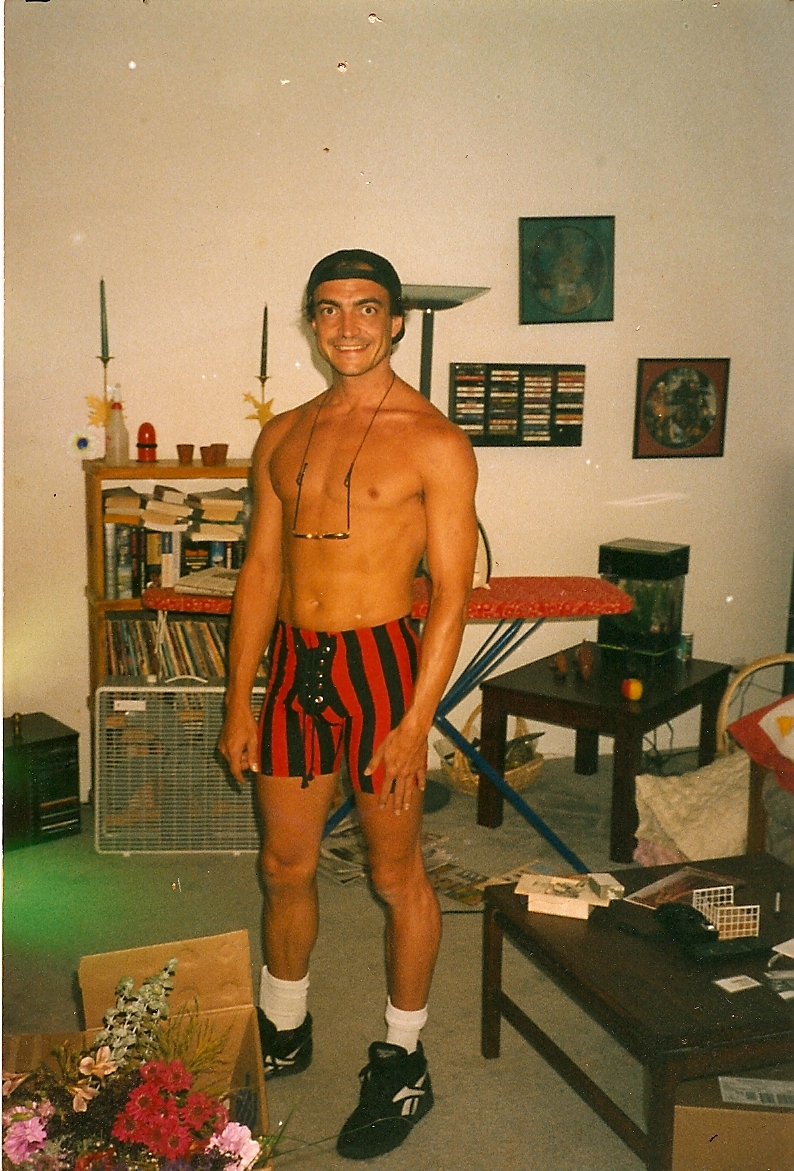
Take, for example, the above picture. I was thirty-three, had been working out like a fiend and eating a very restricted diet, and had gone from 215 pounds in August to the above, 155 pounds, by the following June. I was fitting into size 29 waist jeans and shorts.
And yet, when I saw this picture for the first time, my literal first thought was oh, nice, but maybe if I lose ten more pounds…
Ten more pounds?
From where exactly, psycho? And the diet I was following wasn’t a good one; but my weird relationship with food and eating–always problematic–worked in my favor this time. Essentially I ate mostly salads and turkey, and skinless chicken breasts, etc, and nothing that had more than 2 grams of fat per serving ever passed my lips, with one cheat day allowed per week. On the cheat day I’d allow myself a fast food burger and fries, or pizza. That was me, living large in the airline days.
And incidentally, according to those ridiculous BMI charts, at my height, I should only weigh five more pounds than I did in that picture to not be considered “overweight.” Is it really any wonder we have so many issues with body image and body dysmorphia in this country?
But like with everything, I’ve always been my own harshest critic, and my body has never been exempted from that harsh lens through which I view everything about myself; no matter whether it’s the way I look, the sound of my voice, my writing, my job performance, I’m always highly critical, and always have been. I think it might partially come from an old defensive mentality, learned as a child–a combination of my parents and church constantly pushing humility, plus being mocked and made fun of by other kids eventually turned into if I am meaner about myself than nothing anyone else says can ever hurt me (which, now that I’ve typed it out and looked at it, is really a horrifying way to think, really); and I’ve spent most of my life trying to overcome those deeply rooted and ingrained ways of thinking. For one thing, the humility thing makes it very hard for me to talk about my books and my writing in a positive way, without self-deprecation–and face it, no matter how much we don’t want to believe this about publishing, a writer also has to be a salesperson, selling themselves as their product (which sounds kind of whore-ish when put that way, doesn’t it?)–and you can’t run around putting yourself and your writing down while expecting people to buy it, can you? “Yes, this car? Are you interested? Well, I’m not terribly fond of the color and sure, of course it runs well, but let’s face it, it’s no Porsche” said no car salesman, ever.
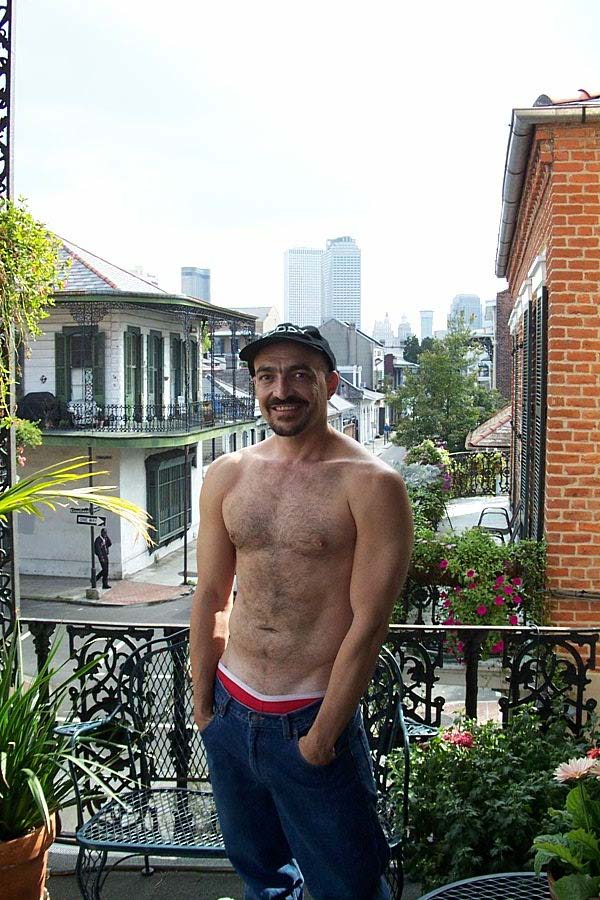
The above photograph was taken in the early spring of 2002. We’d moved back to New Orleans in August 2001, after a year away; a year I generally block out of my memory and pretend never happened; I was incredibly miserable, couldn’t afford a gym membership, and so didn’t work out for over a year, while eating incessantly–directly related to being unhappy–and eating garbage. My weight ballooned, and when we moved back to New Orleans people were shocked to see me. I immediately started working out regularly again and changed back to much healthier eating patterns, and the weight began to drop off again, going from the 200 I weighed when we returned down to the 180 seen above. I was being interviewed for a gay porn magazine–I was writing porn in those days too–and the magazine wanted to interview me, not only about writing and editing porn, but about my mystery novel Murder in the Rue Dauphine, and they wanted to do a photo shoot to go with the piece rather than using book covers and author photos. I was a little taken aback when told to remove my undershirt and unbutton the flannel vest (it was a sleeveless flannel shirt–so yes, a vest, no matter what the sign on the sales rack at Structure read), and a little more nonplussed when asked to remove the vest entirely; it wasn’t so much that I was uncomfortable being photographed shirtless so much as I was worried how I would look in the pictures; plus the thought people would see the pictures and think that I was so arrogant as to demand to be photographed that way. I was sent digital copies of all the pictures, and wasn’t terribly thrilled with how I looked (SURPRISE) but when the piece ran with some of them, including the one above, the response was surprisingly positive, particularly when you consider every other picture in the magazine was of a naked porn star, without an ounce of body fat.
Because yes, porn stars and models are the standard we should use for the sake of comparison.
Maybe someday I will stop holding myself to these ridiculous standards.
The above photo was taken in 2003 or 2004; a good friend (who moved away before Katrina–glad he missed Katrina, but still sorry he’s no longer a New Orleanian) was also a terrific photographer, so I hired him to do some author photos for me. I had already started shifting away from writing and editing erotica under my own name, and I didn’t want to use my “serious” author photo for erotica writing, either as me or Todd Gregory; thinking something a little more daring was necessary. He was certainly game, and so I brought a bag of things I’d wear to the bar to give a try. I look at the above picture now and think, seriously? You were self-fucking-conscious about how you looked?
Yeah, I’d love to look that bad NOW.
When Katrina happened, one of the things that convinced me to stay in decimated New Orleans afterwards, when I came back to check on the house and get some more things out of it, was that my bank, gym, and grocery store were all open. And as I’ve said before, one of the things I clung to in the wake of Katrina was the things I could actually control; one of which being my body. When we moved back from DC and I lost all the weight again, I did it primarily by exercising and teaching aerobics–three good weight workouts a week built around teaching six high intensity step classes per week will shed weight from you very quickly, and I soon realized because I had a good base of muscle this time when I started, returning to working out regularly and teaching aerobics again kick-started my metabolism into a high fat-burning machine…and as such, I didn’t really need to be overly concerned about my diet–so I chose not to be. MISTAKE. I should have started eating healthier again, too. The result was those bad eating habits I’d returned to were even harder to change now, and since I was getting leaner without changing my eating…yeah. But since my body was something I had absolute control over, I focused on that to help me get through it all.
And yet, still felt unhappy with the way I looked.
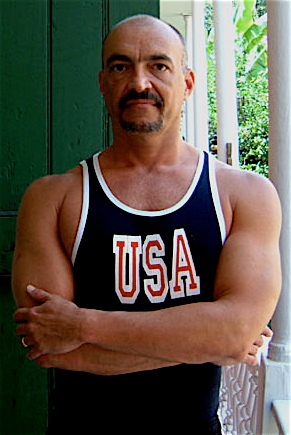
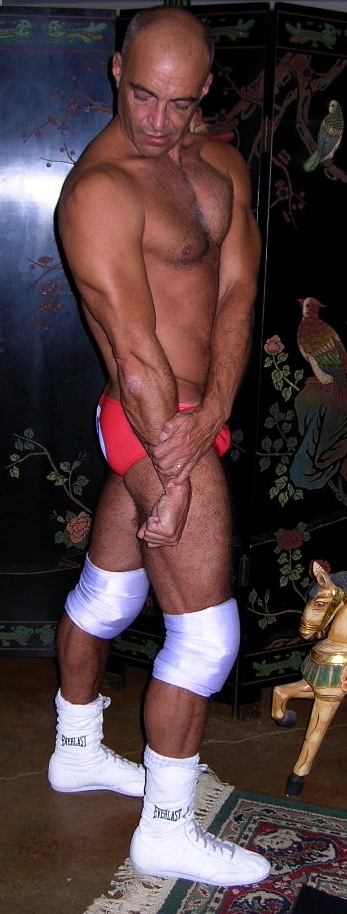
This was a Mardi Gras costume I considered wearing–US Olympic Gay beach volleyball player–but when I saw these pictures…I decided against going out in public wearing this because I was afraid of being judged for not being in good enough shape.
And the only reason I was ever able to dress like that and go out on Fat Tuesday was I would tell myself the entire point of dressing in costume on Fat Tuesday was to look ridiculous.
Now, it’s not really about how I look. I injured my back in 2010, which kept me out of the gym for over a year or so (I could have the dates wrong here); and every time I’d go back, BLAM, I would hurt it again. That was why I eventually hired Wacky Russian; I needed someone to monitor my form and make sure I wasn’t going to injure my back again. Unfortunately, that became a crutch and I stopped going in to work out on my own; and my weight continued to spiral (around the time of the back injury was when I started teaching myself how to cook more and bake; when I started making cheesecakes and brownies, and discovered the joys of both heavy cream and butter) upwards. I started back to the gym last year, but Carnival interrupted my programs and I never went back again…so that’s why getting started up again this year was so good for me because this time I was enjoying it again.
And this time, I don’t honestly care about how my body looks, either to me or other people. I just want my muscles to remain strong and flexible; the exercise is good for my heart and cardiovascular system; and anything that can help get the cholesterol under control so I can stop taking medication for that and my blood pressure would be quite lovely. I’m pushing sixty, and I don’t think I’m ever going to be shirtless and sweaty in a sea of other shirtless, sweaty gay men dancing again any time soon–pandemic or no pandemic–but it feels good, you know? I like how I feel after working out, and I like how I feel in general.
I think having a healthier mindset this time around is also helping.









 Queer and Loathing in America