Nightshift

Yesterday I kind of hit a writing wall; not a big deal, really, just that I was mentally and physically tired for some reason (I suspect upsetting my usual routine by having to go have blood work done in the morning, and now of course I want to write a story called Blood Work), and so I was only about to get about 2300 words out on a short story. I had hoped to not only finish the draft of that particular short story but also get another one done, perhaps even getting to work on a Scotty chapter. Heavy heaving sigh. Ah, well. I’m not going to beat myself up over the lack of productivity here; I am simply going to embrace that I got a pretty decent 2300 words done. So, that is a victory, and one that I am very pleased to have. Each word is another step closer to finished, after all, and once should never berate one’s self for not getting everything done you wanted to as long as you got something done.

I’d intended to go to the gym this morning but didn’t want to get out of bed. I had a good night’s sleep for the first time this week so, well, yeah, that happened. I’ll just have to go after work tomorrow; I have to keep my eye appointment tomorrow morning before work. It’s getting increasingly harder to keep to three times a week; primarily because of my problems sleeping. Heavy heaving sigh.

But…I am liking what I am writing, and I do enjoy going to the gym. (I was wondering what to watch now that Black Sails is over, only to discover season 2 of Versailles is up on Netflix, and I believe this is the season of the Affair of the Poisons!) I just wish I didn’t always get off so late at night that I can’t make it to the gym. There has to be a more efficient way of doing this; there simply has to be.

So,  my plan is to get these two short story drafts finished this week, as well as another chapter of Scotty; I want to have this finished by the weekend, which means a lot of writing today and tomorrow. I also need to get some short stories read for the Short Story Project, and then I think I want to read a novel. (I’ll still read short stories, but I want to read a novel; it’s been awhile since I’ve plunged into the pages of one. Kellye Garrett’s Hollywood Homicide is calling to me, for one thing, and there are any number of wonderful novels in the TBR Pile, you know.) I also want to get the order of the Bouchercon anthology stories finished this weekend, and I need to get my taxes finished and off to my accountant: MUY IMPORTANTE.

The Lost Apartment is again a pigsty; it’s amazing how easily that happens. It’s not as bad today as it was last Thursday, but still. I just don’t seem to be able to manage time properly anymore. I don’t know what that’s all about, but it definitely needs to STOP.

All right, I need to get some things done before I leave for the office this morning; I need to run errands as well before I head in.

For today’s short story discussion, we are going to look at a crime story by Lia Matera, and a literary fiction story by Irwin Shaw.

Lia Matera’s story is “Destroying Angel,” copyright Lia Matera, 1990, and this short story was first published in Sisters In Crime Volume II, 1990, edited by Marilyn Wallace.

I was squatting a few feet from a live oak tree, poison oak all around me (an occupational hazard for mycologists). I brushed wet leaves off a small mound and found two young mushrooms. I carefully dug around one of them with my trowel, coaxing it out of the ground.

I held it up and looked at it. It was a perfect woodland agaricus. The cap was firm, snow white with a hint of yellow. The gills under the cap were still white, chocolate-colored spores hadn’t yet tinged them. A ring of tissue, an annulus, circled the stipe like a floppy collar. A few strands of mycelia, the underground plant of which the mushroom is the fruit, hung from the base. I pinched the mycelia off and smelled the gills. The woodland agaricus smells like it tastes, like a cross between a mushroom, an apple, and a stalk of fennel.

Lia Matera is one of my favorite crime writers, and her Star Witness is one of my favorite crime novels; deliciously sly and incredibly witty and clever. As I was reading this short story of hers, I also lamented that she’s not published a novel in quite a while. This story is incredibly well-constructed, and devious as well; there’s a lot of information in it about mushrooms, as Our Heroine is a mycologist who works at a local nature museum and is dramatically underpaid; as she talks about her work and her mushrooming and working at the museum, and of course how careful one must be to differentiate between the deadly ones and the safe ones…well, you just know someone is going to be poisoned by mushrooms, don’t you? Matera pulls off a delightful sleight of hand in that regard, though, and the overwhelming sense of melancholy and sadness she permeates the story with is masterful. Her novels are available as ebooks now; treat yourself to one and you’ll never look back.

The Irwin Shaw story I read (reread, actually) was “The Girls in their Summer Dresses” by Irwin Shaw.

Fifth Avenue was shining in the sun when they left the Brevoort and started walking toward Washington Square. The sun was warm, even though it was November, and everything looked like Sunday morning–the buses, and the well-dressed people walking slowly in couples and the quiet buildings with the windows closed.

Michael held Frances’ arm tightly as they walked downtown in the sunlight. They walked lightly, almost smiling, because they had slept late and had a good breakfast and it was Sunday. Michael unbuttoned his coat and let it flap around him in the mild wind. They walked, without saying anything, among the young and pleasant-looking people who somehow seem to make up most of the population of that section of New York City.

“Look out,” Frances said, as they crossed Eighth Street. “You’ll break your neck.”

You never hear much about Irwin Shaw anymore, but he was one of the more successful American writers from the 1950’s to the 1970’s; his books were critically acclaimed and best sellers; the novels in included The Young Lions, Rich Man Poor Man and its lesser sequel Beggarman Thief, Evening in Byzantium, and Aurora Dawn (which was lesser known but one of my favorites; it was about a radio show sponsored by Aurora Dawn soap and was clever and biting satire about art vs. commerce). I read most of Shaw’s work in the 1970’s when I was a teenager; I would love to reread some of them again.

I read “The Girls in their Summer Dresses” for an English course in college; I don’t remember which course or which college; but the fact the story was taught gives you an indication of how well-regarded Shaw was. The insights the instructor gleaned from the story–a switch of roles between the young couple, where she took on the more traditionally masculine role while the husband took on the more passive, traditionally feminine role–struck me, at the time and on this reread some thirty years later as more of that MFA program claptrap taught and regurgitated by people who don’t really understand and appreciate the art of fiction. (Yes, as you can tell, I embrace my role as a non-intellectual.) At the time I read the story in college it struck me as a really sad story about a newly married couple whose relationship was, in fact, doomed to fail; and the point of the story showed how it was either doomed to fail, or if it was going to last, how the wife was going to have to completely subsume herself and sublimate her own needs and desires to his, constantly biting her tongue and becoming increasingly bitter about those compromises as the years pass. The young husband is a narcissist and an asshole, who, despite his wife very clearly telling him how much his ‘window shopping’ of every woman they pass on the street bothers and disturbs her–cares so little about how this behavior hurts and disturbs her that his attitude is too bad so sad I’m the man and I’m not going to change so you need to get over it. This is kind of the prequel, in some ways, to Susan Glaspell’s “A Jury of Her Peers”–I can see this woman gladly strangling her husband in his sleep in the future after twenty years of being beaten down and humiliated over and over again.

Of course, I always tend to look at stories from the perspective of a crime writer now; so there’s that, too.

And now, back to the spice mines. Here’s a Throwback Thursday hunk for you:
IMG_2951

We Belong

Wednesday morning, and I have go have blood work done. No worries–it’s just for the semi-annual check-up, but I hate this whole process of fasting/not having anything to drink after midnight, plus the abject misery of having blood drawn–my veins roll, so they always have to DIG for them, generally leaving me with an enormous bruise–blah blah blah. Yay.

Plus, I can’t have coffee until I get back home.

AIEEEEEE!

Heavy heaving sigh.

Well, it wasn’t as bad as feared. She managed to get the blood vials filled on the first try, without having to dig! For once, I don’t mind getting one of those damnable “how was your visit?” emails, as now I get to recognize my technician for a job very well done. I don’t even have a bruise!

It’s been an interesting week. I’m watching the Netflix series Seven Seconds, which I am enjoying the hell out of, and Paul and I are watching also a BBC series called Retribution, which is one of the best concepts for a crime series I’ve seen in quite a while: a young married couple, who grew up as neighbors in rural Scotland, are murdered a few weeks after the wedding by a junkie robbing their apartment; the wife is about seven months pregnant. As the families get the news and grieve, the very next night after the bodies are found the killer for some reason is coming to see them and buys guys at a station twenty miles from where they live. There is a terrible storm that night and he wrecks his car, and the families find him and bring him inside. After they do, they see a news report which identifies him as the killer…and he is at their mercy. They drag him out to the barn, and sometime during the night someone cuts his throat…and now they have to cover up the crime. Juicy, right?

I also started writing two new short stories this week; don’t ask me why, I don’t know why I am on such a short story roll lately. One of them is my Italian short story, the one I’ve been wanting to write since we visited Panzano; I wanted to set a story there ever since I first saw that gorgeous village in Tuscany. The other is one I started a long time ago, but only wrote the opening paragraph; for some reason the rest of the story revealed itself to me this week so I started working on that as well. Who knew?

I also read some short stories this week.

First was “Where Are You Going, Where Have You Been” by Joyce Carol Oates; which was originally published in 1966 and is now available for free pdf download on-line;

Her name was Connie. She was fifteen, and she had a quick, nervous giggling habit of craning her neck to look into mirrors or checking other people’s faces to make sure her own was all right. Her mother, who noticed everything and knew everything and who hadn’t much reason any longer to look at her own face, always scolded Connie about it. “Stop gawking at yourself. Who are you? You think you’re so pretty?” she would say. Connie was raise her eyebrows at these familiar old complaints and look right through her mother, into a shadowy vision of herself as she was right at that moment: she knew she was pretty and that was everything. Her mother had been pretty once, too, if you could believe those old snapshots in the album, but now her looks were gone and that was why she was always after Connie.

I’m not sure how I came across this story, but wow, is it ever disturbing. I’ve really enjoyed my discovery of Oates’ talents through reading the occasional short story, and each one makes me want to read more. Connie, so confident in her looks and the power they give her, unfortunately attracts the attention of the wrong guy who turns up at her house one day with a friend when she is there by herself. As Connie tries to handle the situation…the sense of dread Oates evokes in her prose is palpable. I couldn’t stop reading, while at the same time was afraid to keep reading.

The next story I read was “A Jury of Her Peers” by Susan Glaspell.

When Martha Hale opened the storm-door and got a cut of the north wind, she ran back for her big woolen scarf. As she hurriedly wound that round her head her eye made a scandalized sweep of her kitchen. It was no ordinary thing that called her away–it was probably further from ordinary than anything that had ever happened in Dickson County. But what her eye took in was that her kitchen was in no shape for leaving: her bread all ready for mixing, half the flour sifted and half unsifted.

She hated to see things half done; but she had been at that when the team from town stopped to get Mr. Hale, and then the sheriff came running in to say his wife wished Mrs. Hale would come too–adding, with a grin, that he guessed she was getting scary and wanted another woman along. So she had dropped everything right where it was.

“Martha!” now came her husband’s impatient voice. “Don’t keep folks waiting out here in the cold.”

She again opened the storm-door, and this time joined the three men and the one woman waiting for her in the big two-seated buggy.

When I was in high school, I was in a contest play; one of the many disciplines for what was called Speech Competition in the state of Illinois was one-act plays. I auditioned for the contest one-act at my high school and was cast in Susan Glaspell’s one-act play Trifles, which was based on this short story. As a teenager, I thought the play was kind of silly and dumb, to be honest. We did well, but didn’t make it out of regional competition; we placed third, with every judge placing us third; if any judge had given us a first we would have moved on. But hey, it was my high school’s first time doing a contest play, we had practically no budget or set, and the two schools that beat us did the first act of Antigone, complete with sets and costumes, and the other did the first act of The Importance of Being Earnest, again, with an apparently bottomless budget for sets and costumes; both schools were also known for their drama departments.

Reading the original short story, all these years later, as both a fan and writer of crime fiction, made me appreciate the tale all the more. It’s about psychology; what drove the woman to kill her husband, after years and years of a miserable existence, why now? And the two other wives, the ones who find the motive, and understand it and sympathize with her, have to decide whether to share that with the condescending men/husbands, who basically spend the whole story mocking them and women in general, when they are the ones who actually solve the case…it’s actually genius and actually quite brilliant.

And now, back to the spice mines.

12795475_1033437423383944_9161554592569797704_n

Neutron Dance

Hey there, peeps! Welcome to Tuesday. Last night was a restless night for one Gregalicious; I was awakened at some point during the night when a thunderstorm rolled into the parish. It’s still gray and chilly and raining this morning; the kind where you’d rather stay in bed under a blanket with a nice warm cup of coffee and a book. But alas and alack, I must away to the office this morning. It’s Tuesday and thus my long day.

I finished the first draft of the Chanse short story yesterday morning; it’s very rough but on the other hand, I am rather pleased with it. I’ve never written a private eye short story before, and as I said, it’s incredibly rough; but on the other hand, I’ve now written a private eye short story. Jon Michaelson very graciously asked me about it on Facebook when I mentioned it the other day; there’s no publisher for it as of yet, because that’s how short stories work. You can write a novel under contract and you can write a novel without a contract, but in either case I write them with a particular publisher in mind, or at least I have some sort of idea what the next step is going to be. With short stories, it’s not quite the same; there are limited markets for short stories that pay, and those that pay well are even scarcer. I’d love to get this story into somewhere like Ellery Queen’s Mystery Magazine, but as one of the few well-paying markets that every crime writer is trying to get into, the competition is nothing if not quite fierce. There’s also not a rush; I can take my time and get back to it whenever I choose or whenever the inspiration hits me; I may submit it to an anthology, who knows? The Bouchercon anthology next year will be Texas-themed, if not Dallas-themed; and since this story is set in Texas maybe I can hold onto it and prepare it for that. Who knows? We shall see.

I also muddled through a transitional chapter in the Scotty book; it needs a bit more before it’s finished, and then the book should start flowing more smoothly. Huzzah!

Also, we went public with the table of contents for the Bouchercon anthology yesterday (alphabetically; the order hasn’t been decided on as of yet):

PATRICIA ABBOTT, “When Agnes Left Her House”
J. D. ALLEN, “The Unidentifieds”
JACK BATES, “The Fakahatchee Goonch”
LAWRENCE BLOCK, untitled as yet
SUSANNA CALKINS, “Postcard for the Dead”
REED FARREL COLEMAN, “The Ending”
ANGEL LUIS COLON,    “Muscle Memory”
HILARY  DAVIDSON, “Mr. Bones”
BRENDAN DUBOIS, “Breakdown”
JOHN FLOYD, “Frontier Justice”
BARB GOFFMAN, “The Case of the Missing Pot Roast”
GREG HERREN, “Cold Beer No Flies”
ELEANOR CAWOOD JONES, “All Accounted for at the Hurray for Hollywood Motel”
JOHN D. MACDONALD, “The Hangover”
PAUL D. MARKS “There’s an Alligator in My Purse”
CRAIG PITTMAN, “How to Handle a Shovel”
NEIL PLAKCY, “Southernmost Point”
ALEX SEGURA, “Quarters for the Meter”
DEBRA LATTANZI SHUTIKA, “Frozen Iguana”
HOLLY WEST, “The Best Laid Plans”
MICHAEL WILEY, “Winner”
It was such an embarrassment of riches to choose from; seriously.  I am grateful to everyone who served as an advance reader for the blind readings.
And now, back to the spice mines.
28235249_101812530652079_7100043236405953654_o


The Wild Boys

Sunday morning. We finished watching Altered Carbon last night, and thoroughly enjoyed it; hardboiled private eye story with an interesting concept about the future, gorgeously filmed, and well acted. I also only have one episode left of Black Sails, which I am still loving, and definitely am going to hate to see come to an end.

I didn’t write enough yesterday, but I finished revising two short stories, one of which I turned into the anthology that asked for it. Today I need to write, write, write. I also need to go to the gym, and I need to clean the living room. I’d also like to finish the Chanse short story I’m working on, but we’ll see how that develops. I have also fallen way behind on the Short Story Project, but feel confident that I will find the time today to read some more of them. There’s some others that I should edit as well. Paul is going to be gone all afternoon, so I should go to the gym this morning so I’ll have the apartment to myself this afternoon so I can focus on getting these things done. I’m not going to stress out about anything–I refuse to get stressed about things anymore, I get done what I can get done, which is helping dramatically with my moods and my sanity–but that doesn’t change the fact that things need to get done.

Paul might go visit his mom later this spring; I may take the same week off and just have a staycation. I tried this once before, with the good intentions of getting a lot done, and failed; but I do feel now that somehow things are different than they were at any point in the last four or five or six years; I feel as though I am rededicated, able to get things done; this year alone I’ve written five or six short stories from scratch already, five chapters of the Scotty book and four chapters of the revision of the WIP; which is quite  a lot for the eight or nine weeks we’ve had so far this year. I know I used to produce quite a bit back in the day, but it’s been awhile since I’ve written so much and been so productive; I am really enjoying it more than I remember doing so before, so I feel like this year is different somehow; I am enjoying working out again, I am enjoying writing again; and my self-confidence is coming back with a vengeance, which is, of course, absolutely lovely.

And on that note, I should get back to the spice mines. I want to clean the kitchen and revise another short story before I go to the gym for my workout; the windows also need cleaning, but that can wait until I get home from the gym.

Here’s a hunk to get you through your Sunday:

28685311_1814566945504207_5775792724785308639_n

Sea of Love

Friday. Another week has passed, and now it’s March. Heavy sigh. I have to drive out to Metairie this morning to get stronger contact lenses; I can’t read with the progressives they gave me to try out (computer is fine, books not so much) so I have to head out there and deal with it. I may go ahead and order my new glasses while I’m there. And then I am coming back into the city to do testing at the main office, and then I am free for the weekend. Huzzah! I have a lot of work to do this weekend, however, but at least I won’t have to leave the house for anything other than going to the gym.

I worked a bit on the Chanse short story yesterday, but realized the framework for it wasn’t necessary; I had him returning to his hometown in Texas for the 25 year anniversary of his high school football team’s state championship, and this was his first time back since he left for college. But it didn’t make sense to have that be the framework, given the crime he was going to wind up investigating; so I changed it to send him back to investigate the crime. So, I rewrote the opening, and it worked much better; the story flows better. I am hoping to get it finished in first draft this weekend, and revise the other stories I am working on. I also have to start putting the Bouchercon anthology stories in order (yes, the final ones have been selected; the announcement should be coming on Monday), and the Lost Apartment is, as always on Friday, a pigsty. If the weather’s nice (and it should be) I am going to do the kitchen windows as well. Lots of filing needs to be done, and I also would love to get my taxes finished and turned over to the accountant.

That’s me–living the dream.

I’ve also got to drop the beads off at the library.

I also started writing the sixth chapter of the Scotty book yesterday, which is a difficult chapter. I got 700 words into it. I want to get that one done this weekend as well; I hate putting Scotty through bad stuff, but I think it’s an important story to tell so I am going to tell it. As I have said before, this is probably the most ambitious Scotty story since Mardi Gras Mambo; we’ll see how it turns out in the end. I had wanted to have the entire first draft finished by March 1–I am on chapter 6 out of 20, so you see how that went–but I am pleased with the work that I’ve done and I also threw out what I had done and started over, so there’s that (also following the pattern of Mardi Gras Mambo–two abortive attempts to start it).

And now, back to the spice mines.

IMG_1936

One More Night

Thursday. I overslept this morning and thus didn’t make it to the gym–I’ll have to go tomorrow night after work–but I also had a really great night’s sleep and so am taking that as a win; now that I am out of bed my muscles aren’t tired or sore. I’ll do some stretching and my abs this morning before getting in the shower. I also have to get up tomorrow morning and go to the eye doctor; instead of my usual wimpy not complaining and accepting things, I called them and told them I can’t read in my progressive contacts so I need a stronger prescription. So, I am going in tomorrow to get a new trial pair and perhaps order my new glasses and a year’s supply of the contacts; depending on how the new ones feel.

The decisions have been made on the Bouchercon anthology, and all the people who submitted have been duly noted. This weekend I will read the chosen again and put them in order. I am currently waiting to hear back from all the selected authors. I think we’ll make the announcement of the table of contents next week. Huzzah!

Yesterday I also started writing, of all things, a Chanse MacLeod short story. I know, right? I don’t think I’ll ever write another Chanse novel, but there are ideas I had for him that I don’t want to really waste, and hey, why not write short stories about him? I always had in mind to write about him returning to the town of his birth; I also had a story in mind involving his younger brother; another with him dealing with his fraternity past in Baton Rouge–all stories my publishers were never interested in since they weren’t set in New Orleans. As I have said before, I’ve never really known how to write a private eye mystery short story, but all this short story reading I’ve been doing has kind of opened my eyes in that regard; so thank you, Sue Grafton, Ross Macdonald, Laura Lippman, etc. I’ve already realized that the opening doesn’t work, and it’s just extraneous crap I don’t need. But I am going to soldier on, and hopefully today I will finish the first draft. I also have an idea for a short story involving Chanse’s partner, whose name I cannot recall; I’ve always been interested in writing about her–the straight girl who paid for college by stripping on Bourbon Street. I cannot for the life of me think of her name right now, which is annoying, but I always thought she was interesting. I’d even thought about spinning her off, even using Chanse as a supporting character in the books–but then, is there an audience for a series about a female private eye who used to work as a stripper? But I think I can make it work as a short story. We’ll see.

Last night while I was making dinner I reread some of the short stories I have in progress, and was quite pleased with them. I am going to try to get those revisions done as quickly as I can, so I can get them out of my hair so I can focus on getting the new project done.

I’m still behind on the Short Story Project, but I did manage to read Raymond Chandler’s “Red Wind” yesterday; someone recently talked about it somewhere on social media as the perfect hard-boiled short story. It had been a while since I’d read Chandler–and I haven’t read all of Chandler, either, something I need to remedy–and so I thought it was a great opportunity to read this story, which I wasn’t familiar with.

There was a desert wind blowing that night. It was one of those hot dry Santa Anas that come down through the mountain passes and curl your hair and make your nerves jump and your skin itch. On nights like that every booze party ends in a fight. Meek little wives feel the edge of the carving knife and study their husbands’ necks. Anything can happen. You can even get a full glass of beer at a cocktail lounge.

I was getting one in a flossy new place across the street from the apartment house where I lived. It had been open about a week and it wasn’t doing any business. The kid behind the bar was in his early twenties and looked as if he had never had a drink in his life.

I’ve not read all of Chandler, or his hard-boiled cohorts Dashiell Hammett, Ross Macdonald, or noir master James M. Cain. What I have read I’ve greatly enjoyed; as I have greatly enjoyed John D. Macdonald. I think I’ve been influenced by all of them to some degree; and there simply isn’t enough time to read. I’d love to go back and not only finish reading all of their works but to reread the ones I’ve already read; The Maltese Falcon, for example, is way overdue for a reread and so are the Travis McGee novels; The Big Sleep, Farewell My Lovely, and The Lady in the Lake, along with Love’s Lovely Counterfeit and of course, the Archer novels (although I am reading the Archer short stories). Anyway, I’ve always loved these writers and their work, and I do need to go back and reread them, problematic as some of them may be to modern eyes.

“Red Wind” is a really good story, complicated and complex, but still moves relatively easily from A to B to C. It opens with Marlowe stopping in at a bar across the street from where he lives in an apartment building, and a murder occurs right in front of him and the other denizens of the bar. After dealing with the police he heads back to the apartment building where he runs into the proverbial ‘dame’ of these types of stories, she lies to him, of course, but also manages to save his life when the murderer shows up to eliminate the witnesses. But while the mystery of the murder is now cleared up, turns out the victim has left some loose ends behind–involving the dame and some others. He was a blackmailer; the murder had nothing to do with the shooting (a very clever shift by Chandler), and Marlowe is on the case, trying to solve the blackmail cases and dealing with the LAPD. The writing is choice, terse, and all throughout the story the Santa Ana wind plays a role, almost like another character, driving people to do things they might not do under normal weather circumstances.

And now, back to the spice mines; since I didn’t go to the gym I need to get other things done.

IMG_3978

Rhythm of the Night

Wednesday!

I decided to postpone this morning’s workout until tomorrow, as I was ridiculously tired both last night and this morning. It’s so lovely, though, to be back into a regular routine; because I know that skipping this morning doesn’t mean it’s a loss. I can switch days without worrying or stressing that I am sliding down that slippery slope to not going to the gym again. Huzzah! Definitely making progress.

I checked off another BIG item off the to-do list yesterday; HUZZAH! This morning I have some loose odds and ends to tie up in addition to that, and then I am very excitedly going to get it all together. Yay!

I also reread the short story I wrote Sunday last night, and as opposed to my usual reaction (which is to recoil in horror from something I’ve written) I actually was rather pleased with it. It’s rough, of course, and it needs some things to be added to it, some language needs to be cleaned up, etc, but over all I am rather pleased with it. I have a couple of other short stories in progress that also need to be cleaned up; I am hoping to get all of that finished this week so I can dive headfirst into my March project. While March actually begins tomorrow, I am going to spend the rest of the week tying up odds and ends–but I am actually going to slowly start putting my feet into the water of the March project tomorrow, then hit the ground running once all this other stuff is finished.

Must. Stay. Focused.

If I stay focused, I can get everything done, and done well.

I also submitted a short story to an anthology call; the deadline is this coming Monday, but hey–look at me turning in something early. Madness, right? I don’t know if they’ll use my story or not, but I am pretty pleased with it. It may not be up their alley, but I certainly am not going to be offended if it doesn’t get accepted, you know? (Right? I don’t even recognize myself anymore.) But it feels good. I want to get so much stuff out of the way before this weekend so I can totally immerse myself in the new project.

Altered Carbon continues to enthall, and so does The Black Prince of Florence. I am way behind on the Short Story Project, but am hoping to get my act together on that score soon as well.

And on that note, I should get back to the spice mines.

IMG_1924

Lovergirl

I wrote a short story yesterday, which was kind of fun; I can’t remember the last time I sat down and wrote 4500 words in three hours, and a short story from beginning to end, to boot. I am very pleased with myself, as I am wont to be. It needs work, of course; but I am very happy that I was able to write it from beginning to end. I can now put it aside for awhile to get back to work on other things; but as its deadline approaches I won’t be pushing to get it written–and then giving up as happens so often.

Today I need to get some things accomplished; I am going to the gym this morning before heading into the office. I am doing happy hour bar testing this evening; so I don’t have to go in until later; which now provides me with a Monday, Wednesday, and Saturday weight lifting schedule, with room for replacement days if that becomes necessary. (I can always, for example, go on Friday evening after work if I don’t want to do Saturday; I can go on Sunday to replace Monday, ,etc.) Flexibility in one’s workout schedule is important, and makes success more likely than rigidity.

I need to get my taxes together this week as well; that’s one of the major things on my schedule this week. Ideally, I would love to have everything to my accountant by Friday, so I can get everything filed next week. I also have to get some work done on the Bouchercon anthology; and I need to finish a grant application by Wednesday. There’s a contest I am considering entering as well; we shall see if I decide to pay the entry fee for that (it’s only thirty dollars, but….thirty dollars is thirty dollars. Before I bought the car I would have thought nothing of spending the money; but now I am watching every cent I spend). So, I definitely have my work cut out for me this week; we’ll see how it all works out. This morning I feel energetic, and I know after I work out I’ll have that lovely endorphin rush going. Huzzah! Everyone wins.

I am on the final season of Black Sails, and it continues to enthrall, although I am very well aware that it won’t end happily; but I also have some idea of who will survive the season and who will not.

All right, I need to get my act together and get to the gym. Till later, Constant Reader.

IMG_2279

Loverboy

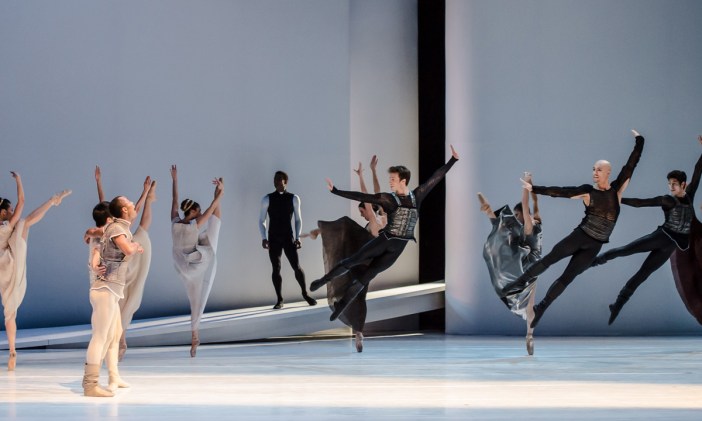
The ballet last night was exquisite.

I’ve seen ballets–or parts of them–on television or Youtube; and I remember, as a child, being taken to see The Nutcracker (isn’t everyone dragged to that as a child?), which I hated (interestingly enough, many things that most children love are things that I didn’t; The Nutcracker is one; The Wizard of Oz another). But as lovely and awe-inspiring as seeing ballets on Youtube or on television can be, there is nothing like being in an auditorium and watching one being performed live on the stage in front of you. I liken it to the difference between watching figure skating on television and then watching it in person; it’s very different, and you never watch it on television in quite the same way again. Romeo and Juliet is, of course, an ubiquitous story; everyone knows it, to the point that it has become almost trite and hackneyed; it’s been adapted for everything imaginable–opera, ballet, film, and of course West Side Story–but, at its heart, it is still a beautiful and sad story.

The opening sequence of the ballet reminded me so much of the opening of West Side Story that I couldn’t help wonder how much the ballet influenced the musical’s choreography, or vice versa.

sw-romeo-george-oliveira-alexis-oliveira-alvaro-prieto-taunt_1000

I read Romeo and Juliet when I was a sophomore in high school. I’d taken a class called Dramatic Literature; a class in which we read plays. Romeo and Juliet was paired with West Side Story (it’s also the class where I first read Tennessee Williams; A Streetcar Named Desire and Cat on a Hot Tin Roof, to be exact); we even watched the films (the version of Romeo and Juliet was the 1968 Franco Zeffirelli production, with Leonard Whiting and Olivia Hussey with the gorgeous score by Michel Legrand). Shakespeare’s language was, to me at fourteen, a mysterious puzzle I couldn’t unlock; archaic references I didn’t understand written in verse, yet somehow beautiful in how the words were put together. At the time, I didn’t understand how two families could feud so bitterly and violently in an Italian city during the Renaissance; of course, now that I’ve read so many Italian histories (I am still greatly enjoying The Black Prince of Florence), I am more than a little surprised that the feud between Capulet and Montague was so bloodless (see the Pazzi-Medici feud, circa fifteen century).

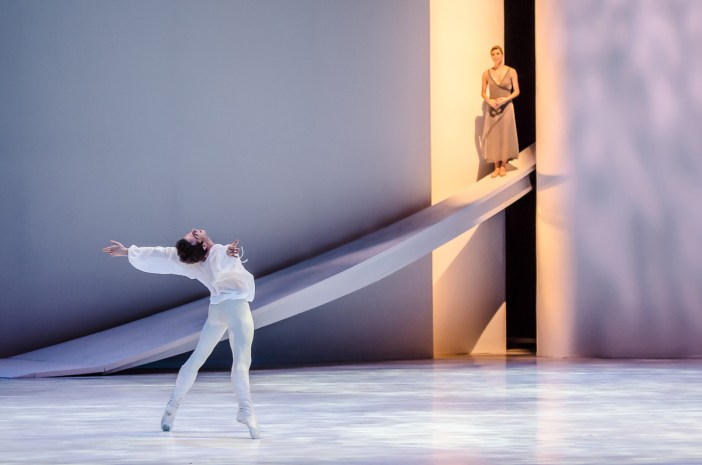
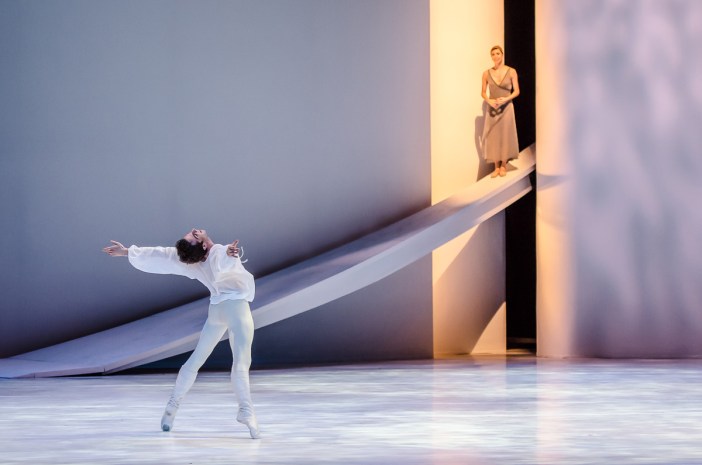
Yet, despite the overwhelming familiarity with the story, it was impossible not to be drawn into last night’s version of it; despite there being no dialogue, no words. The entire story was, as is typical with the ballet, acted out without words and through dance. The choreographer’s choices in telling the story were quite interesting; the stage setting was incredibly minimalist, with emotions and passions being evoked through the movement of the two curved walls that served as set pieces; the long rising ramp that served as not a way to exit the stage but as Juliet’s fabled balcony; and the use of costume and lighting.

sw-romeo-noelani-pantastico-lucien-postlewaite-balcony_1000

The friar was used as a connective device throughout each scene; he was, if anything, the true star of the show, and its emotional heart. The dancer who played the role was magnificent. The ballet was a thing of beauty; I couldn’t stop marveling at how fantastic the dancers were, the exceptional shapes and lines they could form with their bodies, the almost super-human stretches and leaps and twirls and spins, the intimacy of their lifts and how they could mold their bodies around one another’s.

Les-Ballets-De-Monte-Carlo-London-Coliseum-dance-review-Jeffery-Taylor-574512

It was also my first time inside the Mahalia Jackson Theater for the Performing Arts since Katrina; ironically, it was also the first time the Ballet des Monte-Carlo performed there since 2005. Both the outgoing and incoming mayor were there; the Honorary Consul for Monaco, and the ambassador from Monaco were all introduced and thanked from the stage.

_dsc3014cab_0

And yet, as a crime writer, and someone with a vested interest in group dynamics and politics, who has viewed documentaries about ballet companies, with a knowledge of human nature and interaction,I couldn’t help wondering, as the company took its well-deserved bows to a long standing ovation last night,  what turmoils and temperaments boiled beneath the surface of the linked hands and bowing bodies; what slights and grudges boiled behind the smiling faces; which members of the company were friends and which were enemies; who were lovers and friends and who were enemies and rivals, who was gay and who was straight.

I definitely want to write a ballet noir.

And here are two short stories, for the continuation of the Short Story Project.

First up is “Split Second” by Daphne du Maurier,  from the New York Review of Books collection of Don’t Look Now and Other Stories:

Mrs. Ellis was methodical and tidy. Unanswered letters, unpaid bills, the litter and rummage of a slovenly writing-desk were things she abhorred. Today, more than usual, she was in what her late husband used to call her “clearing” mood. She had wakened to this mood; it remained with her throughout the morning. Besides, it was the first of the month, and as she ripped off the page of her daily calendar and saw the bright clean 1 staring at her, it seemed to symbolize a new start tom her day.

The hours ahead of her must somehow seem untarnished like the date; she must let nothing slide.

“Split Second” is an exceptional exercise in character. Du Maurier thoroughly examines and exposes Mrs. Ellis’ character from beginning to end, and while she doesn’t go into a great amount of detail, it isn’t hard to figure out exactly whom she is from what we are told as readers. She’s a widow and her entire world revolves around her daughter, who is off at school; she decides, after a thorough cleaning of her home to go for a walk and is almost run down by the laundry truck as she walks back home. But when she gets back to her house, things are different. It is her house, but it’s no longer the house she left behind; other people are living there, her neighbors are gone–the entire world has changed and shifted as she walked home. It’s a horrifying story, even as the reader begins to glean what has actually happened long before Mrs. Ellis does; not that she ever does, even by the end of the story, and that is part of what makes it so sad, so effective, so powerful; no one has ever quite captured that elegant, melancholy sadness the way du Maurier does.

I then moved on to “The Picture of the Lonely Diner” by Lee Child,  from the Mystery Writers of America anthology, Manhattan Mayhem:

Jack Reacher got out of the R train at Twenty-Third Street and found the nearest stairwell blocked off with plastic police tape. It was striped blue and white, tied between one handrail and the other, and it was moving in the subway wind. It said: POLICE DO NOT ENTER. Which, technically, Reacher didn’t want to do anyway. He wanted to exit. Although to exit, he would need to enter the stairwell. Which was a linguistic complexity. In which context, he sympathized with the cops. They didn’t have different kinds of tape for different situations. POLICE DO NOT ENTER IN ORDER TO EXIT was not in their inventory.

Lee Child is one of the most successful writers in our genre today; everything he publishes is a New York Times best seller, and his character, Jack Reacher, is one of those ubiquitous characters that will go down in the history of the genre, like Poirot, James Bond, and Kinsey Millhone. I am years behind on Lee’s novels; but if you’ve not read Lee Child, you simply must read The Killing Floor, the first Reacher novel. It is quite superb. This story isn’t Child at his best, but Reacher the character is at his best at novel-length, with the labyrinthian plots Child somehow concocts and manages to keep track of (one of my favorite fanboy moments was having lunch with him and Alafair Burke at the Green Goddess here in New Orleans several years ago; while I just sat there wide-eyed and listened to the two of them talk about writing and publishing, praying that I didn’t have sauce running down my chin), but this story does evoke the melancholy that Child evokes in his novels; the inevitability of fate and the powerlessness of humans to counteract it once the gears are moving. I do recommend the story; there is some amazing imagery in it as well.

And on that note, I am back to the spice mines. There are bed linens to launder, and short stories to edit, and a chapter to write; it is rainy and gloomy outside my windows this morning but I am well-rested and ready to work.

Or maybe it’s just the caffeine kicking in. Who knows?

You Belong to the City

Saturday morning and I have sooooo much to do it’s terrifying. Tonight we have tickets to the ballet; Les Ballet de Monte-Carlo, to be precise. They are performing Romeo and Juliette. I have, as I have said before countless times, never seen ballet performed live. I am very excited, obviously. I have an idea for a ballet noir–I have so many ideas, really–and I love that I merely mentioned this one night while watching the superb ballet documentary Bolshoi Babylon, and that he remembered, with the end result we have the tickets for tonight.

He really is quite a dear.

sw-romeo-noelani-pantastico-lucien-postlewaite-balcony_1000

I am writing so many things right now, and working on so much, that it can overwhelm me a bit when I stop to think about it; therefore it’s best not to think about it. The Scotty novel is going to be the most complex plot I’ve written since Mardi Gras Mambo, which means I have to really be careful and pay attention in order to prevent enormous mistakes and errors as I go along. The short stories I am writing…it’s interesting, but in some cases it’s so much easier to just have an idea and then write to figure it out; sometimes when I finish the first draft and get to the end I know what has to be fixed, added, and changed; in other cases, I literally have no idea. My writing process is so bizarre and different than anyone else’s, and I cannot say I honestly recommend the way I do things to any beginning writer.

Take, for example, a story I wrote and submitted to the MWA Anthology Ice Cold numerous years ago. The anthology was for stories set during the Cold War, and I decided to risk writing a story with a gay theme, even if that theme was buried deep inside the story until about the middle. I also started with an image; a man in the depths of winter, standing on a stone bridge over Rock Creek in Rock Creek Park in Washington DC, dropping a gun into the cold, gray water. Stubbornly,  I held onto that image as the opening of the story through numerous revisions and rewrites. The story was rejected; and I’ve tried revising it again and again. It was recently rejected by another market, with a lovely note: You’re too good of a writer to get a standard rejection letter. This story moved too slow, but do send us more of your work. (And it is a sad indication of this ego-destroying business that said email made my day: they like me! They like my work!) And yet the best part of that rejection email was this minor, five word piece of feedback: this story moved too slow. As soon as I read that I realized that the structure of the story was its ultimate failing: the dropping of the gun into the creek wasn’t where the story began, so I am going to revise the story another time, reordering the events of the story. Maybe it doesn’t even begin where I’m thinking it does now; but I won’t know until I start working on it again.

Likewise, another story I am in the midst of writing right now opens with the sentence The ID’s were fake but no one seemed to care. It’s a great opening line, and it was the first thing to come to mind when I started writing the story, and it just evolved from that opening line; I wasn’t really sure what the story was, but I wanted to use that as an opening line, and so I started writing there. Am I tied to that as the opening line? I tend to be a bit stubborn about these things…which is definitely a fault of my own. I was so determined, for example, that the WIP must begin at a certain place that I was trying to make it work–but soon realized that its Chapter One was really Chapter Three, and a lot of the things I was doing were trite and cliche; so I moved the timing of the story back a few weeks. Sometimes, being stubborn is not a plus for a writer.

I am also going to, in today’s edition of the Short Story Project, talk about two Daphne du Maurier short stories that I read for the first time this week, from the New York Review of Books collection Don’t Look Now and Other Stories. As I have said before, I’ve not read all of du Maurier’s work; I hold back because I don’t ever want to run out of things of hers to read. I have several of her short story collections on hand (my favorite, of course, being Echoes from the Macabre, which I read first when I was a teenager, shortly after I read Rebecca for the first time–which also reminds me, I am terribly overdue for a reread of Rebecca), but unfortunately the problem with du Maurier collections is they often overlap; stories tend to appear in more than one collection: “Don’t Look Now,” for example, not only is in Echoes from the Macabre but headlines this particular volume; “The Birds”, which I talked about the other day, also appears in both.

Today’s stories, though, are of a type: “Indiscretion” and “Ls Sainte-Vierge” are both relatively short, and, like several of her other stories, wait until the very end to twist and shove the knife into your throat. This is not easy to do, and I’ve tried it with stories with little to no success; I think my best successes with these style have been “Keeper of the Flame” and “Annunciation Shotgun.”

“La Sainte-Vierge” doesn’t even seem all that dark, through most of it:

It was hot and sultry, that oppressive kind of heat where there is no air, no life. The trees were motionless and dull, their drooping leaves colorless with summer dust. The ditches smelt of dead ferns and long-dried mud, and the grasses of the fields were blistered and brown. The village seemed asleep. No one stirred among the few scattered cottages on the hill-side; strange, uneven cottages, huddled together for fear of loneliness, with white walls and no windows, and small gardens massed with orange flowers.

A greater silence still filled the fields, where the pale corn lay heaped in awkward stacks, left behind by some neglectful laborer. Not even a breeze stirred the heather on the hills, lonely treeless hills, whose only dwellers were a host of bees and a few lizards. Below them the wide sea stretched like a sheet of ice into eternity, a chart of silver crinkled by the sun.

It’s set in a small fishing village on the coast of Brittany; the point-of-view character is Marie, a fisherman’s wife who is very young and desperately in love with her husband. He is about to go out on another fishing voyage, and she has these terrible premonitions that something terrible is going to happen. He brushes aside her concerns repeatedly, telling her she’s completely foolish and superstitious (never a good sign in any story, let alone a duMaurier), so after he leaves in the evening to get the boat ready, she creeps out of the house to a local church to pray to a statue of the Virgin. Du Maurier’s description of the poor village’s cheap and tattered statue and the church is which it resides is morbid, sad and a bit tragic; yet as Marie prays the moonlight comes into the church and transforms the statue before her believing eyes, and she is shown a vision in her religious ecstasy. Happy and content, she returns to her home…but that something terrible the story has foreshadowed all along does occur, just not what she, or the reader, could have possibly seen coming.

The other story, “Indiscretion,” is equally marvelous in the same way but different; this story, in structure and ending, reminded me a lot of de Maupassant’s “The Necklace.”

I wonder how many people’s lives are ruined by a momentary indiscretion? The wrong word at the wrong time–and then finish to all their dreams. They have to go on living with their tongues bitten a second too late. No use calling back the spoken word. What’s said is said.

I know of three people who have been made to suffer because of a chance sentence flung into the air. One of them was myself; I lost my job through it. The other fellow lost his illusions. And the woman…well, I guess she did not have much left to lose, anyway. Maybe she lost her one chance of security. I have not seen either of them since. The curt, typewritten letter came from him a week later. I packed up then and came away from London, leaving the shreds of my career in the waste-paper basket. In less than three months I read in a weekly rag he was claiming a divorce. The whole thing was so needless, too. A word from me–a word from her. And all through the sordid little street that runs between Shaftesbury Avenue and Leicester Square.

This story basically is about fate and coincidence conspiring to wreck the lives of three people who, again, never saw it coming; and how happiness can be destroyed in just a matter of seconds. It’s bitter and sad and melancholy, like most of du Maurier’s work; but it also works beautifully, and her gorgeous writing style contributes to its terrible beauty.

And now, back to the spice mines.