She’s a Beauty

I always find the process other writers use fascinating; I remember back in the day when I used to read books about writing (never, ever read The Art of Fiction by Robert Gardner unless you’re actually reading it for its unintentional hilarity and incredible pomposity; stick with Stephen King’s On Writing, which actually imparts wisdom born of experience, and some damned good advice) and was interested in all the different components of writing, and how different the advice was; it wasn’t until I actually began to write seriously that I realized that the best thing you can get from another’s writer’s process is to simply try the various methods as a starting point; a way to find your own way into what works for you.

That’s what I tell workshops I teach; I’ve taught many over the years and I’ve also worked with/edited many writers at the start of their careers. What works for, say, Sue Grafton–which enormously productive and successful for her–might not work for you. I have been asked any number of times what my process is; but it’s really not that simple.

You see, just as I have creative ADD whenever I’m working on something, I don’t always use the same process. Kristi Belcamino, a friend and fellow writer, asked me yesterday in a comment about my process; so here it is.

I wrote the first Chanse novel, Murder in the Rue Dauphine, (working title: Tricks) without an outline. I knew what the crime was, I knew who the killer was, and I thought I knew how to get from Point A (Chanse being hired) to Point B (unmasking the killer). After writing an enormously lengthy first draft, I realized that I’d actually gotten it very wrong; I got to Point B all right, but around Chapter Ten the book went off course and veered crazily along like a drunk driver trying to drive in a straight line and failing miserably. Even the unmasking of the killer didn’t work; I had to basically throw out the second half of the book and start it over. Starting over the second half then meant that the first half didn’t really fit with the new second half, so I had to go back and redo the entire first half of the novel. It was a long, painful process, and I thought to myself, there’s got to be a better way to do this.

So, when I started writing the second Chanse novel Murder in the Rue St. Ann (working title: Murder in the Rue Royal, changed because of the alliteration which annoyed my editor) I outlined the whole thing, from beginning to end. By doing this, I was able to see–hey, the story is getting derailed here–and could fix it before I wasted time writing a lot of material I wasn’t going to be able to use and would have to throw it and rewrite. I thought this was a much easier way to do it, frankly, and it made more sense. I was able to catch errors in the plot and fix them before I actually sat down to write the manuscript, if that makes sense. I did this, and it worked. But while this was the first novel I wrote after getting my first novel signed, it wasn’t my second novel to get published. That was Bourbon Street Blues, when I introduced a new character, Scotty Bradley.

Bourbon Street Blues was only intended to be a stand-alone, not the start of a series that has lasted now for fifteen years and eight novels (I am writing the eighth now). I pitched the idea to a different publisher instead of my original publisher, and got a two-book contract for a series. As I said, it was intended to be a stand alone, but I figured I’d deal with the series concept when it was time to do that. Having had some success with an outline, I tried something a little bit different this time. My outline for Rue St. Ann was basically a paragraph for each chapter breaking down what happens in the chapter; for Bourbon Street Blues I decided to make the outline a little more detailed; it also made sense to me that hey, if the book has to be this many words long, figure out how many chapters its going to take, divide that number by the word count, and then every chapter has to be that long, give or take. Making every chapter about the same length will also subconsciously give the reader a structure to the story without realizing what I’ve done.

The difference between this and what I’d done with the Chanse books was I started writing this longer, more detailed outline with no idea of how it was going to end, or what was going to happen. But it worked, and successive drafts was just filling in more details, etc. so that I then had a finished draft and then went back over it to tighten language, deepen character, etc. This free-wheeling style of writing seemed to work for Scotty; it was kind of who he was as a person, and so all future Scotty books were done this way; a short first draft, each successive draft making the book longer and then a final polish. Sometimes I get stuck when I’m writing Scotty and don’t know where to go next; then I go back and revise the earlier chapters and get an idea of how to go from there. Sometimes I have to outline the next five chapters, and as I struggle with that outline the answers come to me. (I am also terrified this is going to not work someday.)

So, when I start with the Chanse books I know how I am going to end the book, and have to fill in, with an outline, how to get from Point A to Point B. With Scotty I write a short first draft that’s kind of an extensive outline to get me through when I have no idea what the story is going to be or how it’s going to end. I find with Scotty I go back and revise earlier chapters a lot before it’s finished, so I am always worried later chapters don’t get as much attention as the earlier ones.

My stand-alones–the y/s and so forth–are kind of a combination; it depends on the book. If I know how it starts and I know how it ends, I do an outline to get me from beginning to end. If I don’t know how it ends, and simply have the opening premise, I do a long outline, let it come to me as I do it, and then go back and see if it works, fix what doesn’t (or at least try to), and do it over and over. I usually end up doing three drafts total, maybe four; and then do a quick polish of the final draft before turning it in.

The current WIP, that I keep talking about? I didn’t know how it was going to end, and just started writing. I knew the characters, I knew what the premise was, and basically, I was adapting a story I came up with years ago, using the characters and so forth I’d already created, only using it with a different story and a different theme. I still like the original idea I had, and I may be able to eventually turn that into telling the story I’d originally wanted to tell..but I really like this story I am telling now. I wrote the first draft in less than six weeks, total; I started writing two years ago in June and finished it in early July. I let a friend whose opinion I deeply respect read it, and she gave me some amazing notes. I went through and made some changes–the original draft was over a hundred thousand words, without a final chapter–and then I printed the whole thing out and did the line edit I’ve been bitching about for so long. But in doing all of this, I figured out how to tell the story I wanted, how to get the message I want across, and now know what changes have to be made to the manuscript for this final draft. But when I was writing the first draft, I had a goal to meet every day: three thousand words every day. Sometimes I met it, sometimes I went over it, sometimes I didn’t come close. But writing the book was very organic; it literally came to  me as I wrote it. And this weekend I am going to spend some time reading this leaner draft and figuring out where to put the things I need to add to it, and then write the final chapter. The goal was to start submitting it to agents on October 1; I think I’m going to make it.

Incidentally, this current Scotty? I started outlining the next five chapters…but by the time I finished the second chapter of this outline I knew what Chapter Six needed, and so I started writing it.

Sigh. Does that make sense?

I also try to write something every day–my goal for every day is to write 2500 words minimum, on something. On good days I can get that done in two hours; on bad days it can take me, off and on, all day; on the worst days I don’t do anything. But it’s something I try to maintain; whether it’s the manuscript I am working on, or a short story in progress, an essay; I try to write something every day. I have about ten short stories in progress right now, and ideas for many many more. I don’t use the same process with short stories; they are much harder for me because often I know the set-up and have the idea for the beginning, and sometimes when I don’t know the ending it comes to me while I am writing it and I am able to finish a first draft. Other times I get stuck and it gets put aside for awhile. Sometimes I come back to them, sometimes I never do. Right now, I have the following short stories in progress: “The Gates of Guinee,” “Fireflies,” “A Holler Full of Kudzu,” “The Brady Kid,” “The Rosary of Broken Promises,” “For All Tomorrow’s Lies,” “This Thing of Darkness,” “Circumstance,” “The Weight of a Feather,” “The Terrortorium,” “Quiet Desperation,” “Never Kiss a Stranger,” “Passin’ Time,” “Closing Time,” “The White Knuckler,” “The Ditch,” and “The Weeping Nun.” I hope to finish them all someday; maybe some of them will never be finished. I also have several other book ideas I want to write at some point; one is a horror novel with no title, and I have some (what I think) are terrific ideas for some. I also have an idea for another Scotty book.

Damn, just thinking about all this made me really tired.

Here’s a Throwback Thursday hunk for you, Constant Reader:

21751584_10212982889823550_4735446225636510593_n


Gloria

Tuesday! I have a long day of testing facing me, capped off with bar testing tonight at Good Friends. I have my morning free, at least before I have to run my errands, so I am going to try to get some writing done. I did finish Chapter 5 yesterday, and am trying to get the next five chapters outlined before I get moving on Chapter 6. I think I know what’s going to happen next; but everything’s kind of amorphous and I really want to sit and think it all through before I try writing. Some of the stuff in the first five chapters is going to need to be redone–there’s some stuff that I might have to cut out entirely–and I am going to seriously consider that before just trying to make it all work together.

I printed out another, trimmed copy of the WIP, which is now 276 pages instead of 340. That was some serious editing I did there. I am going to wait until this weekend to read it again; although I have lots of notes about what needs to be done with it.

I also started writing another short story yesterday, “The White Knuckler.” Not sure how it turns out, but right now in my head it’s just another variation on my theme of ‘running into someone from your past on a vehicle of mass transportation,” like my story “A Streetcar Named Death.” I do seem to return to the same themes, or variations on the same type of story, an awful lot. So, I am just going to rough draft it out, and then try to figure out how not to make it just another variation on a theme. I don’t want to be reductive.

Short stories are hard.

Lisa Unger’s In the Blood continues to enthrall. We are also watching a Netflix original series, Atypical, which is about a highly functional autistic teenager and his family. His parents are played by Michael Rappaport and Jennifer Jason Leigh (of whom I’ve been a fan since Fast Times at Ridgemont High); Sam the teen is played by Keir Gilchrist, who played the gay son on United States of Tara. It’s actually a very sweet show, with strong characters played by actors very good in the roles; its focus is that Sam is now ready to start dating, or rather, thinks he should start dating. The show is both funny and touching, and we are enjoying it quite a bit.

So, this morning I am going to sign out of here, do some filing, and basically figure out what I need to do (in other words, get organized), and perhaps curl up in the easy chair with some more Lisa Unger to get inspired, as I always am by brilliantly talented people.

Here’s a Tuesday hunk for you:

20430101_10212597842477607_5335237010569140603_n

Is There Something I Should Know?

It rained last night; it was kind of a shock as there was no thunder and/or lightning, and the sun was actually shining. I only knew it was raining when I took out the trash; and it was pouring. Quietly. It was eerie; there wasn’t any wind so the rain was coming straight down, slowly–the way it does in the jungle. And then I remember, as I seem to forget at times, oh, yes, we live in the tropics. It’s easy to forget that when you live in a city that should be a tropical swamp.

I am working both days this weekend; both Saturday for testing and Sunday for the NO/AIDS Walk. I get to take next Monday off, and then go in late on Tuesday, which will be lovely. But ugh, staring down seven consecutive days of work is horrific. But, you know, it happens. And it’s not like it’s every week, you know?

The new Scotty is taking shape, which is lovely. It’s so vastly different than it’s source material, even if it using the same framework, and I am actually enjoying myself as the plot broadens, expands and takes shape. I am hopeful to have a first draft finished around mid-October, if all goes well and the creek don’t rise; November 1 if I get distracted, as I am wont to do.

Lisa Unger’s In the Blood continues to enthrall me; if you haven’t read her work, Constant Reader, you really need to. She defies classification as well; there are crimes in her novels, but there’s also a touch of the paranormal–but you’re never really sure if the paranormal stuff is real or not; she dances a fine line, but the writing is so incredibly strong she never falls off the beam. In that way, she is kind of Shirley Jackson-ish–thematically and plotting and character-wise; she doesn’t write in Jackson’s style, which would be incredibly difficult to master. She’s just bloody fantastic.

September is drawing to a close, and I am already lining up my reading for Halloween Horror: the annual reread of The Haunting of Hill House,  a reread of It, and I have some horror anthologies and other horror novels in my TBR stack that I’ll be pulling out and diving into.

And on that note, it’s back to the spice mines.

Here’s a hunk to get you through your Monday!

IMG_2767

Rock the Casbah

So, I finished inputting the line edit of my WIP. It went for 101, 276 words to 72, 545. Gulp. I literally sliced a little more than a quarter of the manuscript out, but that’s fine. I think it needs to be slightly over eighty thousand as an optimum, and I have some things I need to add. I am going to print it out one last time (this old school stuff seems to work best for me) and sit down and read it, making notes as I go on where things need to be added. With any luck, on October 1 I’ll start sending out the queries. Wish me luck, Constant Reader!

I should start drafting the query letter, I suppose.

In other drama, someone side-swiped my new car (well, bought it in January) in the parking lot at the office this morning. To add insult to injury, when they backed out of their spot they dragged the front edge of the car along the side of mine–which means they knew they’d hit it/brushed against it, and continued to back up, dragging their front edge against my car, the slimy ass motherfuckers. Of course, they left no note.

Don’t think I won’t be checking the front corners of those kidnap/rape white cans for gray paint every day for the next week or so. They’d best set their van on fire, if they know what’s good for them.

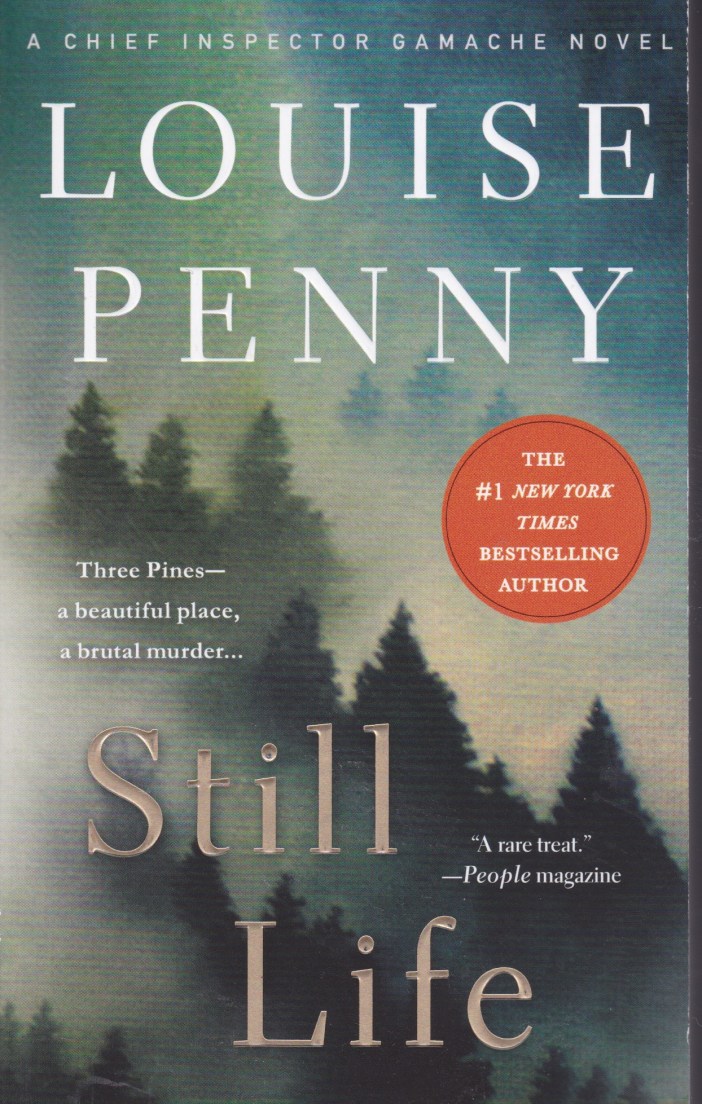
I also finished reading Louise Penny’s Still Life last night.

still life

Miss Jane Neal met her maker in the early morning mist of Thanksgiving Sunday. It was pretty much a surprise all round. Miss Neal’s was not a natural death, unless you’re of the belief everything happens as it’s supposed to. If so, for her seventy-six years Jane Neal had been walking toward this final moment when death met her in the brilliant maple woods on the verge of the village of Three Pines. She’d fallen spread-eagled, as though making angels in the bright and brittle leaves.

Chief Inspector Armand Gamache of the Surete du Quebec knelt down; his knees cracking like the report of a hunter’s rifle, his large, expressive hands hovering over the tiny circle of blood marring her fluffy cardigan, as though like a magician he could remove the wound and restore the woman. But he could not. That wasn’t his gift. Fortunately for Gamache he had others. The scent of mothballs, his grandmother’s perfume, met him halfway. Jane’s gentle and kindly eyes stared as though surprised to see him.

I became part of a discussion on Facebook the other day on whether Louise Penny’s readership–which is quite large–was either male or female. I had not, at the time, read any of Ms. Penny’s work; but I had a paperback copy of her first novel, Still Life, in my TBR pile. I also knew Ms. Penny was quite successful–had hit number one on the New York Times list, been nominated for every possible crime writing award and had won any number of them, and had recently won the Pinckley Prize here in New Orleans (previous winners included Laura Lippman–who was the first recipient–and Sara Paretsky). Any number of people whose opinions I respected were fans, and she got excellent reviews everywhere. I am always a little reluctant to come to the party late–I believe she has twelve or thirteen titles out, and as is my wont, I tend to be hyper-critical of things that have achieved great popularity before I’ve turned my attention to them; it’s a moral failing of which I am quite aware.

First novels can also be tricky. The discussion about Ms. Penny’s readership also veered off, at one point, into a mild debate as to whether her work could be classified as cozy or traditional; there is a distinction between the two categories of crime writing, but it’s also a very fine one; a book can be either, both or neither. I always tend to think of cozies as books with amateur sleuths solving the crime, usually in a small town or village (but not always); traditional do have professionals solving the crime, but aren’t quite as hard-boiled–say, Agatha Christie’s Hercule Poirot novels. Someone else chimed in to say Ms. Penny wrote procedurals, yet another distinction within the field; procedurals obviously have professionals solving the crime and take the reader through police procedure.

Still Life defies categorization; I can only define what I’ve read, after all, and one novel doesn’t give one the ability to officially classify a writer as anything, but this novel seemed, to me, to be both traditional and procedural; the crime-solver is a Surete police detective in Quebec, Armand Gamache, and the book does rather follow his procedure in solving the murder of Miss Neal–shot with an arrow. It also is the story of the village of Three Pines, a close-knit community which is surprisingly diverse for such a small village in the woods in Quebec, close to the American border–there is a black woman who runs the bookstore, and a gay couple who run the B & B which also doubles as a bistro and antique shop. Three Pines is actually a very charming little town, and the book itself is also charming…but it’s not as soft-boiled as these small town mysteries often are.

Agatha Christie’s Miss Marple was also charming, an old spinster who knitted and was kind, but also was a keen-eyed observer of human nature and the goings-on in her small town, St. Mary Mead, and those observations always had a touch of acid in them; Ms. Penny’s characterizations are very similar to those. At first, the way the narrative jumped around and would suddenly give you another character’s point of view for merely a paragraph was just a bit annoying, but as I continued to read on, I realized these sudden shifts were bits where she was defining the character for the reader–and she was doing it masterfully–a few short sentences about that person’s reactions to what was going on at the moment and how their personality, who they were as a person, shaped that reaction; it gave the reader insight into a character that never faltered throughout the rest of the book. Her unpleasant characters were very unpleasant indeed, and the more time you spent with those unpleasant people the less you liked them; even if you felt a bit of sympathy for them in the beginning, she eventually showed you more and more of them until you realized what monsters they truly were. The character of the victim’s niece Yolande was one of these; another was a member of the investigation team, Agent Nichol, whose arrogance and narcissism soon became so unbearable that her final come-uppance was enormously satisfying, even as she failed to learn from it and soon justified it as not being the result of her own failing, but Gamache’s.

Quite monstrous and unsympathetic, indeed.

One of the most interesting things to me about the book–which makes me curious to read more of Ms. Penny’s work–was that the book in and itself, the way it was written, how the story played out, etc., reminded me of Fair Day, the painting Miss Neal had entered into for consideration for an art show in the story. Miss Neal’s art was always seen as primitive at first by the viewer, but the more you looked at it the more it made sense until suddenly the viewer realized that Miss Neal was, in fact, quite genius. At first, the way the story and point of view jumped around seemed disjointed and almost amateurish in its story-telling; but the more time I spent with it I realized it was impressionistic art–once you start seeing the entire story, you realize how clever and brilliant it really is.

And while I was happy to find out the secrets of Three Pines, I was also sorry to finish the book. I certainly enjoyed my visit there, as did Inspector Gamache, and look forward to a return trip.

Goody Two-Shoes

Friday! I made it through another week! Huzzah!

Have you ever wondered how my mind works? Let me give you an example from yesterday:

Before I started the car to run my errands on my way to the office, I saw a headline on my phone as I was stashing it in the center console. The headline had something to do with Melania Trump; I don’t remember what it was. And this is how my thought process went:

Melania is an interesting name, I’ve never heard that name before, but then Michelle Obama was the first First Lady named Michelle, and Laura Bush was the first Laura…they’ve all had unique names, really, Hillary and Barbara and Nancy and Betty and Pat and Ladybird and Jacqueline and Mamie…Mamie is an odd name, I wonder if it was a nickname…those awful bigots in Auntie Mame called her Mamie..gosh I love that movie and haven’t seen it in a long time…I wonder why no one has ever written a book or made a movie called Auntie Maim? It seems like such a natural.

And after I chuckled over the horror novel/movie Auntie Maim:

Rosalind Russell was so great in that movie, she was friends with Joan Crawford, they were in The Women together, it was that unflattering picture in the paper with Roz that convinced Joan to  never go out in public again…I should write an essay contrasting Baby Jane with Sweet Charlotte..Olivia de Havilland was terrific in that but what a movie it would have been with Crawford in that role, I always wanted to write something like Sweet Charlotte…I remember I had that idea twenty or so years ago, what was it called… oh yes, that, how could you write something like that today, oh maybe instead of having the Charlotte character be a woman she could be a gay man, which would have been equally scandalous to be having an affair with a married man but then how would you do the Miriam character they couldn’t both be gay men because that would be a stretch well maybe instead it could be that the lover was murdered and that outed the character and the character ran away and instead of being her cousin the other character is his sister and now Papa’s dying and the thrown away gay son is coming home to make peace with the dying homophobic father and the old crime was never solved…

And then as I pulled into the parking lot at work I wrote the opening in my head, and typed into the Notes app on my phone on my way into the office.

That’s how my mind works.

If you think that’s scary, imagine having to deal with that imagination all the time.

Heavy sigh.

I have maybe three chapters of line edits to input before this bitch of an edit is finished. Only. Three. More.

And I’ve been keeping notes on what and where to tweak.

And for the record, the last time I looked, I’d trimmed 101, 265 words down to around 78,000, give or take a few.

That was a serious line edit.

So, it will probably end up being around 80-85,000 when it gets queried to agents.

Fingers crossed.

And here’s your Friday hunk to slip you into the weekend:IMG_2769


Too Shy

Thursday!

I worked late last night, but also pulled within four or five chapters of being finished with inputting the line edit. Hip hip hurray! HUZZAH indeed! So, so close, and I know exactly how to finish polishing it; I know what needs to be added.

That’s such a lovely feeling, you have no idea.

The rest of this month is going to be a bit challenging; I have to do a lot of bar testing, going to the office on Saturdays, the NO/AIDS Walk is an upcoming Sunday, and just thinking about any and all of it makes me tired. But I will persist. I will persevere. Because I am Gregalicious!

I’m enjoying Louise Penny’s Still Life, which is a really charming read, to be honest, and I can’t think the last time I read a book about which I could use the word charming as a descriptor. Granted, I tend to read darker stuff, but I am enjoying this. I will keep you posted, Constant Reader, as I make my way through the rest of the book. I think I have copies of other Louise Penny novels scattered about the house in TBR piles; but I do think when I finish this I am going to tackle the reread of It. It’s so daunting though, I look at how enormous the trade paperback I recently bought on impulse is, and want to weep. How did I ever read a novel that large in such a short period of time? Will it still hold up after all this time? The suspense! Older Stephen King novels I’ve loved have stood the test of time; and I do think that perhaps I also might give The Shining a reread in October, when I am going to primarily focus on horror, as I always do in the month of Halloween.

I am going to pick up a prescription (I meant to do this yesterday and forgot) and some other errands–since I worked late last night I don’t have to be in until one. I am also going to do some other chores around the house before I leave for the office etc. I am hoping to get some more of the edits input this morning as well.

And here’s a Throwback Thursday hunk for you, Constant Reader, actor Doug McClure:

IMG_2685

Truly

Tuesday! I made it through Monday. I also managed to get a big hunk of edits input into the manuscript, which means I am on the downward slope to getting that finished. I am most likely going to put aside working on Scotty until the edits are finished, now that I’m in a groove, and am very pleased, I must say. I would love to have this done by the weekend, so I can let it sit for another week while I work on Scotty; but I don’t know; that’s going to depend on two things: motivation and energy.

We’ll see how that turns out, won’t we?

Heavy sigh.

I am debating on whether I want to reread It. I bought it the day it was released, back in 1986 (as I have done with everything Stephen King has published since Different Seasons,  and I read it over the course of two days. (I binge-read King’s novels back then; each as they came out, on the day they were released; a habit I have sadly fallen out of.) I also used to reread King novels many times; I can’t count how many times I’ve reread, for example, The Stand, The Dead Zone, ‘salem’s Lot, etc. I still will reread one of those earlier novels on occasion; but I’ve never reread It, though, and I’m not sure why. I think I got out of the habit of rereading King sometime in the mid-1990’s; and what I wouldn’t give for the time to sit down and reread them all, beginning with Carrie and working my way through the most recent. But now that a new film version of It is out, and breaking records, and getting much critical acclaim; it may be time to reread the Big Novel. I loved It the first time, cherishing the characters more so than the story, which did terrify me; but I vaguely remember not liking the ending; which was a first for me with King.

I do love Stephen King, both as a person and as a writer; granted, what I know of him as a person is confined to news reports of things he does, and his Twitter account; plus, I did get to meet him at the Edgars several years ago, which was one of the biggest thrills of my life. It’s hard to describe what King’s work has meant to me; how it’s inspired me as a writer, and pushed me to not only find my own voice as a writer but made me want to figure out how to create characters that, no matter how bad they might be or how awful the things they do, the reader can find some sympathy for. His On Writing is the book I always recommend to beginning writers as a place to start learning to write, and ‘salem’s Lot (with Needful Things running right behind it) is one of the best novels about a small town, and small town life, I’ve ever read. “The Body” is one of my favorite novellas, if not the favorite; and of course the film version, Stand by Me, is one of my favorite films. His uncanny eye for human behavior, his insights into character that are so honest and real and true, are what make the books so damned brilliant for me.

We watched the first episode of American Horror Story: Cult last night as well; it was an excellent start to the season. But that doesn’t mean the show won’t go off the rails as it continues to unfold; it seems like it almost always does. And without the anchor of Jessica Lange giving a balls-out performance at the center, the post-Jessica seasons tend to lose my interest along the way. We never finished watching Hotel, but we did finish the mess that was Roanoke. As Halloween approaches–it’s certainly has felt more like fall around here since Labor Day, with temperatures in the low seventies and no humidity–my mind is turning more and more to reading horror; it’s almost time for my annual Halloween reread of The Haunting of Hill House, and I do have some other horror in my TBR pile I’d like to get through. I promised Katrina Holm I’d read Michael MacDowell’s The Elementals before Bouchercon so we could drink martinis and discuss it; I’ve got some unread Nick Cutter on my shelves, as well as some other things from ChiZine Press (which never disappoints), and there are some Stephen King novels in my collection I’ve yet to read. I also want to reread Peter Straub’s Ghost Story and Floating Dragon; as I said the other day, a horror novel I’ve been thinking about for about thirty years has been percolating in my frontal lobes the last week or so–I finally realized where I could set it, where it would make sense, as opposed to where I’d stubbornly been wanting to set it, where it wouldn’t work so I’ve never been able to write it–and I may start sketching some ideas for it.

And on that note, these edits aren’t going to input themselves.

Here’s a hunk for you, Constant Reader, Eddie Cibrian, in his underwear:

IMG_2636

Tell Her About It

At halftime, LSU was ahead 28-3, and the score could have been even more lopsided.

A punt return for a touchdown was called back for a penalty, and the Tigers also missed two field goals. Chattanooga’s original possession–they got the ball first–was sustained by some sloppy defensive play and some penalties, but after having first-and-goal from the Tiger eight yard line, Chattanooga was forced to kick a field goal–and never led again. Four plays later LSU was ahead 7-3, and never really looked back. Outside of that sloppy play and the penalties, LSU looked very impressive last night, winning 45-10 (Chattanooga’s touchdown came in the fourth quarter when the game was pretty much over, and scored in three plays against the second-team defense.) LSU looked great; getting interceptions, recovering fumbles, completing exciting long passes, and Danny Etling looked calm and cool–sometimes running when he had no one open, sometimes throwing the ball away, never getting intercepted and never getting sacked. (He did get called one time for intentional grounding.) It was, over all, an impressive performance, and LSU could have easily scored over fifty points at the very least.

And it’s always fun to be in Tiger Stadium.

IMG_2726

Today, I have to go make groceries, do some more cleaning, and do some more inputting of edits and I also hope to finish Chapter Five; and maybe tonight we can watch the first episodes of The Deuce and American Horror Story: Cult. I slept really well last night, and I also am planning on making it to the gym for the first time in weeks, and the first time in years without an appointment with my trainer. We’ll see how it goes.

And on that note, it’s back to the spice mines with me.

Stand Back

I have to work today, so am spending this morning catching up on chores around the house. After I get off work, we are heading up to Baton Rouge for tonight’s LSU game, which I am quite naturally excited about. It’s also my first time taking the new car to an LSU game in Baton Rouge! Woo-hoo!

GEAUX TIGERS!

I also started reading Donna Andrews’ latest, Gone Gull, last night, and am enjoying it pretty thoroughly already. I’ve already laughed out loud a couple of times in the first few chapters, an excellent sign, and am looking forward to reading more of it. Since I am working today and going to the game tonight, I have to do other errands–get groceries, etc–tomorrow, but I am also hoping to be able to carve out some time tomorrow to do some writing/inputting edits. I am so far behind on the inputting of the edits–it’s such a tedious process–but maybe if I just devote myself to it tomorrow, I can power through it, and then spend next weekend making the necessary tweaks the manuscript needs to have made before I start querying agents.

Ah, the joyous sting of rejection to come. Woo-hoo. But I’m much better about that sort of thing now than I used to be. Now, as long as the rejection is handled professionally, I no longer mind. And by professionally, I mean that you are notified. There’s nothing more infuriating than writing something for a market–say, an anthology–and finding out you didn’t get into the anthology when the book is released. This has happened to me more than once, and I am really tired of it. I am also really tired of the people involved turning around and saying oh, I just don’t time to contact everyone. Um, it’s part of the fucking job. I notified every single person who submitted a story to Blood on the Bayou–in fact, for every anthology I’ve ever been involved with–to let them know I wasn’t able to use their story, and to encourage them to submit it elsewhere.

There’s no fucking excuse, otherwise.

Agents who say on their website that ‘if you don’t hear from us in two months’ or some other time period? That’s different, because they are letting you know right up front they will only contact you if interested, and are giving you a timeline. Personally, I still think you should thank someone for submitting, but I’m also old school, and maybe agencies nowadays simply don’t have the staff or the time to do that anymore. I’m not an agent, have never been one, and have never worked for an agency, so I give them the benefit of the doubt.

And on that note, tis back to the spice mines.

Here’s a Saturday hunk for you, actor Caspar Van Dien.

21462493_10212914920364356_1506004771641280652_n

Allentown

I was so tired last night when I got home from work–and I worked a short day! After work yesterday, a friend and I went to lunch to a place on the corner of Tulane and Carrollton called Namese, and I had an enormous  bowl of beef pho, which was absolutely delicious. I was in the mood for noodles, and having never actually had pho before, was quite thrilled to try it, and it was amazing. I’ve been wanting to try pho since seeing a show on our local PBS channel, WYES, about the big Vietnamese community in New Orleans, and one of the things they talked about on the documentary was pho. I’d been wanting to try it ever since, and got my chance.

DAMN THAT WAS GOOD.

I’d known we have a big Vietnamese community in New Orleans for quite some time–most of them live in New Orleans East, and were devastated by the flooding after the levees failed back in 2005. Poppy Z. Brite wrote about that community in his brilliant (and deeply disturbing) Exquisite Corpse, doing it so well I never had the nerve to try to write about it myself. (Our first, and only,  Congressman from Orleans Parish was a Vietnamese; Joseph Cao, who defeated “Dollar Bill” Jefferson in the post-Katrina scandal created by the fifty thousand dollars in cash he had stored in his home freezer. Cao was born in Ho Chi Minh City (then called Saigon), and only served one term in Congress–but I liked Congressman Cao; he put New Orleans ahead of party, and I was sorry to see him go.

I have an idea for a noir involving the Vietnamese communities of the Gulf Coast that I hope to write some day. I’ve also been toying with an old idea for a horror novel that’s been dancing in my head for the last thirty years or so–I can tell that I am writing another book; my creativity always spikes when I am writing a book.

Honestly. One would think I could get that under control.

Anyway, I also finished reading Margaret Millar’s Do Evil in Return last night. It wasn’t the below edition I read, but rather one of the volumes of The Collected Millar; this volume also contains Fire Will Freeze, Experiment in Springtime, The Cannibal Heart, and Rose’s Last Summer. But I rather like that Gothic-style cover.

millar-do-evil-in-return-lancer

The afternoon was still hot but the wind carried a threat of fog to come in the night. It slid in through the open window and with curious, insinuating fingers it pried into the corners of the reception room and lifted the skirt of Miss Schiller’s white uniform and explored the dark hair of the girl sitting by the door. The girl held a magazine in her lap but she wasn’t reading it; she was pleating the corners of the pages one by one.

“I don’t know if Dr. Keating will be able to see you,” Miss Schiller said. “It’s quite late.”

The girl coughed nervously. “I couldn’t get here any sooner. I–couldn’t find the office.”

“Oh. You’re a stranger in town?”

“Yes.”

“Were you referred to Dr. Keating by anyone?”

“Referred?”

“Did anyone send you?”

Margaret Millar is a treasure, and her work, despite now being dated because of societal and social changes, are worthy of not only being read by modern audiences but also deserving of study. She, along with Dorothy B. Hughes and Charlotte Armstrong, formed a triumvirate of strong women writing suspense novels featuring women protagonists that were the equal of anything written by male contemporaries; there were numerous other women doing the same, but these three had longer careers and are now being rediscovered, in part thanks to the diligent work of Sarah Weinman and Jeffrey Marks. Library of America has released a two-volume collection of works by great women writers of the time; Soho Crime is releasing thick volumes collecting all of Millar’s work, which I am happily acquiring. I read Armstrong when I was young, and loved her; I am in the process of working my way through the canons of both Millar and Hughes, as well as two other great women writers of the same period, the incomparable Patricia Highsmith and my personal hero, Daphne du Maurier.

Do Evil in Return, originally published in 1950, is ultimately a novel about how society and its hypocritical misogynistic treatment of women can destroy them. The main character of the novel, Dr. Charlotte Keating, is a strong, independent woman with a successful practice in a small California coastal town. She is both single and hard-working; owns her own car and her own home–no small feat for a woman in 1950–and the book opens with a young woman coming to her for help. The woman, Violet O’Gorman, is only twenty and married, but finds herself with a particular problem; estranged from her husband, she had a one-night stand with a married man which has left her pregnant, and she is desperate for an abortion, which of course was illegal in 1950. Dr. Keating–Charley to her friends–refuses to break the law and perform this service, but her heart goes out to her patient and wants to help her, but while distracted by a phone call doesn’t notice the girl slipping out of her office. With a local address her only clue as to how to find Violet, she goes looking for her…and soon finds herself wrapped up in a terrible string of events beyond control, a noose tightening around her own neck. For, like her patient, Charley herself is involved in a love affair with a married man–a platonic one, to be sure, for she refuses to become intimate with him as he is married–and the similarities she sees between herself and young Violet is part of what drives her. The following morning, Violet’s body washes ashore, an apparent suicide, according to the police but Charley herself isn’t so sure.

And of course, she is right.

Millar’s particular genius lies in how casually she lays out her cards; she never tells her reader straight out what’s going on, but allows it to unfurl naturally, leaving it to her reader to figure it out. When we meet Charley’s platonic lover, there is no mention of his being married–Millar simply talks about the stifling existence he has at home with Gwen. As the story continues the reader slowly realizes that Gwen is actually his wife, and she is also one of Charley’s patients. Charley has tried to foist Gwen off on other doctors, but hypochondriac Gwen refuses to see anyone else–and is incredibly needy, ringing Charley for help at all hours of the day or night. Charley’s own feelings for Gwen’s husband also aren’t that simple; and in 1950 divorces weren’t as easy to obtain as they are today.

Perhaps the strongest part of the book is how Millar clearly depicts how claustrophobic a woman’s world was in 1950, and the delicate balance a single, independent professional woman had to maintain. Exposure of the relationship would ruin Charley, both personally and professionally; just as Violet’s unexpected pregnancy has ruined her. Society’s expectations of women, and their sexuality, are the true villains, the true evil in this novel; and the realization that this world Millar so brilliantly depicts was only sixty-seven years ago is truly chilling.

I think this book would be excellent reading for a Women’s Studies course; to let young women know how truly awful and misogynistic society was not so long ago, as a reminder to everyone today how far women have come in a short period of time, and how hard they fought to get to where they are today.