The Letter

It sometimes catches me off-guard when it turns out a favorite movie was adapted from a short story or novel. Many of my favorite writers had their books turned into film more frequently than I think (or knew, or remembered); and more films were based on books and short stories than people remember or think. I knew, for example, that Now Voyager was a novel before a film; so were Stella Dallas, Flamingo Road, Laura, Whatever Happened to Baby Jane, and so forth. I also know W. Somerset Maugham had written Of Human Bondage (the film of which made Bette Davis a star) and the short story “Rain” (filmed with first Gloria Swanson and remade with Joan Crawford). I’d never read Maugham, but I know of his work; it was only recently, however, that I discovered that one of my favorite Bette Davis films, The Letter, was a Maugham short story he himself adapted into a play. Leslie Crosbie is one of Davis’ best performances, opening on a Malaysian rubber plantation with the sound of gunshots, as a man staggers down the front steps of a bungalow-style plantation house, with Bette Davis grimly following, gun in hand, and when he collapses onto the ground, she stands over him and fires four more bullets into his prone body at her feet. It’s an incredible opening, and a remarkable scene for Davis to play. The determination, the anger, the you so deserve worse than this look on her face–yes, she earned an Oscar nomination for that scene alone.

And once I knew (or was reminded; I may have known at one time it was a Maugham story and simply forgotten), I had to read the story.
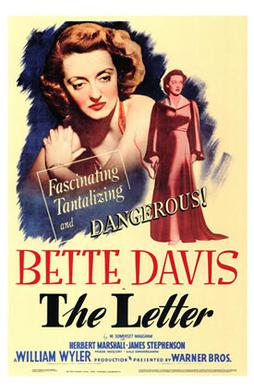
The_Letter_poster

Outside on the quay the sun beat fiercely. A stream of motors, lorries and buses, private cars and hirelings, sped up and down the crowded thoroughfare, and every chauffeur blew his horn; rickshaws threaded their nimble path amid the throng, and the panting coolies found breath to yell at one another; coolies, carrying heavy bales, sidled along with their quick jog-trot and shouted to the passer-by to make way; itinerant vendors proclaimed their wares. Singapore is the meeting-place of a hundred peoples; and men of all colours, black Tamils, yellow Chinks, brown Malays, Armenians, Jews and Bengalis, called to one another in raucous tones. But inside the office of Messrs. Ripley, Joyce and Naylor it was pleasantly cool; it was dark after the dusty glitter of the street and agreeably quiet after its unceasing din. Mr. Joyce sat in his private room, at the table, with an electric fan turned full on him. He was leaning back, his elbows on the arms of the chair, with the tips of the outstretched fingers of one hand resting neatly against the tips of the outstretched fingers of the other. His gaze rested on the battered volumes of the Law Reports which stood on a long shelf in front of him. On the top of a cupboard were square boxes of japanned tin, on which were painted the names of various clients.

There was a knock at the door.

“Come in.”

A Chinese clerk, very neat in his white ducks, opened it.

“Mr. Crosbie is here, sir.”

He spoke beautiful English, accenting each word with precision, and Mr. Joyce had often wondered at the extent of his vocabulary. Ong Chi Seng was a Cantonese, and he had studied law at Gray’s Inn. He was spending a year or two with Messrs. Ripley, Joyce and Naylor in order to prepare himself for practice on his own account. He was industrious, obliging, and of exemplary character.

“Show him in,” said Mr. Joyce.

He rose to shake hands with his visitor and asked him to sit down. The light fell on him as he did so. The face of Mr. Joyce remained in shadow. He was by nature a silent man, and now he looked at Robert Crosbie for quite a minute without speaking. Crosbie was a big fellow, well over six feet high, with broad shoulders, and muscular. He was a rubber-planter, hard with the constant exercise of walking over the estate, and with the tennis which was his relaxation when the day’s work was over. He was deeply sunburned. His hairy hands, his feet in clumsy boots were enormous, and Mr. Joyce found himself thinking that a blow of that great fist would easily kill the fragile Tamil. But there was no fierceness in his blue eyes; they were confiding and gentle; and his face, with its big, undistinguished features, was open, frank and honest. But at this moment it bore a look of deep distress. It was drawn and haggard.

“You look as though you hadn’t had much sleep the last night or two,” said Mr. Joyce.

“I haven’t.”

Mr. Joyce noticed now the old felt hat, with its broad double brim, which Crosbie had placed on the table; and then his eyes travelled to the khaki shorts he wore, showing his red hairy thighs, the tennis shirt open at the neck, without a tie, and the dirty khaki jacket with the ends of the sleeves turned up. He looked as though he had just come in from a long tramp among the rubber trees. Mr. Joyce gave a slight frown.

“You must pull yourself together, you know. You must keep your head.”

“Oh, I’m all right.”

“Have you seen your wife to-day?”

“No, I’m to see her this afternoon. You know, it is a damned shame that they should have arrested her.”

“I think they had to do that,” Mr. Joyce answered in his level, soft tone.

“I should have thought they’d have let her out on bail.”

“It’s a very serious charge.”

“It is damnable. She did what any decent woman would do in her place. Only, nine women out of ten wouldn’t have the pluck. Leslie’s the best woman in the world. She wouldn’t hurt a fly. Why, hang it all, man, I’ve been married to her for twelve years, do you think I don’t know her? God, if I’d got hold of the man I’d have wrung his neck, I’d have killed him without a moment’s hesitation. So would you.”

“My dear fellow, everybody’s on your side. No one has a good word to say for Hammond. We’re going to get her off. I don’t suppose either the assessors or the judge will go into court without having already made up their minds to bring in a verdict of not guilty.”

As you may have noted, Constant Reader, this story was written during a time when casual racism was not only accepted but was par for the course. Maugham wrote during the first half of the twentieth century primarily; “The Letter” was certainly set during the time of decline for the worldwide British Empire (“the sun never sets on the British empire”); an empire that was built on the backs of its enslaved and conquered peoples, and justified its abuses and colonialism and exploitation with the typical white supremacy. The Empire didn’t survive the second World War–the Japanese in particular shattered the Empire’s Asiatic pretensions–but all the worst of British racism and classism and misogyny is there on display in this story (this sentence: Singapore is the meeting-place of a hundred peoples; and men of all colours, black Tamils, yellow Chinks, brown Malays, Armenians, Jews and Bengalis, called to one another in raucous tones–in particular), and really is terribly dated in that regard. The story is also problematic in that it also upholds the standard misogynist trope that a woman will easily and without qualm accuse a man of rape to cover up her own crimes. So, it’s easy to see how such a story could spring from the mind of a gay man in that time period; my gay brothers can make the worst misogynists, I’m ashamed to say, and written during a period when misogyny was so incredibly rampant…yes, I can see it.

The story is vastly different from the film. The film obviously centers Bette Davis; it’s one of her finer performances, and the character of Leslie Crosbie; the story itself is entirely told from the perspective of her attorney, Mr. Joyce. But the bottom line of the story and film are the same: Leslie Crosbie murdered Geoff Hammond; the question is why? Mrs. Crosbie’s story is that he showed up at her door late at night and tried to rape her, and she killed him in self-defense, protecting her honor. The only problem is that she fired four more bullets into his corpse when he was already dead, from close range; this doesn’t sound like self-defense. Mrs. Crosbie herself claims she doesn’t remember any of that; and given that she’s a white woman, her story is she was defending her honor against a rapist, and the victim had taken up with a Chinese woman and was no longer received by honorable people (oh, the racism!), Mr. Joyce has no doubt that Mrs. Crosbie will neither hang nor go to jail; popular opinion in the ruling class is heavily on her side. But it turns out there’s a letter in existence, in her handwriting; begging Geoff Hammond to come see her at her home while her husband was away. Leslie explains this away quickly; in the hubbub of the shooting and its aftermath, she’d quite forgotten she’d invited him over to help her buy a gun as a gift for her husband, and once she hadn’t told the police, and remembered, she couldn’t tell them without making herself look bad. The Chinese woman Hammond was sleeping with has the letter; and wants money for it. Mr. Joyce explains to Mr. Crosbie…who comes up with the money, and then bitterly says to Me. Joyce: “the reason I was away was because I had gone to buy myself a new gun.”

Leslie had lied about her reasons for inviting Hammond over; what else has she lied about? But once the letter has been destroyed, and the jury sets her free–Mr. Joyce asks her one more question–and Leslie explains her truth: she’d been having an affair for years with Hammond, but the Chinese woman–whom he had loved when he was younger–had come back to his life and he no longer wanted anything to do with Leslie. Leslie was furious–bad enough to be thrown over, but for a Chinese woman? She deliberately invited him over that night; he told her he hated her and wanted nothing to do with him, and to her–this justified not only killing him, but her desire to get away with murdering her lover…and, because of racism and misogyny and class, she does.

It was an interesting–if dated–read, and while I winced away from the horrific racism (much worse than the misogyny of how courts always treated upper crust white ladies with such gentility, allowing them to get away with their crimes, and even cheering lustily their acquittals), I’m glad I read the story. I’ll probably read more of Maugham–I’d read Of Human Bondage when I was a teenager and hated it; I should probably reread it through the lens of Waugham’s homosexuality and how that main character’s relationship with toxic Mildred was undoubtedly shaped by his own denial of his sexuality; I’d probably enjoy that more now–and most definitely want to read “Rain”, to see how Sadie Thompson fares in her creator’s words, as well as to see how misogynistic Maugham was in creating her…it seems to me, in the works of his I’ve read, that his female characters were a lot darker and definitely more noir, than I might have thought before.

It might be interesting to retell “The Letter” entirely from Leslie’s point of view. Hmm, now there’s a thought.

Confidential

Here we are, Sunday, and I don’t feel nearly as tired as I did yesterday. Friday and Saturday were days of exhaustion, really; nothing quite makes me feel so old as having to spend most of Saturday on my fainting couch (easy chair) because I have so little energy I can’t really get much of anything done. Oh, I got the laundry finished, and I did a load of dishes, but other than that….yeah, most of the time was spent in the easy chair. We watched Parasite last night on Hulu (it’s streaming free there) and was quite impressed and moved by it; it definitely was not like anything I’ve ever seen before, and that’s saying something, given how most films are merely rehashes of other films, as evidenced by Extraction, the Netflix original film we watched directly after, starring Chris Hemsworth as a mercenary hired to kidnap back an Indian drug lord’s son from the enemy Indian drug lord who’d kidnapped him. That was essentially the plot, and the movie was mostly explosions, guns being fired, and physical fighting scenes (at one point, it occurred to me that I could open a Scotty book with Scotty, Frank and Taylor watching a similar type film, and Taylor idly saying, “This is what Colin does, isn’t it?”–which opens up a huge can of worms.); entertaining mildly, but not a satisfying film-watching experience. It was apparently based on a graphic novel…but let’s just say it was no Watchmen, and leave it at that.

I didn’t write much of anything yesterday because I was so tired, and I tried to read, but my brain couldn’t handle continuing to read a novel, and Scott Heim’s Mysterious Skin deserves better focus from its readers, so I moved on to some short stories. I read W. Somerset Maugham’s “The Letter” (more on that in its own entry) and started reading his “Rain” before my mind derailed again and I had to set the iPad down. I also reread some of my own short stories, that are in some sort of progress–remember how I said the other day that I had nineteen in some stage of completion? There’s actually more than that, if I am being completely honest with myself (which I also knew) and some of the ones I didn’t count–“The Trouble with Autofill,” “Night Follows Night,” “The Enchantress,” “Moves in the Field”, “A Holler Full of Kudzu,” “Once a Tiger,” “Please Die Soon”, “Burning Crosses”–are actually closer to completion than I originally thought; some of them are actually better than I remembered; and letting them sit for so long…rereading them now I was able to see for myself what else the stories needed; the necessary tweaks to get them done and ready to go.

Sometimes you need distance.

Today I have to revise the Sherlock story again, as well as the one I am submitting to a blind-read anthology. They’ve both sat, like the others, for quite some time (at least a week) since I last looked them over, and so I am hopeful that, just as yesterday, rereading the two stories today will help me see what they are missing, so I can get them in order to send them out. April is nearly over, and I need to get these finished, as well as get back to work on the Secret Project; the sooner that is finished the better, quite frankly, and I need to get these things finished and out of my hair; or at least not have them hanging over my head anymore.

Surprisingly, I’m feeling better these days about myself as a writer. I’m not sure what that’s all about, to be honest, but it’s kind of nice. The problem is finding the time and energy to devote and commit to it. Working a basic 9-5 schedule these days is highly unusual and taking more than a little while for me to get used to, if I am being completely honest, and I think the early rising every morning is what is making me so worn out by the end of the week–and sometimes it feels like i need an extra day to recover sometimes. But it is what it is, you know, and the sooner I get adapted to this new reality the better off I’ll be. It isn’t easy, after a lifetime of mostly never working 9-5, to get used to working 9-5. (Cue Dolly Parton’s classic, should have won an Oscar, song.)

I’m behind on everything, I might as well add, not just my writing and not just my reading. My email inbox is overflowing with matters needing my attention; I simply haven’t had the energy or strength over the last two days to even face them, and that must needs be remedied today (I always answer emails as drafts over the weekend, preparatory to send them all on Monday mornings; my first rule of emails is never answer on the weekends because emails beget emails). I knocked off the box of index cards I use as an address book (it’s very twentieth century, and I really need to move everything from it to the spreadsheet address book I created years ago) and those need to be sorted and put away somewhere safe that I won’t knock them over again. I need to do the floors, both kitchen and living room. The sink is again full of dishes. I need to clean stuff out of the refrigerator that is no longer edible–the noodles from over a week ago; the Swedish meatballs from last weekend–and I also need to figure out how to stretch my upcoming paycheck to last another two weeks.

And I have to write today. I want to spend some time with my new story “The Flagellants,” and at least get the ideas about the opening in there and written down. I want to write some more on “Festival of the Redeemer” and “Never Kiss a Stranger.” I want to read some more, since I clearly can focus this morning; I think after I finish writing this and my entry about Maugham’s “The Letter” I may go ahead and do some stretching and then get cleaned up; that always seems to help with motivation and energy. I think this week I have to do some ZOOM things for promotion; I’ll need to check the calendar so I don’t miss out–which has tragically happened before, and will undoubtedly happen again. I suppose there are worse things….it’s really a wonder I have any career at all, quite frankly.

And yet, here I am, some thirty or so novels and some fifty or so short stories into it. Plugging along like some blunderer who doesn’t know what he’s doing so he happily keeps going, writing books and selling stories and getting more publication credits as he goes with little or no direction. I used to  have a plan; I used to make plans–and then everything got so completely derailed during the Time of Troubles that I no longer look ahead, think ahead, plan ahead–what’s that saying? Man plans and the gods laugh?

The Laughter of the Gods would make a great title for my memoirs, should I ever write them. It’s actually a pretty great title, and I should make use of it. *makes note*

I also, of all things, have an idea for a period mystery short story, set in the Roman Jubilee of 1350–that Barbara Tuchman providing me with more ideas all the time. I’d had an idea about writing a crime series set in the fourteenth century and in Italy, following the last years of life of English soldier for hire Sir John Hawkwood, who retired to Italy and died in Florence–but I don’t think he was there in 1350, when someone attempted to murder the Papal Legate and he got an arrow through his cap–this made me think of a story called “The Arrow in the Cardinal’s Cap”, in which the Papal Legate hires Hawkwood to find out who committed this borderline sacrilegious assault on, basically, the Papacy. There is but scant mention in Tuchman’s A Distant Mirror of the incident, and so more research would clearly be needed–I’m not even sure Hawkwood was in Italy at the time, but of course I could fictionalize the character as well, if need be–but I like the idea of writing a period story. I’ve only done a few of those, and while they may be historicals now, they were set during a period I was actually alive and lived through; “The Weight of a Feather” is probably the first and only story I’ve published set during a time I hadn’t been born yet.

So…maybe a trial balloon with a historical story? Why not? I do love history.

And on that note, I’d better head back into the spice mines.


IMG_0474

The Calm Before the Storm

Alfred Hitchcock was a great film director, and was responsible for some of the best movies ever made, from Rebecca through Notorious through North by Northwest to Vertigo to Strangers on a Train to The Birds to Psycho; the list of great Hitchcock films goes on and on and on and has been studied by film academics and written about; you certainly cannot forget Truffaut/Hitchcock, either. Lost in the discussions of his abilities as a filmmaker (and how he was somewhat abusive to his leading ladies) is his contributions to the culture in other ways. Alfred Hitchcock Presents ran for years; an anthology show like The Outer Limits or The Twilight Zone, he presented bizarre stories (often based on short fiction; perhaps the most famous episode of all was based on a Roald Dahl short story in which a wife kills her husband with a frozen leg of lamb, which she then cooks and serves to the investigating police officers) on a weekly basis and the show ran for a long time. (It’s available to stream now, and I keep meaning to dive back into the show.

But Hitchcock also was a master, before it was a thing, of licensing his name out for use; his name meant something as a master director of film suspense, and in addition to the television series there were also anthologies, also published under the aegis of Alfred Hitchcock Presents–my grandmother used to buy and read them; so did my parents–and even today one of the best short story markets for crime is Alfred Hitchcock’s Mystery Magazine. There were anthologies for adults, anthologies for teens and anthologies for kids.

And there was also The Three Investigators.

3 investigators 1

Bob Andrews parked his bike outside his home in Rocky Beach and entered the house. As he closed the door, his mother called to him from the kitchen.

“Robert? Is that you?”

“Yes, Mom.” He went to the kitchen door. His mother, brown-haired and slender, was making doughnuts.

“How was the library?” she asked.

“It was okay,” Bob told her. After all, there was never any excitement at the library. He worked there part time, sorting returned books and helping with the filing and cataloguing.

“Your friend Jupiter called.” His mother went on rolling out the dough on the board. “He left a message for you.”

“A message?” Bob yelled with sudden excitement. “What was it?”

“I wrote it down. I’ll get it out of my pocket as soon as I finish with this dough.”

“Can’t you remember what he said? He may need me!”

“I could remember an ordinary message,” his other answered, “but Jupiter doesn’t leave ordinary messages. It was something fantastic.”

“Jupiter likes unusual words,” Bob said, controlling his impatience. “He’s read an awful lot of books and sometimes he’s a little hard to understand.”

“Not just sometimes!” his mother retorted. “He’s a very unusual boy. My goodness, how he found my engagement ring, I’ll never know.”

She was referring to the time the previous fall when she had lost her diamond ring. Jupiter Jones had come to the house and requested her to tell him every move she had made the day the ring was lost. Then he had gone out to the pantry, reached up, and picked the ring from behind a row of bottle tomato pickles. Bob’s mother had taken it off and put it there while she was sterilizing the jars.

“I can’t imagine,” Mrs. Andrews said, “how he guessed where that ring was!”

“He didn’t guess, he figured it out,” Bob explained. “That’s how his mind works…Mom, can’t you get the message now?”

“In one minute,” his mother said, giving the dough another flattening roll. “Incidentally, what on earth was that story on the front of yesterday’s paper about Jupiter’s winning the use of a Rolls-Royce sedan for thirty days?”

And that is how The Three Investigators series (technically, in the beginning  “ALFRED HITCHCOCK and the Three Investigators”) began. While it’s not as smooth, per se, as the opening of the Trixie Belden series in The Secret of the Mansion, this is also a dramatically different series, and will always have a place in my heart as one of the best series for kids–if not the best–ever published. It never reached the same heights of popularity as Nancy Drew or the Hardy Boys; which was a shame, because it was a much better series than either of those. For one thing, the Three Investigators actually considered themselves to be professional detectives; Nancy and the Hardys, amongst with most of the others, were strictly amateurs (although in the Kathryn Kenny books, “the Belden-Wheeler Detective Agency” became kind of a running gag or thing; it was what Trixie and Honey decided they wanted to be when they grew up; and frankly, I’ve always kind of wanted to see a Trixie-as-an-adult hard-boiled series). And while this opening is a little longish about getting to the point, it eventually does; Bob is a highly excitable young man who works at the library, and this is also our first look at Jupiter Jones, and one of the best things about the series is Jupiter; he is the central character and there would be no Three Investigators without him–and he is one of the most remarkable, and original, characters in kids’ mystery series fiction.

I always thought of Rocky Beach as a sort of stand-on for Long Beach in this series; this is where the boys live, and it’s just south of Los Angeles and a drive to Hollywood. This is where the three boys who make up the titular team of the series live; the third investigator, whom we have yet to meet in this opening, is Pete Crenshaw. And that bit about the contest and the Rolls-Royce? It’s very important. Access to a vehicle, and someone to drive them around, is an integral part of the creation of this investigative agency; they can’t always count on getting rides or paying for cabs or only involving themselves in cases they can investigate on bikes; this is the impetus Jupiter has been looking for to open the agency. Jupiter’s message to Bob is impenetrable to his mother; but it makes perfect sense to Bob–and therein lies another one of the great charms of this series: Jupiter lives with his uncle Titus and aunt Mathilda; the couple own and operate the Jones Salvage Yard, a sprawling junkyard where they repurpose other’s people things, or fix them. Jupiter himself is quite adept at wiring and repairing things; just one, as we the readers will find out, of his many skills. Hidden deep within the salvage yard is the wreck of a mobile home, which the boys use as “headquarters”; over the years Jupiter has managed to hide the mobile home behind piles of junk. The yard is also surrounded by an enormous, tall wooden fence, and Uncle Titus has encouraged local artists to paint murals on the fence. With the help of Bob and Pete, Jupiter has created “secret entrances” into the salvage yard, with tunnels through the piled up junk; that way the boys can come and go as they please without having to use the main entrance. They also have a covered workshop in another area hidden from view; Jupiter’s message to Bob is simply Red gate rover, come over come over, the presses are rolling. Bob knows this means,  come to headquarters, use red gate Rover, and we’re printing our business cards. 

“Red Gate Rover” means use the entrance through the fence that is a mural of a team of firefighters fighting an enormous blaze; there’s a dog watching them, and the knothole in the dog’s eye will spring the hidden gate open. And sure enough, once he gets there, the printing press is rolling and Jupiter presents him with a card, that reads:

THE THREE INVESTIGATORS

We Investigate Anything

? ? ?

–and also has their names. Jupiter is, naturally, the first investigator with Pete as second; Bob is Records & Research, since he works in the library and is their best writer; it is his job to write up their cases. As such, and with an understanding that all cases also need to be introduced as well as get sufficient publicity for their agency to get clients, Jupiter has decided on two things: to ask Alfred Hitchcock to introduce their cases, and offer to help find him a truly haunted house, as he is looking for one for his next film. Using the Rolls-Royce, driven by a very proper British chauffeur named Worthington, Jupiter and Pete call on Mr. Hitchcock at the studio. (The Rolls-Royce, by the way, has every luxurious amenity available to a limousine in that time; and is gold-plated, which sticks out. It was originally commissioned by a Saudi oil millionaire.) They bluff their way in–partly because Jupiter pretends to be Hitchcock’s nephew, even arranging his face to imitate his expressions and voice and patterns of speech–but Hitchcock isn’t that interested in introducing their cases, but has no worries about them looking for a haunted house for him. (While they are calling on Hitchcock, Bob has gone to the library to research something–Jupiter writes the words Terror Castle on the back of one of their business cards and offered no explanation.) But when Jupiter does his impression of “Hitchcock as a 13 year old”, Hitchcock is offended and promises to introduce the first case as long as Jupiter will never do the impression again (and, it is to be noted, the introduction and afterward, as supposedly written by Hitchcock, is clearly done so grudgingly; this was a genius touch by author Robert Arthur–and over the course of the series Hitchcock not only grows fond of the boys but starts sending clients their way).

The thing I loved perhaps the most about this series (outside of the wonderful titles for the books) was they actually were investigators. They actually solved the mysteries they were investigating–well, Jupiter did, mostly–through observation and interpretation of data. Jupiter was, in many ways, kind of a young Sherlock–and he often referred to Holmes. Another thing that was very clever about the series is that the stories were rarely, if ever, told from Jupiter’s point of view; Bob and Pete were always the point-of-view characters, representing the reader, who also couldn’t figure out what was going on. Since it mattered for suspense and storytelling to not know what Jupiter was thinking, Bob and Pete stood in for the reader, confused by the cryptic things Jupiter said–or casually observing Jupiter noticing something that didn’t make sense.

Another thing that, in my opinion, makes the series stronger than others is it is made, very plain, from the very beginning that fat-shaming is a bad thing. Jupiter is described as stocky or husky; he deeply resents being called fat, and whenever someone cruelly makes such an observation, both Pete and Bob always get angry and jump to his defense (Jupiter was also a child star, playing Baby Fatso in a Little Rascals type television show; his being a fat child made him the butt of the jokes in the show and he DESPISES being laughed at)–compare that to how Bess is frequently mocked for being hungry and chubby in the Nancy Drew books, or the depiction of the Hardy Boys’ supposed best friend Chet Morton as an always-hungry, overweight comic relief and foil they always laugh at–yeah, not cool, Stratemeyer Syndicate, not cool at all.

The first Three Investigators story I read was The Mystery of the Moaning Cave. We were in Alabama one summer, and staying with a cousin of my mother’s who had a son my age who also loved to read, and loved mysteries. He had a stack of library books, and I picked up my very first Hardy Boys read, The Mystery of Cabin Island, out of the stack. I was two chapters in when he finished reading his book (The Mystery of the Moaning Cave) and asked me to swap books with him. I was enjoying the Hardy Boys, but the cover of the Three Investigators book he was offering me was tantalizing, plus that title! How could a cave moan? I started reading, and was soon swept up in the story–which remains, to this day, one of my favorites in the series. It reminded me of another book I greatly loved as a child, The Mystery of the Haunted Mine, but the problem was my library didn’t have any of these books, and I could never find more of them anywhere. In junior high a friend of mine was a fan of the series, which led me to reread The Mystery of the Moaning Cave, which I loved all over again, and then its predecessor, The Mystery of the Screaming Clock, which was also amazing. I eventually discovered, on a birthday trip to Toys R Us, an entire shelf of the books; I got five–The Secret of Terror Castle, The Mystery of the Whispering Mummy, The Secret of Skeleton Island, The Mystery of the Laughing Shadow, and The Mystery of the  Coughing Dragon. 

I honestly don’t recall how I was able to collect the rest of the series, or where I got them or what order in which I read them, but I did eventually read the entire series. Later, the series moved on to other authors other than Robert Arthur and the quality became more hit-and-miss, but even the worst Three Investigators case was better than the best books in other series. I still love the Three Investigators, and occasionally will take one down to reread it, again marveling at how well constructed the books are; how tight the plots and how strong the characterizations. I also loved how something small and simple, like the search for an escaped parrot (The Mystery of the Stuttering Parrot) would lead to a massively complicated and interesting case about a massive art theft, or the search for a missing cat with mismatched eyes turned into The Mystery of the Whispering Mummy, or a near car crash led them to a small European principality and international espionage in The Mystery of the Silver Spider. Their cases inevitably started small, but eventually grew into something major; like they grabbed onto a loose, seemingly unimportant thread that unraveled a much larger case.

One thing that always amused me was how adults rarely, if ever, took them seriously. Jupiter’s aunt and uncle, and the parents of Pete and Bob, always looked at their “firm” as a “little mystery-solving club”. Inevitably the adults who pooh-poohed their abilities had to eat their words. I also loved that Jupiter wasn’t athletic but was smart. I identified with that a lot more than I did with the Hardy Boys, who were literally good at everything they tried.

The death of Alfred Hitchcock was an enormous blow, and the publisher–Random House, I believe–introduced a mystery writer for a while to replace Hitchcock, but the quality was already starting to decline, and eventually even the fictitious mystery writer, Robert Sylvester, was replaced by another fictitious entity; but the book in which the switch was made didn’t avoid the truth of Hitchcock’s death, and they actually handled it very well.

And some of the earlier books are seriously dated now; The Secret of Terror Castle centered on the home of a silent film horror star whose career was derailed by his speaking voice when talkies came; obviously, that would have happened around ninety years ago now, so there wouldn’t be any contemporaries still alive. Likewise, The Mystery of the Screaming Clock centered on someone who was a sound effects expert for radio suspense shows–which would, at best, have been seventy years ago now.

I’ve never believed this series was as popular as it deserved to be, nor did it get the attention it truly deserved. The books have been out of print for awhile now–maybe you can get used copies, there may even be ebooks now, I don’t know–but they should still be available. I would love to write one of these, to be honest.

They were the shit, y’all.

Closer to Heaven

Yesterday was Friday, and I was tired.

Really, really tired.

I slept for ten hours last night and woke up still exhausted this morning–bleary-eyed and bone-tired. It makes me a bit nervous, as the last time I was able to sleep so much, or do deeply, only to still be tired, was when I was sick this last time, and whatever that was, I sure as hell don’t want to see it return again. I just feel what we used to say down south–“bone tired”. (Hmm, that’s not a bad title.) So, while I have things to do today–we need to swing by the Cat Practice to get Scooter another bag of food, for one, and I definitely need to do some writing and cleaning and organizing around here, if I have the energy–and in a worst case scenario, I can always simply curl up with some books or short stories. I did manage to do some reorganizing/rearranging of the books last night–out Netflix app on the Apple TV is all fucked up; I’m probably going to have to delete and download it again, which is an enormous pain in the ass. Our wireless was also running ridiculously  slow the last few days, so I rebooted the cable box and the wireless router yesterday, which signed me out of everything fucking thing and I just was too tired to deal with that shit last night. We wound up watching an incredibly bad gay movie on Amazon Prime–I won’t name it out of respect for the effort, time and money that went into it, plus I don’t like dumping on gay creators–during which both Paul and I dozed off here and there, before it was over and I finally retired to bed. I was also too tired last night to focus on doing any reading–which was definitely a lost opportunity, and one that I deeply regret. I’d like to finish reading Scott Heim’s Mysterious Skin this weekend; it’s really quite wonderful, and I’d like to move on to his We Disappear once I finish it. I’ve also got a lot of short stories to read–not the least of which is W. Somerset Maugham’s “The Letter,” and I simply love that it’s the source material for one of my favorite Bette Davis movies, of the same name–and there’s another one, by Mark Twain, about an incident that happened at the court of Charles VI in France (I stumbled on this story somehow; the true story it’s based on is detailed in Tuchman’s A Distant Mirror, which is starting to seem like a really great inspiration for me, almost Biblical in its inspiration). Plus I have, as I noticed last night as I reorganized the books, The Collected Stories of Flannery O’Connor and the latest Lawrence Block anthology–Mr. Block does some seriously excellent anthologies, for the record–and so there’s all kinds of good reading on hand should I have the mental acuity to focus on some reading today.

It’s also not a bad idea to read the stories I am currently readying for submission by the end of the month. Perhaps I should spend the day in my easy chair with print outs of stories and perhaps spend some time with some of my favorite short story writers. It’s also not a bad idea to revisit Bury Me in Shadows, which I have decided to completely overhaul–the problem is the main character’s age, but because I envisioned it originally as being about a teenager, I was stubbornly clinging to that idea, and it actually works better if I advance his age to having just graduated Pre-Law from college and readying to attend law school in the fall; this having a free place to live in the summer and a paying job that is relatively easy makes more sense for the character to agree to what he’s doing; plus it eliminates the entire what is his mother thinking in letting him do this? It will also require me to do some other tweaking (not that kind of tweaking, those days are long in my past, thank you very much), but I also think it’ll be stronger and a better story for it.

Which is always a plus.

I would like to do some work this weekend on other stories that are currently hanging in stasis right now, not the least of which is my pandemic story, “The Flagellants.” I’m not certain why that story is nagging at me; I don’t know what it’s going to be or how its going to end; so I guess it’s one of those stories that will reveal itself to me as I write it, which is madness, really.

Recently someone–I think Gabino Iglesias? I could be wrong–tweeted asking writers to stop talking about how much they hate writing, and his tweets really resonated with me. I don’t hate writing, but it would be easy to assume that I do from reading what I post, tweet and blog about writing. I do love writing; I love everything about it, even the frustrations and irritations–which I usually have to express to get out of my system. Publishing is an entire different subject than writing; I reserve the right to always be able to bitch about the publishing industry and its quirks and utter seeming ridiculousness whenever I please, along with the right to complain about being frustrated with the writing process at any time. But I want to make it very clear that I love writing and that’s why I do it. I love writing what I write, even though I am well aware (and if I wasn’t, have been told enough times by my heterosexual colleagues) that there’s not really any money in writing gay crime stories. But I like writing gay crime stories; I like writing gay characters, and I also feel like the full potential for gay crime stories has yet to be tapped. But I’ve dabbled with heterosexual narratives in my short stories, and if I am ever going to write a novel about straight people–or centering the straight point of view–the short stories are an excellent way to practice.

And…every new story I finish writing puts me that much closer to a second collection of stories, which is very exciting to me. I was originally calling the second collection Once a Tiger and Other Stories, but I am thinking about changing it to This Town and Other Stories, primarily because “This Town” is a better story than “Once a Tiger” and secondly, I like the symbolism of “this town” referring to New Orleans–even though that’s not what the Go-Go’s were referring to in their song of the same title, which was the inspiration for my story. (My original collection began as Annunciation Shotgun and Other Stories before metamorphosing into Survivor’s Guilt and Other Stories.)

I also started writing a blog entry about my love of The Three Investigators, which will probably go up at some point over this weekend; depends, I suppose, on when I finish it. And there’s a shit ton of emails that need my attention in my inbox as well; but I just can’t face that yet today. Maybe later on, after I get some things done, I can spend some time answering emails (as drafts to send on Monday) as well as writing some that I need to send.

But I just heard the dryer stop, which means I need to go fold some clothes and add another load to the dryer, and my coffee cup is also empty and in dire need of refilling; my stomach is growling as well, so it’s probably time for me to push away from the desk, get more coffee, fold some clothes and then have some Honey-nut Cheerios–which has been my pandemic breakfast of choice these days.

It also looks like a beautiful day outside. Have a lovely Saturday, Constant Reader!

IMG_0473

Did You See Me Coming?

And somehow, just like that, we made it to Wednesday again. Well done, Constant Reader; sometimes it feels like we’re just not going to get there.

So, yesterday morning between screenings, I checked out my iCloud drive to just see what precisely I have in progress at the moment (not counting everything else that has been unfinished for years) and the count is: four novels, four novellas, and at least nineteen short stories. (And y’all wonder why I talk about having creative ADHD. Barbara, please.) Then again, should I get all of these things finished by the end of the year, I would absolutely have another short story collection completed (there are already several unpublished, finished stories I have in my “to submit” folders as well, and three that have been sold–two of which are out now–in The Beat of Black Wings and The Faking of the President; so at some point that second collection will be ready to go within the next year or so*) and so it looks as though the dearth of Gregalicious publications will be solved once he gets off his ass and starts finishing things.

Heavy heaving sigh.

One thing I noticed yesterday as I drove to my essential job (yes, my job is considered essential) is that there was a lot more traffic then usual at that time; and then I remembered driving home Friday night after work in heavier traffic than usual as well. Oh no, I thought, I wondered how long it would be before New Orleanians couldn’t stand the isolation anymore and despaired; but there was so little traffic on my way home from work last night that I managed to play one song on my phone through the car speakers as I pulled onto the highway and it was just finishing as I pulled into a parking space across the street from my house (yes, I managed to hit every light as green once I got off the highway too; I LOVE when that happens), so maybe it’s not so bad after all.

These are such strange and new times, and I’m never really certain what to think about them, you know? Or to try to think ahead; this week is about all I can handle right now, thank you very much and good night.  But I’m also a planner, even if the plans and their timing remains somewhat amorphous all the time; it’s just kind of who I am. I’m also aware that if you don’t plan ahead a bit, you tend to get very surprised along the way and that is never, ever a good thing.

Yesterday I discovered, entirely by accident, that one of my favorite old movies–The Letter, starring Bette Davis, had actually been a short story by W. Somerset Maugham first, before he himself adapted it into a play which then became the basis for the two film versions (the more famous Bette Davis version was actually a remake of the Jeanne Engels version from the previous decade), and it was in the public domain, so I downloaded a copy of it to read for the Short Story Project; it’s a long story, clocking in at over 13,000 words, which in today’s world I suppose would make it a novella. I am, of course, rather excited to read the original source material, and I’m not sure I’ve ever read Maugham before–just another one of those great old white male writers I’ve never read; and it occurs to me just now that one of the things I should reread for the Reread Project is Hemingway’s A Farewell to Arms. I’ve never really gotten Hemingway, and certainly didn’t when I was forced to read him in high school–hating the experience so much I never went back to him–but maybe it wouldn’t hurt to give Papa another turn. Perhaps as a more mature adult and reader I can appreciate him more (although my recent reread of The Great Gatsby made me hate the book even more than I already did); but I certainly didn’t mind reading some other Old White Men over the years, like Sinclair Lewis and Theodore Dreiser (I should tackle the massive An American Tragedy sometime; I really liked Sister Carrie when I read it), and I should probably make up one of the greatest gaps in my reading history–The Adventures of Huckleberry Finn, which I’ve never read–but I’ve read a lot of Twain over the years.

It is absolutely insane how many works I have in progress! (I just reread the opening of this entry again) But I do believe that perfectly illustrates my point about my creative ADHD….and there are even more short stories than that, really; those are the ones I’ve worked on at some point over the last few months. And of course, more ideas come to me all the time. Heavy heaving sigh.

And on that note, I need to get ready to face my day. Have a good Wednesday, Constant Reader!

*the third, “The Carriage House”, has been sold to Mystery Tribune, and I’m not sure when it will be released; so stay tuned!

IMG_0695

After the Event

I’ve loved, and been fascinated, by ancient Egypt ever since I was a kid. I don’t remember when, precisely, Egypt became so lodged into my brain; but for as long as I can remember, the ancient history of one of our oldest civilization has intrigued me, and held my interest. I’m hardly an expert–not even close–but I remember pestering my parents to subscribe to the Time-Life Great Ages of Man series; the very first volume of which was, naturally,  Ancient Egypt (for the record, I still have my entire set of those books). Cleopatra, of course, also interested me; I’m not sure if my Egyptian interest came before or after watching the Elizabeth Taylor version of Cleopatra on television. (I still am terribly interested in Cleopatra; the court intrigues and politics of the Ptolemy dynasty makes the Borgias and the Medici look like pikers. I always wanted to write a book about–of all things–Cleopatra’s older sister Berenice, who briefly overthrew their father and took the Egyptian crown. The Romans sent legions to support her father, so her reign was very brief. Her younger sister, Arsinoe, who fought Cleopatra for the throne–only to be defeated by Caesar, also interests me.) I’ve always been interested in Akhenaten (loved Allen Drury’s two books about the Amarna revolution, A God Against the Gods and Return to Thebes), Tutankhamun (of course), and Hatshepsut (I read a great Scholastic mystery set during her reign called The Mystery of the Pharaoh’s Treasure, and I think I bought a copy from eBay a while back; I may have the name wrong.)

But as much as I love Egypt, I didn’t love it enough to read Norman Mailer’s Ancient Evenings. I borrowed it from the library, and couldn’t get through the first chapter.

Sorry not sorry.

As a teenager who loved mysteries, I gravitated towards women authors once I’d fairly exhausted the canons of Ellery Queen, Agatha Christie, and Erle Stanley Gardner primarily because I couldn’t relate or identify with the crime novels being written by men at the time. Grim and hard-boiled and toxic masculinity wasn’t a combination I was terribly interested in at the time; I did appreciate noir (discovering James M. Cain when I was about nineteen was wonderful), though–but that was because I associated it with all those great movies I used to watch with my grandmother. I eventually came around, and started enjoying John D. MacDonald and Hammett and Chandler as I got older.

But when I saw this book on the paperback rack at the grocery store in Emporia, I had to get it. It was a mystery; blurbed by one of my favorite writers, Phyllis A. Whitney, and of course, that was the Sphinx on the cover. I bought it, read it, loved it–and forgot about Elizabeth Peters for about a decade or so (I came back to Barbara Michaels in my mid-twenties, and when I discovered she was also Elizabeth Peters, it didn’t register with me.) Then one day I was in the Waldenbooks and More on Dale Mabry Highway in Tampa when I saw a book on the end cap that called to me: The Last Camel Died at Noon, plus an unmistakably Egyptian scene on the cover. The title and the cover alone sold me–and I also knew by then that Elizabeth Peters was the same writer as Barbara Michaels. I bought it and when I got home, I opened to the first page and started reading….about a page in I stopped. Wait, Emerson and Peabody? I turned back to the beginning of the book and there it was, on the BY THE SAME AUTHOR page: THE AMELIA PEABODY SERIES, and the first title was Crocodile on the Sandbank! 

You can only imagine my delight. I loved those characters, loved that first book, and to find out now there was a series? I read The Last Camel Died at Noon cover to cover in about twenty-four hours, and the next day I went back to Waldenbooks and More and bought the entire series, and settled in to get reacquainted with two of my favorite fictional characters of all time.

crocodile on the sandbank

When I first set eyes on Evelyn Barton-Forbes she was walking the streets of Rome–(I am informed, by the self-appointed critic who reads over my shoulder as I write, that I have already committed an error. If those seemingly simple English words do indeed imply that which I am told they imply to the vulgar, I must in justice to Evelyn find other phrasing.)

In justice to myself, however, I must insist that Evelyn was doing precisely what I have said she was doing, but with no ulterior purpose in mind. Indeed, the poor girl had no purpose and no means of carrying it out if she had. Our meeting was fortuitous, but fortunate. I had, as I always have, purpose enough for two.

I had left my hotel that morning in considerable irritation of spirits. My plans had gone awry. I am not accustomed to having my plans go awry. Sensing my mood, my small Italian guide trailed behind me in silence. Piero was not silent when I first encountered him, in the lobby of the hotel, where, in common with others of his kind, he awaited the arrival of helpless foreign visitors in need of a translator and guide. I selected him from amid the throng because his appearance was a trifle less villainous than that of the others.

I was well aware of the propensity of these fellows to bully, cheat, and otherwise take advantage of the victims who employ them, but I had no intention of being victimized. It did not take me long to make this clear to Piero. My first act was to bargain ruthlessly with the shopkeeper to whom Piero took me to buy silk. The final price was so low that Piero’s commission was reduced to a negligible sum. He expressed his chagrin to his compatriot in his native tongue, and included in his tirade several personal comments on my appearance and manner. I let him go on for some time and then interrupted him with a comment on his manners. I speak Italian, and understand it, quite well. After that, Piero and I got on admirably. I had not employed him because I required an interpreter, but because I wanted someone to carry parcels and run errands.

My God, that incredible, incredible voice.

By the end of the second page, I was madly in love with Amelia Peabody; by the end of the third, I wanted to be Amelia Peabody. How could you not love her? She’s fiercely intelligent, even more fiercely independent, spoke her mind, got straight to the point, and had no desire whatsoever to deal with frivolities, sentimentality, and so forth. The youngest child and only daughter of a classics scholar, her six older brothers got married and left her home to take care of their father. She speaks four languages fluently, and frequently curses the accident of birth that left her a female. Her father died and left her everything–which her brothers thought was fair, until it turned out he was a lot richer than anyone thought and had left her half a million pounds, which was an insane amount of money in the late nineteenth century. Unmarried at thirty-two, she considers herself to be too plain, too old, and too sharp-tongued to ever marry, and has decided she is going to die a spinster. (I could never respect a man who would allow his wife to dominate him, but at the same time I could never allow any man to dominate me.) She decides to use her fortune to travel to visit the places she’s always dreamed of and read about in books–which is what brings her to Rome, along with her paid companion–whom she doesn’t care for, and just chance puts her in the forum at the same time as Evelyn, who faints and Peabody, of course, takes charge. She decides to help Evelyn–who was seduced away from her wealthy family and “ruined”, as well as cut off, and she’d come to Rome with the man she thought she loved only to be abandoned by him, with no clothes but what she is wearing and not a penny to her name. Peabody and Evelyn hit it off, she sends the paid companion back to England and engages Evelyn as her new companion, and they depart for Egypt.

So, now two of our players are now in place; it’s time to meet the other two. Once they are all checked in at Shepheard’s in Cairo, Peabody is quickly besotted with Egypt, and pyramids, in particular–and reading Peabody’s descriptions of the country, you cannot help but fall in love with it, too (not a problem for me; I was already there before I read the book). They go to the Antiquities Museum one afternoon–the director was a friend of Peabody’s father–and Peabody is put off by how disheveled and disorganized–and dusty–everything is. She picks up a dusty pot and begins to wipe the dust from it, only to have an enormous man explode with rage at her. They give each other what-for–they are suitably matched in that regard–and this is Emerson, archaeologist with a passion for discovery and knowledge and preserving the past. Emerson’s brother makes apologies, and a spark is lit between Walter and Evelyn. Soon, the Emersons are off to their dig at Amarna, and Peabody and Evelyn rent a sailboat–a dahabeeyah, to be exact–and begin their trip down the Nile.

Naturally, they stop at Amarna, and stumble into quite a bizarre mystery, which includes an animated mummy and several attempts on our troop’s lives. But the four are definitely up to the task–there are times when I laughed out loud–and hilariously, while both Peabody and Emerson become quite irritated with Walter and Evelyn, who can’t see that the other is madly in love with them; Peabody and Emerson are also falling in love, and refuse to see it, bickering and fighting and–oh, it’s just wonderful and charming, and I know I am failing to do the magnificent Ms. Peters’ work any kind of justice. Amanda is just so, so wonderfully fearless and courageous and pure, and doesn’t even worry about her own safety when those she loves are in danger. The book has a most satisfying resolution, and I remember putting it down that first (much as I do every time I reread it) with a happy smile on my face. The Peabody and Emerson books bring me a lot of joy.

I devoured the entire series, loving them all–the way Peters deftly ages her characters and deepens their relationships, and of course the children…one thing that will always make The Last Camel Died at Noon special for me was that was also the adventure that introduced our merry band of archaeologists to Nofret–and therein lies another tale, for yet another time.

I am so, so delighted I reread Crocodile on the Sandbank. If you’ve not read this series, you really should treat yourself to it, because it is just that: the most amazing gift you can give yourself.

Fancy

Anyone who follows this blog, or follows me on social media, or has ever heard me on a panel anywhere talking about influences and so forth on me as a writer, knows that I love Daphne du Maurier. My novel Timothy is an homage/pastiche of her greatest success as a writer, Rebecca, a terrific novel I reread every year or so because it’s so multi-layered and so surprising; despite the near-constant rereads for most of my adult life, I can still pick it up and marvel at her mastery and how I can still find things in the book that surprise me; new nuggets of insight that change the entire way the book reads. It’s exceptional, it really is, and part of her incredible gift as a story-teller. I would love to–and definitely need to–reread My Cousin Rachel, which Megan Abbott encouraged me to read several years ago and it, too, blew me away completely; I want to reread it because, like everything du Maurier wrote, it changes when you reread it and I can’t wait to see how My Cousin Rachel reads differently on a second time through.

The opening of Mardi Gras Mambo is also an homage to Rebecca; I opened the book with this sentence: “Last night I dreamed I went to Mardi Gras again” and then the next paragraph also was a pastiche and homage to Rebecca. (Little known fact: almost every Scotty book opens with an homage/pastiche to the opening of a famous novel.)

Du Maurier was a terrific novelist, and there are still novels of hers I’ve not read; as I often say here, I hate knowing that there are no more books by an author I love to read, and since du Maurier is dead…yes, there will be nothing new from her, ever again; and so some books, like The House on the Strand and Rule Britannia and The Scapegoat I will pick up off my shelf, pause, and then put back. What also makes it easier to not finish her canon is the fact that, as I mentioned above, you can always reread her novels and they always seem fresh and new. (I would like, at some point, to also reread Frenchmen’s Creek, Jamaica Inn, and The King’s General.)

Du Maurier was also a short story master.

“Don’t Look Now” is one of my all-time favorite short stories (the Visconti film, starring Donald Sutherland and Julie Christie, is also a masterpiece), and I reread it from time to time. It came up again on a thread by Ed Aymer on Facebook recently, which was all about favorite short stories, and I remembered again how much I love this particular story, and wanted to read it again.

My story “Don’t Look Down” is sort of an homage to this du Maurier tale as well; but I made a very deliberate point of not rereading “Don’t Look Now” while I was writing and revising it because I was not only afraid that I might copy her story but I was also concerned that reading her story and being reminded of how good du Maurier was at writing short stories might intimidate me into not finishing it. This morning I took the book down and reread the story, and now I am kind of furious at myself for not rereading the du Maurier during the writing process of my own story; because as I read the du Maurier I realized oh I could have done such a better job on that story. Inevitable, of course, that I would feel that way, but…

“Don’t look now,”  John said to his wife, “but there a couple of old girls two tables away who are trying to hypnotize me.”

Laura, quick on cue, made an elaborate pretence of yawning, then tilted her head as though searching the skies for a non-existent airplane.

“Right behind you,” he added. “That’s why you can’t turn around at once–it would be much too obvious.”

Laura played the oldest trick in the world and dropped her napkin, then bent to scrabble for it under her feet, sending a shooting glance over her left shoulder as she straightened once again. She sucked in her cheeks, the first tell-tale sign of suppressed hysteria, and lowered her head.

“They’re not old girls at all,” she said. “They’re male twins in drag.”

Her voice broke ominously, the prelude to uncontrolled laughter, and John quickly poured some more Chianti into her glass.

“Pretend to choke,” he said, “then they won’t notice. You know what it is–they’re criminals doing the sights of Europe, changing sex at each stop. Twin sisters here on Torcello. Twin brothers tomorrow in Venice, or even tonight, parading arm-in-arm across the Piazza San Marco. Just a matter of switching clothes and wigs.”

“Jewel thieves or murderers?” asked Laura.

And so du Maurier begins her tale, of mystery and supernatural intrigue and suspense, in one of the most beautiful cities in the world, Venice. It starts out innocently enough; a happily married couple on holiday, having a bit of fun at their lunch. But as the story continues, and John and Laura keep joking about the possible identities of the twin sisters. Finally, Laura decides to follow them into the bathroom to “check on them”, with a joking request that if she doesn’t come back, John is to notify the police. So far so good, and actually incredibly charming. But while Laura is gone, John reminisces on the reason for their trip; their daughter, wearing a bright red coat, had drowned accidentally, and while they still have a healthy son at school, he’s brought Laura here to get away and to help her get over how miserably unhappy she’s been since. This immediately shifts the focus of the story in a way only du Maurier can; a charming domestic scene between a happy couple, only to strip away the artifice and expose the raw nerves and unhappiness below. Laura is gone long enough for John to become concerned; and when she does return, what she tells him, high-spiritedly, is that the blind twin is actually psychic, and could see their daughter seated at the table with them! John’s heart sinks, as he is worried about Laura’s mental health, and he immediately concludes the two sisters are charlatans trying to pull some kind of scam, and he worries about their influence on his emotionally fragile wife. There’s also a great throwaway line here,  that foreshadows the outcome of the story–there’s no such thing as a throwaway line in du Maurier, you must pay attention to everything, because she’s so brilliant at sleight of hand; she does this throughout the story, indicating how we all can become so self-obsessed that we don’t see what is plainly in front of us, and a danger–where Laura off-handedly mentions to John that the blind twin also said that he was also psychic, but wasn’t aware of his own gifts.

The construction of this long story is absolutely marvelous, and even when you know the big twist ending, you really have to look for the way du Maurier set up the big twist, and was setting it up, the entire time; almost from the very beginning, and that’s why, when it comes, once the shock and surprise wears off, you kind of smile to yourself, because she didn’t cheat–she was setting you up the entire time.

I tried doing that with my story “Don’t Look Down”, and obviously, didn’t pull it off as well as du Maurier did in “Don’t Look Now” and in many other stories…which is why she is a master and I merely a Gregalicious.

If you haven’t read this story, you really need to–and I also highly recommend, once you’ve read it, that you watch the film, which is also extraordinary.

augMladen-Vukic5

Stand by Your Man

Sunday morning and I’m feeling fine. Yesterday was kind of lovely; I am enjoying this healthy feeling I’m experiencing, and it’s been a while since I’ve not been feeling like shit, so this recovery has been absolutely lovely. Yesterday I managed to be productive yet again–I finished the floors and some odds and ends; there are a few odds and ends that I need to get done today as well–and I got some wonderful reading done; I also managed to get some writing done.

What’s that, you say? Actual writing? Yes, indeed. I wrote about a thousand words on the Sherlock story, give or take; I started writing two new short stories (don’t @ me, I am well aware, but I wanted to get both “Officer Friendly” and “The Pestilence Maiden” started, else I’d forget what they were about or the ideas), and I also did some thinking about all the books and projects that I have in some stage of completion, which was also lovely. It’s nice to slowly be working my way back into my writing again–I was beginning to think I’d never get there, frankly–and yes, it felt really good to be writing again. Today I have to make a run out to get some groceries–my first time leaving the house other than taking out the trash or using the grill–since I got sent home from work over a week ago. I have a mask and gloves, and portable hand sanitizer attached to my key ring. My goal for the morning is to finish this blog, do some other puttering around the house that I need to do before leaving, and then head to the store. When I get back home, I am going to sit down and bang out some more writing, and then at some point I’ll retire to my easy chair to do some more reading.

Now that I’ve actually started to read ebooks, I have to eat a lot of crow. I’ve been resisting reading ebooks for years–I’ve done it, when required, for book award judging, but never really like it and resented having to do it–primarily because I don’t like change, for one thing, and for another, I already spend far too much time looking at screens; the last thing I need to do is read something electronically to relax after staring at a computer screen for a minimum of eight hours a day. My eyes continue to get worse–and it’s a combination of age and blue screen effect, I am fairly certain–and reading electronically was probably not going to help that. But now that I’ve gotten started, I can’t seem to stop. I finished reading This Rough Magic yesterday morning–or was it Friday night? I don’t remember–and yesterday I read a Scott Heim story, “Loam”, and then moved onto another Mary Stewart, Nine Coaches Waiting, which is also fantastic. We watched Zombieland Tap Twice (it was something like that) which was much funnier than I thought it would be, and then the Octavia Spencer horror thriller, Ma–which could have been better, but was perfectly adequate. I do love Ms. Spencer, and wish she would get some better material to showcase her talents more.

I think we’re scheduled to  have shitty weather today, too–rain and so forth–and it looks kind of hazy and sepia-toned out there this morning, and windy–so I should probably get my act together faster this morning and get to the store  so I can not only get it over with, but get back home before the weather turns ugly. Good thing I just looked up the weather–that isn’t going to happen until this afternoon, and I should be able to get there and back before that occurs. It’s also fun to sit at my desk and write during crappy weather, I don’t know why that is, but I like having that tiny barrier of glass between me and the nastiness outside. I’m not sure why that is….but the only thing I like about driving in rain is the coziness of being warm and dry inside my car while only a thin sheet of glass and metal protects me completely from the elements. It’s weird, I know, but everything about me is actually pretty weird; always has been (and for the record, I never became truly happy until I stopped fighting and accepted the weirdness).

I greatly enjoyed Scott Heim’s “Loam”; he’s always been one of the finest writers that our community has produced over the last (gulp) thirty years, and his lack of production has always been a pity and a shame. I read and loved Mysterious Skin years ago, and have always intended to reread it; reading “Loam” got me to find my old copy and place it on the Reread Project pile, which now consists of it, two more Mary Stewart novels (Madam, Will You Talk? and Thunder on the Right), Thomas Tryon’s Harvest Home, Moonraker by Ian Fleming, Sing Me a Death Song by Jay Bennett, Shotgun Opera by Victor Gischler, A Queer Kind of Death by George Baxt, and Harlan Ellison’s collection Strange Wine (I also have Elizabeth Peters’ Crocodile on the Sandbank on deck in my Kindle app).

“Loam” is a long short story about three triplets from the small town of Collingwood, Kansas (is this a nod to Collinwood from Dark Shadows? Perhaps), who are returning for the first time in years, to arrange and attend their father’s funeral. The story begins with the three of them dealing with the rental car arrangements at whatever airport they flew into–I assume Kansas City, which is where I’d fly into if going to visit my part of Kansas–and then slowly, as they make the drive, Heim begins to peel back a trauma the triplets–and the other kids in their first grade class–possibly survived when they were very young; a Satanism scare, in which the teacher and her mentally handicapped son were accused of using (and abusing) the children. This begins to resurface when they stop at a second hand store and find a stack of pictures of their classmates and themselves at that age, possible evidence from the case, which was eventually dismissed as a hoax and a scare–similar to the Satanic scare that happened somewhere else, where the cops basically convinced the children they were abused and to accuse the day care operators of Satanism and abuse–and so we’re never really sure, as are the kids themselves–whether or not it actually happened. It’s very gruesome, and very Gothic, and extremely well written. I recommend it highly; and I wish Scott would write more. I’d never gotten around to his other two novels, In Awe and We Disappear; I’m going to make the time this year, methinks. “Loam” is a Kindle single, part of a group of six stories called “Disorder collection,” whatever that is, and you can get it here for 99 cents. You won’t regret it.

And then I started rereading Nine Coaches Waiting. Again, this is a Mary Stewart novel that I read once, long ago, as I was making my way through the Stewart canon as a teenager; I remember enjoying it, but it didn’t make a strong impression on teenaged me. But as I begin rereading it again yesterday, I could not help but marvel at Stewart’s skill. Nine Coaches Waiting consists of the perfect Gothic romantic suspense set-up; a young orphan girl comes to a huge mansion near the French/Swiss border (she has to fly to Geneva to get there) to be governess to an orphaned young French comte; his estate, Chateau Valmy, is being managed for him by his aunt and uncle; he usually lives with another uncle in Paris, but that uncle, an archaeologist, has been called away for six months to a dig in Greece, and so he has returned to his ancestral home to live with his other uncle. Linda, our twenty-one year old heroine, is half-French and fluent in both languages, but it’s made fairly clear to her during the hiring process that they prefer someone who only speaks English, so that the young Phillippe’s English also will become fluent–as she can only speak to  him in English. Under the cover of that lie Linda comes to Chateau Valmy, and becomes attached to her young charge…while not entirely trusting Phillippe’s aunt and uncle, her employers. What Stewart is doing with this novel is completely subverting the meek governess trope of romantic suspense, that began with Jane Eyre; her employer even mockingly calls her “Miss Jane Eyre” at one point. Victoria Holt went back to the governess well over and over in her novels, from Mistress of Mellyn to The King of the Castle, sticking to, and mirroring, the original trope; I love what Stewart is doing with it, and this is yet another example of what a master writer Mary Stewart actually was.

And on that note, perhaps it’s time for me to get back to the spice mines. Have a lovely Easter Sunday, Constant Reader.

grid-cell-12321-1387651353-4

Amarillo by Morning

So, this morning when I woke up, as my first cup of coffee brewed, I dialed the COVID-19 testing hot-line for staff at the day job and made an appointment to get tested. They scheduled me for 9:20 am; I was called at around eight thirty, which left me with about fifty minutes to wake up, drink some coffee, and pull myself together. Our clinic’s COVID testing set-up is in the parking garage which is the ground floor of our building; staff simply drives into the garage and pulls up to the area where the tents and check-in desk are set up, and the doctor comes out and swabs your nose. Needless to say, as I swilled down coffee and brewed another quick cup to take with me in the car, my nerves were definitely feeling a bit frayed. Saturday was a better day than Friday; yesterday was better than Saturday. So far this morning I seem to feel okay other than fatigue–going up stairs to put on a T-shirt and shorts to drive over to the office made my legs and hips ache a bit; it also triggered a small coughing fit (note: the only time my lungs feel tight is when I cough; other than that I breathe fine and they don’t phase me at all. But when I cough, I feel a tightness in the center of my chest that is pretty severe–but as I said, once the coughing spasm passed, I feel fine) but I got dressed and drove over to the office. It didn’t take long as the streets are pretty empty–there’s some traffic, to be sure, and a pandemic and over-burdened hospitals doesn’t seem to be stopping people from driving like thoughtless assholes–and then I pulled into the garage, got checked in, signed my consent to be tested form, and Dr. Halperin came out and swabbed both nostrils.

And while I can see why the vice-president thought it was invasive–I imagine anything put it any of his orifices would be invasive to him–it really wasn’t that bad. It’s certainly not the worst thing I’ve ever had done to me; I’d certainly rather get my nostrils swabbed like that on a regular basis than have an abscessed tooth ever again, and the worst part of it wasn’t the invasiveness at all. The worst part is the chemical on the swab–it doesn’t quite burn per se, but the closest experience I can think of to it is when you accidentally and deeply inhale mothballs; my eyes watered and it burned a little bit, but not painfully.

In a best case scenario, the test results will be back within 2-4 days–it may be longer, who knows? But I have to go into a strict quarantine until the results do come back, which means not leaving the house or running any errands or doing much of anything. Of course I have gloves and masks, so I can theoretically do some things and leave the house if necessary, but I shouldn’t really take the risk of infecting someone else by going out in public until I know for a certain whether I currently have it, or did have it, or don’t have it at all. I was also a little confused because I’d assumed there would be a blood draw to go with the swab test, but I am also conditioned to thinking about testing for different viruses (HIV, syphilis, and Hep C) so I assumed the testing would also have to involve blood. But then I realized, afterwards as I was driving home, that mucous doesn’t carry the HIV, syphilis or Hep C viruses (virii?); but the COVID-19 virus can be airborne transmitted–which means it must be in the mucous membranes along with the antibodies.

At least that makes testing for it that much easier, so that’s kind of a plus?

I also noticed, this morning, a little bit of PTSD kicking in from the good old HIV/AIDS pandemic days–“oh, look, I need to get tested for a potentially fatal virus and have to wait days to get the results back”–but I quickly tamped that down, shoved the lid closed and firmly padlocked it. I suppose it’s a bit of a surprise that particular version of all the PTSD’s I have locked behind various doors in my brain took so long to try to worm it’s way out, but it did finally show up and I was able to beat it down rather easily.

Thank you, coping mechanisms, developed over several decades of seemingly endless trauma.

I didn’t have to take a nap yesterday, but after we finished watching Miss Fisher and the Crypt of Tears, a lovely stand-alone film follow-up to the wonderful Miss Fisher series from Australia (it was kind of an Indiana Jones-lite adventure, set in Palestine in 1928 and quite fun), I got down my copy of Barbara Tuchman’s A Distant Mirror and opened it up to the chapter about the Black Death. Yes, I recognize that my recent fascination with plagues and epidemics and pandemics is probably morbid, given the current state of affairs in the world, yet my curiosity had always had a bit of morbidity to it and it’s really not surprising that it would take this kind of turn. (And I’m actually kind of glad; I was glad to finally read “Death in Venice” even if it left me a little cold; and it also led me down the path to rereading “The Masque of the Red Death”, and back into my Daphne du Maurier short stories) Realistically, while everyone talks about the Spanish influenza pandemic of a hundred years ago, primarily because it was the most recent pandemic (note to self: reread Katherine Anne Porter’s “Pale Horse Pale Rider”), the worst pandemic in history was clearly the bubonic plague, the Black Death, or, as it was known more simply during the fourteenth century, “the pestilence.”

Here’s how the chapter opens:

In October 1347, two months after the fall of Calais, Genoese trading ships put into the harbor of Messina in Sicily with dead and dying men at the oars. The ships had come from the Black Sea port of Caffa (now Feodosiya) in the Crimea, where the Genoese maintained a trading post. The diseased sailors showed strange black swellings about the size of an egg or an apple in the armpits and groin. The swellings oozed blood and pus and were followed by spreading boils and black blotches on the skin from internal bleeding. The sick suffered severe pain and died quickly within five days of the first symptoms. As the disease spread, other symptoms of continuous fever and spitting of blood appeared instead of the swelling or buboes. The victims coughed and sweated heavily and died even more quickly, within three days or less, sometimes in 24 hours. In both types everything that issued from the body–breath, sweat, blood from the buboes and lungs, bloody urine, and blackened excrement–smelled foul. Depression and despair accompanied the physical symptoms, and before the end “death is seen seared on the face.”

The disease was bubonic plague, present in two forms: one that infected the bloodstream, causing the buboes and internal bleeding, and was spread by contact; and a second, more virulent pneumonic type that infected the lungs and was spread by respiratory infection. The presence of both at once caused the high mortality and speed of contagion. So lethal was the disease that cases were known of persons going to bed well and dying before they woke, of doctors catching the illness at a bedside and dying before the patient. So rapidly did it spread from one to another that to a French physician, Simon de Covino, it seemed as if one sick person “could infect the whole world.” The malignity of the pestilence appeared more terrible because its victims knew no prevention and no remedy.

The chapter is pretty horrific, and it’s hard to imagine what it must have been like to live through in the fourteenth century. It’s impossible to know how many people died because they died so quickly that graveyards overflowed and burial pits had to be dug; people simply dragged the bodies of their dead loved ones to the pits and dumped them there. Estimates were obviously guesses and sometimes exaggerated; one monk’s reported death toll for one particular city, in fact, was more than what its recorded population showed. But it’s not inaccurate to guess that one third of the European population died during the pestilence; towns disappeared, families completely died out. Farms went untended because the farmers and their families died; there were also undoubtedly consequential deaths, not from the plague but because of it; young children whose parents had died starved to death, etc. Naturally they thought it was the end of the world, a punishment from God for sin; and the fourteenth century, which Ms. Tuchman describes as “calamitous”, was certainly ripe for that kind of belief.

One of the interesting things to me about this current pandemic is–and this may entirely be because I am not paying attention and my social media is sort of a bubble; but I cannot believe someone would be saying this about the pandemic and no one i know would notice it and be outraged enough to post about it–where are the evangelicals? Where are all those “end times” preachers and ministers and con artists to prey on the fears of their congregation? Why isn’t anyone pointing out that this could actually be the “rapture” where God is calling his own to him? I have seen that some trashbag minister called this God’s punishment for the gays–but it didn’t gain any traction.

Maybe one of the outcomes of this pandemic will be the ending of that nonsense. I rather doubt it, but you know, hope springs eternal.

I did read for a while yesterday–I got further into Ammie Come Home and I read a short story by Harlan Ellison, “On the Downhill Side”, from his collection Deathbird Stories, which I’d originally read years ago, before I moved to New Orleans, and this story is set in New Orleans. Oddly enough, when I opened the ebook in my Kindle app on the iPad (I was actually looking to see if the collection included his Edgar winning “The Whimper of Whipped Dogs”–it does) it was already opened to that story, so I read it, and as always with Ellison, loved it–and while it certainly is brilliantly written, it was written by someone who didn’t live here. I did love the story; like all of Ellison’s stories, the humanity in it was overwhelming and identifiable and relatable. I’ll probably give it, at some point, its own entry here.

And now I am feeling a bit tired, so I am going to go rest for a bit.

Sexy-Shirtless-Guys-8

Coal Miner’s Daughter

Wednesday, and here we are, in the middle of the week suddenly. It’s also a new month; didn’t March seem to last forever, to the point where it actually felt like it wasn’t just March but Bataan Death March? Does anyone besides me even know what the Bataan Death March was? Americans’ grasp and knowledge of our own history is astonishingly slender and leaves a lot to be desired–which is why the same policies that have failed, repeatedly, throughout our history–“trickle down economics”, anyone–always end up coming back around and fucking us all over again, repeatedly, as new generations continue to be fooled by the desire of the rich and the corporations to fuck us repeatedly, counting on the knowledge that no one knows it has all happened before.

It is astonishing how no one studies the past so we can learn from mistakes made and not repeat them, isn’t it?

I’m actually not, as today’s title might suggest, a coal miner’s daughter but actually a coal miner’s grandson; my grandfather was a coal miner, and received disability until the day he died for the black lung disease he acquired as a result. Alabama isn’t known for coal mining, and I do know that he used to go away to work in the coal mines, so I’m not exactly sure where it was he went to do the work; as a child I didn’t really listen to the stories as closely as perhaps I should have, or it’s the old memory-sieve thing, but I do remember seeing Coal Miner’s Daughter in the theater when it was released, and thinking, when they showed the shack Loretta Lynn grew up in, how similar it was to my maternal grandmother’s house. The house my father grew up in–where my grandfather lived up till pretty close to when he died, I think–wasn’t as ramshackle as my maternal grandmother’s. It never dawned on me to think about how much poverty my parents grew up as children; my maternal grandfather died when my mother was around eleven, and so the only money they ever got was his military pension from serving in the Pacific during the war–and it wasn’t much. My grandmother used to make most of her children’s clothes as well as her own; when I was a kid I remember my mother had mad sewing skills, but they fell into disuse as we moved up the economic ladder as I got older. My parents were, in fact, a perfect example of the upward mobility, the American dream, as it used to exist in those decades that followed the second world war. They married young and moved to Chicago when they were barely twenty and had two small children; they both worked in factories while my dad went to school at night to finish his engineering degree. By the time they were thirty they owned a house in the suburbs and my father was on his way up the corporate ladder; my mom stopped working when he finally made it to management and we were transferred to Kansas. It was always ironic to me that when I was a small child my parents both worked while everyone else I knew’s mom was a housewife; when the economy shifted in my teens my mother became a housewife while most other families became two income.

I didn’t grow up in Alabama, but I grew up thinking of Alabama as home and was raised to have a fierce, deep pride in not only being Southern but in Alabama. I grew up understanding the importance of both Alabama and Auburn football to the pride of the state, and pride in that the fierce rivalry between the two programs was one of the biggest and best in college football. My love for Alabama has grown more conflicted over the years, as I began to reexamine things I was raised to believe in as moral and right and developed my own code of ethics, morality, and right and wrong. Writing Bury Me in Shadows is, in some ways, an attempt to regurgitate and make sense of that through writing. The vast majority of my writing has always firmly centered New Orleans, and writing about New Orleans is probably what I’m best known for, if I am known at all. I have written bits and pieces here and there about other places I’ve lived; I turned Fresno into Polk for the frat boy books, and Tampa into Bay City for other stories, and of course, with the exception of Dark Tide, which was set in the panhandle of Alabama, I primarily fictionalize where I’m from in Alabama as Corinth County–which is where the main character of Dark Tide was from.

Bury Me in Shadows is my first book-length writing about Corinth County; and I decided to show it from the perspective of a native who didn’t grow up there, whose mother moved away before he was born, and has spent very little time there–and hasn’t, in fact, been there since he was eight years old. I am having some fun with it–you can’t go wrong with a meth lab, a burned out plantation house, and the rural woods in northwest Alabama–but it needs some work, and I think I’ve been away from it long enough now so that when I do have the time to go back and start revising and reworking and getting it ready to turn in, my eyes and perspective will be fresh.

I am starting to get more tired though, and it’s harder to get up in the morning than it was earlier in the week. I am only working the morning shift today; this afternoon I have some errands to run and I am going to do some work at home. I think that will help me with the tiredness–the screening process can be draining–and if I get my work done early, I can maybe spend some time reading or writing. I was too tired to read much more of “The Archduchess,” the du Maurier tale I am trying to get through this week, but it’s very interesting. The darkness that always imbues her work is there as the story goes on, which is about a very small European nation whose spring water has some kind of mystical rejuvenating power, but I haven’t gotten to the meat of the story as of yet. But it’s interesting, and I am curious to see where she is going with the story.

I also have a gazillion emails to try to get answered at some point today.

Just thinking about it makes me tired.

And on that note, it’s off to the spice mines. Have a lovely, lovely day, Constant Reader.

e4ebb2626bb0f2c5677c16d9ac93abbc