Forever in Love

Saturday.

I do love the weekends, even the ones when I have over a gazillion things to do.

So, I submitted a story to McSweeney’s. They did an open call for queer stories, and I am a queer writer of queer stories, and I just happened to have a dark little story that just needed to be polished a little bit, which I did yesterday morning and I sent it in. That’s three short stories I have out on spec right now, and my fingers are crossed. All three are kind of long shots, in a way, but nothing ventured, nothing gained, right? I’m hoping to work on the Secret Project this weekend and get it under control, tweak another story to send out on Monday morning, and maybe–just maybe–finish one of these stories of which I don’t have a first draft available to tweak/edit/revise. Which one, I’m not quite sure, but it’s also been a hot minute since I’ve worked on any of the novellas in progress…perhaps this weekend I should give a look to either “Festival of the Redeemer” or “Never Kiss a Stranger.” I kind of want to finish “Condos, for Sale or Rent”; it’s a pandemic story, after all, and it would be interesting to get one of  those written and sent out somewhere….although it could very quickly become dated.

Hell, I started writing it three weeks ago (I think) and it’s probably already dated.

We started watching the new Ryan Murphy Netflix show Hollywood last night, which is essentially about the film industry’s (and by extension, society’s) treatment of minorities and gays during the post-war period when television was rising and the studio system was collapsing. This is the same period I will be writing about in Chlorine, so naturally the show was of interest to me: the fabled Sunday pool parties at George Cukor’s with the gorgeous young men who wanted to be movie stars and if it meant the casting couch so be it; Scotty and the fabled gas station of prostitution; fictional characters mixed in with real ones; Henry Willson and his abusive and predatory agenting methods towards beautiful young men (and Rock Hudson, who is a character in this and very well cast); and the horrors of the LAPD vice squad and how a career could be ruined by an ill-timed arrest or visit to the nelly house (gay bar); and how relationships, actual relationships between men that were more than just sex, weren’t seen as possible (Billy Haines to the contrary). It’s the perfect background for a noir novel, quite frankly, and I also, while watching the first three episodes, came up with the one missing component to my plot for Chlorine–the stakes for my main character, which means now the book is completely possible. The show itself is very well done, the acting superb, and the period setting perfectly done (interesting that the last show we watched, The Plot Against America, was also a period piece and also very well done). I do recommend it; the cast is incredibly pretty, both men and women, and it’s very fun seeing Jim Parsons playing monstrous Henry Willson.

I slept very well last night–the weather was stunningly beautiful yesterday, a gorgeous and incredibly unseasonal cool day, without humidity–and got home from work not only not feeling tired, but fairly energetic. I spent some time once I got home in my easy chair with a purring kitty in my lap, rereading stories that I want to work on and some of the partials that need to become complete, before we tuned into Hollywood. Today, I need to make a brief grocery run, stop and pick up the mail, and run by the bank to deposit a royalty check–always a pleasant feeling, quite frankly–and then I am coming home to probably spend most of the day alternating between cleaning, reading Mysterious Skin (it’s not only haunting but compulsively readable), and doing some writing, as well as some organizing. As I said yesterday, I’d like to get more stories out for submission–it always comes in waves like this–but there are four more markets out there I don’t have something submitted to, and I spent a little time on Submittable looking for markets and found a few more with deadlines later this month that I ‘m going to consider looking at. I also need to finish the Secret Project this week as well; always so much to do.

And that’s not even looking at the emails that are piled up in my inbox. Heavy heaving sigh. But I can spend some time, here and there, today and tomorrow answering emails and saving the drafts to send on Monday morning; I refuse to send emails (except in emergency cases) on the weekends because that simply breeds more emails. And since I’m feeling energized this morning, I kind of want to take on things that need to be taken on, if you know what I mean.

And on that note, I am heading back into the spice mines. You have a lovely day, Constant Reader, and I might check back in on you later today–stranger things have happened–or else I will just talk to you tomorrow.

IMG_0814 a

Break 4 Love

Thursday morning.

I slept rather well last night, even if I did keep waking up periodically throughout the night. I’m not sleepy or tired–at least not thus far,  but it’s still early, Today I have to turn in my Sherlock story, which means going over it one more time today and formatting it properly; it shouldn’t be terribly difficult. Am I nervous? Of course I am; it’s always nerve-wracking when you submit a story that outside of your comfort zone. I also learned yesterday at some point that McSweeney’s is taking submissions for a “queer” issue; I have a couple of stories that might work to submit there–with a little tweaking–so hopefully I will have the wherewithal to deal with doing both of those today.

We watched another episode of The Plot Against America last night, and it’s very well done, and creepy on so many levels. I’ve not seen much about the show in the zeitgeist, but it’s really quite worth watching.

I was tired last night when I finished my work-at-home work (well, it’s not finished, just finished for the day), and so it was another evening of scrolling through Youtube and falling into Youtube wormholes of lists and so forth–and old music videos–before Paul got home and I made dinner, then we talked for a while before watching an episode of the show. Such an exciting life I lead! I literally sometimes  wonder why I bother making myself write these entries every day.  But I am looking forward to this weekend at long last, and my email inbox has already gotten out of control and depressing to look at; my goal for this morning between screening people is to try to get it as cleaned out as possible. Not every email requires an answer, after all, and getting into the trap of answering every email is a fool’s game.

I’ve been extremely scattered again this week, what with all these new story beginnings and ideas I’ve been having. Creative ADHD is certainly the worst, and there are times when I simply can’t reign it in, no matter how hard I try. It’s also sort of frustrating because I know I’m never going to get all these stories written, no matter how hard I work on it; it’s just that some of the titles are almost too good to pass up, you know? I really think “Procession of the Penitents” is a great title; and the idea behind it is also equally good; an assistant ADA, new to her job, sitting second chair to the ADA in charge of sex crimes prosecutions, and the case is a gang-rape at a fraternity party. Then again, it might be too much story for a short story–I’m not certain I can get all the story into six thousand words or less; which sometimes is the problem with my ideas. Before I used to always think in terms of novels–oh this would make a great novel–knowing full well I’ll never get a chance to write every novel I want to write. When I started the Short Story Project two or three years ago, the entire point of it was to retrain my brain into thinking in terms of short stories with the new ideas; it’s worked in that regard, and only in some cases have I come to understand that it’s too much for a short story; but now at least I am thinking in terms of longer stories being novellas. There’s another one I’d love to write–novella or novel–centering Venus Casanova and her last case before she retires from the NOPD; it’s a great idea but then again we have the issue of “should a white gay man write about a black woman?” I mean, sure I can, but will it be authentic? Should I be sucking the air out of the room and taking a publishing slot away from a woman (or man) of color? Probably not, and being a minority myself (although, as I always say, I hit the jackpot by being a cisgender white male; gay is my only crime) doesn’t necessarily make it okay.

The Edgars are being announced today on Twitter at 11 am EDT; you might want to follow @EdgarAwards so you won’t miss a single announcement. Pretty cool. Ordinarily, about now I’d be waking up at the Grand Hyatt in another hour or two, getting some coffee, and getting ready to face the day of the Edgar banquet. I haven’t been in years–I think 2015 was my last attendance–and while I was dreading getting up on stage to speak in front of that glittering room of publishing literati, I’d rather be doing that right now than slurping down coffee and preparing to go to another day of work screening people for symptoms before letting them into our respective buildings. (I work at one building in the morning before switching to the other in the afternoon.)

But such is pandemic life. None of us saw this coming, and back in January when I assumed the role of Executive Vice President of Mystery Writers of America, I certainly had no clue that I’d be presiding over the cancellation of the banquet (first time ever) and symposium (first time ever). Yay for making history?

Heavy heaving sigh.

Yesterday was also payday, but since the first isn’t until tomorrow I don’t have to start paying bills until then–so I am leaving things be, so as to maintain the illusion I have money in the bank for yet another day.

And on that note, hello spice mines! Time to put on my mining helmet and head on back in. Have a lovely Edgar Thursday, Constant Reader!

IMG_0753

The Former Enfant Terrible

I don’t know that I would consider myself a former enfant terrible; I’m not entirely sure I am not currently one, given the actual definition of the term. In French it means unruly child, and I don’t know that I was one of those or not, but the current Webster definition (that of a person whose unconventional or controversial behavior or ideas shock, embarrass, or annoy others)–that I can actually see. I’m certainly annoying; I can be embarrassing; and I am pretty sure I’ve said or done things other people might consider, or see, as shocking. I mean, just being gay shocks some people.

If I could choose which of those three verbs I would pick, if I could only be one: most definitely, without question, annoying.

I am sure there are many who would agree that I have already succeeded on that score. (shrugs) It happens.

Well, we’ve made it to Wednesday somehow, and that’s an accomplishment of which we can be terribly proud. Making it through any day these days is an accomplishment, really; I know that everyone else is as sick of the phrase the new normal as I am (it certainly begs the question of what is normal); and I’m not certain this is a ‘new normal’ anyway; the real new normal is what comes after all of this, and that’s the part I’m kind of worried about, to be honest. What will the new world, arising from the ashes of the COVID-19 pandemic like the phoenix of lore, look like? We had already established that there is a certain percentage of the population who aren’t civic-minded, don’t care about anyone outside of their immediate circle of selfishness, and believe that if they’re unhappy no one else should be; appallingly awful as they are, at least they’re setting example for everyone else of who not to be–although others–a much smaller amount, to be sure–see their wretched behavior and jump on the bandwagon of selfishness and hatred. We’ve always had those people in this country; they were Tories during the revolution; pro-slavery; America First while the Nazis ravaged Europe and began slaughtering undesirables; and so forth.

We started watching David Simon’s new HBO mini-series, The Plot Against America, based on the novel of the same name by Philip Roth. I’m not going to argue the merits of Philip Roth as a writer; he won every conceivable writing award during his lengthy career, and whenever I’ve dabbled into his canon, I’ve not really come away terribly impressed. At the direction of my friend Laura, I read When She Was Good, and I had read another one of his earlier novels already, Letting Go; I wasn’t really impressed terribly by either–I’ve never really understood, or gotten, novels about the sexual messes straight people get themselves into because of their warped sense of everything about themselves, let alone the American puritan ethic about sex and sexuality; I tried reading The Plot Against America because it was a topic that interested me: what if Nazi sympathizer and anti-Semite Charles Lindbergh had been elected president in 1940, rather than Roosevelt winning his unprecedented third term? I gave up about a chapter into it–as I often say about literary novels (looking at you, Jonathan Franzen), why would I read a novel about characters the author clearly doesn’t like? I”m not interested in people debating me about the genius of Philip Roth; I don’t get it, and that’s fine. I’ll give him another try–probably after I finish watching this show, I’ll probably give The Plot Against America another try, It came out around the same time I read Sinclair Lewis’ disturbing, if flawed, It Can’t Happen Here, which was chilling in its depiction of how easily Fascism could rise, and become perfectly acceptable, in this country (I sometimes wonder what Lewis, a brilliant social critic and writer, would think of these modern times in which we find ourselves), which is something I’ve chewed over a few times myself, and have considered writing about at some point. I saw the possibilities of where we are right now back in the 1980’s, during the height of the HIV/AIDS pandemic, as people died and no one cared because it was “the right people” who were doing the dying. That was what first inspired my alternate American history novel idea–one that still is bubbling in the back of my mind, the rise of the American dystopia, and the concurrent horrors that would come in its wake.

I do think that the times in which we currently live will be referred to by future historians as “the Oligarchy” or “the Oligarch Age,” as opposed to the truly falsely named “Gilded Age,” when workers were as disposable as animals and the capitalistic monsters rose to wealth and power in ways unforeseeable to the original founders.

I’m still reading Mysterious Skin (or rather, rereading it) and I’m very interested to find that I don’t remember as much of it as I had originally thought. It brings back to me a lot of memories of Kansas, and while I was never a child there, I can imagine what it would have been like. There’s a dark sensibility to this story, and the writing, that I’m really enjoying; I’ve always believed Scott Heim could write amazing noir stories, and kind of wish he would. I just haven’t been able to focus as clearly on reading as I would like lately; primarily because I’ve been writing again, and apparently, I can either focus on writing or focus on reading, but not both at the same time. It’s a very vivid depiction of being an outsider as a child–for both of its main male characters–and that is certainly something I can relate to, even now; although I never truly felt like an outsider until we moved to suburbia. After that, I spent the next twenty-three years feeling like I didn’t belong, in either my world or any world, for that matter. Heim really gets that across, and far better than I did in Sara.

The weather outside is frightful. Last night as we watched another episode of The Plot Against America, a massive thunderstorm rolled in, and it continued to rain throughout the night–and even this morning, this storm system (or another one, who knows? Not a meteorologist) is still raging outside my windows. Right now the rain has stopped, but when I first woke up it was coming down pretty intensely. It appears that is our forecast for the rest of the day as well, so it’s good, gloomy day for working from home. Ah, there was another blast of lightning, and thunder immediately behind. Yikes! Glad I am not going out there into that mess, quite frankly.

And of all things–because of course I don’t have enough works in progress–I started writing some new short stories last night–“In the Shadow of a Tomb,” “Procession of the Penitent,” “Dimestore Cowboy,” “The Plague Doctor” and “The Arrow in the Cardinal’s Cap”–mostly openings and an idea of the story, and who knows whether anything will ever come out of any of them, really, but it’s nice to be productive again, even if it’s scattered and all over the place. But I am going to try to spend this weekend sending stories out for submission again; it’s a really nice feeling to have stories out in the world, even if they don’t get taken.

And on that note, back to work. Have a lovely Wednesday, Constant Reader!

IMG_0808

For Your Own Good

As Monday rolls around again–huzzah?–and we’re in the last week of April. These last two months have certainly lasted forever, haven’t they? Christ the Lord.

I did something really strange yesterday morning; or rather, more strange than my usual, which is pretty strange. I started writing another Scotty book. It may come to nothing, but ever since the title Quarter Quarantine Quadrille popped into my head a couple of weeks ago, my mind has toyed with the thought over and over again. And since the intro to every Scotty book opens with an homage to the opening of a truly famous classic novel (Rebecca, The Haunting of Hill House, Lolita, Peyton Place, to name but a few) the thought crossed my mind that I could do an homage to “The Masque of the Red Death”, so I looked it up on-line and cut and pasted the first two paragraphs into a word document, and started playing with it a bit. I’ll probably look at the openings of other pandemic-related fictions, like Death in Venice or The Plague before finally deciding on which one to actually use–or even if a Scotty quarantine book is something the world wants or needs–but the actual opening of the first chapter came to me on Saturday night, while we watched that dreadful Chris Hemsworth as a mercenary movie: as I watched a fight scene where Hemsworth’s character took on basically a team of soldiers by himself and killed them all in less than two minutes, Paul said, “I wonder how long this script was? Two pages of dialogue, maybe?” and I thought to myself, this is probably what a Colin novel would have to look like, and from there I leapt to Scotty, Frank and Taylor sitting around during quarantine, watching a movie like this, and Taylor saying, idly, “This is what Colin actually does when he’s not here, isn’t it?” and then forces the questions I’ve been asking myself over the last few books–especially in the last one–about morality and ethics and how do Scotty and Frank and the family look past what Colin’s source of income is? And since I signaled at the end of the last book that Colin was on his way home…and it did come up, during the book, that being involved with Colin makes them targets…that maybe, just maybe, it was time to deal with that in a Scotty book. So I wrote the first few paragraphs of a first chapter, where exactly that happens: they are watching an action/adventure movie when Taylor makes the observation, and the awkward conversation that ensues from it.

It might be a false start and a dead end–Lord knows I already have enough on my plate without trying to write another Scotty book on top of it–but…stranger things have happened.

I also reviewed my Sherlock Holmes story, which was actually much better than I ever dared dream; revising it and making it stronger will not actually be the odious chore I feared it might. On the other hand, I cannot be certain that the editor will feel much the same way about the story as I do, so it must be honed and refined and polished till it gleams in the light of day. (Ironically, I couldn’t remember the end….) But I did a much  better job than I thought I had–yes, I am my own worst critic, this is absolutely true–and this pleases me to no end. The story itself works, and just needs a little bit of tweaking the language and an added sentence here, a subtracted sentence there…yes, I am very pleased with it. Once I get it in shape, off it goes–and I think my other one that’s due this week only needs a tweak here and there as well.

HUZZAH!

Always good news.

We also watched Hustlers–didn’t care too much for it; sorry, felt like it could have been much better–and then the first episode of the Penny Dreadful spin-off, City of Angels, set in Los Angeles in 1938, and I liked it. A lot. It has a very noir sensibility, crossed over with some supernatural/horror elements, and it addresses not only race but Nazi infiltration into Los Angeles in that year–and pulls no punches. Draw your own conclusions, but I thought it was terrific, and look forward to watching the rest of the season. Nathan Lane is very well cast as a hardboiled LA homicide detective, and you can never go wrong with Natalie Dormer. I then watched–while Paul got ready for the week–watched a historical mini-series on Starz called Maximilian and Marie de Bourgogne, I think a multi-language production? Sometimes it sounded like French, sometimes like German, sometimes like something in between; perhaps Flemish? Anyway, it’s quite well-produced and this royal couple never gets the attention they quite deserve, given their marriage resulted in nearly five hundred years of wars between France and Germany (through its many iterations, from Holy Roman Empire to Austrian Empire to German Empire). The fifteenth century is an interesting time; one of blood feuds between branches of both the royal families of England (the Wars of the Roses) and the French Valois (the Orleans and Burgundy branches, respectively; ending with the Burgundy branch being absorbed into the House of Habsburg…so yeah), and a tighter unifying of the Holy Roman Empire into a hereditary throne for the Habsburgs. It was also the century in which Spain was freed of Moorish occupation and unified into Spain again–and once again, the Habsburgs wound up getting involved there and absorbing another throne. I’d known about the series for quite some time, and was glad to see it finally available to stream on one of my (too many) services. Yay, HISTORY!!!

I woke up feeling tired this morning, so I decided to make today another vacation day, stay home and get some things done around the house. I may venture out to the grocery store, but then again, I may not; those trips always seem to exhaust me, and why push it if I don’t have to? I have to be jealously guard my health these days, and my energy–bearing in mind the subconscious depression and angst can also be wearing down my body fairly regularly; another post-Katrina lesson–sometimes you’re not even aware of the depression bogging you down until it actually does. I spent the weekend pretty much in a complete state of exhaustion; it was very odd, and limiting in what I was able to work on and get done. Don’t get me wrong, I am delighted I reread all these in-progress short stories that have been languishing in my “edit” folder for so long–so much so that I actually got ideas on how to fix and rewrite and revise them all; there may be a massive flurry of submissions coming to the few publications out there that take crime stories–but the lack of energy I experienced for the majority of the weekend wasn’t very helpful, really.

And it seems to have carried over into today as well. Yay? Not really.

But I have about a million emails to reply to, several more to initiate, and then I’ going to probably head first into the spice mines, where I need to stay for most of the day. Since I am taking a vacation day, I need to make it worthwhile.

And so, on that note, I am heading back into the spice mines. Have a lovely and productive Monday, Constant Reader. I know I hope to.

IMG_0806

The Letter

It sometimes catches me off-guard when it turns out a favorite movie was adapted from a short story or novel. Many of my favorite writers had their books turned into film more frequently than I think (or knew, or remembered); and more films were based on books and short stories than people remember or think. I knew, for example, that Now Voyager was a novel before a film; so were Stella Dallas, Flamingo Road, Laura, Whatever Happened to Baby Jane, and so forth. I also know W. Somerset Maugham had written Of Human Bondage (the film of which made Bette Davis a star) and the short story “Rain” (filmed with first Gloria Swanson and remade with Joan Crawford). I’d never read Maugham, but I know of his work; it was only recently, however, that I discovered that one of my favorite Bette Davis films, The Letter, was a Maugham short story he himself adapted into a play. Leslie Crosbie is one of Davis’ best performances, opening on a Malaysian rubber plantation with the sound of gunshots, as a man staggers down the front steps of a bungalow-style plantation house, with Bette Davis grimly following, gun in hand, and when he collapses onto the ground, she stands over him and fires four more bullets into his prone body at her feet. It’s an incredible opening, and a remarkable scene for Davis to play. The determination, the anger, the you so deserve worse than this look on her face–yes, she earned an Oscar nomination for that scene alone.

And once I knew (or was reminded; I may have known at one time it was a Maugham story and simply forgotten), I had to read the story.
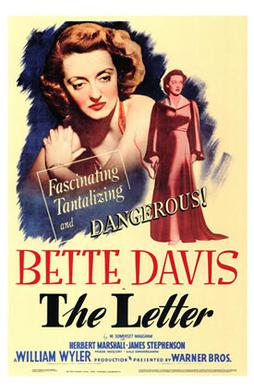
The_Letter_poster

Outside on the quay the sun beat fiercely. A stream of motors, lorries and buses, private cars and hirelings, sped up and down the crowded thoroughfare, and every chauffeur blew his horn; rickshaws threaded their nimble path amid the throng, and the panting coolies found breath to yell at one another; coolies, carrying heavy bales, sidled along with their quick jog-trot and shouted to the passer-by to make way; itinerant vendors proclaimed their wares. Singapore is the meeting-place of a hundred peoples; and men of all colours, black Tamils, yellow Chinks, brown Malays, Armenians, Jews and Bengalis, called to one another in raucous tones. But inside the office of Messrs. Ripley, Joyce and Naylor it was pleasantly cool; it was dark after the dusty glitter of the street and agreeably quiet after its unceasing din. Mr. Joyce sat in his private room, at the table, with an electric fan turned full on him. He was leaning back, his elbows on the arms of the chair, with the tips of the outstretched fingers of one hand resting neatly against the tips of the outstretched fingers of the other. His gaze rested on the battered volumes of the Law Reports which stood on a long shelf in front of him. On the top of a cupboard were square boxes of japanned tin, on which were painted the names of various clients.

There was a knock at the door.

“Come in.”

A Chinese clerk, very neat in his white ducks, opened it.

“Mr. Crosbie is here, sir.”

He spoke beautiful English, accenting each word with precision, and Mr. Joyce had often wondered at the extent of his vocabulary. Ong Chi Seng was a Cantonese, and he had studied law at Gray’s Inn. He was spending a year or two with Messrs. Ripley, Joyce and Naylor in order to prepare himself for practice on his own account. He was industrious, obliging, and of exemplary character.

“Show him in,” said Mr. Joyce.

He rose to shake hands with his visitor and asked him to sit down. The light fell on him as he did so. The face of Mr. Joyce remained in shadow. He was by nature a silent man, and now he looked at Robert Crosbie for quite a minute without speaking. Crosbie was a big fellow, well over six feet high, with broad shoulders, and muscular. He was a rubber-planter, hard with the constant exercise of walking over the estate, and with the tennis which was his relaxation when the day’s work was over. He was deeply sunburned. His hairy hands, his feet in clumsy boots were enormous, and Mr. Joyce found himself thinking that a blow of that great fist would easily kill the fragile Tamil. But there was no fierceness in his blue eyes; they were confiding and gentle; and his face, with its big, undistinguished features, was open, frank and honest. But at this moment it bore a look of deep distress. It was drawn and haggard.

“You look as though you hadn’t had much sleep the last night or two,” said Mr. Joyce.

“I haven’t.”

Mr. Joyce noticed now the old felt hat, with its broad double brim, which Crosbie had placed on the table; and then his eyes travelled to the khaki shorts he wore, showing his red hairy thighs, the tennis shirt open at the neck, without a tie, and the dirty khaki jacket with the ends of the sleeves turned up. He looked as though he had just come in from a long tramp among the rubber trees. Mr. Joyce gave a slight frown.

“You must pull yourself together, you know. You must keep your head.”

“Oh, I’m all right.”

“Have you seen your wife to-day?”

“No, I’m to see her this afternoon. You know, it is a damned shame that they should have arrested her.”

“I think they had to do that,” Mr. Joyce answered in his level, soft tone.

“I should have thought they’d have let her out on bail.”

“It’s a very serious charge.”

“It is damnable. She did what any decent woman would do in her place. Only, nine women out of ten wouldn’t have the pluck. Leslie’s the best woman in the world. She wouldn’t hurt a fly. Why, hang it all, man, I’ve been married to her for twelve years, do you think I don’t know her? God, if I’d got hold of the man I’d have wrung his neck, I’d have killed him without a moment’s hesitation. So would you.”

“My dear fellow, everybody’s on your side. No one has a good word to say for Hammond. We’re going to get her off. I don’t suppose either the assessors or the judge will go into court without having already made up their minds to bring in a verdict of not guilty.”

As you may have noted, Constant Reader, this story was written during a time when casual racism was not only accepted but was par for the course. Maugham wrote during the first half of the twentieth century primarily; “The Letter” was certainly set during the time of decline for the worldwide British Empire (“the sun never sets on the British empire”); an empire that was built on the backs of its enslaved and conquered peoples, and justified its abuses and colonialism and exploitation with the typical white supremacy. The Empire didn’t survive the second World War–the Japanese in particular shattered the Empire’s Asiatic pretensions–but all the worst of British racism and classism and misogyny is there on display in this story (this sentence: Singapore is the meeting-place of a hundred peoples; and men of all colours, black Tamils, yellow Chinks, brown Malays, Armenians, Jews and Bengalis, called to one another in raucous tones–in particular), and really is terribly dated in that regard. The story is also problematic in that it also upholds the standard misogynist trope that a woman will easily and without qualm accuse a man of rape to cover up her own crimes. So, it’s easy to see how such a story could spring from the mind of a gay man in that time period; my gay brothers can make the worst misogynists, I’m ashamed to say, and written during a period when misogyny was so incredibly rampant…yes, I can see it.

The story is vastly different from the film. The film obviously centers Bette Davis; it’s one of her finer performances, and the character of Leslie Crosbie; the story itself is entirely told from the perspective of her attorney, Mr. Joyce. But the bottom line of the story and film are the same: Leslie Crosbie murdered Geoff Hammond; the question is why? Mrs. Crosbie’s story is that he showed up at her door late at night and tried to rape her, and she killed him in self-defense, protecting her honor. The only problem is that she fired four more bullets into his corpse when he was already dead, from close range; this doesn’t sound like self-defense. Mrs. Crosbie herself claims she doesn’t remember any of that; and given that she’s a white woman, her story is she was defending her honor against a rapist, and the victim had taken up with a Chinese woman and was no longer received by honorable people (oh, the racism!), Mr. Joyce has no doubt that Mrs. Crosbie will neither hang nor go to jail; popular opinion in the ruling class is heavily on her side. But it turns out there’s a letter in existence, in her handwriting; begging Geoff Hammond to come see her at her home while her husband was away. Leslie explains this away quickly; in the hubbub of the shooting and its aftermath, she’d quite forgotten she’d invited him over to help her buy a gun as a gift for her husband, and once she hadn’t told the police, and remembered, she couldn’t tell them without making herself look bad. The Chinese woman Hammond was sleeping with has the letter; and wants money for it. Mr. Joyce explains to Mr. Crosbie…who comes up with the money, and then bitterly says to Me. Joyce: “the reason I was away was because I had gone to buy myself a new gun.”

Leslie had lied about her reasons for inviting Hammond over; what else has she lied about? But once the letter has been destroyed, and the jury sets her free–Mr. Joyce asks her one more question–and Leslie explains her truth: she’d been having an affair for years with Hammond, but the Chinese woman–whom he had loved when he was younger–had come back to his life and he no longer wanted anything to do with Leslie. Leslie was furious–bad enough to be thrown over, but for a Chinese woman? She deliberately invited him over that night; he told her he hated her and wanted nothing to do with him, and to her–this justified not only killing him, but her desire to get away with murdering her lover…and, because of racism and misogyny and class, she does.

It was an interesting–if dated–read, and while I winced away from the horrific racism (much worse than the misogyny of how courts always treated upper crust white ladies with such gentility, allowing them to get away with their crimes, and even cheering lustily their acquittals), I’m glad I read the story. I’ll probably read more of Maugham–I’d read Of Human Bondage when I was a teenager and hated it; I should probably reread it through the lens of Waugham’s homosexuality and how that main character’s relationship with toxic Mildred was undoubtedly shaped by his own denial of his sexuality; I’d probably enjoy that more now–and most definitely want to read “Rain”, to see how Sadie Thompson fares in her creator’s words, as well as to see how misogynistic Maugham was in creating her…it seems to me, in the works of his I’ve read, that his female characters were a lot darker and definitely more noir, than I might have thought before.

It might be interesting to retell “The Letter” entirely from Leslie’s point of view. Hmm, now there’s a thought.

Confidential

Here we are, Sunday, and I don’t feel nearly as tired as I did yesterday. Friday and Saturday were days of exhaustion, really; nothing quite makes me feel so old as having to spend most of Saturday on my fainting couch (easy chair) because I have so little energy I can’t really get much of anything done. Oh, I got the laundry finished, and I did a load of dishes, but other than that….yeah, most of the time was spent in the easy chair. We watched Parasite last night on Hulu (it’s streaming free there) and was quite impressed and moved by it; it definitely was not like anything I’ve ever seen before, and that’s saying something, given how most films are merely rehashes of other films, as evidenced by Extraction, the Netflix original film we watched directly after, starring Chris Hemsworth as a mercenary hired to kidnap back an Indian drug lord’s son from the enemy Indian drug lord who’d kidnapped him. That was essentially the plot, and the movie was mostly explosions, guns being fired, and physical fighting scenes (at one point, it occurred to me that I could open a Scotty book with Scotty, Frank and Taylor watching a similar type film, and Taylor idly saying, “This is what Colin does, isn’t it?”–which opens up a huge can of worms.); entertaining mildly, but not a satisfying film-watching experience. It was apparently based on a graphic novel…but let’s just say it was no Watchmen, and leave it at that.

I didn’t write much of anything yesterday because I was so tired, and I tried to read, but my brain couldn’t handle continuing to read a novel, and Scott Heim’s Mysterious Skin deserves better focus from its readers, so I moved on to some short stories. I read W. Somerset Maugham’s “The Letter” (more on that in its own entry) and started reading his “Rain” before my mind derailed again and I had to set the iPad down. I also reread some of my own short stories, that are in some sort of progress–remember how I said the other day that I had nineteen in some stage of completion? There’s actually more than that, if I am being completely honest with myself (which I also knew) and some of the ones I didn’t count–“The Trouble with Autofill,” “Night Follows Night,” “The Enchantress,” “Moves in the Field”, “A Holler Full of Kudzu,” “Once a Tiger,” “Please Die Soon”, “Burning Crosses”–are actually closer to completion than I originally thought; some of them are actually better than I remembered; and letting them sit for so long…rereading them now I was able to see for myself what else the stories needed; the necessary tweaks to get them done and ready to go.

Sometimes you need distance.

Today I have to revise the Sherlock story again, as well as the one I am submitting to a blind-read anthology. They’ve both sat, like the others, for quite some time (at least a week) since I last looked them over, and so I am hopeful that, just as yesterday, rereading the two stories today will help me see what they are missing, so I can get them in order to send them out. April is nearly over, and I need to get these finished, as well as get back to work on the Secret Project; the sooner that is finished the better, quite frankly, and I need to get these things finished and out of my hair; or at least not have them hanging over my head anymore.

Surprisingly, I’m feeling better these days about myself as a writer. I’m not sure what that’s all about, to be honest, but it’s kind of nice. The problem is finding the time and energy to devote and commit to it. Working a basic 9-5 schedule these days is highly unusual and taking more than a little while for me to get used to, if I am being completely honest, and I think the early rising every morning is what is making me so worn out by the end of the week–and sometimes it feels like i need an extra day to recover sometimes. But it is what it is, you know, and the sooner I get adapted to this new reality the better off I’ll be. It isn’t easy, after a lifetime of mostly never working 9-5, to get used to working 9-5. (Cue Dolly Parton’s classic, should have won an Oscar, song.)

I’m behind on everything, I might as well add, not just my writing and not just my reading. My email inbox is overflowing with matters needing my attention; I simply haven’t had the energy or strength over the last two days to even face them, and that must needs be remedied today (I always answer emails as drafts over the weekend, preparatory to send them all on Monday mornings; my first rule of emails is never answer on the weekends because emails beget emails). I knocked off the box of index cards I use as an address book (it’s very twentieth century, and I really need to move everything from it to the spreadsheet address book I created years ago) and those need to be sorted and put away somewhere safe that I won’t knock them over again. I need to do the floors, both kitchen and living room. The sink is again full of dishes. I need to clean stuff out of the refrigerator that is no longer edible–the noodles from over a week ago; the Swedish meatballs from last weekend–and I also need to figure out how to stretch my upcoming paycheck to last another two weeks.

And I have to write today. I want to spend some time with my new story “The Flagellants,” and at least get the ideas about the opening in there and written down. I want to write some more on “Festival of the Redeemer” and “Never Kiss a Stranger.” I want to read some more, since I clearly can focus this morning; I think after I finish writing this and my entry about Maugham’s “The Letter” I may go ahead and do some stretching and then get cleaned up; that always seems to help with motivation and energy. I think this week I have to do some ZOOM things for promotion; I’ll need to check the calendar so I don’t miss out–which has tragically happened before, and will undoubtedly happen again. I suppose there are worse things….it’s really a wonder I have any career at all, quite frankly.

And yet, here I am, some thirty or so novels and some fifty or so short stories into it. Plugging along like some blunderer who doesn’t know what he’s doing so he happily keeps going, writing books and selling stories and getting more publication credits as he goes with little or no direction. I used to  have a plan; I used to make plans–and then everything got so completely derailed during the Time of Troubles that I no longer look ahead, think ahead, plan ahead–what’s that saying? Man plans and the gods laugh?

The Laughter of the Gods would make a great title for my memoirs, should I ever write them. It’s actually a pretty great title, and I should make use of it. *makes note*

I also, of all things, have an idea for a period mystery short story, set in the Roman Jubilee of 1350–that Barbara Tuchman providing me with more ideas all the time. I’d had an idea about writing a crime series set in the fourteenth century and in Italy, following the last years of life of English soldier for hire Sir John Hawkwood, who retired to Italy and died in Florence–but I don’t think he was there in 1350, when someone attempted to murder the Papal Legate and he got an arrow through his cap–this made me think of a story called “The Arrow in the Cardinal’s Cap”, in which the Papal Legate hires Hawkwood to find out who committed this borderline sacrilegious assault on, basically, the Papacy. There is but scant mention in Tuchman’s A Distant Mirror of the incident, and so more research would clearly be needed–I’m not even sure Hawkwood was in Italy at the time, but of course I could fictionalize the character as well, if need be–but I like the idea of writing a period story. I’ve only done a few of those, and while they may be historicals now, they were set during a period I was actually alive and lived through; “The Weight of a Feather” is probably the first and only story I’ve published set during a time I hadn’t been born yet.

So…maybe a trial balloon with a historical story? Why not? I do love history.

And on that note, I’d better head back into the spice mines.


IMG_0474

Casting a Shadow

And it’s Friday again! Cue the dancing horses.

I have a lot that I want to get done this weekend. I need to get those stories pulled together, and I want to get started on finishing off the Secret Project. Stupidly, I also started writing another short story yesterday, “The Flagellants,” which I am not really sure what it’s going to be about, or how to even finish the stupid thing. (An\d because I am twelve years old, sometimes when I think the title quickly it sounds like flatulence, which is a joke I may make in the story because I am twelve years old.) And yes, I got the idea from the bubonic plague chapter in Barbara Tuchman’s A Distant Mirror; during the fourteenth century’s bubonic plague outbreak, the church was already in disrepute and many felt that the plague was God’s judgment on a sinful mankind, so there were some religious cults that sprang up; the flagellants movement was one of these, and it was enormously popular and spread throughout central Europe, primarily Germany. These penitents would march through town and flagellate themselves with whips and cat o’nine tails and knotted ropes, trying to take on the sins of all mankind.

Naturally, I found this interesting, and I really liked “The Flagellants” as a title, and we’re kind of in the midst of a pandemic…granted, we’re not that far into it as of yet, but we’ve already seen ridiculous behavior in the name of Jesus–so far, nothing I’m aware of from other faiths–but I began to think about it some more and wondered, what if this becomes more lethal and lasts longer than anyone is even considering now? The second wave of the Spanish influenza pandemic of 1918-1919 was much worse than the first, and in the wake of the Great War (aka World War I) and said pandemic there was a huge religious revival in the US during the 20’s–we tend to only think of that decade as flappers and bathtub gin, but that wasn’t all that was going on during that decade (it was also the decade that inspired Sinclair Lewis to write Elmer Gantry, and the decade of Aimee Semple McPherson)…and the old “what if” questions started running through my head, and I remembered the religious fanatics who always protest at Mardi Gras and Southern Decadence…and yeah, that’s kind of how stories get born. I’m not sure where this story is going to go or what it’s going to become–it’s kind of fun and different than anything I’ve written before–and I’m not entirely sure it’s going to end up as a crime story, which makes it even more fun.

I slept really long and well last night, and didn’t want to get up this morning, which was lovely–and a long time coming. It’s been a while since I’ve had such a great night’s sleep, and it was absolutely wonderful. I feel rested and ready to go mine some spice this morning.

As expected, Joey Burrow was the Number One draft pick last night, taken by the Cincinnati Bengals–and I said to Paul, “it’s going to be weird rooting for the Bengals now”–one of the many reasons I don’t get so far into the NFL is it is impossible for me to not root for former LSU players and their new teams to do well; and I really can’t devote more time to the NFL than I already give to the Saints. But after last night, I feel it’s pretty safe to say the Saints are Louisiana’s favorite team, and now the Bengals are our second favorite. I also never pay attention to the NFL draft, but I did last night because I wanted to see how the LSU players would do in it. Five players in the first round, I believe–Joey Burrow, K’Lavon Chaisson, Patrick Queen,  Justin Jefferson, and Clyde Edwards-Helaire (which is a record, I believe, for LSU and one short of the overall record)–and now I need to go read the Advocate to see how the rest of the team did, and where they wound up.

Obviously, I will always love this 2019 team and everyone on it. It’s kind of hard not to, after the dream season they just gifted us with–and it’s going to be a very hard act to follow; every LSU team going forward is going to be compared to this one.

This weekend, I hope to get some more writing done. I didn’t get hardly anything written this week (after having such a great writing weekend last weekend), but I do need to finish revising and polishing these stories that are due, and maybe even work some more on some of these ones that are in progress–I may just keep writing “The Flagellants” and see where it goes, just letting it develop as it goes–and I need to start getting some other stuff prepared to get back to work on. I also want to do some reading this weekend; I’ve really fallen behind on that, and I want to make reading more of a priority; it certainly is a better thing to do with my time than falling into Youtube rabbit holes.

And now back to the spice mines.

IMG_0247

After the Event

I’ve loved, and been fascinated, by ancient Egypt ever since I was a kid. I don’t remember when, precisely, Egypt became so lodged into my brain; but for as long as I can remember, the ancient history of one of our oldest civilization has intrigued me, and held my interest. I’m hardly an expert–not even close–but I remember pestering my parents to subscribe to the Time-Life Great Ages of Man series; the very first volume of which was, naturally,  Ancient Egypt (for the record, I still have my entire set of those books). Cleopatra, of course, also interested me; I’m not sure if my Egyptian interest came before or after watching the Elizabeth Taylor version of Cleopatra on television. (I still am terribly interested in Cleopatra; the court intrigues and politics of the Ptolemy dynasty makes the Borgias and the Medici look like pikers. I always wanted to write a book about–of all things–Cleopatra’s older sister Berenice, who briefly overthrew their father and took the Egyptian crown. The Romans sent legions to support her father, so her reign was very brief. Her younger sister, Arsinoe, who fought Cleopatra for the throne–only to be defeated by Caesar, also interests me.) I’ve always been interested in Akhenaten (loved Allen Drury’s two books about the Amarna revolution, A God Against the Gods and Return to Thebes), Tutankhamun (of course), and Hatshepsut (I read a great Scholastic mystery set during her reign called The Mystery of the Pharaoh’s Treasure, and I think I bought a copy from eBay a while back; I may have the name wrong.)

But as much as I love Egypt, I didn’t love it enough to read Norman Mailer’s Ancient Evenings. I borrowed it from the library, and couldn’t get through the first chapter.

Sorry not sorry.

As a teenager who loved mysteries, I gravitated towards women authors once I’d fairly exhausted the canons of Ellery Queen, Agatha Christie, and Erle Stanley Gardner primarily because I couldn’t relate or identify with the crime novels being written by men at the time. Grim and hard-boiled and toxic masculinity wasn’t a combination I was terribly interested in at the time; I did appreciate noir (discovering James M. Cain when I was about nineteen was wonderful), though–but that was because I associated it with all those great movies I used to watch with my grandmother. I eventually came around, and started enjoying John D. MacDonald and Hammett and Chandler as I got older.

But when I saw this book on the paperback rack at the grocery store in Emporia, I had to get it. It was a mystery; blurbed by one of my favorite writers, Phyllis A. Whitney, and of course, that was the Sphinx on the cover. I bought it, read it, loved it–and forgot about Elizabeth Peters for about a decade or so (I came back to Barbara Michaels in my mid-twenties, and when I discovered she was also Elizabeth Peters, it didn’t register with me.) Then one day I was in the Waldenbooks and More on Dale Mabry Highway in Tampa when I saw a book on the end cap that called to me: The Last Camel Died at Noon, plus an unmistakably Egyptian scene on the cover. The title and the cover alone sold me–and I also knew by then that Elizabeth Peters was the same writer as Barbara Michaels. I bought it and when I got home, I opened to the first page and started reading….about a page in I stopped. Wait, Emerson and Peabody? I turned back to the beginning of the book and there it was, on the BY THE SAME AUTHOR page: THE AMELIA PEABODY SERIES, and the first title was Crocodile on the Sandbank! 

You can only imagine my delight. I loved those characters, loved that first book, and to find out now there was a series? I read The Last Camel Died at Noon cover to cover in about twenty-four hours, and the next day I went back to Waldenbooks and More and bought the entire series, and settled in to get reacquainted with two of my favorite fictional characters of all time.

crocodile on the sandbank

When I first set eyes on Evelyn Barton-Forbes she was walking the streets of Rome–(I am informed, by the self-appointed critic who reads over my shoulder as I write, that I have already committed an error. If those seemingly simple English words do indeed imply that which I am told they imply to the vulgar, I must in justice to Evelyn find other phrasing.)

In justice to myself, however, I must insist that Evelyn was doing precisely what I have said she was doing, but with no ulterior purpose in mind. Indeed, the poor girl had no purpose and no means of carrying it out if she had. Our meeting was fortuitous, but fortunate. I had, as I always have, purpose enough for two.

I had left my hotel that morning in considerable irritation of spirits. My plans had gone awry. I am not accustomed to having my plans go awry. Sensing my mood, my small Italian guide trailed behind me in silence. Piero was not silent when I first encountered him, in the lobby of the hotel, where, in common with others of his kind, he awaited the arrival of helpless foreign visitors in need of a translator and guide. I selected him from amid the throng because his appearance was a trifle less villainous than that of the others.

I was well aware of the propensity of these fellows to bully, cheat, and otherwise take advantage of the victims who employ them, but I had no intention of being victimized. It did not take me long to make this clear to Piero. My first act was to bargain ruthlessly with the shopkeeper to whom Piero took me to buy silk. The final price was so low that Piero’s commission was reduced to a negligible sum. He expressed his chagrin to his compatriot in his native tongue, and included in his tirade several personal comments on my appearance and manner. I let him go on for some time and then interrupted him with a comment on his manners. I speak Italian, and understand it, quite well. After that, Piero and I got on admirably. I had not employed him because I required an interpreter, but because I wanted someone to carry parcels and run errands.

My God, that incredible, incredible voice.

By the end of the second page, I was madly in love with Amelia Peabody; by the end of the third, I wanted to be Amelia Peabody. How could you not love her? She’s fiercely intelligent, even more fiercely independent, spoke her mind, got straight to the point, and had no desire whatsoever to deal with frivolities, sentimentality, and so forth. The youngest child and only daughter of a classics scholar, her six older brothers got married and left her home to take care of their father. She speaks four languages fluently, and frequently curses the accident of birth that left her a female. Her father died and left her everything–which her brothers thought was fair, until it turned out he was a lot richer than anyone thought and had left her half a million pounds, which was an insane amount of money in the late nineteenth century. Unmarried at thirty-two, she considers herself to be too plain, too old, and too sharp-tongued to ever marry, and has decided she is going to die a spinster. (I could never respect a man who would allow his wife to dominate him, but at the same time I could never allow any man to dominate me.) She decides to use her fortune to travel to visit the places she’s always dreamed of and read about in books–which is what brings her to Rome, along with her paid companion–whom she doesn’t care for, and just chance puts her in the forum at the same time as Evelyn, who faints and Peabody, of course, takes charge. She decides to help Evelyn–who was seduced away from her wealthy family and “ruined”, as well as cut off, and she’d come to Rome with the man she thought she loved only to be abandoned by him, with no clothes but what she is wearing and not a penny to her name. Peabody and Evelyn hit it off, she sends the paid companion back to England and engages Evelyn as her new companion, and they depart for Egypt.

So, now two of our players are now in place; it’s time to meet the other two. Once they are all checked in at Shepheard’s in Cairo, Peabody is quickly besotted with Egypt, and pyramids, in particular–and reading Peabody’s descriptions of the country, you cannot help but fall in love with it, too (not a problem for me; I was already there before I read the book). They go to the Antiquities Museum one afternoon–the director was a friend of Peabody’s father–and Peabody is put off by how disheveled and disorganized–and dusty–everything is. She picks up a dusty pot and begins to wipe the dust from it, only to have an enormous man explode with rage at her. They give each other what-for–they are suitably matched in that regard–and this is Emerson, archaeologist with a passion for discovery and knowledge and preserving the past. Emerson’s brother makes apologies, and a spark is lit between Walter and Evelyn. Soon, the Emersons are off to their dig at Amarna, and Peabody and Evelyn rent a sailboat–a dahabeeyah, to be exact–and begin their trip down the Nile.

Naturally, they stop at Amarna, and stumble into quite a bizarre mystery, which includes an animated mummy and several attempts on our troop’s lives. But the four are definitely up to the task–there are times when I laughed out loud–and hilariously, while both Peabody and Emerson become quite irritated with Walter and Evelyn, who can’t see that the other is madly in love with them; Peabody and Emerson are also falling in love, and refuse to see it, bickering and fighting and–oh, it’s just wonderful and charming, and I know I am failing to do the magnificent Ms. Peters’ work any kind of justice. Amanda is just so, so wonderfully fearless and courageous and pure, and doesn’t even worry about her own safety when those she loves are in danger. The book has a most satisfying resolution, and I remember putting it down that first (much as I do every time I reread it) with a happy smile on my face. The Peabody and Emerson books bring me a lot of joy.

I devoured the entire series, loving them all–the way Peters deftly ages her characters and deepens their relationships, and of course the children…one thing that will always make The Last Camel Died at Noon special for me was that was also the adventure that introduced our merry band of archaeologists to Nofret–and therein lies another tale, for yet another time.

I am so, so delighted I reread Crocodile on the Sandbank. If you’ve not read this series, you really should treat yourself to it, because it is just that: the most amazing gift you can give yourself.

Ring of Fire

One of the fun things about reading history is it gives me a lot of inspiration. Rereading the Black Death/bubonic plague chapter in Barbara Tuchman’s A Distant Mirror recently, I stumbled across this:

The apparent absence of earthly cause gave the plague a supernatural and sinister quality. Scandinavians believed that a Pest Maiden emerged from the mouth of the dead in the form of a blue flame and flew through the air to infect the next house. In Lithuania the Maiden was said to wave a red scarf through the door or window to let in the pest. One brave man, according to legend, deliberately waited at his open window with drawn sword and, at the fluttering of the scarf, chopped off the hand. He died of his deed, but his village was spared and the scarf long preserved as a relic in the local church.

And so, an idea for my own story, “The Pestilence Maiden,” was born. So far it consists of one sentence: “Death again walked the crumbling, hole ridden streets of New Orleans.”

Great opening, isn’t it? But it’s not really a crime story; since the Pestilence Maiden would be a supernatural, purely symbolic creature representing the plague come to New Orleans, yet again.  After all, New Orleans has a long history of epidemics–yellow fever, typhus, cholera; hell, we even had bubonic plague in 1916–so is it so far out of the question that we would have a Pestilence Maiden walking the streets of the city? No, not really.

I returned to work yesterday, and it was lovely to get out of the house for a while and be out in the fresh air. I am working at doing the screenings; basically, our facility is open for certain services (the food pantry, the pharmacy, some lab work by appointment) and so everyone who goes into the building needs to be screened for symptoms, given a sticker and a mask, and some hand sanitizer before they go inside. Anyone with symptoms gets sent across the parking lot for COVID-19 testing; we no longer require a fever or multiple symptoms–all you need is one. We are also offering optional HIV testing for anyone who gets a COVID-19 test; we also have oral swab kits for people who want to pick one up and test themselves at home–but their exposure has to have been more than three months out, rather than our usual anyone can get an HIV test at any time we are open for testing. I’m very glad and happy that we are back to providing some HIV testing; we may not be what we were but at least we are able to do something, you know? I also suspect that people are violating quarantine for sex hook-ups, which means there’s going to be a strong need for STI testing once “shelter-at-home” orders have been lifted.

I mean, yay for job security, I guess? Even if it ghoulish.

I would much rather the HIV pandemic come to an end, frankly, even if puts me out of a job.

I finished rereading Crocodile on the Sandbank last night, and, well, Dr. Mertz deserved to be named a Grand Master for that book alone. The voice of Amelia Peabody–everything about Amelia Peabody–is absolute genius. Rereading the book, I fell in love with Peabody and Emerson and Evelyn and Walter all over again. The brilliance of how she constructed this book, those characters–I mean, wow, the woman was an absolute master. I mourn every year since Dr. Mertz’ death that there is no new Amelia Peabody adventure to enjoy, to laugh out loud at the rapier-like wit of the dialogue, and the frank adoration of both couples, not only for their partners but for their beloved friends, who all shared this initial adventure together and literally all met during the course of this book…wow. Just wow. It will get its own blog post soon enough, but oh, how I love and miss Peabody and Emerson.

I really missing visiting them and their Egypt.

It’s also Pay-the-Bills day, which is never, no matter what anyone might think, much fun. But I whipped through them all, and am glad to  have that mess behind me. I am also wondering about when I can schedule a Costco trip. I’d rather not go on the weekend, for obvious reasons–if there was a line to get in Wal-mart, I can’t imagine Costco isn’t doing the same thing, you know–but there are things I need to get from there, and so might as well bite the bullet and figure out when I can go. (The case of Pellegrino alone…)

We started watching Murder is My Life, an Australian crime series starring Lucy Lawless, on Acorn streaming last night. One can, of course, never go wrong with anything if Lucy Lawless is in it, and it’s actually quite fun and well done. (I was watching while at the same time racing to finish Crocodile on the Sandbank.) It’s always fun to find a new show, and let’s face it, Acorn is one of the esssential streaming services if you like British and/or Australian crime television.

How is everyone doing out there these days? Difficult times, to be sure–and it’s okay to get overwhelmed sometimes. While I have never–who has?–been involved or experienced anything this epic and global before, I’ve actually been through a local natural/manmade disaster; and some deeply personal level stuff that required my acquisition of numerous coping skills and mechanisms. Those coping skills have come in handy, believe you me, since the curtain came down and the world shut done to deal with this global pandemic. And as it seems to stretch out in front of us endlessly, with no real end in sight–there’s no way of knowing, so we are still charting strange new waters–just always remember this, Constant Reader: when you are starting to get overwhelmed by the scope and enormity of the macro, find something micro to fixate on, and focus on that–something small you can handle, get taken care of, and can be in control of; whether that’s cleaning out old clothes from the closet or dresser you will never wear again, or doing your windows, and a deep clean of your floors, including baseboards–that focus will get you through. Every single time, it will get you through.

And on that note, I am going to head back into the spice mines. I am working from home today–the endless data entry–and need to get working on my emails.

Have a lovely Wednesday, Constant Reader, and stay safe.

febChase Isaacs4

A Man Could Get Arrested

And today I am going back to work. I took a vacation day yesterday–one last gasp, as it were–and actually managed to get some writing done. I got another two thousand (almost three) words done on the Sherlock story; which was great because I was beginning to think I was never going to get back into a writing groove again. They may not be good words, but they are words, and I will take them gladly, thank you very much.

It felt really nice to be writing again, and writing something that I should be writing, instead of all these story fragments and openings that I’ve been working on lately; something I need to be getting finished rather than letting my creative brain ping all over the place uncontrollably, like a pinball. It’s also kind of nice to be going back to work this morning; I am very much a boundary person, and because i am so jealous of my free time, there are definitely boundaries I’ve set up around my job–primarily if you aren’t getting paid don’t spend time on it.

It can be tricky sometimes.

But I’ve been out for over a week now, and as you can imagine, isolating myself entirely from my day job for that amount of time has left me without a clue as to what is going on at the office, and I do have to swing by there today, if not to stay and work (I’m not sure what will be needed or required from me now) or if I have to come back home and do data entry (but there’s something at the office I need in order to continue doing that), so who knows what the day holds for me?

Heavy sigh. These are, after all, strange times in which to be living.

The weather here has cooled off–the cold front that resulted in those dreadful storms across the south on Sunday has lingered; yesterday was actually kind of a lovely day, all things considered–sunny and cool in the low seventies, a beautiful and rare spring day–but alas, my trip to the uptown Rouse’s yesterday did not yield what I needed it to, and am going to have stop at the one in the CBD on the way home from the office to get the other things I need.

Oh! I am also guesting over at Art Taylor’s The First Two Pages today, talking about my story “The Silky Veils of Ardor” in Josh Pachter’s anthology The Beat of Black Wings.

One of the more interesting things about this entire quarantine/shelter-at-home experience with COVID-19 is the behavioral changes I’ve made. I’ve already mentioned that I’ve become a bit addicted to my Kindle app on my iPad, after years of vowing not to read electronically; I’ve actually been using my phone as a phone as well, which is terrifying to consider. I’ve successfully avoided and staved off phone calls for years, other than calling in to board meetings. Who knows, I may even start listening to podcasts. The world has turned upside down.

But I also started a wondrous reread last night: Elizabeth Peters’ Crocodile on the Sandback, which is the first in one of my favorite series of all time, and introduces us to Amelia Peabody, the headstrong spinster heiress who decides to visit Egypt–her father was a classics scholar, while her older brothers married and moved away, she stayed with her father to take care of him and inherited his enormous fortune when he died, and decided to see all the places her father studied–and her wit and charm! Obviously, I loved the Amelia Peabody series, and the characters, but I had forgotten how much. My God, Amelia can make me laugh out loud, and revisiting the book, I remembered how much I loved her–and this book, where she meets the three people (Emerson, Walter, and Evelyn) who are destined to be her created family (along with Abdullah) and when she finally reaches Egypt and falls in love with the country…and that take charge and take no prisoners attitude….well, before I knew it, I was zipping along in the book and was close to being finished with it. Trust me, when I am finished there will definitely be a blog appreciation of Amelia Peabody.

And I should get to work now. Have a lovely day, all, and I’ll see you on the other side of the spice mines.

IMG_0110