End of the Road

I started researching new markets to potentially submit short stories to–after my breakthrough that my stories cannot be described, as a rule, as ‘mystery’ tales–and I was very surprised to see how few magazines actually are interested in stories that could be considered mysteries. The stories I have–that I am thinking about sending out into the void–are technically not mysteries, but then again…will markets not looking for mystery stories consider them to be mysteries?

I guess the only way to find out it to actually submit stories.

What was also really interesting to me was that there are still markets that want you to send them hard copies through the mail, with the SASE for response. Ten years or so ago, when I was doing an open call for Blood Sacraments, I wanted hard copy submissions, and was surprised (and more than a little appalled) at some of the emails I received from authors who demanded to know how very dare I not want to take electronic submissions? Needless to say, those were writers I put on the “never work with” list; I would never presume to write an editor and demand an explanation for their submission guidelines, never ever ever ever. But with the passage of time, my own reluctance to read submissions electronically and get them in my inbox has gradually eroded away; times change and you have to change with it. If I want to submit to those markets, I will have to get large envelopes, print out copies, and purchase postage.

I am certainly not going to send them a pompous email demanding they explain why they don’t take electronic submissions.

And, FYI? Blood Sacraments was the last time I did an open call for submissions untilt he Bouchercon anthologies. And yes, the entitled attitude in the emails from people who saw the call and “had questions” about my guidelines is entirely why.

Helpful hint: editors and publishers don’t owe anyone explanations for why they set their guidelines the way they do. And when you send snarky emails questioning them, all you do is point out to them that you would be an enormous pain in the ass to work with. And unless you have the kind of star power that will guarantee lots of sales, you aren’t worth it.

Sad, perhaps, but true.

And I have absolutely no problem whatsoever with disqualifying stories that are not submitted properly or ignored the guidelines in any way, shape or form. That’s my first system of weeding out stories from “possibles” to “rejects”: did they follow the guidelines?

I won’t read anything that doesn’t–nor will I write the person back to tell them they need to. You get one chance.

I have myself submitted things and not followed the guidelines–primarily out of stupidity–and you know what? If that got me rejected without being read, it’s only fair and I have no one to blame but myself.

Next up in Florida Happens is Barb Goffman’s story “The Case of the Missing Pot Roast.”
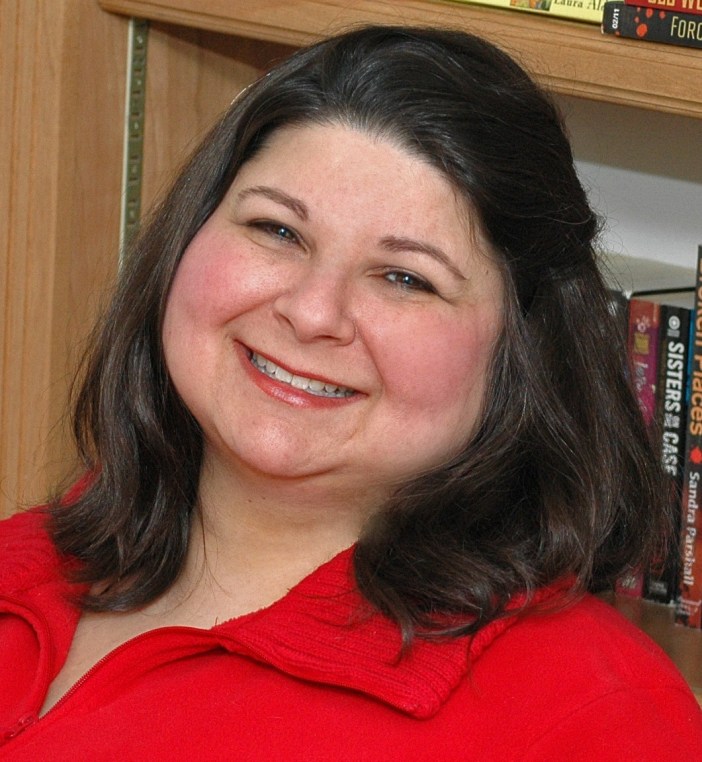
Barb Goffman
 

Barb Goffman has no idea how to cook pot roast, but it sure was fun to write about. She’s won the Agatha, Macavity, and Silver Falchion awards for her short stories, and she’s been a finalist for national mystery short-story awards twenty-two times, including eleven times for the Agatha (a category record). Her book Don’t Get Mad, Get Even won the Silver Falchion for the best collection of 2013. Barb is thrilled to be a current Macavity and Anthony award finalist for her story “Whose Wine is it Anyway?” from the anthology 50 Shades of Cabernet.  She works as an independent editor and proofreader and lives with her dog in Winchester, Virginia. Learn more at www.barbgoffman.com.

About her story, Barb says, “My story is about a woman whose husband has been diagnosed with Alzheimer’s disease. She wants to care for him at home, but it’s proving challenging, with strange things going on, including a missing pot roast. I can’t say any more about the plot without giving things away, but I will say that I loved writing this story. It’s heartfelt but also funny and–perfect for an anthology about Florida–also a little bit weird.”

Looking back, I should have known something was wrong when the pot roast disappeared. Sure, everyone misplaces something sometime. I once searched for the remote control for an hour till I spotted it in the bathroom. And for years I’ve found my husband, Charles’s, false teeth all over the house—they’ve never fit quite right so when they bother him he takes them out and puts them down, never paying attention where. But the pot roast? I was sure I’d left it defrosting on the counter when I went to get my hair done, yet when I came home, it was gone.

I searched for it in vain. It wasn’t in the fridge or freezer. Not in the garbage. Not in the oven. Charles was clueless. There was no way he’d cooked and eaten it in the hour I was gone. So what happened to that pot roast was a mystery. In the back of my mind, I wondered if I’d only dreamed I’d bought the roast. But I couldn’t admit my faculties might be failing. So I dismissed the missing pot roast as weirdness and whipped up some pasta.

That was a month ago. Perhaps if I’d forced myself to figure out what happened to the pot roast, I wouldn’t be in this position now. But back then, I had bigger problems. Charles had started suffering from short-term memory loss and personality changes, and he was getting worse every day. One minute he’d be the man I’d loved for decades, optimistic and kind; the next, he’d be surly and paranoid, acting like a wary stranger. He’d accused me of stealing from him—me, his wife of fifty-one years. And then, in a heartbreaking moment, he’d accused me of trying to kill him.

“Alzheimer’s,” his doctor had diagnosed.

I’d figured that was the problem, but having it confirmed was a terrible blow. His doctor gave me all kinds of pamphlets and urged me to look into long-term care for Charles. I cried when he did that. I knew eventually such care would be necessary. But not yet. I was only seventy-one years old and in relatively good health. I was determined to care for Charles in our home for as long as I could. He was my husband. My love. I owed him that.

It’s easy to see why Barb’s work is so award-worthy with this tale. She really gets inside the head of her main character, who is dealing with a raeally difficult situation–complicated with her own issues of dealing with her husband’s illness in addition to questioning, at times, her own sanity and whether the things her husband says to her when in the grips of his dementia are true, real, or based in anything even slightly reality based. Can she trust the home health-care worker who is helping out with things around the house? Where are the pot roasts going?

And that last paragraph is chilling, absolutely chilling. Well done, Barb!

Go Home

Sunday morning, with lots to do and a long, relaxing day ahead in which to do it all. I woke up relatively early this morning, which was a wonderful and pleasant surprise, and feel rested. I have a short story to work on, a reread of Royal Street Reveillon to get through, and I’d also like to make some progress on my reading of Eryk Pruitt’s What We Reckon. I cleaned and did errands and read yesterday; along with some note taking on various projects as well as filing. This coming week should be interesting, to say the least; I am doing some testing on Monday and Thursday at the Blacks in Government conference at the Riverside Hilton, which will be a lovely change from my ordinary routine, and I have a three day weekend next weekend in honor of my birthday.

Yes, the old man officially turns fifty-seven next weekend; although I always change my age on New Year’s. After this next New Year’s, I’ll be telling people I’m fifty-eight. Age has never mattered  much to me; for the early portion of my life I was always younger than everyone else around me; later on I was always older than everyone else I hung around with. I learned early on that age is a relative concept.

Yesterday was kind of a lovely day for me. It rained off and on most of the day, and there really is nothing lovelier than being inside and dry while it rains outside, and our rain is do torrential and tropical–so lovely to deal with when you’re inside rather than when you’re actually outside dealing with it. As the bed linens agitated in the washing machine and the wool blankets tumbled dry in the laundry room, I was filing and getting my desk area organized, listening to the rain and looking out my windows to see all the leaves outside glistening and wet, and water cascading out of the rain spout on the house next door when a phrase formed in my head, and I scribbled into my journal, standing up at the kitchen counter: It was one of those lovely summer Saturdays New Orleans gets sometimes in August–where thunderstorms roll through the city all day, the dark clouds creating an artificial twilight at three in the afternoon. Perfect for staying inside and cleaning, the washing and drying and folding of clothes. The cat sleeps lazily in the desk chair, waking up every now and then to groom before curling up again into a tight ball of differentiated ginger stripes.

I may never use that in something I write, be it a short story or a novel, but it’s a nice piece of writing nonetheless. My notebooks and journals are filled with such scraps of writing, of ideas and thoughts and fragments and character descriptions or settings.

And next up in Florida Happens, for the Short Story Project is “The Fakahatchee Goonch” by Jack Bates.

jack bates

Goonch is just another name for a catfish. A really big catfish.  Sometimes it’s called the Devil Fish or Black Demon because it lurks deep down there in the murkiest part of the Fakahatchee Preserve. Bottom feeders mostly. They eat gator leftovers or anything else that might get tossed into the swamps. Back in the mauve and neonMiami Vice days, legend had it the Everglades was a good place to dispose of a problem quick.  People think that’s how the goonch developed a taste for meat.

Of course, the guys who trawl for catfish say those fish are just as apt to eat water weeds and such if the pickings are slim.  Sometimes they feed on their own.  Had some guys drag in twenty to thirty pounders, about three feet long. That ain’t no fish tale.

Neither is this one. The catfish I’m talking about is an eight-man goonch. Know what that is? That’s when eight grown men stand in a line, shoulder to shoulder, and that goonch lays across all of their extended hands from tip to tail. That’s how big the Fakahatchee goonch was said to be. Had a mouth like the gaping orifice of hell, or so I’m told. I ain’t never seen it, but I know it’s there.

There have been nights when I’m frog hunting where the frog croaking will go quiet and the swamp gets real still. Something big enough to rock my aluminum skiff passes through the water. Up ahead in the dark there’ll be a splash and a few ticks off a clock later my skiff will rock a second time except maybe a little more treacherously on the creature’s return pass. and I’ll have to sit down, clutch the sides so I don’t tip out. Only way I know it’s safe to leave is when the frogs start croaking again.

Sometimes though, a frog will puff its chest and blowout its braggadocio regardless of the danger it’s in.

Jack’s bio reads “Jack Bates writes some pretty good crime fiction from the comfort of his loft office. His stories have appeared all around the web, in various anthologies, and in a few magazines. Three have been finalists for the Derringer Award from the Short Mystery Fiction Society. He’s also written award-winning scripts for stage and screen including a short-lived web series. An incomplete list of his works can be found on his blog http://flashjab.blogspot.com/.   When not writing, he plots or travels or runs errands or chats it up with other old movie buffs on twitter. He pens the Harry Landers, PI, series for Mind Wings Audio Books. He’s also released several ebooks with Untreed Reads which launched the Hack Ward PI series with Monkey See, Monkey Murder. In 2012, his YA Steampunk novel, Colt Buchanan and the Weather Walkers, was released by Red Willow Press.”

This short story is quite fun, and in the classic mold of slightly off, wacky Florida noir. Set in a dive bar on the west coast of Florida in a nothing town on the edge of a swamp, a stranger walks in with a wad of cash and an air of mystery about him; two tough rednecks are playing pool with their girlfriends when the two men decide to win some of the stranger’s money off him–and things continue to spiral downward from there. It reminded me of John D. Macdonald with maybe a dash of Hiassen thrown in for good measure, and is a very fun and satisfying read; one that I’m glad is in the book.

And now, I have spice to mine.

Tender Love

One of the more interesting things I’ve noticed this year about this year’s Bouchercon anthology (Florida Happens) is that three of this year’s contributors (Hilary Davidson, Barb Goffman, and Susanna Calkins) are also finalists for the Anthony in the Short Story category. (I am hoping to find the time to read the stories and talk about them on here as well; along with my on-going talking about the nominees for Best Original Paperback and the stories in Florida Happens.) Not a bad pedigree for my anthology, wouldn’t you say?

Next up in terms of our short stories in Florida Happens is Hilary Davidson’s “Mr. Bones.”

34535827_10215894075241894_7172627381826355200_o

Hilary’s bio reads:

Award-winning novelist and travel writer Hilary Davidson got her start in journalism in 1995, when she moved to New York for five months to intern at Harper’s Magazine. Afterwards, Hilary joined the staff of Canadian Living magazine in Toronto as a copy editor. Her first freelance article, “Death Takes a Holiday” — about a New Orleans cemetery — was published by The Globe & Mail. She left her day job to write full-time in June 1998. She went on to write 18 nonfiction books (17 of them for Frommer’s Travel Guides) and articles for wide array of publications including Discover, Martha Stewart Weddings, American Archaeology, Chatelaine, and CNN Travel.

Hilary’s debut novel, The Damage Done, won the 2011 Anthony Award for Best First Novel, and the Crimespree Award for Best First Novel. The book was also a finalist for a Macavity Award and an Arthur Ellis Award. The novel’s main character, Lily Moore, is, like Hilary, a travel writer. While their personal lives have little in common, they do share a few things, such as a love of vintage clothing, classic Hollywood movies, and Art Deco design. The second book in the series is The Next One to Fall and the third is Evil in All Its Disguises. Hilary’s first standalone novel, Blood Always Tells, was published by Tor/Forge in April 2014 and released as a trade paperback in March 2015. Her next novel is One Small Sacrifice, which will be published by Thomas & Mercer in spring 2019.

Her short fiction has won the Derringer Award, the Spinetingler Award, and two Readers’ Choice Awards from Ellery Queen. Hilary’s story “The Siege” was a finalist for the 2016 Anthony Award for Best Short Story. Her stories have appeared in Ellery Queen Mystery Magazine, Thuglit, Beat to a Pulp, Crimespree, All Due Respect, Crime Factory, Spinetingler, and Needle: A Magazine of Noir. Her work is featured in many anthologies, including Beat to a Pulp: Round One and Round Two; Crimefactory: First Shift; Thuglit Presents: Blood Guts, & Whiskey; Pulp Ink; D*CKED; and Trouble in the Heartland: Crime Fiction Inspired by the Songs of Bruce Springsteen. 

Hilary has served as an At-Large Director on the National Board of the Mystery Writers of America from January 2012 to January 2016. She has previously served on the Mystery Writers of America’s New York Board as well.

Pretty impressive, eh? Not mentioned in the above is her collection of short stories, The Black Widows Club, which you can buy here. I have it, and I need to get back to it; the stories I’ve read are pretty awesome.

You can visit her website here.

And so, without further ado, is the opening of her contribution to Florida Happens, “Mr. Bones.”

I’d be the first to admit that Mr. Bones wasn’t going to win any prizes for Pet of the Year. He was a pugnacious alley cat with mouse breath and an anger-management problem, but I loved him. So when I got home from a three-day dermatology conference in New York and discovered he was missing, I was devastated.

“Tell me exactly what happened,” I pleaded with my boyfriend.

“Nothing happened. Your cat just hasn’t come home,” Andrew said.

We were standing in the kitchen, and I couldn’t help but turn and look at the door to the backyard. Mr. Bones’ three bowls were there — dry food, wet food, and water — and they were all full.

“He didn’t eat anything today?” I asked. “Was he sick?”

 “Come on, Monica. There’s always something wrong with that cat.”

“What time did he go out this morning?”

 “I don’t know. It was early. He woke me with his screaming to get outside.”

“Are you okay?” I asked him.

“What do you mean?”

 “Your hand is bandaged up.”

 “Oh, that’s nothing,” he said. “I was cutting an avocado. Should’ve known not to try that without you around.” He gave me a sweet smile, which made him look even more like Tom Hiddleston than usual. “I picked up takeout from Moe’s for dinner. I know you love their Southwest Salad with tofu.”

Andrew and I had been living together for almost six months, and it was going well. But I was too wound up about Mr. Bones to think about eating. “Thanks, but I need to look for Mr. Bones. He’s probably sulking right now.”

I stepped outside onto the patio behind the house. “Honey, I’m home!” I called out. Something rustled in the warm stillness of the night, but my cat didn’t come running. If he heard me, he would have, because he was more like a dog in that way. I called for him and waited.

Andrew rapped on the storm door. “Come on, Monica. He’ll be back when he’s ready.”

Oh, pets.

We love our little furry buddies, don’t we? And losing them is always heartbreaking; something you never get over but just learn to live with. (I still get sad remembering my childhood dog, or our previous cat, Skittle, whom we lost eight years ago.)  The bond between pet and owner is always powerful. I’ve never written a story about a pet–not sure why that is; I just never have. (I gave Scotty and the boys a cat in Garden District Gothic, though.) There are also some great pet short stories by crime writers–“Ming’s Biggest Prey” by Patricia Highsmith and “Less Than a Dog” by Agatha Christie are two particular favorites of mine–and Hilary Davidson’s “Mr. Bones” certainly belongs with those two classic tales. Monica a dermatologist, returns from a convention to find that her cat has gone missing in her absence, and her live-in boyfriend’s antipathy to the situation as she searches the neighborhood for her missing pet is notable–as is the nastiness of the old cat-hating woman who tears down her fliers. So, what happened to Mr. Bones?

And now, back to the spice mines.

King for a Day

Ah, Monday. Blue, blue Monday, and yet the beginning of still another work week.

I worked quite a bit yesterday, and even made it to the gym. I was one of six people in the gym, and if you guessed that at one point in my workout four of the other five people had taken up all the options for my next exercise, you’d have guessed correctly. And no one apparently notices the signs posted everywhere that read Please rerack your weights when finished.

No. One.

Back when I used to work in fitness environments, I was always amazed at how people just leave their weights on the machines or dumbbells wherever they used them rather than putting them back–as though they assumed that the staff people working were there to clean up after them. It used to happen in aerobics classes I taught, too–the attendees would finish, then leave their steps, dumbbells, and sometimes their sweaty towels there for me to put away.

It would be so lovely to one day be wealthy enough to have my own workout room in my home. All I want, really–a room that’s a dedicated office space and a workout room. Is that really so much to ask for?

Lately, so many things have been getting on my nerves that I’ve wondered if I am on edge, or if something’s going on in my subconscious that’s bubbling up by making me highly annoyed and irritated with people, or something, I don’t know what; but the more I think about it, the more I tend to think, no, you’re just sick of assholes.

Seriously. And then I remembered the most important thing of why I am a crime writer: I can kill off assholes fictionally.

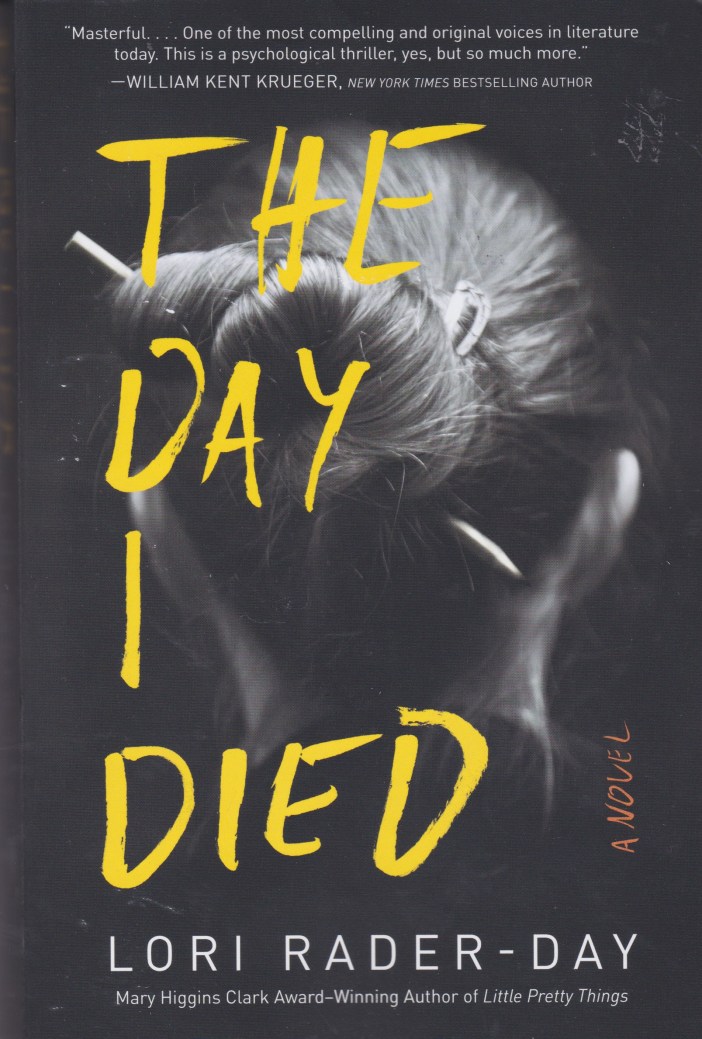
I also finished Lori Rader-Day’s The Day I Died, and started reading Nadine Nettman’s Uncorking a Lie.

the day i died

On the day I died, I took the new oars down to the lake. They were heavy, but I was saving myself the second trip. The blades rode flat along the ground, flattening two tracks through the wet grass.

It was morning. The air was cool, but down on the dock, the slats were already hot. I noted a lone fishing boat out on the water. Inside, two men hunched silently over their tackle, their faces turned out across the lake. Beyond them, mist rose off the water, nearly hiding the far shore.

This moment. This is what I return to.

Later, I will note the long crack on the new oar, just before my head goes under, just before the flume of blood rises off my skin under the water like smoke. I will come back to othis moment and think, if I had just gone back up the steps to the house immediately. If I had just stayed up at the house in the first place.

If I had just.

Lori Rader-Day’s Anthony Award shortlisted 2017 novel is quite excellent. Thematically, it’s about desperation–what people do when they have no other options. In the case of Anna Winger, Rader-Day’s main character, her childhood was desolate and bleak; the child of an alcoholic abuser, she moved from there to an abusive relationship with a boyfriend before fleeing for her life and that of her unborn child. Now, she lives in a wretched little town in Indiana, working as a freelance handwriting analyst. A child has gone missing in Parks, Indiana, and the local police bring her in for her expertise, bringing her into the case sideways. The case also stirs up dark memories of her own past for Anna, and her child–now thirteen and entering that rebellious stage–is becoming more and more closed off from her, difficult to know; and she has to wonder, as a mother, if this life they’ve led of constantly moving and never establishing roots anywhere, is messing up her own child. The parallels between the missing child case of the present and her own disappearance from her own life brings her to her own breaking point–and to where she can no longer ignore or deny her past, but most confront it.

Rader-Day’s strengths–her depiction of how claustrophobic yet lonely small towns can be; her ability to create sympathetic, damaged characters–are all here, and the book is structured beautifully; each incident and scene flowing into the next until the reader has to keep compulsively turning the page.

And now, back to the spice mines.

Object of My Desire

It is Sunday, and I have again slept later than I intended. I meant to set an alarm, as I have things that must be done today but I also stayed up later than I intended and as such, forgot to set said alarm when I tumbled into bed last evening. It’s fine; I should be able to get everything done today that I want to get done. I just have to be a bit better about planning and wasting time. Clearly, I needed the sleep, don’t you think?

I am reading The Day I Died by Lori Rader-Day, as part of my Bouchercon homework, and enjoying it a quite a lot. This is the second of Rader-Day’s novels that I’ve read (the other being Pretty Little Things; I’ve not read her first, The Black Hour, and she’s just released a new one, Under a Dark Sky), and I am enjoying this even more than I did the first I read. Rader-Day writes about damaged women, makes them the center of her stories, and they work through a lot of their damage over the course of the novels. I will, rest assured, have plenty of other things to say about this novel once I’ve finished reading it.

I cleaned my kitchen floors yesterday; not as thoroughly as they need, of course, but more of a surface thing that will pass muster at a glance, but this surface cleansing would not pass muster with my mother. Her nose would wrinkle, her eyes would narrow, and she wouldn’t say anything to me–but that facial expression would tell me everything I need to know about what she was thinking. She would get on her hands and knees and would scrub the floor, probably more than once, with a hard brush and an abrasive cleanser.

I worked briefly on my story “Please Die Soon” as well yesterday; it is shaping up nicely, but I need to concern myself a bit more thoroughly with the pacing, methinks.

Today, for the Short Story Project, we move on to the second story in Florida Happens, “The Best Laid Plans” by Holly West:

June 1948

Bev Marshall waits anxiously behind the wheel of the Buick, watching for the rest of the crew to emerge from the house. It seems they’ve been gone at least an hour, but her watch shows it’s only 10:45 p.m. Less than ten minutes since they went in. The boys work fast, but not that fast.

There are four of them in the crew. Joe Scullion is their boss and Bev’s boyfriend. Alex McGovern is the brawn, and Sean Cregan is a master lock picker. Bev’s their driver. They earn their living burgling wealthy neighborhoods all over the Eastern Seaboard, coming home to Philly with thousands in cash and valuables. Five years working together and not a single arrest, not that the coppers haven’t tried.

It’s been a good run, but after tonight, Bev will be done with all of them.

She thinks she sees movement out of the corner of her eye and snaps her head toward it. Is it them? She squints into the darkness, her hand resting lightly on the key in the ignition. Everything is still and she concedes it must’ve been her imagination. Wrecked by nerves, she quashes the urge to chew a fingernail and slips her hand into her purse in search of cigarettes. Her fingers brush the thick envelope containing every cent she has—nearly five thousand dollars. Along with whatever money she’s able to get for tonight’s haul, it’s enough to keep her going for a year, maybe more if she lives modestly.

She lights a cigarette and pulls the smoke deeply into her lungs, thinking about Richie O’Neill. She’ll miss him when this is done. He runs a hockshop on Vine Street and fences most of the loot they steal. Over the years, he’s become her trusted friend, so when he let it slip recently that Joe had his eye out for a new driver, she believed him. Turns out Joe had fallen hard for some dame he’d met in Atlantic City and he wants to marry her, maybe have some kids.

Holly West is the author of two novels, historical crime novels set at the court of King Charles II of England; the period popularly known as the Restoration. Those novels, Mistress of Fortune and Mistress of Lies, sound terrific. I also love that period, and look forward to reading these novels; you can find out more information about Holly and her novels here, at her website.  She is also on Facebook, Twitter, and Instagram. You can also sign up for her newsletter at her website. She is also editing an anthology called Murder-a-Go-Go’s, crime stories inspired by the music of the Go-Go’s, with an introduction by Jane Weidlin; it also contains my story “This Town,” and I personally cannot wait to read the entire thing.

36281289_10156275148680993_5425430004299202560_o

Holly’s story, “The Best Laid Plans,” is entirely self-contained but also feels like it could be the opening of a great noir novel. The main character, Bev Marshall (I also have a very dear author friend by that name; such lovely serendipity) drives the getaway car for a gang of thieves, and is a bit in love with the leader of the gang–who, however, has recently punched her in the face, changing everything. Bev is now planning on getting away from him, and the gang, and starting a new life…and Florida is a way station on her getaway plan. But things, of course, don’t go quite according to plan. A very very well-written and fun story, with a main character I personally would like to spend with.

Well done, Holly! And now, back to the spice mines.

Spies Like Us

SATURDAY! Sorry, I was too tired to post yesterday.

And yes, Constant Reader, we somehow managed to make it through yet another week. I think we deserve a round of applause.

Thank you, thank you.

Thursday I had a late day at the office, so I managed to do three loads of laundry, a load of dishes, and made it to the gym before going to work. I know, right? Who am I, and what have I done with Gregalicious? 

I am looking forward to the weekend, to be honest. I want to clean the hell out of my apartment, have some errands to run, would like to get to the gym, and get some writing done. I think I unlocked the key to “Please Die Soon” last night, but I also realized I need to talk to a friend of mine for research purposes. (I actually need to talk to two friends for separate research purposes, so I should probably get going on that as well. Heavy sigh.) MAKE A GODDAMNED LIST ALREADY.

And now we move on to Florida Happens, and our first story, “The Burglar Who Strove to Go Straight”, by Lawrence Block.

(‘Excerpted from The Burglar Who Liked to Quote Kipling by Lawrence Block, originally published in 1979, when St. Petersburg was decidedly less scenic than it is now.)

Browsers came and went. I made a few sales from the bargain table, then moved a Heritage Club edition of Virgil’s Eclogues (boxed, the box water-damaged, slight rubbing on spine, price $8.50). The woman who bought the Virgil was a little shopworn herself, with a blocky figure and a lot of curly orange hair. I’d seen her before but this was the first time she’d bought anything, so things were looking up.

I watched her carry Virgil home, then settled in behind the counter with a Grosset & Dunlap reprint of Soldiers Three. I’d been working my way through my limited stock of Kipling lately. Some of the books were ones I’d read years ago, but I was reading Soldiers Three for the first time and really enjoying my acquaintance with Ortheris and Learoyd and Mulvaney when the little bells above my door tinkled to announce a visitor.

I looked up to see a man in a blue uniform lumbering across the floor toward me. He had a broad, open, honest face, but in my new trade one learned quickly not to judge a book by its cover. My visitor was Ray Kirschmann, the best cop money could buy, and money could buy him seven days a week.

“Hey, Bern,” he said, and propped an elbow on the counter. “Read any good books lately?”

This is a charming story, and as you can imagine, I was thrilled to death to have something by Lawrence Block to kick the book off. I’m a big fan–although I’ve not read the entire backlist, I certainly have loved everything of his I’ve read–and of course, his anthologies of crime stories inspired by paintings (Alive in Shape and Color, In Sunlight or in Shadow) were also fantastic. I never thought I’d see the day when I edited an anthology that would have a story by Lawrence Block as the lead-off–so you can imagine the thrill; and it’s a story about books and a bookstore. How could I not love that?

Have I mentioned lately how much I love my life?

And now back to the spice mines.

IMG_2383

Your Wildest Dreams

Good morning! It’s Thursday, everyone, and with a short day at the office ahead of me and just one more day before the weekend, I am feeling good. Not as good perhaps as I should, but I slept really well last night, don’t have to be at work until later this afternoon, and I am going to even go to the gym this morning before it’s time to go to work.

I call that a winning day, don’t you?

I am reading Lori Rader-Day’s The Day I Died as prep work for my moderating duties at Bouchercon next month. I am, in case you weren’t paying attention, Constant Reader, moderating the panel highlighting the Anthony Award finalists for Best Paperback Original. After I finish Lori’s book I’ll be reading Bad Boy Boogie by Thomas Pluck, What We Reckon by Eryk Pruitt, Cast the First Stone by James Ziskin, and Uncorking a Lie by Nadine Nettmann. I’m enjoying Lori’s book–I also enjoyed the previous one of hers I’d read, Little Pretty Things, and as I’ve said before, there’s no one more fun to traverse the back roads of rural Alabama on a rainy morning with. All of these books had been in my TBR pile for quite some time, so it’s great to have an excuse to pull them out and read them.

I worked a little more on “Please Die Soon” yesterday; the story is becoming even creepier the more I work on it–although I think I may have done some overkill with it. But I am going to keep going with it, and once I am finished with the first draft I’ll figure it out in the revision process. I am also letting “A Whisper from the Graveyard” sit for a while–I know there’s some serious tweakage needed in it as well before submitting it–and I am starting to get to work on the August/September project as well. Exciting times for a Gregalicious.

And before I go to the gym this morning, I’m going to try to get the house straightened up a bit.

And while I know I’ve already talked about my story in Florida Happens (“Cold Beer No Flies”) I intend to spend the rest of this month’s focus on The Short Story Project on the stories and authors in the book, to try to whet your appetite for either preordering the book or buying it at Bouchercon. We are doing a launch for the book there on Thursday at 1; all the authors present gathering to sign and/or discuss the book and their story. And of course, it’s just easier for me to start by talking about my own.

Dane Brewer stepped out of his air-conditioned trailer, wiped sweat off his forehead and locked the door. It was early June and already unbearably hot, the humidity so thick it was hard to breathe. He was too far inland from the bay to get much of the cooling sea breeze but not so far away he couldn’t smell it. The fishy wet sea smell he was sick to death of hung in the salty air. It was omnipresent, inescapable. He trudged along the reddish-orange dirt path through towering pine trees wreathed in Spanish moss. The path was strewn with pine cones the size of his head and enormous dead pine needles the color of rust that crunched beneath his shoes. His face was dripping with sweat. He came into the clearing along the state road where a glorified Quonset hut with a tin roof stood.  It used to be a bait and tackle until its resurrection as a cheap bar. It was called My Place. It sounded cozy—the kind of place people would stop by every afternoon for a cold one after clocking out from work, before heading home.

The portable reader board parked where the parking lot met the state road read Cold Beer No Flies.

Simple, matter of fact, no pretense. No Hurricanes in fancy glasses like the touristy places littering the towns along the gulf coast. Just simple drinks served in plain glasses, ice-cold beer in bottles or cans stocked in refrigerated cases at simple prices hard-working people could afford. Tuscadega’s business was fish, and its canning plant stank of dead fish and guts and cold blood for miles. Tuscadega sat on the inside coast of a large shallow bay. The bay’s narrow mouth was crowned by a bridge barely visible from town. A long two-lane bridge across the bay led to the gold mine of the white sand beaches and green water along the Gulf Coast of Florida. Tourists didn’t flock to Tuscadega, but Tuscadega didn’t want them, either. Dreamers kept saying when land along the gulf got too expensive the bay shores would be developed, but it hadn’t and Dane doubted it ever would.

Tuscadega was just a tired old town and always would be, best he could figure it. A dead end the best and the brightest fled as soon as they were able.

 He was going to follow them one day, once he could afford it.

Towns like Tuscadega weren’t kind to people like Dane.

“Cold Beer No Flies” was originally conceived of back when I lived in Kansas, as far back as when I was a teenager. There was a bar in Emporia called My Place, which was an okay place–it had a concrete floor, just like the one in my story–and it also had one of those rolling readerboard signs along the road, and it literally read that: MY PLACE COLD BEER, NO FLIES. I always thought that was funny, and I always wanted to write a story called “Cold Beer No Flies.” I think I wrote the original first draft of the story in the 1980’s, and it languished in my files all these years. When it came to be time to write something for Florida Happens, I picked out “Cold Beer No Flies”, read the first two drafts of what I had written before, and decided to reboot the story and adapt it to the Florida setting. I’d always seen it as a noir story, and in rewriting/adapting it to fit this I needed to obviously move the setting from Kansas to Florida. I also had the bright idea to set it in the panhandle; I figured (rightly) that the majority of stories would be set in the beach communities literally the southern coasts of the state, and not many people would be moved to right about either the interior parts or the panhandle. I picked a dying, rotten little small town and placed it on a panhandle bay, similar to the little town my grandparents retired to in the early 1970’s. I also wanted to look at, and explore, what it’s like to grow up gay and working class in such a place–very redneck, very conservative, very backwards, very religious, very homophobic. The story turned out very creepy, I think, which was precisely what I was going for, and I hope you enjoy it when the time comes, Constant Reader.

And now, back to the spice mines.

536a946bd2915add3da2f3ce62e4968b--rugby-men-rugby-players

Take Me Home

Saturday morning and I feel great. If you think that means I slept well last night, you would be correct in that assumption.  It’s amazing what a difference it makes; those of you who have no trouble sleeping at night and can get amazing rest every night? You have no idea how lucky you are, and how much I envy you.

Today I have errands to run, a house to clean, a workout to do; as long as I stay motivated I can easily get all of these things done. I also have writing to do–I want to finish “A Whisper from the Graveyard” this weekend, and I also want to finish making my notes on the Scotty book, at which point I need to revise the outline I did (after finishing the first draft) so I can start the massive edit/rewrite for the second draft I need to get done. As I also mentioned the other day, I also need to start reading the books on the Anthony shortlist for Best Paperback Original, since I am moderating that panel at Bouchercon this year. To jog your memory, those books are, as follows: The Day I Died by Lori Rader-Day; Bad Boy Boogie by Thomas Pluck; Uncorking a Lie by Nadine Nettman; What We Reckon by Eryk Pruitt; and Cast the First Stone by James Ziskin. I got some good reading ahead of me, don’t I? Yes I do!

Huzzah! This is, after all, always a good thing.

I am, alas, as always, behind on my writing schedule. I had wanted to get Scotty finished this month (ha!) before embarking on an a project that will consume August and September; and then I had wanted to work on the WIP in October and November before starting on Bury Me in Satin in December. I don’t see that happening now, alas, since I got so little done on Scotty this month. Then again, you never know. If I can maintain good sleeping habits and maintain meeting goals and staying motivated every day in the face of the oppressive heat of a New Orleans August, I just might be able to get back on schedule.

Here’s hoping.

I did finished reading Jessica Knoll’s The Favorite Sister this week.

the favorite sister

A man whose name I do not know slides his hand under the hem of my new blouse, connecting the cable to the lavalier mic clipped to my collar. He asks me to say something–sound check–and for a single reckless beat, I consider the truth. Brett is dead and I’m not innocent.

“Testing. Testing. One. Two. Three.” I’m not only dishonest. I’m unoriginal.

The sound guy listens to the playback. “Keep your hair off your left shoulder as much as you can,” he tells me.  I haven’t had my ends trimmed in months, and not because my grief has bested my vanity. I’m hoping viewers are better able to see the resemblance to my sister. I have nice hair. Brett had beautiful hair.

“Thanks,” I reply, wishing I could remember his name. Brett would have known it. She made a point of being on a first-name basis with the crew–from the gaffer to the ever-rotating harem of production assistants. My sister’s speciality was making underappreciated people feel appreciated. It’s a testament to that quality that we are all gathered here today, some of us prepared to tell heroic lies about her.

This is Knoll’s second novel; her first, Luckiest Girl Alive, was stunningly brilliant and I loved it. I also believe she may have made the Edgar shortlist for Best First Novel. In this book, Knoll again takes as her theme ambitious women and the conflicts they have with each other, set against the backdrop of a reality television series which is clearly based, in some ways, on the Real Housewives shows. The show, Goal Diggers of New York, ostensibly focuses on five women who are all entrepreneurs, don’t have kids, and in most cases are also single. Goal Diggers has the same pedigree as the Real Housewives shows; originally intended as a docu-series focusing on real women and the struggles they have running businesses and so forth, it has descended into a ratings-hungry juggernaut predicated on pitting the women against each other emotionally and forcing them into feuds. The ultimate cleverness of the book is it follows, basically, the same trajectory as if it were, indeed, a reality show about women; it reads like a season of a Real Housewives franchise. There are three main point-of-view characters–sisters Kelly and Brett, and Brett’s former best friend, an author of color named Stephanie. Kelly narrates the action in the present, after all the events of the book are finished–the device used is her filming what is known as a ‘talking head’ interview; where the camera is trained on the cast member and asked questions. The rest of the book is about the filming of the most recent season of Goal Diggers, which ended in tragedy; that is shown from the alternating POV’s of Brett and Stephanie, who manufactured a feud for the season as a storyline but the ‘fake feud’ actually runs far deeper, with a far worse betrayal at its heart, than anything that was taped for the series. The book addresses a lot of current hot topics in our culture and society: racism, homophobia, same-sex marriage, sexism. It’s very hard to talk about the book without giving spoilers; like a season of a reality show, the twists and turns the plot takes are part of the joy the reader gets from the story, and to discuss them would spoil it for new readers. But it’s very well-written, and the characterizations are quite strong.

I have to say, I enjoyed every second of reading this book, and I can’t wait for Knoll’s next one.

And now, back to the spice mines.

Love Touch

Tuesday!

Time keeps slipping through my fingers. There’s only one week left in July, and there’s so much I have to do before August 1! Heavy heaving sigh. There’s nothing else for me to do but gear up, buckle down, and get to work.

Yay?

In other exciting news, the Bouchercon program was announced and I have three, yes, three, panels this year! Such a bounty of riches!

They are all on Friday, September 7, and first up, at noon is:

A Nooner–The Sex Panel

Helen Smith (M)
Hillary Davidson
Christa Faust
Greg Herren
Catriona McPherson

Fun, right?

Then, at three:

Anthony Nominated Paperback Originals

Greg Herren (M)
Nadine Nettman
Thomas Pluck
Eryk Pruitt
Lori Rader Day
James Ziskin

and then, last but not least, at 4:

The Rainbow Connection–LGBTQ Inclusivity

Terri Bischoff (M)
Kelly J. Ford
Greg Herren
Kristen Lepionka
Catherine Maiorisi
CS Poe

All I know for sure is I will be ready for a drink at five.

Today’s story for the Short Story Project is “Witch War” by Richard Matheson, from The Best of Richard Matheson:

Seven pretty little girls sitting in a row. Outside, night, pouring rain–war weather. Inside, toasty warm. Seven overalled little girls chatting. Plaque on the wall saying: P.G. CENTER.

Sky cleaning its throat with thunder, picking up and dropping lint lightning from immeasurable shoulders. Rain hushing the world, bowing the trees, pocking earth. Square building, low, with one wall plastic.

Inside, the buzzing talk of seven pretty little girls.

“So I say to him–‘don’t give me that, Mr. High and Mighty.’ So he says, ‘Oh yeah?’ And I say, ‘Yeah!'”

“Honest, will I ever be glad when this thing’s over. I saw the cutest hat on my last furlough. Oh, what I wouldn’t give to wear it!”

“You too? Don’t I know it! You just can’t get your hair right. Not in this weather. Why don’t they let us get rid of it?”

“Men! They make me sick.”

Seven gestures, seven postures, seven laughters ringing thin beneath thunder. Teeth showing in girl giggles. Hands tireless, painting pictures in the air.

This is a story that leaves you wanting a lot more. Those seven girls? They are the entire military might of whatever side they are fighting for, and as the story progresses their gossip and chatting about clothes and make-up and the things girls theoretically talk about when they are in groups is interrupted because the enemy is launching an attack, and the girls go to work….and then go back to their gossiping and chatting once the battle is over and the enemy annihilated. Very reminiscent of Ender’s Game by Orson Scott Card, I also think this would have made a terrific novel; the story really leaves you wanting more.

And now back to the spice mines.

59961988699ac4c62f2a733b8f4274ba

Tonight She Comes

Reality television.

I started watching in back in the original days of The Real World on MTV; the social experiment of picking vastly different young people from vastly different places with vastly different backgrounds, to see whether or not they can learn from each other and grow; or simply clash and create drama for the cameras. I enjoyed watching, I’m not going to lie–I didn’t lose interest until later seasons, when it became all about the kids getting drunk and hooking up and so forth. But the influence of The Real World–and its sister show, Road Rules–on reality television is unmistakable.

I’ve stuck my toe in the water with several reality shows–I used to be completely addicted to Project Runway, until it left Bravo for Lifetime and I lost interest–and the same with RuPaul’s Drag Race–after the Adore/Bianca/Courtney season I didn’t see how it could be anything other than a disappointment going forward so I stopped (although I did tune in for the glory that was RPD All-Stars Season Two), but I never got into Survivor or The Bachelor or any of the others. But I do watch the Real Housewives–New York is, without question, the gold standard, with Atlanta a close second with Beverly Hills trailing them both substantially; I can’t with Potomac, Orange County, and Dallas. 

I also really enjoyed the first season of Lifetime’ UnReal, but got behind on Season 2, heard bad things, and so never picked it back up again.

My love of (some of) the Housewives shows has resulted in my winding up on two Housewives related panels over the years at Bouchercon (Albany and New Orleans, to be precise), which were enormously fun; and I have also managed to observe what a cultural phenomenon these shows have become. There are recaps everywhere all over the Internet; there’s the Bravo website itself; and these women are often sprawled all over the tabloids I see while in line at the grocery store. (And no, I have only ever watched about twenty minutes of a Kardashian show and it was so horrible I never went back. More power to you if you’re a fan, but they are just not for me.

I even wrote a very short book–which is no longer available anywhere–based on the filming of such a show in New Orleans; it was pulled from availability primarily because I was never truly satisfied or happy with it. I wrote it very quickly in a window between deadlines and never felt I was able to explore all the things, the issues, with reality television that I wanted to with it. And yes, I decided to use that same backstory–a Real Housewives type show filmed in New Orleans–to write the new Scotty book because 1) it’s a great idea and 2) since I am writing off dead-line I can do it the way I want to and hopefully say the things I wanted to say in the first. Some of the original elements of the story I used before still exist in this Scotty book, but there’s a lot of changes I’ve made so it’s not the same story. The draft is very very rough, and since I’ve finished it and put it aside I’ve had a lot of great ideas for it; fixes and changes and so forth.

I think it might be the best Scotty yet, and it’s certainly the most complicated.

I started reading Jessica Knoll’s The Favorite Sister yesterday, and before I knew what happened most of the afternoon was gone and I was about half-way through. Her book is also built around a reality television show, and boy, is this book biting. I loved her debut, Luckiest Girl Alive, and this one is just as good. You’ll get a full report, Constant Reader, when I finish it.

Next up for the Short Story Project: “Don’t Walk in Front of Me” by Sarah Weinman, from Baltimore Noir, edited by Laura Lippman:

I wanted honest work and got it at Pern’s. A Jewish bookstore is a strange place to work for a guy like me, but I didn’t have much choice; a month of job hunting left me frustrated and ready to break things, and the ad stuck on the store’s main window was as close to salvation as I could get.

Thus Sam–we were on a first-name basis from the beginning–was very particular about which items I could handle and which I couldn’t (“Anything with God’s name on it, leave it to me”), he left me to my own devices when it came to  handling teh cash register, stocking the books, and helping out customers. I hadn’t know much at all about Judaism, but I sure learned fast.

When I told my mother where I was working, she was understandably confused, but got over it quickly enough. I had a job, and a pretty decent one, and that was what mattered to her most.

“I worried about you, Danny, the whole time you were incarcerated. She articulated each syllable, just as she did every time she used the word. Which was a lot, because my mother adored big words. It was her way of showing how much more educated she was than the rest of the mamas in Little Italy.

Sarah Weinman is a fine short story writer; her stories in Lawrence Block’s stories-inspired-by-art are two of my favorites. Her upcoming study of the kidnapping case that inspired Lolita, The Real Lolita, will be out this fall and I can’t wait to dig into it. This story is another one of her little gems: a guy with a criminal past takes the only job he can get, and slowly but inexorably gets drawn into trying to help his boss solve a personal problem, and how things get out of hand from there. Brava, Sarah! WRITE MORE SHORT STORIES.

And now, back to the spice mines.

34276625_213697892755340_5149474438521028608_n