RuPaul likes to say we’re all born naked–everything else is just drag, and she isn’t wrong here.
Everything we wear is a form of drag. We always try to dress properly for whatever occasion, but yes–there’s work drag and formal drag and casual drag and gym drag and sports drag and around-the-house drag and pretty much any way you want to look at clothing…it’s all kind of a costume, really. And those costumes also depend on the time period.
I used to always think that I had no fashion sense–straight women and other gay men have often been astounded at how little I care about clothes or fashion or style. I have slight color-blindness, too–it’s hard for me to differentiate between darker shades; the darkest shades of blue and purple and brown and gray and green all look black to me. I also have some difficulty determining whether colors actually go together or not–which is why when it comes to formal/dressier clothing I tend to stick to black, white and red; I have so many red dress shirts, Constant Reader, you have no idea–so as I got older, I tend to go with what is easiest and less anxiety-inducing for me.
Of course, I also worked at an airport and had to wear a uniform for over two years: airline work drag. And after years of being a personal trainer, where all I wore was workout clothes or sweats, so yeah–my fashion sense has always been untrained and severely lacking for the most part.
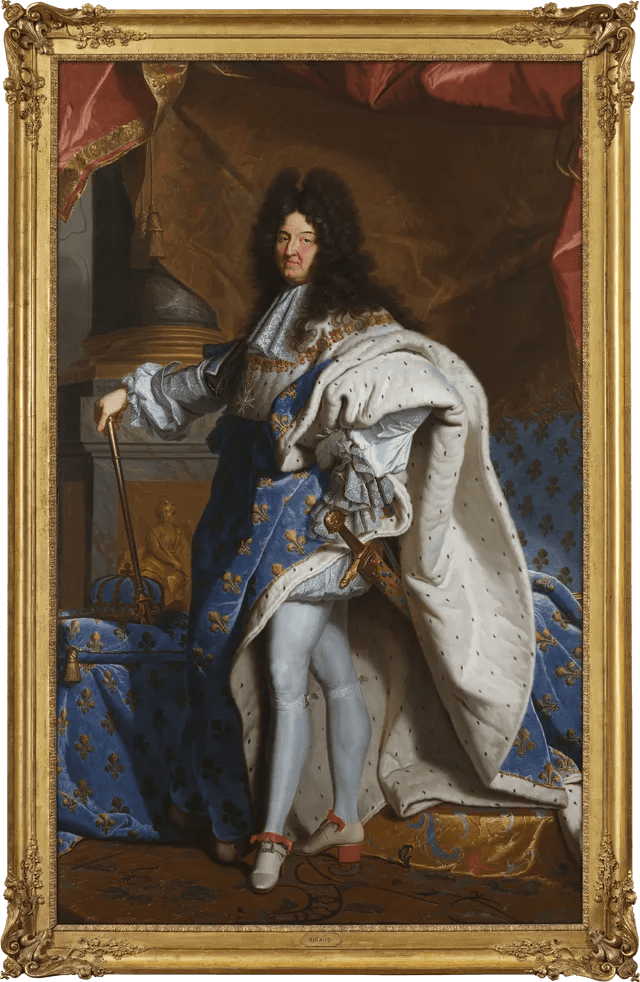
I also always used to deplore the fact that men’s clothes gradually became so incredibly boring from the heydays of Beau Brummel-type male fashion icons. Look at the above painting of Louis XIV. Now imagine a man wearing that outfit to an awards show or a film premiere. Even our own Founding Fathers wore tights, powder, wigs, and heeled shoes.
But somehow, those clothing items became feminized and gender swapped–of course, women in the past also wore heeled shoes, wigs, powder and tights beneath their skirts and bustles and hoops. But even in the 1930’s and 1940’s, men’s clothes were far more stylish–trench-coats and linen pants, fedoras and other hats, spats and Oxford shoes, argyle socks. I hated the “traditional” styles of dress for men that developed in the post-war period. and the utter rejection of those same styles in the 60s and 70s. Men’s clothing began to evolve a bit more during this period–and some serious fashion faux-pas were prevalent during the last decades of the century.
As I said the other day (and as so many others have pointed out), men have always dressed as women for one reason or another that had nothing to do with gender expression or identity for years. The Sun King’s gay younger brother (he also had a gay bastard son by Louise de la Valliere; homosexuality was rampant at the Sun King’s court) Philippe duc d’Orleans (whose son was the namesake for New Orleans) had many male lovers and often dressed as a woman for appearances at court. I’ve always wanted to write about Philippe, who has always fascinated me–the young gay bastard son of Louis XIV, who died young, was Louis duc de Valentinois; I’ve also had some minor interest in writing about him as well, or just gay life at Versailles in general.
There is a long-standing drag tradition in New Orleans as well. The Red Dress Run, for example, may not be full drag as we know it, but it’s essentially all about men in red dresses for charity.
One of the things I really enjoy about the modern young generation is they don’t subscribe to the antiquated rules of fashion for men and women. I love seeing young actors and celebrities showing up at red carpet events in daring outfits instead of that tired old tux look. Yes, men look dashing in tuxedos; I’ve always wanted to go full tuxedo with hat, cane, tails and gloves–but again, not the ordinary or expected.
I wore a kilt twice when I went to the Edgars, and wore it again at Bouchercon in Albany for our Real Housewives of Bouchercon panel. I loved wearing it–skirts are sooooo much more comfortable than pants–and it was definitely a fashion risk; people who didn’t know me but saw me wearing it undoubtedly thought ah, that one must be gay. I love the way the Musketeers dressed in The Three Musketeers–I think the seventeenth century was probably my favorite era for men’s clothes; I also love a pirate look from the early eighteenth as well.
One thing I definitely need to explore more with Jem is not only his sense of fashion for his clients, but for himself–both in and out of drag. Those are critical decisions for a queen–because while a particular look or style for a queen can evolve over the years, it’s very unusual for them to do something radically different than their usual; again, it probably has to do with ease more than anything else; it’s much easier to fall back on a regular look and color palette than to reinvent yourself every time or to come up with something new every time. I do think I am going to have Jem do the Madonna constant reinvention thing–mainly because it’s more interesting that way for me–because it is part of who he is as a person; Jem thinks he’s boring but he’s actually quite adventurous. Jem has very little confidence in Death Drop, which is easy for me to write because I know how that feels. One of the goals of the series is to show him develop self-confidence and self-assurance and becoming more comfortable with himself, and part of that is going to come from performing in drag and another part from actually solving crimes…which makes him start believing in himself more.
And that is always fun to write–character growth and development.
 Queer and Loathing in America