I sometimes wonder how dramatically different my life would be had my parents not migrated to Chicago when I was a child to provide us with a better life than we could expect in Alabama. I’ve always been somewhat grateful to them for this, because I can’t imagine or fathom what growing up in the rural South would have been like for teenaged gay Greg; Kansas was bad enough. But my heart will always have a place in it for the state I was born and where my parents grew up (and will both eventually be buried), and whenever I mine Alabama for fiction, it always comes up roses.
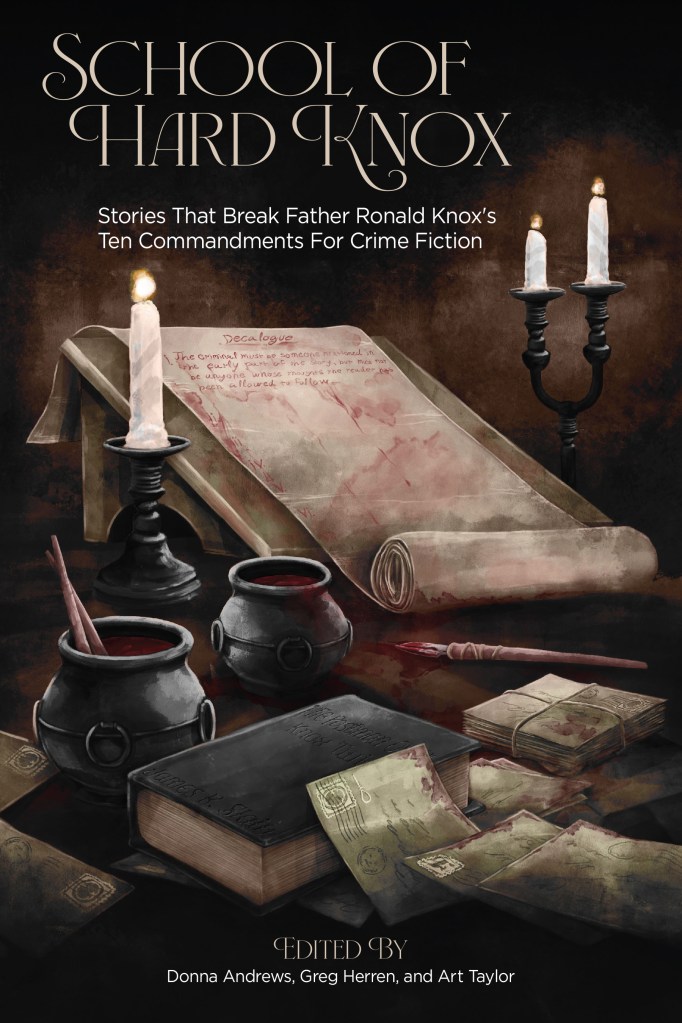
I was enormously pleased and flattered to be asked to participate in the Crippen and Landru anthology School of Hard Knox, and the last thing I was expecting was to get a co-editing credit. Art, Donna, and publisher Jeffrey Marks (a fine writer in his own right; check out his novels and short stories) did the majority of the heavy lifting; my contributions were more along the lines of sending an email cheering the others on or giving a thumbs up/thumbs down to a design question.
If you’d like, you can preorder a copy right here.
The premise of the anthology was that Father Ronald Knox, a scholarly clergymen, had come up with the ten commandments for writing crime fiction during the Golden Age, and each of us could chose a commandment and write a story breaking it. Obviously, it was pretty clear to me that Rule 2 was perfect for me:
All supernatural or preternatural agencies are ruled out as a matter of course.
And I knew precisely which story in the archive I could revise and rework to break this commandment and fit perfectly into the book, “The Ditch.”
I also cannot believe who I am sharing the table of contents with. Check out this talent!

Now THAT’S a table of contents! Not sure what I am doing there with these amazing writers, but I am most pleased to be there.
And this is how my story, “The Ditch,” opens:
I‘d just finished reading my book–The Hardy Boys, The Secret of the Lost Tunnel— and was reaching to turn off my bedside lamp when my phone chirped on my nightstand to let me know I’d gotten a new text message. I frowned. It was just past ten on a weeknight. Sure, it was summer, but Mom and Dad were strict about phone usage after eight o’clock. My orange-and–-blue Auburn Tigers clock, hanging just over my desk, read a few minutes past ten [on a weeknight]. I picked up the phone and looked at the screen. My wallpaper was a photo of me standing on a white sand beach on the Florida gulf coast.
I need your help. Come over! Please! Emergency!!!
It was from my best friend, Zane Tidwell.
I closed my eyes and exhaled. Classic Zane, always sending desperate–sounding text messages expecting me to drop everything and rush right over. Everything was an emergency to Zane, from not getting his homework done to failing a test to not having any clean underwear to having a nightmare of some kind—all of these things qualified as emergencies in Zane’s brain. He worked himself up into quite a state over the stupidest things.
“The boy who cried wolf” was all Mom would say.
The problem being, sometimes it was an emergency, like that time he broke his arm when he was home alone, or when his mother fell and hit her head, or when his dog ate rat poison.
He always counted on me keeping my head on straight and not panicking and solving the problem for him. We’d been best friends ever since we were little boys in Bible study, and things had always been this way.
I was the calm one and Zane–well, Zane was a drama queen.
He knew I wasn’t even supposed to use my phone after eight, let alone leave the house after ten.
I typed out you know I can’t it’s too late to leave the house and if I get caught they’ll take my phone and ground me forever with my thumbs.
Please you have to come I don’t know what to do I am really in big trouble now PLEASE!!!!
I stared at the screen. In big trouble? What did that mean? But if the needle on the Zane drama-meter was going up, he wasn’t above calling me on the landline.
And that would send Mom and Dad over the edge.
I sighed. I was going to have to go over there.
“You’re more trouble than you’re worth, Zane Tidwell,” I whispered, typing out Be there soon and hitting send.
“The Ditch” is an Alabama story, of course, and has a teenaged protagonist (I’m not sure why I always write about Alabama from a young person’s perspective; probably because most of my memories are from childhood, I suppose) whose name we never really know. The ditch is actually a real place; my main character’s house is based on where my aunt and uncle lived–which is where we would visit–and about twenty or so yards behind the house was this ditch–or rather, what they called ‘the ditch.’ (I’d share a photo from Google Earth, but all it looks like from the air is a line of trees.) We used to spend a lot of time playing down there, and of course to me as a child it seemed enormous, but it’s probably a lot smaller in reality than I remember (everything seemed enormous to me when I was a child). I never knew what created the ditch, or why it was there, but it’s very similar to what I describe in the story, if smaller. There was all kinds of garbage down there–broken bottles, rusting cans, and so forth, so we were never supposed to go down there barefoot. I also remember that when we were in the ditch we weren’t visible to anyone not standing on the edge–which was a bonus for us as kids. The rope swing was also there (and now I think how fucking insane was it that adults let kids play like that? You could break your neck falling off that thing!) and I’ve also included the ditch in another, unfinished longer piece. There was something creepy yet idyllic about the place, and of course whenever I think about it as an adult it’s always what a perfect place to hide a body! What a perfect place for a ghost! and so on.
I wrote “The Ditch” originally for another anthology’s open call, but I knew when I finished it and turned it in it wasn’t going to get selected. (I was right.) I also knew it needed to be revised and the ending changed as well as some other things (minor but important) but had never gotten around to getting the revision done. So when this opportunity presented itself, I was going to use a different story but had some trouble with its ending and then was despairing when it hit me: you know how to fix “The Ditch” you just haven’t done it yet, so stop spinning your wheels with this one and do that instead, so I dug back into it and really had a great time with the revision. I’m very pleased with how it turned out, and I hope you will be, too!
(Ironically, this week the ending to the other story popped into my head, so I will be working on that this week, too.)
 Queer and Loathing in America