You Don’t Have to Tell Me

There really is nothing quite like a good read, is there?

Alafair Burke has become one of my go-to’s; an author whose every book I preorder and start salivating when I get the shipping notice. I’ve not read her extensive backlist as of yet; I was late to the Burke party and began with The Ex. I do possess most of the backlist and it’s all in my TBR pile, but I’ve gotten so addicted to reading the new ones when they come out I never think to go back to the shelves to get one of the older titles–which is something I clearly need to do; and never have I felt that pull more than while reading her latest.

You see, she wrote a series about a New York cop named Ellie Hatcher–and Ellie comes back as part of the ensemble cast of Find Me, and what I saw of Ellie made me want to go back and read more about her. Well done on that front, Alafair! (This is something that I absolutely love when authors do; like how whenever Laura Lippman needs a Baltimore private eye, she brings in her old series character Tess–which is always a welcome joy whenever it happens….and maybe something I might be able to do with Chanse at some point. Hmmm.)

But I was very excited when Find Me was delivered into my hot little hands, and yesterday, while I was freezing inside the Lost Apartment, I grabbed a blanket and repaired to my easy chair, intent to read for an hour.

I didn’t stop until the book was finished.
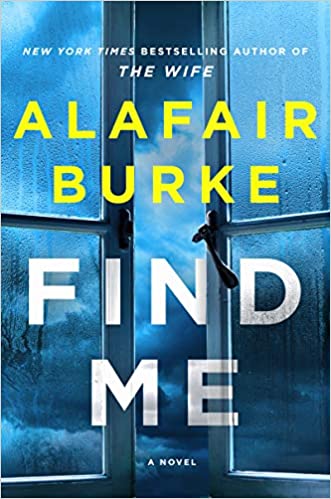
Hope Miller shifted her gaze from the gas nozzle to the pump. When the gallon counter hit twelve, she scolded herself for not filling up before her trip into the city. She couldn’t risk an empty tank.

The nearest customer leaned against his green Jeep, sharing her same awkward wait, watching the digital numbers tick by. She noticed him looking at her. When he noticed her noticing, he flashed a practiced grin. She didn’t smile back.

That phrase, “It takes more muscles to frown than smile?” She had googled it once. Turns out, facial descriptions are subjective. Smiles, sneers, frowns, and smirks are all in the eye of the beholder. And the so-called facial nerve controls forty-something muscles, but some people have all of them, while others are missing almost half.

But scientists did agree on one thing–that smiles are innate. Reflexive. And viewed across cultures as a sign of friendliness.

A single man smiling at a single woman alone at a gas station at night?

Pretty great opening, isn’t it? The entire opening chapter is an exercise in suspense: is the woman imagining that this man isn’t just some stranger at a gas station? Is she being paranoid, or is this just the start of an innocuous encounter encapsulating the micro-aggressions directed at women by men on a daily basis? I understand that paranoia myself a bit–I experience it every time I travel throughout the deep South and have to stop for gas or to get something to eat; I am always on high alert during these times, paying attention to any and everything around me, and especially the people. I’ve stopped for gas and noticed someone staring at me before, and then following me back onto the highway, my heartrate increasing and adrenaline pumping through my veins as every mile ticks off on the odometer; I will often deliberately slow down to force the suspicious vehicle to eventually pass me…and this happens more regularly than it probably should. Anyway, I can relate to the main character’s paranoia; this is masterful suspense writing by the author, because now I have been pulled into the story and I am worried about the main character.

The book is mostly set in the Hamptons, with some scenes taking place in New York City; there’s even a detour to Wichita (KANSAS!!! It keeps popping up everywhere lately!). The main character of the story is NOT the paranoid young woman in the first chapter (and I cannot explain to you, Constant Reader, how wonderful that first chapter is; everything in that first chapter, every tiniest detail–everything she feels and thinks and remembers–is crucial to the story), but rather her sort-of adopted sister, criminal defense attorney Lindsay Kelly. The young woman in the first chapter, Hope Miller, is already, in and of herself, a mystery. She was found some years earlier, as a teenager, thrown from a wrecked vehicle with no memory of who she is, where she came from, or how she wound up in New Jersey. (The car had Indiana plates and was reported stolen.) Eventually, she takes the name Hope Miller and moves in with the Kelly family–a woman without a past that Lindsay somehow feels responsible for; more so than as a friend or as a sister. Hope is damaged, obviously, and has only recently decided to take control of her life and start over somewhere different than the small town in New Jersey where she’s been living since the Kellys took her in–she wants to go somewhere where everyone doesn’t know her as “the mystery girl with amnesia.” Hope disappears, and Lindsay is desperate to find her; has her true past finally come back to haunt Hope? Who is she? And what, if anything, does she have to do with the murder of a local charter fisherman who was murdered around the time she disappeared? Is she dangerous?

The search for Hope soon draws in some more characters–including, as mentioned earlier, police detective Ellie Hatcher from Manhattan–and there are multiple stories going, all of them tied together, all of them leading back to Hope’s mysterious past, and there’s also a potential link to a serial killer Ellie’s father investigated back when she was a girl. The characters are all well-drawn and developed enough to be real enough to draw the reader in to root for them; Burke is also masterful at pacing and when is the right opportunity to play yet another card that will either further confuse or enlighten the reader as the story continues to take shape out of the amorphous confusing mist entangling the characters.

Juggling all of the subplots and keeping them tied into the main story is also not an easy task for a writer, but Burke manages to do so, tidily winding up every loose end to leave the reader, as they close the book, smiling and satisfied with the experience.

Silver Bells

City sidewalks, busy sidewalks, dressed in holiday style….in the air there’s a feeling of Christmas….

“Silver Bells” is, hands down, one of my favorite Christmas songs.

I’ve always wanted to write a story built around the song; maybe that’s something I can do for next year–but then again, who knows what will happen between now and then as far as my writing and deadlines are concerned? Heavy heaving sigh.

The other night, when I did my ZOOM thing for the release of #shedeservedit, afterwards I had a horrible rush of doubt and fear about the book itself. Who am I, after all, to write about rape culture and sexual assaults and so forth? Was writing the book an attempt to assuage my own guilt for my own complicity in the systemic toxic masculinity of our society, culture and civilization?

Some of the above? None of the above? All of the above?

I started writing the fiction collectively known and referred to as “the Kansas book” when I was actually in high school in Kansas. I created a fictional version of my high school and the county, including the county seat; it went through many iterations and renamings over the years as I worked on aspects of this enormous book, with interconnected characters and stories and so forth. Some of it was pulled out of this enormous “Bible” (for wont of a better word) to become my novel Sara about ten years or so ago; bits and pieces of it have now been pulled out to use for #shedeservedit, which will be out in January and has been what I have mostly referred to as “the Kansas book” for the last six or so years. The first draft of this iteration was written over a month, in July of 2015; I wrote three thousand words per day (or tried to; I did take some time off here and there) and by the end of the month I had nineteen chapters of about five thousand words in total of what needed to be a total of twenty chapters; I’d done ninety-six thousand words in a month but still didn’t know how to end the book (this is always a problem for me, by the way; and I am always afraid I don’t stick the landing). Over the next four or five years, I revised and rewrote the book, trying to see if I could figure out how to stick the landing as well as figure out what the dismount should be. I knew how I wanted to end it, but wasn’t sure if it would work…but also never wrote it, thinking the endless revisions and rewrites and changes might point the way to the proper dismount.

But this version, that begins with the star quarterback going missing after a game one night, might use the characters I dreamed up in the late 1970’s and have adapted and changed and grown over the years, but the plot-line that runs through this book wasn’t born until about 2004, when I decided to take all the things I’d been loosely working on over the decades since high school and pull it all together into a crime novel: the final and complete edition of the Kansas book. And it has gone through many iterations before I started that massive attempt to write an entire first draft of the new story in one month; back in 2004 I saw it as a book that flashed back between the present and 1977, when the quarterback was to have gone missing. I eventually abandoned that attempt–though I have reserved the right to do another such book, flashing back and forth in time, set in this universe somehow; I’ll figure that out later–and moved on to this final version of the missing quarterback theme/story.

Ironically, even from its earliest iteration, the underlying story here was about privilege; the privilege that comes with being a football player in a small city (am never sure where the cut off between town and city is precisely; I know when I lived in Kansas Emporia was considered a large town–population 27k or so–while the town we lived in was considered small–population 952; and Wichita, Topeka and Kansas City were considered cities) with a highly successful high school football team. With athletic success comes privilege; that was even true back in the 1970’s, and was even more true when it came to college teams. Originally, the quarterback’s body was found, naked, on the fifty yard line with evidence he’d had rectal sex the morning after Homecoming. That changed–the location of the body at any rate–and I also realized the Homecoming murder was also a cliché, so I had to move it up further in the season–which also made more sense with the timing of the event that may have possibly triggered the murder in the first place…this was a huge issue with the original draft I wrote in a month; why would it have taken so long for the murder to happen if the potentially triggering event was in the summer?

These are the trials and tribulations that an author must face when writing a crime novel.

Sometimes fate intervenes, as well. When I was writing Sleeping Angel all those years ago, I kept thinking something was missing from the manuscript; there was a hole where I should have been making a point and wasn’t. I was writing this book around the time when there were a rash of queer kids committing suicide in the news–basically being bullied to death–and this was around the same time that Dan Savage started the “it gets better” campaign. Ah, I thought, there’s what’s missing from the story.

It wasn’t like I didn’t know how it felt to be bullied, after all.

I decided to pull the Kansas book back out, and write that first draft, in the wake of two news stories that happened around the same time: Steubenville, Ohio and Marysville, Missouri. As I watched those cases unfold, I knew that was the answer to the Kansas book; my ‘small city with a great football program’ (and whose name went through many changes over the years–Kahola to Greenfield to Carterville to its final name, Liberty Center) obviously had to have a rape culture problem, derived from the culture of toxic masculinity that was created in order to have a successful football program. This decision was reiterated when I read Missoula: Rape and the Justice System in a College Town by Jon Krakauer–which I bought and started reading one day when I was trapped in the Newark airport by a flight cancellation for like eight hours or so. (Also: shout out to friend Gwen Florio, a reporter for the Missoula paper whose coverage of the stories there featured heavily in the book)

So, when I sat down to write that draft in a month (oh to have that kind of focus again), that was in the forefront of my mind: the triggering event that may have potentially have led to the murder was the sexual assault of a cheerleader at a party before school started.

So, yes, I have written a crime novel set in a small town with a rape culture problem. Am I the best person to write such a book? Maybe, maybe not. But that’s why I am so nervous–how are people going to react to this story? From me?

And then I think, oh, it’s not like anyone pays any attention to you or your career anyway.

And now back to the spice mines.