Under the Bridge

 Sunday morning, and I must confess that other than doing the errands and some slight cleaning yesterday, I fear the day was mostly a bust for getting things done. But that’s fine; I am off today and tomorrow as well–tomorrow should include both the gym and a Costco run–and I intend to get a lot of writing done today. The kitchen and living room are still in need of some straightening as well, and I assume that I shall get to that as I pass the day. I was thinking about going to the gym this morning, but I think I shall go tomorrow instead, and then have a Monday-Wednesday-Friday workout schedule to try to stick to; with perhaps going in on the weekends simply to stretch and do cardio. I have now discovered a new show to watch for cardio–The Musketeers, and there’s at least three seasons, I believe–which will makes things ever so much easier. I certainly did a lot of cardio while I was watching and enjoying Black Sails, so The Musketeers might just do the trick. (I had high hopes for Netflix’ Troy: The Fall of a City, but it was so boring I had to give up. HOW DO YOU MAKE THE TROJAN WAR BORING?)

While I was goofing off yesterday and watching things on Amazon/Netflix/Hulu/Youtube–yes, I know–I was also reading through Bertrand Russell’s brilliant and informative The History of Western Philosophy, and I came across this:

The last dynastic pope was Benedict IX, elected in 1032, and said to have been only twelve years old at the time. He was the son of Alberic of Tusculum, whom we have already met in connection with Abbot Odo. As he grew older, he became more and more debauched, and shocked even the Romans. At last his wickedness reached such a pitch that he decided to resign the papacy in order to marry. He sold it to his godfather, who became Gregory VI.

I do find it interesting that Russell chose to word it that way: that the height of his wickedness was his decision to resign and marry.

This led me into an Internet wormhole, looking up Benedict IX, the dynastic papacy, and the Tusculan popes. As you know, Constant Reader, history always has fascinated me; I would love one day to write historical fiction, as there are so many historical figures that fascinate me, from Catherine de Medici to Cardinal Richelieu to the Byzantine empress Irene to now, Benedict IX; and the century before him, where a woman named Marozia had enormous influence not only over the papacy but on who was elected pope (Marozia, in fact, founded the dynasty of popes called the Tusculans; which concluded with Benedict.) The Fourth Crusade, which wound up sacking Constantinople, also interests me, as do the histories of Venice and Constantinople.

And one can never go wrong with the Borgias and the Medici.

Anyway, one of the debaucheries of Benedict IX was sodomy, and it appears that the historical record holds that he was homosexual; how can I not be fascinated by a gay Pope, the way I am interested in Louis XIV’s gay brother Philippe duc d’Orleans?

So, of course I am making notes for a historical fiction novel called Benedictine, the tale of the gay pope.

Am I nothing if not predictable.

Next up in Florida Happens is Eleanor Cawood Jones’ “All Accounted For at the Hooray for Hollywood Motel”.

Eleanor Cawood Jones began her writing career in elementary school, using a #2 pencil to craft short stories based around the imaginary lives of her stuffed animal collection. While in college at Virginia Tech, she got her first paid writing job as a reporter with the Kingsport Times-News in Kingsport, Tenn., and never looked back. Eleanor now lives in Northern Virginia and is a marketing director and freelance copywriter while working on more stories as well as her upcoming mystery novel series. She’s an avid reader, people watcher, traveler, political news junkie, and remodeling show addict. She spends her spare time telling people how to pronounce Cawood (Kay’-wood).
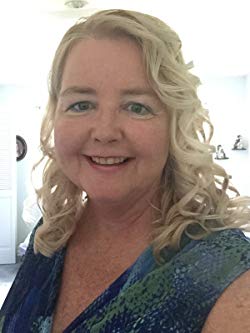
eleanor jones

Mona, lingering over a third cup of coffee, flipped through her collection of vintage postcards while the all-consuming sound of crunching cereal across the table grated increasingly on her nerves.

She took a sip of lukewarm coffee, gritted her teeth, and reminded herself of her husband’s many good qualities—of which turning mealtime into crunchtime was not one. Things were easier when she had to dash off her to accounting job. In those days, there was never time for another cup of coffee, much less prolonged crunching noises.

“Rodney!”

Rodney looked up from the Racing Times. “Mmmm?” At least he wasn’t speaking with his mouth full.

“I wonder if this hotel is still around?” She held up a ’50s postcard with a modestly clad bathing beauty posing in front of a diamond-shaped, brightly painted sign advertising the Hooray for Hollywood Motel. In the photo, an appealing, pink-painted building featuring a bright blue swimming pool practically beckoned vacationers. A single story structure in a horseshoe shape provided easy access to drive in and unload luggage. The fine print mentioned another pool in the back of the motel as well, as well as an onsite restaurant. Nothing about ocean front, but Mona knew the area well enough to know the motel would be right between the coastal road A1A and highway 95 in the heart of Hollywood, Florida.

Rodney perked up. “Alexa, phone number for Hooray for Hollywood Motel in Hollywood, Florida.”

Mona shuddered, once again, at having to share her vintage, mid-century kitchen with Alexa the interloper. But Rodney had retired two years before her and had spent his spare time acquiring gadgets, of which this conversational internet talkie was the latest.

This charming little story tells the tale of Mona and Rodney, a retired couple from Ohio who impulsively decide to take a trip to Florida, based on finding an old postcard. They’d honeymooned in Florida years earlier, and now that they’re retired, why not? But once they arrive at the vintage old motel, Mona finds herself helping out the crotchety owner, and soon Mona and Rodney are helping revitalize and bring the old motel back to life…until one morning they find the owner floating in the swimming pool.

And then things get interesting.

Very pleased to have this charming tale in Florida Happens, and now I must get back to the spice mines.

Love Touch

Sunday morning, as I sit here in my cool workspace swilling coffee, trying to wake up and figure out what to do with the rest of my day. I need to go to the grocery store and I should also probably make an attempt to go to the gym; but I can’t seem to find my iPad, which makes doing cardio pointless (I read or watch TV on my iPad while on the treadmill; perhaps not having my iPad is simply an excuse for not going; what if it’s gone, lost, stolen? I am trying not to think that way and am hoping that I simply left it at the office. If not, I am terribly screwed because I don’t know where it is and I currently don’t have the cash on hand to replace it. So, yes, let’s just continue pretending happily that it’s as the office, shall we?)

I could, of course, just go to the gym and do weights. That always feels good, at any rate. Perhaps once I finish swilling this coffee….

I slept late yesterday, and I slept even later today. I spent most of yesterday not only reading but doing chores around the house, on the pretense that today I would not only go to the grocery store and the gym, but I would also spend some time writing today. I need to finish a short story; I need to revise still another, and there’s that new one struggling to take root in my brain that I haven’t really decided what to do with just yet. There are two others swirling around up there in my head, as well as others I’ve not thought about or have forgotten about in the meantime. But now, now as I wake up I feel more confident about running the errands and going to the gym and actually doing some writing today.

I’ve been reading The History of Western Philosophy by Bertrand Russell, and greatly enjoying it; is there anything quite like well-written non-fiction? It’s why I love Joan Didion and Barbara Tuchman; one of the things I love to do while reading is to learn, and non-fiction fills that need quite beautifully. I also like non-fiction that makes me think; which is why I am looking forward to reading Dead Girls by Alice Bolin. I still would love to do a collection of my own essays, book reviews, and so forth; but egad, what an odious chore pulling all of that together would be. I struggle with essays, but I also think that the writing of essays; the ability to pull thoughts from my head and extrapolate them out to their fullest meaning, is vitally important and a skill-set I wish I had honed more properly. A friend once pointed out to me, as I bemoaned my inability to write essays, that my blog itself is nothing more than years of personal essays. That took me aback, because it was, in many ways, correct; there is definitely some truth to that, but it’s hard for me to take the blog seriously in that fashion, because so much of it is simply written off the top of my head in the morning as I wake up and drink coffee and try to figure out what to do with the rest of my day.

One of the problems for me with personal essays is, ultimately, the issue of self-deprecation, which I’ve addressed in previous blog entries about my writing and my career and my books; who am I to write about this subject? Am I expert enough in this to write about it, or am I simply talking about things that smarter, better-educated people have written about long ago and having the hubristic belief that I am the only person to see this truth for the first time? 

And, in considering myself self-deprecatingly as not that special or particularly smart, I defeat myself and never write the essay.

And of course, there is the problem of all the lies my memory tells me.

But yesterday, I took the afternoon to finish read an ARC of Lou Berney’s new novel, November Road, and was blown away by it.

Scan.jpeg

Behold! The Big Easy in all its wicked splendor!

Frank Guidry paused at the corner of Toulouse to  bask in the neon furnace glow. He’d lived in New Orleans the better part of his thirty-seven years on earth, but the dirty glitter and sizzle of the French Quarter still hit his bloodstream like a drug. Yokels and locals, muggers and hustlers, fire-eaters and magicians. A go-go girl was draped over the wrought-iron rail of a second floor balcony, one book sprung free from her sequined negligee and swaying like a metronome to the beat of the jazz trio inside. Bass, drums, piano, tearing through “Night and Day.” But that was New Orleans for you. Even the worst band in the crummiest clip joint in the city could swing, man, swing.

A guy came whipping up the street, screaming bloody murder. Hot on his heels–a woman waving a butcher knife, screaming, too,

Guidry soft-shoed out of their way. The beat cop on the corner yawned. The juggler outside the 500 Club didn’t drop a ball. Just another Wednesday night on Bourbon Street.

Lou’s previous novel, The Long and Faraway Gone, won every crime-writing award under the sun that it was eligible for: Edgar, Anthony, Macavity, and I don’t know what all; it was the crime publishing equivalent of the EGOT. It was, obviously, an exceptional novel. I met Lou when we were on a panel together at the Raleigh Bouchercon, along with Lori Roy and Liz Milliron; moderated by the amazing Katrina Niidas Holm. It was funny, because the panel topic was, I think, writing about small towns which, in fact, none of us on the panel really did, but we had fun with the topic and I know I brought up Peyton Place at least once and pointed out that suburbs are small towns with the primary difference being suburbs are bedroom communities for cities while small towns aren’t attached in any way to a larger city. It was fun and spirited and I liked Lou, thought he was incredibly smart, as were Liz and Lori. Lori and Lou went on to win Edgars for that year; and I admire their work tremendously. I’ve not had the opportunity to read Liz’ work; but she did have a terrific story in the New Orleans Bouchercon anthology, Blood on the Bayou.

Anyway, I digress.

I’ve been looking forward to November Road since I finished reading The Long and Faraway Gone, but I still need to go back and read Lou’s first two novels, Whiplash River and Gutshot Straight. 

I also have to admit, I was a little hesitant about Lou’s new book; it’s built around the Kennedy assassination in 1963, which always gives me pause (I have yet to immerse myself in Stephen King’s 11/22/63). I’m not sure why I don’t care to read fiction around the Kennedy assassination, but there you have: an insight into my mind. But the Kennedy assassination, while a primary plot device, is just that: a device to set the story in motion. Frank Guidry is involved with a mob boss in New Orleans, and after the Kennedy assassination he is given instructions to fly to Dallas, retrieve a car, and drive it to Houston to dispose of it. While he is doing this, he realizes that he is getting rid of evidence that may be of vital importance to the investigation into the president’s murder–and as such, is a loose end who knows too much and figures out he’s got to disappear now because they’re going to want to kill him. And sure enough, they do send someone after him, Paul Barone, a remorseless killer and tracker. The cat-and-mouse game between them builds suspense throughout the book.

But it’s not just about Frank, and it is a credit to Berney’s talent, creativity and imagination in that he throws in another primary character, constructed carefully in all the facets and layers that make her live and breathe: Charlotte. Charlotte is a wife and mother in a small town in Oklahoma, married to a useless drunk fuck-up with whom she had two daughters, and her salary working for the local town photographer is the primary thing keeping a roof over their heads. Her own ambitions for being a photographer herself are constantly shat upon by her boss, her society and culture and environment: she is a woman, a wife and mother, and in 1963 that so thoroughly defines her that any other ambition she might have throws her identity as wife and mother into question. Trapped, with the walls closing in on her closer every day, Charlotte takes the president’s assassination as a sign for her to run away with the girls and start over. Charlotte is an extraordinary character;  her relationship with her daughters is the strong backbone of this story. You root for her, you want her to make her escape and make her dreams come true.

Frank and Charlotte cross paths in New Mexico, and Frank sees them as his salvation; his murderous pursuers might be thrown off as they are looking for a single man, not one traveling with his wife and kids; the book becomes even stronger and more suspenseful once they are all together. Frank and Charlotte become close, despite not being completely honest with each other; they are both keeping their cards close to their vests, but yet form a loving bond. WIll they escape, or will they not?

November Road reminded me a lot of Laura Lippman’s Sunburn; the same kind of relationship building between a man and a woman where a lot of information, important, information, is held back from each other, and that lack of trust while falling in love is an important theme in both books: women trying to make their best lives, even if it means making morally questionable decisions, while becoming involved with a man who isn’t completely honest with her. Berney’s writing style, and tone, and mood, also put me in mind of Megan Abbott’s brilliant Give Me Your Hand. If you’ve not read yet the Lippman and Abbott novels, I’d recommend getting them and holding on to them until Berney’s book is released in October and reading them all over the course of a long weekend.

Bravo.