Walking on Broken Glass

Sometimes I try to remember the first time I saw or heard or watched or read something, anything, that made me feel less weird, less like an outsider…often to no avail. I can never remember if it was That Certain Summer (a very SPECIAL ABC Movie of the Week), or reading Larry McMurtry’s The Last Picture Show, or discovering The Front Runner on the paperback racks at the News Depot on Commercial Street in Emporia; and then I will remember something else, some vague memory of something–hints about Richard the Lion-Hearted in Norah Lofts’ The Lute Player, or subtle hints here and there throughout history (Edward II and Piers Gaveston; Louis XIV’s brother Phillippe Duc D’Orleans; James I and Robert Carr; Achilles and Patroclus)…Mary Renault’s Alexander the Great series…I can never remember precisely the first time I was exposed to who and what I am in popular culture, nor can I remember if it was positive or negative. I do know that in my own life, it was made very clear to me when I was very young that what I am was not normal, was unacceptable, wasn’t what I was supposed to be. My earliest memories are of me not being like other boys, and it took me a while to realize that the others were just playing at being boys (something I was never very good at) and were actually like that; that they weren’t, underneath, just like me, just better at pretending than I was.

This is why we have emphasized, as a community, the importance of representation in popular culture; kids needs to see themselves reflected in the culture they consume so they don’t feel like they don’t belong. Queer kids aren’t raised queer; we don’t learn how to be queer by interacting with our peers (who are mostly straight when we are kids), nor do we learn anything about being queer while we are inside the educational system in this country. I’ve always firmly believed that queers take longer–at least in the olden days–to form lasting romantic relationships because we don’t have “trial runs” when we are kids; we don’t get to date, we don’t get to “go steady”, etc. We don’t get to play House with other kids of the same gender, we don’t learn societal and cultural expectations about relationships and how they work when we are actually kids. Our queer adolescence doesn’t actually start until we come out–admit it to ourselves without shame, and then start telling our family and our friends and our co-workers that we aren’t wired the same way they are. It’s very tricky, and very complicated and sometimes very messy.

Representation absolutely matters.

And we cling to that representation when it shows up. When a prime time show like SOAP introduces the first long-running gay character to the world in Jody Dallas (does anyone even remember this was Billy Crystal’s big break, playing gay on a sitcom in the 1970’s/early 80’s?), we watch–even if the depiction is problematic to the extreme (you also learn very early that your hunger for representation will also force you to turn a blind eye to some things). Steven Carrington on Dynasty, the terrible film Making Love from the early 1980’s, as well as some other problematic depictions and films along the way–we took what we got, and always had to remember that these characters and stories also had to be palatable to straight people…that, in fact, these characters and stories were created with straight people in mind.

As they used to say, “but will it play in Peoria?”

As i stare down sixty this month, I am very happy to see that representation becoming common-place. It’s lovely to see gay books–THRILLERS, even–being published by major presses with queer characters in them. It’s lovely seeing straight writers including sensitive depictions of queer characters and their stories in their books.

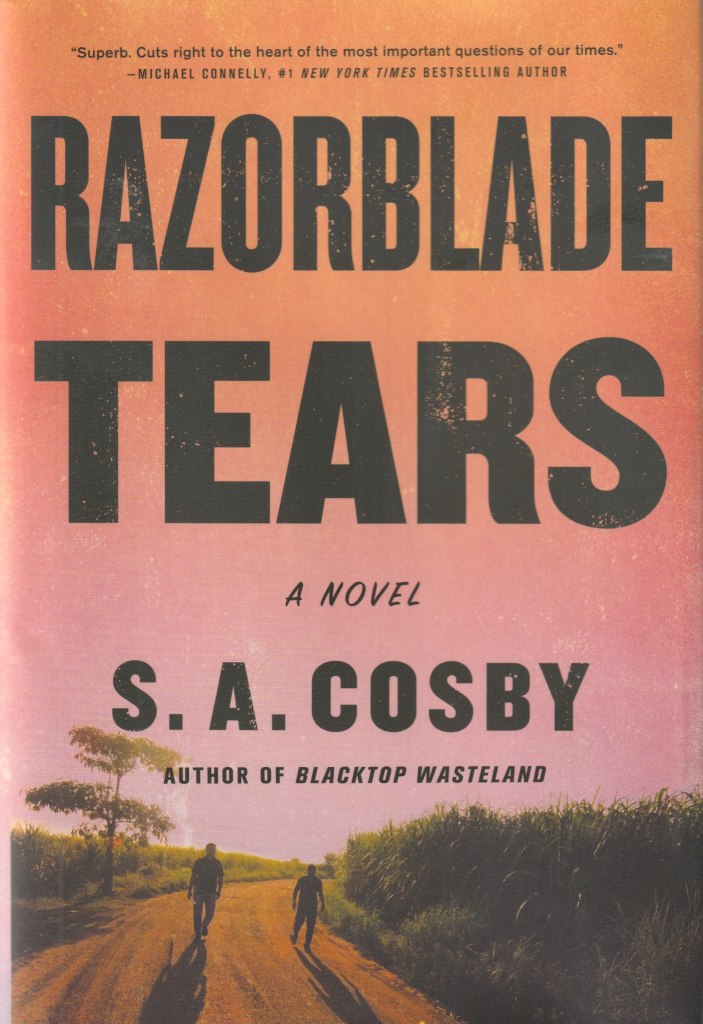
And over the year, yes, problematic tropes that can make you very, very tired have also developed–which makes me wary every time I approach a book by a non-queer person that takes on a trope without hesitation, as S. A. Cosby’s Razorblade Tears does, and that trope is one of the biggest and most hated by the queer community: bury your gays.
Ike tried to remember a time when men with badges coming to his door early in the morning brought anything other than heartache and misery, but try as he might, nothing came to mind.

The two men stood side by side on the small concrete landing of his front step with their hands on their belts near their badges and guns. The morning sun made the badges glimmer like gold nuggets. The two cops were a study in contrast. One was a tall but wiry Asian man. He was all sharp angles and hard edges. The other, a florid-faces white man, was built like a powerlifter with a massive head sitting atop a wide neck. They both wore white dress shirts with clip-on ties. The powerlifter had sweat stains spreading down from his armpits that vaguely resembled maps of England and Ireland respectively.

Ike’s queasy stomach began to do somersaults. He was fifteen years removed from Coldwater State Penitentiary. He has bucked the recidivism statistics ever since he’d walked out of that festering wound. Not so much as a speeding ticket in all those years. Yet here he was with his tongue dry and the back of his throat burning as the two cops stared down at him. It was bad enough being a Black man in the goo ol US of A and talking to the cops. You always felt like you were on the edge of some imaginary precipice during any interaction with an officer of the law. If you were an ex-con, it felt like the precipice was covered in bacon grease.

“Yes?” Ike said.

My faulty memory doesn’t remember how and when I first became aware of S. A. Cosby. What I do remember is that I bought and read one of his earlier works (perhaps his debut?) My Darkest Prayer, and enjoyed it thoroughly. Hard-boiled with a healthy dose of noir, I had a great time reading it–and was thrilled when his Blacktop Wasteland debuted to raves and attention and lots of recognition. Cosby can write like a house afire; and while he keeps up a rat-a-tat pace of story, he also manages to construct sentences and paragraphs beautifully, with a poet’s gift for language–spare and tight, yet poetic and beautiful at the same time (Megan Abbott is the Galactic Empress of this).

So, when I heard the “elevator pitch” for Razorblade Tears, I inwardly winced a bit, even as I had to admit Shawn’s guts; taking on bury your gays is a ballsy move–and also a bit of a dangerous one. If you don’t stick the landing…you’re fucked.

For those of you who don’t know what bury your gays means, it’s very simple: a show, or a book, or a movie, will introduce gay characters (lesbians, queers, whatever initial in the all encompassing umbrella those characters might choose for their identity), get the audience (and especially the queer viewers) deeply vested in them–and then kill them off suddenly and unexpectedly, all so the other queer characters (but usually the straight ones) will experience some kind of personal growth…in other words, you introduce a gay man into your narrative simply to later use him as a plot device, so the other characters can mourn and experience personal growth.

That’s probably explained badly, but you get the gist: gays will inevitably die. A good example of this is the so-called groundbreaking AIDS movie, Philadelphia–but the Tom Hanks character in that movie existed so that Denzel Washington’s character could grow and develop and move on from his own homophobic beliefs and fears about HIV/AIDS; as Sarah Schulman, one of our community’s finest minds, once said, “the entire point of Philadelphia is to make straight people feel better about HIV/AIDS and the gay men dying from it.” (Sections of her book Stagestruck: Theatre, AIDS, and the Marketing of Gay America are absolutely brilliant; it should be required reading for any Queer Studies course.)

The plot of Razorblade Tears is so deeply steeped in “bury your gays” that the gays are already dead when the book opens. The gays in question–Derek and Isiah–were brutally murdered, and the police don’t seem to care too much about looking into who killed them. Their homophobic fathers–both ex-cons–decide to look for their son’s killers. Both Ike and Bobby Lee feel a lot of guilt about their sons and how they rejected them both–their relationship, their eventual marriage, their child–while they were alive; finding their killers isn’t just about revenge but also a matter of atonement. In some ways, it’s like this book is borne from the anger every queer child rejected by their parents feels–you’ll be sorry when I’m dead.*

Ike and Bobby Lee are, indeed, sorry now that their sons are dead.

This also falls into another long-existent fictional trope: don’t fuck with a father. How many films (I’m looking at you, Liam Neeson), books or television shows are about a father’s rage, a father’s revenge, what a father will do to save or avenge their children?

Ike and Buddy Lee aren’t supermen, though. Cosby’s strength (besides his ability with words and images) is how well he creates characters and makes them human through their faults and frailties. Ike and Buddy Lee don’t much like each other as the story begins to move along–I kept thinking of the old Sidney Poitier/Tony Curtis movie, The Defiant Ones–but their ability to look past their own internal prejudices to see the commonalities between them as they unite in this foolhardy crusade to avenge their murdered sons is the real strength of the book here. (As well as the language.) You eventually start to understand them, care about them, want them to get their vengeance…even as you know it will bring them no peace.

I have to admit, I was hesitant to start reading this. I really was concerned I wasn’t going to be able to read it with the empathy necessary for Ike and Buddy Lee and their suffering–that I would think, yeah, well, maybe you should have thought about that when he was alive–but the book ultimately isn’t about their redemption, either; which is a genius move by Cosby. He makes their pain all too real–I cannot imagine the pain any parent should feel when their child dies–but he makes it clear there’s no easy answers here for Ike and Buddy Lee, and that pain will go on even if they get justice for their sons.

Shawn is also a master of writing about the Southern working class–about the poverty, the lack of opportunity, the societal neglect and how those factors all combine to keep those already mired in it trapped with little chance of escape; he clearly loves the rural South but not so much that he can’t expose the tragedy and ugliness that exists there.

It’s a powerful book, and I do recommend it….although the people who probably should read it inevitably won’t. I can recommend it, and do, enthusiastically; it’s a very powerful book, and it made me think–and what more can you want from art?

*sadly, I have seen all too often that a lot of those parents aren’t sorry when their rejected child dies; far too regularly they will say something along the lines of “So-and-so died for me years ago.”

Broken Wings


I have written, from time to time, about the issues I face  as a “gay author.”  I try not to get into it often; I always fear there’s a stench of sour grapes when I talk about the challenges of being a gay author of fiction that place gay men in the center of their own stories. Revolutionary, right?

When I first started publishing, back when dinosaurs roamed the earth, ironically there was a movement by gay authors to not be called or considered “gay” authors. More than one disdainfully told me when refusing to be interviewed for either Lambda Book Report when I was editor or for one of the queer newspapers I wrote for, or said on panel discussions at conferences, “I’m not a gay writer; I’m a writer who happens to be gay. You don’t call them straight writers, after all.” This statement, which I heard on more than one occasion, always took me aback, because the truth was it didn’t matter what you called yourself; booksellers and reviewers and readers would still see you that way. There was an arrogance, a smugness, to it; kind of saying yes, technically I am but I am not one of those writers, don’t lump me in with THEM.

Basically, you can call yourself whatever you want, but the market and the industry won’t give a rat’s ass what you call yourself.

Case in point: without fail, when you’re a gay author (or a queer author, or whatever kind of minority writer you might be) and you attend a mainstream writer’s/reader’s conference for whatever genre you may write in, you will inevitably find yourself assigned to what’s called a diversity panel. Make no mistake about it: these panels are important and do need to be held. My primary objection to them is their ghettoization aspect; i.e., the only thing of value these authors have to add to the conference conversation is whatever it is that marginalizes them. I have always argued that any minority writer assigned to a diversity panel should also be assigned to another panel. Reducing a minority writer’s value to simply being able to speak to diversity issues doesn’t help the author; and if we are really concerned about increasing diversity in publishing/whatever genre we are discussing, then audiences besides those who show up for diversity panels should also be exposed to those minority writers. People who come to diversity panels already are hungry for diversity in their reading and writing, which makes it a little bit of preaching to the choir.

Case in point: I was at a mainstream genre conference a few years ago, and of course was assigned to the diversity panel. (I was assigned to another, so I was fine with it.) It was an interesting mix of people, but as we talked about how to find and help new minority writers, a noted editor on the panel, cut me off and passionately said, But it has to be about the WRITING. The WRITING has to be good.

In other words, the reason we don’t have more diversity in publishing in general is because the writing isn’t good.

My jaw literally dropped, and I was stunned into silence by the implications of this noted, and relatively powerful, editor’s statement.

And it takes, as you can imagine, a lot to stun me into silence.

During the years 2004-2008 I kind of withdrew into myself and wasn’t really paying attention to the world of LGBTQ publishing as I had from 1997-2004; a lot of things were going on in my personal life, Katrina happened, and I basically just kept my head down and did my work. It seems, to me, looking back, that the world of LGBTQ publishing changed dramatically during that four years I wasn’t paying attention, when I wasn’t deeply immersed in it; perhaps these things were around before and I simply hadn’t been aware, or noticed; but when I started looking around again at queer publishing I became very aware of something that I hadn’t been aware of before: a new-subgenre of fiction called “m/m”; which was fiction about gay men written by straight women for other straight women (a generalization, of course; some of it is written by gay men and some of the authors are queer-identified women, and likewise, the readership is not all, but primarily, straight women). I found it to be a rather interesting phenomenon; I had always argued that gay male writers should market our work to heterosexual women, so it didn’t bother me that straight women were writing about gay characters and gay themes. I’ve always believed writers should write about subjects and characters they are passionate about, and if straight women were passionate about writing about gay men, more power to them, and welcome to our little niche of the publishing world. I certainly don’t want anyone telling me what I can and cannot write, or who I can write about, any more than any other writer would. There was a bit of a kerfuffle over the Lambda Literary Awards back then making a rule stating the awards were only for actual LGBTQ writers, and there was some outrage about that. I completely concurred with the outrage; the awards were for books and writing rather than the actual author. In my opinion, if a straight woman wrote a great and deserving book about a gay man, why not allow her to enter the Lambdas? The book and its writing is what, ostensibly, was being judged; let it be judged on those merits.

Yet I also noticed, in the wake of this decision by the Lambdas (which was later reversed), some horrific commentary and borderline, if not outright, homophobic statements being made by some of these ostensible so-called allies; homophobic statements always seem to rear their ugly heads whenever any gay man dares question the validity and/or authenticity of these works:

If authors only wrote from their experience, we wouldn’t have science fiction or vampires or werewolves.

Funny how a community that wants to be accepted and treated equally will discriminate.

The first is so fucking offensive on its face I don’t think I really need to explain precisely why it is; but imagine if a white writer said that in defense of writing about a black main characterYes, Virginia, queers ARE like mythological creatures or beings from another planet, so you just go right ahead! Frankly, if this is your line of thinking, you definitely shouldn’t be writing stories about characters with experiences different than your own. Imagine if I said well, of course I can write about a straight woman because it’s really no different than writing about werewolves or vampires or Martians.

If that’s not clear enough for you, try this: WE ARE HUMAN BEINGS.

The second is an implied threat; you need our support to get your equal rights as citizens so how dare you question us? You’d better shut your mouth and toe the line or else, you know, I might vote for homophobic candidates!

Ah, yes, the blackmail argument, which begs the question: Are you really an ally? A real ally doesn’t support a community so long as it toes the line of cisgender straight white people’s way of thinking.

Has there been a more flagrant and obvious expression of clueless straight privilege?

Another favorite was well, the best novels about gay men have always been written by straight women! Mary Renault and Patricia Nell Warren, to name two!

Ah, nothing like a nice straight white lady turning actual lesbians into straight ladies in order to prove their point. Um…yeah.

Or, my personal favorite, gay fiction largely began on the Internet, which erases decades of powerful writing by successful LGBTQ fiction writers, and their careers–not to mention all those Lambda Literary Awards given out, apparently, to “Internet writing” in the late 1980’s thru the mid 1990’s….

Needless to say, when I denounced the exclusion of their books but called out the homophobia…if you guessed they ignored the fact that I was on their side in general but instead focused on me calling out their comments as homophobic, you guessed correctly.

Seriously?

In 1998, Sarah Schulman published Stagestruck: Theater, AIDS, and the Marketing of Gay America. As a gay man of a certain age, reading (and reviewing) this book was an eye-opening experience. In that year, we were in approximately the seventeenth year or so of the HIV/AIDS crisis in the United States, but things were starting to change and look different. Medications were being developed and prescribed that lengthened life and reduced the impact of the HIV virus on immune systems; there was light at the end of the proverbial tunnel, and it looked like an HIV/AIDS diagnosis might not be the death sentence it had been since its first discovery.

Schulman’s book opened with her being made aware of similarities between her novel People in Trouble and the hit Broadway musical Rent.

Here’s what happened: I was twenty-eight years old in 1987, the year I joined ACT UP (the just-born AIDS Coalition To Unleash Power) and full throttle into a love affair with a married woman. An artist, she was very conflicted about sexuality with women and had contempt for the gay community in general. She practiced an art ideology that equated formal invention with radical content, something I contest passionately. My fantasy was that by exposing her to the realities of the AIDS crisis, she would drop her blinders about the functions of homophobia and simultaneously develop an understanding of the value of artwork based in experience. Needless to say, older now, I understand that my project was doomed from the start.

That year I completed my fourth novel, People in Trouble, about a love triangle composed of a married artist couple and the woman’s younger lesbian lover. The novel was set against the backdrop of the AIDS crisis and featured many scenes and feelings that came out of my actual experience. People in Trouble is about an East Village performance artist who is at the end of a relationship with a male artist and who, despite her own homophobia, falls in love with a lesbian. She creates a performance piece that targets a greedy landlord who is evicting people with AIDS. There is a subplot about an interracial gay male couple–one a queen, one an activist–in which ones dies of AIDS. A second subplot involves an activist group called Justice, who devise a credit card scam to feed homeless people. It was, as David Leavitt wrote in 1990, “the first work of fiction that portrays the enormous activist response the epidemic has generated.” And the book clearly showed how this response was firmly rooted in the gay and lesbian community, despite the neglect and inaction of dominant society.

Does the plot of her novel sound familiar?

The first part of Stagestruck, about Schulman trying to get someone, anyone, to acknowledge the great similarities between her book and Rent, was interesting to me, but what was even more interesting to me was the sudden realization she had, which led to the rest of her book, and her thesis: her book, which was well-received and sold well, basically told the same story as one of the behemoth Broadway musical successes of all time; the primary difference being her book centered the point of view of the lesbian in the love triangle while the musical centered the straight male POV. She then took this thesis; that gay and lesbian works can only be presented to a mass audience if told from a heterosexual point of view, and ran with it. She examined marketing of products, the how things are sold to gays and lesbians (and how those marketing techniques differed); film and television, using Philadelphia (the great HIV/AIDS movie, told from the point of view of the homophobic lawyer, whose experience with the dying gay man was used as an opportunity to grow as a person) as a prime example; the entire book absolutely fascinated me, and it changed forever my perceptions of what is now known as “own voices” in terms of film, books, plays, and television programs.

The other day, on a social media thread, initiated by a female writer about how tired she was of trying to convince straight white male crime writers that representation of other voices and characters wasn’t oppression, I blithely commented, I love to ask them to name a crime novel by a gay man with a gay main character. A very well-meaning straight woman posted a link to a review of one such book as comment in response to mine, adding, here’s a great one to recommend when you run out of the handful.

When. You. Run. Out. Of. The. Handful.

In all honesty, I wasn’t sure whether I should be offended or not. She didn’t mean to be offensive, and props to her for actually knowing such a book to recommend. She clearly had no idea who I was or the kinds of books I write (and have been writing for nearly twenty years), nor how extensive my knowledge of the literature of my community actually is.

And yet…yeah.

The other day, there was some interesting threads going on Twitter because of a book announcement: a nice straight lady, with no doubt good intentions, announced the sale of her latest young adult manuscript, which is about teenagers in 1983 dealing with the HIV/AIDS crisis.

There was some pushback.

First of all, there’s absolutely no reason why a straight woman cannot write a novel about the HIV/AIDS crisis in 1984. I want to be absolutely clear about that. But yes, like Philadelphia, a book about HIV/AIDS that centers the heterosexual point of view on the subject rather than the gay male one is kind of intrinsically offensive. Is that invalid to write about? No, it’s not. But, as Schulman said about Philadelphia, “making straight people the heroes of the HIV/AIDS crisis is a lie.” It wasn’t straight people who created ACT UP or the Gay Men’s Health Crisis or any of the HIV/AIDS organizations that sprang up in response to the epidemic, and the recent historical revisions like the mini-series The Reagans that try to paint Ronald and Nancy Reagan somehow as heroes of the AIDS crisis is a slap in the face to everyone who died during the 1980’s and the people who loved them. Don’t get me wrong: there have always been, and always will be, straight allies in the fight against HIV/AIDS; but the truth is the crisis became an epidemic because of deliberate societal and institutional neglect; or to quote the bigot on the powerful episode of Designing Women, one of the first prime time television series to address the crisis, “At least it’s killing all the right people.”

Because this is what people actually believed at the time.

The beleaguered author also went on to tweet: First off, I was actually in high school in ’83 and the fear affected everyone in different ways which is what this addresses. Second, I worked for a state government’s outreach office in the early ‘90’s bringing money in for prevention and support of AIDS programming 1/2 Third, I worked closely on this with a knowledgeable and generous AIDS activist. Also, there are currently NO YA books about this time in this context. I’m not taking space from a gay male author. Feel free to write one. Seriously. Teens today need to know what it was like.

Those responses, by the way, were written to a gay man who questioned her about her profiting on the experiences and suffering of gay men.

Now, let’s dissect this woman’s tweets, shall we?

  1. “I was actually in high school in 1983 and the fear affected everyone”: ‘I am going to write about the AIDS epidemic in 1983 and center straight people and their fears because that was the most important thing about HIV/AIDS in 1983.
  2. “I worked for a state’s outreach office in the early 90’s bringing money in for prevention and support of AIDS programming”: how very dare you question me, you ungrateful gay man after everything I’ve done for your community!
  3. “I worked closely on this with a knowledgeable and generous AIDS activist”: I have a gay friend. Please note she didn’t actually go so far as to name the activist; so yeah, this is the ever-popular dodge. Nor does she say this activist is a gay man.
  4. “There are currently NO YA books about this time in this context. I’m not taking space from a gay male author. Feel free to write one. Seriously. Teens today need to know what it was like.” Dripping with contempt and privilege here; so this is the one I really want to break down.

First of all, there are very few y/a books from mainstream presses written by gay men about gay teenagers.

I suppose it’s never occurred to Nice White Lady that maybe there are reasons why there aren’t any of these books; namely, for one, we lost almost two entire generations of writers to societal neglect and homophobia which led to the prolonging of this epidemic in the first place.

There is actually plenty of what is called “witness fiction” out there about HIV/AIDS and the 1980’s; in addition to Schulman’s People in Trouble, there are also Christopher Bram’s In Memory of Angel Clare; Felice Picano’s Like People in History; William J. Mann’s The Men from the Boys, simply to name a few—and that’s just in fiction. Paul Monette’s memoir  Borrowed Time is pretty brilliant, as well. It actually won the National Book Award.

And yes, she is right on that score: none of the witness fiction is young adult. Imagine, just imagine, a gay male author trying to sell a young adult novel to a major publisher about HIV/AIDS and gay teens in the 1980s, the 1990’s, or even in the aughts.*

But let’s not forget: I was personally banned from speaking at a GSA in Virginia in 2005. Nancy Garden’s Annie on My Mind was tried for obscenity in Kansas in the early 1990’s.

So…yeah, I can’t imagine a y/a about HIV/AIDS from a period when the majority of people writing about it were gays and lesbians going out to auction in New York.

When I started writing fiction and getting published, of course HIV/AIDS was something I had to think about. Did I want to talk about it in my fictions? In my stories and my novels? I decided not to; fully knowing that some people might see, or consider, this to be an abdication of responsibility. But writing from my own experience, my own witness fiction, drawing from that emotional well, isn’t a place I ever wanted to go to in fiction. I decided not to because there was already plenty of fiction and non-fiction, beautifully rendered and written, that told the HIV/AIDS story. There was also a very strong sense in publishing that I recall in the early aughts that it was time for gay writers to move away from the HIV/AIDS narrative, that we had other stories to tell.

This woman’s book sold at auction, which kind of denies her statement that she “isn’t taking space from a gay male author.” Yes, dear, you actually are, because there aren’t many out gay men either writing books about HIV/AIDS or just telling gay stories that are going out to auction to every publisher in New York.

I don’t wish her ill. I hope her book is well-researched and well-written, and I hope she has written a great novel exploring the issues of HIV/AIDS in 1983 amongst teenagers. I don’t know whether I will read it or not—it’s very title seems a bit, well, distasteful to me—but I might; I cannot speak about something I’ve not read. I think it’s terrific she wants to bring this story, and that year, to life for modern teen audiences.

But if this book centers straight white people as the heroic center of the HIV/AIDS crisis in 1983; if the focus is the fears and worries of straight teenagers about HIV/AIDS; if this book doesn’t show realistically the overwhelmingly homophobic heterosexual response to not only the epidemic but to gay men in general; then it is not only an ahistoric and offensive lie, but a slap in the face to everyone currently living with the disease, to everyone who died, and to those of us who are still mourning the overwhelming losses we suffered.

*I am merely taking this woman at her word that there are no such books. I am not as widely read in queer fiction as I once was, and I certainly am not well versed in what’s out there for young adult fiction.