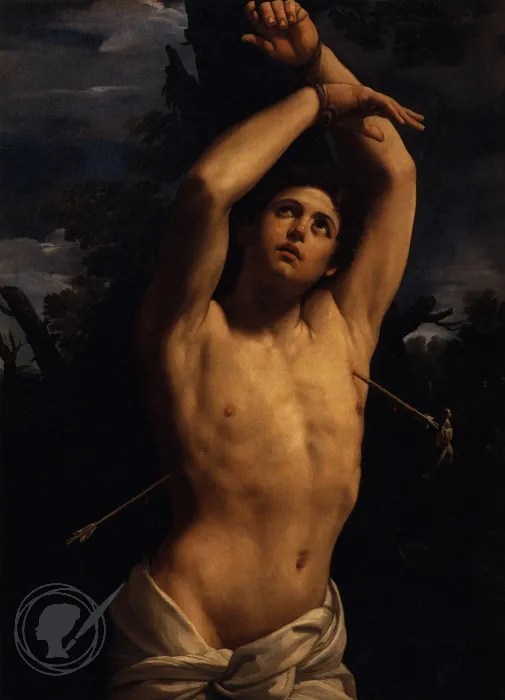
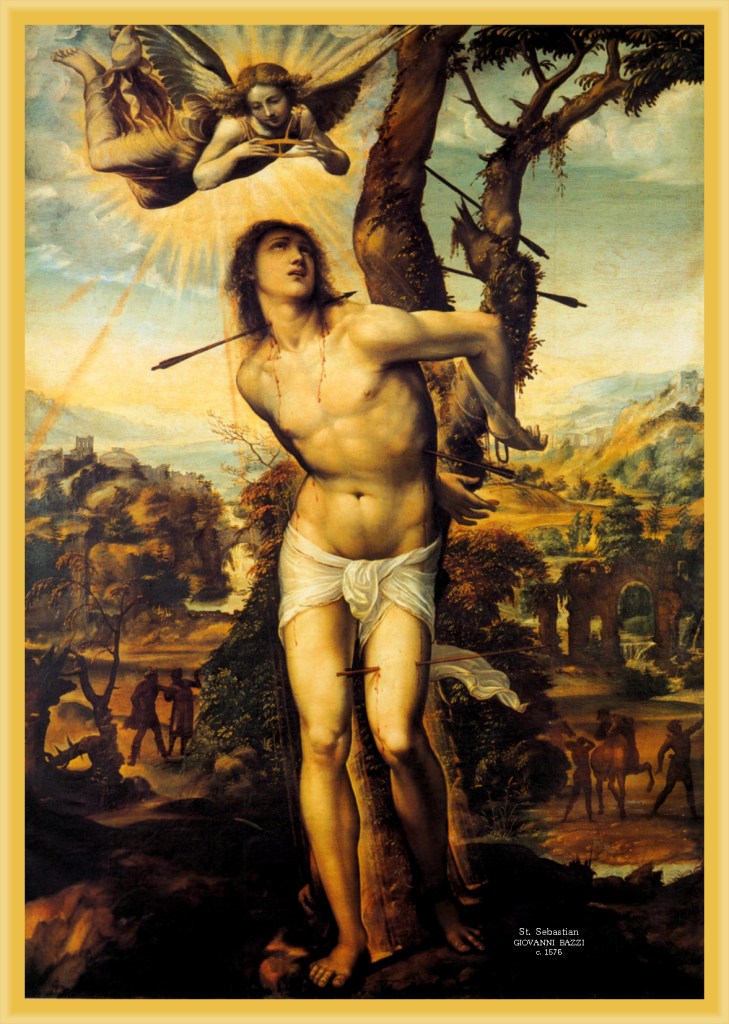
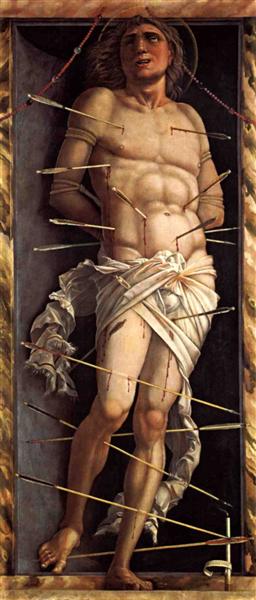
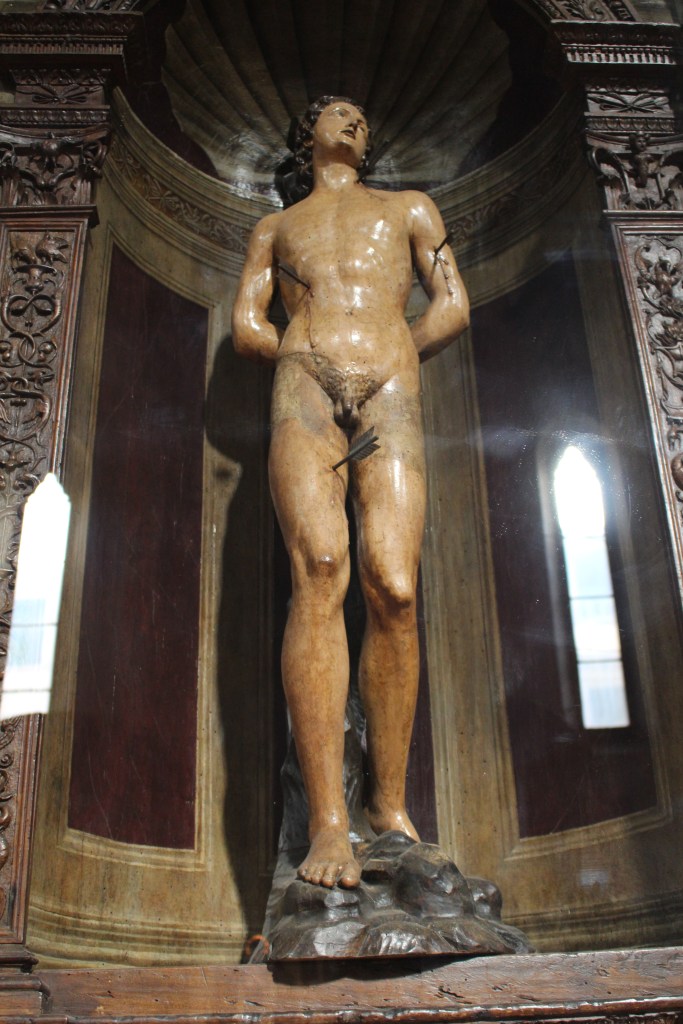
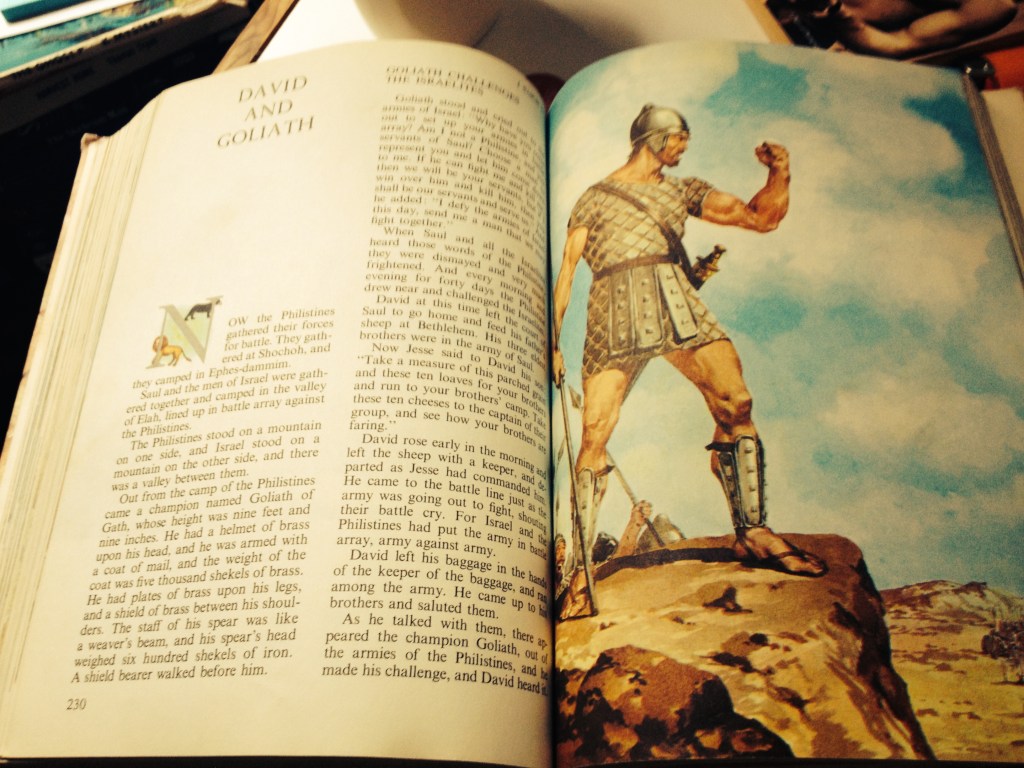
Ah, the gay obsession with muscular bodies. It goes way back into the past; the Greeks always showed men in their art to illustrate perfection—gods and heroes—as muscular and lean and physically proportioned. The emergence of gay artists during the Renaissance sparked a revival of an ideal male form since they took most of their inspiration from the classical art of ancient Greece and Rome (which essentially plagiarized almost everything of Greek culture). Leonardo and Michelangelo and other great artists, regardless of sexual orientation, always somehow got away with depicting nudes etc in art by using Biblical or other mythological sources; the influence of queer artists can be seen in every cathedral in Europe—look for the nudes. (I’ve always loved that Michelangelo painted the ceiling of the Sistine Chapel with hot male nudes depicting Bible scenes.)
And of course, Michelangelo’s David set a standard for male physical beauty for centuries.
I often wonder how much cultural and societal influences impact our own tastes. I’ve often mentioned how I don’t have a type; people always assumed I did, but I never have. I appreciate men I find beautiful, of course, but just because I find aesthetic beauty in someone has never meant I wanted to fuck them. I’ve always been attracted to all different types. My attraction to bears, for example, I know comes from a childhood obsession with professional wrestlers (which will be addressed in another entry, about the evolution of professional wrestlers’ bodies). Anyway, if we are perpetually bombarded images and told this is what is attractive, do we change our tastes?
I’m not going to lie: I have always liked muscles—but they aren’t necessary; no one has to have a perfectly sculpted body with high vascularity for me to find that person attractive. Perfect male physiques have become so ubiquitous now, with OnlyFans and reels and videos and TikToks and so forth; I think it’s great these young men have find a way to make money from their looks, and more power to them…but the more I see those perfect bodies the more humdrum and alike they all start to look, like The Stepford Hunks (which would also make a good title for a satirical story or novel sometime).
And muscles serve mainly as visuals for fucking, anyway.
The year I turned thirty-three was really the pivotal time, a turning point, in my life.
I was thirty-three and still single, and the only gay relationships I’d had at that point weren’t really relationships; they were, actually, borderline abusive and only served to convince me all the more that I was destined to be alone and miserable–that maybe I was actually better off alone. It was time to make changes…the only thing I had control over was myself–I couldn’t make my job better, I couldn’t improve my finances, and if I was weird-looking in the face, I couldn’t do anything about that either. I was losing my hair and I basically thought you’re too old to find a partner now, so you’re just going to be alone for the rest of your life, so make the most of it.
The first thing I looked at was my physical self. I wasn’t in shape and hadn’t been since I stop cheerleading in college. That was something I could change (I also identified several other areas in which I could change–including my attitude, and started working on those), and so I decided I was going to live healthier. I was getting older (laughable now) and I knew the longer I waited, the harder it would be to change my physical self (as I am finding out now for sure). I had joined gyms before but had never stuck with it more than a week or so, paying them for a membership I didn’t use for at least a year before I could quit–which was also a bad financial decision.
So, rather than joining a gym, I decided to be smarter. I got out the Abs of Steel tape I’d bought and never used (it was still shrink-wrapped) and told myself, okay, if you do this workout three times a week and do push-ups with it, and can do that every week until New Year’s, then I will go ahead and invest in joining a gym again. Any exercise was better than none, three times a week was better than two, twice better than once, and once better than none at all. I wrote that in sharpie on a note card and taped it to my bathroom mirror so I had to see it every time I went in there. I changed the way I ate (simplifying my diet to “nothing with three or more grams of fat per serving”, started drinking skim milk, using fat-free everything and eating more salads and vegetables and turkey sandwiches. I had dropped from 210 pounds in August to 170–and the change was not only dramatic (forty pounds is a lot to lose in slightly less than four months) physically but also emotionally.
And so, I joined a gym.
It was a new, gay gym in Tampa at the time, Metroflex, and it was convenient because it was on my way to work. I could take the work uniform with me, workout, shower, change and head to work. It was very convenient, and I worked out three days a week: Mondays, Wednesdays, and Fridays. My trainer, whose name I forget now, was really good and thorough–he explained things, which was something I’d never ever, not even when I was an athlete back in high school, really understood about working out. And…I started getting into the weeds by reading diet and exercise books.
One thing I did notice, though, as I was losing weight was how differently people treated me. I’d never really paid much attention to it before, other than the way guys in bars would avert their eyes when ours met–which I just took to mean as blech gross why are you even here–and it was hard to get a bartender’s attention. I stayed out of bars when I was doing that first diet-and-exercise change that fall, and when I went back I stopped drinking alcohol, sticking to water but eventually going back to Bud Lite, but once I started going again after the weight loss…I never had to wait for a drink because as soon as I walked up to the bar, the bartender was right there. People smiled at me a lot more. I got treated treated better in restaurants and stores by the staff–even passengers at the airport were friendlier and nicer than they used to be.
I found that to be very interesting from a sociological point of view; a little experiment in human behavior, if you will. Other things started happening, too, all of which was very much a boost to my fragile ego.
And thought about writing an essay called Looks Don’t Matter and Other Lies.
I also liked the attention. I liked being flirted with and bought drinks in gay bars. I loved being treated better, but at the same time I had to be careful. I have some obsessive tendencies–part of the faulty brain wiring–and my tendency to judge myself very harshly was a dangerous combination that led to some really unhealthy habits with food and eating–I often will skip eating without a second thought, and often when I travel I forget to eat, and get sick. I also don’t see myself in the mirror the way I actually look; body dysmorphia. I always worried I was overweight, and I also wanted to get bigger–you see how those two positions are diametrically opposed to each other–but it was all a part of the whole parcel of self-examination and evaluation with the intent to make positive change.
But as my life began to change and improve with my new approach to life (I was also writing again), I attributed a lot of it to the changes wrought by my exercise devotion. I was so much happier, had so much more energy, and felt better overall. I also met and fell in love with my life partner…and realized several things: I did not want to work in the heterosexual world anymore nor did I want to spend a lot of time in it; and the best thing for me to do, the thing that made the most sense, was to become a personal trainer to help other people reset their lives and take a holistic approach to working out—mind, body, spirit—that would be more effective, and also I could charge enough per hour being a trainer that I could do it part time and spend the rest of the day writing.
I was a good trainer, too.
So, that’s what I did. I also started writing a fitness column for the local gay paper, and for other national glossies. It wasn’t the kind of writing I wanted to be doing, but getting a clip file was important for writers starting out back then, and I stayed committed to my own workouts, even after I stopped working as a trainer.
I can also happily say that since I left the travel agency here in New Orleans in 1997, I’ve never worked in a hetero business ever again.
Injuries and getting older have messed up my working out since about 2011, but I am hoping that once I get past this rehab of my arm I will be able to do regular, harder workouts again and get back into better shape.



 Queer and Loathing in America