Never Surrender

’tis Wednesday already; the week is already half over. Next week is the combination Tennessee Williams Festival/Saints and Sinners weekend (AIEEEEE!), which is going to be, literally, insane. But I can hang; it’ll be lovely seeing everyone, but I can’t believe it has come up upon us all again so suddenly. It’s like I wasn’t paying any attention and the next thing you know, BOOM, there it is.

As I continue to work on this plethora of short stories (I started ANOTHER fucking one yesterday), I am, however, pleased to announce that one of the ones I’ve done since the beginning of the year will be appearing in the anthology Murder-a-Go-Go’s. The book’s theme is crime stories inspired by songs of the Go-Go’s, and will be edited by the amazing Holly West, and published by the crew at Down and Out Books. My story was inspired by the song “This Town” and is also, coincidentally enough, titled “This Town.”

Our IDs were fake, but no one seemed to care. Even when a burly bouncer asked to see them, bare meaty arms adorned with tattoos, bored eyes flicking over the laminate before waving us inside. Celia was right about that, like she was right about everything. She could always find someone with coke to share or sell, or who was happy to share their blunt with us. She was a golden girl, the kind I used to think only existed in books or movies, the girl that’s too perfect to exist, the one every other girl wants to be friends with, wants to be. The one all the guys notice first, their eyes wide open and their jaws gone slack.

 She always had the trendiest new make-up, the first to try out a daring new look we were too cowardly to try but quick to copy, always the first, the one everyone else imitated. She seemed to glow from inside, drawing everyone’s eyes to her effortlessly, and she somehow managed to always look perfect, even when she was drunk, even after dancing for hours when our make-up was running down our cheeks and perspiration dampened our armpits. Her skirts were just the tiniest bit shorter than everyone else’s, her tops seemed to fit her in a way they didn’t fit anyone else, her hair thicker and shinier and bouncier. She pulled in guys like night insects to a white light, caught up in her magic, wanting her. They only noticed the rest of us once she’d turned her attention elsewhere. We didn’t mind taking second place to her because it seemed like the natural order of things. She always knew the right thing to say—whether kind or insulting—and we all gravitated to her, wanting to be her friends, to be her. She was our pledge class president, organized, efficient, determined we be the best pledge class our Omega Psi chapter had ever seen. Even the sisters seemed to be a little in awe of her, grateful she’d picked Omega Psi out of all the offers she’d had—every sorority had offered her a bid, I’d overheard one sister telling another at Monday night dinner, her voice awed as she went on to say that had never happened in the history of the Greek system at Tulane.

And she made us all feel special, whispering “Sisters” to us as we hooked our pinkie fingers and whispered the word back to her, committing to a lifelong bond with her.

I am so glad they liked this story, because I loved it. It’s soooo dark. When I was going through Go-Go’s lyrics to choose a song, I was really surprised; I knew all the songs by heart–if I heard one I can sing every word–and danced like crazy to them, always thought they were these upbeat cheerful songs…and then yikes! Reading the lyrics without hearing the music? JFC, are these songs dark. I mean, check out this verse from “This Town”:

Change the lines that were said before 
We’re all dreamers – we’re all whores 
Discarded stars 
Like worn out cars 
Litter the streets of this town 
Litter the streets of this town

I mean, we’re all dreamers – we’re all whores? As soon as I read that line, the story just jumped into my head; a group of girlfriends, on Fat Tuesday,  wandering around in the Quarter getting wasted…and then the first line of the story popped into my head: Our ID’s were fake but no one seemed to care. That was how it started, and the next thing I knew I had over four thousand words and a very rough first draft.

I love when that happens. And the editor liked it! YAY! Huzzah for good news! It gives me hope for these other short stories I’m writing.

And I also have read some more stories for the Short Story Project. First up is “Damage Control” by Thomas H. Cook, from the MWA anthology Manhattan Mayhem.

She’d been found in the dilapidated Bronx apartment where she’d lived for the past seventeen months. It was a basement apartment and had only a couple small windows, but she’d make it darker still by drawing the curtains. It was so dim inside that the first cop to arrive had stumbled about, looking for a light switch. He’d finally found one only to discover that she’d unscrewed all the light bulbs, even the ones in the ceiling and the fluorescent ones on either side of the bathroom mirror. Neighbors later told police that they hadn’t seen a single sliver of light coming from her apartment for well over a month. It was as if the terrible capacity for destruction that I’d glimpsed in her so many years before had at last grown strong enough to consume her entirely.

This is a truly sad story; in which a man is forced to look back on a painful decision made years earlier, when his family took in a foster child to give their only child a sister. The two girls got along well at first, but the foster child became a problem child, possibly even dangerous, and for the sake of their blood daughter they gave the foster child back to the system. Now an adult, she has died, and he is having to reflect, remember, what happened all those years ago, wonder if things could have been different, if maybe he had tried a little harder maybe things wouldn’t have ended so badly for her. There’s a horrible twist at the end as well, which makes the story all the more poignant and sad; about how a life can be so easily wasted and thrown away, based on a perception that ma or may not be correct.

I then moved on to a Shirley Jackson story, from the recent collection Let Me Tell You. The story is titled “Paranoia.”

Mr. Halloran Beresford, pleasantly tired after a good day in the office, still almost clean-shaven after eight hours, his pants still neatly pressed, pleased with himself particularly for remembering, stepped out of the candy shop with a great box under his arm and started briskly for the corner. There were twenty small-size gray suits like Mr. Beresford’s on every New York block, fifty men still clean-shaven and pressed after a day in an air-cooled office, a hundred small men, perhaps, pleased with themselves for remembering their wives’ birthdays. Mr. Beresford was going to take his wife out to dinner, he decided, going to see if he could get last-minute tickets to a show, taking his wife candy. It had been an exceptionally good day, altogether, and Mr. Beresford walked along swiftly, humming musically to himself.

I absolutely, positively love love LOVE Shirley Jackson. The other night, as I was trying to decide which story to read next, I suddenly realized that I have three short story collections by one of my favorite authors and haven’t read any of them. I immediately grabbed Let Me Tell You and sat down with it. “Paranoia” is brilliant, positively brilliant; to tell you why would spoil it, and if its spoiled the effect is ruined, but it is, with every word and sentence, the perfect fictional story representation of defining the word paranoia. It reminded me, as I kept reading, of precisely why I love Jackson so much. God, what a great story!

And now, tis back to the spice mines with me.

IMG_1984

New Moon on Monday

I made it to the gym again yesterday, which felt fantastic–despite the fact that I added a set to everything, and upped the speed of the treadmill by .2 miles per hour. The stretching helps; I can’t believe I worked out all those years without bothering to ever take the time to stop and stretch (okay, yes, I was naturally flexible, but I wouldn’t have lost the level of flexibility I had if I’d been stretching all those years). I also organized a bit, did some chores around the house, and wrote the first draft of a story for an anthology with a deadline of February 15th. The story’s not quite there yet, but I think it’s not only a good idea but one that revisions and rewrites will only make stronger. Huzzah! And yay for me!

It was also in the seventies (!!!) yesterday; considering just three days ago we had a hard freeze…yeah, the weather in southeastern Louisiana might be a bit bipolar. I also had a breakthrough on how to revise the first chapter, not only of the WIP but of the Scotty as well. Hallelujah! I really think this focus and positivity mantra might actually be working. Granted, it’s still only January, but between the working out, and the writing…yeah, this is turning into a much better year already than last.

I also read some short stories!

First up was “Music for Chameleons.” by Truman Capote, from his collection Music for Chameleons:

She is tall and slender, perhaps seventy, silver-haired, soigne, neither black nor white, a pale golden rum color. She is a Martinique aristocrat who lives in Fort de France but also has an apartment in Paris. We are sitting on the terrace of her house, an airy, elegant house that looks as if it was made of wooden lace: it reminds me of certain old New Orleans houses. We are drinking iced mint tea slightly flavored with absinthe.

Three green chameleons race one another across the terrace; one pauses at Madame’s feet, flicking its forked tongue, and she comments: “Chameleons. Such exceptional creatures. The way they change color. Red. Yellow. Lime. Pink. Lavender. And did you know that are very fond of music?” She regards me with her fine black eyes. “You don’t believe me?”

During the course of the afternoon she had told me many curious things. How at night her garden with filled with mammoth night-flying moths. That her chauffeur, a dignified figure who had driven me to her house in a dark green Mercedes, was a wife-poisoner who had escaped from Devil’s Island. And she had described a village high in the norther mountains that is inhabited entirely by albinos: “Little pink-eyed people white as chalk. Occasionally one sees a few on the streets of Fort de France.”

I love Truman Capote’s work–I reread In Cold Blood every few years or so, and his short fiction is also pretty compelling. I started reading this story before, but never finished; but in reading it now I realize I kind of borrowed the opening of this one for the opening of a chapter of Garden District Gothic, when Scotty goes to see Vernita Godwin, who is sitting on her front gallery in the Garden District sipping absinthe. I really love that image, of two people on a gallery sipping absinthe while ceiling fans turn overhead. The story isn’t really a story, in the classic definition of what comprises a story; this is more of the slice of life school of short stories, because it’s really just about a conversation between two people after dinner, about life in Fort de France, Guadeloupe. Part of the conversation is about a homophobic hate crime that had occurred on the island in the past; surprisingly, justice was actually served because, as the lady puts it, ‘we don’t tolerate murder here.’ But the strongest image of this poetically written story is the lady, sitting at the piano playing classical music for the iguanas, who listen in the doorway to the terrace and bob their colored heads in time with the music. That’s what I read Capote for–those poetic images.

Next up was “The Intoxicated” by Shirley Jackson,  from The Lottery and Other Stories:

He was just tight enough and just familiar enough with the house to be able to go out into the kitchen alone, apparently to get ice, but actually to sober up a little; he was not quite enough a friend of the family to pass out on the living-room couch. He left the party behind without reluctance, the group by the piano singing “Stardust,” his hostess talking earnestly to a young man with thin clean glasses and a sullen mouth; he walked guardedly through the dining-room where a little group of four or five people sat on the stiff chairs reasoning something out carefully among themselves; the kitchen doors swung abruptly to his touch, and he sat down beside an enormous white enamel table, clean and cold under his hand. He put his glass on a good spot in the green pattern and looked up to find that a young girl was regarding him speculatively from across the table.

“Hello,” he said. “You the daughter?”

“I’m Eileen,” she said. “Yes.”

I’m also a huge fan of Shirley Jackson who, as Stephen King once said, ‘never had to raise her voice.’ This story, like the Capote, is a slice of life type story, with a bit of a bizarre twist to it. The drunk party guest and the teenaged daughter have a lengthy conversation about how his generation has ruined the world and how it is up to hers to burn everything to the ground so it can start over, and be the better for it. It’s unsettling, but the end–when he returns to the party a little more sober than when he left it–leaves you to wonder what is going to become of Eileen–and what that story would be like.

I haven’t read a lot of Jackson’s short fiction–I’ve not read “The Lottery,” although I’ve seen the short film made of it in grade school and in an Acting class in high school we did the play, but I intend to remedy this grave error and lack in my reading history during this Short Story Project.

The third story I read was “Pastorale” by James M. Cain,  included in Best American Noir of the Twentieth Century, by editors  James Ellroy and Otto Penzler;

Well, it looks like Burbie is going to get hung. And if he does; what he can lay it on is, he always figured he was so damned smart.

You see, Burbie, he left town when he was about sixteen years old. He run away with one of them traveling shows, “East Lynne” I think it was, and he stayed away about ten years. And when he came back he thought he knowed a lot. Burbie, he’d got them watery blue eyes what kind of stick out from his face, and how he killed the time was to sit around and listen to the boys talk down at the poolroom or over at the barber shop or a couple other places where he hung out, and then wink at you like they was all making a fool of theirself and nobody didn’t know it but him.

This was Cain’s first published story, and it is not only a macabre, dark little story but it also, as the editors point out, contains themes Cain would return to again and again in his short novels; amoral man has affair with beautiful woman and they plan together to kill her husband. “Pastorale” though, isn’t told from the point of view of the amoral man, like The Postman Always Rings Twice or Double Indemnity; the story is told by a third party, someone who knows what happened and is telling the story to someone–the reader, but it’s told almost entirely in vernacular and in that man’s voice, which is arresting and very strong and very rural; the voice reminded me a lot of his Appalachian saga of incest and murder, The Butterfly, and it also reminded me of Faulkner. The tale teller passes no judgment on Burbie or his lady love for their adultery and murder; if anything, he thinks they were fools because Burbie’s own vanity is what wound up bringing them down. It also gave me some thoughts about voice, and point of view, and story-telling.

If you cannot tell, Constant Reader, I am greatly enjoying my self-education in The Art of the Short Story, and I hope you are enjoying following me on this path half as much as I am enjoying going down it.

And now, back to the spice mines.

Breakin’ (Ain’t No Stoppin’ Us)

I slept extremely well last night; my sleep has been better lately. It also rained last night, which didn’t hurt. Our bipolar weather is humid and in the sixties this week, heavy sigh, but it’s going to get cold again this weekend, of course. I have a three day holiday this weekend, so I am hoping to get a lot accomplished. Saturday is errands and cleaning and reading and some editing; Sunday and Monday will be primarily devoted to writing. I am sooooo behind, Constant Reader, sooooo behind–but I am not allowing it to cause me the stress it usually does. Instead, I am going to not worry about it, make to-do lists, and go from there, which only makes sense. If I focus on getting things done and ticking them off on the list, they’ll get done, right? And then I will feel accomplished.

Huzzah! Always try to find a positive way to look at things; that way you won’t get overwhelmed.

The Short Story Project continues, with yet another story from Troubled Daughters Twisted Wives, edited by Sarah Weinman. Next up in the book–which I can’t seem to either put down or step away from–is “Louisa, Please Come Home” by Shirley Jackson.

“Louisa,” my mothers voice came over the radio; it frightened me badly for a minute. “Louisa,” she said, “please come home. It’s been three long years since we saw you last; Louisa, I promise you that everything will be all right. We all miss you so. We want you back again. Louisa, please come home.”

Once a year. On the anniversary of the day I ran away. Each time I heard it I was frightened again, because between one year and the next I would forget what my mother’s voice sounded like, so soft and yet so strange with that pleading note. I listened every year. I read the stories in the newspapers–“Louisa Tether vanished one year ago”–or two years ago, or three; I used to wait for the twentieth of June as though it were my birthday. I kept all the clippings at first, but secretly; with my picture on all the front pages I would have looked kind of  strange if anyone had seen me cutting it out. Chandler, where I was hiding, was close enough to my old home so that the papers made a big fuss about all of it, but of course the reason I picked Chandler in the first place was because it was a big enough city for me to hide in.

Shirley Jackson is one of my favorite writers, as Constant Reader is undoubtedly–or should–be aware of by now. This story, which I’ve not read before, is strange, as all her stories are strange; interesting and unusual and unlike anything I’ve ever read before. Louisa tells the story of how she ran away; how she planned it carefully, and how she actually accomplished it, and did it all on the day before her sister’s wedding. Jackson lets us know what Louisa is like by showing us; that Louisa is painstaking and careful, and she also leaves parts of Louisa mysterious. We never know why Louisa decided to run away from her family and disappear; only that she did and how she did it, and how she very carefully created an entirely new life for herself in another city. She doesn’t miss her family, has no desire to go back, has no interest in how her disappearance may have impacted them. She is a method actress, in a way; the most interesting thing about Louisa is that when decides on a part to play, as she does every step of the way as she disappears, she becomes an entirely different person, to the point where her appearance even changes slightly. Someone from her old life eventually catches up to her, and this is where the Jackson macabre touch with a twist comes into play; the ending of this story is so real yet so bizarre and unforeseen that it stands as yet another example of Jackson’s genius.

And now, back to the spice mines. Here’s a hunk for you:

23415215_10159586736200290_2405475615155149540_o

You Got Lucky

Friday at last.

This was a six day work week for me, which is why this week feels like it has lasted for fucking ever. 

I am looking forward to having two full days off this weekend AND being home. I have made a monster to-do list for Saturday, so that I can get everything that needs to be done over and finished so Sunday can simply be a day of relaxing, reading, and revising. Huzzah!

My reread of The Haunting of Hill House continues. I am going really slowly, and savoring her words and sentence structure, as well as marveling at the genius of Shirley Jackson. Take this paragraph, when Eleanor first sees Hill House:

No human eye can isolate the unhappy coincidence of line and place which suggests evil in the face of a house, and yet somehow a maniac juxtaposition, a badly turned angle, some chance meeting of roof and sky, turned Hill House into a place of despair, more frightening because the face of Hill House seemed awake, with a watchfulness from the blank windows and a touch of glee in the eyebrow of a cornice. Almost any house, caught unexpectedly or at an odd angle, can turn a deeply humorous look on a watching person; even a mischievous little chimney, or a dormer like a dimple, can catch up a beholder with a sense of fellowship; but a house arrogant and hating, never off guard, can only be evil. This house, which seemed somehow to have formed itself, flying together into its own powerful pattern under the hands of its builders, fitting itself into its own construction of lines and angles, reared its great head against the sky without concession to humanity. It was a house without kindness, never meant to be lived in, not a fit place for people or for love or for hope. Exorcism cannot alter the countenance of a house; Hill House should stay as it was until it was destroyed.

I should have turned back at the gate, Eleanor thought.

If I ever wrote a paragraph half that good, I could die happy.

See what genius it is? Note that not once does she describe the house at all; she gives the reader absolutely no guidance into what Hill House actually looks like. Instead, she just describes the reaction to seeing it for the first time; even going into a little sidebar about houses that look pleasant and inviting. Instead, she allows the reader to try to find, in their imagination, what Hill House actually looks like.

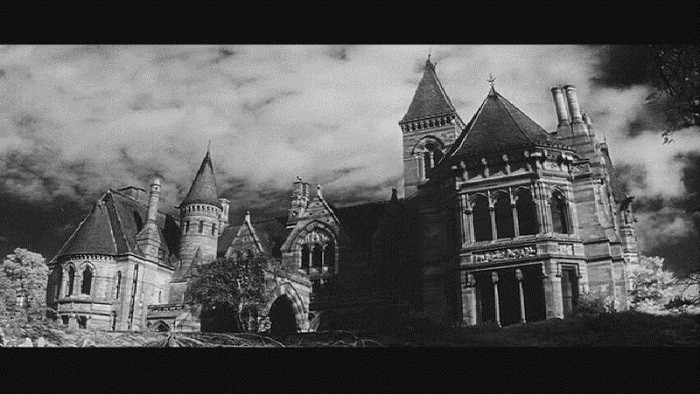
And to give credit where its due, when Robert Wise originally filmed the book in the early 1960’s, his stand-in for Hill House was pretty creepy.

the-haunting-of-hill-house

But a lot of that is actually the cinematography; this house wouldn’t look creepy at all in color and with proper lighting.

It can even be made to look worse:

HILL-HOUSE-03262015

There’s no way in hell I’d go anywhere near that place in the night. In the dark.

But it is certainly much closer to what Jackson describes above than the house depicted on the edition of the book I am currently rereading:

haunting

That house isn’t in the least bit terrifying, or scary.

God. how I love this book.

Far from Over

Monday morning. I am very tired this morning; I worked Condom Outreach yesterday at the Halloween New Orleans Tea Dance at Crescent Park, which was fun, tiring and entertaining on many levels. Lots of pretty boys to look at, lots of alcohol/drug related sloppiness, and the weather was bizarre. It was hot and humid when we walked over there, than a nasty storm rolled in for a while, and after the storm moved on it was very cool the rest of the time. It’s still cool now; I suspect the heat and humidity have finally broken, thank the Lord.

IMG_3184

I have to say, Crescent Park is beautiful; the view of the river there is spectacular. I also took some terrific panorama shots:

IMG_3212.JPG

Gorgeous, right?

Last night we watched the premiere of The Walking Dead, and I have to say, finally. Last season Paul and I wearied of the show; primarily because Rick and the gang basically turned into wimps over and over again. It was awesome last night seeing them kicking ass and not bothering to take names. Huzzah!

I also started my reread of The Haunting of Hill House, and am reading it more slowly than I usually do; trying to savor it as well as thinking about its influence on other novels about ‘the bad place.’ I’ve already seen it’s direct influence, in the earliest chapters, on Burnt Offerings; Eleanor’s drive to Hill House is very similar to the drive taken by the family to the house in Burnt Offerings. The writing is so lyrical, and whimsical, almost like a fairy tale in its use of language and imagery; and Eleanor, poor Eleanor…also of note–Eleanor is selected by Dr. Montague for the Hill House expedition because when she was a young girl, stones rained down on her family home from the sky for several days without explanation; there’s mention of the same phenomenon happening to the Whites in Stephen King’s Carrie.

And that opening!

Lord, if I could only write an opening that sublime and beautiful and haunting.


Pass the Dutchie

Bouchercon next year will be in St. Petersburg, Florida. It will be hot and sticky, but there will be lovely gulf breezes and a sun shower every afternoon right around three o’clock.

Last night we watched LSU beat Ole Miss 40-24; we’re on a three game win streak now and bowl eligible. There’s a bye next week, and then LSU has to play at Alabama. Heavy sigh. I don’t know if I’ll even watch that game…I know I will, but it’s going to be hard to watch. LSU hasn’t beaten Alabama since 2011, and it’s not very likely they will this year. The fan in me is hopeful; the realist in me isn’t.

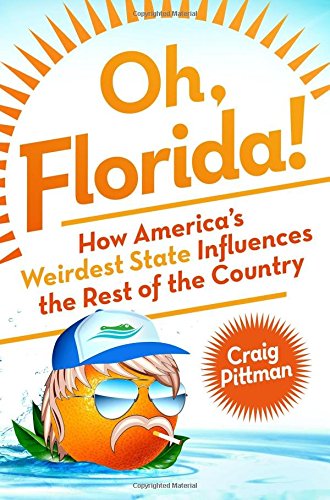
I did manage to finish reading Anna Dressed in Blood yesterday. I’m not going to review it, though–it was okay; I can see why it appeals to tweens and young teens, but it doesn’t really work on an adult level. I think maybe if I hadn’t watched all eleven or twelve or however many seasons of Supernatural there are, I might have enjoyed it more; but it was too reminiscent of the show for me. The main character’s name is even Cas…and of course, there’s a Cas on Supernatural. Apparently the author, Kendare Blake, has turned it into a series, and that’s terrific. I doubt I’ll read another. I only knew of the book because a tween reviewer raved about my own Sara and compared the two to each other favorably; she also compared it to Pretty Little Liars, which I also appreciated. I started my reread of The Haunting of Hill House last night as well, and also finished reading Craig Pittman’s Oh, Florida!, which I also enjoyed. It reminded me a lot of childhood summers spent in Florida, and even inspired me to drag out an old short story set in the Panhandle, “Cold Beer No Flies,” which I’ve been sort of working on since getting back from Toronto. I do recommend the book highly; while it doesn’t fully explain the weirdness that is Florida, it is very informative, at times funny, and I enjoyed it tremendously.

51eCxTDS8iL

It’s even got me thinking about writing a new series set in Florida, if you can believe that. But that’s how my mind works. I’ve been toying with a couple of ideas for noir novels set in Florida for a long time–I also have an idea for a funny noir style novel set there as well–and the lovely thing about having this book on my shelf is I can always take it down and reread a section to get my inspiration jump-started.

I also need to get that damned copy edit of Jackson Square Jazz finished this week. That’s my goal; get the copy edit done, start the final revision of the WIP, and do two chapters of the new Scotty this week while writing some short stories. It’s lofty, but I think I can get it all done.

And on that note, t’is off to the spice mines.

Dead Giveaway

Tuesday morning, it’s sixty degrees and I’ve had another glorious night of sleep. I am still a bit groggy, only being on my second cup of coffee, but today it’s back to reality after the bliss of Bouchercon and being wrapped up in the world of writing and publishing for almost a week. Heavy heaving sigh. I think we brought the cold weather back down from Canada with us! But I am digging out from under–I really did go AWOL while we were gone on a lot of things–so this morning I need to get caught up on my email and get the house back in some kind of order. I have Friday off as well, since I am working Sunday (condom outreach at the Gay Halloween tea dance at Crescent Park), so that will also help some as far as getting caught up is concerned.

Methinks I need a to-do list.

I started writing a short story yesterday; it’s an idea that’s been lying around in my head for a really long time and I thought, hell, I should start writing this, partly because an idea for the opening came to me. For the longest time this dark noir story was set in Kansas in my head–I even wrote, I think, a rough draft a long time ago but have always wanted to revise it as a noir, and reading Craig Pittman’s Oh Florida! made me realize that part of the problem with the revision I was having was because it should have been set in the panhandle of Florida. (I really recommend the Pittman; Im enjoying the hell out of it and it’s bringing back a lot of memories for me of all the time I’ve spent in Florida) I had started writing another one last week–“Sorry, Wrong Email”–that I would also like to finish this week….so much to do; I really need to make that damned to-do list.

First thing on the to-do list: make a to-do list.

Second thing on the to-do list: figure out what my next horror read will be. (I’m thinking I need to finally finish off Stephen King’s Mr. Mercedes trilogy with End of Watch, which is more paranormal than mystery; but I may save that for a weekend read.) Maybe it’s time to reread The Haunting of Hill House, which I haven’t gotten around to doing yet. Hmmmm. Decisions, decisions.

And man, looking around my kitchen at the messy wreckage…I need to get this mess cleaned up.

Okay, enough procrastination. It’s back to the spice mines with me, and here’s a hunk for your Tuesday morning:

IMG_2995

Try Again

Stephen King, in his seminal work on horror Danse Macabre, talked about two different kinds of house horror novels–the haunted house, and the bad place. The primary difference between the two is that a haunted house story is about the actual spirits and what they do; what must be done to put the spirit to rest (Barbara Michaels’ brilliant Ammie Come Home fits into this category), and the bad place where you don’t really know what is causing whatever it is that is going on in the place; it’s just a bad, bad place. Examples of the bad place  are of course Shirley Jackson’s The Haunting of Hill House, Stephen King’s The Shining, and Michael MacDowell’s The Elementals.

While I was traveling to and from Toronto, I read two short novels about ‘bad places’; Robert Marasco’s Burnt Offerings and Christopher Rice’s The Vines. 

I remember Burnt Offerings from when I was a kid, and we used to go to the Zayre’s department store every Saturday. I would spend the entire time my mother was shopping looking at every book in the book racks, and I picked it up numerous times only to always set it back and pick something else; I’m not sure why. I remember it was also made into a movie with Bette Davis that I’ve also never seen, and periodically it appears on lists of ‘best haunted house’ novels. Vaillancourt Books recently reissued it, and I bought a copy. It’s good, even if it subscribes to one of those horror tropes that always requires the suspension of belief–if something seems too good to be true, it usually is. A family from the city–Queens, i believe–take a summer rental out on Long Island that, of course, is too good to be true; a dilapidated but once stately manor. Husband, wife, young son, and the husband’s aunt–despite the husband’s misgivings–move out there for the summer; the only requirement of them (other than the rent) is that three times a day the wife must take a tray of food up to the owners’ mother’s suite of rooms and never knock–just leave the tray outside. The wife soon becomes obsessed with the house and cleaning it, putting it into order; finding treasures in closets and cupboards and bringing them out…and ignoring the distance growing between her and her husband, his aunt, and her son. Strange things start to happen, and occasionally she is aware that something’s terribly amiss…and then goes back to cleaning. The story is told very simply, the setting is perfect, and the descriptions of the treasures she finds are lovingly written–and the sense of growing impending doom and claustrophobia are perfect.

The Vines is Christopher Rice’s second horror novel (The Heavens Rise is the first; it’s still in my TBR pile) and it, too, is a variation of the bad place horror convention; Spring House is a gorgeously restored house outside of New Orleans with a horrifying history of its own. The night of owner Caitlin Chaisson’s birthday party, she sees her husband having sex with a beautiful young woman who works for the catering company; emotionally distraught, she leaves the house intent on slashing her wrists and killing herself in the estate’s gazebo. But as she cuts at her wrists, her husband and his one-nighter come outside to the gardening shed, and something monstrous grows up out of the ground to drink her blood and avenge her betrayal. The one-nighter loses her mind and the husband disappears; none of this makes any sense to the police who arrive and are not willing to upset the wealthiest woman in the parish. There are two other primary characters–Nova, the African-American daughter of Caitlin’s groundskeeper and a student at LSU who is there that night, and Caitlin’s former best friend, a gay nurse who has been estranged from her since he told her the truth about her husband’s infidelities–and years earlier, Blake and his teenaged boyfriend were attacked in a hate crime, the boyfriend dying…the true story of the attack has never come out, and it’s a lot more complicated than anyone ever knew. It’s a terrific tale of vengeance from the past and vengeance for the present, with the tension building as it hurries to its climax. I was also impressed with how Christopher handled the bloody, slave-owning history of Spring House–something I’ve wondered about how to handle without being too heavy-handed with a ghost story I’ve been wanting to write with its origins in the Civil War period in rural Alabama.

And now, back to the spice mines.

Is There Something I Should Know?

It rained last night; it was kind of a shock as there was no thunder and/or lightning, and the sun was actually shining. I only knew it was raining when I took out the trash; and it was pouring. Quietly. It was eerie; there wasn’t any wind so the rain was coming straight down, slowly–the way it does in the jungle. And then I remember, as I seem to forget at times, oh, yes, we live in the tropics. It’s easy to forget that when you live in a city that should be a tropical swamp.

I am working both days this weekend; both Saturday for testing and Sunday for the NO/AIDS Walk. I get to take next Monday off, and then go in late on Tuesday, which will be lovely. But ugh, staring down seven consecutive days of work is horrific. But, you know, it happens. And it’s not like it’s every week, you know?

The new Scotty is taking shape, which is lovely. It’s so vastly different than it’s source material, even if it using the same framework, and I am actually enjoying myself as the plot broadens, expands and takes shape. I am hopeful to have a first draft finished around mid-October, if all goes well and the creek don’t rise; November 1 if I get distracted, as I am wont to do.

Lisa Unger’s In the Blood continues to enthrall me; if you haven’t read her work, Constant Reader, you really need to. She defies classification as well; there are crimes in her novels, but there’s also a touch of the paranormal–but you’re never really sure if the paranormal stuff is real or not; she dances a fine line, but the writing is so incredibly strong she never falls off the beam. In that way, she is kind of Shirley Jackson-ish–thematically and plotting and character-wise; she doesn’t write in Jackson’s style, which would be incredibly difficult to master. She’s just bloody fantastic.

September is drawing to a close, and I am already lining up my reading for Halloween Horror: the annual reread of The Haunting of Hill House,  a reread of It, and I have some horror anthologies and other horror novels in my TBR stack that I’ll be pulling out and diving into.

And on that note, it’s back to the spice mines.

Here’s a hunk to get you through your Monday!

IMG_2767

Me and You and a Dog Named Boo

As I continue to muddle my way through this manuscript–honestly, I don’t know sometimes why it’s like pulling teeth and other times it’s just comes right out–I am constantly amazed at how many other ideas I get when I am working on something; ideas that are infinitely more interesting and sound like more fun to write than whatever it is I am actually working on. AND IT HAPPENS EVERY SINGLE TIME. And once I am finished, the creativity and urge to work on something else goes right away.

Surely I can’t be the only writer who experiences this?

AUGH.

Madness.

But as I think about these short stories, I remember probably the two finest collections of short stories ever–Echoes from the Macabre by Daphne du Maurier and Night Shift by Stephen King. I recently bought another copy of Night Shift on ebay, as my copy is in a box somewhere. Both du Maurier and King were short story masters; in fact, when I was a kid I loathed short stories and loathed reading them; this was primarily because I had to read things like “The Minister’s Black Veil” ad nauseum in English classes. I wasn’t lucky enough to be exposed to the truly great stories, like Faulkner’s “A Rose for Emily” and Jackson’s “The Lottery” until I got to college; but even by then the damage was done; that, along with the assigned short stories in writing courses (if I ever have to write an essay on Irwin Shaw’s “The Girls in the Their Summer Dresses” again I cannot be held responsible for what I do) had conspired to create a mentality that I loathed short stories. My experience writing short stories in writing courses in various colleges and universities had also taught me that I wasn’t a good short story writer; any good short stories I might write for a class were good purely by accident because I did not know what I was doing. That still stands true for today; I would rather write a novel than a short story.

But I am digressing, as is my wont.

Reading the du Maurier and King short story collections made me aware of what was possible for a truly gifted author to do with a short story; just as Jackson did with “The Lottery” and Faulkner with “A Rose for Emily.” My own difficulties with writing short stories comes from not, I realize now, having an actual system; I get an idea–usually both a title and a first line; maybe a character–and then I just kind of write with no idea of what’s to come, or what the story is about. This is the issue I had with “The Weeping Nun”; I wanted to write a story to submit to an anthology about Halloween stories, and I had this great title with an amorphous idea for a story, a point of view character, and an opening line: Satan had a great six pack. The problem, as I started writing the story, was realizing that as it came to me it had nothing to do with a weeping nun; but I was determined to somehow force that into the story so I could use the title.

On reflection, it seems perfectly insane and ludicrous now; but I am nothing if not obtuse and I am incredibly stubborn in stupid ways. I liked that title, and damn it, this story was going to fit that title if it fucking killed me.

The end result was the story was never finished, I missed the deadline for submission, and there was just frustration left in the wake of yet another short story failure.

And of course, this week as I struggled with writing the novel, it came to me in a flash: the story I was writing had nothing to do with the story of the weeping nun; I should have simply retitled the story and followed it to its logical conclusion and saved the story of the weeping nun for another time.

Idiocy, really. So simple, but I just couldn’t see it at the time.

And now I want to finish writing the damned story, which I now see as being about the gates of Guinee on Halloween night in the French Quarter.

Heavy heaving sigh.

And now, back to the spice mines.

Here’s a hunk to cheer you up, Constant Reader:

hot-firefighters-with-puppies-calendar-charity-australia-1