Fall in Love with Me

A chilly Monday morning in New Orleans. I am arming myself with coffee and a thorough to-do list to get me through the week. I am confident both will hold me in good stead.

We’re binging Stranger Things, and after a slow first couple of episodes, it certainly has picked up steam. We were both regretful we had to turn it off last night in order to go to bed; if we didn’t have to work this morning we would have stayed up and finished it off. But there’s always tonight. (rubs hands together in glee).

I’m also about halfway through Hell House, which is holding up beautifully. I am again amazed at how similar, both in title and structure, the book is to The Haunting of Hill House, The tone and voice are completely different, of course; Hell House actually goes into the POV of all of the characters at one time or another, whereas Jackson focused primarily on Eleanor. And Hell House is definitely more haunted than Hill House; it’s called ‘the Mount Everest of haunted houses’–and the house has a much more infernal history than Hill House’s softer, more Gothic history of madness and death. There are times, too, when Hell House’s backstory seems almost over-the-top; yet at the same time, I can’t help but think wow, a book about everything that went on back then would be fascinating. It’s very definitely both a haunted house book and a “bad place” book.I do remember how it ended, I just don’t remember how Matheson gets the reader there. Definitely enjoying the ride thus far.

This morning I also had a breakthrough on a short story I’ve put aside. The question is, can I finish it and polish it in time for the looming deadline? I think so.

Okay, it’s time to get back to the spice mines. Here’s a hunk to get your week rolling:


swim3


Breaking Us in Two

Sunday. It’s one degree warmer than yesterday morning–wow, right? But you will undoubtedly be thrilled to know that I get everything on my list done yesterday other than go to the gym; and after spending two hours in the storage unit moving boxes of books around, I was pretty damned exhausted physically, and then braved Costco on a Saturday afternoon (it wasn’t bad at all, other than stupid people, which is every day). I also came across some books in the storage that I thought hey, these need to be reread and so I took them out. One of them was Richard Matheson’s Hell House, which seemed, at least to me, to be the proper reread after The Haunting of Hill House, in that they’re very similar; one could even go so far as to say Matheson basically took Jackson’s story structure and turned the dial up a notch. I am enjoying the reread very much; although I’m not very far into it thus far. I also found my copy of Michael Rowe’s groundbreaking anthology Queer Fear, which I reviewed in the Lambda Book Report many years ago when I worked there, and was to be my first encounter with Mr. Rowe; I remember he came up to me at the Lambda Awards the next year, introduced himself, and thanked me for the lovely review. We’ve crossed paths a few times since, and have become friends over the years. I do remember loving Queer Fear, and look forward to delving into it and rereading its short stories again.

I also found my high school scrapbook and my diaries from the 1990’s. I used to buy blank books and carry them around with me everywhere, so I could jot down story and/or book ideas, or write diary entries whenever I wanted to. I am always hesitant to reread my old diaries; I often wince from my immaturity and my over-dramatization of events in my life. Yet at the same time, the diaries also served as a very vital source of self-reflection and self-examination; I suppose this blog has served that purpose since I started it on Livejournal back in 2004 (the idea that I have been consistently blogging for thirteen years rather staggers the mind, doesn’t it? But I’ve been writing in a diary of some sort, off and on, since I was a teenager; this seems to be a natural continuation of that process).

I also found the three ring binder where I kept everything from the Virginia situation of 2005 and 2006; including the ACLU letter to the school board. I’d always intended to write a non-fiction book about it all, called Gay Porn Writer, in which I examined what happened to me in the context, not only of the times but extrapolating it out further into what was going on in publishing and the culture. My memory lies to me now, of course, so I am not certain that I’ll ever write such a book–I don’t know that I would remember things correctly, and even then, what is colored by my perceptions of things. I’ve since moved on, of course–I mentioned the incident in passing on my panel at Bouchercon and had to explain it a little, which was kind of crazy. It was so long ago, and I used to get invited to speak about it all the time. The memories are now hazy and unclear, but I am definitely going to keep all this information.

You never know.

I think I am probably just going to scan everything in the scrapbook, in order to preserve it electronically, and then throw it away. I don’t really need to keep programs from my high school football games, or from choir concerts, and scanning them will better preserve them anyway.

I have one errand to run today, and I also want to go to the gym for a little bit, start dipping my feet back into the water of working out regularly, and despite the cold, I am going to give that a try.

And hopefully, I’ll get some writing done, or at least something done that will move all projects forward.

Here’s a Sunday hunk for you:

IMG_3002

Midnight at the Oasis

Stephen King. What is there left to say about Stephen King? From the first moment I read Carrie, I was a fan. I’d read a lot before I discovered him; and yet his writing was a revelation to me. What he was able to do with setting, with character, the way he made his stories–regardless of subject matter–relentlessly realistic opened my eyes to what one can accomplish with writing. Over the years, as I’ve continued to read King (I still am not completely caught up; I am several books behind–the days when I could buy the book on release day and devour it in one or two sittings are sadly, far in the past), I continue to marvel at his extraordinary expertise. And while some of his books seem to go off the rails a bit, I would be proud to claim any of what I consider his lesser books (and by that I mean ‘ones I am not as fond of as others’) as my own: The Tommyknockers, Rose Madder, Dreamcatcher. I used to reread his books, over and over again–I don’t even know how many times I’ve reread salem’s Lot and The Stand and The Dead Zone and Christine, for example; and I wish I had the time to sit down and reread them all, from Carrie on. His On Writing is the one text I would tell every beginning writer to read from beginning to end, commit to memory, go back to whenever needed.

But I decided I wanted to talk about a different Stephen King title today: Danse Macabre.

stephen-king-danse-macabre

As I often point out, I am more of a fan of horror than anything else; I’ve not read as widely in the genre as I would like, nor do I even know enough about the genre to write about subgenres and subcategories expertly. There are any number of horror writers whose oeuvres I’ve stuck my toe into, and found the water just fine, but haven’t had the time to fully commit to reading: Christopher Golden, Gemma Files, Douglas Clegg, Brian Keene, Nick Cutter, and John Boyne, just off the top of my head, and there are many more. There is just so much time, after all, and there are just so damned many books; and as someone who is primarily defined professionally as a crime writer, I have to read so much within my own genre, not to mention true crime–and of course, I love my nonfiction, which I can just walk away from without too much worry of having to go back to the beginning to start over.

But I do feel that King’s Danse Macabre, published originally in 1981, is an excellent overview of the horror genre up until that date. King’s non-fiction writing is very similar to his fiction; it’s smart but also accessible. And it’s excellent; it is serious scholarship about the genre of horror, written by the grandest master of the grand masters, talking in an accessible way about the best books, the best writers, the best films, and the best television programs within the genre…how they influenced his own work, and why. It’s truly exceptional.

I’ve always had a copy of Danse Macabre–well, I’ve always had a copy of every Stephen King book in my house–and it’s been a long time since I’ve revisited it. I may, once I tire of rereading Antonia Fraser’s Mary Queen of Scots, give it another whirl. Reading it the first time was what reminded me of Richard Matheson, introduced me to other writers like Robert Bloch and Harlan Ellison (my God, Harlan Ellison) and even, for the first time, made me truly aware of Shirley Jackson; reading this was what sent me to the used bookstores in search of books by these authors again, and I’ve never regretted those forays into their work–Ellison and Jackson are certainly up there on my list of absolute favorites, and many of the others I originally found through reading Danse Macabre are certainly favorites.

And that’s not even including the television shows and movies.

And now, back to the spice mines.

Feelings

Since October is, for me, the month of Halloween and therefore irrevocably tied to the horror genre, as Constant Reader already knows, I have decided to write only about horror in this month. I am casting my mind back, as it were, over the years and trying to remember what films and books drew me to the genre in the first place. As an author, I am often asked in interviews or on panels about influences, and while there are certain answers that I always give–Shirley Jackson, Stephen King, James M. Cain, Daphne du Maurier–there are often authors, books, films and television programs I forget at the time. (I once made a list of my favorite movies in response to a meme…and somehow forgot to name what could possibly be my favorite film of all time: The Princess Bride. In my defense, I often do these things very quickly and off the top of my head. )

So, in talking about the genre this month, I am also trying to dig deeper and not write about influences I have talked about before; or at least I am going to try not to–there is simply no way I can write about horror and not, for example, talk about Thomas Tryon’s terrific The Other, or Ira Levin. I do feel as though I’ve talked about Shirley Jackson and The Haunting of Hill House ad nauseum already; likewise with Daphne du Maurier’s sublime “Don’t Look Now.” (I may give in to the inevitable temptation and do so before the 31st; but I am going to honestly try to resist those temptations.)
 

omegamancover

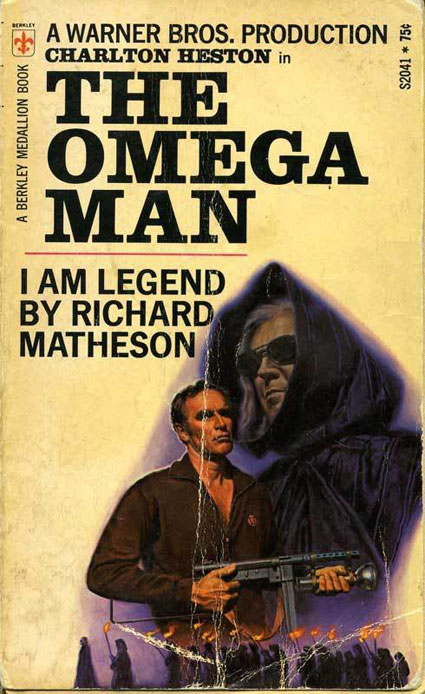
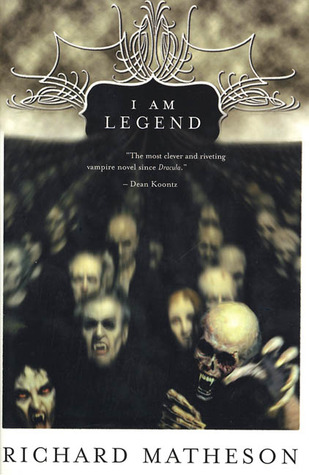
I think I was twelve when I first read something by Richard Matheson: I Am Legend. It had recently been made into a film starring Charlton Heston (I’ve seen the film, renamed The Omega Man. It’s okay, but not as good as the book.) I Am Legend, for those not familiar with the story (it was also filmed again sometime in the last decade or so, with Will Smith. I have not seen the remake), is one of those “last man on earth” stories; only in Matheson’s world, a terrible plague has turned everyone who has not died into vampire-like creatures. The last man on earth is Robert Neville, who somehow is immune to the plague. He barricades himself up into his home at night while the vampires try to find a way to either get inside or taunt him, hoping to lure him out–while during the day he scavenges for supplies and kills vampires by staking them through the heart (the matter-of-fact description of him doing this is chilling and has always stayed with me; there are several scenes in Stephen King’s ‘salem’s Lot where the gang of heroes also hunts and stakes vampires during the day–when I first read ‘salem’s Lot this reminded me of Matheson’s book. Likewise, when I read Stephen King’s apocalyptic novel The Stand, it again reminded me of Matheson’s book.) I Am Legend isn’t just a scary book about the aftermath of the end of the world though; there’s a lot of thought given to what it means, what this new society of people, this Brave New World of vampire-like people will be like, and what it’s like to be the last of your own kind. I didn’t catch a lot of this when I was a kid, and frankly, as it delved more into philosophy towards the end the unsophisticated reader I was found it a bit disappointing. When I revisited the book in the 1980’s–I went on a Matheson kick, and was delighted to discover that many episodes of television shows, or films, that I greatly enjoyed were actually based on Matheson’s work: Somewhere in Time, What Dreams May Come, Stir of Echoes–it’s quite an extensive list.
0ee08510ac0676ae995599ec51738eff

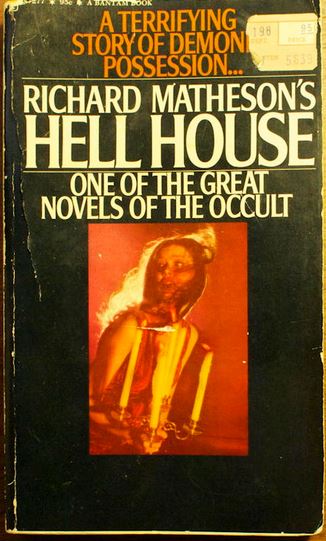
I also read Hell House when I was about thirteen, but didn’t connect that Matheson had written both books. Hell House, about “the Mount Everest of haunted houses”, was similar in structure to Shirley Jackson’s The Haunting of Hill House, but also very different. It was made into a terrifying film called The Legend of Hell House, which I recently rewatched, and actually holds up. (As a weary, cynical adult, I can see how cheaply the film was made now; but it’s just as spooky and scary as it was when I was a teenager and it terrified me.)
hellhousebookcover

That was the version I originally read; this is the one I reread:
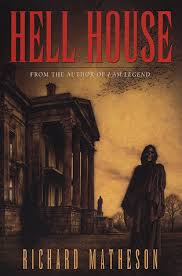
imgres

Again, I would love to spend a week in a mountain cabin sometime revisiting Matheson’s work.

And now, back to the spice mines.