Mystery to Me

The other day after work I was too tired to write and so I settled into the easy chair with one Sparky for cuddle time, but needed something to watch. I finished burning through the news to get caught up as I do every day, and then started searching for something else to watch when I saw Scooby Doo, Where Are You? in my “Up Next” list as I scrolled through it. It’s always tricky when I need something to watch on my own without Paul–it has to be something he’s not interested in watching–and at some point over the last four years I started revisiting this show from my childhood but never finished the rewatch–mainly because I am now in my sixties; far too old for the audience they were going for.

While I wouldn’t say Scooby Doo Where Are You? was necessarily a huge influence on me and my life, I did love it and watched it every Saturday. It started sometime after Jonny Quest and The Hardy Boys cartoon was cancelled, and a kid who was devouring kids’ series books by the stacks and checking out every book in the school and public library that had the words mystery, secret, clue, haunted, ghost, riddle, or phantom in the title, the adventures of the Scooby gang was usually the highlight of my Saturday morning cartoon experience. I have not been a fan of anything that came in the wake of the original half-hour show (we will never discuss the abomination/hate crime that was Scrappy Doo), and for the purpose of this entry (and really, in my heart and mind) we will pretend that the show was cancelled after the original series run and nothing was rebooted, restarted, revamped, or overhauled in the years since the original Scooby Doo money train was derailed.
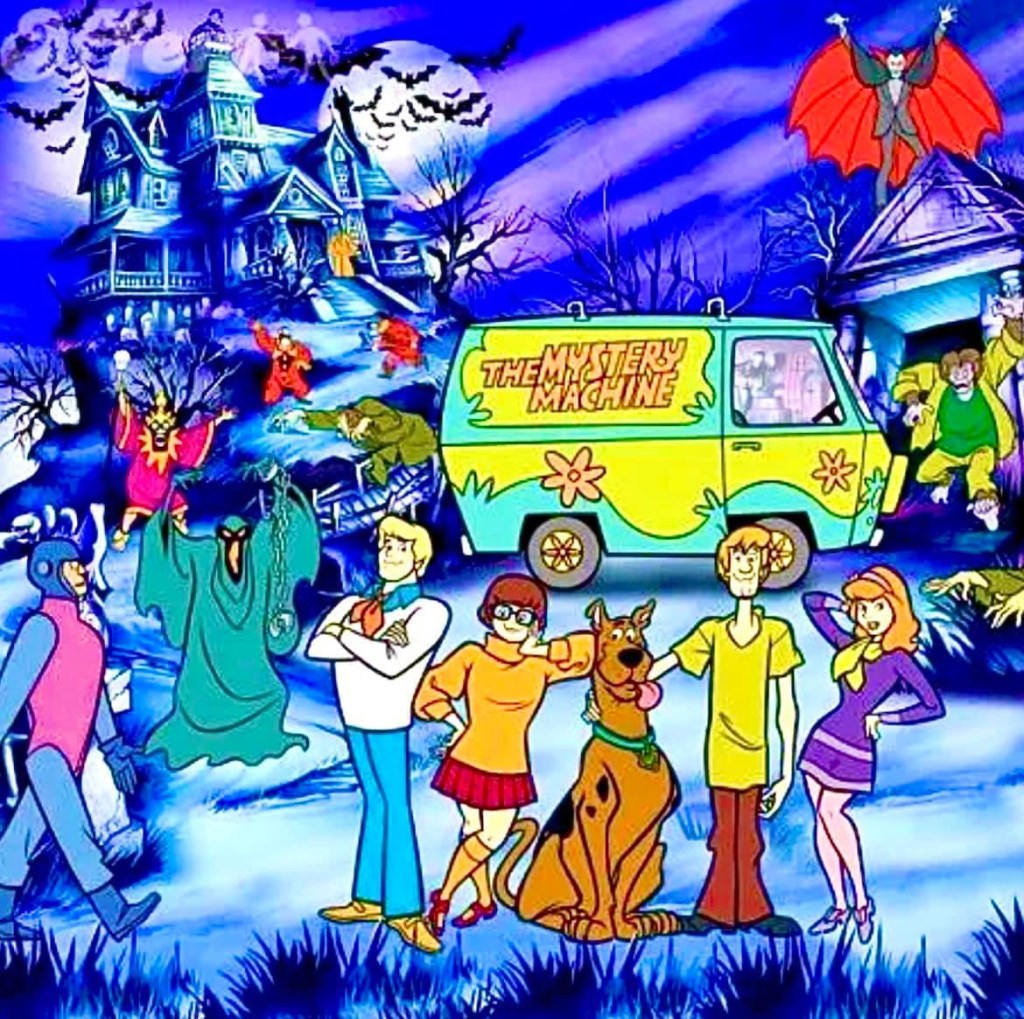
But saying Scooby Doo didn’t cement my interest in mysteries wouldn’t be true. The show did, silly as it was (watching as an adult I couldn’t help but wonder, “why would the bad guys go to such extremes to scare people off?”–which also is a contrivance often used in the Nancy Drew/Hardy Boys type books, too), but I watched it every Saturday morning. I kept watching through the next iteration, the hour long show with guest stars, but after that I was too old and had better things to do on Saturday morning than watch cartoons. I’ve always had a soft spot for Scooby, just as I did for the animated Hardy Boys show and Jonny Quest, and unlike many others, I never see reboots or remakes or re-imaginings as “destroying my childhood” because I am not a moron. I can see how the show appealed to kids–you can never go wrong with a sentient Great Dane with limited speaking abilities–and I remember writing Scooby fan-fic when I was young. I started out “novelizing” episodes, and started writing my own. I’d forgotten about that when I was originally rewatching, but in my head the kids’ series I eventually came up with was linked very much, not only to other kids’ series, but Scooby Doo as well.

I don’t want to adapt Scooby or write Scooby books anymore, but I do occasionally want to go back to my kids’ series and think, why don’t you give this a try? Often times, the reason I don’t write things I think might be fun challenges is mostly cowardice and Imposter Syndrome. Can I really write kids’ fiction? Can I really write historicals? However, writing Jonny Quest might be interesting, especially with a reading of the Quests as a queer family.

One of the things about Scooby Doo that always interested me as a kid, and continues to interest me as an adult: Velma. Velma was clearly the smartest of the gang1, which was fun and unusual, and Daphne (‘danger prone Daphne’) wasn’t dumb despite being the pretty one, even though she often needed rescuing. Over the years the character of Velma was really interesting to me–being a brain, of course, meant she had to wear glasses and was hopelessly far-sighted–because she wasn’t easily scared and she was often the one who figured everything out. It was also interesting to me over the years to see many people read Velma as a coded lesbian, which begs the question why? She never has any interest in the opposite sex, but none of them do, really–it’s not that kind of show. We have no background on the gang, either–how are they able to just drive around the country at their age without having to check in with parents, and where does their money come from?

Of course, this is asking a lot out of a children’s cartoon series, which is also why I find it odd to revisit these shows looking for queer coding, and you can usually find it. The all-male environment of Jonny Quest, which is also a kind of “found family” show or Velma not being a late 1960’s/early 1970’s stereotyped girl are good examples of this.

I’ve always wanted to do a reread of all the kids’ series (I still have the books) to reread them for queer coding. I’ve already mentioned before that there was homoeroticism in both the Ken Holt and Rick Brant series–deliberate or not, it’s hard to say–but does this exist in the more popular Nancy Drew and Hardy Boys books. Is tomboy Trixie Belden a budding butch lesbian, with Honey her future femme wife? What about cousins Bess and George in the Nancy Drew series, who are also almost a parody of butch/femme dynamics?

This is the kind of stuff I would love to write–critical queer theory about kids’ mystery series, books, and television programs.

Maybe when I retire.

  1. Calling themselves that also always amused me, since gangs usually are criminals of some sort or another; gang is usually mean that way, even though it’s just a descriptor for a group of people with a similar interest. ↩︎
Johnny Are You Queer?

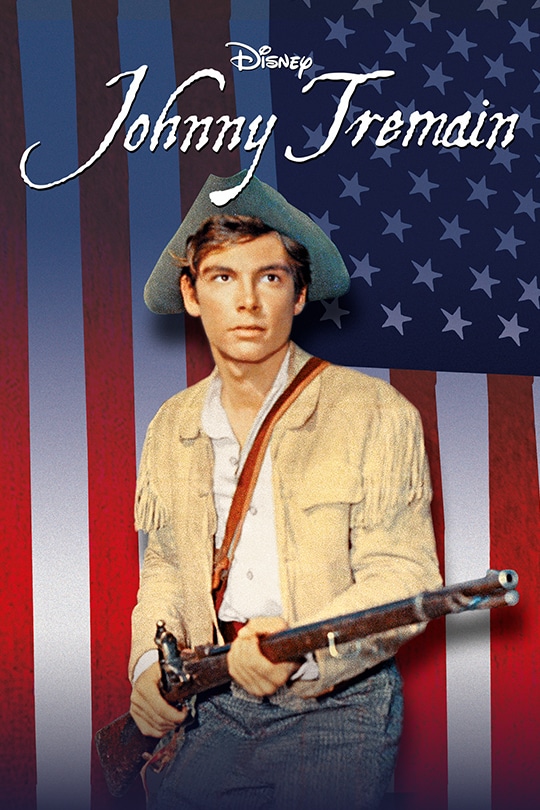
I have been wanting to rewatch Johnny Tremain for quite some time now.

When Disney Plus went live, the first thing I did (after subscribing) was search for it there; I did this at least once every two weeks since the service launched, to no avail. I would look for it on Amazon Prime, Netflix, everywhere; whenever I would sign up for yet another streaming service I would look for it. I never quite understood–and still don’t–why Disney Plus doesn’t have it; but the other day at work I realized I hadn’t looked for it for a while, so signed into Disney Plus on my browser: nope. Oh might as well give Amazon Prime a try, I thought, although Disney not having one of its own properties while another streaming service had it was, I thought, highly unlikely.

And yet, there it was: to rent or buy. I didn’t want to buy it, and I really hate paying to rent to stream something when I already pay for far too many streaming services (I really need to get past the mentality of subscribing when I want to watch something when it’s far cheaper in the long run to merely rent the movie or show), but I’v been wanting to rewatch this movie for years and there it finally was; so I did, and rewatched it yesterday whilst making my daily allotment of condom packs.

I also remembered, when I found the film, that Johnny Tremain was my gateway drug to not only my lifelong interest in American history–which eventually led to an interest in history in general. We had an assembly at my elementary school to watch the movie, and I saw it again when it aired on The Wonderful World of Disney (it may even have still been Disney’s Wonderful World of Color). I eventually read the book, which I got from a Scholastic Book Fair, and it became a treasured favorite. I also recognized, before rewatching the movie as a sixty-year-old, that it was a Disney film aimed for kids made in the 1950’s during the Red Scare when we were all living under the shadow of the mushroom cloud; Walt himself was, among many other things, a deeply conservative pro-America anti-Communist homophobe, and given all those things, it was going to most likely be–if looked at with a cold, judgmental, independent eye–a barely disguised propaganda film. (I am also curious to reread the book; since it was published in 1943, during the height of the second world war, it was also probably pro-American propaganda, when all the country needed to be united to believe that we were fighting evil to make the world a better place, and since American democracy was the be-all end-all…you see what I mean?)

I mean, once you recognize and identify Lost Cause mythology as an ideation to perpetrate and protect white supremacy, it’s also relatively easy to start reexamining all of American history and see the mythology that has been built up around the founding and creation of the country, as well as the deification of the Founding Fathers.

But while I was researching the book and movie the other day, I also came across a paper–queer theory–by Dr. Frank Henderson at Furman University that essentially reexamines the text of the novel from a queer perspective looking for subtext: the piece is titled “Could Johnny Tremain Be Gay? Reinterpretation as a Subversive Act” and was published in the Journal of Homosexuality (I read the abstract, and an article about it, rather than paying $40 to access the actual paper and read it; seriously, how do academics research if this stuff is so expensive? I will probably try to track a copy down through the library; which I guess, actually, is what academics do), and it gave me some pause for thought. I do remember that Johnny was more bratty and selfish in the book than he was in the movie (I remember being startled by this when I read the book the first time) and he literally had nothing but disdain for Cilla or any other girl in the book (which, at the time, was part and parcel of that weird societal norm or belief that prepubescent boys think girls are icky and don’t like them or want anything to do with them–again, very odd in a heteronormative culture) but when he becomes friends with Rab, an older boy involved with the Sons of Liberty, he almost idol-worships the older boy and allows himself to forget his innate selfishness and get involved with something bigger than himself–the revolutionary thinking that led Boston to revolt in the first place. That can be read, as Dr. Henderson states, as a queer relationship between the boys, and that Johnny could be read as queer. I seriously doubt that was what Esther Forbes was thinking when she wrote the book–the book was meant for boys and there was, as I said, that weird “boys don’t like girls” norm for a very long time (it certainly was a consistent theme in Disney productions aimed at boys; same with the Hardy Boys book and other mystery/adventure series aimed at boys from the time). This was in theory erased from the film…but I’m not entirely sure it was.

First of all, there’s absolutely no question that Hal Stalmaster, who played Johnny but never really worked much afterwards, mostly guesting on television shows, was a stunningly beautiful young man.

He also wasn’t a very good actor, but the heavy-handed direction of any Disney live-action film aimed at kids for a very long time didn’t inspire the best work from the cast (Mary Poppins, of course, being an exception).

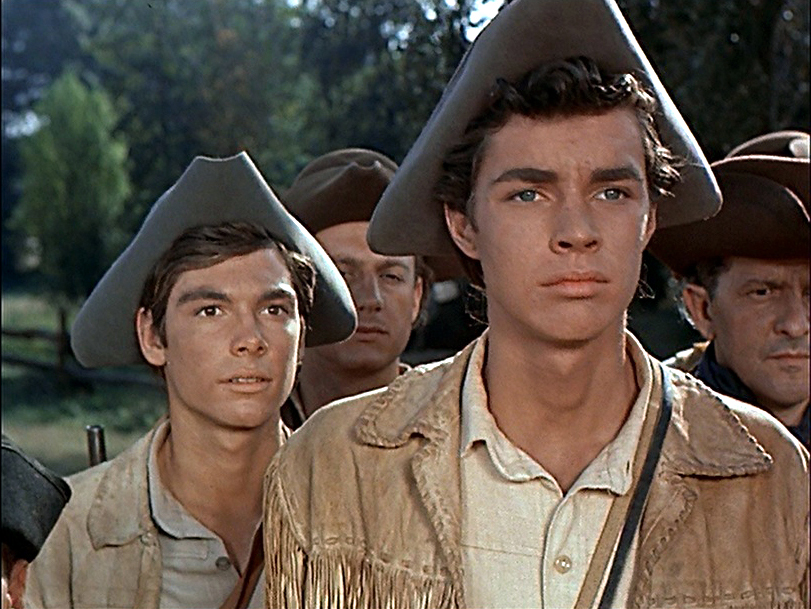
The young actor who played Rab was also ridiculously good looking–and turned out to be a younger Richard Beymer (billed as Dick) who would go on to play Tony in West Side Story and later, Twin Peaks–and they certainly had more chemistry together than Johnny had with Cilla, who was turned into a love interest of sorts, with him giving her a quick peck on the cheek (their only intimacy) as he runs through the streets of Boston with the news that the British would be leaving Boston “by sea”.

The movie was very typical Americana–so yes, propaganda–which sterilized and cleaned up the period in Boston before the outbreak of the war, with rather stiff pronouncements about ideals and principles and freedom and the rights of man and liberties and tyranny–all the patriotic buzzwords cast about by people who want to silence those who don’t agree with them–without any real explanation of what that means.

And yet, as oversimplified and “cleaned up” as this is made to be in the movie, it’s still effective–it’s very stirring to think about the nerve of the American rebels, doing something practically unheard of in history–not just defying their king (there was a long history of rebellions against the worst abuses of kingship throughout the centuries; just the century before the British actually beheaded their king and did without one for eleven or so years; 150 years before Louis XVI went to the guillotine in Paris) but defying the might of the most powerful and richest empire the world had ever seen. It’s hard not to think about–although everyone in this movie is a revolutionary, all Bostonians except for the villains, and the villainous American loyalists are actually worse than the British military themselves–what that period must have been like to live through; the divided loyalties, the betrayal of neighbor by neighbor, spies and treachery and murders. (I’d love to write a historical mystery set in Boston during this period, actually.)

It’s not a bad movie, but it’s also not a great one; and it certainly does its part in upholding the mythology created about the American revolution.

And yes, this could easily be yet another essay.