Private Eyes

I loved the Three Investigators.

When I was writing about rereading “The Birds” the other day, it brought Alfred Hitchcock to mind again. I have been revisiting the old Alfred Hitchcock Presents anthologies lately, and slowly (finally) realizing what an enormous influence on my writing Mr. Hitchcock was. Obviously, there’s the films, and the television series, of course, but even more so in books–books he had little to do with other than licensing his name–because hands down, no questions asked, my favorite juvenile series was The Three Investigators. I loved those books, and still do. The Hardy Boys, Nancy Drew, the other series–they don’t really hold up well for me now, but I can still enjoy the The Three Investigators as much today as when I first read them. The books are incredibly well written, and the three boys themselves are very distinct from each other yet not one-dimensional, and that holds true for all the members of their supporting cast–Uncle Titus, Aunt Mathilda, Hans and Konrad, Hitchcock himself, Worthington the chauffeur–as well as the primary settings, the Jones Salvage Yard and Headquarters, a wrecked mobile home hidden in plain sight, beneath and behind piles of junk, with secret tunnels leading to it.

What I liked the most, though, was that the plots of the mysteries themselves were very intricately plotted, and the criminals were actually pretty smart, so it took a lot of good detective work, thinking, and intelligence to outwit them. Many of the books were treasure hunts, which of course I love love love, and often required the solving of a puzzle, which I also loved. The three boys who formed the investigation were Jupiter Jones, Pete Crenshaw, and Bob Andrews. Jupiter (First Investigator)had been a child star on a Little Rascals type television show as “Baby Fatso”, which he doesn’t like being reminded of, or being called fat (this was actually one of the few kids’ series that dealt with fatphobia and flat out said making fun of people for being overweight was cruel; think about how much Chet Morton gets teased for being fat in The Hardy Boys and the same with Bess Marvin in Nancy Drew); he is also the brains of the outfit. He has a quick deductive mind, pays attention to details, and has read a lot so he’s got a lot of arcane knowledge in his mind that comes in handy quite often. Pete (Second Investigator) is strong and athletic and not nearly as bright as Jupiter. Pete also gets scared easily, but an ongoing theme in the books is how Pete always overcomes his fears to come to the aid of his friends. Bob Andrews is Records and Research; he works at the local library so can do research for them, and he also is the one who writes up all their cases to present to Mr. Hitchcock, to see if it’s worthy of his introduction. When the series begins, he has a brace on one leg from a bad fall down a nearby mountain–so he doesn’t get to get involved in any legwork or in-person investigations for several volumes until the brace comes off.

And of course I loved learning from Jupiter’s vast stores of knowledge.
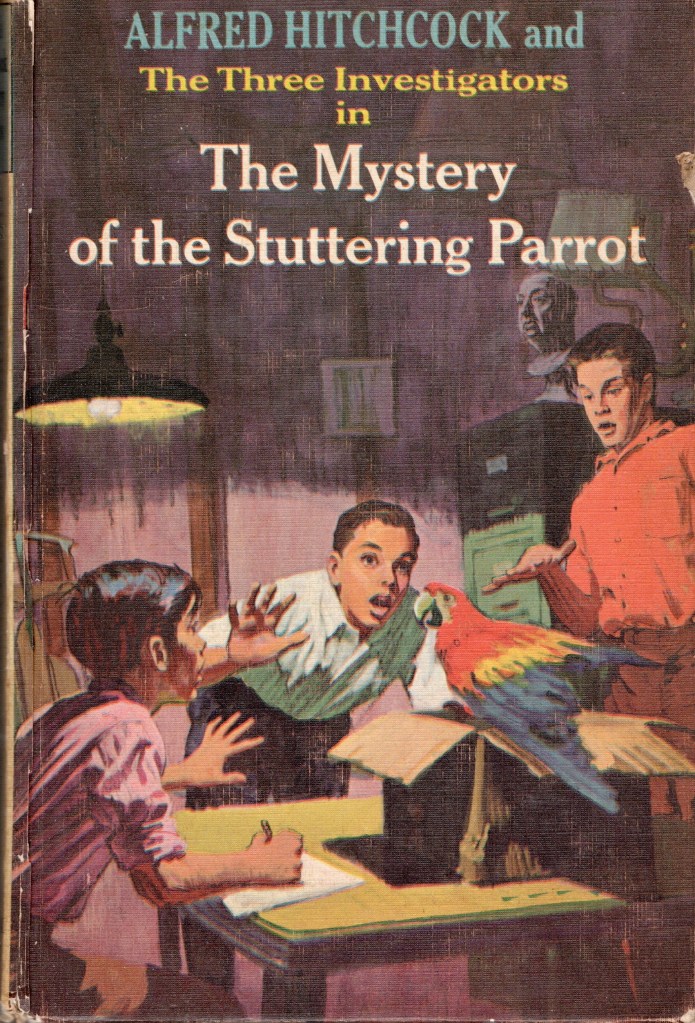
“Help!” The voice that called out was strangely shrill and muffled. “Help! Help!”

Each time a cry from within the mouldering old house pierced the silence, a new chill crawled down Pete Crenshaw’s spine. Then the cries for help ended in a strange, dying gurgle and that was even worse.

The tall, brown-haired boy knelt behind the thick trunk of a barrel palm and peered up the winding gravel path at the house. He and his partner, Jupiter Jones, had been approaching it when the first cry had sent them diving into the shrubbery for cover.

Across the path, Jupiter, stocky and sturdily built, crouched behind a bush, also peering toward the house. They waited for further sounds. But now the old Spanish-style house, set back in the neglected garden that had grown up like a small jungle, was silent.

“Jupe!” Pete whispered. “Was that a man or a woman?”

Jupiter shook his head. “I don’t know,” he whispered back. “Maybe it was neither.

Jupe and Pete are on their way to call on a prospective new client, referred to them by none other than Alfred Hitchcock himself. Professor Fentriss had bought a parrot from a peddler, primarily because he stuttered and was named Billy Shakespeare (Fentriss is an English professor). The parrot says “to-to-to be or not to-to-to be, that is the question.” But this is in and of itself mysterious, as Jupe points out, because parrots don’t stutter; they have to be taught to stutter. Why would anyone teach a parrot to stutter? But the stuttering parrot is just the start of a bizarre and unusual case, with twists and turns and surprises everywhere the boys turn. Their detecting soon leads them to the revelation that there were six parrots and a mynah bird the peddler was selling, and they were all taught specifically to say one phrase. The phrases are clues to a treasure trail, and the prize is a magnificent and incredibly valuable painting by a master.

This book is an excellent example of precisely why I loved this series so much. The pacing is always excellent, the characterizations are three-dimensional, the mystery is intricate and puzzling and hard to figure out, and the conclusion of the book, where the boys have to beat several bad guys to actually find the painting, which takes place in a spooky abandoned cemetery on a foggy night, is some of the best atmospheric writing I’ve ever encountered. You really feel like you’re lost in the fog with bad guys you can’t see out there somewhere.

I’ve never understood why these books never achieved the popularity of the Hardy Boys and other series like them. They were better written, better stories, and just over all vastly superior to the Hardy Boys in every way. The first book in the series, The Secret of Terror Castle, remains one of my favorite kids’ books to this day (several books from this series make that same list). The problem with the series was time, really. Alfred Hitchcock eventually died, and they had to get someone else to fill in for him. Eventually, recognizing that Hitchcock’s name alone dated the books, they removed the references. The books themselves were never updated, which is also a shame because it dates the books but at the same time gives them a kind of nostalgic charm, as well. The Secret of Terror Castle was about the home of a silent film star whose career was ended by talkies, who turns out to be still alive. That was a stretch for me even when I first read it in the early 1970’s, let alone today. Whenever I think about writing my own kids’ series, I always think of it in terms of being Hardy Boys-like, but really what I would want to do is emulate the Three Investigators, whose books were well-written and a lot of fun to read.

Be sure I will talk about them again another time.
Spooky

I’ve decided to launch a new reading project for this year: one in which I tackle rereading middle-grade mysteries. I am not going to limit myself to merely the series books I loved (although they will play a big role in the project), but will also include other mysteries I have, either in one of my reading apps or an actual hard copy, that do not belong to the series. My childhood memories aren’t as clear as I would perhaps like; then again, that period of my life was around fifty years ago, so it would be more of a miracle if I did have stronger memories.

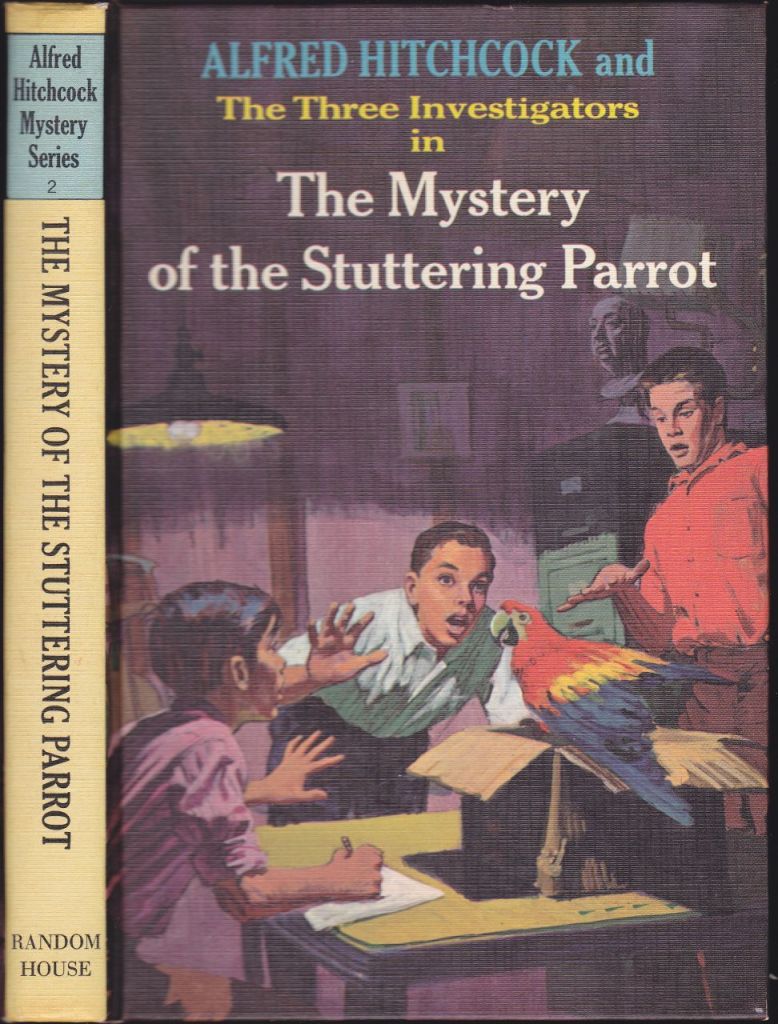
The first two series books I ever read were not from either the Nancy Drew or Hardy Boys series; they were from the Trixie Belden series (The Red Trailer Mystery) and The Three Investigators (The Mystery of the Moaning Cave). Both series wound up being favorites of mine once I eventually got back to them and remembered them; I remember buying five Trixie Belden books at a store at the Ford City mall in Chicago, and I got my first five Three Investigators books from a Toys R Us, I think in the Chicago suburb of Berwin? The two series weren’t as ubiquitous or available as Nancy Drew and the Hardy Boys; which made finding more of them a kind of triumph for me. I’ve already blogged about The Secret of Terror Castle, which was the first Three Investigators book in the series, so I won’t cover that one again. But recently I sat down and reread the second book in the series, The Mystery of the Stuttering Parrot, and remembered again why I love this series so much.

“Help!” The voice that called out was strangely shrill and muffled. “Help! Help!”

Each time a cry from within the mouldering old house pierced the silence, a new chill crawled down Pete Crenshaw’s spine. Then the cries for help ended in a strange, dying gurgle and that was even worse.

The tall, brown-haired boy knelt behind the thick trunk of a barrel palm and peered up the winding gravel path at the house. He and his partner, Jupiter Jones, had been approaching it when the first cry had sent them diving into the shrubbery for cover.

Across the path, Jupiter, stocky and sturdily built, crouched behind a bush, also peering toward the house. They waited for further sounds. But now the old, Spanish-style house, set back in the neglected garden that had grown up like a small tropical jungle, was silent.

“Jupe!” Pete whispered. “Was that a man or a woman?”

Jupiter shook his head. “I don’t know,” he whispered. “Maybe it was neither.

The Three Investigators cases often began this way; with two of them (sometimes all of them) landing smack dab in the middle of something mysterious; whether it was the sight of a weird ghost as they walk past an abandoned house being demolished (The Mystery of the Green Ghost) or biking past an enclosed estate (The Mystery of the Laughing Shadow) or simply riding in the gold=played Rolls Royce limousine and almost getting into an accident (The Mystery of the Silver Spider). Many of their other cases begin with them being hired to find a lost pet, which turns into something more complicated and complex: The Mystery of the Coughing Dragon and The Mystery of the Whispering Mummy fall into this category….while the majority of their cases come by way of referrals from Alfred Hitchcock himself (and why has no one ever done a book about the licensing of the Hitchcoc name, and all the products the great director attached his name to? It’s far overdue.). The Mystery of the Stuttering Parrot combines all three: the boys were referred by Hitchcock to a friend whose recently purchased parrot has either been stolen or gotten free; they are on their way to visit Professor Fentriss to talk to him about the missing parrot–which stuttered–when they hear the cries for help coming from within the house. They are confronted outside by a man with a revolver (he is described here, and throughout the book, as a fat man–even by Jupiter, who hates being called fat), who claims to be Mr. Fentriss and that the bird has returned; he also claims that Hitchcock had called him to say the boys were on their way over. As they are leaving they realize that the house had no telephone wires (which used to actually be a thing, before cell phones), so they go back. Indeed, the man they met was an imposter and Mr. Fentriss is also tied up in his home. They rescue him, discover that he bought the missing parrot from a sickly Hispanic man selling the birds (there were others) out of his donkey cart, and that his friend Irma Waggoner sent the peddler to them. (Note: the man is described, and referred to, over and over as a Mexican; he actually is Mexican, so it’s not necessarily problematic–other than the fact that no one knew he was Mexican at first; referring to all Latinx/Hispanic people as Mexican when they may not actually be Mexican is problematic. In an update they would undoubtedly change it to Hispanic–as he did speak Spanish as a first language and his English isn’t good–which we see when the boys find him later in the book.) Miss Waggoner’s parrot has also disappeared; it also spoke, as did Mr. Fentriss’. (I kept thinking as I read it for the first time but parrots don’t stutter; he would have to be taught to do that. Very early on Jupiter also mentions this; I always feel inordinately proud of myself every time I read Jupiter saying this) Eventually, it turns out that the man who taught the birds special speeches had a masterpiece painting in his possession, and each parrot speaks a clue to the location of where he hid it when he realized he was dying–so the boys not only have to find all the parrots to get all the messages, they also have to decipher the clues and find the painting. Eventually they do–while also trying to avoid a flamboyant international art thief and his thugs–in a spooky, abandoned graveyard in the fog. A little bit of luck, and the boys solve the mystery–but despite that piece of luck, the entire case is actually solved by deductions based on the evidence presented thus far, with Jupiter revising his theories whenever new evidence is presented.

I love this series, and the books still make for compelling reading today. Some of the story is dated of course–no cell phones, no computers for research (Bob does all their research at the library, where he works part time), the casual racism of the time–but many of the books still hold up. Hitchcock’s death obviously impacted the series, but I’ve never understood why The Three Investigators never became as popular as–if not more so–than Nancy Drew and The Hardy Boys. The three boys have distinct personalities–you know Pete will never want to investigate anything complicated, but will inevitably prove how courageous he actually is; Bob is studious and not as easily excitable as Pete, and he’s the one who usually follows Jupiter’s train of thought while Pete always gets confused; and Jupiter himself is a young Sherlock Holmes. Robert Arthur, who wrote the original series up through number 11, The Mystery of the Talking Skull (someone else wrote number 10, The Mystery of the Moaning Cave, which also ironically is the first of the series I actually read). Arthur won two Edgars from Mystery Writers of America for his radio plays; he also ghost edited some of the Alfred Hitchcock Presents anthologies I remember from my childhood. The Three Investigators are no longer in print, because of legal disputes between the Arthur estate and Random House about who owns the characters and so forth; it’s a shame. The books are still in print in many different languages–and are especially popular in Germany–where two of the books were actually filmed.

Most of my series books are in storage, but there are some still in the Lost Apartment–and I think when I am too tired to read something new, I may just get down a series book as an homage to my childhood and revisit some of these kids’ series.