Two Out of Three Ain’t Bad

Ah, Third Chanse.

If you will recall from my last entry about the Chanse series, I had a new editor for the second book in the series. I had also written a proposal for the follow-up, Murder in the Rue St. Claude, which was going to be about a nursing home and an angel of death. The second book ended with a tragedy for Chanse, and the last scene of the book was Chanse saying goodbye to someone before their life-support was turned off. I did a trickery and was going to have the person be in the nursing home, still living, only a suspicious death happens there and one of the workers talks to Chanse about her fears. The editor wasn’t the most professional or organized person, and I had to send the proposal to her three times on request with no contract offer. I was very irritated by this, but there were also a lot of changes going on there–including moving the offices from LA to New York, which I thought was an incredibly stupid business decision…and I wound up with yet another new editor right before Katrina hit. I honestly wasn’t sure if I would go back to writing ever again–one of the lulls in my career–but things eventually settled down and I started house sitting for a friend in Hammond over on the north shore while I waited for the city to reopen so I could drive into the city and get some more things from the house. I did, my friends’ trip was cut short, and I was going to return to Kentucky to my parents’ after one more swing by the apartment to pick up things. Imagine my surprise that my mail service was open, my grocery store and bank were open, and so was my gym. We’d moved into the main house from the carriage house, which hadn’t been rented yet as it needed some work before the hurricane, and so….I just moved back into the carriage house and cleaned up around the property and kept an eye on the main house, as well as emptying out the water from the machines that were trying to keep the insides of the apartments dry (the roof was gone).

While I was in Hammond, my new editor got me to reluctantly co-edit an anthology about New Orleans called Love, Bourbon Street (a title I hate to this day), and he was trying to talk me into writing a Chanse book about Katrina. I didn’t really want to, but he kept insisting and finally, I gave in and agreed to write it. However, the nursing home I was researching was a place they left people to die in–wasn’t touching that with a ten foot pole–and it occurred to me that I could wrap the case around Hurricane Katrina. He was hired by the client the Friday before Katrina, and obviously he couldn’t do the job now.

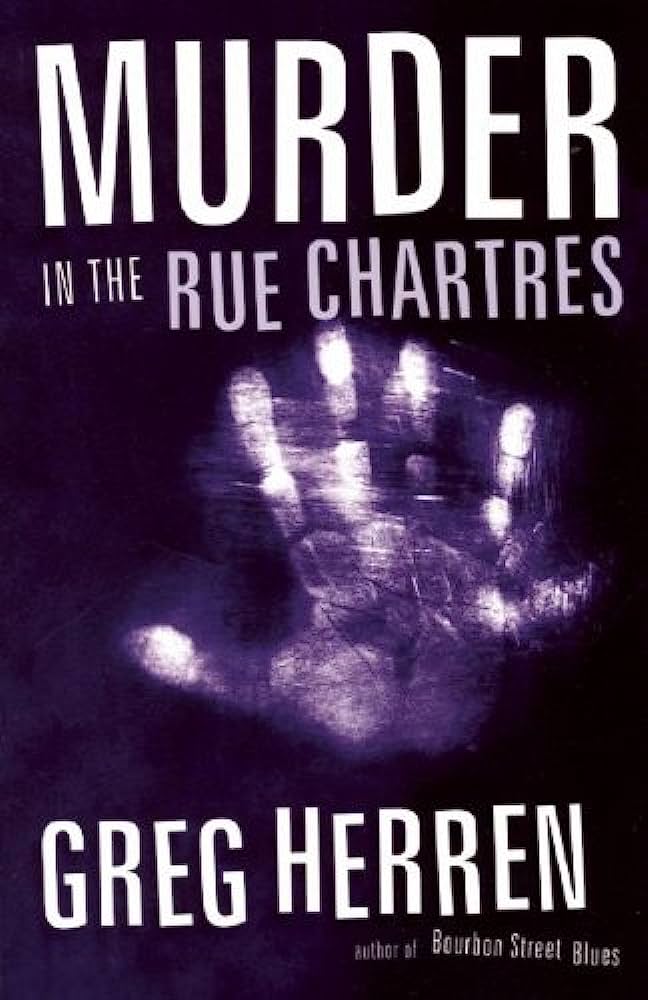
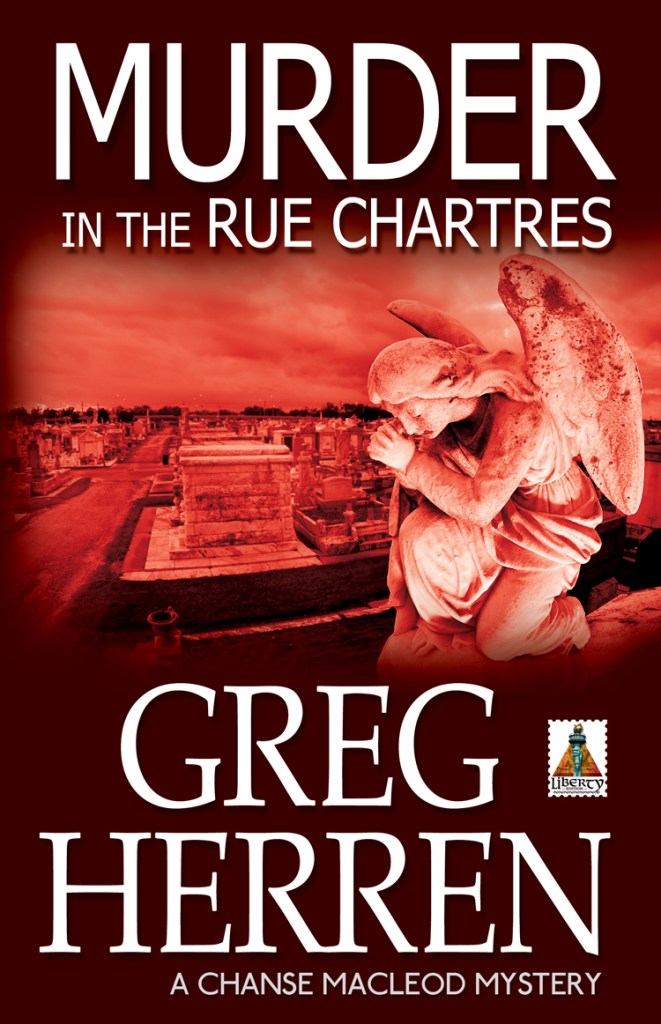
And that was the seed from which Murder in the Rue Chartres (no title at the time of contract) grew.1
It was six weeks before I returned to my broken city.

Usually when I drove home from the west, as soon as I crossed onto dry land again in Kenner, excitement would bubble up inside and I’d start to smile. Almost home, I’d think, and let out a sigh of relief. New Orleans was home for me, and I hated leaving for any reason. I’d never regretted moving there after graduating from LSU. It was the first place I’d ever felt at home, like I belonged. I’d hated the little town in east Texas where I’d grown up. All I could think about was getting old enough to escape. Baton Rouge for college had been merely a way station—it never occurred to me to permanently settle there. New Orleans was where I belonged, and I’d known that the first time I’d ever set foot in the city. It was a crazy quilt of eccentricities, frivolities, and irritations sweltering in the damp heat, a city where you could buy a drink at any time of day, a place where you could easily believe in magic. I couldn’t imagine living anywhere else. Any time I’d taken a trip before, within a few days I’d get homesick and started counting the hours until it was time to come home.

But this time wasn’t like the others. This time, I hadn’t been able to come home, and had no idea how long it would be before I could. Now, I was nervous, my stomach clenched into knots, my palms sweating on the steering wheel as I sang along to Vicki Sue Robinson’s “Turn the Beat Around” on the radio. It was everything I’d feared for the last few weeks when I thought about coming home, the anxiety building as the odometer clocked off another mile and I got closer to home.

It was different.

The most obvious thing was the lack of traffic. Even outside the airport, the traffic was usually heavy, sometimes slowing to a complete standstill. But other than a couple of military vehicles, a cement mixer, and a couple of dirty and tired looking sedans, I-10 was deserted. There was a film of dirt on everything as far as I could see, tinting my vision sepia. Huge trees lay toppled and debris was everywhere. Signs that used to advertise hotels, motels, restaurants, storage facilities, and pretty much any kind of business you could think of were now just poles, the signs gone except for the support skeleton. Buildings had been blown over, fences were wrecked and down, and almost everywhere I looked blue tarps hung on roofs, their edges lifting in the slight breeze. My breath started coming a little faster, my eyes filled, and I bit down on my lower lip as I focused back on the road.

No cars joined at the airport on-ramp, or the one at Williams Boulevard just beyond it. No planes were landing or taking off.

Most of the writing I did in the fall of 2005 was my blog, which at the time was on Livejournal. (The old stuff is still there, but I started making things private after a year because of plagiarism; I guess people thought they could steal my words if they were on a blog.) I documented as much of the experience as I could, so people outside of Louisiana could see that the city wasn’t fully recovered despite no longer being in the news. American attention had moved past New Orleans by the spring of 2006.

When I started writing the book, I was really glad I had done that with the blog, because more than anything else it reminded me of the emotions I was going through, that horrible depression and not remembering things from day to day, the need for medications, panic attacks, depression, and the way the entire city just seemed dead. I did repurpose a lot of stuff that was on the blog–rewritten and edited, of course–and I could tell, as I wrote the book, that I was either doing some of the best work of my life to that point or I was overwriting it mercilessly. You never can be sure.

But I also needed to flesh out the murder mystery I came up with, and I also wanted to write about a historical real life tragedy of the Quarter. The client who hired him that Friday before Katrina roared into the Gulf and came ashore was engaged, and she wanted Chanse to find her father, who’d disappeared from their lives when she and her brothers were very young. But what happened to her father? Who killed her, and why? Was her murder a reaction to her looking for him?

I had started using Tennessee Williams quotes to open my New Orleans novels with the third (Jackson Square Jazz: “A good looking boy like you is always wanted” from Orpheus Descending) and I liked the conceit so much I kept doing it. I knew someone who’d built a crime novel around the basic set up of Cat on a Hot Tin Roof, and I thought, what if the person who knows all the answers has been in a mental hospital for decades? Then what if Mrs. Venable had succeeded in getting Catherine locked up with all of Sebastian’s secrets lobotomized out of her head?

I named the family Verlaine as a nod to the Venables, and aged Mrs. Venable as well as gender swapping her (this was also a bit influenced by The Big Sleep), and I was off to the races.

My editor wrote me when he finished reading the manuscript and told me it was one of the best mysteries he’d ever read. The reviews! My word, I still can’t believe the reviews, and how good they were. I got a rave in the Times-Picayune, Library Journal and Publishers Weekly.

And yes, it won a Lambda Literary Award for Best Gay Mystery.

  1. The irony that two books I wanted nothing to do with, let alone write or edit, ended up with each winning Lambda Literary Awards, does not escape me. ↩︎

Bourbon Street Blues

It’s Southern Decadence weekend in New Orleans.

It’s probably hard to imagine what Southern Decadence is like unless you’ve actually been to it; even the hundreds of pictures I’ve taken and shared on social media over the years can’t even remotely begin to get the concept of what it’s like across–the same as Carnival, really; it has to be seen and experienced to be truly understood. My first Southern Decadence was in 1995, which was around the twenty-second or third time it was held; my knowledge of Decadence, primarily from urban legend and tales told from one gay to another and passed down over the years, is sketchy and probably untrustworthy (if you’d like the unvarnished truth and read about the history, I highly recommend Southern Decadence in New Orleans from LSU Press, co-written by Frank Perez and Howard Philips Smith; I have a copy and thoroughly enjoyed reading it. Alas, my memory isn’t what it used to be, but the story is it began as a bar crawl for a friend who was moving away, and grew from those humble beginnings into a massive event that draws queers from all over the world).

That first Decadence I came to was also one of the hottest, temperature wise, or perhaps it was simply because I wasn’t used to the summers in New Orleans yet since I didn’t live here. I just remember being in Oz one afternoon and just soaked in my own sweat, and going down the back staircase from the second floor–the staircase that opens out onto the dance floor–and having to hold onto the railing because the steps were slick and wet. The railing was also wet, and when I touched the walls so were they–all the humidity and body heat and sweat–but at the same time it was so much fun. Gorgeous, flirty and friendly men everywhere, everyone scantily dressed and getting wasted and just having a good time. This was during the height of the circuit parties, most of which have died off over the years–there’s no longer a Hotlanta weekend in Atlanta in mid-August anymore, for example–but back then, it seemed like every month if you had the time and the money there was a circuit party somewhere you could fly off to and be yourself and have fun being in an entirely gay environment for a few days. That was, for me, one of the primary appeals of circuit parties and gay bars–they were safe havens for everyone to be out and proud and loud…and after a few weeks navigating the straight world for work and play and life in general…it was lovely to let loose in, for want of a better word, a safe space.

Circuit parties also had their downsides, don’t get me wrong–Michelangelo Signorile detailed some of those in his book Life Outside, which got taken out of context an awful lot–drug use and rampant sex and bad choices also led to other problems, not to mention the spread of HIV and other STI’s; the very first time I ever went to a circuit party–Halloween in New Orleans, 1995–there was a very Masque of the Red Death feel to it; here were all these gay men crowded into a riverfront warehouse, doing drugs and dancing and having a great time while the plague raged outside the doors. I even wrote about that in my diary on the flight back to Tampa a few days later.

But Decadence was always my favorite, out of all of them, and it was something I looked forward to every year. My workouts were always planned so I would hit peak physical condition for Decadence and maintain through Halloween, before starting to work on the Carnival body. It feels weird to talk about it that way, but that was my mentality and my schedule for years. Bulk up for a couple of months, then lean down leading into the event.

I had always wanted to write about Southern Decadence, and I know I’ve written about how I came up with the idea for the book numerous times; standing on the balcony at the Pub watching one of the strippers fight his way through the mob of gay men to get to the Pub so he could work, Paul saying you really should write a book about Southern Decadence and seeing a scene vividly in my head as I looked down at the sea of sweating gay men. I’ve also written about where the idea for the character and his family came from. So what is there left for me to say about Bourbon Street Blues?

The new cover for the ebook edition.

The name’s Dansoir. Dick Dansoir.

Okay, so that really isn’t my name. It’s my stage name from the days when I was on the go-go boy circuit. I started when I was in college, at Vanderbilt up in Nashville. As with almost everything that goes on in my life, I became a go-go boy on a fluke. The Goddess brings interesting experiences into my life all the time. Sometimes I don’t think it’s all that great, to tell the truth, but she always seems to be watching out for me.

I was working out at my gym one day when this guy came up to me and asked me if I wanted to make some easy money.

Like I hadn’t heard that one before.  

I was twenty-one at the time, just turned, but I wasn’t some wide-eyed dopey innocent. I was raised in the French Quarter, after all, and by the time I went off to college at age eighteen I had pretty much seen everything. French Quarter kids have a lot more life experience than other kids their age. You can’t really help it. The French Quarter is like Disneyland for adults, and growing up there, you get used to seeing things that other people can only imagine.

Anyway, this guy said he was a booking agent and scout for this agency that booked dancers in gay bars throughout the deep South. The troupe was called Southern Knights.

“You can make a lot of money this way,” he said to me above the sounds of people grunting and weights clanging. “You’ve got the look we like.”

I looked at myself in one of the mirrors that are everywhere in gyms. I was wearing a white tank top and a pair of black nylon jogging shorts. I was pumped up from lifting, and if I did say so myself, I looked pretty good. I’m only about five-eight—nine if I have thick-soled shoes on. I have curly blond hair that’s darker underneath. The sun does lighten it, but that darkness underneath always makes people think I dye it. I don’t. I have big, round brown eyes. I am also one of those blonds lucky enough to be able to tan. I’d gotten a good tan that summer and it hadn’t faded yet. The white tank top showed the tan off nicely. I also have a high metabolism and can stay lean rather easily.

But scam artists are everywhere. I wasn’t about to fall for a line from some stranger in the gym. For all I knew, it was a trick to get my phone number, or an escort service, or something else I didn’t want to be involved in.

Not that I have anything against escorting. People go to escorts for all kinds of reasons—loneliness, fear of commitment, whatever—but they do fulfill a need in the gay community, and more power to them. I just never saw myself taking money from someone for having sex. I like sex. I enjoy it. So, it just never seemed right for me to tale money for doing something I like.

Besides, taking money for it would make it work. I prefer to keep my status amateur.

I got a copy of the book out yesterday and skimmed/read it again, to get another look and remind myself of Scotty’s roots and beginning. I realized yesterday, as I turned the pages of an ARC (yes, I still have ARC copies of Bourbon Street Blues available), several things: one, that the reason I always hate reading my own work is because my brain is trained to read my work editorially, to fix and edit and correct and look for things needing to be fixed (and I can always find something) and that second, it’s really been so long since the last time I looked at this book–or any of the earlier Scottys–was four years ago, when I was writing Royal Street Reveillon. So, by making the obvious effort to flip the editorial switch off, and having so much distance from the book that it almost seemed like something new to me, I was able to skim/read the entire thing without wincing in horror or pain or embarrassment.

The original cover, which always makes me smile.

Bourbon Street Blues was also the last novel I wrote that didn’t have an epigram of any kind, let alone Tennessee Williams: I started that practice with Jackson Square Jazz with a line from Orpheus Descending: “A good-looking boy like you is always wanted.”

Reading the book took me back to the days when I was writing it. The Greg who wrote Bourbon Street Blues is still here, I’ve just been through quite a bit since then and have changed because of my experiences. There were some sentences in the book I would change now to make better, but there are still some jewels in there, and well, I can kind of understand now why the character is so well-liked. He’s charming and humble and kind; sure he talks about “being irresistible” a lot, but that’s part of the charm. Guys find him attractive. He doesn’t necessarily see it, but is more than willing to accept it and not question it. He enjoys his sexuality and he enjoys having sex. I wanted Scotty to be unabashedly sexual and to have no hang-ups, carrying no stress or issues about being a very sexual gay man.

As I read the book again, I also started seeing something that had been pointed out to me over the years a lot–and began to understand why this was pointed out to me so much; an old dog can learn new tricks, apparently–but I still think other people are wrong. The book isn’t “all about sex,’ as some have said. Rather, Scotty sexualizes men; he sees them as potential partners and appreciates beauty in men. His friend David also loves to get laid, so they cruise a lot–whether they are at the gym (either the weight room or the locker room), a bar, wherever they are–and so people get the idea that the book itself is incredibly sexual, even though there is literally only one sex scene in the entire book and it’s not graphic; Scotty’s weird mish-mash of spirituality and beliefs and values make the act itself a sacred ritual, and that was how I wrote the scene; from a spiritual, commune-with-the-Goddess perspective. It’s also funny in that people are so not used to seeing world through the Gay Male Gaze that it’s jarring, and puts sex and sexuality into the minds of the reader.

The question is, would people think the same if this was done through the Straight Male Gaze, in which women are sexualized? Since this is the default of our society–literature, film, television–is flipping the script to show the Gay Male Gaze so uncommon and so unheard of that it triggers such a reaction from some of the readers?

There’s also so much innocence in the book, and it’s also interesting to see it as a kind of time-capsule: Scotty doesn’t have a computer; his rent (on Decatur Street in the Quarter, with a balcony) is $450 a month (ha ha ha ha, that’s what the condo fee would be now monthly); and he also doesn’t have a cell phone. The whole point of the book was to do a Hitchcockian wrong place/wrong time now you’re in danger kind of story; and that is precisely what Bourbon Street Blues is. I’d forgotten that one of the running gags in the book is that he never gets a chance to sleep much throughout the story so he’s tired all the time and just wants it all to be over so he can go to bed.

Another thing that’s dated: even in 2002, in my naïveté and innocence, the evil politician running for governor–when described by Scotty’s brother Storm as problematic–even he doesn’t support an outright ban on abortion–he wants to ban it but with the rape, incest and health exceptions.

Even in 2002 I couldn’t conceive of anyone running for statewide office calling for an outright ban on abortion.

How things change.

It was also interesting that I got two things very wrong in the book, too: for one, I was thinking for some reason the swamp on the edges of Lake Pontchartrain on the way to Baton Rouge on I-10 was the Atchafalaya (it’s the Manchac/Maurepas), and while I had always remembered I’d given Scotty’s mom a name in this book but forgotten it later when I needed a name for her in a different book–I had the name wrong. I thought I’d called her Marguerite in Bourbon Street Blues then named her Cecile in a later book; I had actually called her Isabelle. (I’ve even told that story–about the names–before on panels and been WRONG ALL THIS TIME!)

It was also interesting and fun to remember–as I read–that Scotty was also not looking for a boyfriend. He was perfectly happy and content being single (which was also something important I wanted to write about–a gay man who didn’t care about finding a life-partner, figuring if it was meant to be it would happen). I also presented him with two potential love interests–Colin the cat burglar and Frank the hot daddy–with that actually being resolved without him having to make a choice between them. I also had the book end with Scotty being slowly persuaded into becoming a private eye.

Originally I had conceived it as a stand alone novel, but the publisher offered me a two-book contract, so when I was writing Bourbon Street Blues I knew there was going to be a sequel. This freed me to leave some personal things open for him; I knew I was going to bring Colin back in the next book so he was going to have to choose between them, and I also knew the personal story needed to be wrapped up by the end of the third book, which was going to be the end of the series with everything resolved. That changed when I wrote Mardi Gras Mambo, but that’s a story for another time.

Bottom line: it’s a good book and I am proud of it. It’s only available now as an ebook from Amazon, but I hope to eventually make it available through every service as well as get a print-on-demand version for those who might want one.