You Don’t Have to Tell Me

There really is nothing quite like a good read, is there?

Alafair Burke has become one of my go-to’s; an author whose every book I preorder and start salivating when I get the shipping notice. I’ve not read her extensive backlist as of yet; I was late to the Burke party and began with The Ex. I do possess most of the backlist and it’s all in my TBR pile, but I’ve gotten so addicted to reading the new ones when they come out I never think to go back to the shelves to get one of the older titles–which is something I clearly need to do; and never have I felt that pull more than while reading her latest.

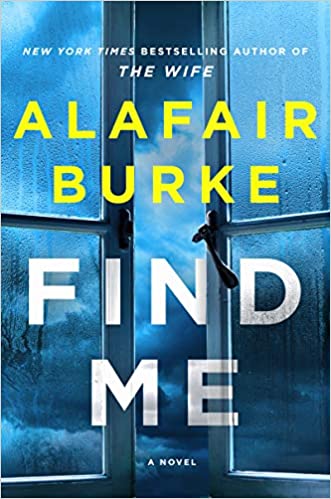
You see, she wrote a series about a New York cop named Ellie Hatcher–and Ellie comes back as part of the ensemble cast of Find Me, and what I saw of Ellie made me want to go back and read more about her. Well done on that front, Alafair! (This is something that I absolutely love when authors do; like how whenever Laura Lippman needs a Baltimore private eye, she brings in her old series character Tess–which is always a welcome joy whenever it happens….and maybe something I might be able to do with Chanse at some point. Hmmm.)

But I was very excited when Find Me was delivered into my hot little hands, and yesterday, while I was freezing inside the Lost Apartment, I grabbed a blanket and repaired to my easy chair, intent to read for an hour.

I didn’t stop until the book was finished.
Hope Miller shifted her gaze from the gas nozzle to the pump. When the gallon counter hit twelve, she scolded herself for not filling up before her trip into the city. She couldn’t risk an empty tank.

The nearest customer leaned against his green Jeep, sharing her same awkward wait, watching the digital numbers tick by. She noticed him looking at her. When he noticed her noticing, he flashed a practiced grin. She didn’t smile back.

That phrase, “It takes more muscles to frown than smile?” She had googled it once. Turns out, facial descriptions are subjective. Smiles, sneers, frowns, and smirks are all in the eye of the beholder. And the so-called facial nerve controls forty-something muscles, but some people have all of them, while others are missing almost half.

But scientists did agree on one thing–that smiles are innate. Reflexive. And viewed across cultures as a sign of friendliness.

A single man smiling at a single woman alone at a gas station at night?

Pretty great opening, isn’t it? The entire opening chapter is an exercise in suspense: is the woman imagining that this man isn’t just some stranger at a gas station? Is she being paranoid, or is this just the start of an innocuous encounter encapsulating the micro-aggressions directed at women by men on a daily basis? I understand that paranoia myself a bit–I experience it every time I travel throughout the deep South and have to stop for gas or to get something to eat; I am always on high alert during these times, paying attention to any and everything around me, and especially the people. I’ve stopped for gas and noticed someone staring at me before, and then following me back onto the highway, my heartrate increasing and adrenaline pumping through my veins as every mile ticks off on the odometer; I will often deliberately slow down to force the suspicious vehicle to eventually pass me…and this happens more regularly than it probably should. Anyway, I can relate to the main character’s paranoia; this is masterful suspense writing by the author, because now I have been pulled into the story and I am worried about the main character.

The book is mostly set in the Hamptons, with some scenes taking place in New York City; there’s even a detour to Wichita (KANSAS!!! It keeps popping up everywhere lately!). The main character of the story is NOT the paranoid young woman in the first chapter (and I cannot explain to you, Constant Reader, how wonderful that first chapter is; everything in that first chapter, every tiniest detail–everything she feels and thinks and remembers–is crucial to the story), but rather her sort-of adopted sister, criminal defense attorney Lindsay Kelly. The young woman in the first chapter, Hope Miller, is already, in and of herself, a mystery. She was found some years earlier, as a teenager, thrown from a wrecked vehicle with no memory of who she is, where she came from, or how she wound up in New Jersey. (The car had Indiana plates and was reported stolen.) Eventually, she takes the name Hope Miller and moves in with the Kelly family–a woman without a past that Lindsay somehow feels responsible for; more so than as a friend or as a sister. Hope is damaged, obviously, and has only recently decided to take control of her life and start over somewhere different than the small town in New Jersey where she’s been living since the Kellys took her in–she wants to go somewhere where everyone doesn’t know her as “the mystery girl with amnesia.” Hope disappears, and Lindsay is desperate to find her; has her true past finally come back to haunt Hope? Who is she? And what, if anything, does she have to do with the murder of a local charter fisherman who was murdered around the time she disappeared? Is she dangerous?

The search for Hope soon draws in some more characters–including, as mentioned earlier, police detective Ellie Hatcher from Manhattan–and there are multiple stories going, all of them tied together, all of them leading back to Hope’s mysterious past, and there’s also a potential link to a serial killer Ellie’s father investigated back when she was a girl. The characters are all well-drawn and developed enough to be real enough to draw the reader in to root for them; Burke is also masterful at pacing and when is the right opportunity to play yet another card that will either further confuse or enlighten the reader as the story continues to take shape out of the amorphous confusing mist entangling the characters.

Juggling all of the subplots and keeping them tied into the main story is also not an easy task for a writer, but Burke manages to do so, tidily winding up every loose end to leave the reader, as they close the book, smiling and satisfied with the experience.

The Moment I Knew


Thursday, y’all, and I think I am going to take a vacation day tomorrow to try and help me get caught up on all the things I need to get caught up on. Another three day weekend, following up on the one just past already? To be fair, it kind of needs to actually happen, to be honest. I also have to remember to dedicate myself to making sure all the things I need to get done actually get done.

Which, you know, is the real trick here.

I also kind of need to pull myself together. While I am fully aware that there are certain things about myself I cannot control–depression, the mood swings, etc–it is still enormously frustrating to have to deal with them, try to work through them, get through them while trying to keep going with everything I am juggling these days. Part of it comes, undoubtedly, from my inability to ever get a handle on everything; even when I am making lists and working from them there’s always something I am forgetting when I make the list or something that comes up new after I make the list–and the list is so long and daunting to begin with that the thought of adding something else to it is paralyzing, which drags me back into the endless cycle of plate spinning to “Flight of the Bumblebee” again.

Obviously, the insomnia never helps either, nor does fearing, every night when I go to bed, that I am going to have insomnia again.

We started watching Mythic Quest last night on Apple Plus, and it’s not bad; we watched two episodes and I think it has the potential to become really funny; it stars Rob McIlhenny of It’s Always Sunny in Philadelphia, and I was really surprised to discover that not only was he the driving force behind that show, but this one as well. We’re also watching We Hunt Together on Showtime–we started the other night, before getting distracted by Ted Lasso, which I absolutely love–and while it’s not bad, it’s not the best British crime show I’ve watched. It’s very unusual in that it features two mixed couples (a Black man and a white woman) on opposing sides of the law–the investigating detectives and the criminal couple killing people–and reflects the similarities of relationships and their dynamics in both; it’s like they are mirror images of each other if it’s a funhouse mirror. It’s an interesting choice, and the acting is superb; the female cop is played by Eve Myles of Torchwood fame, whose work I always enjoy.

During my condom-packing hours yesterday I also returned to the Cynical 70’s Film Festival, this time watching Jane Fonda in her Oscar-winning role as Bree Daniels, the call girl, in Klute (what is with women winning Oscars playing prostitutes, anyway?). Klute is a very strange film, and it’s the first of what is called, by film scholars, the Paranoia Trilogy of director Alan J. Pakula (I have recently watched the other two, The Parallax View and All the President’s Men). Klute, to me, is a deeply flawed film, but an interesting one all the same. It’s a crime movie, the title character is a cop who takes a leave of absence to investigate the disappearance of a friend, and yet neither the cop nor the investigation are the lead story of the movie; it’s really a character study of Bree Daniels. Klute, the detective, is played almost completely emotionlessly by Donald Sutherland (obviously a choice made by both director and actor; since this is also the same period that produced his stunning performance in Don’t Look Now), so the emotional heart and center of the movie is Fonda’s performance. I came away from the film not entirely convinced by that performance; there was complexity there and some moments of truly fine acting, but over all–the film hasn’t really aged all that well (the underground world of orgies and call girls and pimps and heroin of Manhattan in the 1970’s it is trying to depict feels very screenwriter-ish to me; a film studio’s thoughts about how that particular subculture would look, walk and talk)–but I can see why she won an Oscar; those scenes where she is able to really inhabit the character are stellar. Klute is a subversion of noir/crime thrillers, really; by focusing on the character study of Bree rather than the story, it becomes less a crime story than the story of the unfortunate aspiring actress/model who turns to tricking to pay the bills and then is trying to leave the life but isn’t entirely able to; not only because she needs the money but because she likes the power of being in control–or at least, the allusion of control hooking brings her.

Imagine Double Indemnity if the focus of the film wasn’t the plan to kill Phyllis’ husband, but rather who she is and why she is the way she is.

The paranoia is also there in that Bree’s phone is tapped, not only by Klute but also by the killer. There’s another part of the film that is a flaw; the motive for the killing and the motive for hiring and paying Klute doesn’t really wash; but’s that probably also the crime writer/editor in me. I had also thought the film was based on a book but was apparently wrong; I could have sworn I remember seeing a paperback novel of Klute on the wire racks at Zayre’s, but of course it could have simply been a novelization of the film.

I did find Don’t Look Now also available to stream somewhere as I idly looked through all my streaming services apps last evening before we started watching Mythic Quest; I definitely want to watch that film again–and it’s not a bad idea for me to delve back into Daphne du Maurier’s short stories again. I may even have to read one of the novels she wrote that I haven’t read yet; there appears to be an adaptation of The Scapegoat (which I’ve not read) available to stream as well. The concept of the book intrigues me–the concept of the look-alike, which is something I’ve always wanted to write about myself. I’ve always had this idea of a bartender in a gay bar being approached by someone who thought he was someone else as a great starting place for a thriller; the problem, of course, being that now DNA would take away any possibility of an imposter passing for someone else. (FUCKING technological improvements.)

This idea came to me–not the least because of The Ivy Tree by Mary Stewart–but because when I used to visit New Orleans before moving here, consistently people–locals–would come up to me and start talking to me like I was someone else; eventually I would point out to them that they didn’t actually know ME and they would be very startled. This continued for a year or so after we moved here–I would sometimes get bought drinks by total strangers who thought I was someone else, and now that I think about it, perhaps the reason so many bartenders gave me a drink for free now and then was because they thought I was someone else. But it stopped after living here for a few years–I’d forgotten this used to happen–but they would always tell me I had a double here in New Orleans; one that I never met or saw anywhere. Isn’t that strange? But I always thought it was a good opening or idea for a story–but of course now, as I mentioned before, DNA has ruined the imposter stories forever.

Today is a better day, so here’s hoping it lasts and I can get back on track.