Separate Lives

Well, in typical Greg screw-up fashion, I screwed up this morning. I’d signed up to tour the local FBI office and attend two presentations, all of which I was looking forward to, but I had the time wrong. As Constant Reader knows, I am not good in the mornings. So, I thought I had to be there for nine a.m. No, everything started at nine a.m. I needed to be there for eight thirty. As I was getting ready to shave, I double-checked the address and noticed that on the agenda I needed to be there for eight thirty. It was eight-oh-five; I hadn’t shaved, showered, or dressed, let alone drive across town to the lake front. In other words, I wouldn’t been able, even if I hurried, to leave the house until it was time to be there, and then had to hurry to get there. Sigh. So, I made another cup of coffee and felt like a complete idiot.

And now have my morning free.

And before anyone says anything, no. I won’t show up late. I am not that person. It’s disrespectful to everyone who showed up on time, it’s disrespectful to the FBI, and if they want you to allow half an hour to clear security screening, then I need to be there half an hour ahead of time. Period. Plus, you don’t mess with the FBI. Trust me on this one.

Sigh. I hate when I fuck up. Especially after the chapter went to all the trouble to get this sorted out and put together.

Sigh.

I was really looking forward to it, too.

Anyway.

I finished watching season 2 of Versailles last night, and I have to say, it really ended well. You really can’t go wrong with the Affair of the Poisons and the involvement of the King’s mistress, Madame de Montespan, and her subsequent fall from glory. The show is incredibly well done, and they managed to get the character of the second Duchesse d’Orleans, Elisabeth Charlotte, the Princess Palatine, absolutely correct. Liselotte was always one of my favorite people from this period of French history, and the rapprochement between her and her gay husband, and her gay husband’s lover, was incredibly unique in history. I was worried they’d gloss over it, but no, there it was, front and center. Why no one has done a biography of Monsieur, I’ll never know; I suppose everyone is so dazzled by The Sun King that no one has ever thought that, you know, a view of the French court and Louis XIV through the eyes of his gay brother could be interesting.

Believe me, if I spoke French I’d be all over it.

Then again, were I able to speak French, there are so many things I would have written by now.

Sigh. I often regret my monolinguism.

This weekend I managed to read a lot of short stories, giving me a lot of material for The Short Story Project over the next few days, but the weekend was pretty much a bust for writing. I only managed to eke out slightly over a thousand words on one short story and perhaps one hundred on another, which was, as one would imagine, enormously frustrating for me. I am still choosing to see that as a win; getting closer to being finished and all, but still enormously disappointing. The thousand words or so was basically wheel-spinning, because I don’t know how to end the story yet, and I know I need to go back to the very beginning and start revising it so I can figure that out. It’s so weird; I do this with novels all the time but with short stories, I resist doing it until I’ve got a draft version finished. So incredibly stupid, I know, and yet…here we are.

Heavy sigh.

All right, enough of that nonsense. Here are two of the short stories I read over the weekend, both from Alive in Shape and Color, edited by Lawrence Block.

First up, we have Jeffery Deaver’s “A Significant Find.”

“A crisis of conscience. Pure and simple. What are we going to do?” He poured red wine into her glass. Both sipped.

They were sitting in mismatched armchairs, before an ancient fireplace of stacked stone in the deserted lounge. The inn, probably two hundred years old, was clearly not a tourist destination, at least not in this season, a chilly spring.

He tasted the wine again and turned his gaze from the label of the bottle to the woman’s intense blue eyes, which were cast down at the wormwood floor. Her face was as beautiful as when they’d met, though a little bit more worn, as ten years had passed, many of which had been spent outside under less-than-kind conditions; hats and SPF 30 could only give you so much protection from the sun.

If you’ve not read Jeffery Deaver, you simply must read the Lincoln Rhyme series. I am terribly behind on it, but tore through the available volumes over the course of a month or so when I first discovered him. He’s also a very nice man, and it’s lovely when someone nice enjoys exceptional success.

Anyway, this story is terrific. The couple we see in these paragraphs, whom are the main characters of the story, are an archaeologist team at a conference in France. They, while enormously successful with publications and so forth, have never made what is known in their field as a ‘significant find.’ There’s a very strong possibility that they are about to  make one; based on some information passed on to the husband in casual conversation in the bar; undiscovered cave paintings. It turns out the person passing the information on has his own information, collected from a local boy, wrong; the couple figure out what he had wrong, and are about to go look for the cave. The crisis of conscience is whether or not to share the discovery with the colleague who originally got the information. This is the kind of moral dilemma that characters in Tales from the Crypt episodes find themselves in and almost without fail made the wrong choice; so the story always ends up with their come-uppance. This was what I was expecting out of this story; but Deaver manages some exceptionally clever sleight-of-hand and thus the ending of the story comes out of nowhere and is satisfying in its own way; the pay-off is quite good.

I then moved on to “Charlie the Barber” by Joe R. Lansdale.

Charlie Richards, who thought of himself as a better-than-average barber, was lean and bright-eyed, with a thin smile, his hair showing gray at the temples. He loved to cut hair, and he loved that his daughter, Mildred–Millie to most–worked with him. They were the only father-and-daughter barber team he knew of, and he was proud of that. He was also glad she lived at him with him and her mother, Connie, at least for now.

Next year she was off to the big city, Dallas. Graduated high school a couple years back, hung around, cut hair, but now she was planning to attend some kind of beauty college where she could learn to cut women’s hair as well. Planned to learn cosmetology too. Claimed when she finished schooling she could either fix a woman up for a night out, or spruce up a dead woman for a mortuary production. Charlie had no doubt that would be true. Millie learned quickly and was a hard worker.

This story was inspired by one of those classic Norman Rockwell paintings, with it’s homey, almost propaganda-like charm about American simplicity and virtue. Being a story by Joe R. Lansdale, who is embraced by both the horror and crime writing communities–he won an Edgar for Best Novel, and numerous Stoker Awards–you just know this euphoric American idyll story of a small town barbership in the 1950’s is going to take a truly dark turn. Charlie was a POW during World War II and still suffers from a degree of PTSD; the supply closet in the back of the barn, with its tight, confined space and darkness, always takes him back to the horror of the camp and what he had to do to escape the butchering of the prisoners; he was one of the few survivors. And sure enough, the peaceful charming world of the barbershop is turned upside down just before closing time when something wicked that way came. The story is both horrifying and brilliant; the juxtaposition of the Rockwell Americana painting/world view and the automatic nostalgia the time period conjures, steeped in nostalgia for the 1950’s as a more innocent, charming time (which is completely false), against the horror that walks through the barbershop door and what they have to endure to survive it–the sort of thing that did happen, but without 24 hours news channels and the Internet most people never heard about these things–is stunning. Lansdale is a terrific, terrific writer, and this story is one of the best ones I’ve read thus far in this Short Story Project.

IMG_2254

Crimson and Clover

Constant Reader knows I love history.

One of the (many) reasons I didn’t major in history was because I really couldn’t pick a period to specialize in; there are so many different periods of history that fascinate me. I talk on here a lot about the sixteenth century, but I am also interested in the seventeenth. I’ve actually been toying with a book idea set in that century for going on ten years now; periodically I will read some history of that century as background, but there is still so much I don’t know. I am reading Royal Renegades right now, about the children of Charles I of England–fascinating stuff; I knew basics about the English Civil War but not a lot–and the Stuarts of that period were particularly entwined with France. Charles I’s wife was Henrietta Maria, youngest sister of Louis XIII and aunt to Louis XIV; she fled to France for safety and some of the royal Stuart children also made it over there at some point. Henrietta Anna, Charles I’s youngest daughter, grew up at the French court; she eventually married Louis XIV’s brother, Philippe, the Duc d’Orleans.

And therein lies a tale.

My interest in Louis XIV–and Versailles–led me to discover that the Sun King’s younger brother, Philippe (whose existence, for that matter, completely invalidated the plot of Dumas’ The Man in the Iron Mask, although I’ve always loved that story), was, if not a gay man, then bisexual: he had children by both his first wife, Henriette Anna Stuart, and his second, Elisabeth Charlotte, Princess Palatine. In fact, Philippe is called the Father of Europe because all of European royalty in the nineteenth century were his descendants.

As a small child reading history, I picked up on the homosexuality that most historians always tried to gloss over (Edward II and Piers Gaveston; James I and first Robert Carr, later George Villiers; Richard the Lion-Hearted; Henri III of France; etc) but there was never any real attempt to gloss over Monsieur’s (Philippe was known throughout his life as Monsieur, after the death of his uncle Gaston, from whom he inherited that particular title as well as the title of duc d’Orleans) sexuality. He had a long term relationship with the Chevalier de Lorraine, which started when he was a young man and lasted until the Chevalier’s death. Monsieur’s first wife put up with it but didn’t care for it; his second wife didn’t care one way or the other.

The story goes that his mother, Anne of Austria, made him that way–which is, in modern times, a laughable thought (a domineering mother, etc etc etc)–by dressing him as a girl when he was a child, and continuing to do so after he was of an age to start wearing male clothing. Apparently, Queen Anne was concerned that Louis XIV and his younger brother would have an adversarial relationship the way her husband Louis XIII had with his own younger brother, Gaston. The troubled marriage of Louis XIII and his Spanish wife is also fascinating; they were married very young, she had two miscarriages, and he blamed her for the second one and they became estranged, not living together as man and wife for a very long time afterwards (the second miscarriage was around 1619, I believe; Louis XIV was not born until 1638 and his younger brother in 1640)–this estrangement between King and Queen–and the way George Villiers, Duke of Buckingham shamelessly flirted with Queen Anne when he came to Paris to negotiate the marriage of Charles I to Henrietta Maria–were the seeds from which Dumas also wrote The Three Musketeers.

Since so much time had passed (almost nineteen years) since Louis XIII last slept with Queen Anne, there were lots of rumors and talk that her two sons were not Louis XIII’s; there are many who believed Cardinal Richelieu fathered the boys with the Queen (fictionalized in Evelyn Anthony’s The Cardinal and the Queen); but there was never any question that the two boys were Bourbons. (Like the Hapsburgs with their genetic ‘jaw’, the Bourbon ‘nose’ was also relatively famous; both Louis and Philippe had the nose–but then that could simply mean that their father was a Bourbon rather than confirmation that Louis XIII was)

Monsieur often dressed as a woman for court functions, even as an adult; despite this proclivity he was a great soldier and commander of the French army–he was so successful in the field that his brother was jealous of his successes and often removed him from command.

His second wife was a diarist and a compulsive letter writer; her memoirs and letters are one of the best sources for information about life at the court of Louis XIV.

I’ve always been a little surprised that, while there are scores of biographies of Louis XIV (who, despite his incredible ego, wasn’t as great a king as he thought he was; he accomplished a lot but he also succeeded in planting the seeds for the French Revolution and creating the court system that also played a big part in the downfall of his dynasty. He also wasn’t successful militarily and diplomatically; his wars were expensive and ruinous–although all of Europe had to unite against him in order to beat him.) there are very few, if any, of Monsieur. I would think a biography of him would be something a gay historian would be interested in writing, because of the ability to look at his sexuality, his difference from the others at court, and how, as a prince, he was able to be himself–despite his own religious mania, Louis XIV never seemed to care about Monsieur’s proclivities–and on his own terms. Not to mention how incredibly difficult and strange it would have been to be the younger brother of the egomaniacal Sun King.

Was Monsieur gay? Bisexual? Transgender? Was this a result of his mother dressing him as a girl when he was young or was that just a coincidence?

As I said, the seventeenth century is interesting. And a lot was going on as well–the Thirty Years’ War was the last European war over religion; there were civil wars in both France and England; the colonizing of North America by the British, French, and Spanish truly got into full swing; and it was also the time, of course, of Cardinal Richelieu, the first great modern statesmen.

I hope to write this book someday. But in the meantime, I am having a great time doing the background research.

And now, back to the spice mines.

Here Comes the Sun

For right now, I am trying to clear my head and figure out what I need to do. In the meantime….

I’ve mentioned that I’ve been watching Versailles and really enjoying it. I often talk about the sixteenth century and how I am utterly fascinated by it; I also love the seventeenth century, but in that particular century my fascination is almost entirely with France. Don’t get me wrong–the Stuarts in England were very interesting, and Charles II and the restoration period is definitely one of my favorites; but my heart, alas, is really in France.

And part of that, of course, has to do with Louis XIV.

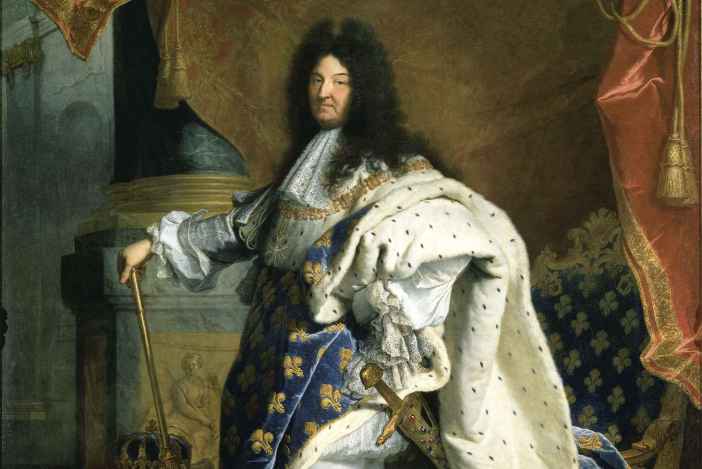
2048x1536-fit_louis-xiv-1701-hyacinthe-rigaud-musee-louvre

The Sun King, le Roi Soleil, le Grande Monarch. The third king from the house of Bourbon, who took the throne at age five and reigned for seventy-two years; which is the longest reign by a king (there were dukes and princes who ruled longer; but his was the longest for an actual King) in European history. His father was Louis XIII, the feckless and foppish king from Dumas’ The Three Musketeers; his mother was Anne of Austria, the Spanish princess whose honor the Musketeers and d’Artagnan were trying to protect/save (despite the fact, of course, that covering up the Queen’s adulterous affair with the Duke of Buckingham, the nation’s biggest enemy, was actually treason). His younger brother was Phillippe, duc d’Orleans; from whom most of Europe’s royal houses are descended. Louis XIV was the king who said l’etat c’est moi (I am the state), ruled without a chief minister, and centralized all political power in France in the person of the King; making him an absolute monarch and the envy of every other king in Europe who chafed under the rules and restrictions placed upon them by their governing bodies.

He also built the magnificent palace that was (is) Versailles; and because nobles couldn’t be trusted away from court–and also because he didn’t trust Paris, he made it mandatory for the court to live at Versailles, where he could keep his eye on them. It enhanced and centralized his power, but at the same time it planted the seeds for the eventual collapse of the French monarchy. But he built France into the major power all of Europe always had feared it could become; the conspiracies and ambitions of the great nobles had crippled the country for centuries–going back to the Norman conquest, which made the great northern province of Normandy the property of the king of England, setting both countries on the road to centuries of war and hatred.

Louis XIV fought several major wars in his later years, and France lost both, and was greatly weakened by those wars. But one must also take into consideration the fact that it took almost ALL of Europe combined years to defeat France in first the War of the Grand Alliance, followed almost directly by the War of the Spanish Succession. The fact that France was able to rally so quickly after defeat to wage another major war against almost all of Europe is indicative of just how strong and powerful the country became under Louis XIV. (Germany was also divided and squabbling for centuries, but that’s a tale for another time.)

I heard about this series a while ago, and it’s only recently become available in the US. I got it from iTunes.

title-card

The series takes place early in the reign of Louis XIV, shortly after his mother/regent Anne of Austria has died and he has taken control of the reins of government. (No mention of Cardinal Mazarin, though.) Louis’ distrust of his nobility and his capital came from the civil wars known as the Fronde, which took place when he was still in his minority, and were basically a revolt of the nobility–which the backing of the Parisians–against his mother and Cardinal Mazarin’s regency. It was eventually suppressed, but Louis never trusted his nobles again, nor did he ever live in Paris once he started turning his father’s hunting lodge at Versailles into the palace it became.

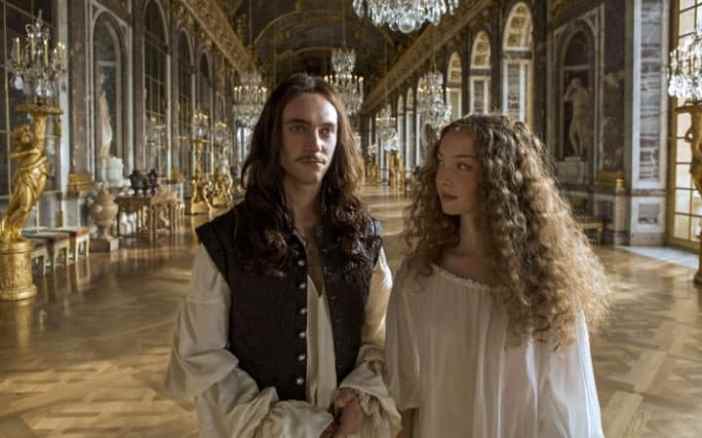
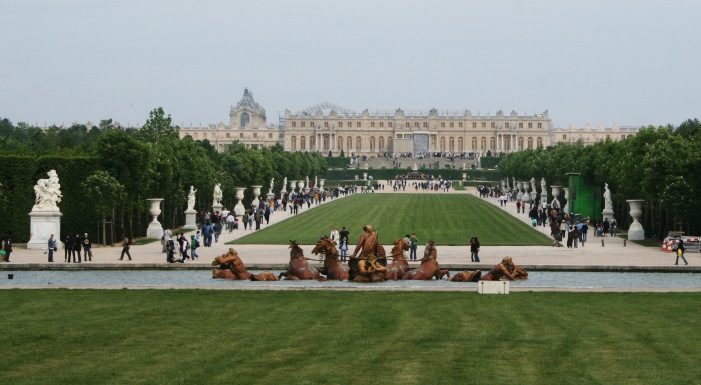
The show is beautiful. I know some of it was shot on location at Versailles itself, and the palace is breathtaking and awe-inspiring. I cannot imagine how amazing it must be in person. I’ve always wanted to go there, and now I really do.

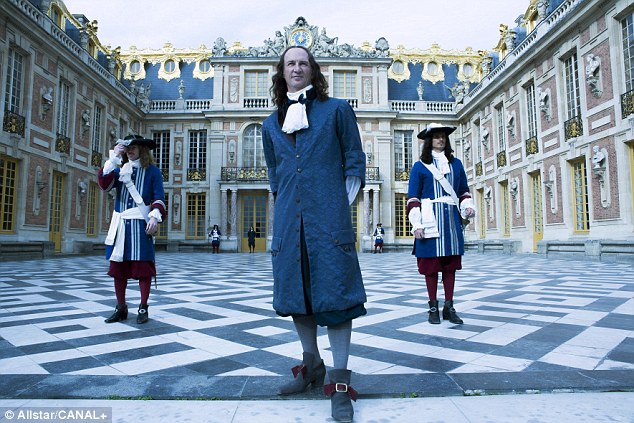
The costumes! The sets! I love the way men dressed–well, royalty and the nobility, anyway–during this period. (The 1974 version of The Three Musketeers is one of my favorite movies of all time.)

shoes

Stunning.

versailles_4-large_transeo_i_u9apj8ruoebjoaht0k9u7hhrjvuo-zlengruma

And of course, the fountains and the grounds.

versailles_tapis_vert_1

The plot itself isn’t great–it gets off to a very slow start; and Louis XIV, while interesting, isn’t Henry VIII; his life doesn’t quite loan itself to the soapy fun that was The Tudors.

But they did not shy away from his brother Philippe’s sexuality…Monsieur, as he was known, preferred men to women; he had lots of children with his two wives, but he always had a male lover, or “favorite”, as they were called then.

I’m enjoying it, but it may not to be everyone’s tastes.