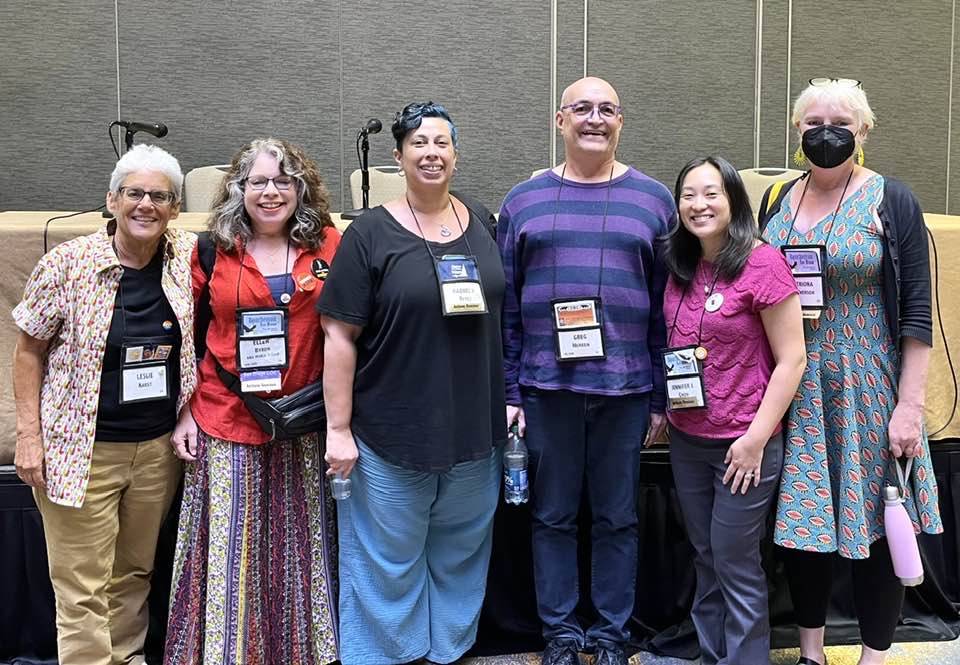
I was, somehow, on two humor panels at this past Bouchercon. I moderated one of those panels, which was a great time and one of the best experiences I had moderating a panel because of the amazing wit and talent of my panelists, whose work I look forward to reading. I was a last minute step-in, so I didn’t have time to read their books ahead of time or prepare anything; so the entire panel was extemporaneous–which is incredibly hard for a panelist because you literally have to think on your feet–and they rose to the challenge magnificently. However, I couldn’t use those questions as a self-interview, so instead, I will share the questions marvelous Leslie Karst came up with as the fill-in moderator for the Best Humorous Mystery Anthony panel, which I got to share with Ellen Byron, Jennifer J. Chow, Raquel V. Reyes, and Catriona McPherson…and a lovely time was had by all.
(You can only imagine how thrilling it was to be nominated for an award with these oh-so-talented and wickedly witty women. The imposter syndrome was strong in me on that panel.)
But, with a strong and heartfelt thank you to Leslie for these questions, away we go.
Did you set out to write a humorous (whatever that means) book?
I don’t. That would trigger my anxiety, I think, and I’d second-guess myself constantly. I’m not really sure how funny I actually am–and it’s not self-deprecation for me to say that I don’t think I’m being–or trying to be– funny most of the time. But people always have laughed. It took me a long time for me to realize that they weren’t laughing at me, but with me.
I believe humor should come out of the characters and how they react to, and/or see things, around them. New Orleans is a very easy city to write funny about because the daily paper is an endless source of unintentional humor. Our city government is weird and crazy, as is our history. Something that would draw stares and a crowd anywhere else isn’t even blinked at here. I tried mightily to resist, but have to shamefully confess that I, too, have walked to the Walgreens on the corner in pajamas and house shoes. Are the Scotty books camp? I’ve been thinking about that a lot lately, as I have been watching and reading about the camp aesthetic in the queer community, and I think they are, based on all the definitions I’ve seen and heard and read about. Scotty exists in a very close to reality as I can make it world, but the situations he and the other characters find themselves in are often over-the-top and ridiculous but normalized in that world, much as they are in real life. No one bats at an eye at any of it, because it’s normal. I think that makes my Scotty series camp.
The book that was nominated, A Streetcar Named Murder, was one in which I didn’t even think about being funny. I had the over-the-top character of the neighbor/best friend, Lorna, for comic relief, but my main character was supposed to be the one who sees and recognizes the ridiculousness but accepts it as reality. Catriona McPherson tagged me on Facebook because one scene in the book made her laugh for several minutes–which I took as a great compliment, because she is one of the funniest people I know–but I didn’t even think about writing that scene as funny; it’s actually when Valerie discovers a dead body, and the dying woman–wearing a pirate wench costume–says her last words, trying to identify who killed her. I remember making the conscious choice as to what those last words would be and tying it into her costume, but that seemed to me how it had to be, if that makes sense? And of course, when you’re writing a book and revising and reediting and rewriting and copy editing and page proofing…you do get so heartily sick of a book and its characters that it just seems tedious and tired and dull to you. Any humor I may have deliberately thought up and wrote into a manuscript no longer is funny to me by the final pass…which is worrying. I am never sure the book is funny or not.
What’s the most challenging thing about writing humor?
Being funny! The thing that always gets me about humor is how quickly and easily it’s dismissed when it comes to books–books aren’t supposed to be funny, you know; they’re supposed to be serious–which always puts funny books at a disadvantage, especially when it comes to awards, particularly juried ones. How do you say one book is funnier than another? Do you judge just the humor, or is that just a factor in the overall quality of the book? The odds of five to seven judges all agreeing on the same thing being funny are exponentially greater than the odds of five to seven judges agreeing on something tragic. Humor is harder than tragedy, and it’s even harder when you’re trying to find the humor in a tragedy.
Humor is incredibly subjective, and difficult to agree on. I’m one of the few people who thought Seinfeld went on for too many seasons and had stopped being funny long before they stopped; likewise with any number of other highly popular comedies, from Friends to Modern Family; shows that remain consistently funny for a long run are very rare, and I’ve always appreciated the comedies that went out before the quality began to decline (The Mary Tyler Moore Show, All in the Family, The Bob Newhart Show).
Have you ever gotten the giggles in a highly inappropriate setting, and how did that go?
My grandmother’s funeral. In fairness, my eldest cousin is one of the funniest people I know, and I made the mistake of sitting next to her and she kept whispering to me and I couldn’t help it. It did NOT go over well, and we’ll leave it at that?
Have you ever had to change anything in a book (funny or not) because of pushback from your editor?
Nothing major or significant, really; there was never anything like “this scene! What were you thinking?”
Is writing humor difficult for you, or does it come naturally? Any tips on writing humor for those writers in the audience?
Like I said, I don’t really try, it just happens. So I guess I would have to say it’s easy, with the qualifier being if I am not trying to be. The Scotty books were my first experience with really writing humor, and for me, it was more about him and his reactions to all the crazy things happening around him–which is why I’ve been wondering if the books are camp or not lately. The original idea for the first one did strike me as funny; I just saw one of the dancers working at the Pub during Southern Decadence weekend maneuvering through the big crowd in the street to start his shift. I had a mental flash of a guy wearing only a day-glo lime-green thong being chased through the crowd with bad guys with guns also trying to fight their way through the enormous crowd of scantily clad partying gay men. Likewise, the original idea for Vieux Carre Voodoo came to me when I was walking through the Quarter and passed under a balcony just as they started watering their plants–so got wet. (It’s a regular hazard in the Quarter.) I then had an image flash into my head of the same thing happening to Scotty–only he was wearing a white bikini that became see-through when wet. Why would he be walking through the Quarter in a bikini? Because he’s going to ride in the Gay Easter Parade dressed as a sexy gay bunny–white bikini, cottontail, and bunny ears. There was one scene in Jackson Square Jazz where he finds a dead body, and sighs resignedly and says, “not again.” I wasn’t sure if that would get past my editor, but it did.
I think it’s easier when the humor comes organically out of the characters and the situations they’re in. I don’t write jokes, but I do imagine a scene that I think is amusing and then fit it into something I am working on, if that makes sense?
Humor is hard.
Is there any type of humor that you would deem inappropriate for your books?
No. I’m a sixty-two year old gay man who lived through the 1980s and has been doing HIV/AIDS work for the last twenty years, so my sense of humor is very dark. I’ve been told I have a very dry, caustic wit; but there’s a very fine line between dry wit and being bitchy and cruel. I don’t like to cross that line, but have.
A Streetcar Named Murder was nominated for both the Lefty and Anthony Awards for Best Humorous Mystery. It was a thrill, an enormous compliment, and a complete surprise in both cases. I’m sorry the ride had to end….
 Queer and Loathing in America