Zero to Hero

I came to Disney later in life. You also have to remember that I grew up in a different world than the one everyone who grew up in the 1970’s or later did; we couldn’t rent movies, there were only three television networks plus PBS and whatever local independents there might be, and so the only chance to actually see classics of Disney’s past was if they were re-released, and that didn’t happen very often. My parents, despite their youth, weren’t going to spend the money to take us to see something they didn’t care about seeing, either; money was tight, and Mom used to take us to see movies when we were little in the summer to get out of the heat. I do vaguely remember seeing The Happiest Millionaire on the big screen–my only real memory of it was he owned an alligator–but for the most part, we never really saw many Disney movies, and especially not animated ones.

Yes, when I was a child I watched Disney’s Wonderful World of Color every Sunday night after Mutual of Omaha’s Wild Kingdom for years. But my childhood was also not a great time for Disney, either in animation or live action. Sure, some films were gems, but not in the same vein as the big classics, like Snow White and the Seven Dwarves and Peter Pan and Cinderella. Disney was more focused on live animation movies (this was the period of The Love Bug movies and Kurt Russell’s college student movies (and beautiful Jan-Michael Vincent in The World’s Greatest Athlete.) at this time.

It was the Disney renaissance of my late twenties/early thirties, timed with my self-discovery journey about who I was and wanted to be and figuring out everything, really, that turned me into a Disney Queen. It was hard not to get up caught up in Disney’s beautiful visuals and songs about misunderstood outsiders who eventually find where they belong, from The Little Mermaid to Beauty and the Beast to so many others. All the films essentially had the same basic story beats: someone who doesn’t feel like they belong goes on an adventure, where they find themselves and what they were meant to be, and wind up with a great final reward of love and acceptance. How does that not resonate with gay men in the time of HIV/AIDS? The fact that songwriter Howard Ashman was a gay man dying of AIDS while working on The Little Mermaid and Beauty and the Beast1 only made the films resonate with gay men all the more–and I went whole hog on the Disney Queen roleplay. (My favorite character of all Disney animation remains Malificent, of course.)

But I also always had a very soft spot for Hercules, even though it wasn’t one of the more popular animated Disney films. I’m always a little curious when Disney announces it’s making an animated film out of something that hardly seems kid-friendly; like The Little Mermaid, which is a horrible Hans Christian Anderson fairy tale. Likewise, when I heard they were making Hercules I arched an eyebrow. I loved Greek mythology and ancient Greece when I was a kid (my three favorite ancient civilizations were Greek, Roman, and of course Egyptian), and I was always interested in Hercules–although as a child I knew the correct Greek name was Heracles–because I kind of saw him as an ancient Greek Superman; the heavily muscled physique he was always depicted as having was just a bonus for little gay Greg, and I always wanted to write about him; discovering that in the original myths he had both male and female loves once I became an adult was just more fire to the flame. The Disney film, of course, altered a lot of the not-so-kid-friendly aspects of the myth, obviously; they made Hera his mother rather than his principle enemy, they cut the Muses down from nine to five, and eliminated his cruelty, his bouts of madness, and his insane all over the map sexuality to make him another Disney prince, who grows up an outsider and has to prove himself and that he not only belongs but is a hero.

The Muses were the narrators of the movie, and they were a delight. Their songs were all done in the style of old-time girl groups, and I thought they were a terrific narrative device. I loved the soundtrack, too.

Imagine my delight when I found out local New Orleans author Farrah Rochon, who is an highly acclaimed romance writer, was writing the backstory for the Muses in a young adult novel called Bemused.

And Reader, it was utterly charming.

I loved it.
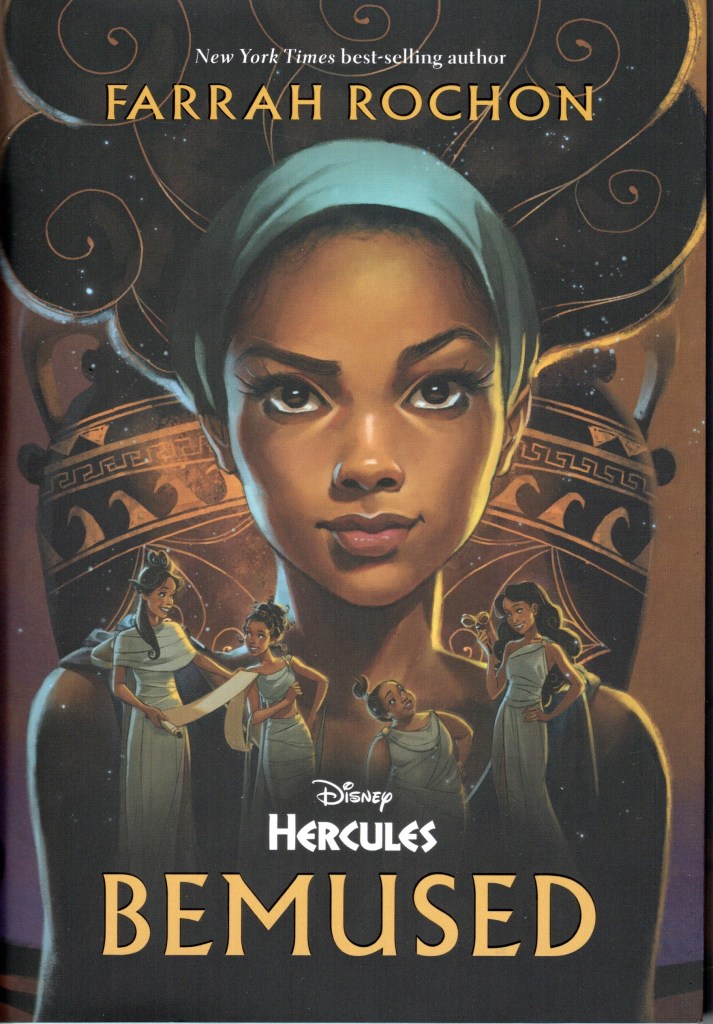
Mnemosyne stood on the edge of the craggy cliff, listening to the whistle of the brisk windblowing through the barren tree branches below. The blanket of thick gray storm clouds that had shrouded the valley for the past few days had finally lifted. She took in a lungful of the clean mountain air. It was invigorating. And comforting.

And she was far enough away from the oppressive demands of Mount Olympus that she could finally feel a sense of calm. She had not experienced true peace in so long that even she, the Goddess of Memory, could barely recall what it was like.

Her fear had lessened with every moment that passed after she’d fled from Mount Olympus, the place where she’d spent so many onerous years. Now, she had a new destiny to fulfill. Had the time finally come?

A loud crack, followed by a harsh, high-pitched squawk, sent Mnenosyne scrambling for cover. She looked up just intime to see a bird swooping overhead, its wings extending out several feet on each side.

Mnenosyne, you see, was a Titan who didn’t fight Zeus and his siblings in their war to take over the heavens. She stayed on Olympus, and eventually developed relationships with several of the other goddesses in the pantheon, namely Athena and Artemis. But (this is the Disney universe, not the ancient Greek one) Hades spends a lot of time undermining her faith in capricious and fickle King of the Gods, Zeus, whom he resents for giving him the underworld to rule over and wants to overthrow (straight up from the film) him. He wants Mnenosyne on his side due to her control over memories; she can convince all the gods that Hades has always been the King of the Gods and Zeus the lord of the underworld, and so she is key to his plans. But she flees Olympus, making all of them forget she ever existed–but Hades kept a journal so she couldn’t do that to him as there was a written record. Hades is the big bad in this book, just as he was in the movie (which was probably the last time I’ve enjoyed James Woods in anything), and she creates her daughters, but keeps their gifts hidden as she keeps moving them around to avoid scrutiny and coming to the attention of the gods. But Hades finds her and kidnaps her, and her daughters now must use their powers to find her and save her from the clutches of Hades, so it’s also a very charming coming of age story as well as an interesting adventure.

This is an excellent read, and belongs on your shelves next to your Rick Riordan novels.

  1. Miss me with the “Stockholm syndrome” takes on Beauty and the Beast, thank you very much; the entire point of the film is that someone monstrous becomes capable of love and caring for someone besides himself, which finally breaks the curse on him. It’s actually a beautiful story, it makes me cry every time I watch it at least three times (when he loves her enough to let her go; when he dies; and when he transforms back), and at some point I am going to write about this masterpiece of a movie. ↩︎

Ode to Billy Joe

Robby Benson. Swoon. I mean, LOOK at him.

Eat your heart out, David Cassidy!

I don’t know when I first became aware of one Mr. Robby Benson, but I do know he was a major crush of mine when I was a teenager–he and Jan-Michael Vincent–and I also think he’s another one of those who definitely helped create a type for me; dark hair and bright blue eyes, and that smile! Jesus Mary and Joseph!

I wasn’t alone in my teen years crushing on Robby; I think most teenaged girls of my generation all had a bit of a crush on him. For one, he was ridiculously beautiful; it kind of should be against the law to look that good. He was also photogenic and telegenic, and I loved his speaking voice. I know my teen years are also when I developed my love of jeans cut Daisy Duke short; and as you can see from the pictures above, Robby’s were cut so short they were basically speedo-sized. Years later, Daisy Dukes were my favorite shorts to wear, because all modesty aside, I’ve always had muscular legs; assets best displayed in shorts cut immodestly short.

But in looking up information on Robby Benson for this post, I realized I had never seen the movie Ode to Billy Joe, which was one of his best-known films. I knew about the movie, of course, but never saw it. It was released the summer we moved to Kansas and it never played in Emporia, and I never saw it on television, either. So, yesterday, I remedied that by watching it on Youtube, which has the entire movie uploaded for free.

The movie itself is simple. Based on the story song by Bobbie Gentry that is probably one of the biggest and best-known hits of all time, it’s ethereal and mysterious and unclear; and the lyrics themselves create an indelible image of a rural Southern lunch and the casual, unknown to anyone speaking, cruelty of the conversation. The narrator had a strong connection to Billy Joe, and his suicide affects her deeply, but nobody really notices. It’s genius in exposing that Southern mentality of “the girls don’t matter”–no one’s noticed that she is connected to him in some way, no one notices that she’s upset, and the way Gentry sings the lyrics is so matter-of-fact yet horrible as she recounts an emotionally troubling experience for herself, and paints such a powerful image of the invisible daughter, left to grieve on her own for the boy she loved, and does she know the reason he jumped? I’ve always liked the song, even if it doesn’t work for me musically (the lyrics don’t match the melody), because it tells so many truths about rural Southern girls that what actually happened isn’t the point–the point is the isolation and loneliness she feels, and the alienation from her own family.

The movie, screenplay and novelization by Herman Raucher of Summer of ’42 fame, fleshed out all those mysteries. It was from the movie and book that turned Ode to Billy Joe into a queer story and a tragedy; it’s also interesting that it wasn’t more of a scandal when the movie was released in 1976; maybe him having had a sexual encounter with another man and committing suicide took the sting and shock of the gay twist; after all, misery and suicide were the only possible outcomes for most queers in movies at the time. Watching the movie, but taking away my own quibbles about its depiction of southern rural life to talk about it as it stands as a queer film, it was really quite revolutionary. First of all, Robby Benson was a full-fledged teen heart throb with photo shoots in every magazine like 16 and Tiger Beat, and having someone who didn’t telegraph gay (or the societal images of what gay looked like then) who was also a heart throb playing the part was putting an acceptable face on a (at the very least) bisexual character. What was also interesting to me about the film was that it was produced by Max Baer (aka Jethro from The Beverly Hillbillies), and the man Bobby Joe had the encounter with was played by James Best, who would go on to greater celebrity and fame as Sheriff Roscoe P. Coltrane on The Dukes of Hazzard later on in the decade. Glynis O’Connor is fine as Billie Lee (seriously, Bobby Joe and Billie Lee? I have an army of relatives from the rural south, and out of all of them there is exactly ONE who has that stereotyped Southern two first names thing), but Benson’s appeal is clearly on display here–and I understand why girls loved him so much: he always played sensitive and vulnerable young men, which girls love.

And he is just stunningly beautiful in this movie.

Benson’s most successful role of all time was, ironically, from voice work: he voiced the Beast in Disney’s Beauty and the Beast.

I also found it interesting the Bobby Joe committed suicide in the Tallahatchee River, which was also where the white supremacists dumped Emmett Till’s body…so that river is kind of hexed, wouldn’t you think?

He also aged incredibly well–Benson is still quite beautiful.

Gorgeous

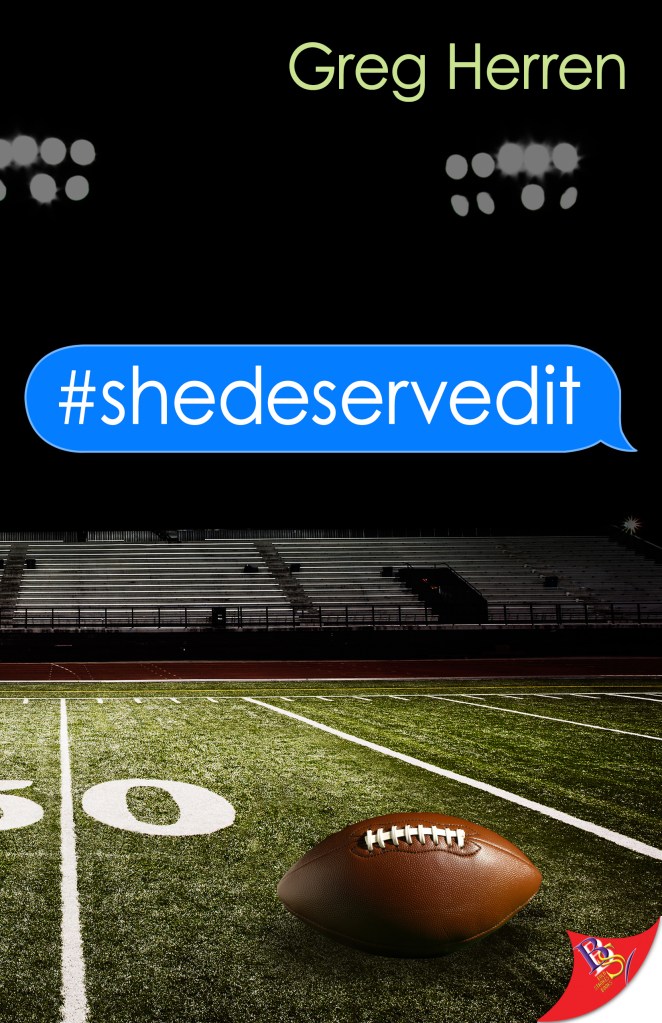
So, as Constant Reader is aware, I’ve been working, off and on, since 2015 on something that I referred to for years as “the Kansas book”, whose actual title is #shedeservedit.

It will be released on 1/11/22 officially; if you pre-order it from the Bold Strokes website, it will ship actually on January 1 (well, probably the 2nd since the 1st is a holiday).

Here’s the cover copy:

Liberty Center High School’s football team has a long history of success, and the dying small town has nothing else to cling to. But when Lance, the star quarterback, is found dead, Alex Wheeler becomes the prime suspect in his best friend’s murder. Alex thought he knew Lance’s secrets–but Lance was keeping his sexuality private and someone else found out. How well did Alex really know Lance, and what else did he keep hidden? 

To prove his innocence and figure out what really happened to Lance that last night, Alex starts connecting the dots and finds that everything leads back to the recent suicide of a cheerleader who may have been sexually assaulted at a team party. Did online bullying and photos of her from the party drive her to suicide? Or was she murdered? Alex and his girlfriend India soon find their own lives are in danger as they get closer and closer to the horrifying truth about how far Liberty Center will go to protect their own.

I’ve been writing what I had taken to calling “the Kansas book” since I was in high school, really. While I was in high school I wrote several stories about a group of kids at a fictional high school, completely based on my own, and while it was certainly melodrama…we also didn’t have shows for teens like Beverly Hills 90210 and movies for teens like Sixteen Candles, Fast Times at Ridgement High, or Risky Business yet; all “teen fare” at the time was mostly from Disney, G-rated, and farcical; likewise, television programs targeted toward younger viewers were mostly for really young kids or what we now call “tweens.” And while I had crushes on both Kurt Russell and Jan-Michael Vincent (who didn’t?), those Disney films were little better than The Brady Bunch. I think it was in 1980 when I decided to take those stories and extrapolate them into a longer story, thinking it would be my first novel–and it expanded from the kids to include their older siblings and parents and teachers as well. I moved the story from the rural county to the county seat, and over the course of three years I painstakingly wrote about three thousand notebook pages. It was a sloppy mess, to be honest; I was thinking in terms of writing something along the lines of Peyton Place–the story of a town over the course of five years–but as I wrote I dropped characters and storylines; changed character names when a better name occurred to me; as I said, it was a total mess…and when I completed it, in the days before computers, I realized that I needed to type the entire thing up, and alas, I didn’t know how to touch type and whenever I typed anything I consistently made errors. So, I simply set it aside and went back to writing short stories before starting, in 1991, to try my hand at novels again.

In the years since, I cheerfully pulled elements from that ancient manuscript out to use for other books and other stories–there was a murder mystery at the heart of the book, and I actually used that as the basis for the plot of Murder in the Garden District; apparently I have always had crime in mind when it came to my writing–and I also pulled character names and other stories from it to use elsewhere. I reverted back to the rural county aspect of the original short stories to write Sara; one of the things I had to do recently was go through Sara and anything else I’ve written and published already having to do with Kansas to record the character names to make sure I wasn’t using them again in this book. I also originally began the basics of this book sometime before Katrina–the star quarterback’s dead body being found on the fifty yard line of the football field, and originally the primary POV character was the only detective on the small town’s police force. What I wrote was really good–I believe I got up to about five chapters–and it was also a flashback story with parallel time-lines; one in 1977, when the quarterback was murdered, and the present day, with someone who was in high school at the time becoming convinced that the person convicted of the crime was actually innocent and railroaded as a cover-up. I could never get the whole plot worked out, and it went through several changes and stages as I worked on it, still being called “the Kansas book.”

Two real life crimes–the rapes in Steubenville, Ohio and the other in Marysville, Missouri, in which girls were either drugged or pressured into over drinking and then when too wasted to even speak were sexually assaulted by athletes–inspired me to drag the framework of this story out and use it to tell a similar style story. I was, like anyone with a conscience or a soul, horrified by these rapes, and even more horrified by the aftermath; the way the girls were humiliated and shamed publicly and on social media, and I couldn’t get a hashtag that the kids in one of the towns used while shaming the victim: #shedeservedit.

That, I felt, was my title, and I could build the story from there. I could still have the dead quarterback; I could still have the town reeling from the one-two punch of the rape and the murder, only now I could layer in the victim-blaming and shaming. (I will never forget female newscasters talking about how sad it was that the boys convicted for the Steubenville case’s lives were ruined; I saved my sympathy for the poor girl they victimized; how on earth would she get past this?) I wrote the entire first draft in one month in the summer of 2015, and have tinkered with it, off and on, ever since. It was early last year, I think, pre-pandemic, when. I finally decided that two books I’d been working on between others over the last few years needed to be done and out of my hair; and the best way to force myself to finish them both once and for all was to offer them to my publisher. I did that, was given deadlines, and now, as I am finishing the final version of #shedeservedit, I also have a release date (1/11/22) and a cover to share with you all, so here it is (obviously, see above).

Writing this has been a journey, as writing any book can be; the Imposter Syndrome reared its ugly head numerous times during the writing of this book–should a man be writing a book about this subject? Is telling such a story from the point of view of a young man, friend to both the rape victim and the rapists, the right way to tell it? Am I centering a young man in a story about sexual assault and the toxic rape culture that has grown up around a small town’s athletic success?

I guess time will tell.