Missing You

Sunday morning, and after a glorious night’s sleep I am wide awake this morning and pretty ready to give the day my best shot. The Lost Apartment needs to be cleaned, as always, and I am wanting to do some writing/editing today as well. I am going to go to the gym later today–it is my experience that going earlier wears me out, despite the endorphin high, with the end result I often don’t get any writing done. I want to work on revising and polishing a story to get it out of my hair–early submission, since the deadline is a long way’s off–and the same with another. I also want to get that Chanse story–the first one–revised and sent off somewhere as well; and in addition to all that revising I want to work on the Italy story.

My work, as it were, is cut out for me today, is it not? I’ll also probably finish watching season 2 of Versailles as well this evening.

Yesterday I got my contacts ordered and did some shopping at Target, which was lovely. I also went car shopping with a friend; he needed a ride and I took him out there. I merely sat there and read short stories from Sue Grafton’s Kinsey and Me; I finished all the Kinsey short stories yesterday, and read some others as well. I was, frankly, worn out by the time I got home but managed to finish the laundry somehow, despite being so tired; I also watched several episodes of Versailles before finally retiring for the evening once the laundry was finished. Paul moves into the hotel this Wednesday; tomorrow morning I am touring the FBI offices in New Orleans with the local Sisters in Crime chapter, and then Tuesday is my usual long day. Then of course the festivals kick into gear, and the rest of the week/weekend is utter and complete madness.

There’s also some filing needing to be done, as always. I’ve also renamed both the Italy story and the Chanse story–the Chanse title, “Glory Days”, only worked if it were his high school reunion, which I dropped from the story–and I think the new title of the Italy story is better.

Here are two of the short stories I read yesterday”

First up is “Trapped! A Mystery in One Act” by Ben H. Winters, from Manhattan Mayhem, edited by Mary Higgins Clark.

Setting

Studio L, an unremarkable rehearsal studio in a warren of unremarkable rehearsal studios, collectively known as the Meyers-Pittman Studio Complex, located on the sixteenth floor of a tall nondescript building in Chelsea, a couple blocks south and one long avenue over from Port Authority. The walls are mirrored; the floor is marked with tape; tables and chairs are clustered to represent the location of furniture on the real set.

Downstage right is a props table, laden with all manner of weaponry. The play in rehearsal is the Broadway thriller “Deathtrap” by Ira Levin, and the table displays the full range of weaponry called for in that show, viz., “a collection of guns, handcuffs, maces, broadswords, and battle-axes.”

This is an incredibly interesting twist on the short story; it’s actually a short story written in play form, and it’s also an homage to the classic thrilled play Deathtrap by Ira Levin. The play was an enormous hit on Broadway, and featured the wonderful Marian Seldes in a supporting role; she set a record for most consecutive performances by one actor in this play. Ira Levin is also one of my favorite writers. Deathtrap was made into a film; not as successfully as the play, alas; the film starred Michael Caine, a young post-Superman Christopher Reeve, and Dyan Cannon. What makes this story/play so clever is it’s a play on Deathtrap; which is a play about a play which basically tells the same story of the play–and this is a play about a murder during a production of a play about a play; complete with the requisite twists and so forth. Winters is an Edgar-winning author (for The Last Policeman), and one of my favorite novels of the last few years, Underground Airlines. if you’re not familiar with Winters, you should make yourself so. I loved this; clever clever clever.

It also reminded me of a crime short story I wanted to write about the production of a play. *makes note*

Next up is  “Fat” by Raymond Carver, from the collection Will You Please Be Quiet Please?

I am sitting over coffee and cigarets at my friend Rita’s and I am telling her about it.

Here is what I tell her.

It is late of a slow Wednesday when Herb seats the fat man at my station.

This fat man is the fattest person I have ever seen, though he is neat-appearing and well dressed enough. Everything about him is big. But it is the fingers I remember best. When I stop at the table near his to see the old couple, I first notice the fingers. They look three times the size of a normal person’s fingers–long, thick, creamy fingers.

When I talked about Barry Hannah several weeks ago, I mentioned that the other writer my professor in my second attempt at taking Creative Writing wanted us to read, whose glory we should bask in, was Raymond Carver. The only texts for the course were Airships by Barry Hannah and Will You Please Be Quiet Please? by Carver. We read two stories before starting on our short stories; I was unimpressed with both writers. Several years ago I decided to repurchase the collections and try them again (I’ll talk about Hannah another time) thinking that perhaps now, as a more mature adult and reader, I might appreciate them more. It wasn’t the case with Hannah, and it certainly isn’t the case with Carver, either.

I am not sure what the point of this story is; waitress waits on a large gentleman, everyone else on staff is mean and cruel about him whereas she is fascinated in him in some way; it’s rather oblique in its meaning, and in its ending; when she says she feels like her life has changed in some way, why? Why did this man have such an effect on her? It isn’t clear and maybe that’s the intent; is it the recognition of the casual cruelty of her co-workers and her boyfriend? Why is she so fascinated by this customer and how much he eats?

It’s a very small story, and rather intimate; I like the way Carver does his writing and tells his story, yet I fail to see the genius here in the actual story itself. I learn nothing about the waitress, not do we learn anything, really, about her customer other than he is polite, well put together, and enormous. Is it about the waitress seeing, and disliking, the casual cruelty of her co-workers and her lover, seeing them in a different way in their inability to see her customer as anything other than enormously fat, that his size somehow strips him of his humanity? Is that what Carver’s intent is, to be so vague and uninvolved with the story that it’s left to our interpretation? I honestly don’t know, and what’s more, I don’t care. I don’t care about this waitress. I don’t care about her friends. The authorial distance just doesn’t work for me. I’ll keep reading his stories, though–I read “Neighbors” for the class, and I remember it fondly–although it didn’t drive me to read more of Carver’s work.

I suppose this is why I am not a literary writer, and could never be one; my purpose is writing a story is to not only to tell the story but to make the reader understand the characters, get to know them, and hopefully empathize with them; to make, in the case of anything I write, to make the inexplicable explicable. I don’t get that from either Carver or Hannah, to be honest. Ah, well.

And now, back to spice-mining.

IMG_1980


Mickey

My wonderful book about the classic horror novels of the 1970’s thru the 1990s, Paperbacks from Hell, attributed the boom in horror fiction to three bestselling novels that set the stage: Thomas Tryon’s The Other, Ira Levin’s Rosemary’s Baby, and William Peter Blatty’s The Exorcist. I read all three of these books when I was in junior high school; the Tryon and the Levin remain two of my favorite novels, and I reread them periodically. But after reading The Exorcist one time, I’ve never felt the need to have a copy on hand, nor have I ever felt the desire to go back and reread it. It did occur to me sometime within the past few years that I should give it another go; my primary memory of the book is, of course, the crucifix masturbation scene which everyone in the seventh grade discussed in breathless whispers whenever someone new had read the book. I may not have ever owned a copy; I may have borrowed it from someone. There were any number of paperback copies floating around my junior high school, the binding bent and broken and covers battered as they were passed around from kid to kid. It also occurred to me that many of my memories of The Exorcist were not from the book, but from the incredibly disturbing film; it was a huge hit and was nominated for ten or eleven Oscars (winning maybe one or two). Mike Oldfield’s “Tubular Bells,” used extensively in the score, was also hugely popular. (All three of the books were made into films; The Other the only whose film version wasn’t a success–but it’s hard to see how it could have been filmed successfully; although it would be really cool if someone tried it again.) So, Labor Day morning, I took down the copy of The Exorcist that I bought recently and read it again.

the exorcist

The Exorcist is undoubtedly an important work in the horror genre; it helped create a boom and directly resulted in a lot of really talented writers getting some great books published over the next thirty years or so. I had noticed, though, that not many people who write horror ever include it on those “Best Horror” lists, or list it as an influence. I read a book in the last year or so that was undoubtedly influenced by The Exorcist; Paul Tremblay’s A Head Full of Ghosts, which I really enjoyed and also put me in mind of a reread of Blatty’s blockbuster. The fact that Blatty is a homophobe made me a bit uncomfortable going back to the book–okay, he may not be a homophobe, but he certainly felt welcoming and admitting LGBT students at Georgetown University meant the school had betrayed its Jesuit heritage and should be stripped of its standing as a Jesuit university (you can read about that here: http://www.nytimes.com/2013/08/04/education/edlife/how-georgetown-became-a-gay-friendly-campus.html?mcubz=1).

So making millions of dollars about a child masturbating with a crucifix is kosher–I guess because, literally, the devil made her do it–but treating LGBT college students as human beings is a crime against Catholicism. Got it.

And to be fair to Mr. Blatty, I only vaguely remembered the above incident; and wasn’t 100% sure I was correct, so that didn’t play into my reread of the book (I didn’t go looking into it until this morning, while actually writing this entry).

Part of the issue with The Exorcist is that once you are aware of it, it’s really not that shocking anymore. This book was a shocker when it was first released; it was denounced far and wide as demonic–including by the Catholic Church (which is even more perplexing on the reread, because the book is very very Catholic), and the scares involved how shocking it was. I seem to recall Blatty based the book on an actual case of an exorcism from the early 1960’s, or perhaps the 1950’s–I don’t recall exactly. So, after forty-odd years the shocks and scares are no longer shocking or scary; my memory of the first read of the book is vague so I cannot remember if it was more pruriently shocking or if it was, indeed, scary to the twelve year old who read it all those years ago. But knowing the story, and what is coming, and knowing that the shock value has completely worn off in the intervening years, I was able to read it and evaluate it simply as a novel.

And it doesn’t, sadly, hold up very well.

I was torn about blogging about The Exorcist, because I generally don’t like to criticize other writers and other books publicly; but it’s an old book, and the author has made a fortune off it. There’s also the suspicion that knowing how homophobic the author is might have played into my disappointment in the reread, but let me give you some sentences:

Looking down at the pain in those sensitive eyes, Chris surrendered; couldn’t tell her what she really believed. Which was nothing.

In fact, Chris had smelled nothing, but had made up her mind she would temporize, at least until the appointment with the doctor. She was also preoccupied with a number of other concerns.

She seemed to be thinking, and still in this posture, she stepped outside and joined her son, who was waiting on the stoop.

Her eyes still on her notes, Sharon probed at the silence in a strained, low voice.

Chris looked at him appraisingly, with gratitude and even with hope.

There are lots more examples; weird analogies, and strange character behavior. It’s also really hard to tell who is the main character. Chris MacNeil, the mother, is a divorced atheist actress; her marriage failed, according to the book, because her husband couldn’t bear being Mr. Chris MacNeil; his wife’s success and fame was too much for his ego to handle, and Chris not only understands but doesn’t blame him. He is a neglectful father to Regan, which also doesn’t bother her too much. She is renting the house in Georgetown because she’s appearing in a movie being filmed there, a musical remake of Mr. Smith Goes to Washington which has an added subplot about campus unrest and protests (which sounds absolutely terrible) shoe-horned in; her main home is in LA. Yet once her role in the movie is finished, she stays in Georgetown inexplicably; Regan is being home-schooled by Chris’ secretary, who does double duty as Regan’s teacher–so there’s no reason for them to stay other than the fact that it’s necessary to the plot for her to remain in close proximity to Georgetown University’s campus. The filming is over before the possession truly gets going; so…

There are also some bizarre behaviors exhibited by Chris as well–she will have an encounter with her strangely acting daughter, be terribly upset, and then go downstairs and have a pleasant conversation with her housekeepers about the film they went to see. It becomes very difficult to have sympathy for her, because she isn’t really fleshed out as a character. The book is also told from an omniscient point of view, so the reader has a very hard time engaging with the characters or feeling deep sympathy for them; certainly it’s hard to identify with any of them. Sharon, the secretary, is a complete cipher; as are the Swiss couple who work as housekeepers. Burke Demmings, the director of the film and a friend of Chris’, is a vicious and cruel drunk who openly mocks her servants; which she just dismisses as “oh, that’s just Burke.”

Because her housekeepers aren’t people who should at least be treated with a modicum of respect as human beings?

The police detective who becomes involved in the case–Burke ends up dead at the foot of the steep staircase down to M Street behind the house–is incredibly annoying; he never gets to the point and dances around the subject and is one of the most unbelievable cops I’ve ever encountered in fiction; he seems a bit like Columbo, but at least the viewer knew that Columbo was actually incredibly smart and that was his method. You never get that sense with Detective Wilderman; he’s just annoying.

Father Karras is by far the most likable and interesting character in the book; and I suppose the reason it’s called The Exorcist. Damien Karras (it’s funny; at the time the book was published the name was unusual but interesting; of course The Omen has forever altered the perception of that name) is having a crisis of faith; his own homosexuality is hinted at but subtextually; his ‘friendship’ with Father Dyer is hinted at, they have a lightly teasing homoerotic kind of friendship but it’s never really gotten into; although one of the insults the demon throws at Karras is an accusation of homosexuality, which rattles him. There’s also a scene where Father Dyer mentions that ‘the gays are leaving the priesthood in droves.’

But the underlying premise, and theme that drives the book, is that Catholicism is real, the one true Faith; even though the demon is apparently an old Babylonian god named Puzuzu–who predates Catholicism and Jesus–the power and faith can defeat him. The ultimate sacrifice of Father Karras in taking in the demon and then killing himself–what happened to the demon? What happened to his soul? Does he redeem himself with this act?

Father Karras was interesting to me (he is constantly described, not just in the text but by characters, as ‘looking like a boxer’–whatever that means: “they told me you looked like a boxer”.) as a character, and I would have loved to have seen the entire story through his eyes; the loss of faith, his struggle with choosing the church over his mother; the relationship with Father Dyer; his doubt that Regan is actually possessed and the slow dawning that demons, and therefore, his faith, are real; and why he would make that ultimate, final sacrifice.

I’m glad I reread the book, even though it was kind of disappointing. I greatly enjoyed the television series, which was recently renewed for a second season (yay!), and it is an important book in the genre; no matter what quibbles I have with it, its importance cannot be denied, and I think horror aficionados should read it.

Half Breed

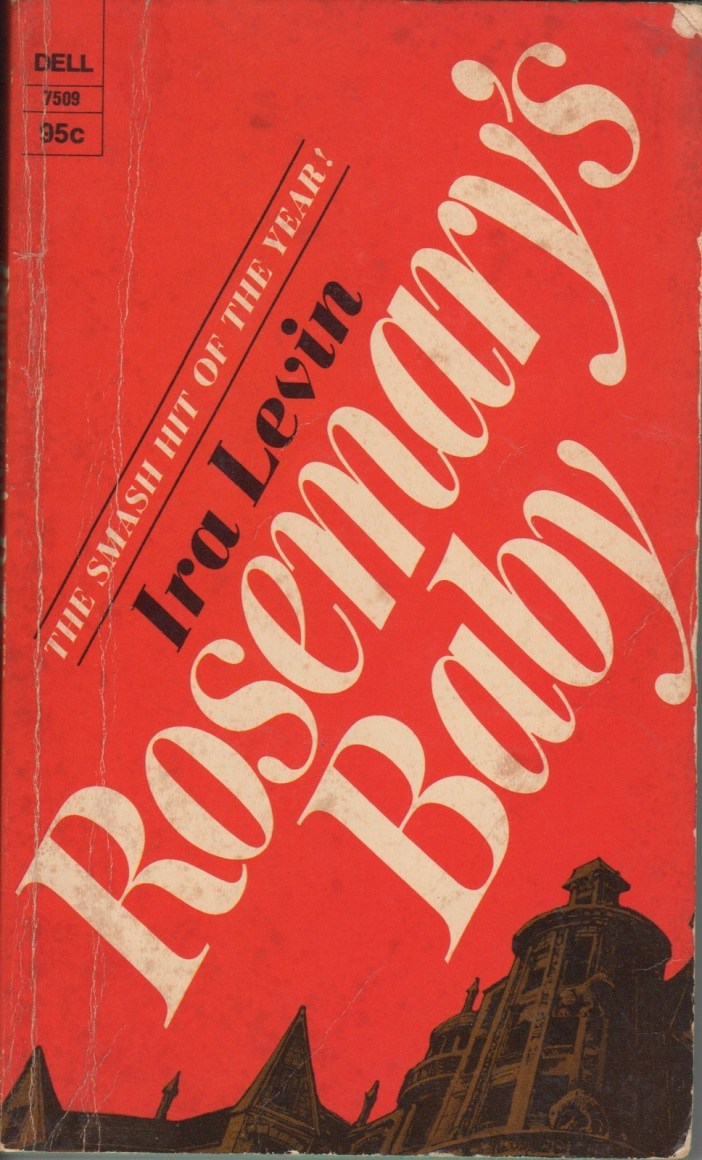
Ira Levin was one of my favorite writers. He only wrote seven novels during his lifetime (he died in 2007), and I’ve read all of them but one; they were each extraordinary. Like James M. Cain, his most famous novels were very short; but each one that I read was exceptional. His books were so ubiquitous that they’ve entered the vernacular; the references may be lost on younger people, but most people will know what you mean when you reference a Stepford wife or a boy from Brazil.

And everyone knows Rosemary’s Baby.

rosmarys-baby-apr-1968-ira-levin-publ-dell-7509-0-95-218pp-pb

Levin was an amazing writer, truly amazing. Take the opening to Rosemary’s Baby:

Rosemary and Guy Woodhouse had signed a lease on a five-room apartment in a geometric white house on First Avenue when they received word, from a woman named Mrs. Cortez, that a four-room apartment in the Bramford had become available. The Bramford, old, black, and elephantine, is a warren of high-ceilinged apartments prized for their fireplaces and Victorian detail. Rosemary and Guy had been on its waiting list since their marriage but had finally given up.

The opening paragraph of The Stepford Wives:

The Welcome Wagon lady, sixty if she was a day but working at youth and vivacity (ginger hair, red lips, a sunshine-yellow dress), twinkled her eyes and teeth at Joanna and said, “You’re really going to like it here! it’s a nice town with nice people! You couldn’t have made a better choice!” Her brown leather shoulderbag was enormous, old and scuffed; from it she dealt Joanna packets of powdered breakfast drink and soup mix, a toy-size box of non-polluting detergent, a booklet of discount slips good at twenty-two local shops, two cakes of soap, a folder of deoderant pads–

Both start so innocently; a young couple getting the apartment of their dreams, a wife newly moved to the suburbs being greeted by the Welcome-Wagon Lady (do people still do that, I wonder?). Sunshine, light, and innocence, right? Both books begin with new beginnings; a fresh start in a new home. And yet–both wives, Rosemary and Joanna, wind up in terrifying situations, and even worse, no one believes them, least of all their husbands–particularly since it was their husbands who sold them out in the first place; Guy Woodhouse selling Rosemary out to a cult of Satanists in exchange for career success, Joanna’s husband selling his feminist wife out for a realistic, animatronic robot version with a sexier figure who is programmed to be an obedient wife/slave to her husband. The Stepford Wives was the first Levin novel I read, and I read it shortly after it came out in paperback, plucking it off the wire paperback racks at the Zayre’s in Bolingbrook shortly after we’d moved to that suburb. And it’s really a frightening book to read when you’ve just moved to the suburbs.

But I can’t help but wonder why Levin’s work in these two instances isn’t considered domestic suspense? Both books are from the point of view of women; about their issues and their place in their marriages; and borrow the most important theme from romantic suspense novelists like Phyllis Whitney and Victoria Holt: his heroines cannot fully trust their husbands. Of course, both books veer into the supernatural…are they horror novels?

My favorite work of Levin’s is his first novel, which also won the Edgar for Best First, A Kiss Before Dying. It’s been filmed twice–neither film is worth watching, frankly–and it literally is genius. If you haven’t read it, you really need to–it’s one of the best suspense novels I’ve ever read. The problem, of course, with A Kiss Before Dying is you can’t really discuss it without spoiling it–and while you can still enjoy the book knowing the big twist, not having it spoiled really makes you appreciate how genius Levin really was.

And now, back to the spice mines.